Piston.my

Latest News

Although insurance coverage for your motor vehicle is compulsory if you want to use it on public roads, the business is competitive and insurance companies offer all sorts of extra benefits if you buy a policy from them. However, one of the best for motorists would be the insurance coverage offered by the car company that sold them their new vehicle. Not all companies do this and it is not their line of business, but they work with their panel of insurance companies to offer their customers the best possible package.

The Honda Insurance Plus (HiP) plan is an example. Introduced in 2002, it is exclusively for Honda owners and provides comprehensive protection and coverage. Working with its panel of 8 insurance companies, Honda Malaysia recently enhanced the HiP package to offer Rescue, Protection and Savings.

“As a car owner myself, I understand the importance of having the peace of mind knowing that my passengers and I are well-protected throughout the ownership of the car,” said Honda Malaysia’s Managing Director & CEO, Toichi Ishiyama. “The all-inclusive and wide-ranging HiP is the best insurance plan for Honda owners because it is developed by Honda, for Honda customers and with our Honda cars in mind.”

“At Honda Malaysia, we are dedicated to offering competitive and comprehensive protection packages for our customers and this HiP plan has been designed to be one of the best in the industry. We believe that this exclusive insurance plan will be able to provide the assurance to Honda owners that they and their cars are well taken care of and they are able to fully experience the ‘Joy of Owning’ and ‘Joy of Driving’ a Honda car,” Mr. Ishiyama explained.

Rescue
The first benefit – Rescue – has a rescue team on call 24 hours a day, 7 days a week. Benefits include 24/7 towing assistance in case of accidents, breakdowns and floods, and the vehicle will be sent to any Honda authorised Body & Paint Centre within a 450 kms round trip from the location. Roadside repair service offers free labour of up to RM200 per event, excluding the cost of spare parts (if needed).

Apart from that, the 24/7 roadside repair services are also available for unexpected situations such as a flat tyre, replacing a flat battery or even running out of fuel. HiP policyholders can also be assured of efficient assistance for hassle-free claims when they are necessary to be made.

Protection
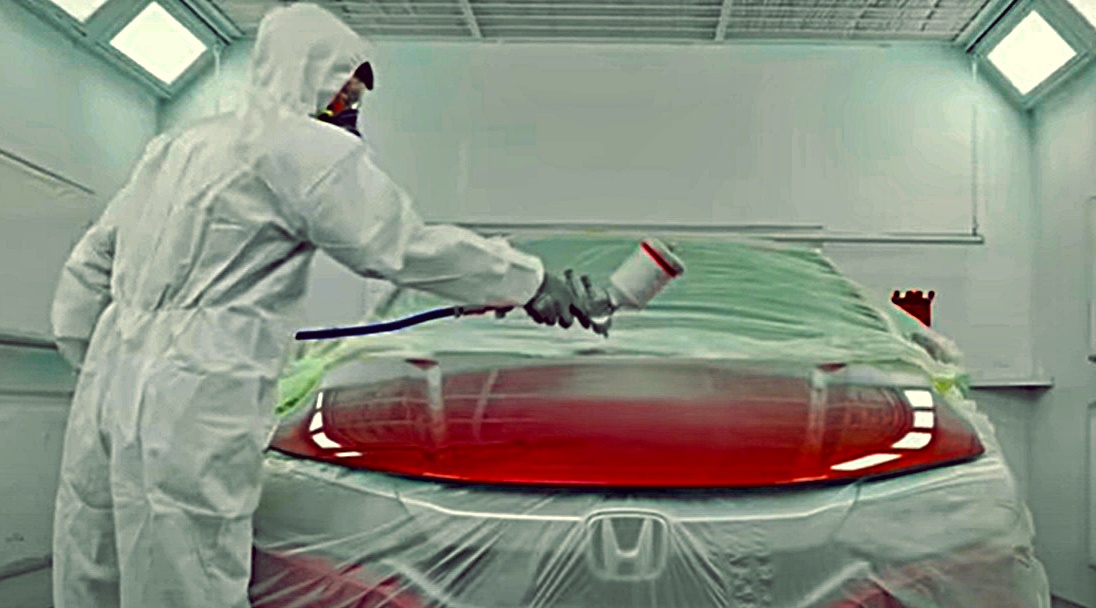
Through the Protection benefit, HiP policyholders are promised high quality workmanship on all body and paint repairs at all Honda Authorised Body & Paint Centres. Only Honda genuine body and parts replacements are used and these come with a 6-month warranty (or maximum of 10,000 kms).

The good thing about having HiP is that if a vehicle is sent to an authorised Honda Body & Paint Centre for repairs, pre-approval of the claim can be faster if it is estimated to be below RM20,000.

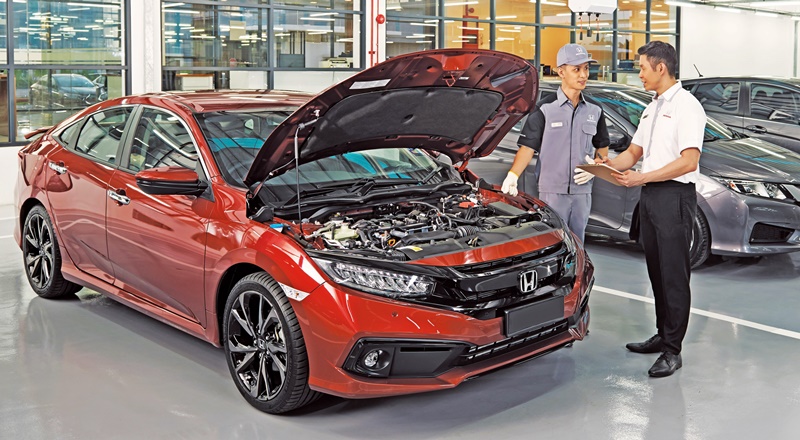
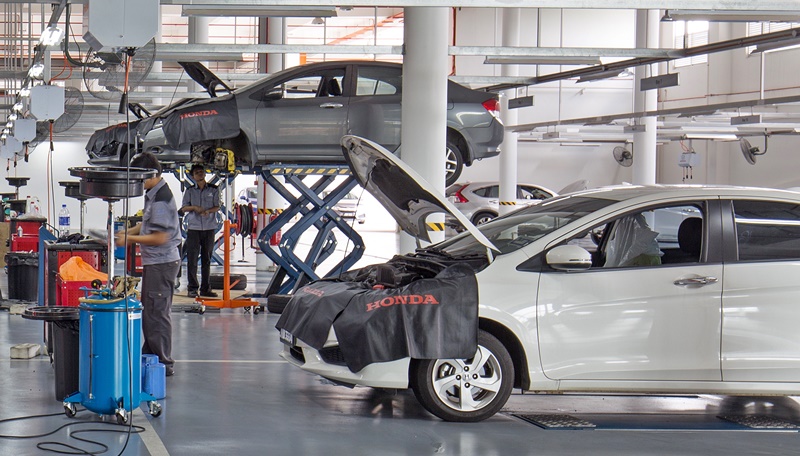
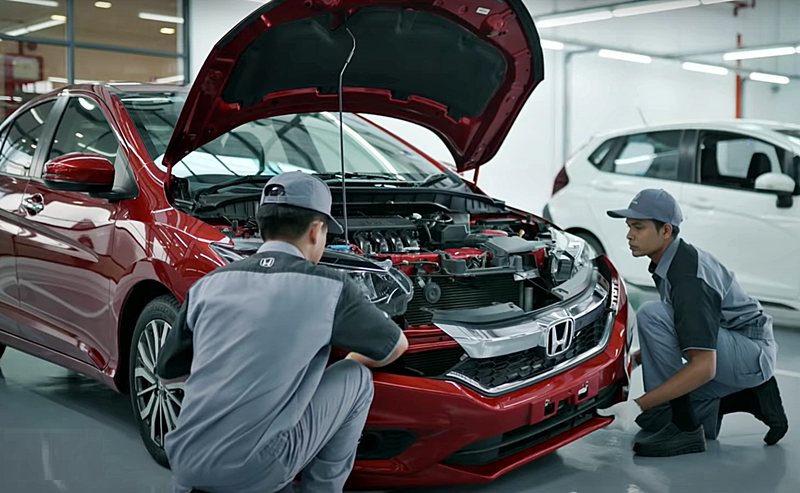
All authorised Honda service centres and Body & Paint Centres handle repair work under the Honda Insurance Plan.

Besides that, HiP policyholders will be given medical assistance such as medical referral and arrangement of appointments, dispatch of medications which are not available locally, and medical evacuation or repatriation, if required. As an additional new protection benefit, each HiP policyholder will now get Personal Accident Coverage of up to RM15,000 in the event of Accidental Death or Permanent Disability in the Named Vehicle accident.

Savings
Honda Malaysia has made sure that those who take HiP will enjoy savings and the best value for their premium paid. The extended coverage terms and better savings from replacement costs will help to ease financial burdens.

The existing HiP 100% insurance payout based on the agreed value if car is stolen or severely damaged in an accident for the vehicle age of up to 10 years (since original registration) is now upgraded to 13 years. Other newly introduced privileges include Unnamed Driver whereby HiP provides coverage for all drivers under private registration with no additional names and compulsory excess payment required; flood allowance of up to RM1,500; special relief allowance of RM1,500 in the event of car theft or total loss; and RM1,000 for lost key reimbursement.

Genuine Honda parts are used for repair work and when new parts replace old ones, there is no betterment charge (terms and conditions apply).

Apart from that, there’s 100% coverage for 10 years with no betterment fee imposed when old parts damaged due to accident are being replaced with new original parts.

HiP is available to all existing and new Honda owners who can start their first policy from the time they purchase a new vehicle or when they need to renew their insurance. More information is available at www.honda.com.my.

Safe practices implemented at all authorised Honda dealerships for customers’ peace of mind

PISTON.MY

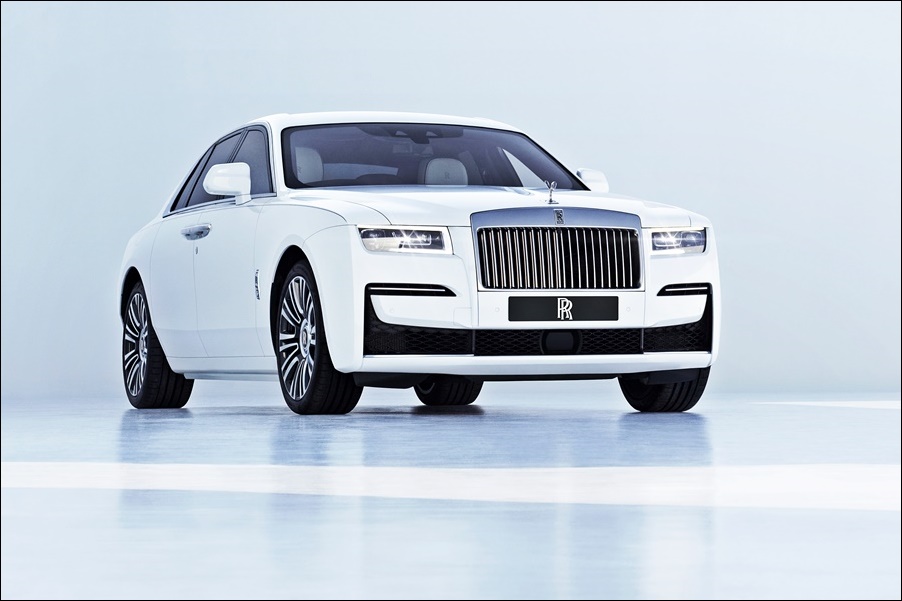
Ghost is the sort of name companies would avoid using since a ghost is not what people like to encounter. Yet Rolls-Royce has been able to use it as the name for one of its cars and not only that – it also has names like Phantom and Wraith for other models! Obviously, those who own these cars have no issues with such names or Rolls-Royce would have heard long ago since the first Silver Ghost was sold in the early 1900s.

It is said that the reason for using ‘Ghost’ in the name was in reference to the car being as quiet as a ghost (and perhaps moving as fluidly as well). The silver was probably inspired by the fact that the car was finished in aluminium paint.
2020 Rolls-Royce Ghost

The Silver Ghost was produced between 1906 and 1926 and the model line did not continue after that. Then, in 2009, the modern Ghost was announced, with deliveries starting at the end of that year. It was an entirely new model, placed below the Phantom by size and by price but nonetheless a true Rolls-Royce as well.

That first Ghost appealed to a whole new generation of customers, both in age and attitude. These men and women asked Rolls-Royce for a slightly smaller, less ostentatious model and what the company created proved to be so successful that in its 10-year lifespan, the Ghost has become the most successful models in the marque’s 116-year history.
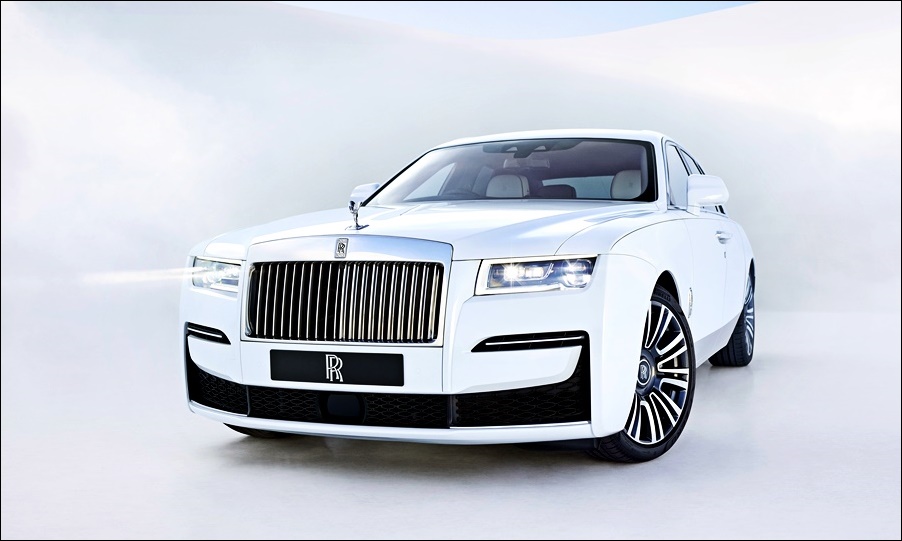
2020 Rolls-Royce Ghost

What today’s customers expect
In the 10 years that have passed, much has changed in the world. Attitudes have evolved and even those who buy Rolls-Royce today are younger than ever before. It is time for a new Ghost but before even starting anything, the potential customers had first to be consulted. Rolls-Royce listened carefully to what they wanted, and their expectations indicated that the new super-luxury limousine would have to be dynamic, serenely comfortable and perfect in its minimalism.

“The result is the most technologically advanced Rolls-Royce yet. It distils the pillars of our brand into a beautiful, minimalist, yet highly complex product that is perfectly in harmony with our Ghost clients’ needs and perfectly in tune with the times,” said Torsten Muller-Otvos, CEO of Rolls-Royce Motor Cars as he introduced the all-new second generation Ghost tonight (afternoon in the UK where the global unveiling took place). Pursuing this minimalist aesthetic for new Ghost was the design team’s absolute objective.

Architecture of Luxury
The base on which the new Ghost sits on is the proprietary aluminium spaceframe known as the ‘Architecture of Luxury’ and it is already used for the Phantom as well as the Cullinan SUV. The spaceframe makes possible an acoustically superior, highly rigid and dynamic proposition for a new car.
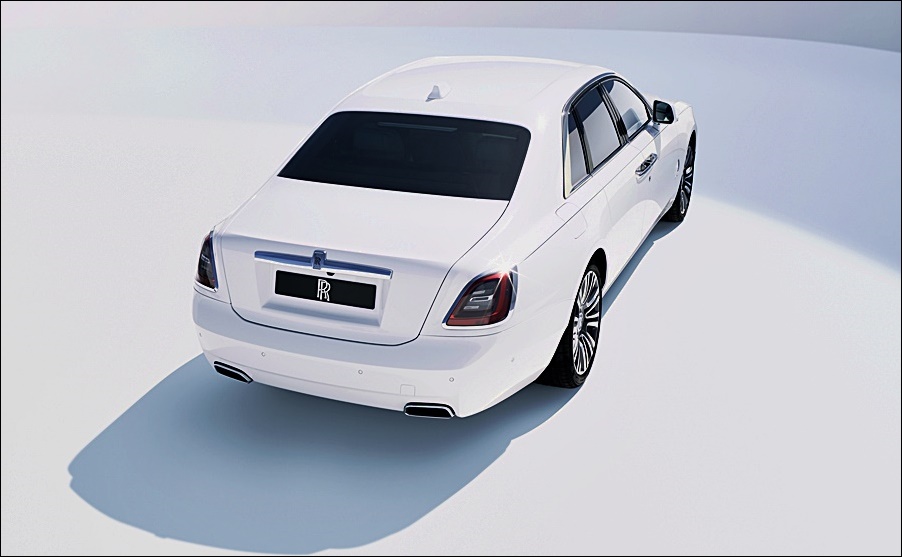
2020 Rolls-Royce Ghost

The Rolls-Royce architecture is based around four fixed points, one at each corner of the motor car. The moveable aluminium bulkhead, floor, crossmembers and sill panels were positioned specifically for ride comfort as well as driving dynamics. Two of the cast suspension mounting assembles were pushed to the very front, placing its engine behind the front axle to achieve an optimum 50:50 weight distribution.

These were undertaken to incorporate an all-wheel drivetrain, all-wheel steering and completely redesigned Planar Suspension System, which further enhances the marque’s hallmark Magic Carpet Ride. This was achieved without compromising the car’s low centre of gravity, which aids cornering dynamics.

To accommodate this without intruding on cabin, its overall length is now 5,546 mm, 89 mm more than the first generation Ghost, while overall width has grown by 30 mm to 1,978 mm.
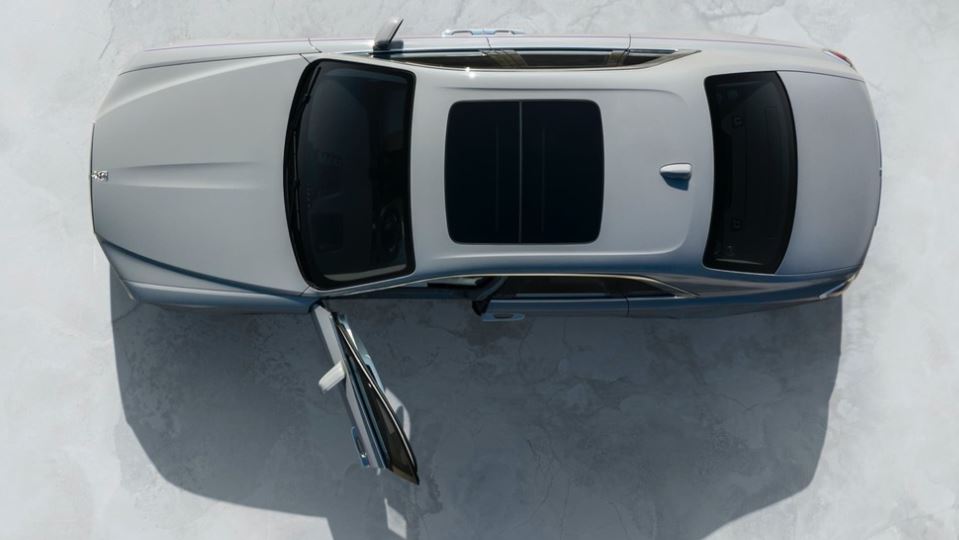
Further capitalizing on the company’s aluminium expertise, the metal superstructure of the new Ghost is 100% made of the material. The car’s outer body is rendered as one clean, expansive piece, flowing seamlessly from the A-pillar, over the roof and backwards to the rear of the car, recalling the seemingly one-piece coachbuilt Silver Dawn and Silver Cloud models.

The 6.75-litre twin-turbocharged V12 petrol engine still lives under the bonnet, able to deliver ‘near-instant torque and near-silent running’. Specific tuning for this model extracts 563 bhp/850 Nm from the engine, with maximum torque available from just 1,600 rpm, or just 600 rpm above idle. To further refine its already remarkable acoustic properties, the air intake system incorporates larger porting.
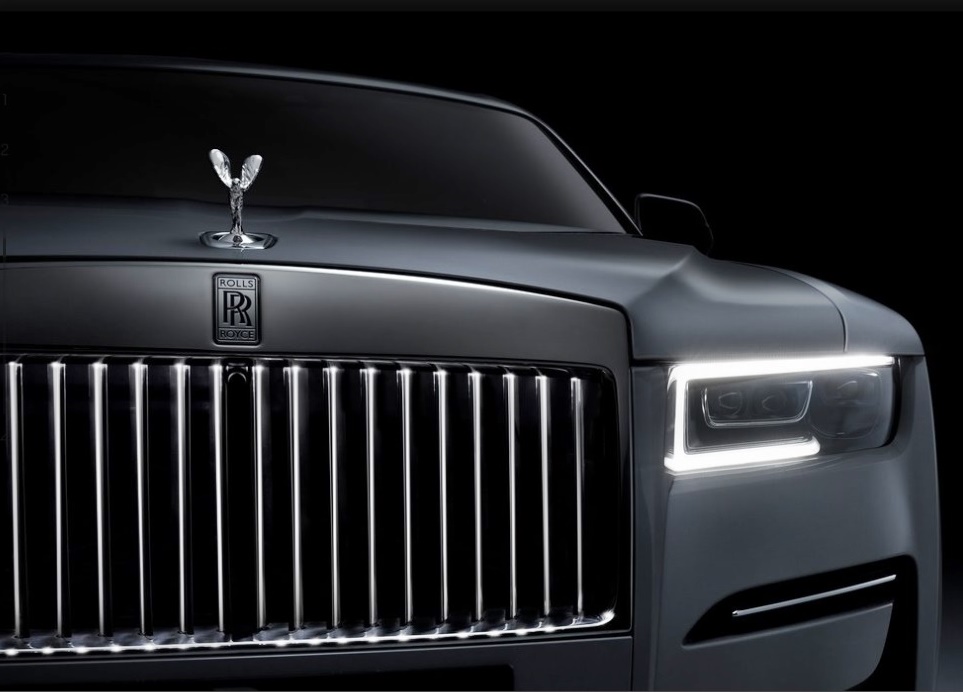
Planar Suspension System
The hallmark Magic Carpet Ride has evolved and for the new Ghost, the engineers redesigned the suspension completely and call it the Planar Suspension System. Named after a geometric plane, which is completely flat and level, the system is the result of 10 collective years of testing and development to create ‘a sense of flight on land never before achieved by a car’.

Created through physical engineering developments as well as sophisticated scanning and software technology, it incorporates a world-first Upper Wishbone Damper unit above the front suspension assembly, creating an even more stable and effortless ride. This works alongside the Flagbearer system, which uses cameras to read the road ahead and prepare the suspension system for any changes in road surface, as well as the marque’s Satellite Aided Transmission.

BHPetrol RON95 Euro4M

The Upper Wishbone Damper alone was the result of 5 collective years of road and bench testing. Only available in a Rolls-Royce, this technology further evolves the double-wishbone Magic Carpet Ride suspension system.

The 5-link rear axle benefits from self-levelling high-volume air suspension technology, as well as rear-wheel steering. Both axles are managed via the Planar software. This also governs other chassis technologies, including the all-wheel drive, all-wheel steering, stability control and self-drying braking systems.

The Planar software also manages information that requires the car to proactively adapt to intrusions in the road ahead. The technology consists of a stereo camera system integrated in the windscreen to see the road ahead, adjusting suspension proactively rather than reactively up to 100 km/h. The second is Rolls-Royce’s Satellite Aided Transmission system, which draws GPS data to pre-select the optimum gear for upcoming corners. The result is unprecedented levels of ride comfort and control for a car, meeting the expectations of customers.
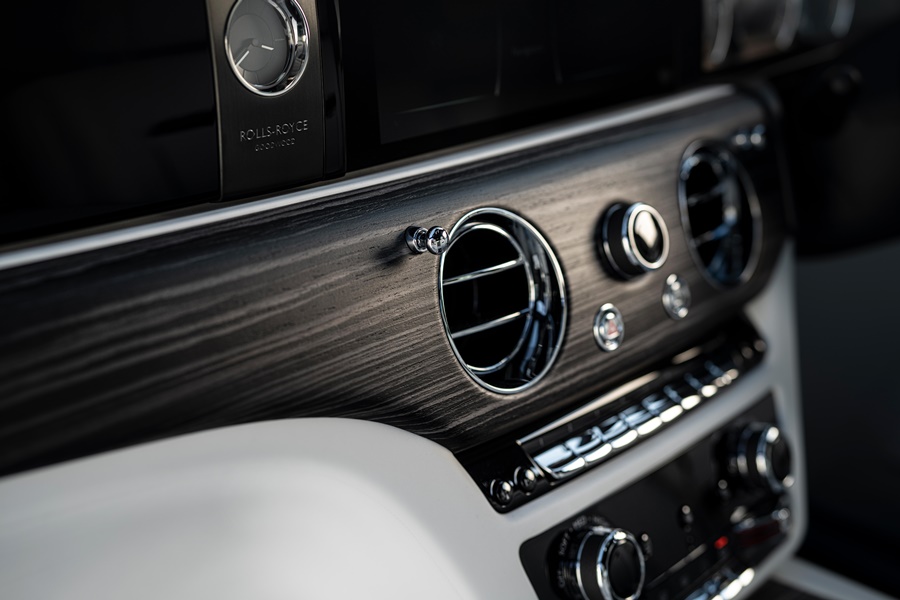
2020 Rolls-Royce Ghost

Clean and healthy air
Carmakers have long given to the cleanliness of air in the cabin and today, this is being taken further to also ensure the air is hygienically clean. For the new Ghost, the company has developed a Micro-Environment Purification System said to be capable of removing nearly all ultra-fine particles from the cabin air in less than two minutes.

Although the owner may spend most of the time in the rear seat, the latest technology would still be desired, especially by today’s generation of customers. To this end, the car has been developed to be ‘the most technologically advanced motorcar Rolls-Royce has ever produced’.
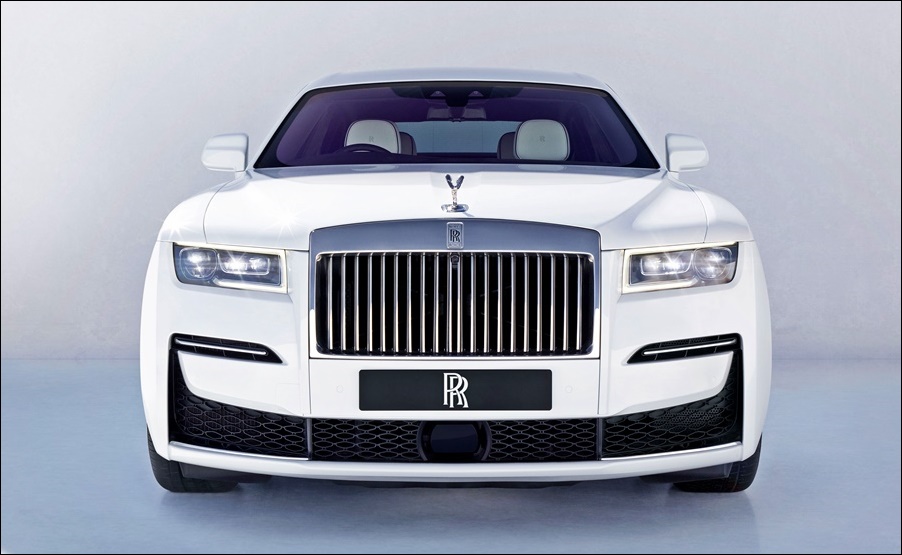
2020 Rolls-Royce Ghost

Notable high-tech equipment and features include LED and laser headlights with more than 600 metres of illuminated range; Vision Assist (including day and night-time wildlife and pedestrian warning); Alertness Assistant; a 4-camera system with panoramic view, all-round visibility and helicopter view; Active Cruise Control; an industry-leading 7×3 high-resolution head-up display; wifi hotspot; self-parking; and the very latest navigation and entertainment system.
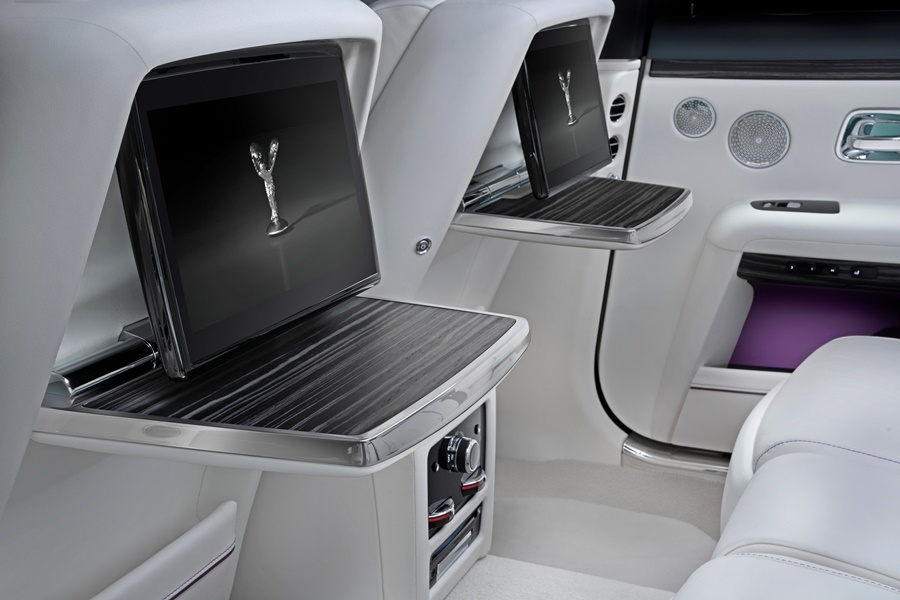
2020 Rolls-Rpyce Ghost

Audio quality engineered into the car
It is likely that most Ghost owners will have preferences of their own but as a standard offering, the sound system has audio quality that is engineered into the very fabric of the car.  A resonance chamber is in the body’s sill section, the frequency response of the Bespoke Audio speaker component defining the chamber’s size and shape. In essence, this transforms the car into a sub-woofer.

A powerful amplifier controls 18 channels (one for each speaker), providing a 1300W output. State-of-the-art optimization technology and high-precision magnesium-ceramic compound speaker cones enable infinitesimal changes in sound with an outstanding frequency response.

Rolls-Royce owners have enjoyed self-closing doors since the first Phantom of modern times. Operated by a button on the dashboard and on the C-pillar for cars with rear doors, this is a much appreciated and celebrated convenience. For the new Ghost, it has been developed further and, for the first time, the occupants can now also open the doors with power assistance.
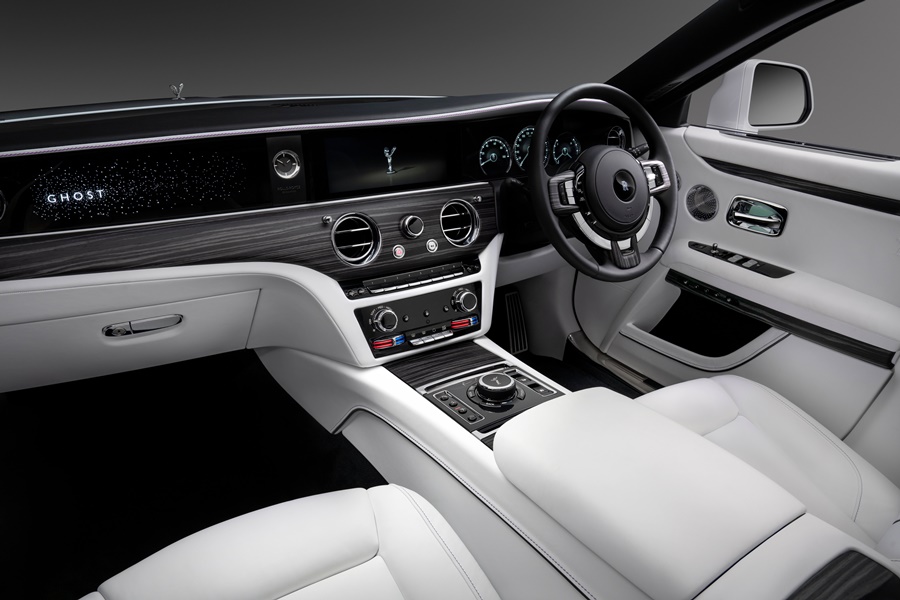
2020 Rolls-Royce Ghost

Minimalist interior mirrors exterior
A clear understanding of the changing luxury consumption patterns of customers and a broader view of emerging design movements suggested that the interior aesthetic should pursue the same minimalist principles as the exterior. However, creating an environment defined by reduction, simplicity and elegance is an extremely complex endeavour. It also relies on sourcing the very finest materials, leathers, woods and metals. To this end, each of the 20 half hides used to create the interior suite of new Ghost are subject to the automotive industry’s most exhaustive quality control checks to ensure that each of the 338 panels used – however visible – is of the very best quality.
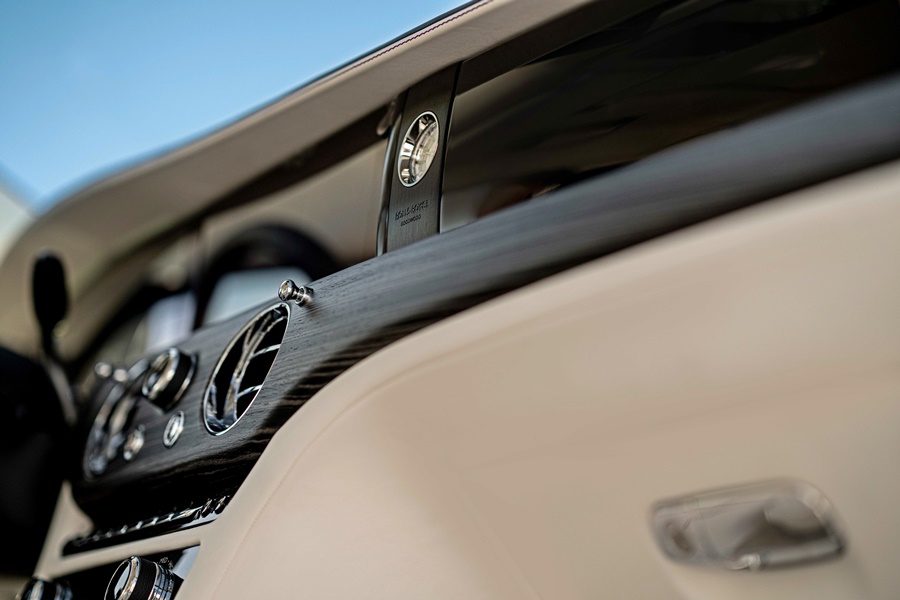
2020 Rolls-Royce Ghost

Wood sets for the new Ghost are available in an open-pore finish, bravely showcasing materials in their naked form. Indeed, two new finishes have been developed specifically for the car. The first is Obsidian Ayous, inspired by the rich versatility of colours found in lava rock. The second is Dark Amber which introduces subtle glamour to the interior suite by integrating veins of fine aluminium particles into the dark wood.

Post-Opulent design treatment
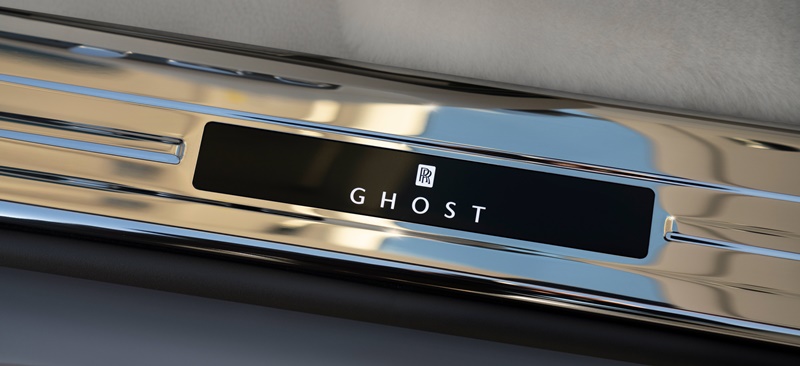
Finally, something about the ethereal glowing Ghost nameplate, surrounded by more than 850 stars. Located on the passenger side of the dashboard, the constellation and wordmark are completely invisible when the interior lights are not in operation. Perfectly attuned to new Ghost’s Post Opulent design treatment, the Bespoke Collective chose not to use simple screen technology to achieve the effect they desired. Instead, they embarked on creating a highly complex and true luxury innovation. The illumination itself comes from 152 LEDs mounted above and beneath the fascia, each meticulously colour matched to the cabin’s clock and instrument dial lighting.
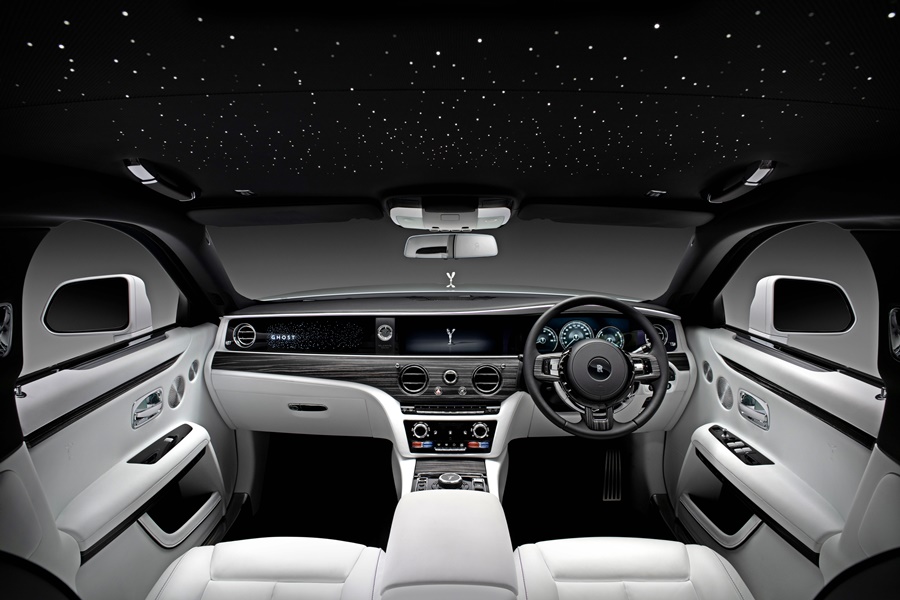
2020 Rolls-Royce Ghost

To ensure the Ghost wordmark is lit evenly, a 2 mm-thick light guide is used, featuring more than 90,000 laser-etched dots across the surface. This not only disperses the light evenly but creates a twinkling effect as the eye moves across the fascia, echoing the subtle sparkle of the Starlight Headliner.

As for the price, well, there isn’t one for a Rolls-Royce in the sense that every unit will have some degree of personalisation so the price will vary from customer customers. Production of the new Ghost is underway and the first owners should be getting their car by Christmas this year.
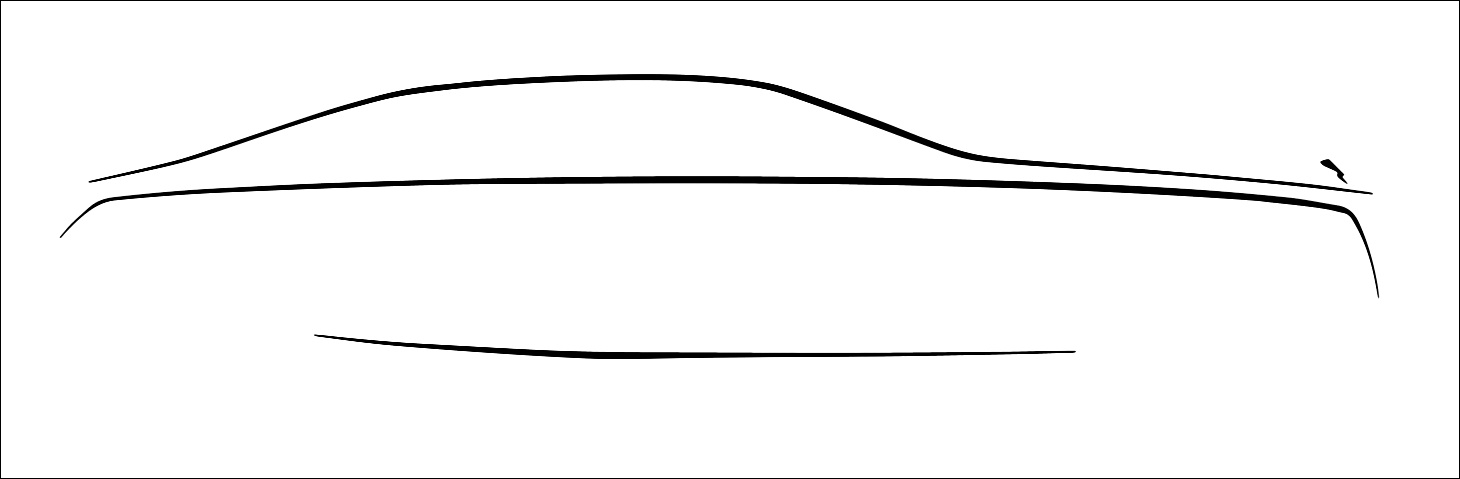
New brand identity for Rolls-Royce, to be used from September 2020

When a model has been a success – to the extent of being ‘European Car of the Year’ in 2017 – it is a bigger challenge for the product team to come out with a successor. How to make it better than what has already been regarded as a superior product in all respects would have been on the minds of the team.

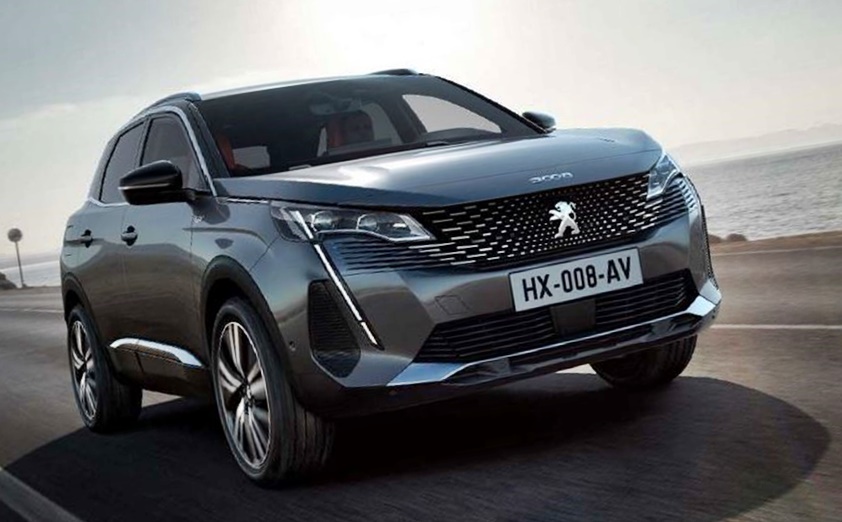
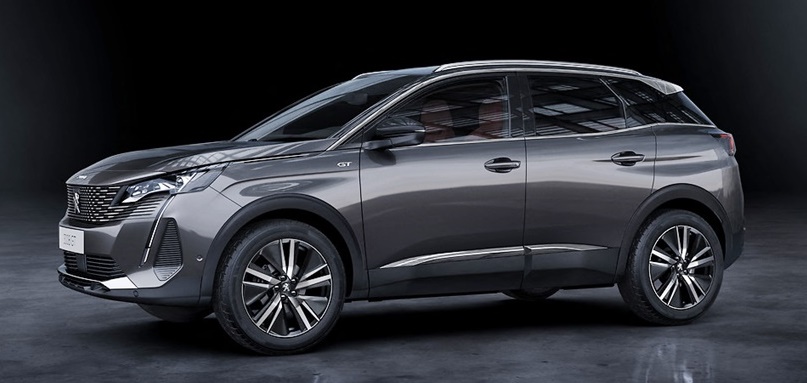
Well, a full model change is not quite due yet but with the market being so competitive these days, an update has to be significant, especially with the brisk pace of technological advances. So the new 3008 revealed today refreshes the French carmaker’s successful SUV to maintain it as a leading choice for buyers.

2021 Peugeot 3008

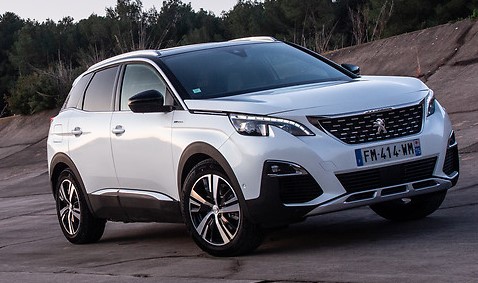
Current 3008

Evolutionary changes
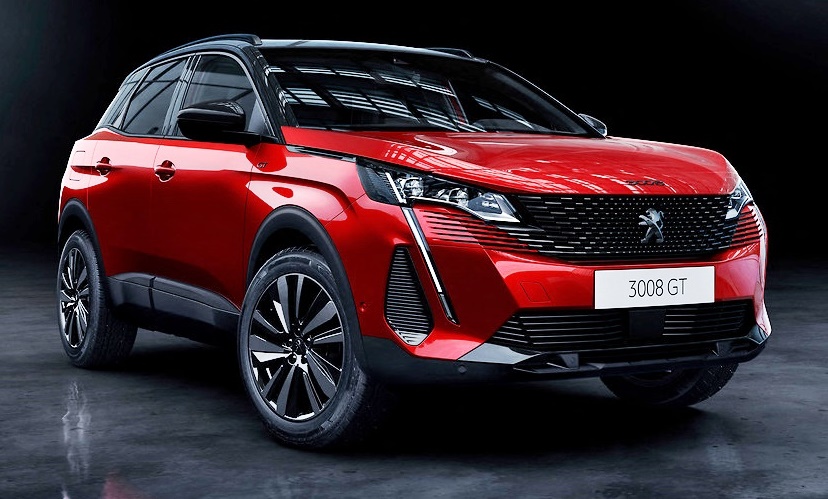
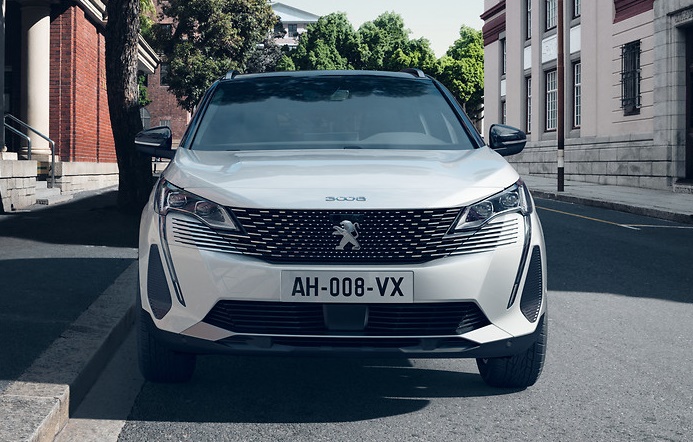
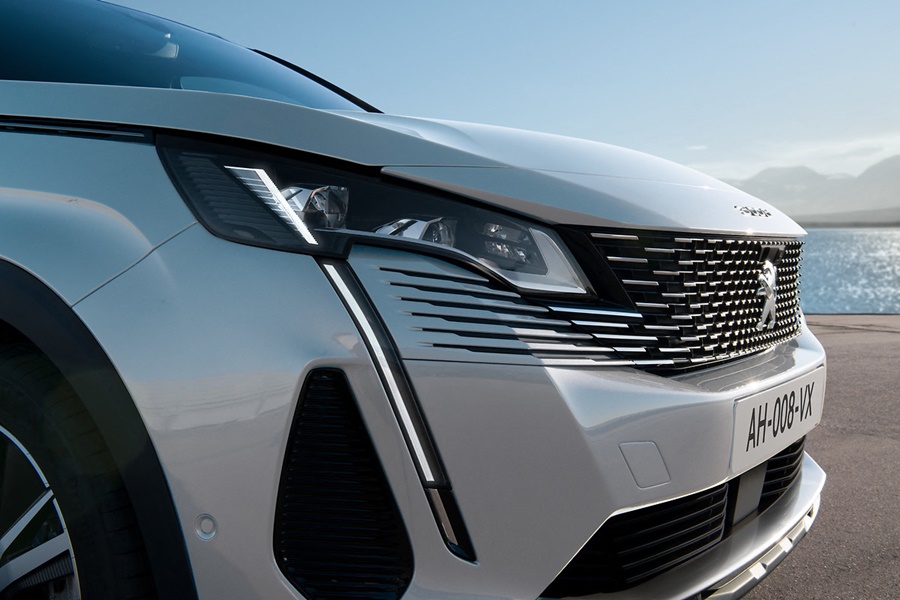
The appearance has, predictably, evolutionary changes with ‘an inspired design’ setting the codes for the next phase of modernity, while enhancing refinement and vibrancy. A new frameless grille symbolises the increasingly modern style, while maintaining a fluid design. It  extends with fins under the headlamps to connect all of the elements.

To emphasise the sportiness, shiny black side scoops and a painted tread plate have been included into the new bumper from the first trim level. There is also a specific grille on the GT/GT Pack versions, with a scalable design pattern to emphasise the stylistic upgrade of those versions.

2021 Peugeot 3008

The front headlamps have also been redesigned to be more aggressive, standing out with their unique shapes. LED technology is used across the whole range and extended by hook-shaped DRLs with a chrome tip. This light signature is perfectly in line with the current Peugeot style and is identifiable at first glance.

2021 Peugeot 3008

2021 Peugeot 3008

On the GT/GT Pack versions, Full LED headlamps offer an even more high-tech and distinctive look, thanks to the extended light signature and the bend lighting function which optimises visibility at speeds of up to 90 km/h.

Of particular note is the new ‘Foggy Mode’ function which has replaced the foglights. It is integrated into the Full LED headlamps, and switches on the low beam headlamps with reduced intensity when the rear fog lamps are activated.

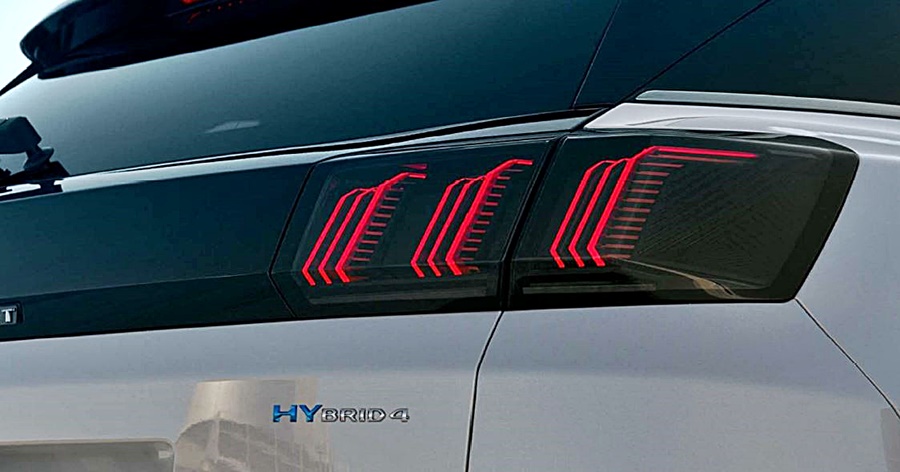
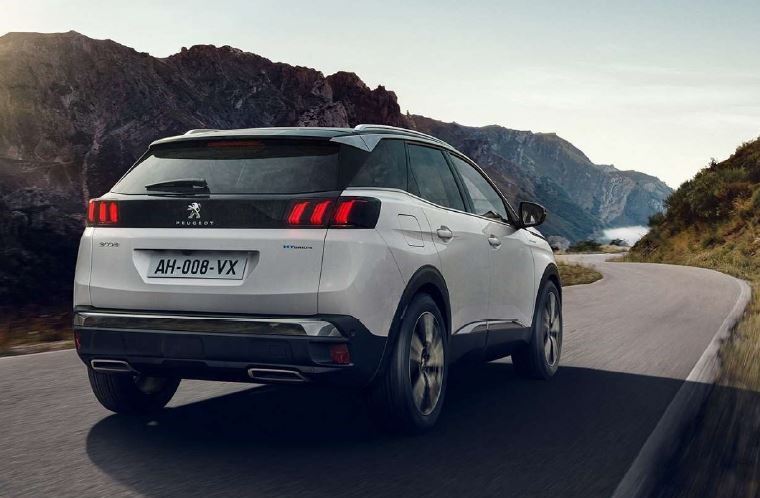
At the rear, new, upgraded lighting units include Full LED technology (including the reversing light), displaying the 3D ‘claws’ for a distinctive light signature. The indicators are sequential now and the LED lighting units are also installed across the whole range.

2021 Peugeot 3008

The lights are covered with a clear, smoked glass, extending the black boot lid on each side of the vehicle, which helps to visually widen the rear of the vehicle.

Depending on the market and the requirements of the distributor, there are also variable design elements, including a new ‘Black Pack’ option. This has darker elements such as the grille, roof bars, tread plates and wheels.

The new i-Cockpit
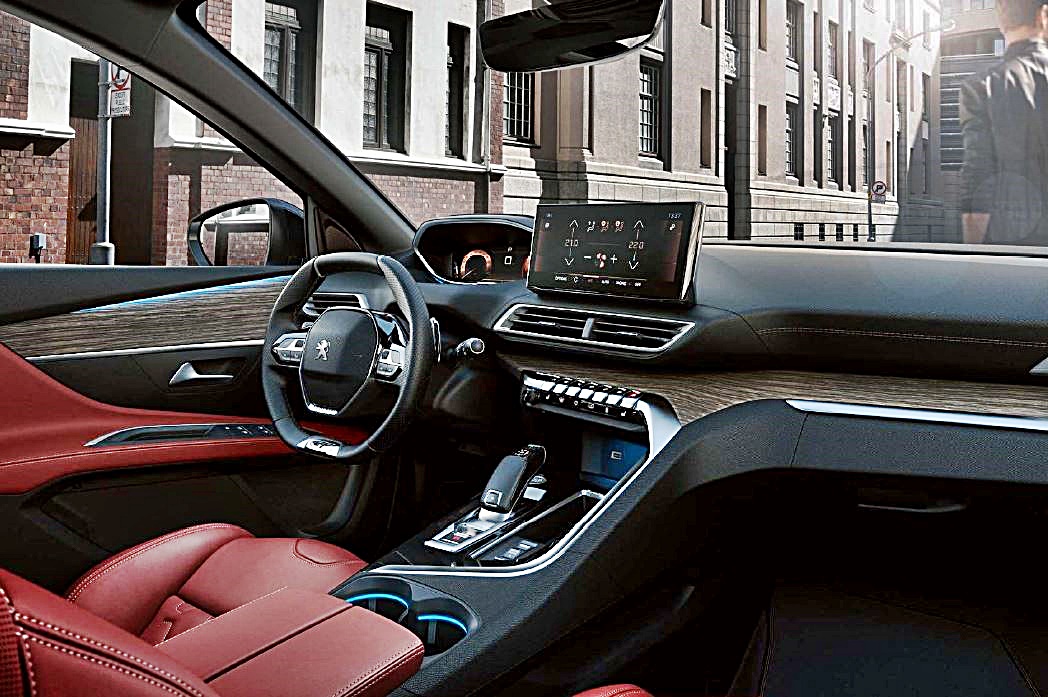
One of the features that has won the 3008 high marks is its i-Cockpit and for the latest version, this has changed to be even more modern. The 12.3-inch digital display, fully customisable and configurable, features a panel with ‘Normally Black’ technology for high quality rendering with better readability and contrasts.

2021 Peugeot 3008

The new central touchscreen is 10 inches in viewing size and, as before, the screen has high definition comparable to what you have on a smartphone these days. Below it are a series of 7  piano keys – operated in toggle fashion – allowing direct and permanent access to the main comfort functions.

2021 Peugeot 3008

To complement the update of the i-Cockpit, the interior has new trim with higher perceived levels of quality. High-end versions will have Nappa leather upholstery and Alcantara lining and also available is a range of new exclusive decor such as New Dark Lime Wood and window winders with chrome inserts. The rearview mirror is also frameless now, adding a touch of elegance.

New smart technology
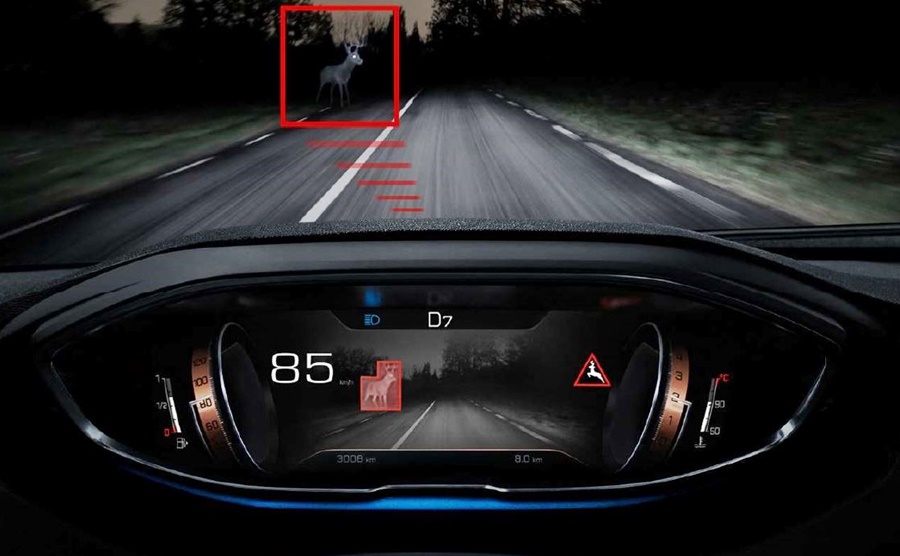
Since this generation of the 3008 was launched, new and more advanced driving aids have been introduced into the market. The new 3008 gets many of these systems which include Night Vision, Adaptive Cruise Control with Stop and Go function, Lane position assist, Active warning of unintentional lane (or roadside) departure, and the latest-generation automatic emergency braking (AEB) which can detect pedestrians and cyclists.

2021 Peugeot 3008

Night Vision is unique in the compact SUV segment as it detects living beings (pedestrians/animals) in front of the vehicle at night or in reduced visibility. The system’s range guarantees detection up to 200 – 250 metres – beyond the range of the high beam – with a central display of the infrared view within the digital meter, and therefore in the driver’s field of vision.

2021 Peugeot 3008

With smartphones an integral part of daily life, the 3008 now integrates information and apps from the device onto the central screen. MirrorScreen compatibility including Apple CarPlay and Android Auto connection protocols make this possible.

Powertrain choices
Peugeot, like other carmakers, has an electrification program for its models as the decade progresses. Besides petrol and turbodiesel engines, there are also hybrid powerplants, along with all-wheel drive and front-wheel drive variants. The PureTech petrol engines are in two displacements – 1.2 litres (3 cylinders) and 1.6 litres (4 cylinders), while the turbodiesel is available with only a 1.5-litre displacement.

2021 Peugeot 3008

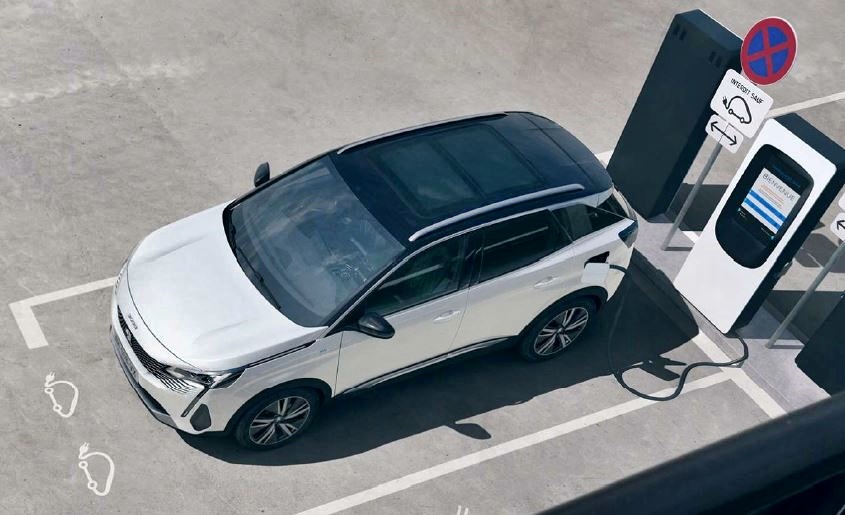
The hybrid powertrain for the AWD variant has a 200-bhp PureTech engine working with two electric motors, one at the front and the second positioned on the rear axle. The 2WD variant uses a hybrid powertrain of a 180-bhp PureTech engine with an 80 kW electric motor located at the front.

The lithium-ion battery pack has a capacity of 13.2 kWh and two types of on-board chargers are available – a 3.7 kW single-phase charger as standard and a 7.4 kW single-phase charger as an option. Estimated recharging times range from around 1 hour and 45 minutes to 7 hours.

2021 Peugeot 3008

Revealed today, on sale in 2021
The global online event today has only provided an overview of the new model and the sales launch will take place towards the end of the year in Europe. The Malaysian market should see it some time in 2021, perhaps faster than usual since the PSA Group now has the Naza factory in Kedah that serves as a regional production hub, supplying the 3008 and 5008 to ASEAN markets.

Peugeot’s innovative i-Cockpit continues to evolve after 10 years in the market

COVID-19

PISTON.MY

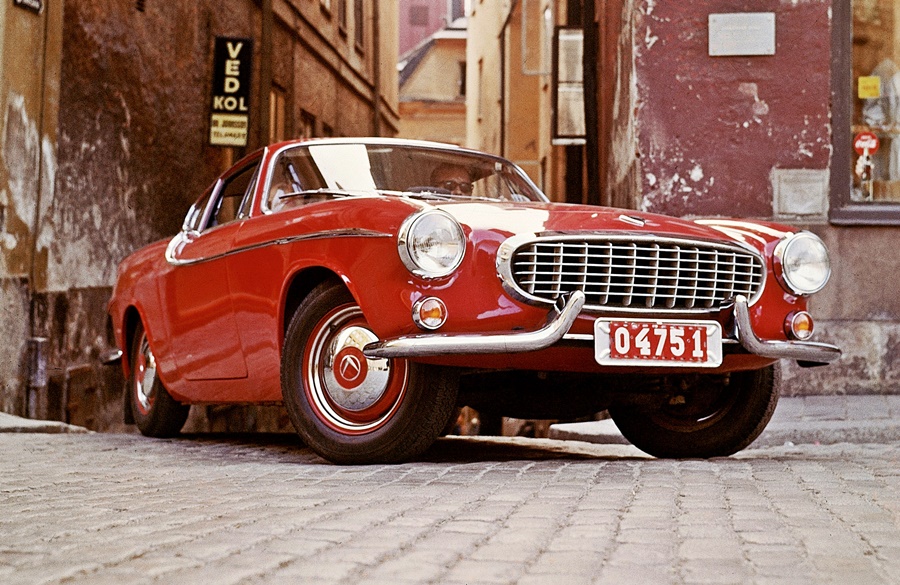
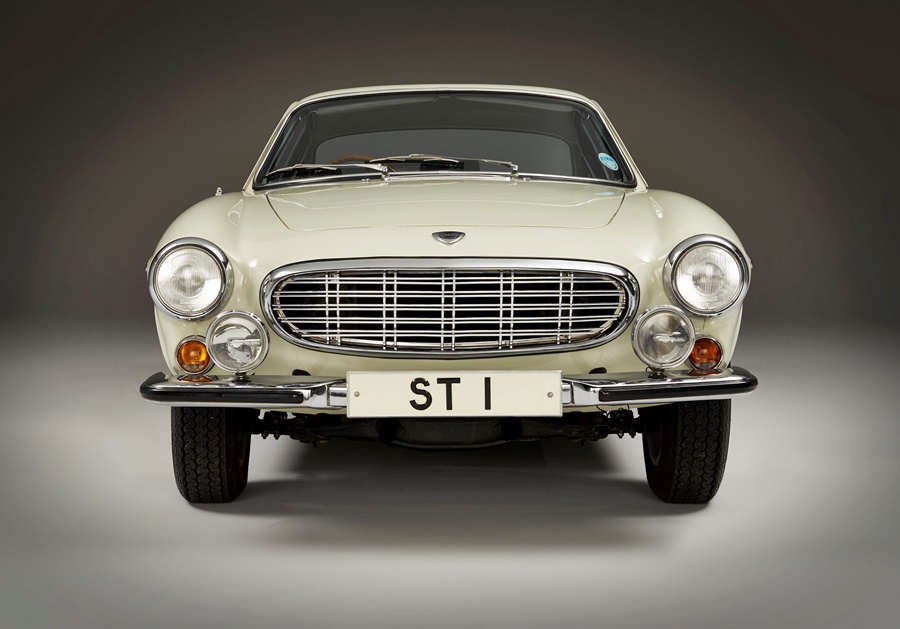
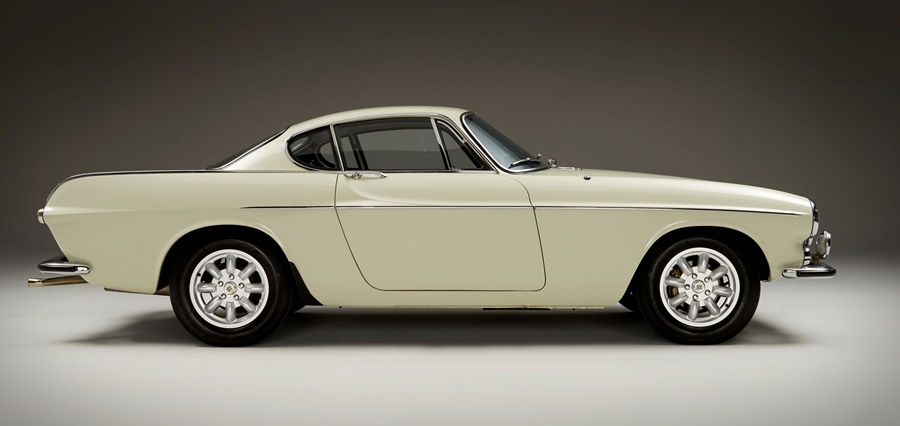
When ‘Volvo’ is mentioned, many models come to mind and it depends on which generation is responding. Older people will think of the 122 Amazon and 244 while a generation later would remember the 850R. But everyone is likely to remember the P1800, perhaps Volvo’s most internationally renowned model ever and the one that arouses most emotions.

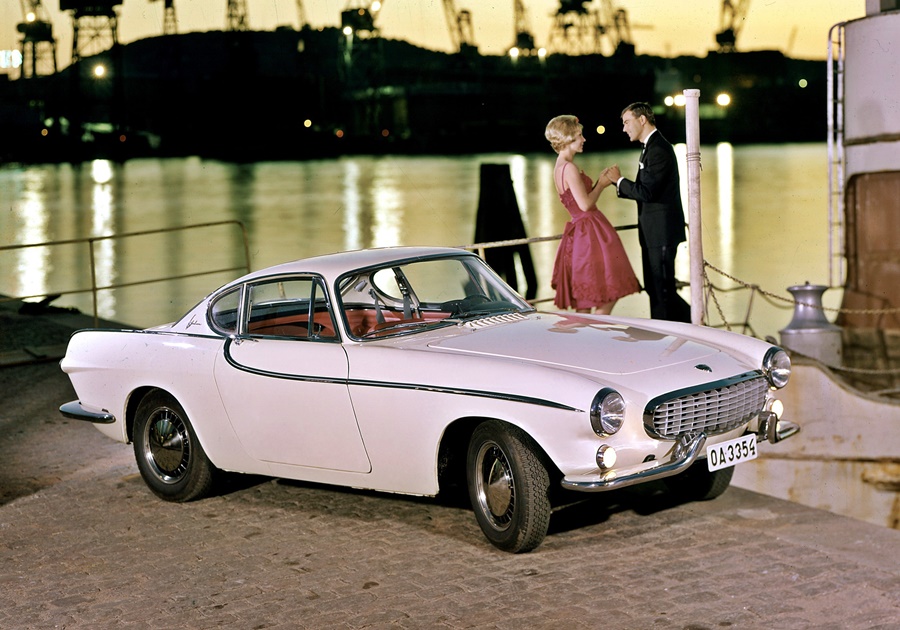
Planned in Sweden, designed in Italy, unveiled at a car show in Brussels, built in Britain and a huge success in the USA, production of the P1800 took place between 1961 and 1972. It had reached showrooms after 4 years of careful planning and development and while sales numbers were not spectacular, the image viewpoint it played was far bigger role than any previous Volvo model.

A ‘halo model’
The Volvo P1800 was born for that very reason – to attract the attention of passers-by to Volvo’s showrooms and to increase what today is known as ‘floor traffic’. Once ‘captured’, it was up to the sales advisors to do whatever they could so that people who entered the showroom left it after placing an order for a new Volvo.

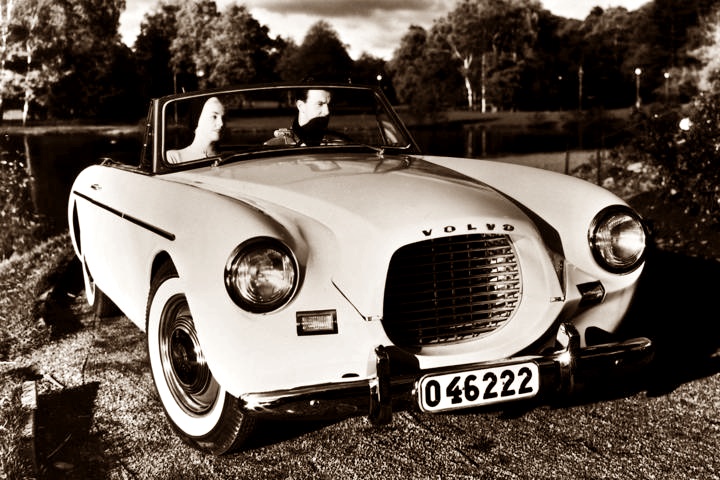
The P1800 wasn’t Volvo’s first go at making a sportscar. Back in the early 1950s, it had produced the open 2-seater plastic-bodied Volvo Sport between 1955 and 1957. Only 67 cars were ever made and the production ended rather abruptly because the company’s President then, Gunnar Engellau, was disappointed with the quality. “Not a bad car… but a bad Volvo” was the way he put it when he gave the order to stop production.

1956 Volvo P1900 Sport
Volvo’s first attempt at a sportscar was in 1956 with the P1900 Sport, but poor quality doomed it to a short production life.

However, he recognised the importance of having a prestigious and exciting model to boost overall sales, and Volvo dealers were desperate for just such a car. This led to another go at making a sportscar and design proposals were ordered from Italy. Volvo consultant Helmer Petterson – who was deeply involved in the planning of the new car – had got his son, Pelle, a job at Pietro Frua, thanks to Pelle’s fresh degree in industrial design from the Pratt Institute in New York.

Designed in Italy… by a Swede
When the time came to unveil the 4 proposals to Volvo’s board members in 1957, Helmer sneaked in his son’s design as a fifth possibility – and that was the one that everyone picked! Engellau, in particular, liked it since he had very definite views about wanting an Italian-designed car. That of course is precisely what he did get – except that it was actually the work of a 25-year old native of Goteborg, Volvo’s home city!

Eventually, however, the truth behind the winning design proposal emerged. Engellau was furious as he felt he had been tricked and promised that Pelle would never be acknowledged as the car’s designer. And indeed, many years went by before the truth was made known and Pelle Petterson received the credit he was due for designing one of the world’s most attractive sports coupes.

The new sportscar had a fixed roof, steel body, with a lot of the mechanical components taken straight from the 122 Amazon. It was powered by the newly developed B18 engine in its 100 bhp sports version when it eventually arrived in the showrooms.

Initially made overseas
At this time, Volvo found itself in a hugely expansive phase and the company realized from the outset that it did not have sufficient in-house capacity to manufacture the new model – not for pressing of body panels, nor for painting or assembly, not even on a small scale. The hunt for a suitable partner got under way and after much deliberation, a decision was taken to use two British companies to build the car: Pressed Steel would build the bodies and Jensen Motors would paint and assemble the cars.

Production started but this was a far from friction-free method. Constant problems with personnel, working methods, quality, suppliers and logistics along with an unwillingness to deal with these issues meant that as soon as it was possible, Volvo transferred production home to Sweden.

By early 1963 – after Jensen had completed 6,000 cars – production of the 1800 started up in Volvo’s Lundby factory. But it was not until 1969 that body pressings were transferred from Pressed Steel in Scotland to Volvo’s own press shop in Olofstrom. The move home also coincided with a change of name for the P1800. At first, it was badged the ‘P1800 S’; later in 1963, it was known simply as the ‘1800 S’, the alphabet standing for Sweden.

During the car’s long life, no radical changes were made to the successful exterior lines. Only details such as the grille, trim mouldings, wheels and colours differentiate the various model years. From the technical viewpoint, the 1800 shadowed the development of Volvo’s other models and was continuously upgraded. Disc brakes all round, more powerful engines and electronic fuel injection were the most noticeable changes.

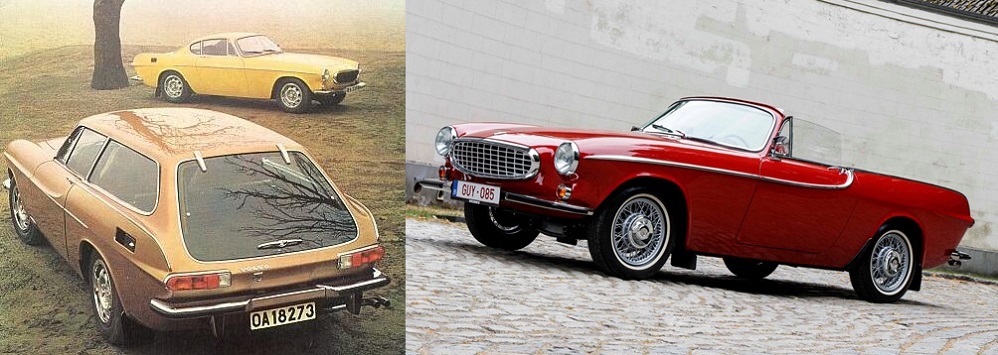
The P1800 ES (left) and the Convertible (right).

During its production life, two other body variants were also available. One was a convertible (only 30 units) and the other was the 1800 ES, with an extended roofline and an estate car rear featuring a large glass tailgate. The variants were designed in in-house this time and attracted considerable attention too.

Becoming The Saint’s car
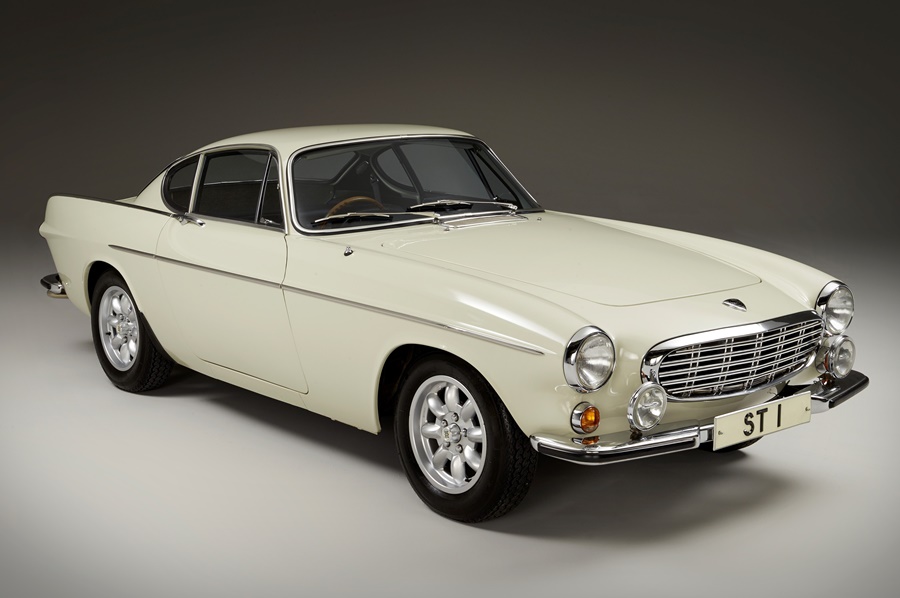
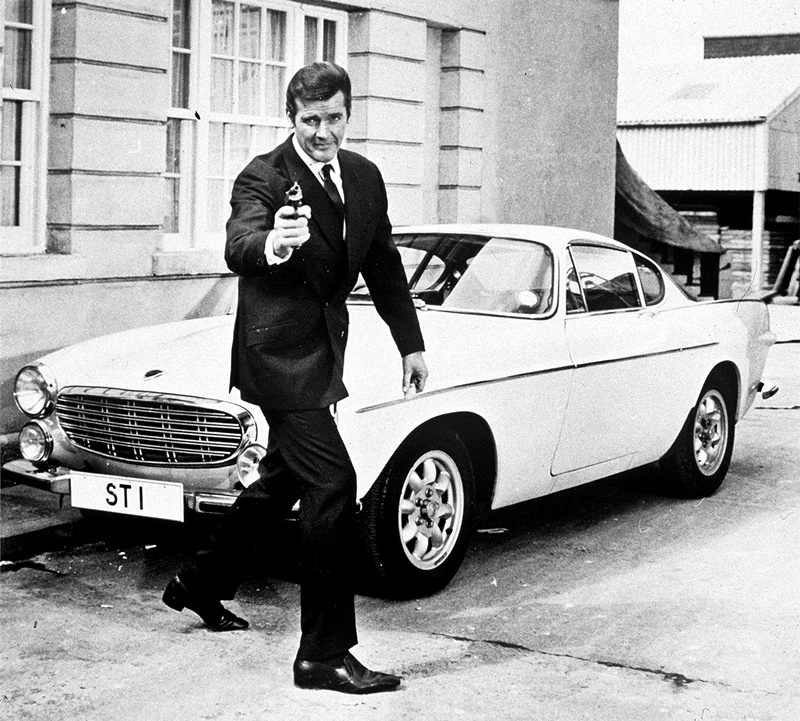
Roger Moore was fortunate enough to drive a P1800 in his role as crime-fighter Simon Templar in the British TV series, ‘The Saint’. The TV production company had been looking for an attractive sportscar that would suit a gentleman of independent means and, after being turned down by Jaguar, approached Volvo to ask for the P1800. Volvo was, of course, quick to oblige as it would be a brilliant PR move for the new model. Every week, it appeared in the living rooms of TV viewers,  becoming so firmly etched in minds that it came to be referred to as ‘The Saint’s car’.

The P1800 gained worldwide publicity every week on TV as ‘The Saint’s Car’, driven by Roger Moore who played the part of Simon Templar.

The P1800 was never intended to be a mass-produced car. As mentioned earlier, it was planned as a niche product or what is today referred to as a ‘halo model’. Yet it was viable enough to be within the reach of most people who wanted a car that looked like a Ferrari but cost and functioned like a Volvo – pleasant, reliable and economical.

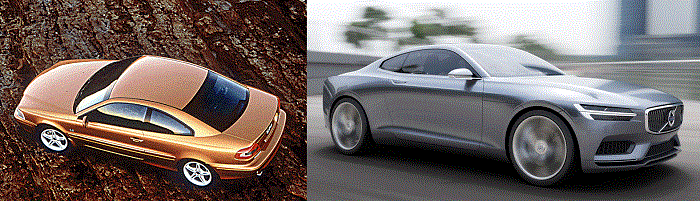
In 1997, Volvo produced a coupe designated the C70 (left) and it was also used in a remake of ‘The Saint’. Its designers have been looking at a coupe for the 21st century as well, and their ideas were shown in the Concept Coupe in 2013 (right).

LOOKING BACK: The forgotten Volvo P1900 sportscar with a fibreglass body

COVID-19

Social distance

PISTON.MY

BRABUS declares itself to be the world’s largest independent automotive tuner for more than 4 decades and during that time, it has established a reputation for raising the performance levels of Mercedes-Benz models. Its expertise in petrol and diesel internal combustion engines (ICE) is considerable but with the industry moving towards electrification, will the company be able to continue its business of providing performance upgrades?

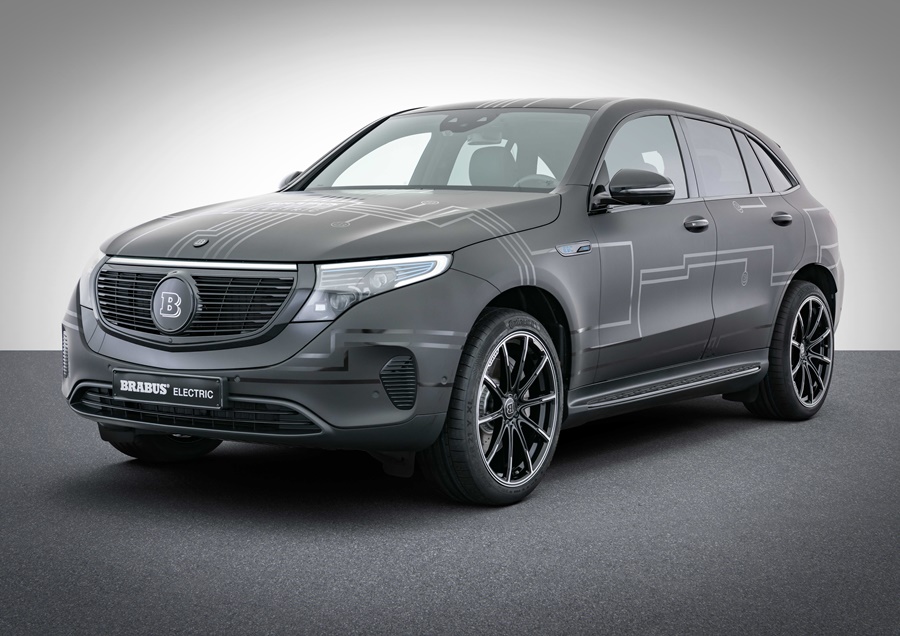
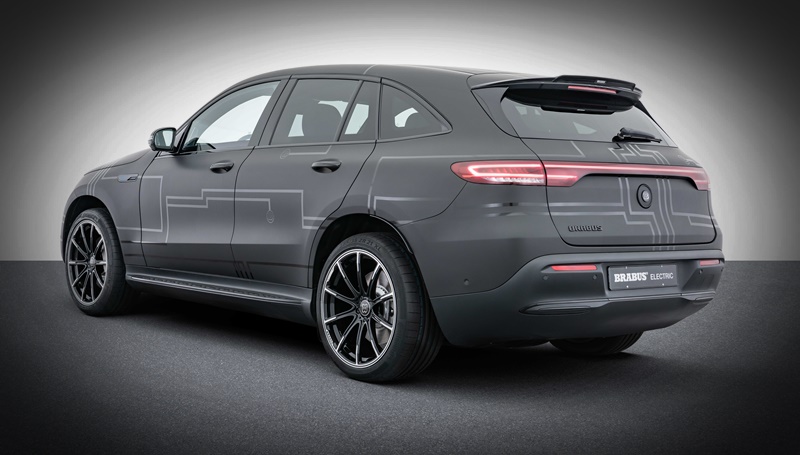
BRABUS Electric concept

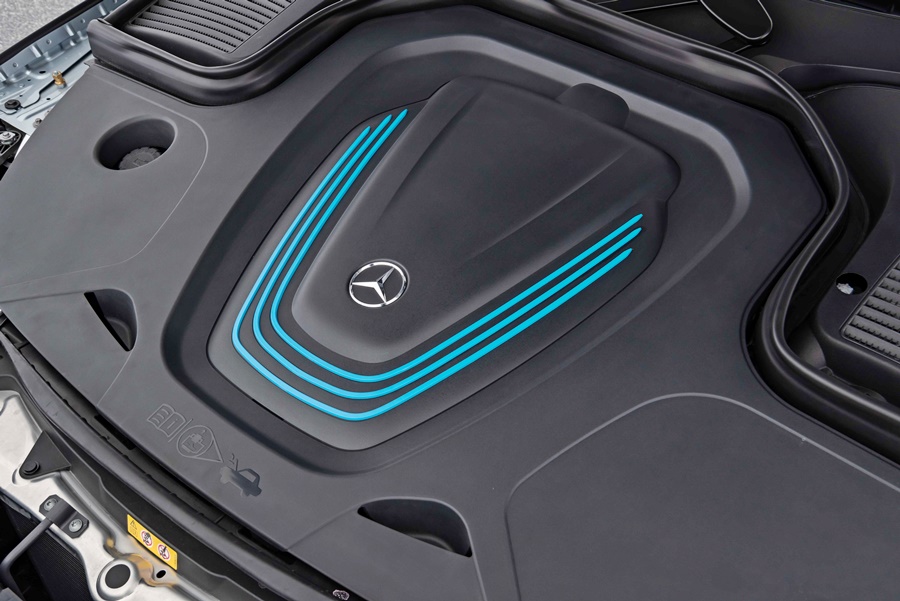
The answer would be yes and BRABUS is already showing that it can do for electrically-powered cars what it has done for ICE cars. In fact, it already has a Zero Emission Division for some time now and this division began looking at the EQC 400 4MATIC by Mercedes-Benz when it arrived on the market.

It has developed a performance upgrade for the EQC’s electric powertrain and delivers even more agile driving dynamics. Known as the E-PowerXtra performance upgrade, output goes up by another 10 kW to 310 KW (416 bhp) and peak torque is raised to 830 Nm from 760 Nm. As a result, the 5-door SUV can zip from standstill to 100 km/h within a claimed 4.9 seconds. The top speed remains limited to 180 km/h.

BRABUS Electric concept

The upgrade is designed to become active when the driver selects drive mode ‘S’ with the standard DYNAMIC SELECT switch. When drive mode ‘E’ is active, , the PowerXtra ELECTRIC upgrade offers ‘one pedal driving’, a feature often requested by drivers of electric vehicles. The SUV decelerates sharply when the driver just lifts off the accelerator pedal. This requires far less frequent use of the brakes in normal traffic and further increases the energy recovery rate.

BRABUS Electric concept

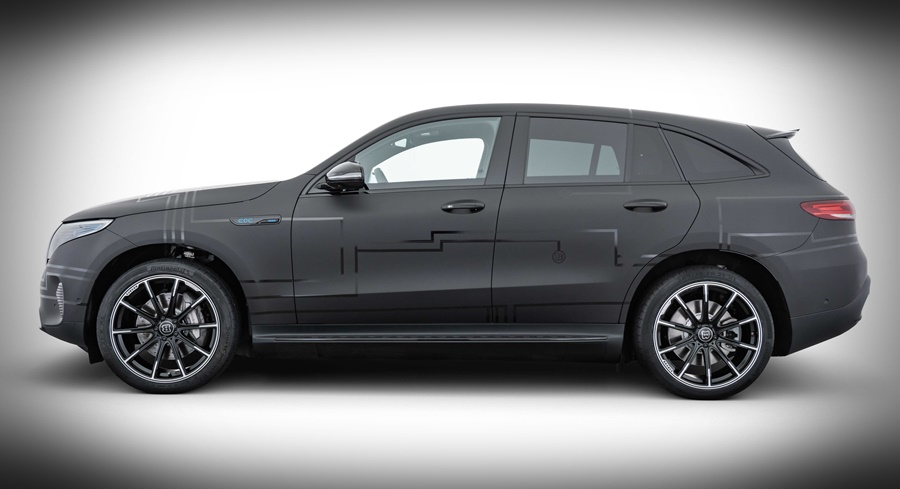
While the aerodynamic-enhancement kit with the exception of the already available rear spoiler is still under development, the appearance can already be upgraded with tailor-made BRABUS Monoblock Z alloy wheels with diameters of 20 or 21 inches. The eCrossover can be refined with two variants of the sporty and elegant 10-spoke design available for this model.
The BRABUS Monoblock Z PLATINUM EDITION wheels with 21-inch diameter are even more exclusive. The product of a high-tech forging process, these rims offer a combination of lightweight construction and maximum strength. The front axle runs on size 9Jx21 wheels with 255/40R21 ContiSportContact tyres of size. The rear fender wells accommodate forged 10.5Jx21 rims with tyres sized at 285/35R21.

BRABUS Electric concept

BRABUS Electric concept

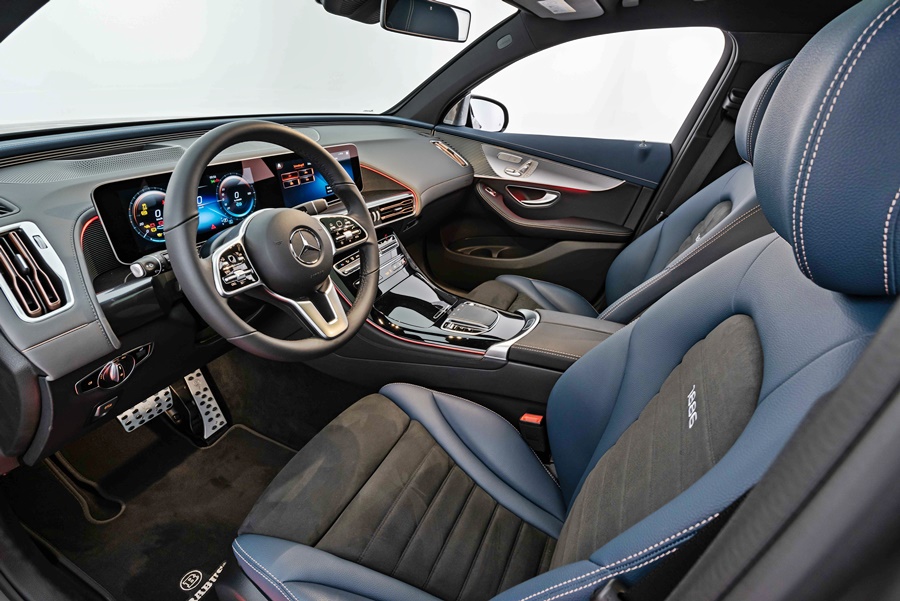
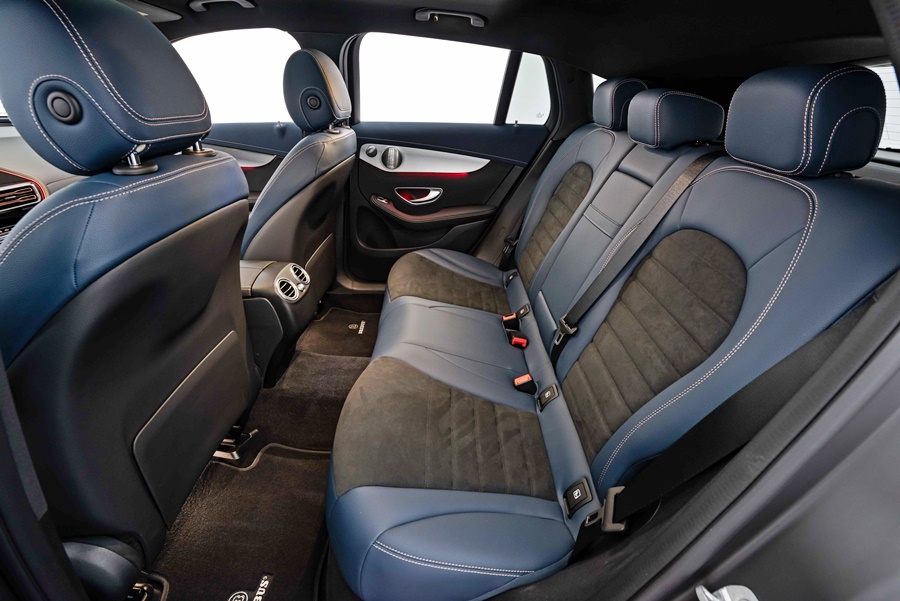
As for all Mercedes-Benz models, BRABUS offers a host of custom refinement options for the interior of the EQC 400 4MATIC that include an exclusive fine leather interior crafted by the company’s own upholstery shop.
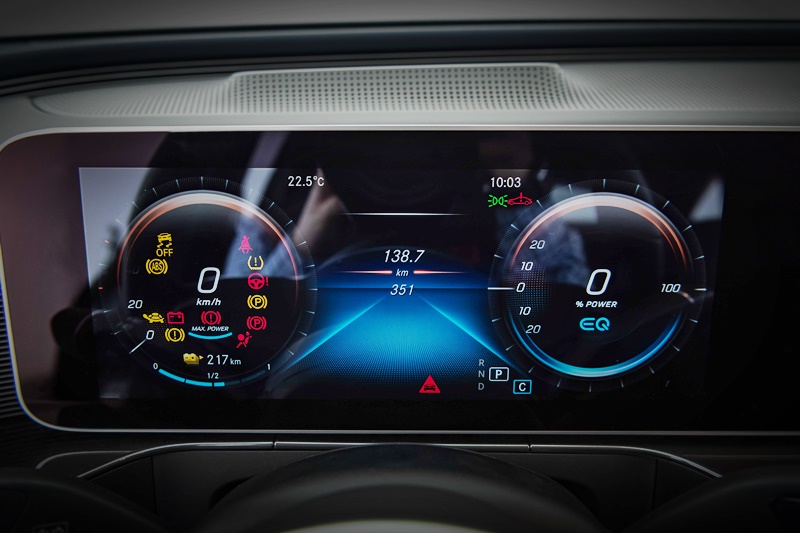
BRABUS offers exclusive options for the interior that create numerous possibilities for the customer. The line-up ranges from aluminium pedals and door-lock pins to scuff plates with backlit BRABUS logo in changing colours and a complete redesign of the cockpit.

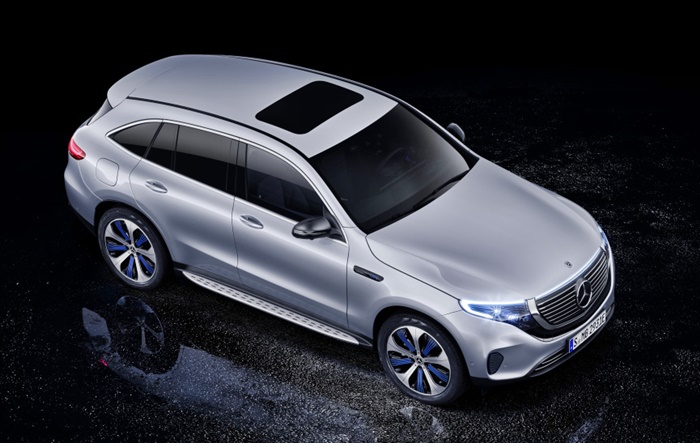
2018 Mercedes-Benz EQC 400 4MATIC
The Mercedes-Benz EQC 400 4MATIC made its global debut 2 years ago.

The other side of the BRABUS business – armoured SUVs

PISTON.MY

x

OBITUARY

We are very sad to learn that Osamu Masuko, special adviser and former Chairman of the Board of Mitsubishi Motors Corporation (MMC), passed away on August 27 at the age of 71 due to heart failure. The news was only issued in an official statement by the company today, although Mr. Masuko’s funeral took place earlier.

Originally from Mitsubishi Corporation, the trading company, Mr. Masuko was appointed as the President of MMC in January 2005. He developed and implemented the Mitsubishi Motors Revitalization Plan and was largely credited with revitalizing the company when its image was seriously damaged due to what was regarded as a cover-up of defects for a long period.

He led the development of advanced environment-friendly vehicles including the world’s first mass-produced electric vehicle, the i-MiEV, as well as the world’s first 4WD SUV plug-in hybrid EV, the Outlander PHEV.

In the ASEAN region, he promoted in local production and expanded sales, particularly in Thailand which is the production hub for the Triton. In addition, in 2016, he built solid relationships with the Alliance companies (Renault and Nissan) and the Mitsubishi Group, establishing close cooperation and sharing resources.

Our condolences to his family and may he rest in peace.

BHPetrol Euro5 Diesel

Archive

Follow us on Facebook

Follow us on YouTube