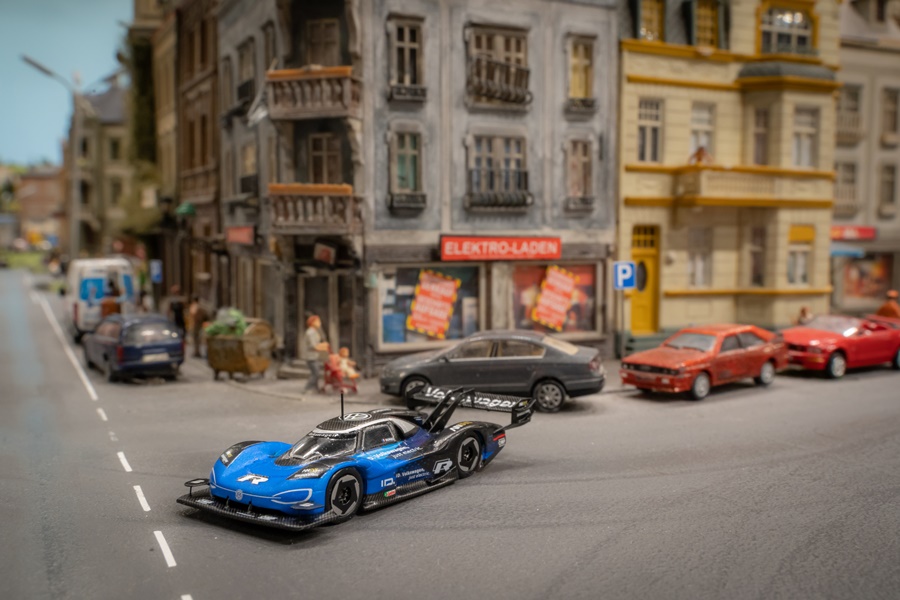
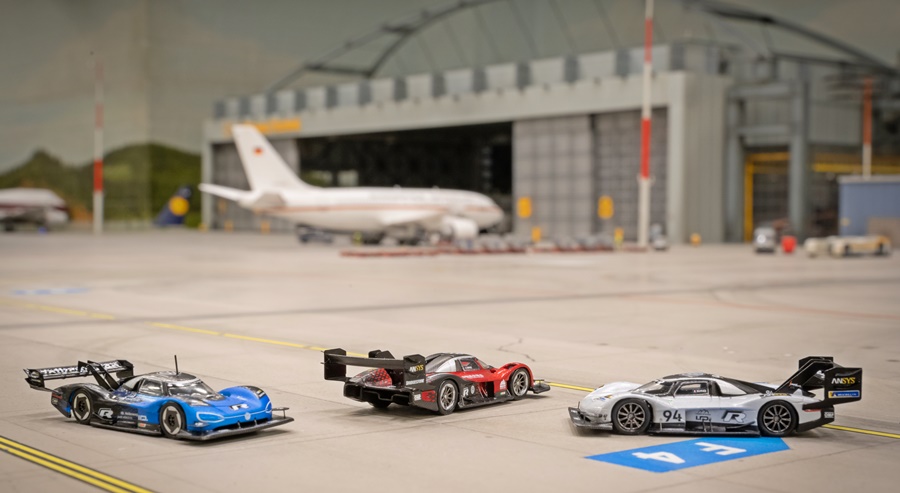
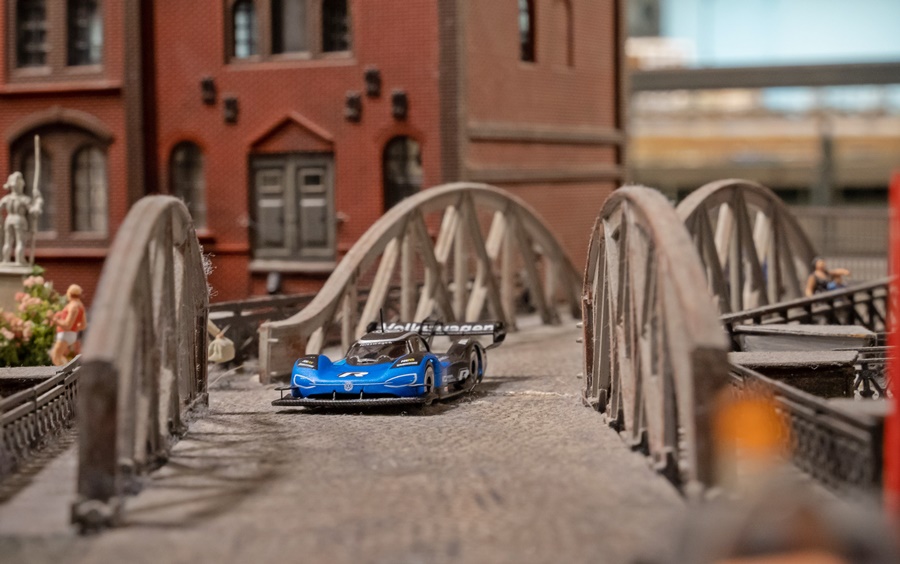
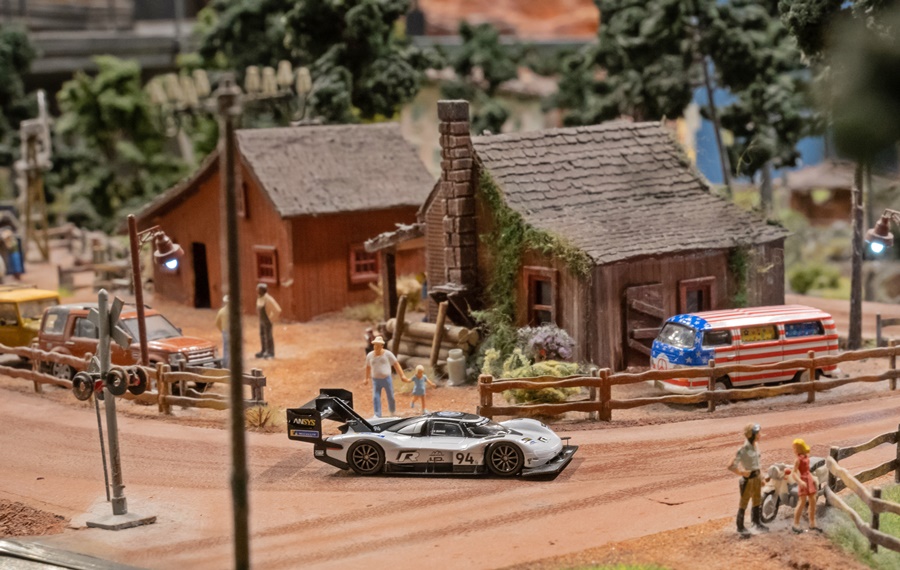
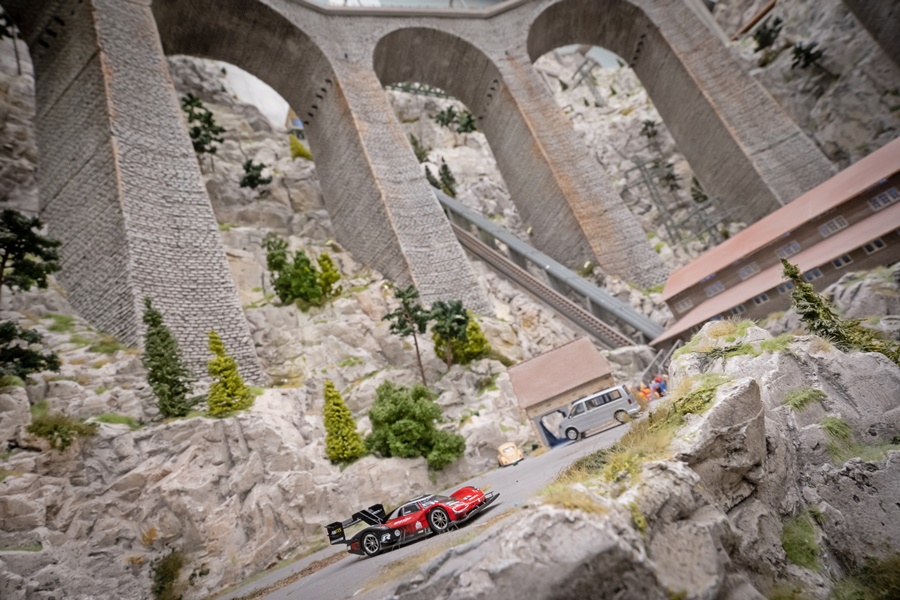
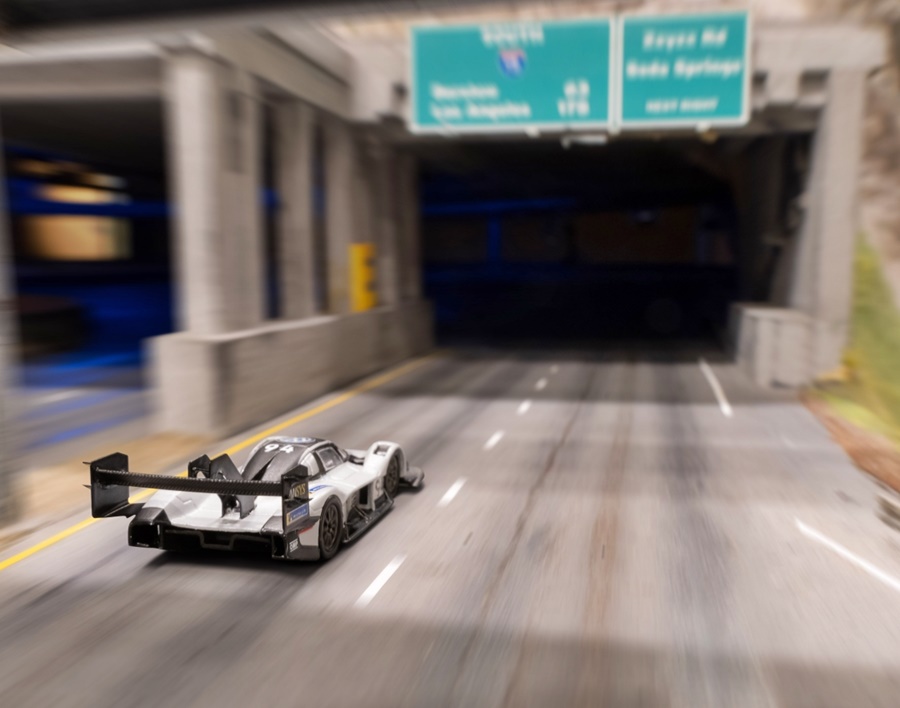
Volkswagen Motorsport’s team has been in many places around the world – at famous racetracks and locations, like the Nurburgring Nordschleife, Goodwood, Pikes Peak and Tianmen Mountain. Despite everything being very different this year, the ID.R super electric car has still been on the road. However, the soundtrack for the first stop of the world tour for the 671-bhp electric racing car was the roar of jet engines, not the sound of powerful electric motors.
That’s because the car was visiting Knuffingen Airport, an airport in the south of Germany which is one of the few that is currently operating as usual. After extensive reconstruction, aircraft like the Airbus A380 are taking to the air again.
The next stop on the tour is Venice. The legendary city is not the kind of place you would expect to see a record-holder alongside the gondolas and between the historic buildings at Piazza San Marco. A few hundred kilometres further south, the lack of tourists mean there is not a lot going on at the Trevi Fountain in Rome.
Back in Germany, a traditional parade can be seen near Neuschwanstein Castle in Bavaria. In other parts of Germany, the car visits a fair close to the home of Volkswagen Motorsport in Central Germany and the Elbe Philharmonic Hall that towers above the Port of Hamburg.
Across the Atlantic, the spectacular, brightly-lit hotels in Las Vegas are obviously particularly inviting for a ‘star’ like the ID.R, which can be right at home on the Strip with its electric atmosphere of neon signs. From here, it is not far to the Grand Canyon, where the car has a glorious view of the national park and a nice long ride the next day.
A miniature world tour
Even the ambitious engineers at Volkswagen Motorsport would have struggled to imagine the Volkswagen racing visiting so many locations, or other stops in Scandinavia and Provence—particularly not in 2020. However, the COVID-19 pandemic has made the world a little smaller and forced Volkswagen to rethink its plans accordingly.
The Miniature Wonderland in Hamburg
Because long-distance travel was made virtually impossible, the powerful member of Volkswagen’s EV family instead visited Miniatur Wunderland in Hamburg… in 1/87th scale. Like the ID.R, Miniatur Wunderland is a record-breaker and constantly striving for new superlatives. The biggest model railway in the world has 15 kms of track, which equates to more than 1,368 kms of real rail, and more than 1,000 trains with more than 10,000 carriages travel around the more than 1,330 square-metre facility.
The exhibition also features over 9,000 cars and 130,000 trees, while almost half a million LEDs illuminate the little wonderland. More than 300 employees have invested almost a million hours of work so far.
How it began
The idea of building Miniatur Wunderland came about on a journey.: “About 20 years ago, I was in a model railway shop in Switzerland,” recalled one of the founding members, Frederik Braun. “It brought back childhood memories and the dream of building the biggest model railway in the world was reborn. When I told my brother, he initially thought I had lost the plot completely.”
“That is true,” confirmed Gerrit Braun. “But it then ignited a spark in me too, and we started to consider how we would go about doing it. It was clear that we did not simply want to build another display, but something totally new.”
Work began on Miniatur Wunderland in December 2000. One year later, the first part was ready to open, and construction on the model railway continues to this day. It is definitely well worth a visit – and somewhere in there, you will find a record-breaking Volkswagen.
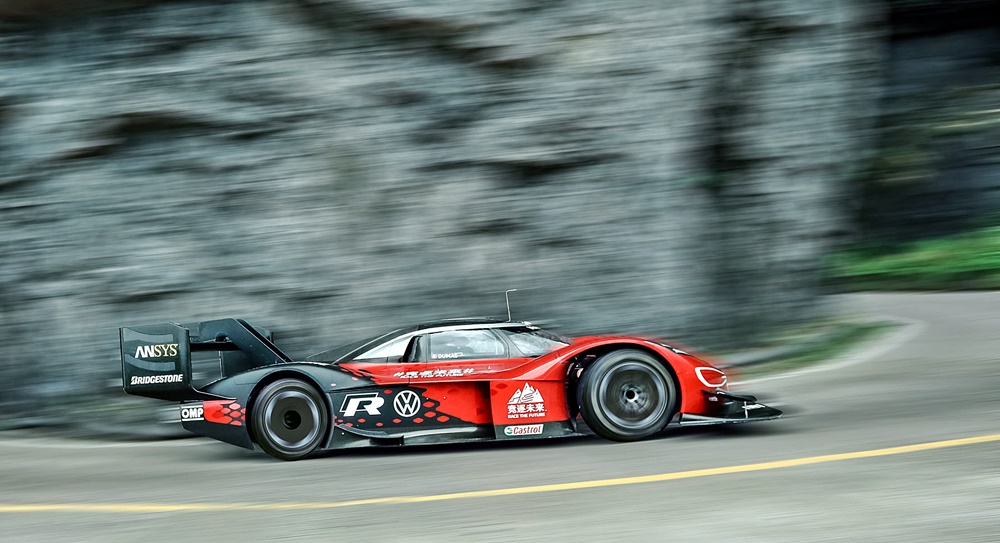
The full-sized record-breaking ID.R racing in the Tianmen Mountain region in China.
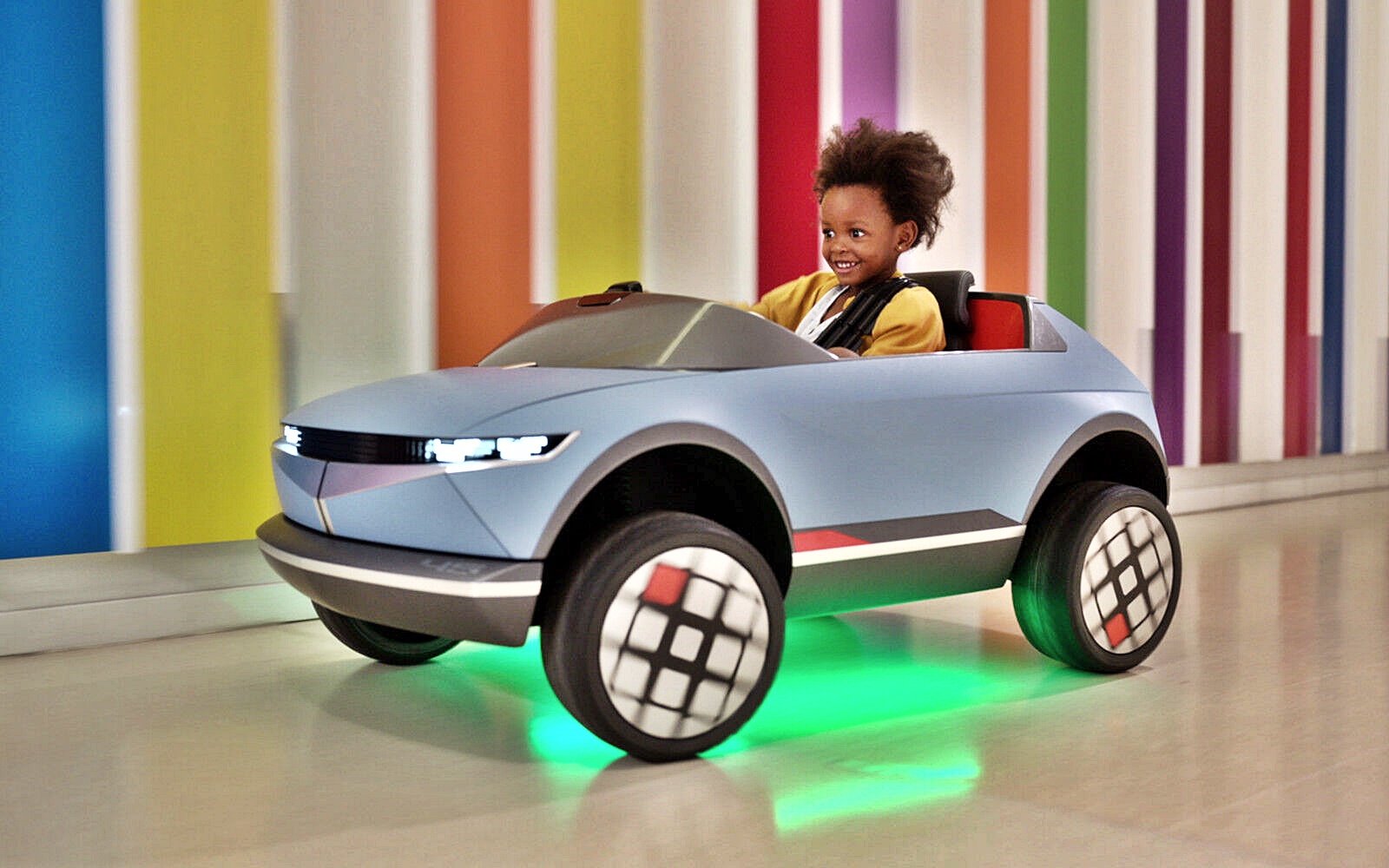
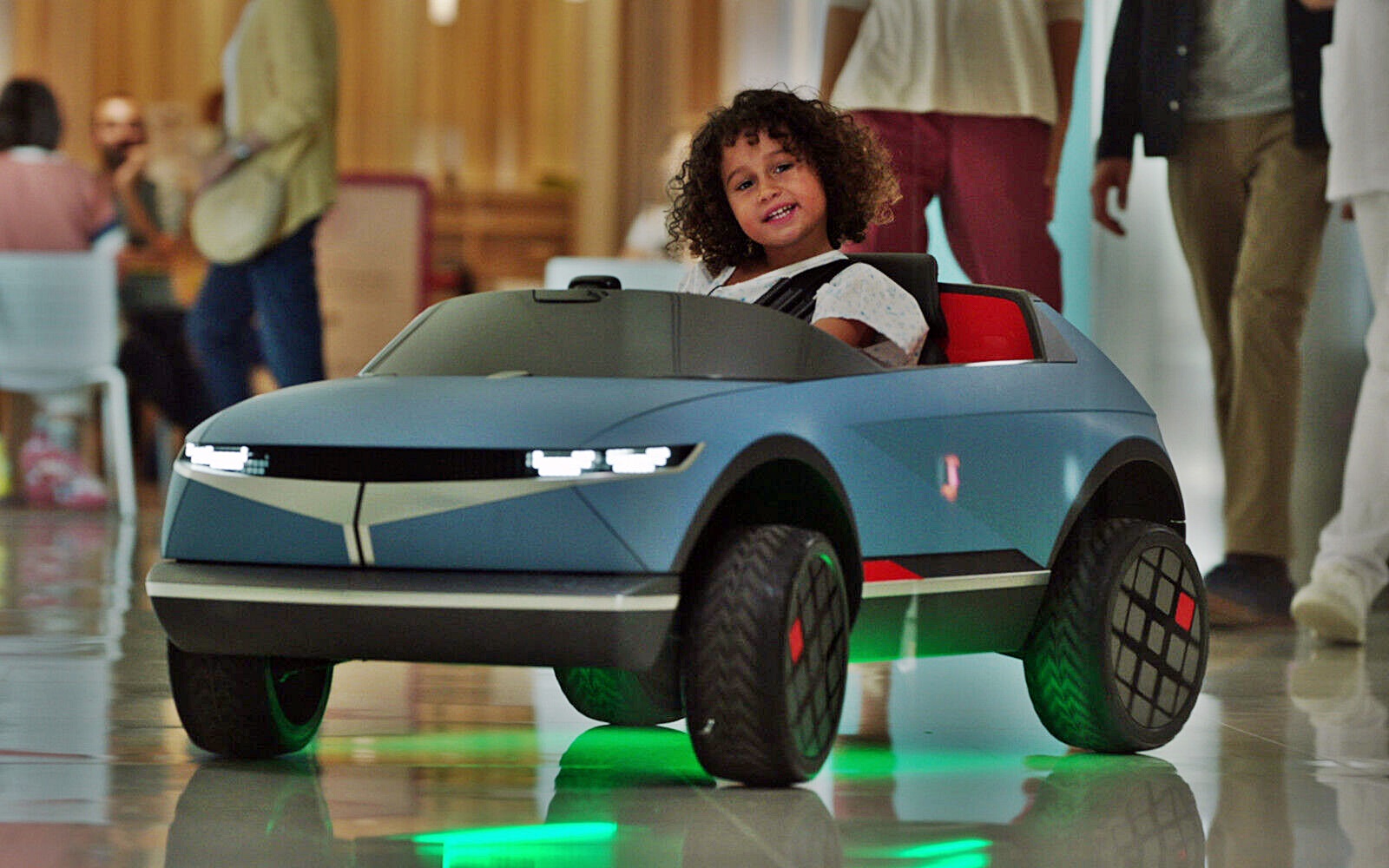
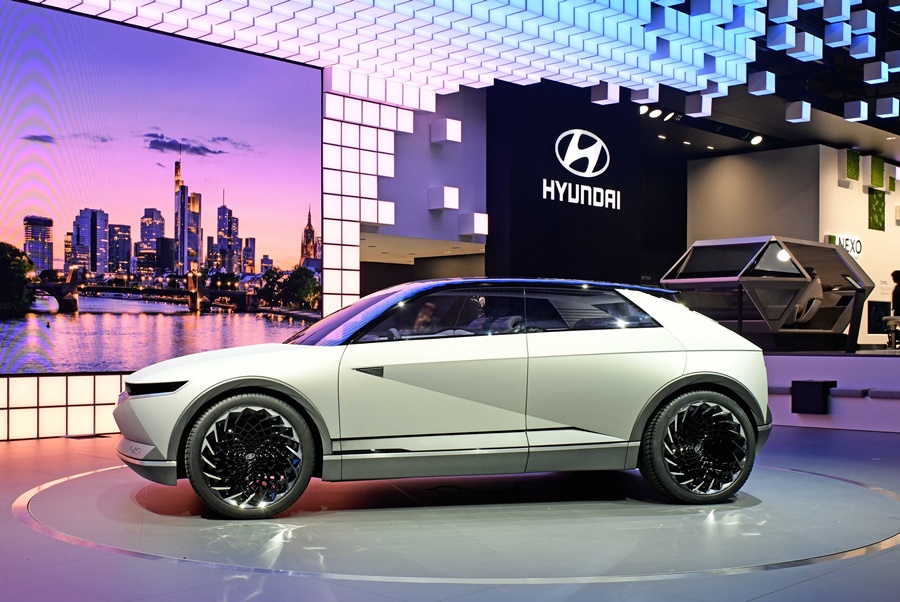
Two months ago, Hyundai Motor revealed its smallest ever model, a one-of-a-kind mini EV based on the ‘45’ concept car based on the ‘45’ EV concept that Hyundai displayed in 2019 at the Frankfurt Motorshow.
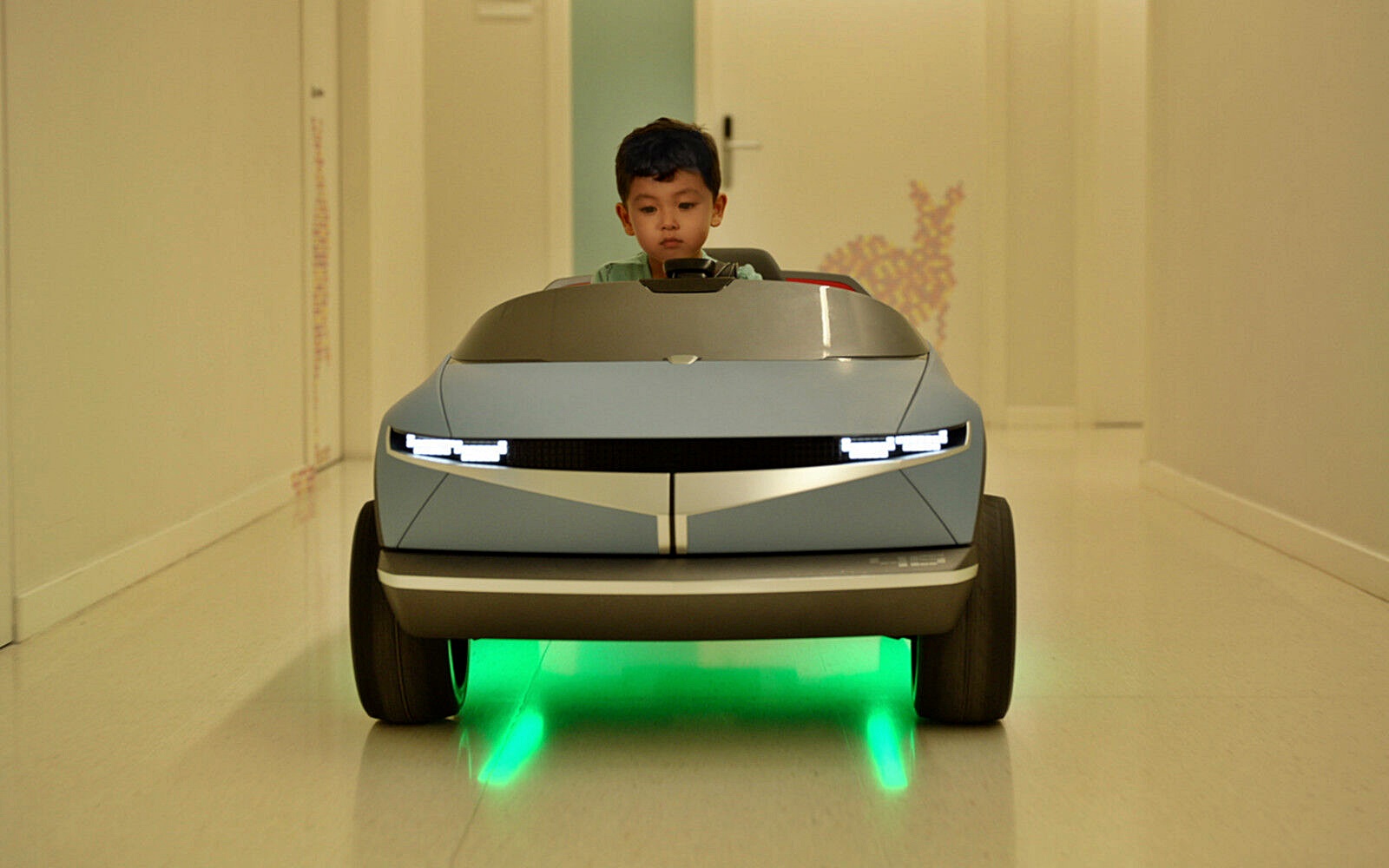
While it would be a wonderful Christmas present for little ones, the Korean carmaker has offered it to the SJD Barcelona Children’s Hospital in Spain as part of the ‘Little Big e-Motion’ project. The mini EV is being used to support the mobility of young patients from hospital bed to treatment room, which is considered one of the most stressful trips for the children.
EAVC is an artificial intelligence-based technology that optimizes vehicle environment based on information from both inside and outside the vehicle. Hyundai Motor Group is leading the development of this next-generation technology, as part of an academic research collaboration with the Massachusetts Institute of Technology (MIT) Media Lab.
EAVC technology monitors facial expressions, heart rate and respiratory rate, and combines these readings with input from the vehicle including speed, acceleration, noise and vibration. The technology then processes the data utilizing machine learning to optimize the vehicle environment and actively controls vehicle systems such as lighting, climate, music and fragrance dispenser.
EVAC is at the heart of Hyundai’s ‘Little Big e-Motion’ project. Equipped with this technology, the mini EV – designed by the same team that oversaw the ‘45’ concept – can provide a fun, safe mobility experience for young patients and help improve their health outcomes.
“The hospital is very excited to have such a technology available for kids. This will dramatically change the way patients will face treatment,” said Joan Sanchez de Toledo, Head of Paediatric Cardiology Department at SJD Hospital.
The 2019 Hyundai 45 Concept on which the mini EV’s design is based.
The EAVC-equipped mini EV interacts with its young ‘driver’ through five key technologies: Facial Emotion Recognition System, Breathing Exercise Belt, Heart Rate Monitoring Sensor, Emotion Adaptive Lighting, and Emotion Adaptive Scent Dispenser.
The Facial Emotion Recognition System uses a camera in front of the seat to identify the child’s emotions in real-time. The Breathing Exercise Belt wraps around the body and its air pockets apply gentle pressure the help relieve anxiety and enable more stable breathing, while the accelerometer, the Heart Rate Monitoring Sensor, measures the heart rate and breathing rate.
The Emotion Adaptive Lighting displays green, yellow or red to show the child’s emotional state in colours. The Emotion Adaptive Scent Dispenser sprays fragrance timed with breathing to help put a smile on the faces of the young patients. The vehicle also blows bubbles to celebrate the child’s progress toward treatment.
In addition to providing emotional support for the young patients, EAVC also assists the work of the medical staff at the hospital by informing them about the emotional state of the young patients without in-person interactions, which is especially useful in the era of COVID-19.
Hyundai Motor plans to continue supporting the treatment of young patients at SJD hospital through the project, while also fine-tuning its EAVC technology through this application. The company hopes to expand the use of this next-generation technology in mobility devices in the future to enhance driver safety and well-being.
Although Toyota is well known for hybrid vehicles, which it pioneered as a mass producer, it has also been developing and selling fully electric vehicles (EVs) for many years. While it recognises that pure EVs are – which are also referred to as Battery Electric Vehicles or BEVs – are going to increase in the market, the segment is not particularly large yet. Nevertheless, the company has made plans to sell 1 million BEVs and hydrogen fuel cell vehicles (which also have electric powertrains) by 2030.
Meanwhile, it is improving a small range of BEVs and selling them in limited numbers, mainly in Japan where engineers can more easily monitor usage and investigate any issues that arise. With BEV technology as part of Toyota’s future mobility roadmap, there is a need to encourage large numbers of people to adopt them and the company is progressively introducing such models.
A new mobility option
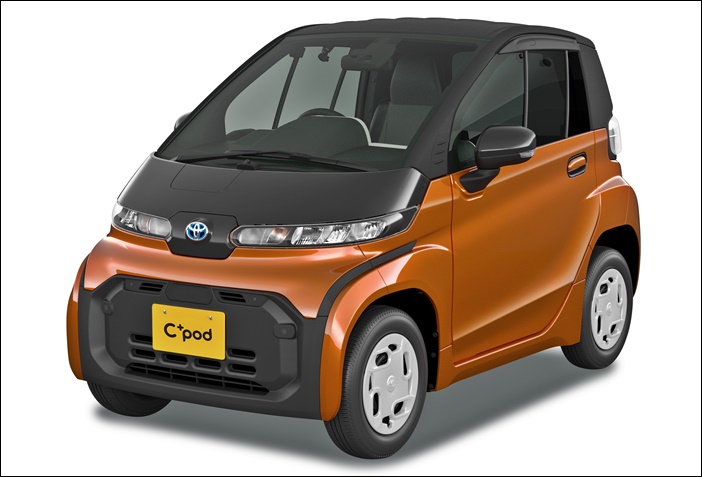
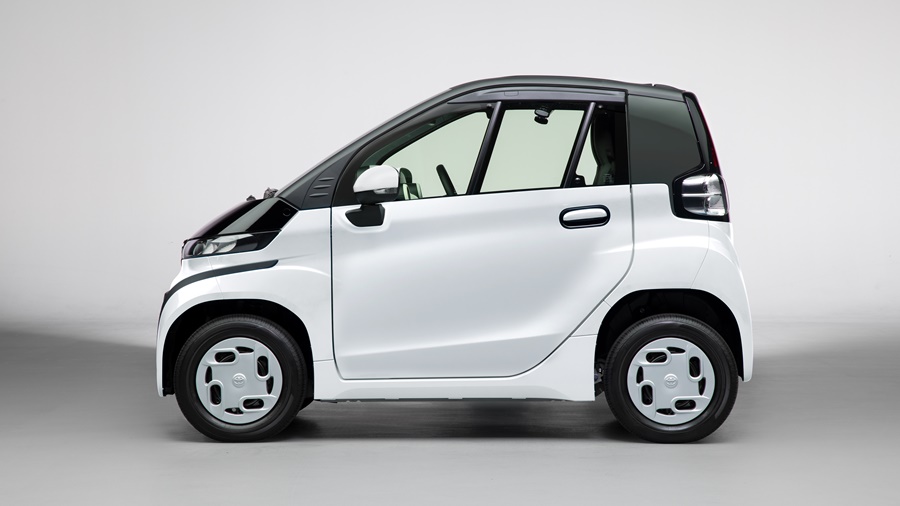
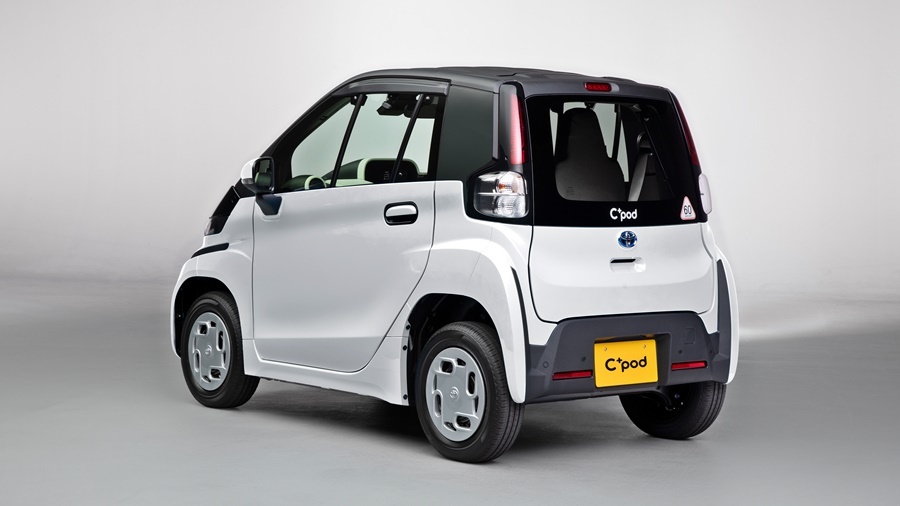
The latest one announced today is the new C+pod, a 2-seater BEV designed as a mobility option that improves per-person energy efficiency. In addition to short-distance daily use, the C+pod is also aimed at corporate users visiting customers on a regular basis, and at users in urban or mountainous communities needing safe, unrestricted, and environmentally-friendly transportation options.
The C+pod is 2.5 metres long and 1.3 metres wide so it is a compact vehicle and can turn within a tight radius of 3.9 metres. It’s therefore ideal for urban use and require minimum steering wheel operation when parking.
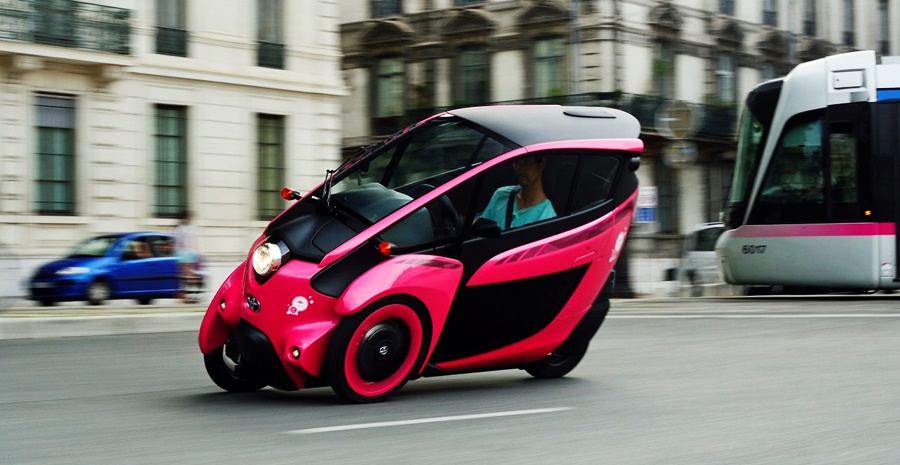
Toyota has been producing the i-Road 3-wheeler BEV since 2013 and is running it in public trials in Japan and Switzerland.
The under-floor location of the lithium-ion battery in front of the seat creates a flat, low-floor package that minimizes steps. The motor is positioned in the rear of the vehicle while the independent suspension system absorbs irregularities in the road surface and maintain stable movement.
Lightweight body with 150-km range
The motor can generate up to 9.2 kW with 56 Nm of torque, which is sufficient to give the lightweight 690-kg vehicle good performance. Factory tests using industry test cycles have achieved cruising range of up to 150 kms which would be adequate for daily use.
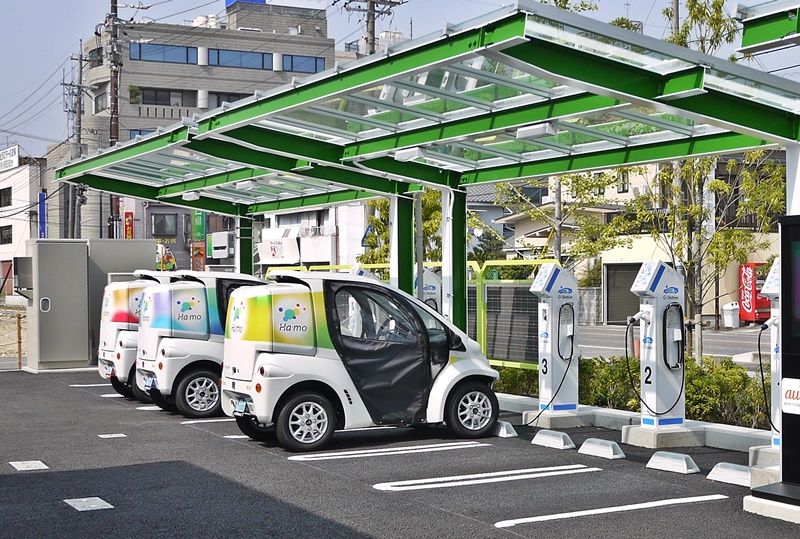
The C+pod can be charged at home or in public areas and in Japan, there are around 15,000 stations nationwide, all of which will be marked on the navigation system. Depending on the charging method used, an empty lithium-ion battery pack can be fully recharged between 5 and 15 hours.
There are now around 15,000 charging stations throughout Japan (Toyota COMS BEVs being recharged in Nagoya)
Mobile power supply capability
The C+pod includes an external power supply system of up to 1,500W as standard for use during power outages and natural disasters. In addition to use through the accessory power outlet near the passenger’s feet, the optional vehicle power connector can be plugged into the standard charging inlet at the front of the car for use as an external power supply socket, which can supply power for up to about 10 hours.
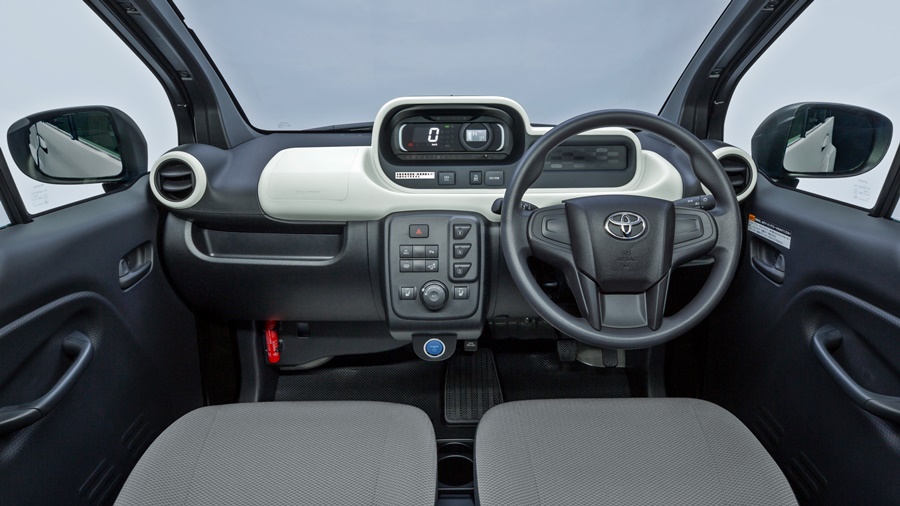
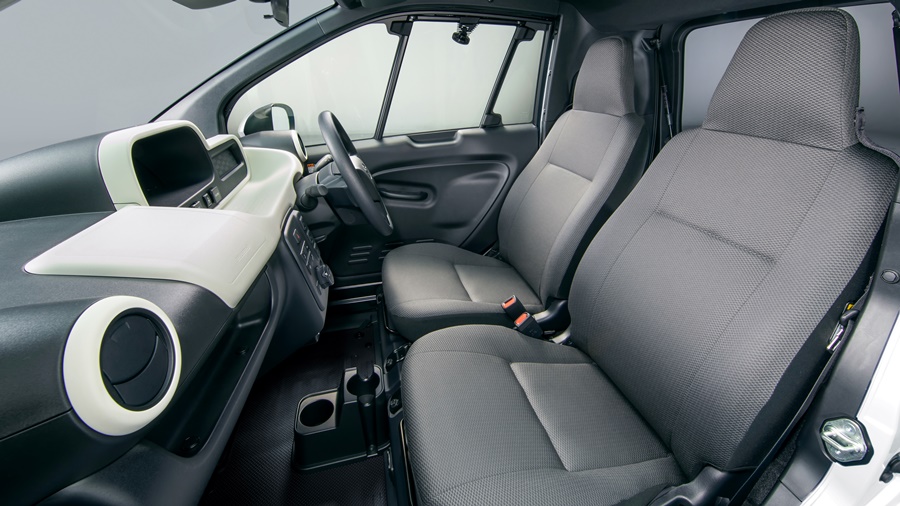
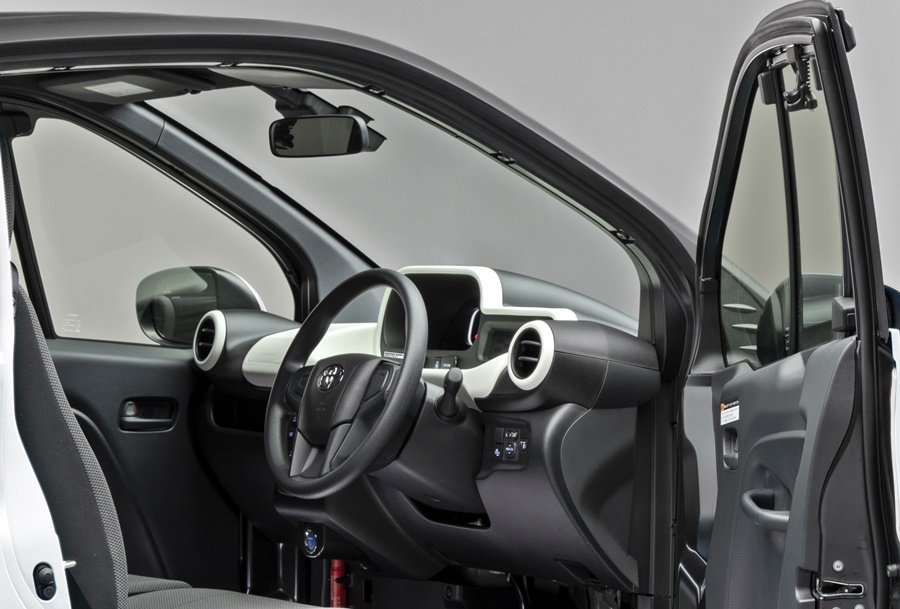
The 1100-mm wide cabin provides a simple space for two adults to sit side-by-side. Positioned above a white centre tray, the instrument panel features meters and other functional equipment. The contrast with the black tones of the interior creates a feeling of spaciousness.
Toyota has made sure the C+pod has safety features to protect the occupants even though its body is compact and has plastic panels in some areas. Its structure efficiently disperses and absorbs impact energy across multiple components during frontal, side or rear impacts. Injuries to pedestrians are also reduced during a collision with the vehicle, thanks to the design of the front end elements.
The C+pod will be sold only in Japan and customers can choose from two grades, priced from 1,650,000 yen (about RM65,000).
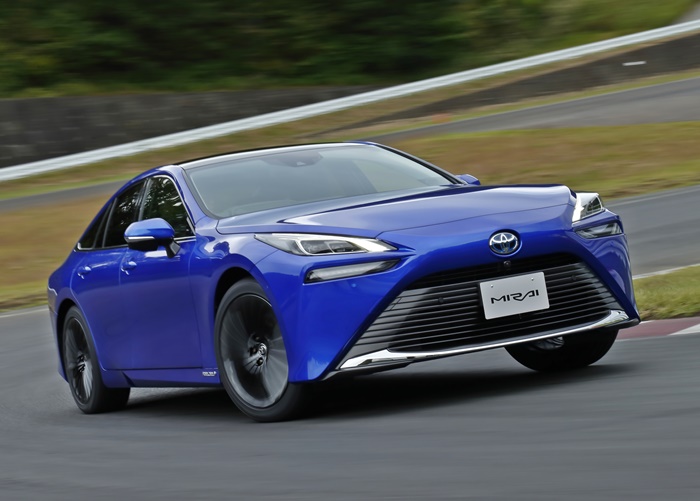
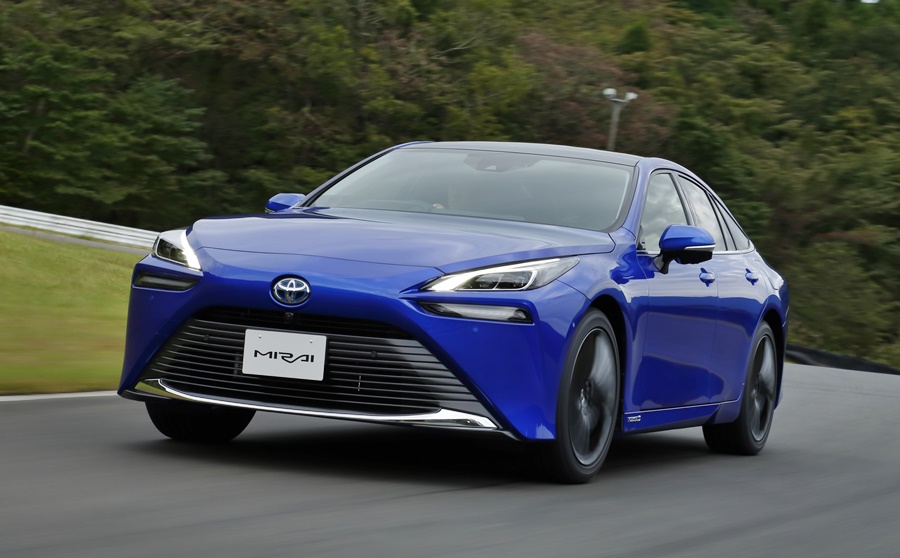
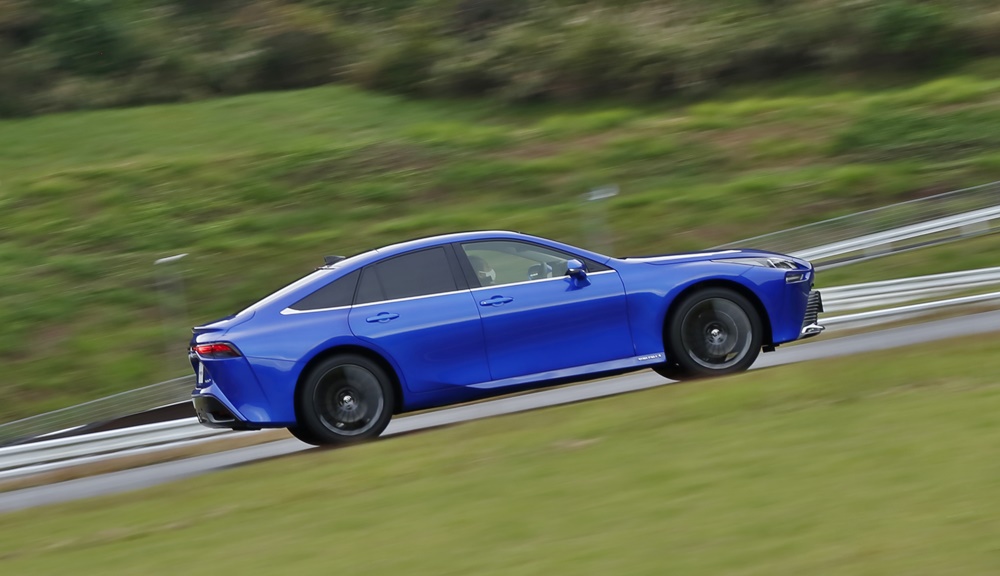
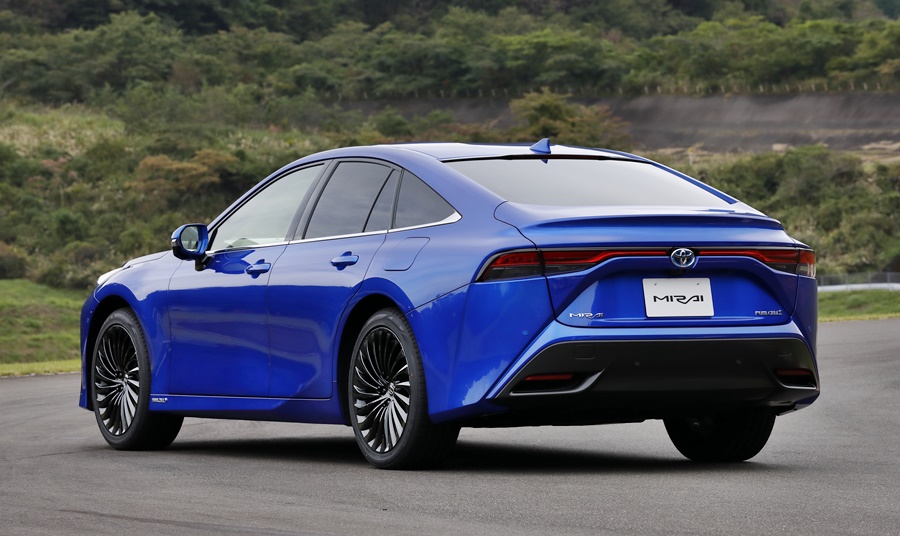
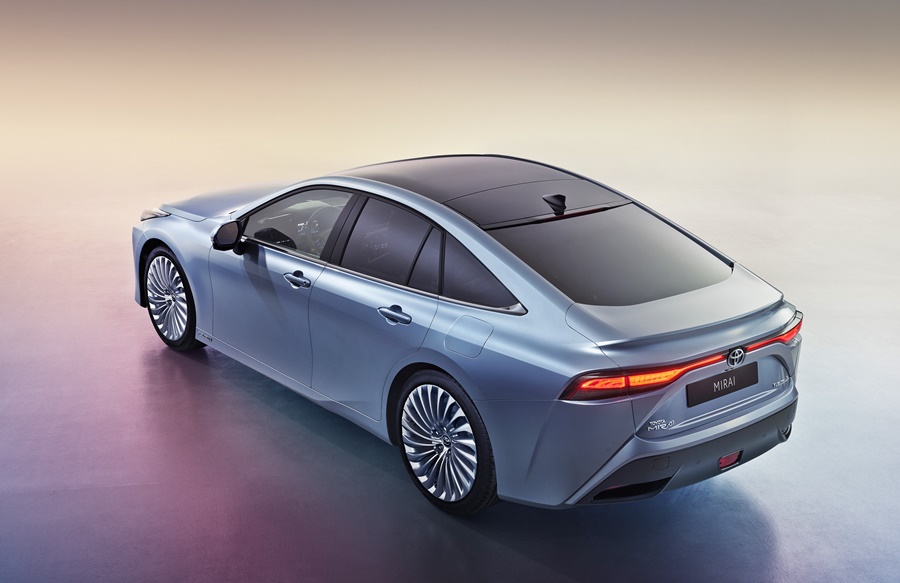
The Mirai, Toyota’s electric vehicle powered by a hydrogen fuel cell (FCEV) has started its second generation with its market launch in Japan, on schedule, today. The company had given an early glimpse of the new model a year ago at the Tokyo Motorshow and said it would begin selling the car by the end of 2020.
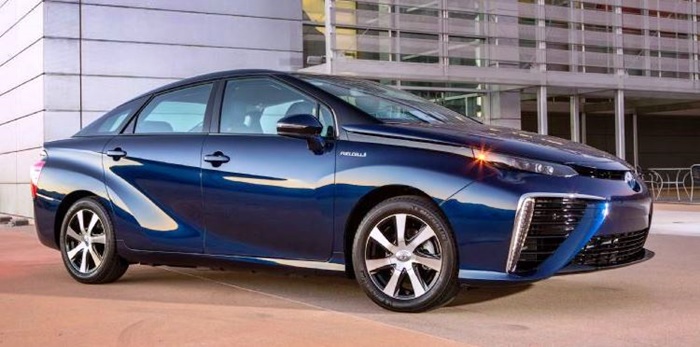
After beginning serious development of FCEVs in 1992, the Mirai’s predecessor was launched in 2014 and was a revolutionary model. Like the Prius hybrid, it was a global forerunner in mass production of FCEVs. However, it was sold only in a limited number of markets where hydrogen refuelling stations were available.
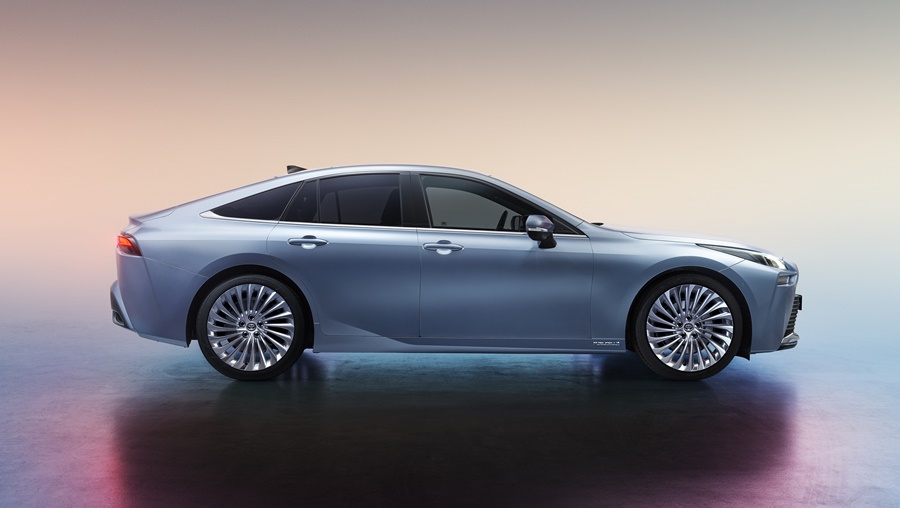
2021 Mirai second generationFirst generation Mirai
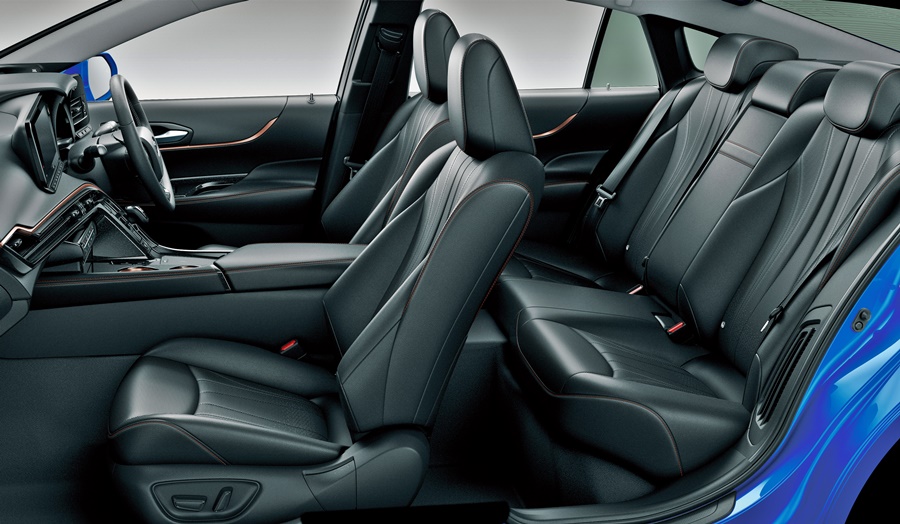
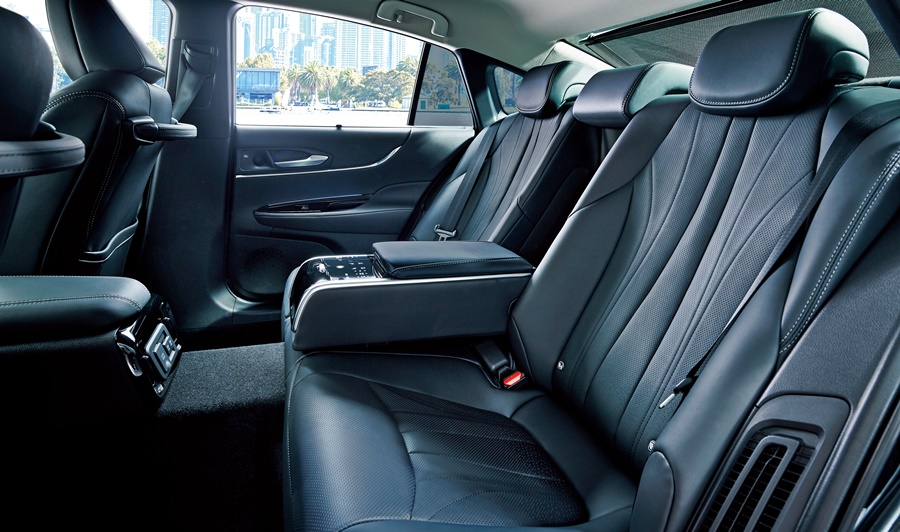
Feedback from customers indicated that more seating space was desired, so the new Mirai has space for 5 persons instead of 4. Its cruising range has also been increased by approximately 30% compared to the first generation, with up to 650 kms claimed.
Also following the way the Prius design evolved, the new Mirai’s appearance is less radical and has been given a more premium image. The concept of ‘silent dynamism’ was incorporated into the design with the aim of creating an emotional appeal not just because it is an eco-car, but because of its styling.
Sleeker, less radical styling
The new Mirai has sleeker proportions with overall height by 65 mm and 140 mm added to the wheelbase to extend it to 2920 mm. With the rear overhang extended by 85 mm, overall vehicle length is now 4975 mm.
“We have pursued the goal of making a car that customers will feel they want to drive all time, a car that has an emotional and attractive design and the kind of dynamic and responsive performance that can bring a smile to the driver’s face,” said Yoshikazu Tanaka, the new Mirai’s Chief Engineer who also headed the team for the development of the first generation.
“I want customers to say ‘I chose the Mirai not just because it’s an FCEV, but because I simply wanted this car; it just happens to be an FCEV.’ We will continue our development work focusing on that feeling, and we hope that with the new Mirai, we will be a leader in helping realise a hydrogen energy society,” he added.
Simple, modern cabin
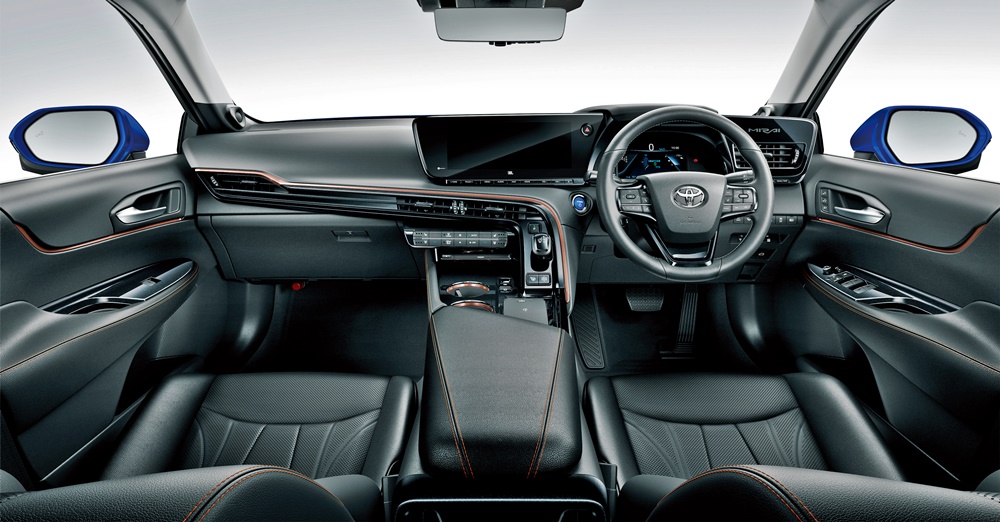
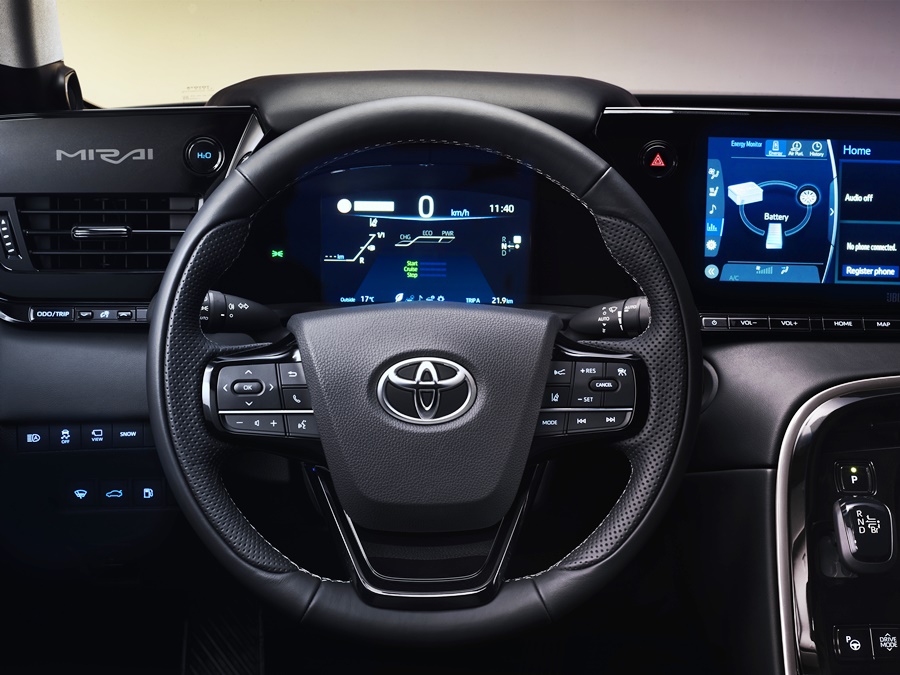
The interior has been conceived as a simple, modern space with a warm, comfortable. Key elements include a 12.3-inch centre display and an instrument panel that wraps around the driver. As the Mirai runs only with an electric motor, there is no engine vibration or noise and with the enhanced body rigidity and additional soundproofing measures, the low level of quietness is significant.
A Toyota innovation is the catalyst-type filter is incorporated in the air intake. As air is drawn into the car to supply the fuel cell, an electric charge on the non-woven fabric filter element captures microscopic particles of pollutants, including sulphur dioxide, nitrous oxides and PM 2.5 particulates. The system is effective in removing 90 to 100% of particles between 0 and 2.5 microns in diameter from the air as it passes into the fuel cell system.
The Mirai sits on the TNGA-based GA-L platform which is intended for high-end rear-wheel-drive vehicles. The structures of various parts including the rear have been redesigned to create greatly enhanced body rigidity. This has a positive effect on ride and handling, enhancing driving dynamics and comfort.
The more rigid body also contributes to better occupant protection and with advanced driver assistance systems, the Mirai offers higher standards of motoring safety than before with the latest Toyota Safety Sense suite.
The driver assist functions are based on the Mobility Teammate Concept, a unique Toyota concept for automated driving whereby the car and driver act as partners to enhance each other’s capabilities and drive together. AI technology is used with on deep learning capability to forecast various situations that may be encountered while driving and provide support for driver responses.
Increased used of hydrogen for mobility
Since launching the first generation 6 years ago, hydrogen use for mobility has progressed widely to include trucks and buses. Toyota has continued to improve and advance its fuel cell (FC) systems in areas such as size, efficiency, and productivity.
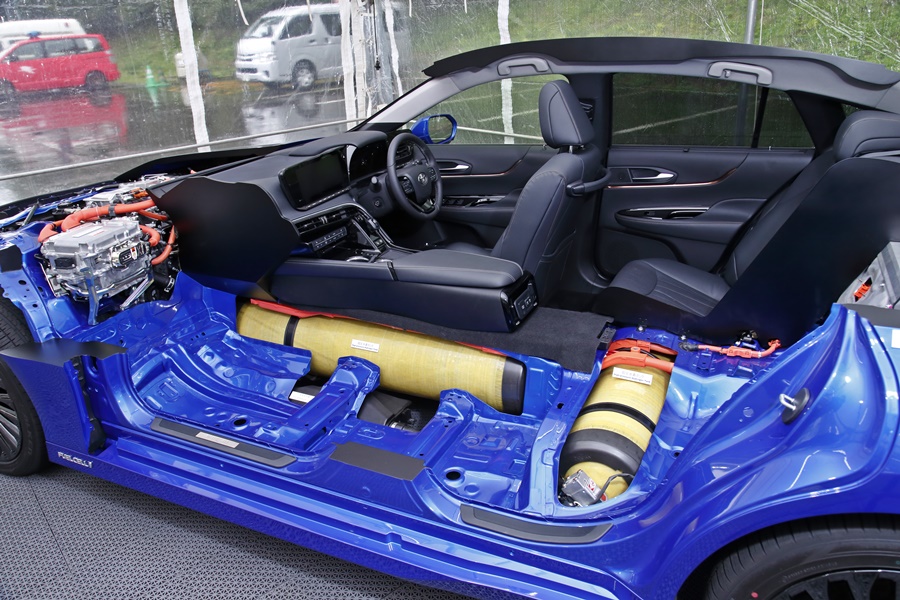
There are three tanks which together increase the fuel capacity by around 1 kg (compared to the first generation), increasing hydrogen capacity by approximately 20% which, in turn, extends range. One of the tanks is now installed inside the floor tunnel space, which also helps in weight distribution for better stability and handling.
Though the Mirai is also powered by electricity, the hydrogen it uses can be pumped in much faster than the fastest recharging time for an electric vehicle which can be up to 25 minutes. The FCEV is said to be able to fully refuel in about 3 minutes from high-pressure pumps, certainly something that will appeal to potential buyers.
Compact and more powerful FC system
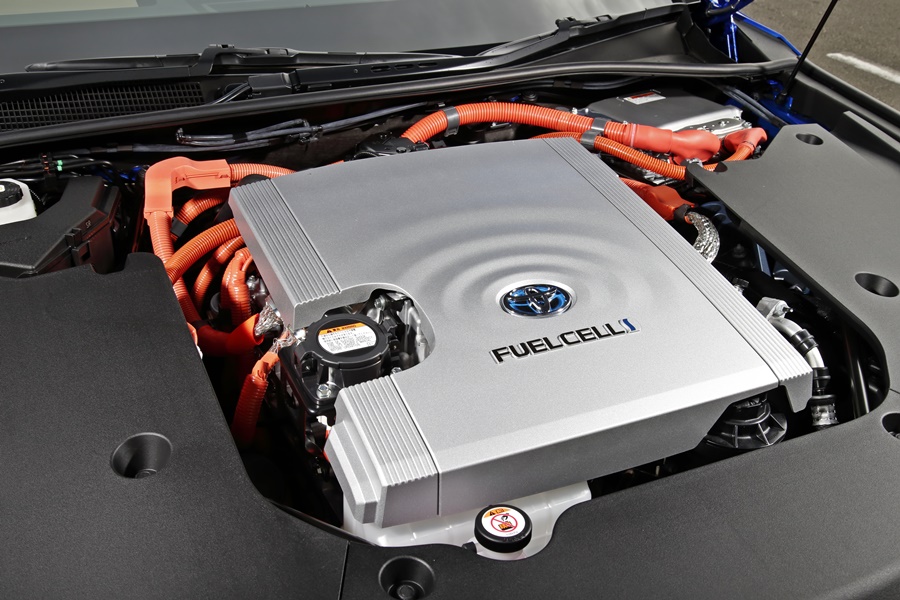
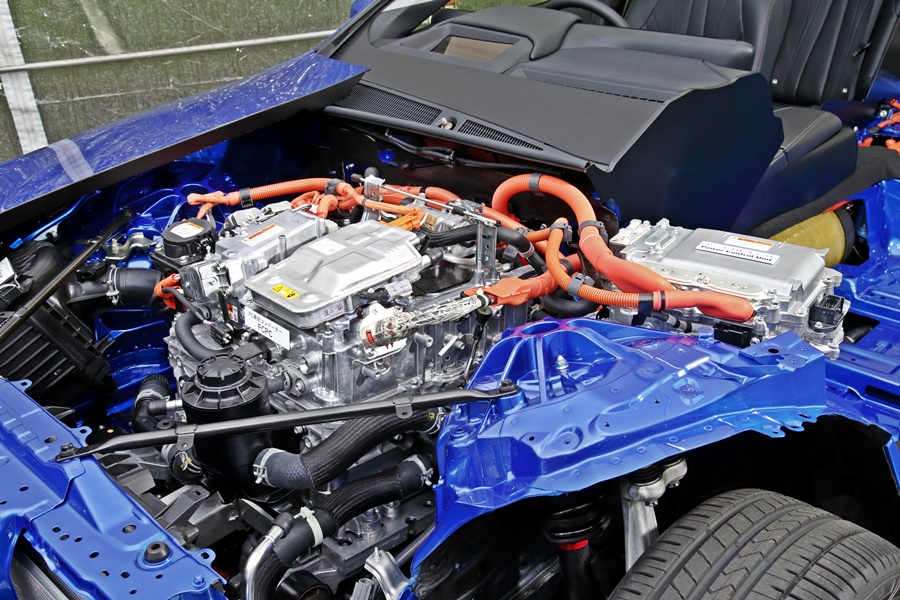
The compact, high-output FC stack is located in what is traditionally the ‘engine compartment’ but the motor and battery are at the rear. Toyota’s new FC stack and fuel cell power converter (FCPC) have been developed specifically for use with the GA-L platform. The designers have been able to bring all the elements together in the stack frame with each part made smaller and lighter, while at the same time improving performance.
The FC stack uses a solid polymer, as in the current Mirai, but has been made smaller and has fewer cells (330 instead of 370). Nonetheless, it sets a new record for specific power density at 5.4 kW/litre as maximum power has risen from 114 kW to 128 kW. Cold weather performance is also said to have been improved with start-up now possible at temperatures from as low as -30˚.
The car is equipped with lithium-ion high-voltage battery in place of the previous nickel-metal hydride unit. Although smaller in size, it is more energy-dense, giving higher output and superior environmental performance. Containing 84 cells, it has a 310.8 rated voltage compared to 244.8, and a 4.0 Ah capacity, versus 6.5 Ah. Overall weight has been reduced from 46.9 to 44.6 kgs.
Aiming for higher sales volumes
The introduction of the new Mirai will see Toyota target deeper market penetration with a 10-fold expansion in sales volume. To achieve this, the carmaker has adjusted the price downwards by around 20%. In Japan, where two grades are offered, prices start from 7,100,000 yen (about RM277,200) while the pricing in Europe is expected to start from 64,000 euros (about RM316,000) which is less than what Tesla charges for its similarly-sized EV.
Of course, actual prices customers pay will depend on incentives and rebates that governments in different countries offer. As with hybrids, the acceptance of FCEVs will depend on how much they are sold for and right now, with the advanced technologies being new, they are expensive. Therefore, governments have to help to make them affordable while the carmakers boost volumes so that economies of scale can kick in to lower costs. This has already happened with hybrids and next would be EVs, before FCEVs.
There is also the matter of refuelling stations which is an even greater challenge because it involves hydrogen supply. Even with plug-in hybrids (PHEVs) and full EVs, the issue of recharging stations has been one that consumers think about. This is being addressed by rapid expansion of the recharging station network in some countries, as well as the improvements in technology to provide longer range.
Don’t expect it in Malaysia anytime soon
Vehicles with petrol and diesel engines will be phased out eventually and in fact, they will be banned in some countries, including Japan, by the end of the decade. It’s uncertain how the situation will be in Malaysia given the instability of policies and the way they are executed. The aspiration to become the ‘EV hub of ASEAN’ is pretty much a dream, especially the governments of Thailand and Indonesia are already pushing ahead with clearly-defined programs to increase EV usage, which attracts some of the carmakers to make further investments as well.
The original Range Rover was launched in 1969 and final production took place in 1996. It has come to be known as the Classic Range Rover and can be regarded as the first premium 4×4 (the ‘SUV’ term didn’t exist then). Well-kept units are collectors items and with the engineering having been robust, they remain capable vehicles even today.
Electrifying classic models
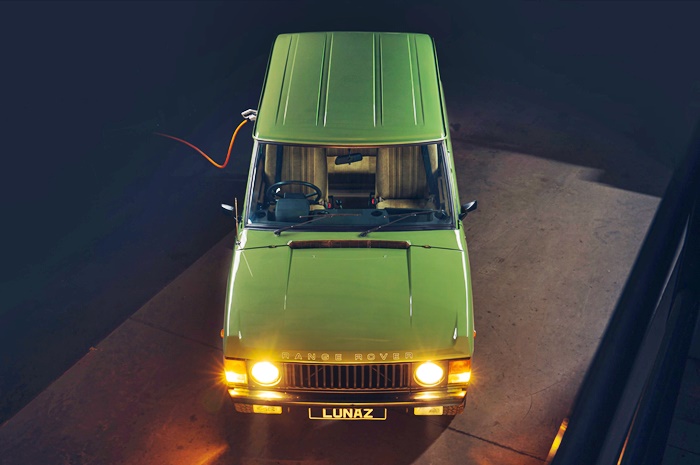
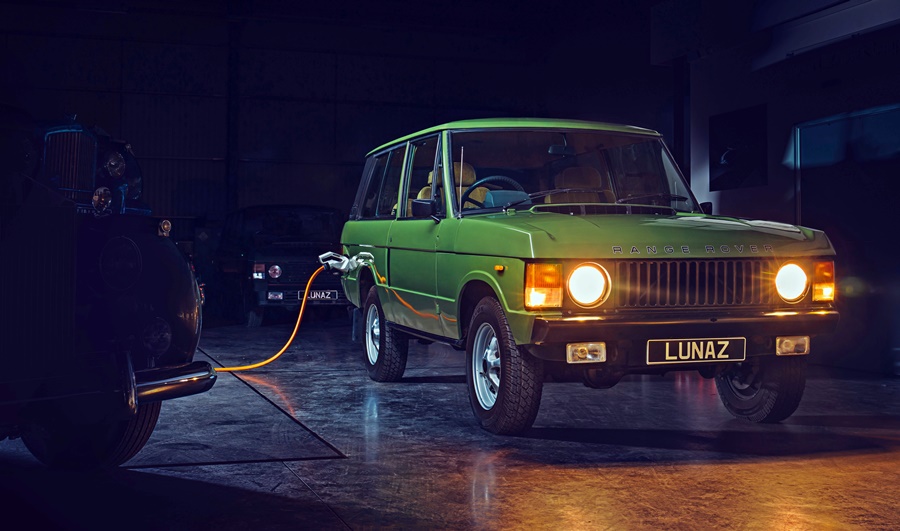
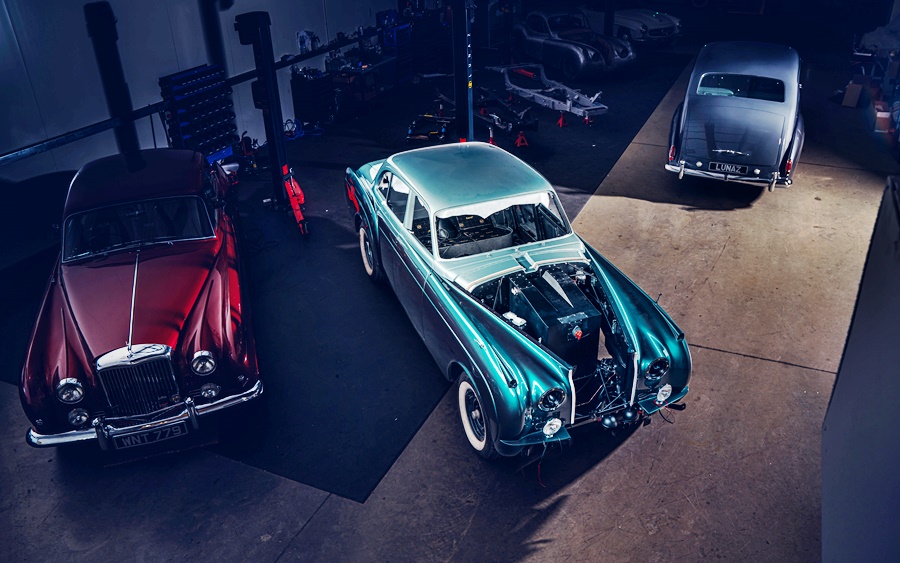
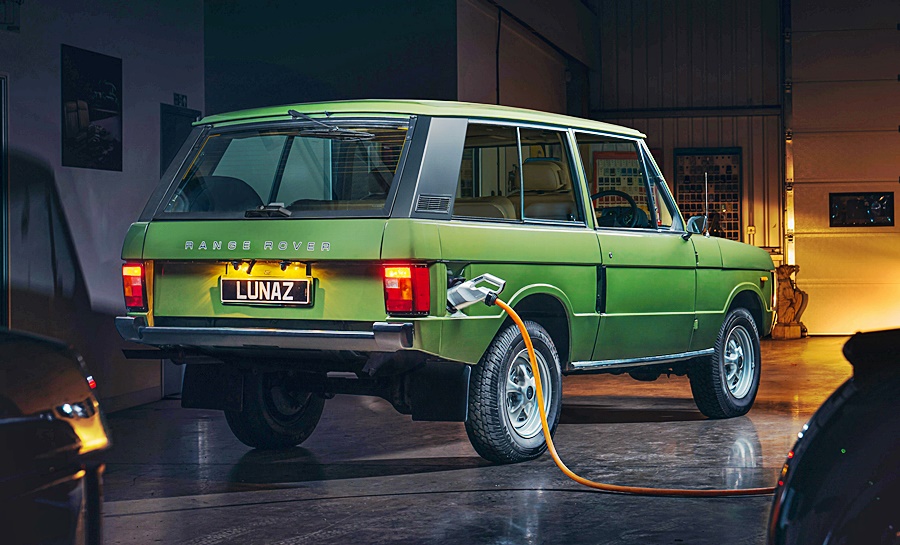
For those who want the Classic Range Rover, there is also a new source from Lunaz, a company in England that specialises in making electric classic cars. Lunaz has earlier ‘electrified’ Jaguar, Bentley and Rolls-Royce classics and now intends to also create an initial run of 50 original Range Rovers built in the ‘classic era’ between 1970 and 1994.
The original Range Rover which as produced between 1969 and 1996.
Since unveiling its electrified classics, Lunaz has received requests from customers to apply its re-engineering and restoration approach to the Range Rover. In response to this, the company has decided to offer two versions – the ‘Town’ and ‘Country’ specifications – which can be delivered in mid-2021.
The more urban expression of these cars will be presented with increased focus on rear-seat and driver comfort, reflecting their dual use as either self-driven luxury vehicles or chauffeured cars. They will be available in both standard and long wheelbase and either the classic 3-door configuration or the 4-door models.
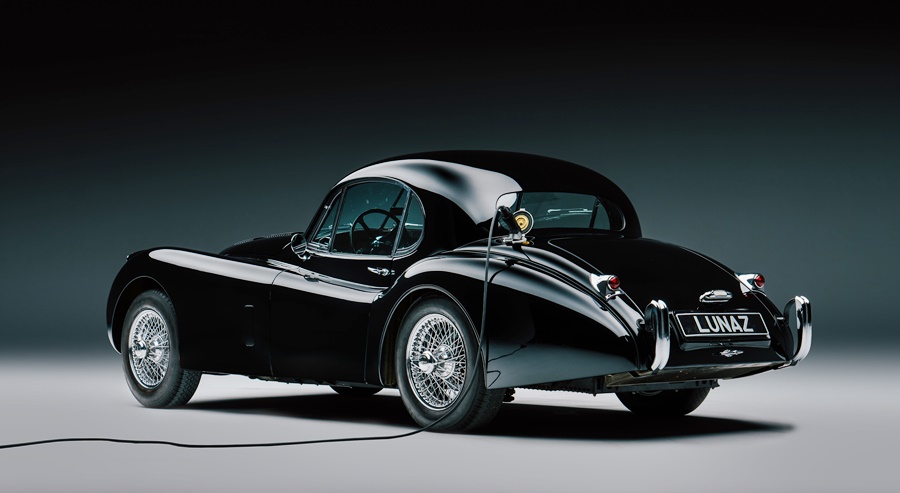
Lunaz has been converting these other classic models with electric powertrains. These include the Jaguar XK120 (below).
Modern engineering, classic looks
The ‘Country’ specification will include a full suite of engineering, technological and design features that augment a full electric classic off-roading experience for the first time. Every vehicle Lunaz produces goes through a full bare metal restoration and re-engineering process ahead of conversion to the company’s proprietary electric powertrain. This approach allows Lunaz to answer the questions of usability and reliability that detract from the experience of owning the most celebrated classic cars in the world.
The electric classic Range Rovers will include a 4-wheel drive system, updated suspension including anti-roll bars and uprated brakes. Within the cabin, the pure utility of the original interior design will be significantly elevated. The Lunaz design philosophy balances the integration of technology and usability within a classic architecture.
Design Director Jen Holloway and her team will work in close consultation with customers to tailor the car to their exact requirements. Material palettes that honour the textile interior that debuted on the original classic Range Rover will be offered as well as more traditional upholstery options with the very finest leathers and woods.
Usability is further enhanced with the inclusion of a full suite of contemporary technologies. Modern conveniences and features will include an infotainment system, air conditioning and entertainment screens integrated into the existing design scheme to ensure the spirit of the original car is maintained.
Electric vehicles have usually been expensive due to the advanced and new technologies but those that have become mainstream models have the benefit of economies of scale to push prices down. Not so with the classic electric Range Rovers by Lunaz which are expected to start at £245,000 (about RM1.33 million), ex-factory. This is the price of exclusivity and being one of 50 owners in the world.
While still improving and innovating its technologies for models with internal combustion engines, the Hyundai Motor Group (HMG) is also investing substantially in battery electric vehicle (BEV) technology. Such vehicles will grow in numbers in coming years and HMG has been developing core technologies for them.
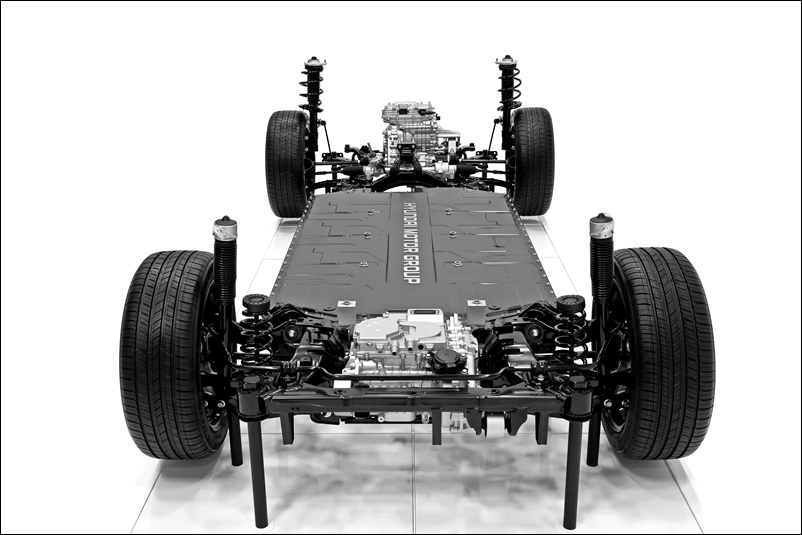
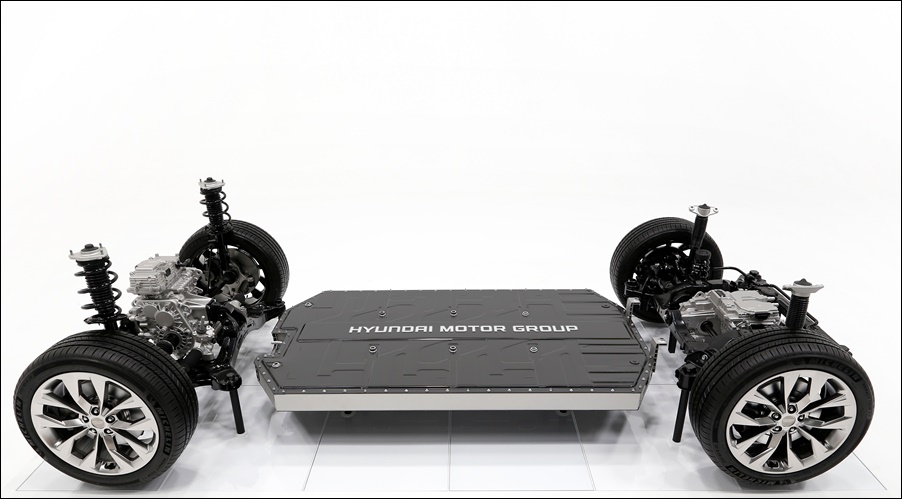
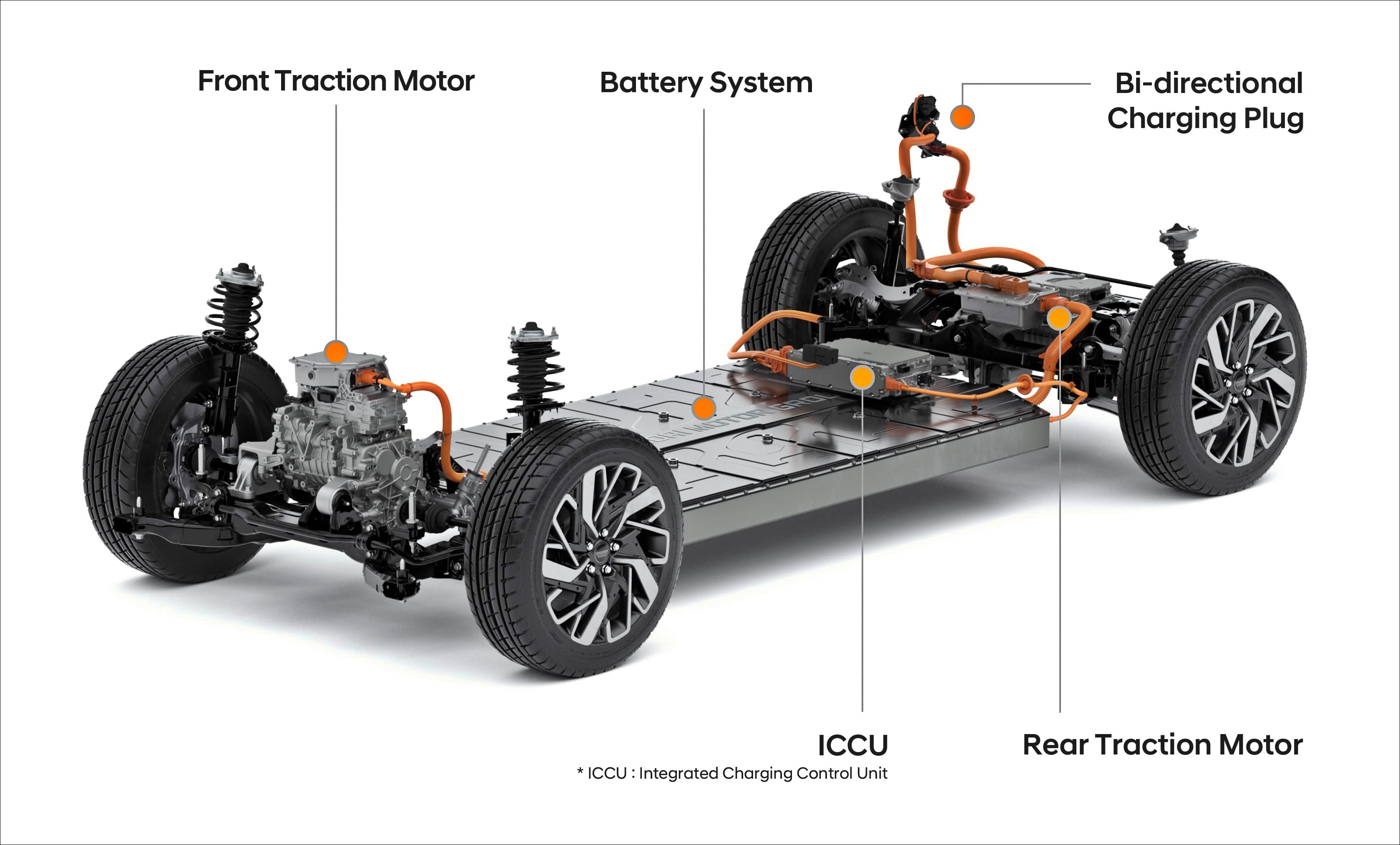
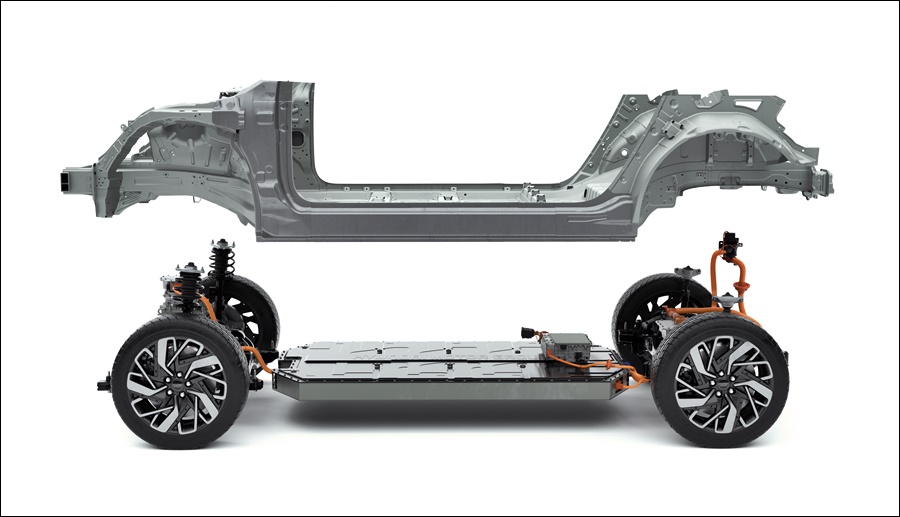
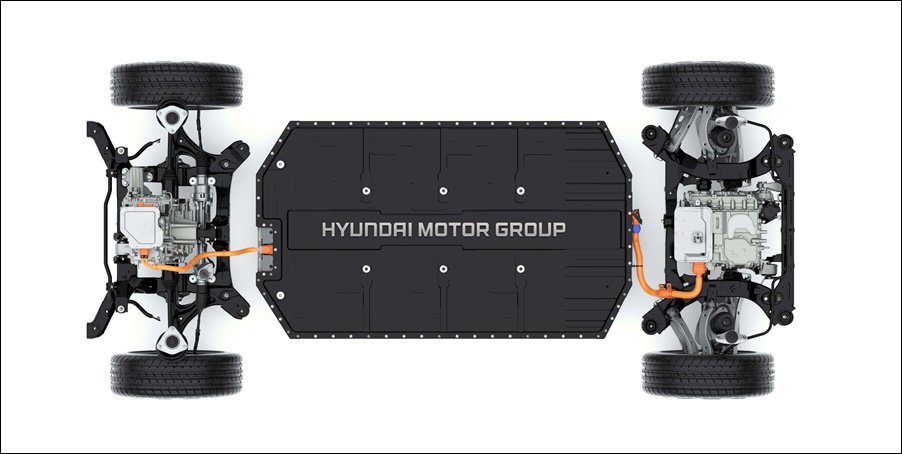
One of these is the new Electric-Global Modular Platform (E-GMP) which is specifically for BEVs. The E-GMP is ready to be used and from 2021, the E-GMP will support a range of new BEV models. These include the Hyundai IONIQ 5 and Kia’s first dedicated BEV. The platform will be used for as many as 23 BEV models in HMG with the sales target of more than 1 million BEVs worldwide by 2025.
The E-GMP provides various advantages compared to the Group’s existing platforms which have engineering oriented towards internal combustion engines. With a brand new approach that is dedicated to the electrified powertrain, there is increased development flexibility, stronger driving performance, increased driving range, strengthened safety features, and more interior space.
“Today our front-wheel driven Hyundai and Kia BEVs are already among the most efficient ones in their segments,” declared Albert Biermann, President and Head of R&D Division for Hyundai Motor Group. “With our rear-wheel drive E-GMP, we are extending our technological leadership into segments where customers demand excellent driving dynamics and outstanding efficiency.”
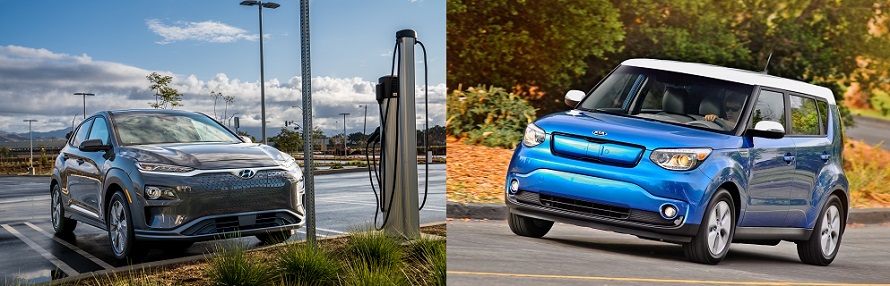
EV variants of the Hyundai Kona (left) and Kia Soul (right) are currently available in some countries.
Maximizing development flexibility
The E-GMP reduces complexity through modularization and standardization, allowing rapid and flexible development of products which can be used across most vehicle segments. Moreover, flexible development can satisfy various customer needs for varying levels of vehicle performance.
The new platform will also enable the company to enlarge its EV line-up over a relatively short period through modularization and standardization. This will satisfy consumer expectations of variety and choices.
Driving performance and safety
With optimal weight distribution between front and rear, a low centre of gravity thanks to its low-mounted battery pack, and the adoption of electric motors, handling can also be enhanced. A 5-link rear suspension system, which is typically used for medium and large vehicles, and the world’s first integrated drive axle enhance ride comfort and handling stability.
The platform secures battery safety through a battery support structure made of ultra-high strength steel. Hot-stamped steel components surround this structure for additional rigidity. Collision energy can be absorbed efficiently by energy-absorbent sections of the body and chassis, effective energy load paths, and a central section of the battery pack tightly bound to the vehicle body.
The battery pack itself – mounted between the front and rear wheel axles – will be the most power-dense system that HMG has ever created. It has enhanced cooling performance with a new separate cooling block structure which helps make the battery pack more compact. With energy density enhanced by around 10% compared to existing EV battery technology, the battery packs are lighter, can be mounted lower in the body, and liberate more cabin space.
From the early 1980s, the industry moved towards front-wheel drive which offered space-saving benefits. The E-GMP, however, will have rear wheel drive although there can also be all-wheel drive (with an additional electric motor).
Charging System
Most existing EVs and the fast-charging infrastructure provide 50 kWh ~ 150 kWh charging for EVs equipped with a 400V system; however, the development of 800V infrastructure, with up to 350 kWh charging, will gradually enable even more fast-charging.
In line with this trend, Hyundai Motor Group has invested in IONITY, Europe’s leading high-power charging network, as a strategic partner and shareholder. IONITY operates 298 high-power charging (HPC) stations – using a charging capacity of up to 350 kWh – along highways in European countries. The company plans to increase this number to 400 HPC stations by 2022, including 53 currently under construction.
The E-GMP offers 800V charging capability as standard and enables 400V charging, without the need for additional components or adapters. The multi-charging system is a world’s first patented technology which operates the motor and the inverter to boost 400V to 800V for stable charging compatibility.
A BEV using the E-GMP will be capable of a maximum range of over 500 kms with a fully charged battery pack. If the pack is completely empty, it can receive a high-speed recharge up to 80% capacity in 18 minutes; up to 100 kms of driving range can be available with a recharge of just 5 minutes.
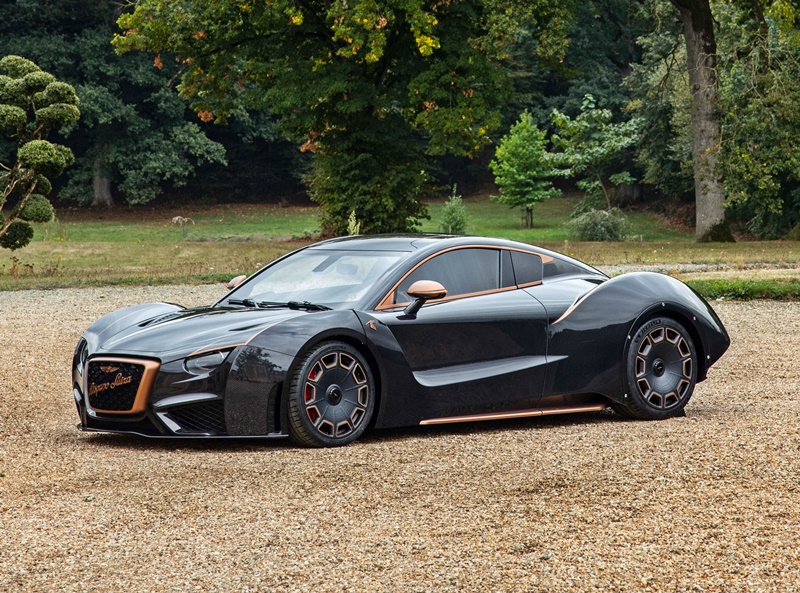
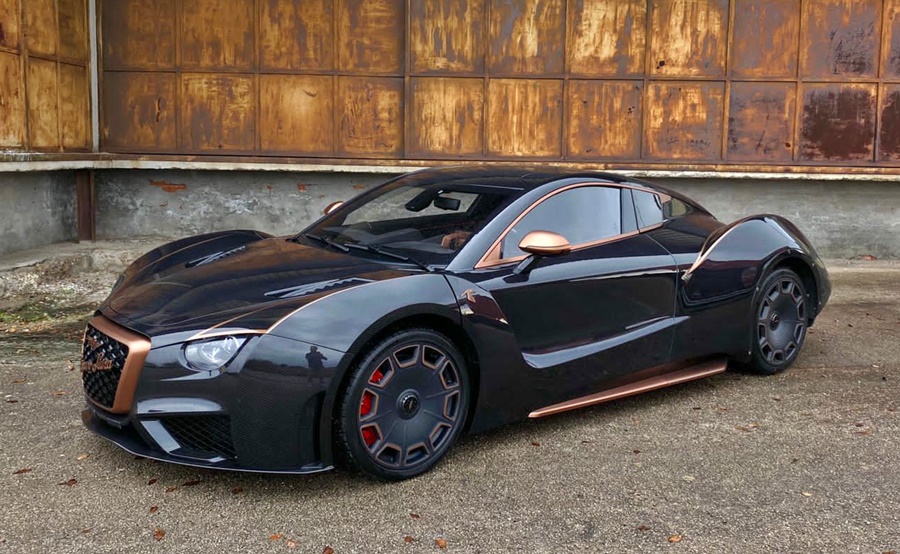
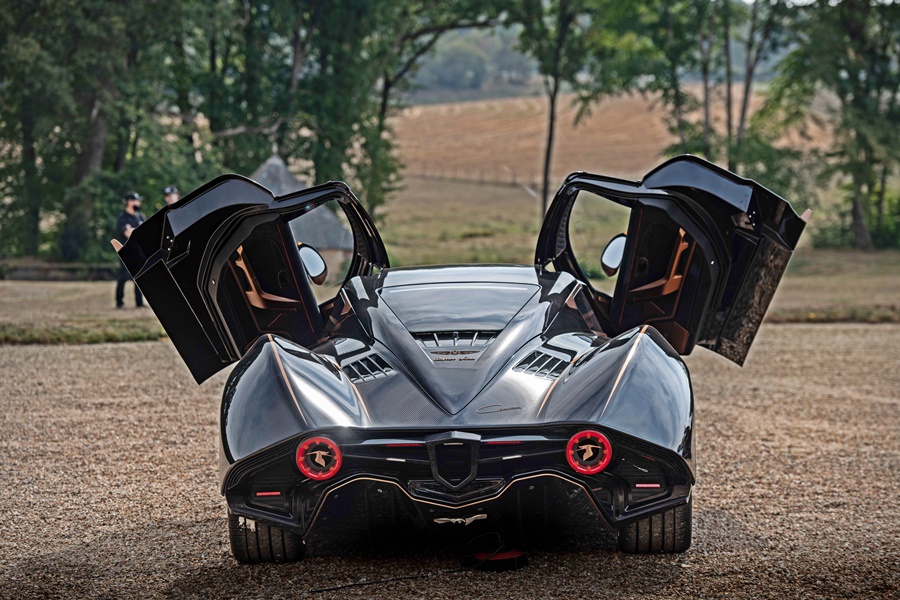
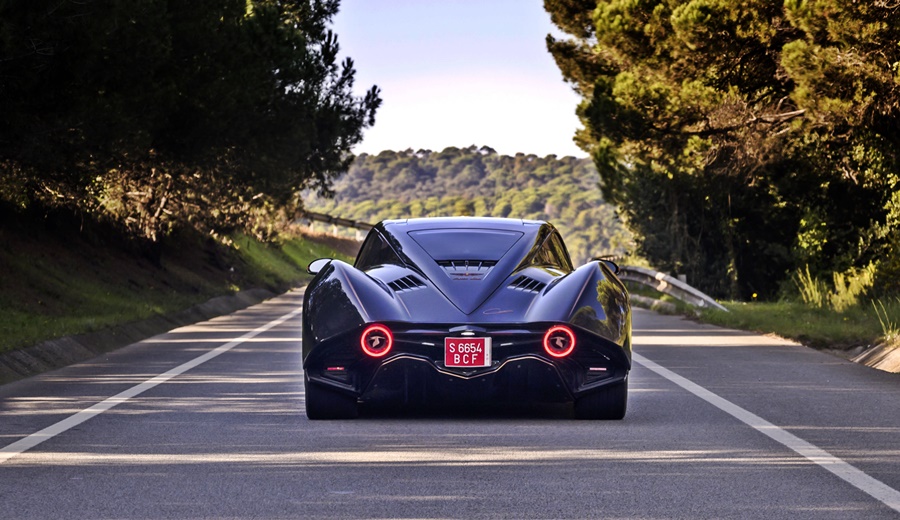
Hispano Suiza, the Spanish manufacturer with a history going back to 1904, has launched a second model as a follow-up to its Carmen all-electric hypercar which debuted last year. The new model is the Carmen Boulogne, a sportier evolution of the Carmen, and it also fully electric.
The current plan is to build only 5 units for sale, each priced from 1.65 million euros (about RM8.2 million) and take approximately 12 months to complete. 14 units of the Carmen will be available, with the first unit to be delivered in 2022.
A name from 1921
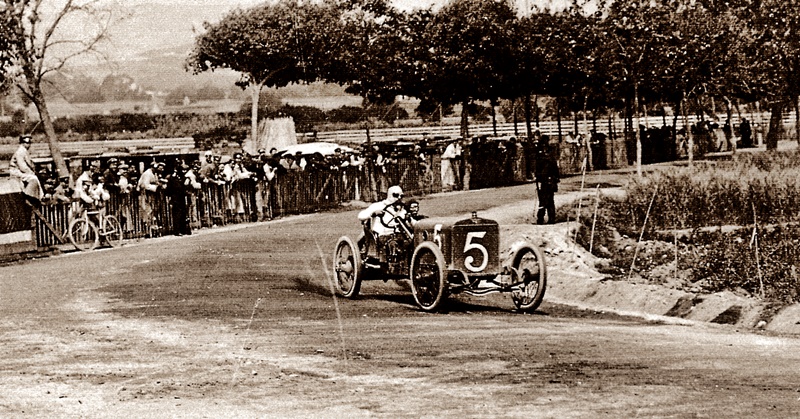
The ‘Boulogne’ name dates back to 1921, when Hispano Suiza made a racing version of its high-performance H6 Coupe and entered it in the George Boillot Cup, an endurance race lasting more than 3½ hours around the French city of Boulogne. There, Hispano Suiza achieved three consecutive victories with its H6. The Carmen Boulogne pays tribute to these historic motorsport victories
Its powertrain produces 1,114 ps – 95 ps more than the Carmen – and it can go from 0 to 100 km/h in a claimed 2.6 seconds, with a maximum speed limited to 290 km/h. Its weight of 1,630 kgs is 60kgs less than the Carmen, achieved by optimisation of structural elements such as the suspension and carbonfibre subframe. There are also new CNC parts and a carbonfibre roof, among other things.
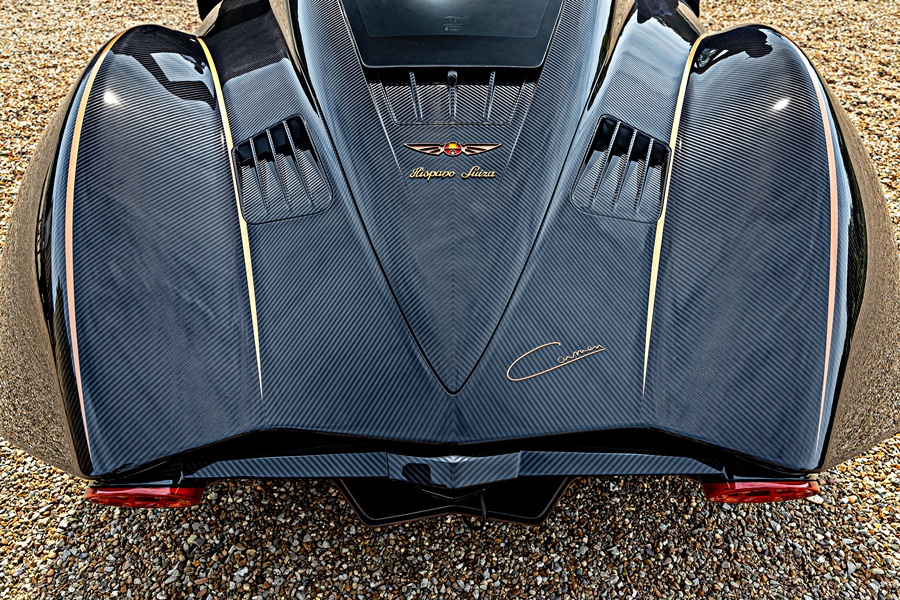
Visible carbonfibre bodyshell
The entire carbonfibre bodyshell of the Carmen Boulogne is visible under a clear varnish that emphasizes its sportiness and preserves the timeless elegance of this model. It sports the same semi-circular headlights and aggressive ‘scowl’ as the Carmen, with the difference of an imposing copper-coloured grille.
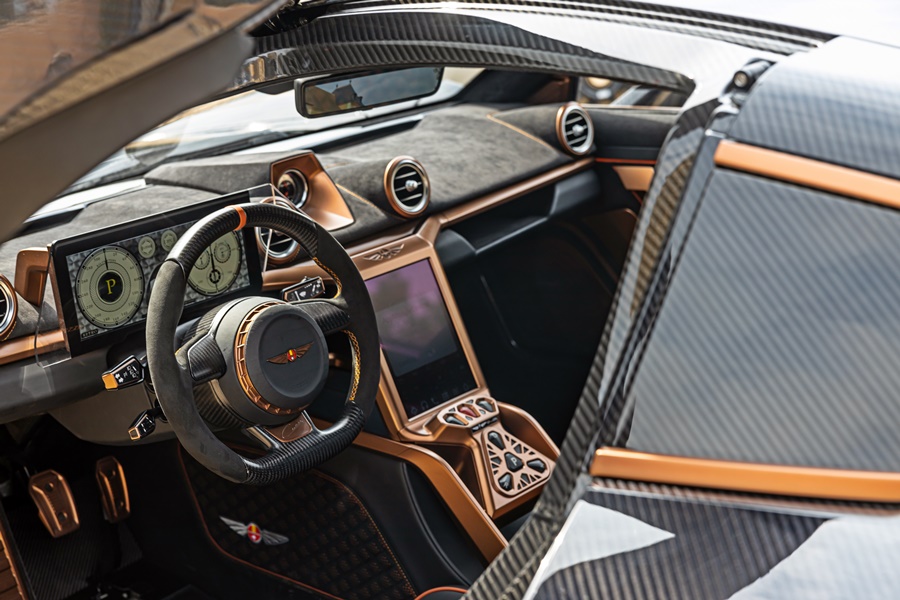
The five customers can fully customize the model with the assistance of the brand’s ‘Unique Tailormade’ department. The sleek interior features suede or black Alcantara on the bulkhead and door panels.
The Carmen Boulogne is powered by four permanent-magnet synchronous motors, two on each rear wheel. The torque of each engine is controlled through sophisticated vectoring systems developed in-house with the expertise gained in Formula E.
1,600 Nm of torque from standstill
From 0 to 6,500 rpm, the engines are capable of generating up to 1,600 Nm of torque, allowing for the sizzling acceleration. The lithium-ion polymer battery pack that provides ‘fuel’ has a capacity of 80 kWh and is claimed to enable driving range of up to 400 kms.
The batteries are designed and produced in-house, including a complete temperature control system to ensure that the cells can operate optimally. The fast-charging capability at more than 80 kW DC is said to require 30 minutes to charge 30 – 80%.
The 2021 Carmen hypercar gets its name from the founder’s daughter, with design inspiration from Hispano Suiza’s iconic 1930s design called the Dubonnet Xenia (top car).Hispano Suiza has a long history going back to the early 1900s and was a well known name in motor racing.
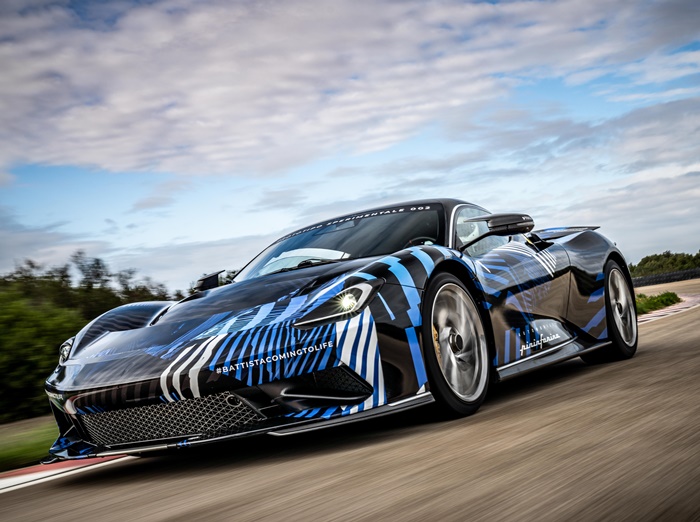
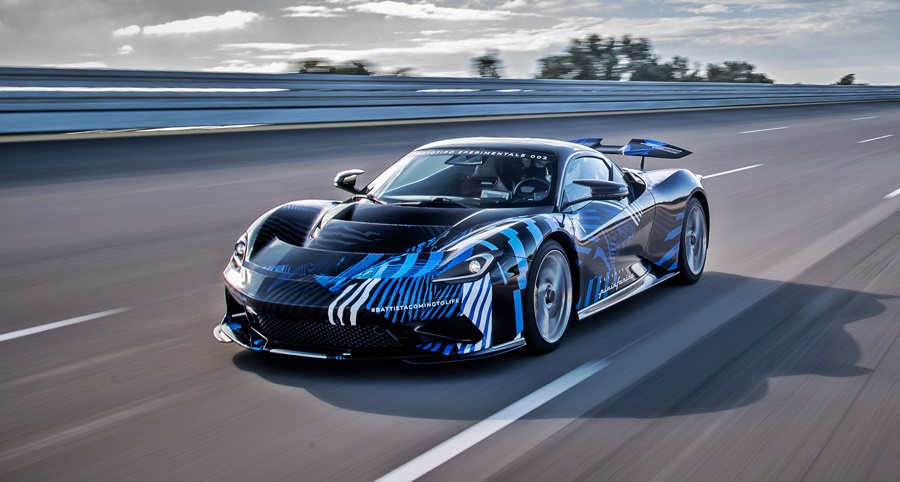
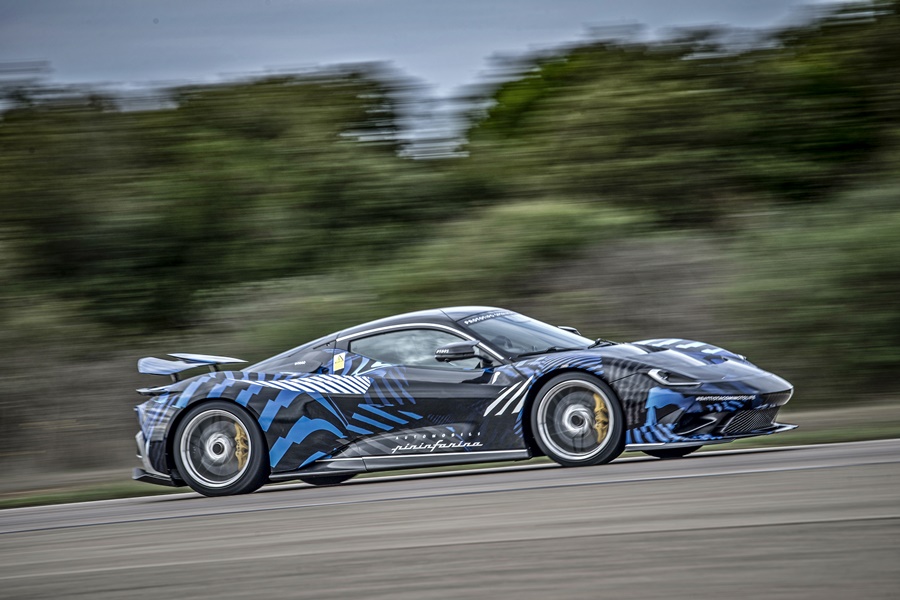
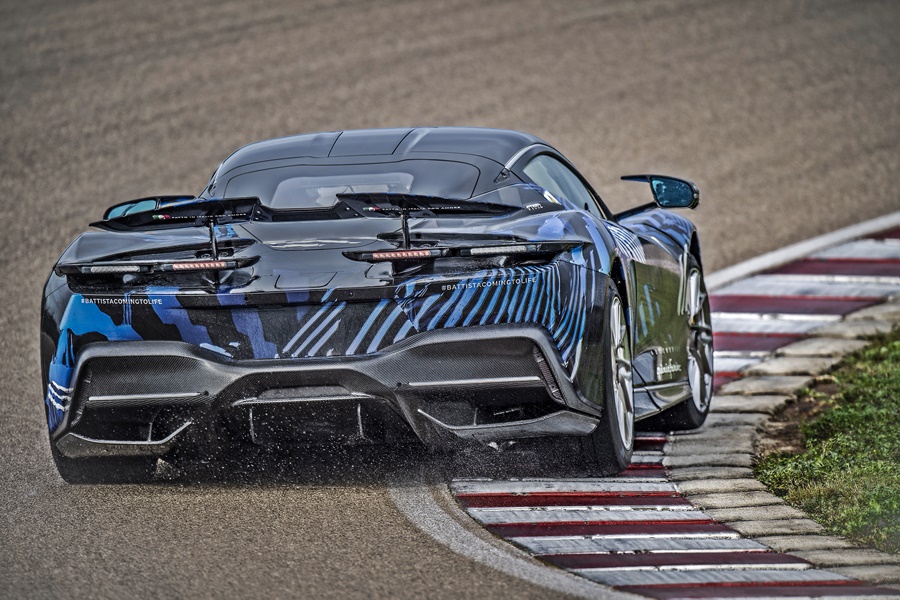
After all the computer simulations, wind tunnel studies and laboratory testing, the Pininfarina Battista all-electric hypercar is now starting its real-world testing. The first exercise has been a high-speed test run at the 12.6-km long track of the Nardo Technical Centre in Italy. Laps were also done on the laps of the twisting 6.2-km handling track.
This is a landmark moment and the successful test marks the beginning of the next chapter in the development programme of the most powerful Italian sports car ever produced. After this, there will be 9 test and validation versions driven on public roads and in private test facilities to fine-tune, validate and homologate its bespoke chassis settings, advanced torque vectoring system and unique sound experience.
The Nardo Technical Centre track in Italy where very high speed testing can be conducted.
“We have undertaken extensive development using advanced simulation technology, and we can now fine-tune the calibration of Battista’s bespoke chassis and pioneering four-motor torque vectoring system on road and track,” said Automobili Pininfarina’s Chief Product and Engineering Officer, Paolo Dellacha.
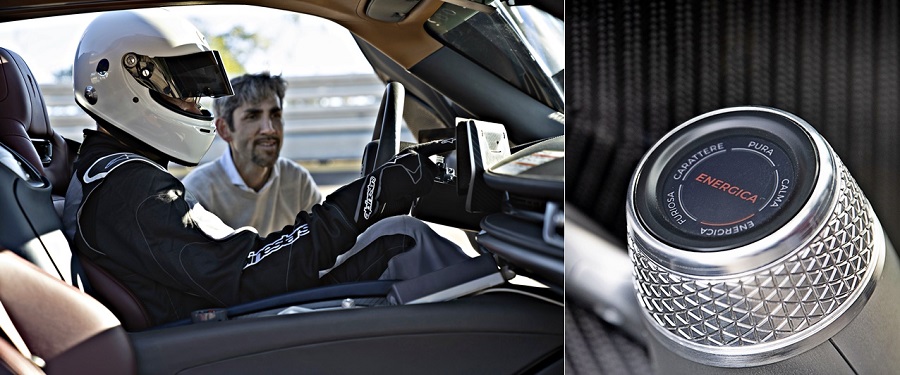
The Battista’s 120-kWh battery pack provides electrical power to 4 electric motors – one at each wheel – for a combined power output of 1,900 ps and maximum torque of 2,300 Nm. Its advanced powertrain is able to intelligently distribute power between all four wheels for optimised traction in all conditions. Five unique driving modes (Calma, Pura, Energica, Furiosa and Carattere) allow customisation of characteristics to driver preference or conditions.
“The phenomenal performance potential of the Battista is clear. Our clients will never have experienced acceleration like this before, yet giving them the opportunity to tailor their experience using a range of drive modes means this hypercar offers much more than just speed thrills,” aid the company’s Test Driver and Vehicle Dynamics Manager, Georgios Syropoulos.
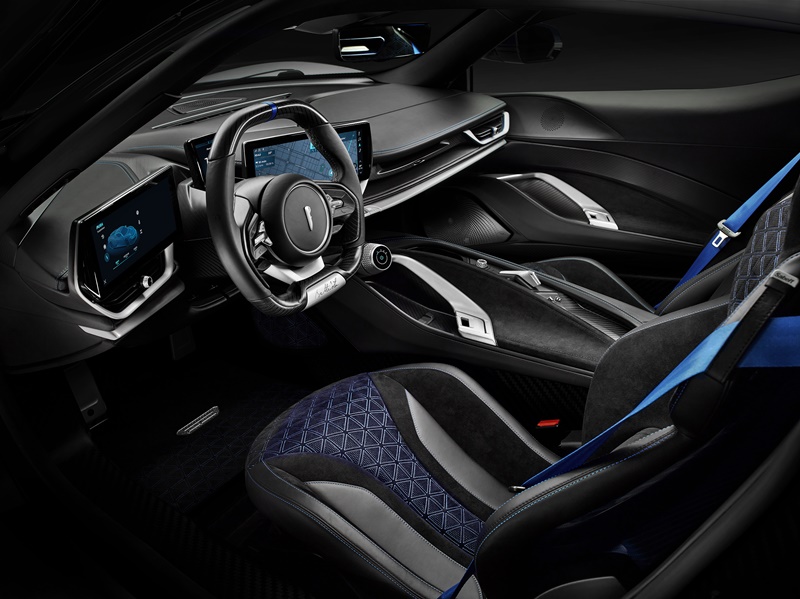
The prototype Battista tested at Nardo Technical Centre was not a stripped-down development mule. Within its carbonfibre bodyshell, it had a fully finished interior complete with luxuriously executed detailing so the engineers could assess every element of the car.
Tailored driving experience
During the testing, the engineers carried out tuning of the advanced racing-inspired Brembo CCMR carbon-ceramic brake technology. Work will focus on blending its operation with the high-speed aerobrake and energy recuperation system for optimum performance.
The 4-motor torque vectoring will be uniquely tuned to suit the characteristics of the Battista in all conditions. Energy-neutral torque vectoring will be optimised to recuperate and shift electrical energy seamlessly for enhanced range and efficiency.
After around 1,000 of hours of virtual dynamic testing; double-wishbone suspension components, forged aluminium wheels, torsion bars and elastokinematics will be evaluated and fine-tuned, taking maximum advantage of the Battista’s ultra-stiff carbonfibre monocoque.
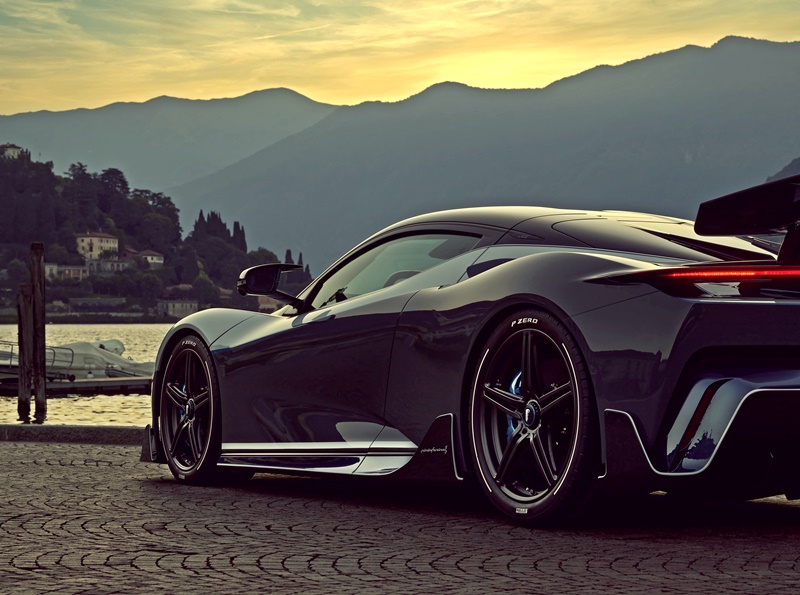
Customers will have a choice of 20-inch forged aluminium front and rear ‘Prezioso’ wheels and 20-inch front and 21-inch rear forged aluminium ‘Impulso’ wheels, with a saving of 8.9 kgs in unsprung mass across all wheels. High-performance Michelin Pilot Sport Cup 2R or Pirelli P Zero will be available on request.
Quicker acceleration than F1 cars
Customers who receive the first hypercars and put them to the test should be able to accelerate from 0 – 100 km/h in under 2 seconds. That promised performance is quicker than a current Formula 1 car. For those who can find a place to get up to 300 km/h, the time claimed from 0 to 300 km/h is less than 12 seconds, with a top speed of 350 km/h.
The fully electric hyper GT is the realisation of the company founder’s dream to see a car produced wearing the Pininfarina name. No more than 150 examples will be available, each priced from US$2.5 million (about RM10.2 million) at the time the prototype Battista was unveiled in April 2019.
Click here to read more about The World’s First Globally-Connected Hypercar
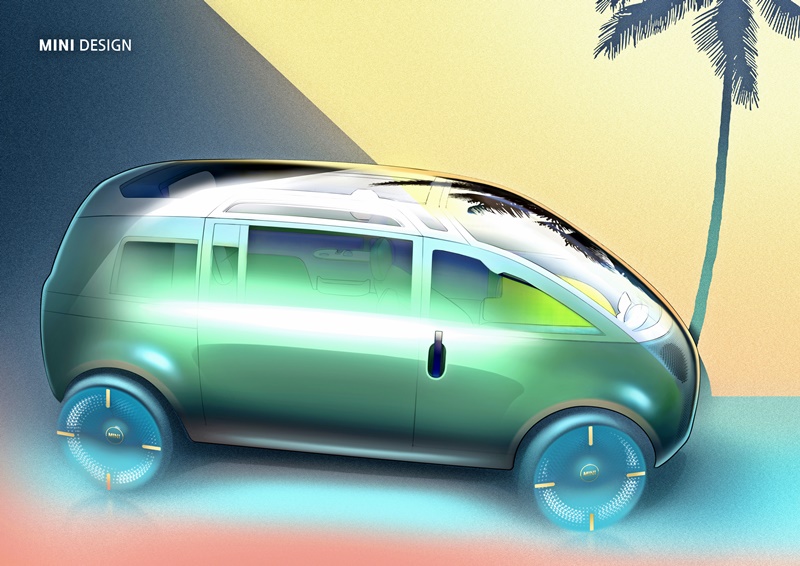
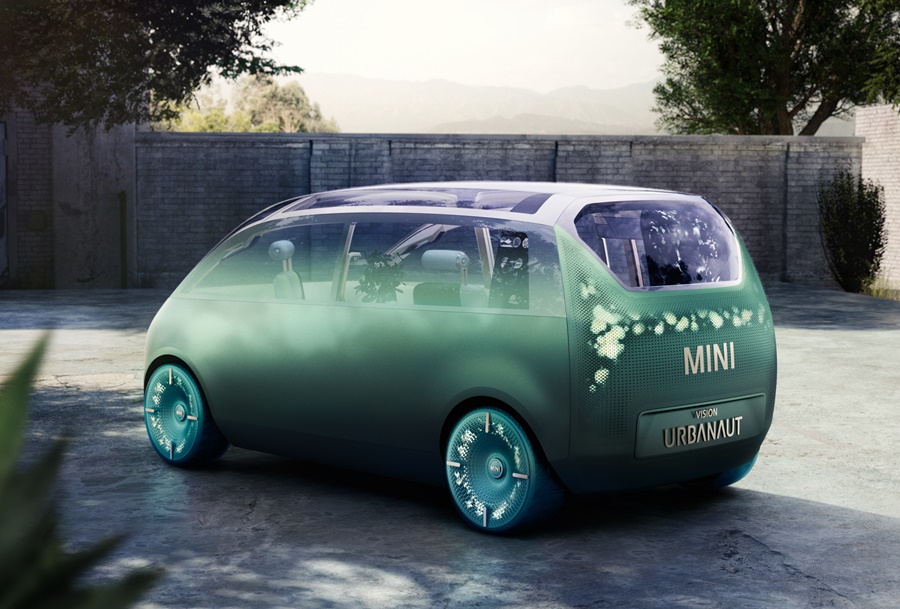
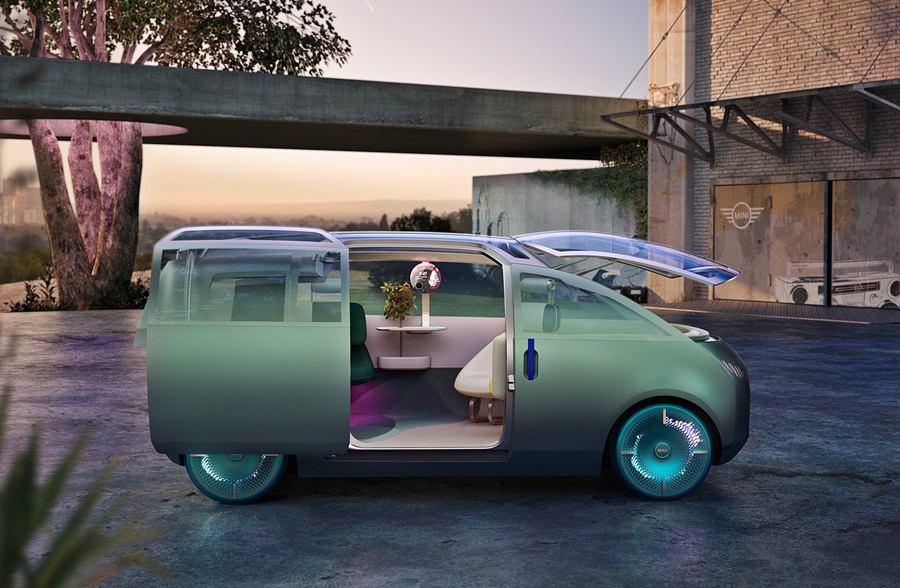
Tomorrow’s MINI will continue to have its practical minimal footprint but offer yet more interior space and versatility. To preview some of the ideas that MINI designers are exploring, the brand used the BMW Group’s #NEXTGen event to present the MINI Vision Urbanaut concept.
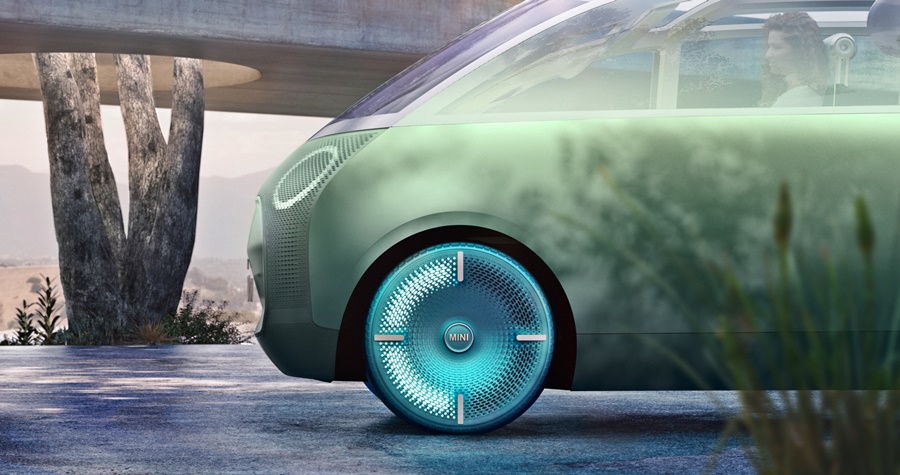
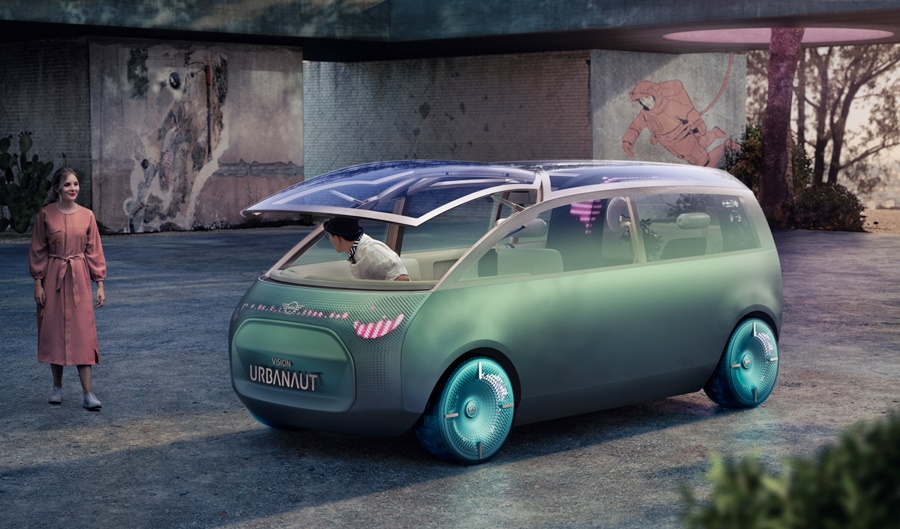
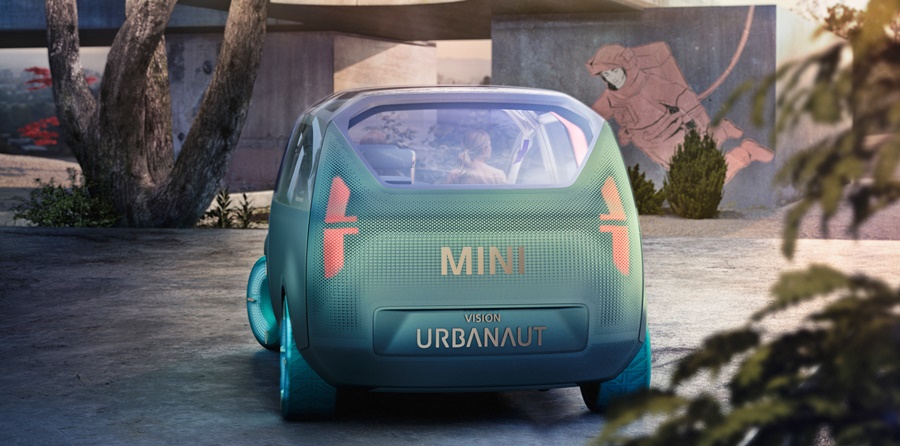
The purist mono-volume design of the Vision Urbanaut gives new meaning to the ‘Creative Use of Space’ approach. In signature MINI fashion, the wheels are positioned at the outer corners of the body, with short overhangs rounding off a compact and agile appearance.
In fact, the wheels are used as visual highlights of the concept car. Finished in the colour Ocean Wave, a turquoise blue which sparks associations with the beach and the sound of the sea, the abstract Union Jack profile of the wheels reminds one of the British heritage. Their shape recalls skateboards, further highlighting the car’s nimbleness and non-conformist MINI twist.
Evolution of MINI design elements
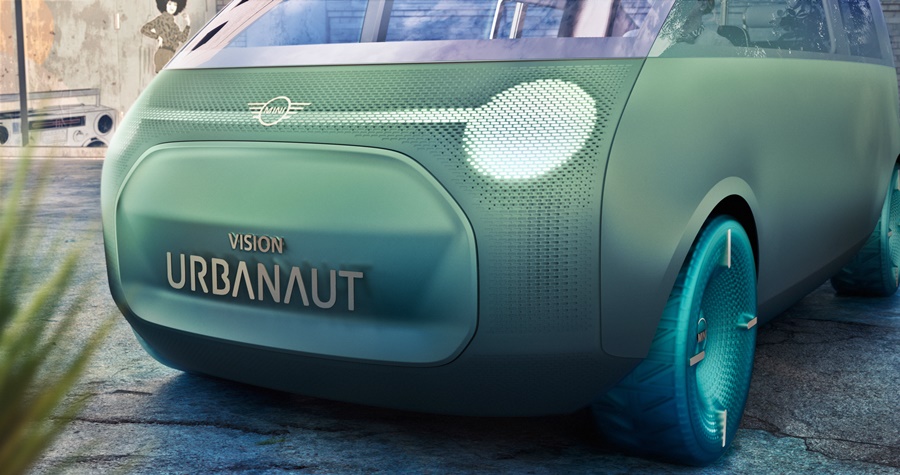
The front end represents a clear evolution of two time-honoured MINI design icons – the headlights and radiator grille. Positioned under a milled aluminium structure with slotted openings, the headlights are only visible when switched on. Thanks to their multicolour dynamic matrix design they can display different multi-coloured graphics, which creates a new form of communication between the car and the outside world.
The enclosed grille itself is octagonal in shape, representing an evolution of the traditional hexagonal form. Since the Vision Urbanaut does not have a combustion engine requiring cooling air, the grille assumes a new function as an ‘intelligence panel’ for automated driving.
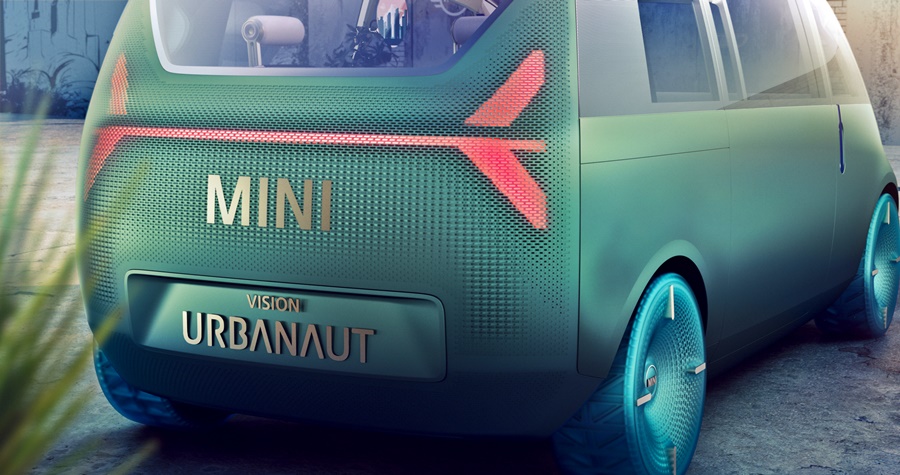
As with the headlights, multicolour dynamic matrix rear lights behind milled aluminium covers. The distinctive, convex surfaces also pay homage to previous MINIs and the classic Mini. One small detail – the contour of the rear windows – references the form of the front grille and underscores the car’s stylistic consistency.
The windows show a pattern in body colour, fading in a gradient from bottom to top. This creates a harmonious transition from the vehicle body to the windows and roof. The pattern also provides a certain amount of privacy without having to darken the windows; the interior remains bright.
Designed from inside out
As an innovative space concept, the Vision Urbanaut was designed from the inside out. The designers created the spacious interior experience before developing the exterior, using floor plans, pieces of furniture plus wooden scale models to provide an indication of size. Over the course of the project, augmented reality was employed to create a digital model, which was then systematically optimised.
Unusually tall for a MINI, but only 4.46 metres in length, the Vision Urbanaut provides an interior space that can be used in many different ways and offers a whole new ease of movement inside the car.
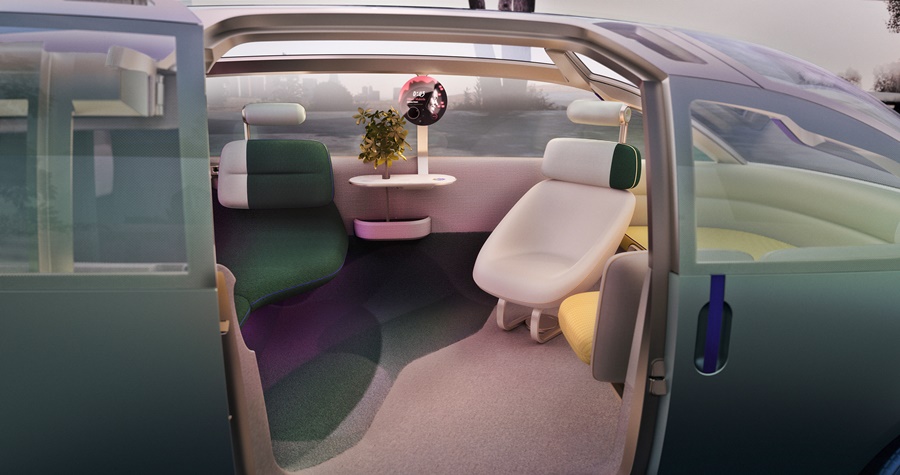
The interior thus provides the ideal environment in which to go on a journey but is also the aim of the journey. Having arrived at the chosen destination, it can transform into a living room in just a few simple steps. Occupants enter the innovative cabin through a large sliding door in the side of the car. The cutting-edge slide and swivel mechanism is the ideal design for urban driving conditions where space is at a premium. There are no other doors on the driver’s side or front passenger side.
Extremely variable layout
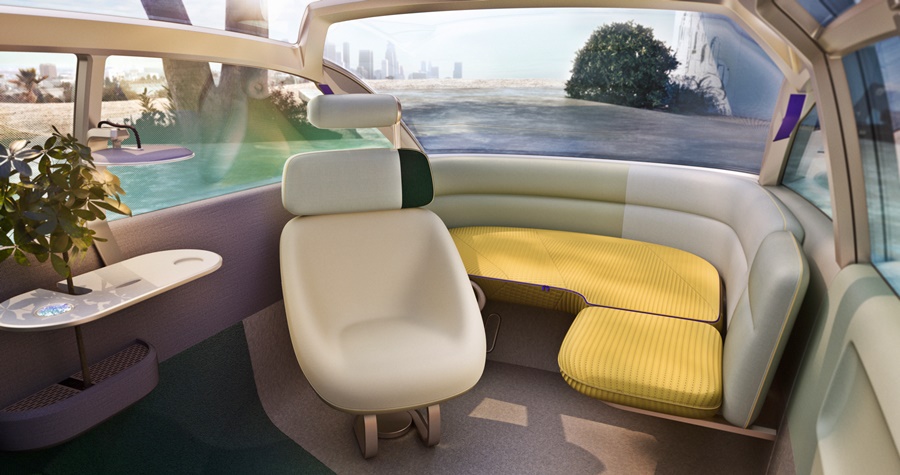
An extremely variable 4-seat layout provides the basis for the bright interior. The two front seats are designed to rotate, while the backrests for the generously sized seat surface in the rear can be folded manually (left rear seat) and turned around (right rear seat).
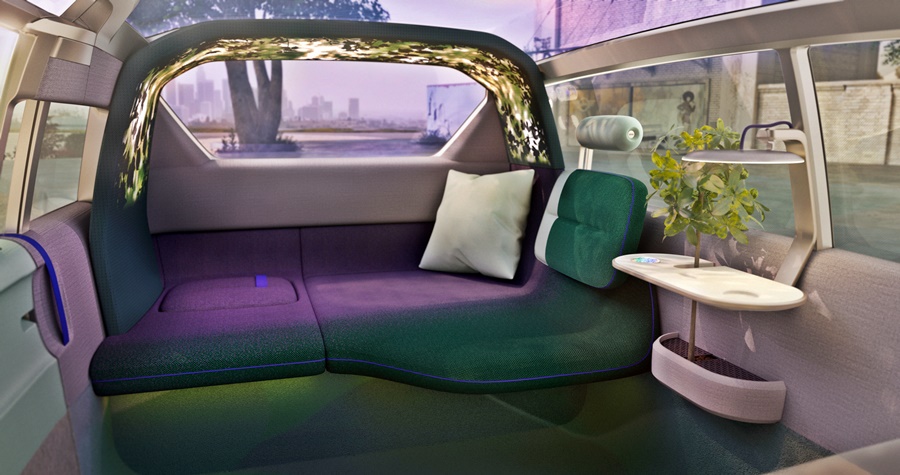
When the car is stationary, the dashboard lowers and the driver’s area becomes a comfortable seating corner – the ‘daybed’. Added to which, the windscreen can be opened upwards when stationary to create a kind of ‘Street Balcony’.
The darker environs of the cabin’s rear section provide a quieter space – the Cosy Corner. This area invites passengers to enjoy some time to themselves. With the door open, it is even possible to sit on the floor. A small integrated table is the car’s centre point, a place where passengers can interact.
The MINI Token is the centrepiece of the Vision Urbanaut’s experience worlds. It is roughly the same size as a worry stone and activates the three preconfigured MINI moments – Chill, Wanderlust and Vibe – when placed in purpose-designed slots in the table.
MINI Moments
“MINI sees its future self primarily as an enabler of and companion for unforgettable times – what we might call ‘MINI moments’. The MINI Vision Urbanaut uses three curated MINI moments – ‘Chill’, ‘Wanderlust’ and ‘Vibe’ – to present a wide range of possible usage scenarios,” said Oliver Heilmer, Head of MINI Design.
“The Chill moment, for example, invites you to catch a breath and pause in the here and now. The car becomes a kind of retreat, a haven where you can relax – or work with full concentration – during a journey. Wanderlust is the only MINI moment where the MINI Vision Urbanaut is being driven or driving with automated driving functions. The Vibe moment puts time with other people at centre stage – in every way,” he explained.
The exterior and interior change to reflect the MINI moment at hand. Even the wheels, transparent and illuminated from the inside, change their appearance according to the selected MINI moment.
All-electric powertrain, of course
Nothing is mentioned of the powertrain but, as would be expected, it is a pure electric drive which would use the BMW Group’s advanced technologies in electrified powertrains. Given more mention is the Vision Urbanaut’s responsible use of resources. As well as maximum space within a small footprint and the all-electric drive system, the Vision Urbanaut is committed to a responsible approach to materials. This is achieved not only by reducing the number of components in the exterior and interior design, but also by enabling dual functions such as the dashboard/daybed.
In addition to the use of recyclates, this also means ensuring that the design is free of chrome and leather while using recycled materials. The dominant material in the interior is knitted textile, and the use of cork on the steering wheel and sections of the floor adds a special touch thanks to its natural feel, and ensures an authentically pleasant interior climate.
The first widely recognised Car of the Year event (and perhaps the first one in the world too) was the European Car of the Year which began in 1964. Journalists from a number of countries in Europe collaborated to pick a model from each year’s new offerings as the Car of the Year (COTY), and the event continues to this day.
Since then, there have been numerous COTY events all over the world, some by publications and websites and some by motoring media groups. And there is even a ‘World Car of the Year’ award now although some models may be specific to certain regions.
For the country COTY, it was usually the case that a model from a brand of that country would be the winner. But in recent times, this has been changing: the Volkswagen Golf, for example, was the first foreign model to win the ‘Japan Car of the Year’ title while in Korea, a Toyota Camry was its COTY one year.
First time for a non-German model
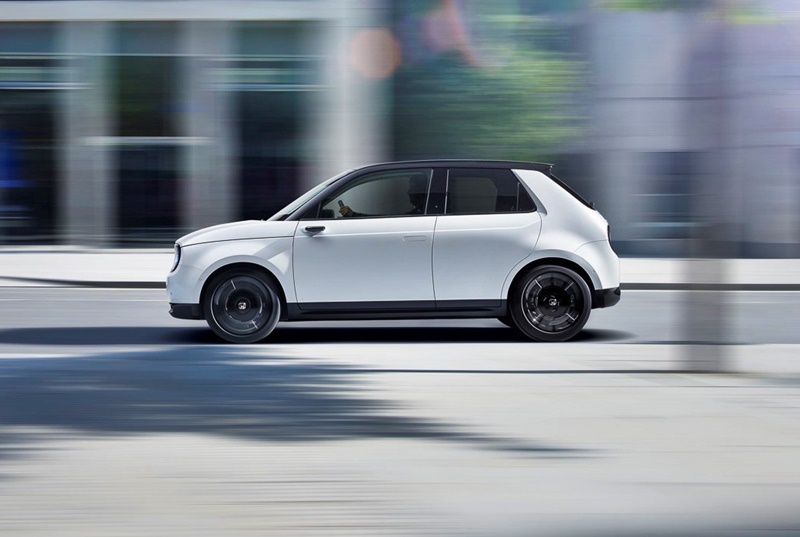
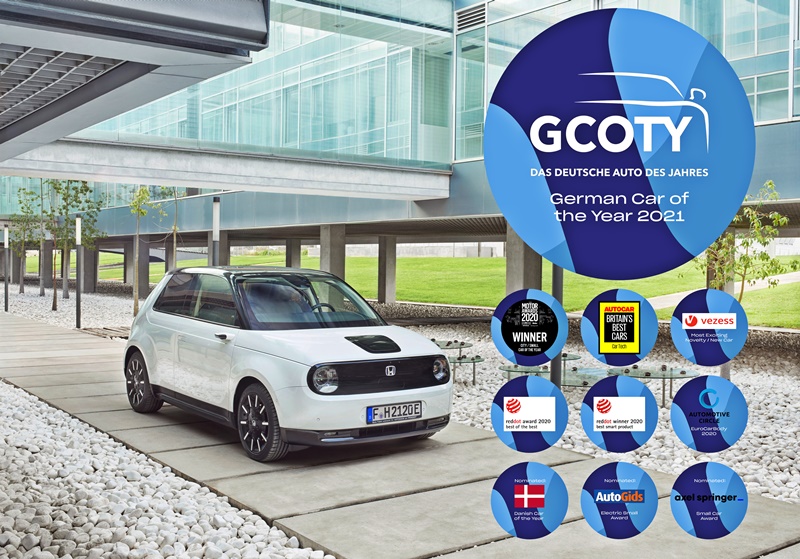
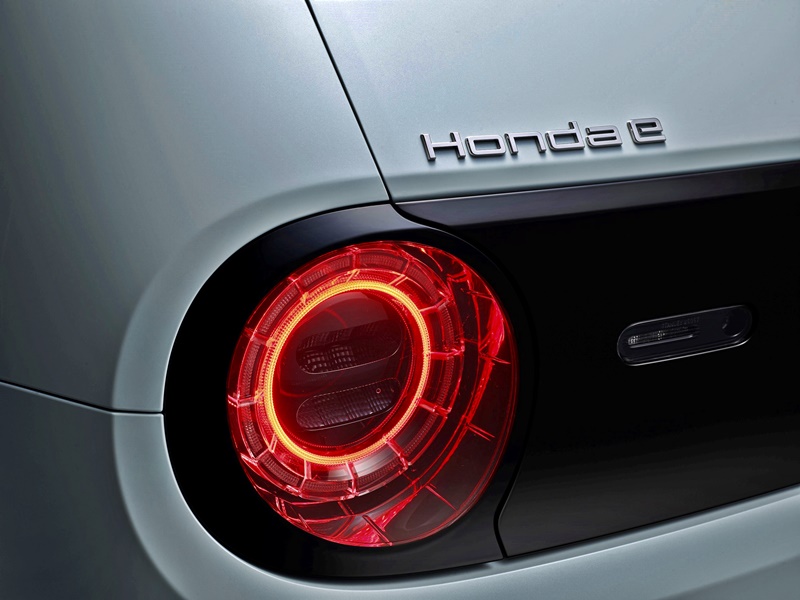
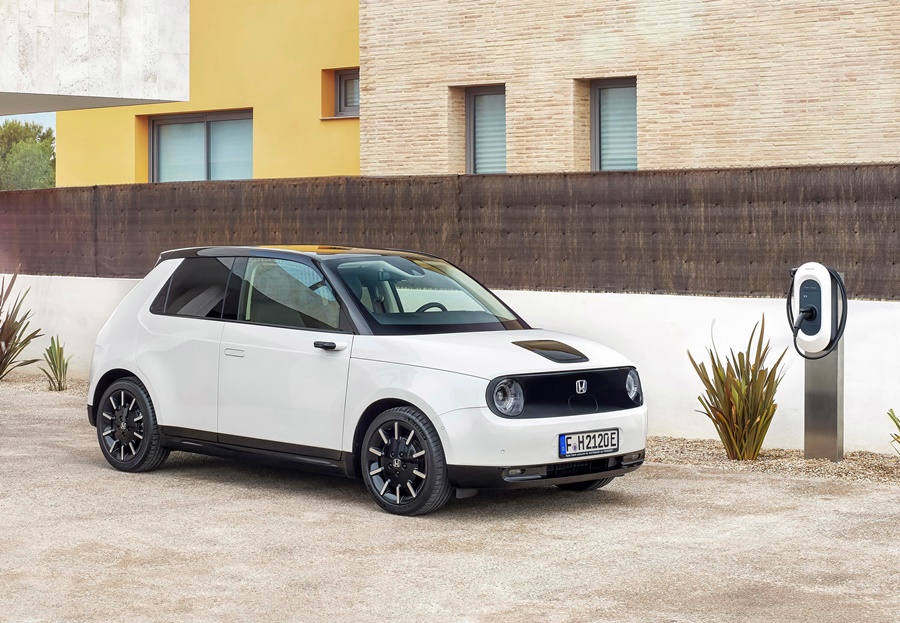
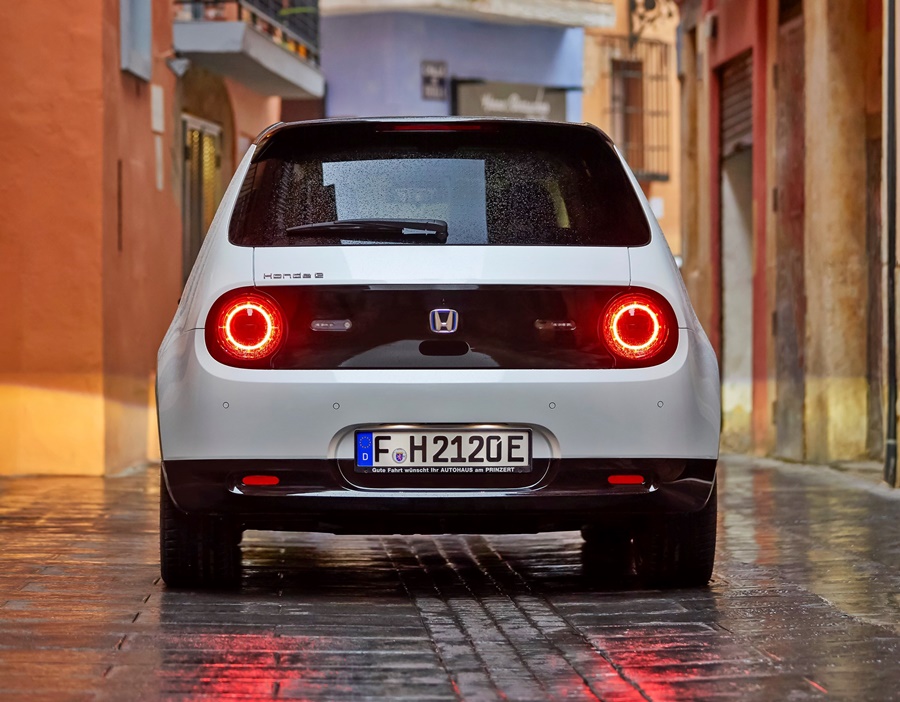
Now in Germany, a non-German model has been voted ‘German Car of the Year’ 2021. It’s the Honda e, the Japanese company’s first battery electric vehicle for Europe. This is a first and certainly an impressive achievement considering that the German auto industry produces many well engineered products. The Honda e also won in the ‘New Energy’ category.
The German Car of the Year awards are decided by a jury of leading German car journalists. The panel tests and reviews the latest cars, ranking them according to their usability, driving characteristics, market relevance and level of innovation. The winners of 5 categories – Compact, Premium, Luxury, New Energy and Performance – are then assessed again to decide an overall winner.
“For Honda e to be the first Japanese car to be awarded ‘German Car of the Year’ is a great honour, and one we are incredibly proud to receive,” said Katsuhisa Okuda, COO & President of Honda Motor Europe. “The Honda e is a perfect example of a product with a unique design, featuring cutting-edge technology and advanced intelligent connectivity to keep owners connected with their everyday life. We are very thankful for this award.”
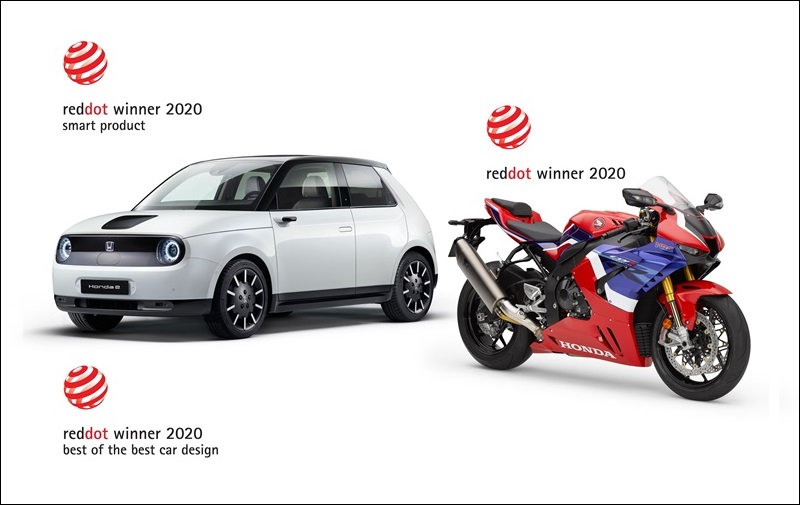
The electrically-powered Honda was launched earlier this year and is represents Honda’s commitment to electrify 100% of its mainstream models for Europe by 2022. The German COTY award is just one of many accolades it has received in 2020. These include the top honour in the Red Dot Design Awards; Autocar UK’s ‘Britain’s Best Car’ Awards 2020 in the ‘Best Car Tech’ category; and ‘City/Small Car of the Year’ in the News International Motor Awards 2020.
222-km range, 30 minutes recharging
The Honda e has a powertrain producing up 100 kW (equal to 136 ps) or 113 kW (154 ps) with 315 Nm of torque. With a 35.5 kWh lithium-ion battery pack that can be recharged to 80% in 30 minutes, it has a claimed range of up to 222 kms, depending on driving conditions.
There are two variants of the model which is currently only sold in Europe and Japan. Prices in the UK range from £27,160 to £29,660 (about RM147,370 – RM161,000). The prices include a UK government Plug-in Car Grant discount amounting to £3,000 (RM16,300) for the model.
Visit www.honda.com.my to know more about Honda’s electrified models available in Malaysia.