Ever since the pneumatic tyre was invented, motorists have had to live with the possibility of the air inside leaking out due to being punctured by a nail or damage from hitting a pothole. Loss of air pressure, which is what keeps the tyre in its hard shape to roll along, means the tyre cannot be used and has to be replaced. Not something you want when you are on the way to a meeting or a holiday resort.
Various solutions have been developed over the years which try to keep the tyre usable even when the air is gone. Run-flat tyres are capable of continuing even when deflated, though at limited speeds and for a limited distance. Obviously, they need to be replaced or repaired as soon as possible.
More specialised tyres for off-road use have flexible foam inside which can maintain the tyre shape even when air has leaked out.
Regenerating the tread
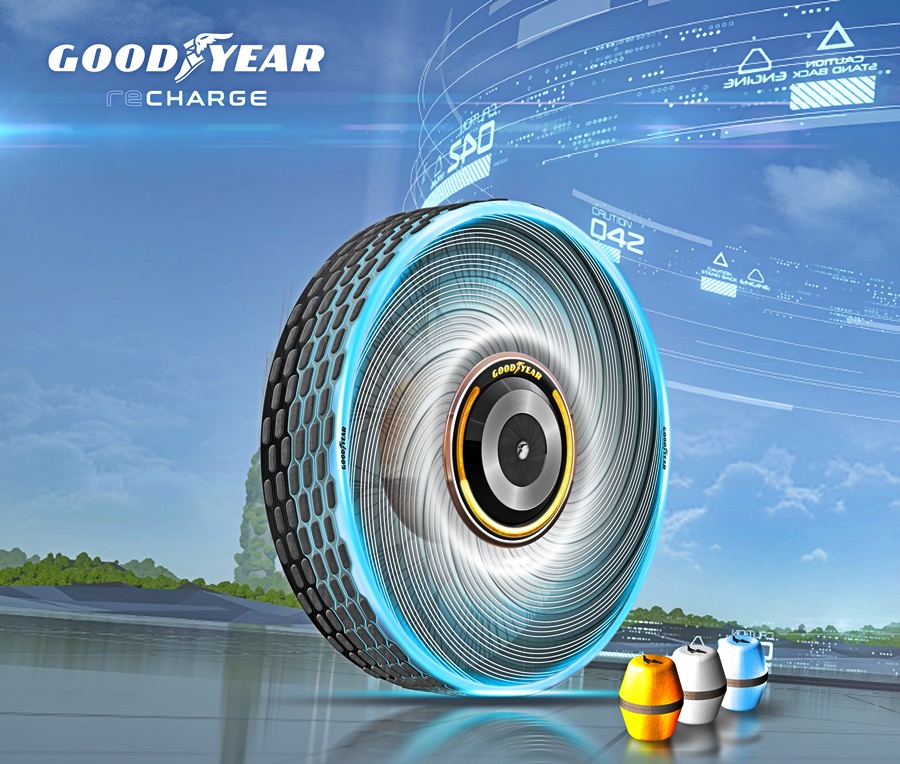
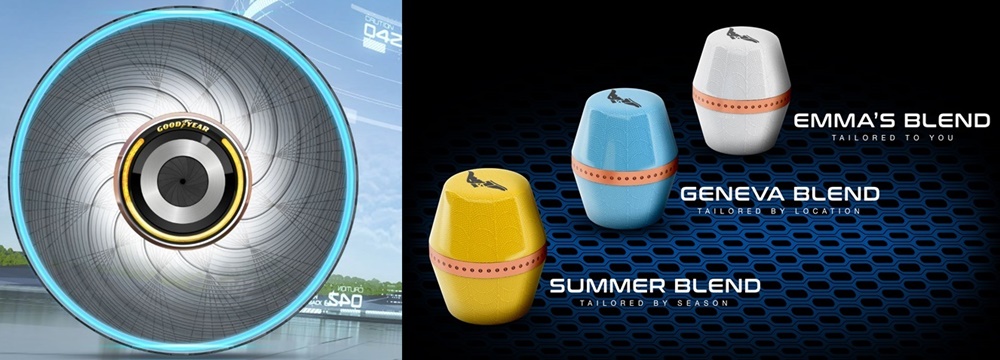
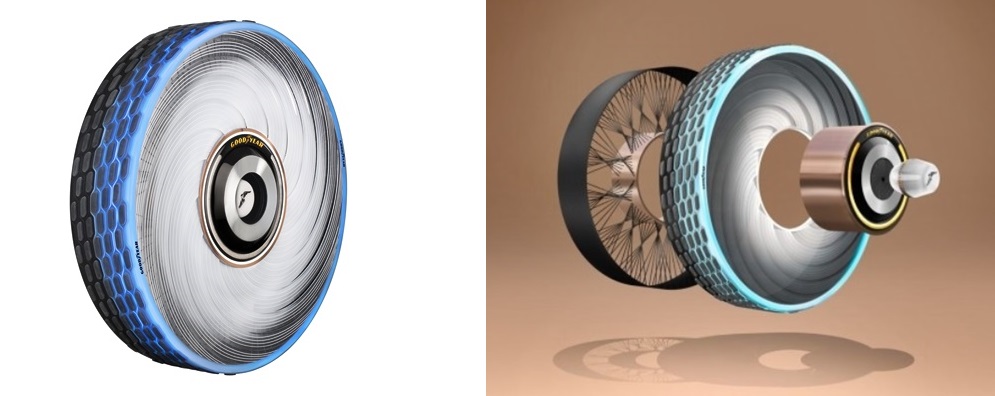
Now Goodyear is taking another approach with a prototype tyre it calls recharge. This is reloadable and has a tread compound that can be recharged with individual capsules, radically simplifying the process of replacing your tyres.
Filled with a customized liquid compound, these capsules allow the tread to regenerate and the tyre to adapt over time to climatic circumstances, road conditions, or simply how you want to travel. Thanks to artificial intelligence, a driver profile would be created around which the liquid compound would be customized, generating a compound blend tailored to each individual.
The compound itself would be made from a biological material and would be reinforced with fibres inspired by one of the toughest natural materials in the world – spider silk. This would make it both extremely durable and 100% biodegradable.
No maintenance needed
In addition to radically simplifying the process of replacing tyres using the rechargeable capsules, the tread would be supported by a lightweight, non-pneumatic frame and tall-and-narrow shape. This is a thin, robust low-maintenance construction that would eliminate the need for pressure maintenance or downtime related to punctures.
“Goodyear wants the tyre to be an even more powerful contributor to answering consumers’ specific mobility needs,” said Mike Rytokoski, Vice-President and Chief Marketing Officer, Goodyear Europe, “It was with that ambition that we set out to create a concept tyre primed for the future of personalized and convenient electric mobility.”
Recharge is just a concept for now although it could become one of the features of tyres of the future. Only thing is, if the tread can be regenerated, then the tyres doesn’t need to be replaced. That’s good for the environment but is it going to be good for company business?
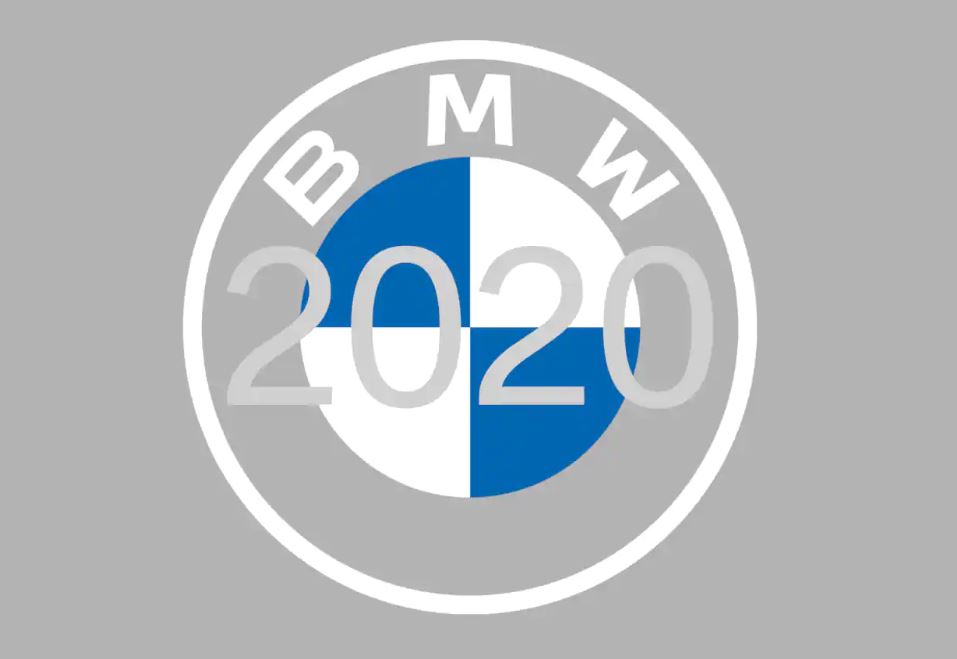
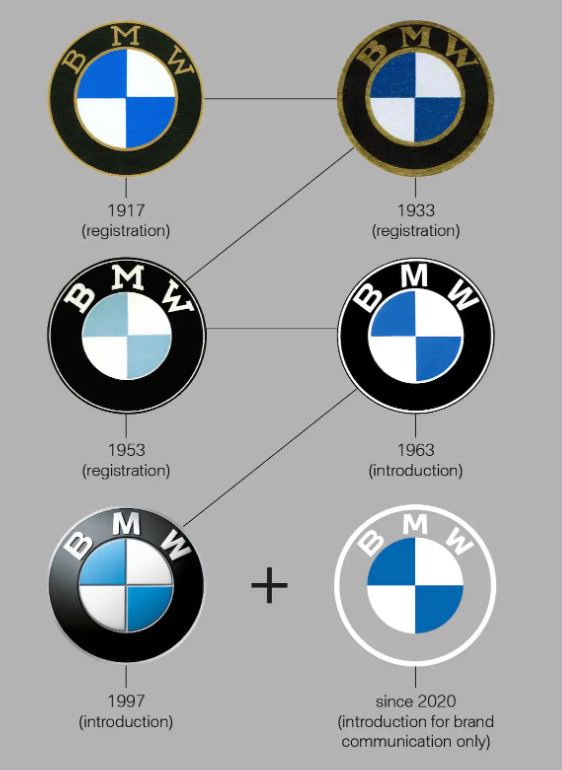
After more than 20 years, the BMW brand has a new corporate identity for online and offline communication purposes. The BMW, BMW i and BMW M communication logos have been completely reworked, with a new logotype and new design principles. According to the company, it has ‘the visual style of today and is better-suited to the digital age’.
The new design is described as an expression of the revised brand identity, which places the customer at the centre of all activities. More minimalist in a sense and two-dimensional, it conveys openness and clarity. The additional transparent version of the logo is a more open invitation than ever for customers to join the world of BMW. The change reflects BMW’s transition from centering purely on the automotive world to being about technology and connections.
The redesigned logotype expresses openness and strength of character to ensure a contemporary, future-proof presence both online and offline.
History of the BMW logo. Its design has always been linked to an aircraft propeller although this origin is a myth (and even BMW admits it).
The origins of the ‘BMW propeller’ design
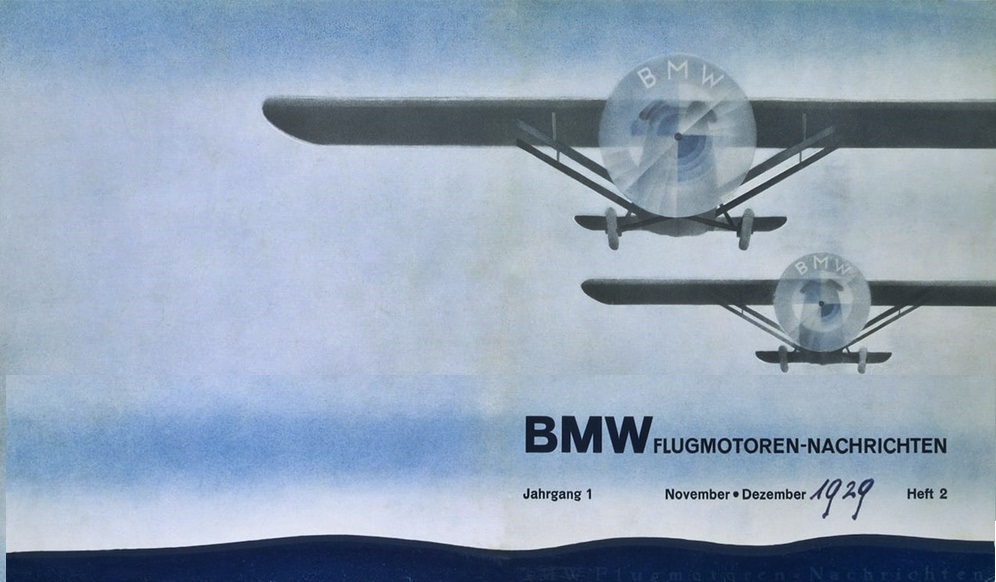
The fundamental elements of the BMW logo are its colours: white and blue, which are the colours of the state of Bavaria in Germany, home of BMW. The myth of the ‘BMW propeller’ actually began 91 years ago with aA BMW ad showing an airplane with the BMW logo in the rotating propeller. At the beginning of the global economic crisis, the ad was trying to promote a new aircraft engine that BMW was building under licence from Pratt & Whitney. The propeller interpretation fit very well into the advertising image of the young company, as it underlined the company’s roots and its expertise in aircraft construction.
Then, in 1942, BMW itself linked the propeller to its company symbol. An article appeared in a BMW publication called ‘Flugmotoren-Nachrichten‘ (Aircraft Engine News) which backed up the story of the BMW badge as a spinning propeller. The story was illustrated with a photo of the BMW logo overlaid on a rotating propeller.
“For a long time, BMW made little effort to correct the myth that the BMW badge is a propeller,” explained Fred Jakobs of BMW Group Classic. So according to the expert, sticking to the story that the BMW emblem is a propeller would not be entirely wrong. It’s not strictly true that there is a propeller in BMW’s company logo, though. Constant repetition has made this explanation a self-propagating urban myth. “This interpretation has been commonplace for 90 years, so in the meantime, it has acquired a certain justification,” Jakobs said.
New logo stands for openness and clarity
“BMW is becoming a relationship brand. The new communication logo stands for openness and clarity,” explained Jens Thiemer, Senior Vice-President for Customer and Brand BMW. “We want to use this new transparent version to invite our customers, more than ever, to become part of the world of BMW. In addition, our new brand design is geared to the challenges and opportunities of digitalization for brands. With visual restraint and graphic flexibility, we are equipping ourselves for the vast variety of touchpoints in communication at which BMW will be present, online and offline, in the future. This additional communication logo symbolizes the brand’s significance and relevance for mobility and driving pleasure in the future.”
The global launch of the new brand design starts this month and progressively up to May 31, 2021, it will begin to appear in all communications, on and offline, and for international trade fairs and events.
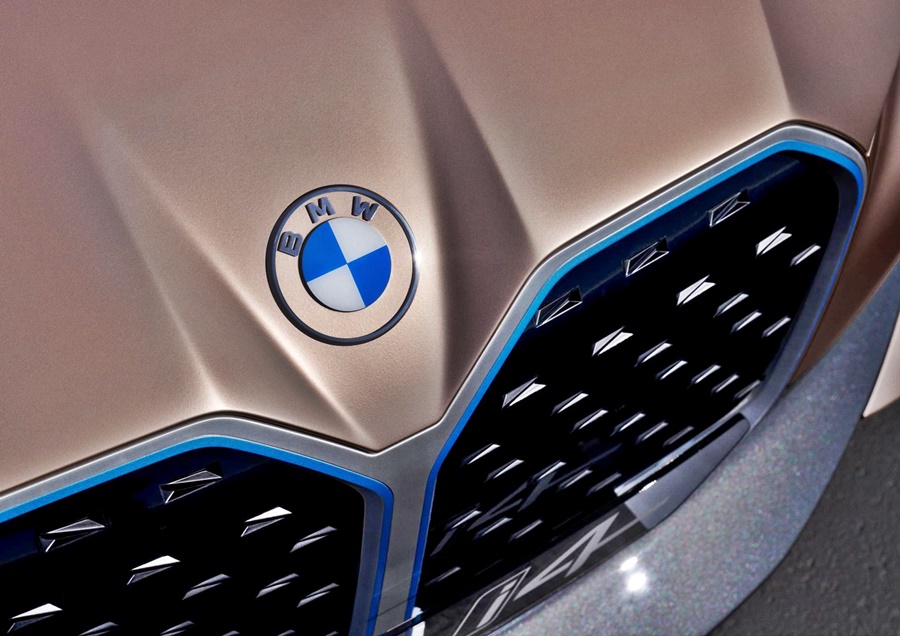
The new logo is intended for media communications and not for use on vehicles or dealership facilities, but it can be seen on the BMW Concept i4 unveiled recently.
BMW clarifies that the new logo is a new media branding and will be used in addition to the existing logo. It won’t be used on the vehicles or feature on the exterior and interior of dealerships. However, it seems that concept cars may use it, as evident in the BMW Concept i4 unveiled recently.
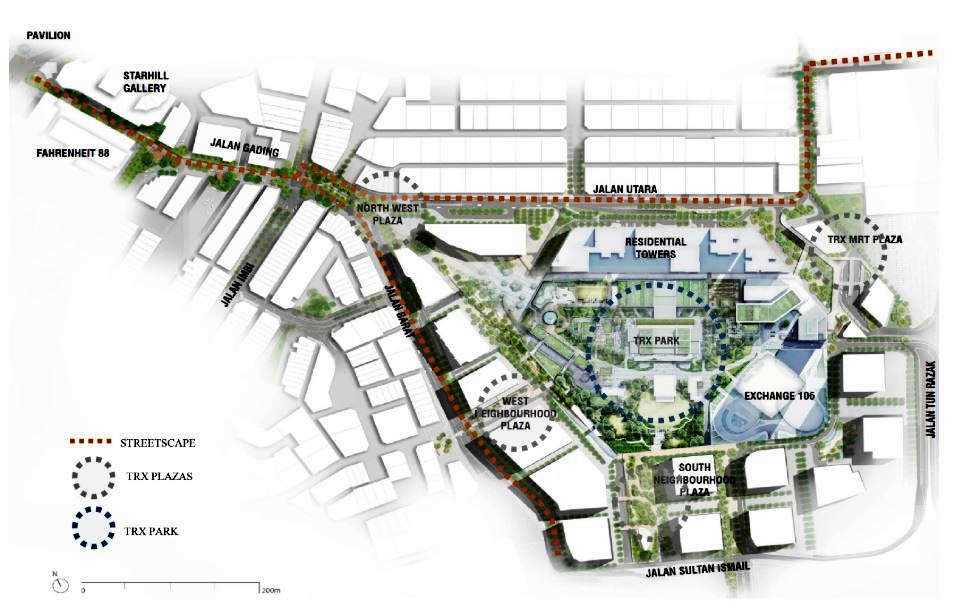
Waze, the popular GPS guidance app, has announced a new initiative at Kuala Lumpur’s Tun Razak Exchange (TRX) which will help drivers find their way around the 70-acre site. The initiative sees the installation Bluetooth-enabled hardware devices – called Waze Beacons – across TRX’s basement roads leading to carparks in the development which will have 30 buildings.
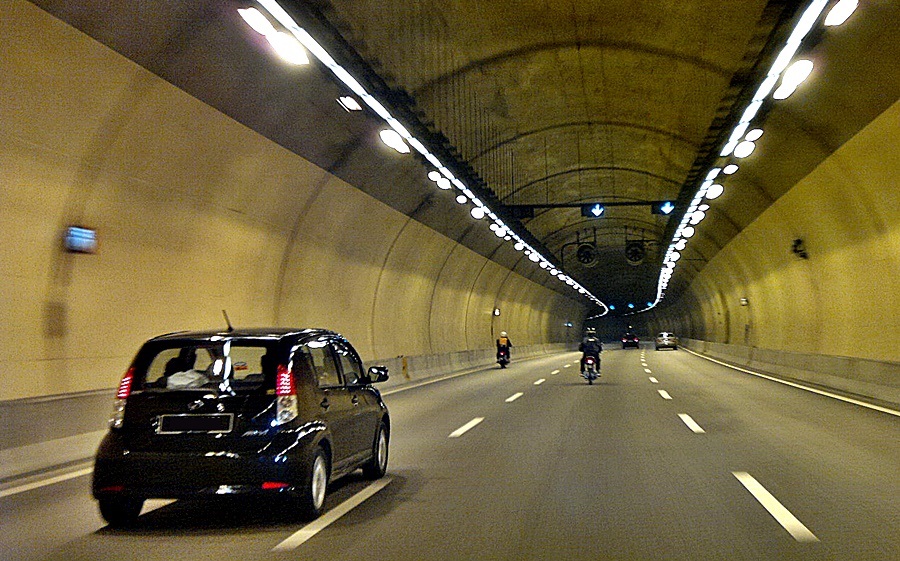
Under the 70-acre TRX site will be many roads leading in and out of the basement carparks.
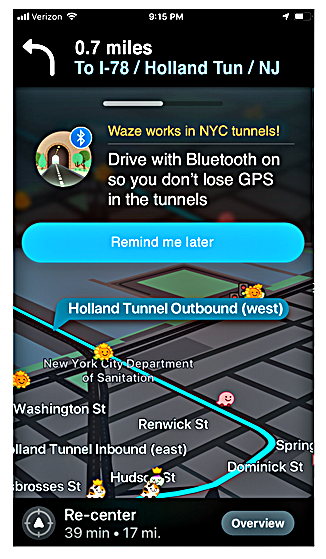
The collaboration between Waze and TRX City Sdn Bhd is the first program of its type in Southeast Asia. It will make use of Bluetooth connectivity underground and provide seamless navigation to drivers where there is limited or no GPS signal reception. This will help ensure better location services, increased driver safety, and better visibility of real-time traffic events while driving underground in TRX.
“We are thrilled to partner with Waze, to be the first in Southeast Asia to put Waze Beacons to the test. Our underground roads are an ideal test ground as they lead out to key exits, and we look forward to enhancing TRX’s level of services. Ensuring seamless connectivity is critical to support TRX’s status as an international financial hub.” said Dato’ Azmar Talib, CEO of TRX City.
“The Waze Beacons Program will help realise the TRX masterplan of making the district the best-connected address in Kuala Lumpur. The development will have direct access to major highways such as the SMART Tunnel, Maju Expressway (MEX) and the future Setiawangsa-Pantai Expressway (SPE), as well as connections to Jalan Tun Razak, Jalan Bukit Bintang and Jalan Sultan Ismail via many ingress and egress points,” Dato’ Azmar added.
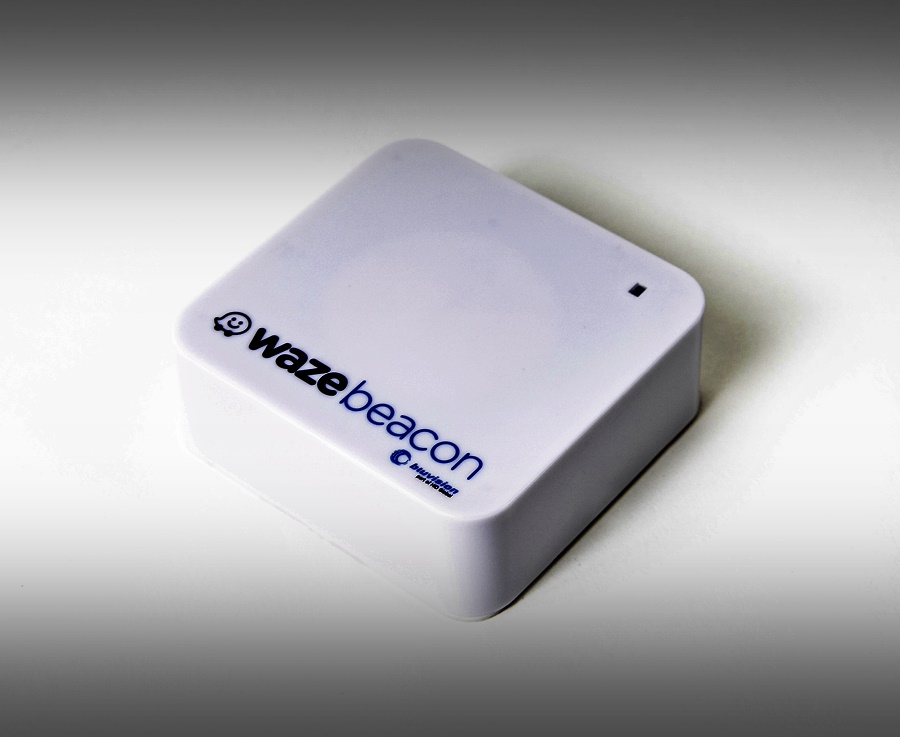
The Waze Beacons, installed and owned by TRX City, do not collect data and work by emitting a signal that can aid navigation apps (not only Waze), making it easier for drivers to navigate underground areas with multiple exits and roundabouts during periods of poor connection, and prevent traffic confusion and congestion. The signals are available for use by all developers looking to make it easier and safer to get around TRX. These installations will also serve as a pilot-scale project for other parts of Kuala Lumpur.
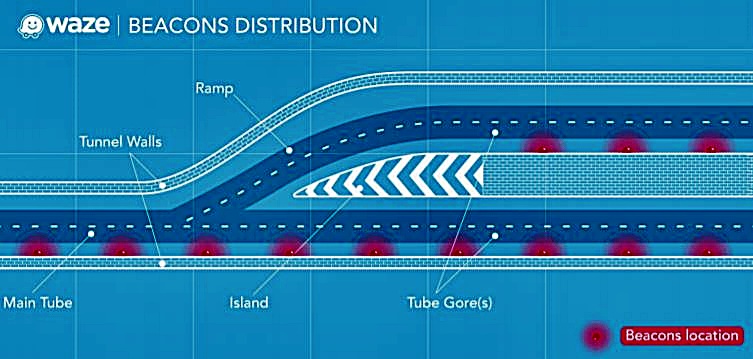
Waze’s collaboration with TRX has seen these devices installed across TRX’s Basements 2 and 3 which have up to 3 and 21 decision points, respectively, leading out to parking spaces, and various connecting roads and highways.
Waze Beacons are small units installed in the walls and send out signals using Bluetooth connectivity.With Waze Beacons emitting signals, route guidance will still be available even when there is no GPS signal underground.
Waze Beacons was launched in 2016 and has successfully been introduced in the USA, Brazil, France, Italy, Australia, Norway, and Czech Republic. In total, they are found in roughly 260 kms of tunnels and roadways worldwide.
“The Waze team and I are pleased to bring the Waze Beacons Program to Malaysia, the first Southeast Asian country to adopt the technology,” said Gil Disatnik, Head of the Waze Beacons Program. “Seamless navigation can be enjoyed in TRX when its underground roads are open to the public, but this is just the beginning and we hope to expand into more areas nationwide across Malaysia soon. No matter the navigation apps used, Waze Beacons technology is open and free to use, and we ultimately hope to empower road users to outsmart traffic together.”
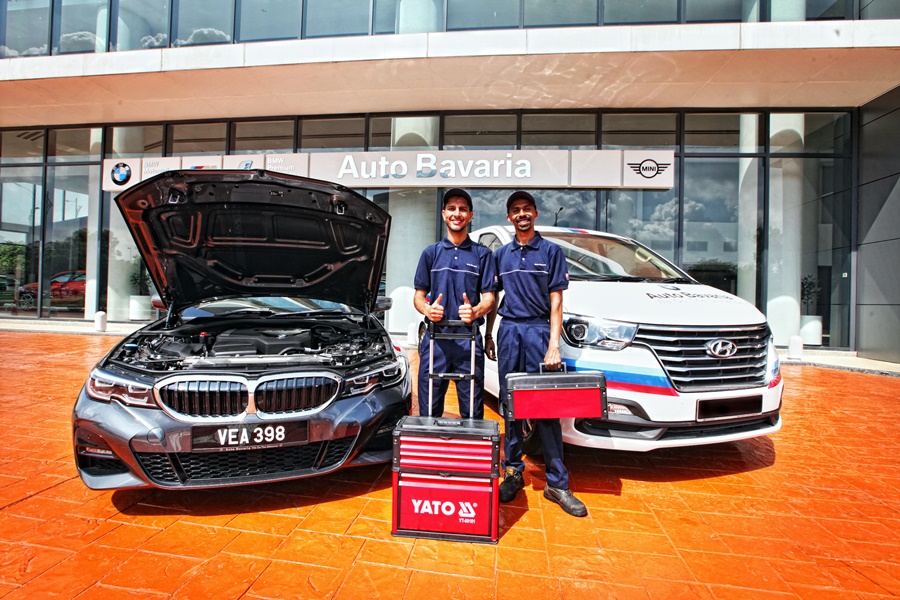
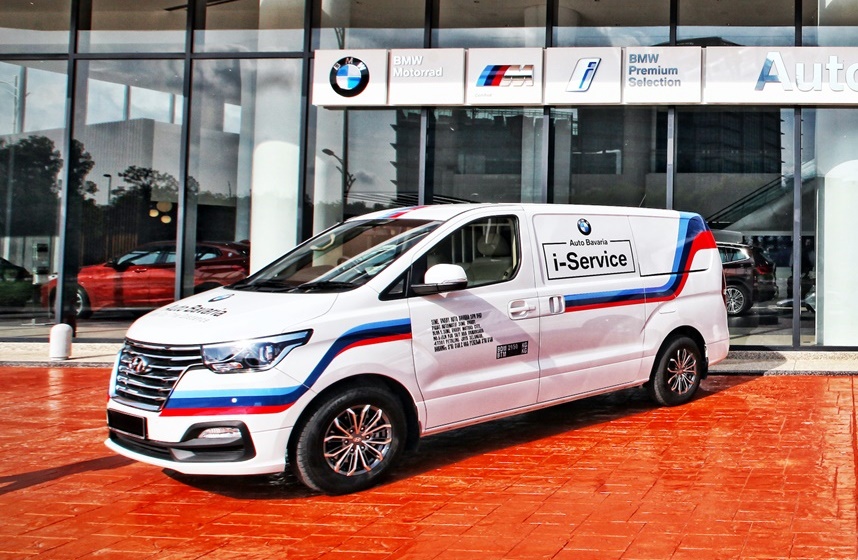
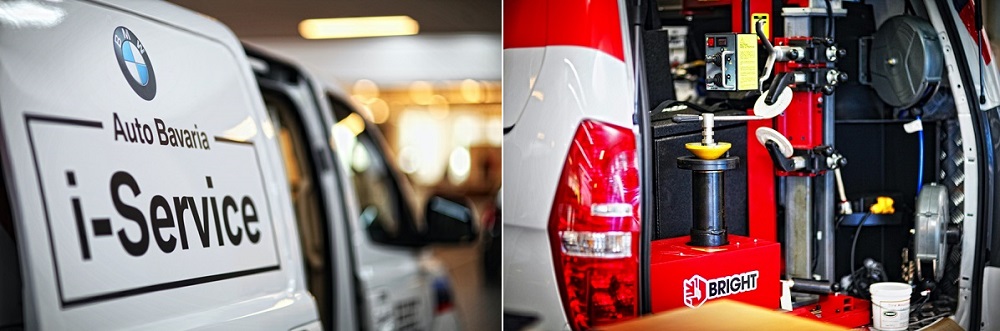
Authorised BMW dealership Auto Bavaria has launched a new service for customers which gives them the convenience of having their BMW vehicles at their doorstep. Said to be the first of its kind, the Auto Bavaria i-Service service can be requested through the company’s mobile application.
Additionally, using the app, owners can book service appointments, check their vehicle service history, view the service progress, and make payments. It also has a special ‘track & chat’ feature to track the location of the i-Service vehicle and chat with technicians to monitor the progress of their vehicle being serviced.
Customers can direct the i-Service vehicle to a location closest to them – be it at home or at the workplace within a 40-km radius from Auto Bavaria dealerships – to perform scheduled maintenance services. Such services include oil change, brake pad change, tyre change, and tyre balancing and battery change, saving them a trip to the service centre.
Every i-service vehicle is equipped with the latest tools and equipment and manned by experienced and qualified technicians. They carry BMW genuine parts which are needed as well.
Prior to any work commencing, customers receive cost estimates, including itemised costs for parts and labour beforehand. This ensures price transparency so that customers can make informed decisions about the maintenance of their vehicles.
Initially, there will be three i-Service vehicles catering to prime areas in the Klang Valley, with plans for expansion in the near future. The service is available from Mondays to Saturdays (except public holidays) during normal working hours.
“Quality, efficiency and innovation are the three cornerstones of our vision in providing first-class and uncompromising aftersales service to our customers. Auto Bavaria i-Service is a testament to our commitment in delivering greater convenience, innovative solutions and peace of mind when it comes to caring for the needs of our customers, and in preparing ourselves for the future of automotive ownership experience,” said the MD of Auto Bavaria, Vi Thim Juan.
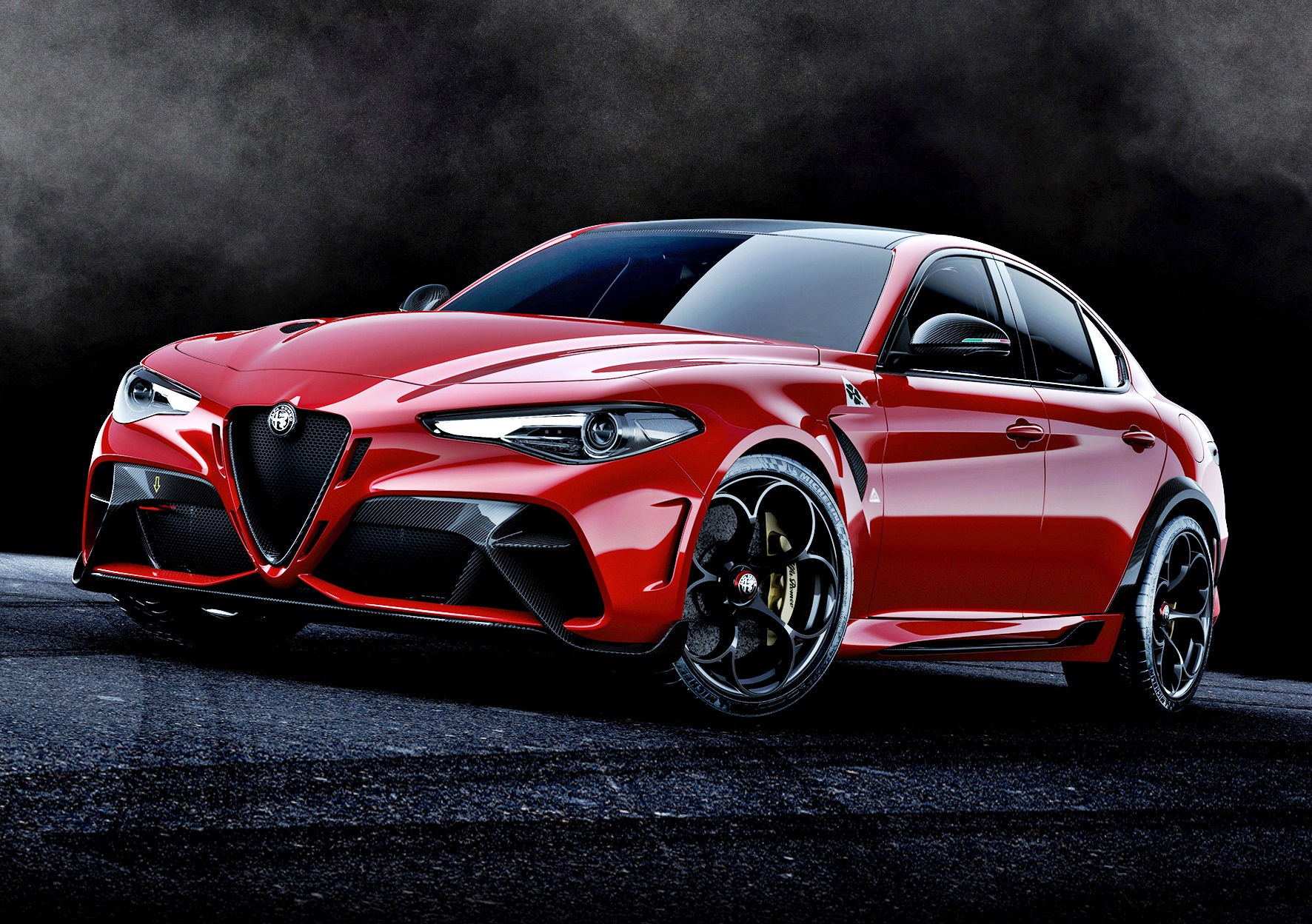
In 1965, Alfa Romeo’s competition department, Autodelta, developed the ‘Gran Turismo Alleggerita’ (GTA) which was based on the Giulia Sprint GT. The car was especially light (‘allegerita’ is Italian word for ‘lightened’) as the body of the Giulia Sprint GT was replaced with an identical version in aluminium, giving a total weight of 745 kgs, compared to the 950 kgS of the road version. With increased performance, it quickly became a legend, winning many races of that era.
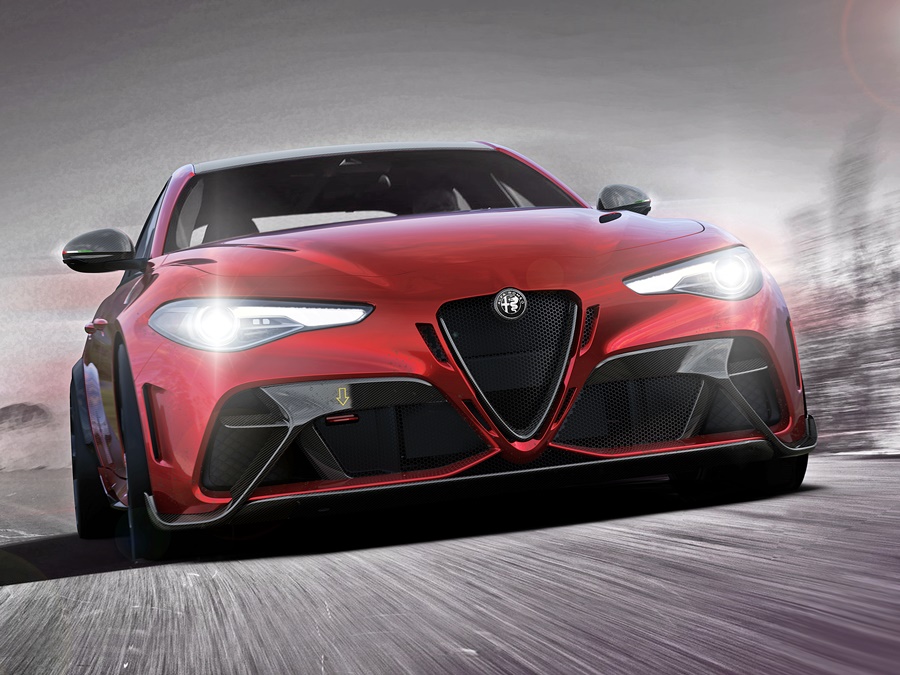
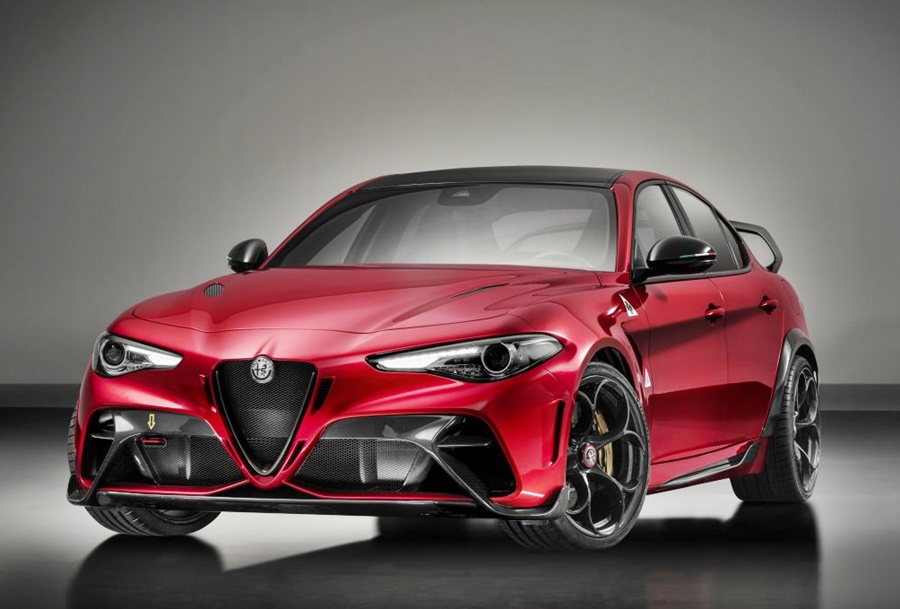
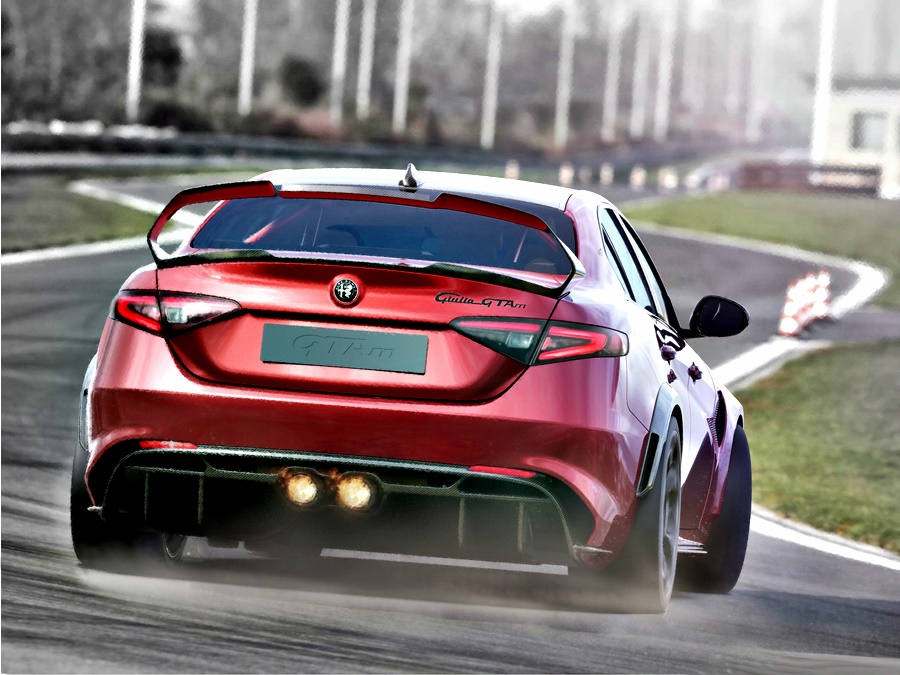
This year, as the brand celebrates its 110th anniversary, a new Giulia GTA inspired by its 1965 namesake will be launched. The new GTA is based on the Giulia Quadrifoglio and is fitted with a more powerful version of the Alfa Romeo 2.9-litre V6 Bi-Turbo engine, now with 540 bhp.
The pursuit of lightness
Like the 1965 cars, lightness was pursued and extensive use of ultra-light materials gives a weight saving of 100 kgs compared to the Giulia Quadrifoglio, giving it a best-in-class power-to-weight ratio of 2.82 kgs/bhp.
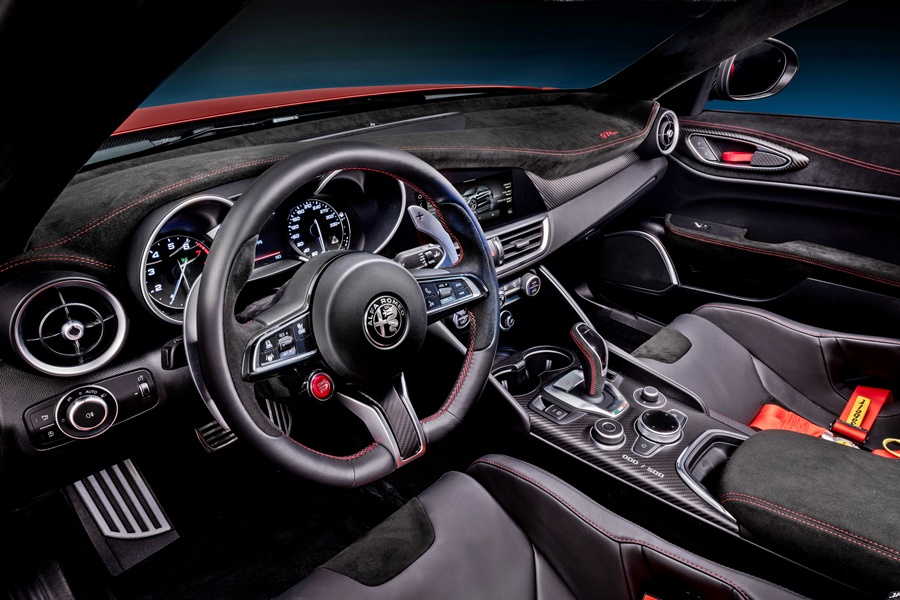
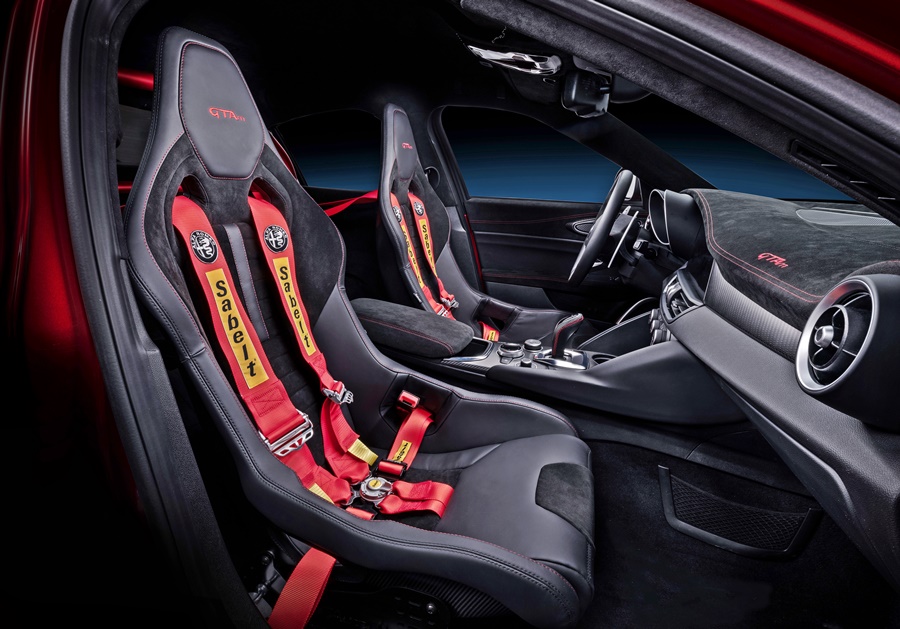
Lightweight materials used include carbonfibre for the driveshaft, bonnet, roof, front bumper, front wheel arches and rear wheel arch inserts and the shell of the sports seats. Aluminium has been used in doors and suspension systems and various other composite materials have been used throughout.
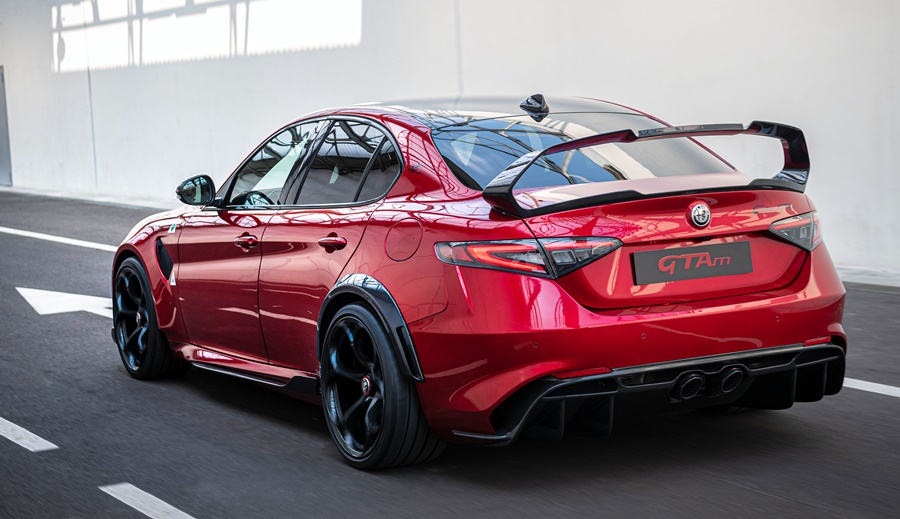
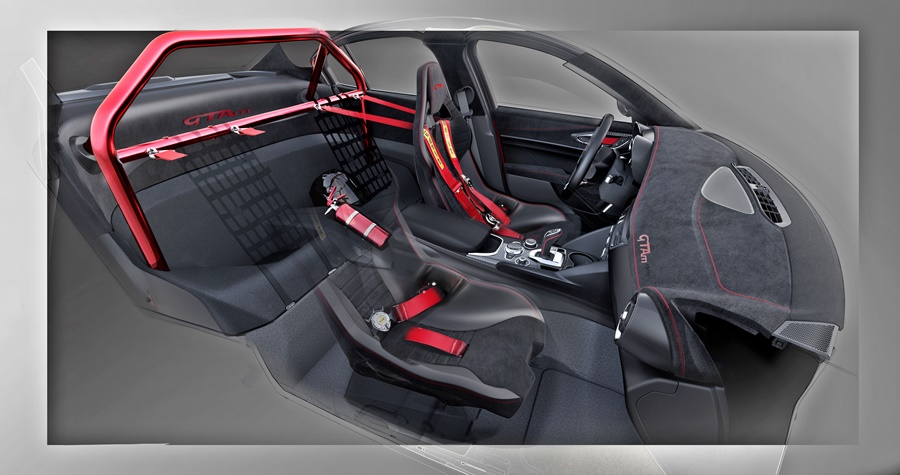
Two road-legal versions will be available – the Giulia GTA and Giulia GTAm. The Giulia GTA will have 4 seats and the Giulia GTAm will be fitted with 2 race seats, roll-bar and six-point harness.
Functional style
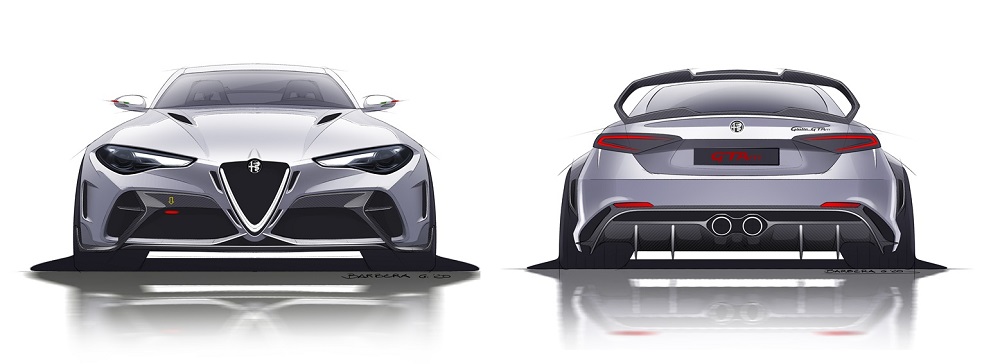
On the Giulia GTA, the Alfa Romeo engineers have worked to improve the aerodynamics and handling but above all, to reduce the weight. The active aerodynamics were specifically studied to increase the downforce. These solutions contain technical know-how that comes directly from Formula 1, thanks to the synergy with Sauber Engineering and the use of the Sauber Aerokit. The same task is assigned to the side skirts, the specific rear spoiler and the active front splitter.
On the GTAm, the aerodynamic front has been optimised by adding a larger front splitter and a real carbonfibre rear wing, which ensure a perfectly balanced load at high speeds.
The titanium Akrapovic central exhaust system, integrated in the carbonfibre rear diffuser, is also new, as are the 20-inch centre lock wheels. Handling at high speeds has been improved by widening the front and rear wheel tracks by 50 mm and developing a new set of springs, shock absorbers and bushings for the suspension systems.
To achieve the higher performance, the Alfa Romeo engine, made entirely of aluminium, has received meticulous development and calibration work.
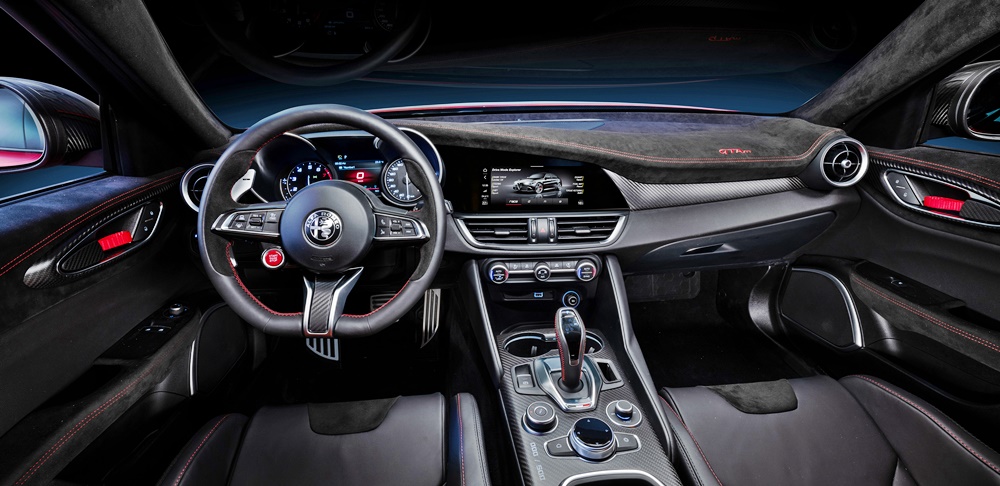
An Alcantara- trimmed dashboard, door panels, glove compartment, side pillars and the central trim on the seats, characterise the interior. Alcantara is used even more extensively in the GTAm version, where the rear bench has been removed, leaving room for a fully upholstered ‘basin’, with specific mouldings designed to hold helmets and a fire extinguisher.
The new matt carbonfibre inserts give the interior a distinctive technical and aesthetic elegance. In the new GTAm, the interior is unique in that it features a roll-bar, no door panels or rear seats and the door is opened with a belt in place of the handle, another touch inspired by the racing world.
In the GTAm, Lexan – a unique polycarbonate resin which comes straight from the world of motorsport – has been used in the side and rear window frames, further contributing to the weight reduction. The result is a weight of around 1,520 kgs which, combined with the increase in output to 540 bhp, making the Giulia GTAm capable of delivering very high performance. Acceleration from 0 to 100 km/h, with the Launch Control system, is claimed to be 3.6 seconds.
500 lucky customers
The Giulia GTA and its extreme version, the Giulia GTAm, will be built in a limited run of only 500 units, all numbered and certified and ready to take up their place alongside their 1965 forerunner as one of the most sought-after collector’s items.
As an exclusive dedicated customer experience, the owners will receive a personalised experience package which includes a Bell helmet in special GTA livery, a full racing set by Alpinestars (race suit, gloves and shoes) and a personalised Goodwool car cover for protecting their GTA or GTAm. Customers can also take part in a specific driving course devised by the Alfa Romeo Driving Academy.
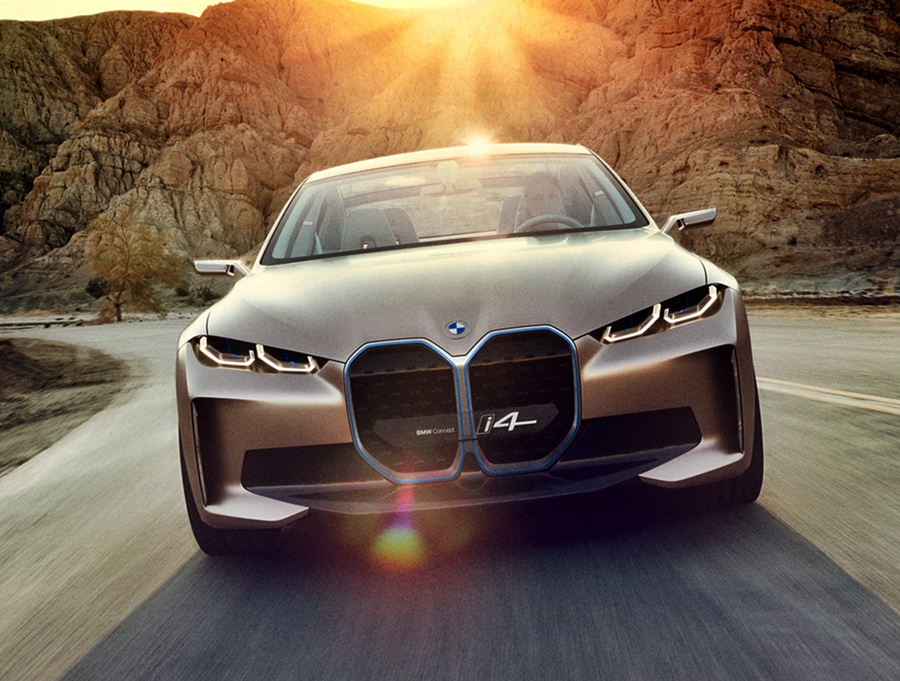
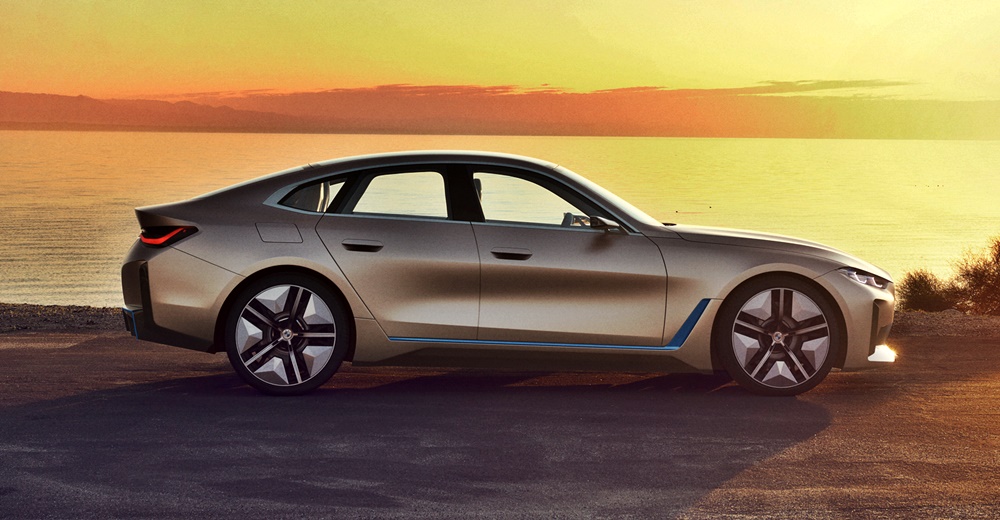
The BMW Concept i4, one of the many models that were to be unveiled at the now-cancelled Geneva International Motor Show, provides a look ahead to the new i4 model to be launched in 2021. It will be the BMW Group’s first all-electric model in the premium midsize class.
“The BMW Concept i4 brings electrification to the core of the BMW brand,” said Adrian van Hooydonk, Senior Vice-President, BMW Group Design. “The design is dynamic, clean and elegant. In short: a perfect BMW that happens to be zero emission.”
“The design of the BMW Concept i4 shows fantastic proportions, a powerfully expressive character and, of course, a lot of attention to detail,” added Domagoj Dukec, Head of BMW Design. “With the Curved Display, we have redefined BMW’s signature driver focus in an extremely elegant way. At the same time, the BMW Concept i4 transports a feeling of sustainable driving pleasure.”
As part of the package, the Concept i4 includes several exterior and interior design elements which will be incorporated in both the i4 and other electrically-powered production vehicles.
Electrifying aesthetics
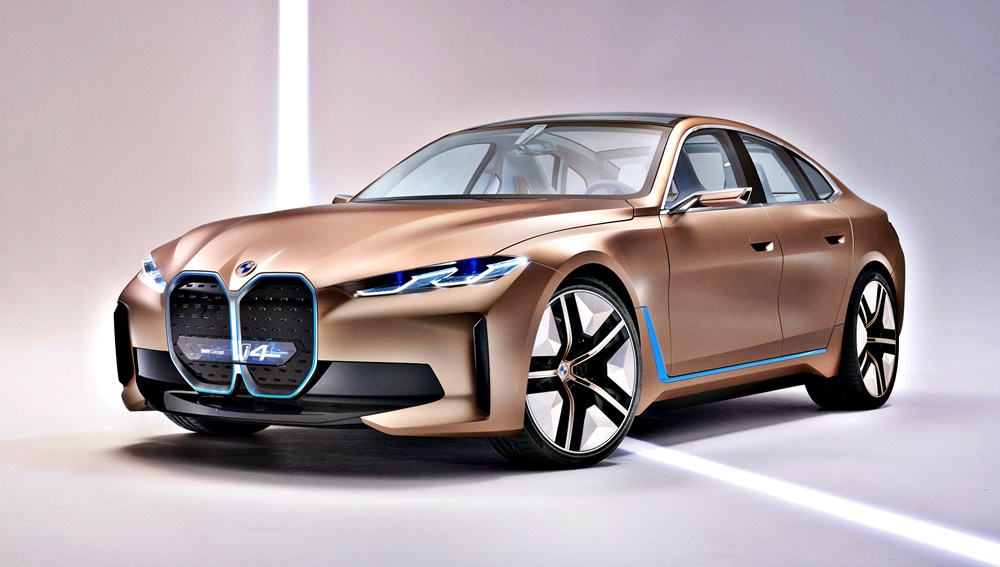
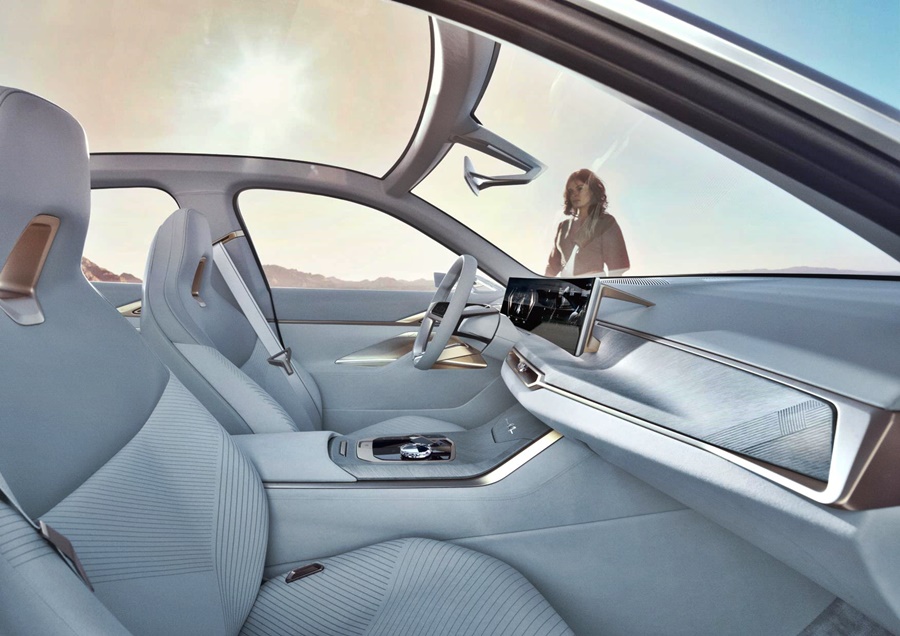
The long wheelbase, fastback roofline and short overhangs form a basic profile for a Gran Coupe. With its four doors, the Concept i4 offers not only a high level of everyday usability and practicality, but also a much larger interior than the car’s modern and dynamic proportions would immediately suggest.
Crisp, smooth lines and taut volumes merge into a rich, smoothly contoured sculpture and create a clear surfacing language. The modern exterior paint shade known as ‘Frozen Light Copper’ mirrors that on the BMW Vision iNEXT and showcases the interplay of surfaces to visually stunning effect.
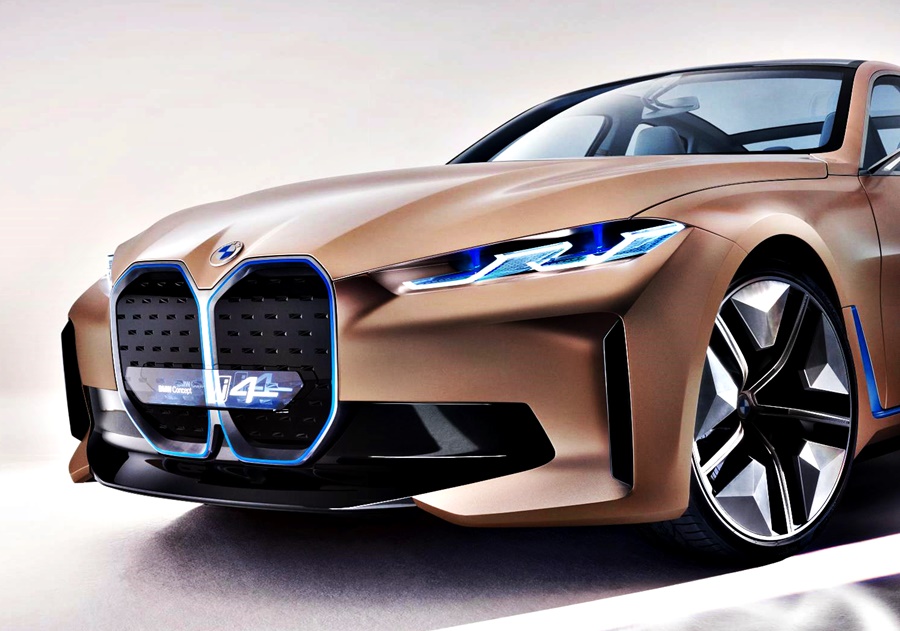
Blue elements in the front end, flanks and rear end point to the car’s BMW i origins. They shine a spotlight on the signature BMW i icons and bring the technology below the surface to the fore – for example, the kidneys in their role as an intelligence panel, the mouldings in the side skirts concealing the battery technology, and the diffuser elements in the rear end, which fill the design space vacated by exhaust tailpipes and enhance aerodynamic efficiency.
A host of aerodynamic measures help maximise the car’s electric range. The blanked-off kidney grille and clear aero lips provide detail examples of sophisticated airflow engineering at work.
Another distinctive area of the car are the wheel rims. These have been designed exclusively for the Concept i4 and blend aerodynamic and lightweight design; smooth – and therefore aerodynamically optimised – surfaces contrast with ultra-low-weight, high-strength spokes.
The front-end treatment presents the familiar BMW icons in a new look, lending a visually powerful face to the electric age at BMW. The prominent, closed-off kidney grille provides a tangible connection between the past and future of BMW.
The BMW icon also gains new functionality: With no combustion engine to require cooling, the grille now serves primarily as an ‘intelligence panel’ housing various sensors. The headlights likewise provide a bridge between the past and the future; the classical 4-eyed front end has a very modern and pared-back interpretation.
Innovation meets minimalism
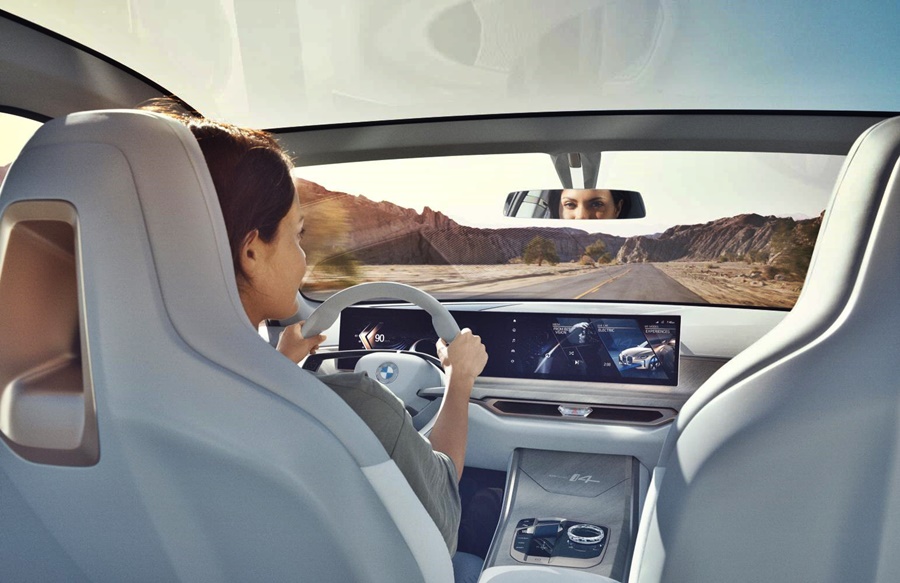
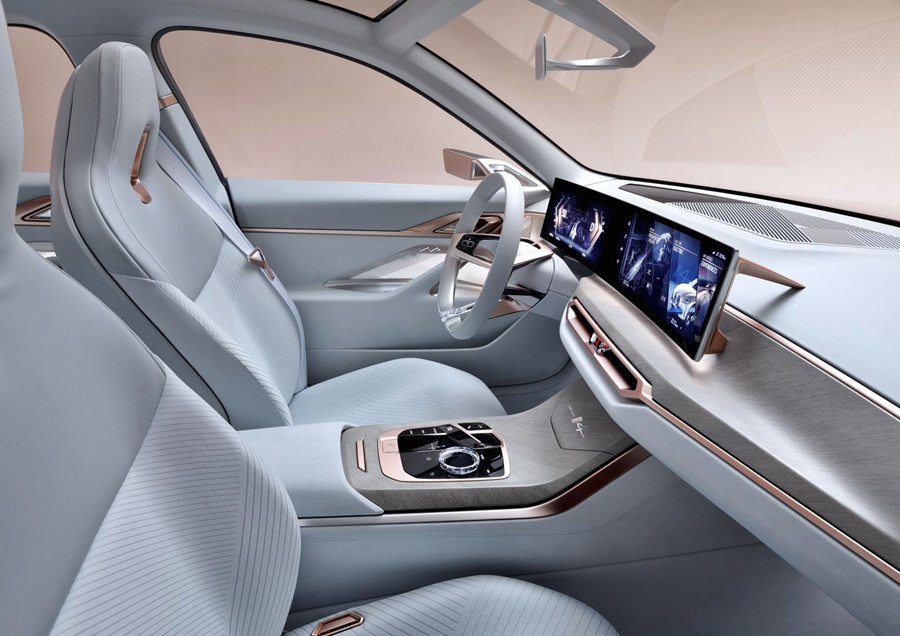
The interior of the Concept i4 focuses on those times when the driver chooses to pilot the car themselves. To this end, every element in the front of the cabin is trained on the driver. The new Curved Display teams up with the steering wheel to reveal a new take on driver orientation and offers a look ahead to the display in the production versions of the iNEXT and i4.
The Curved Display encompasses a large proportion of the section in front of the driver and almost all operating functions are integrated into the display. This is part of an overall approach centred on reducing the number of haptic controls to the minimum.
Spacious rear compartment
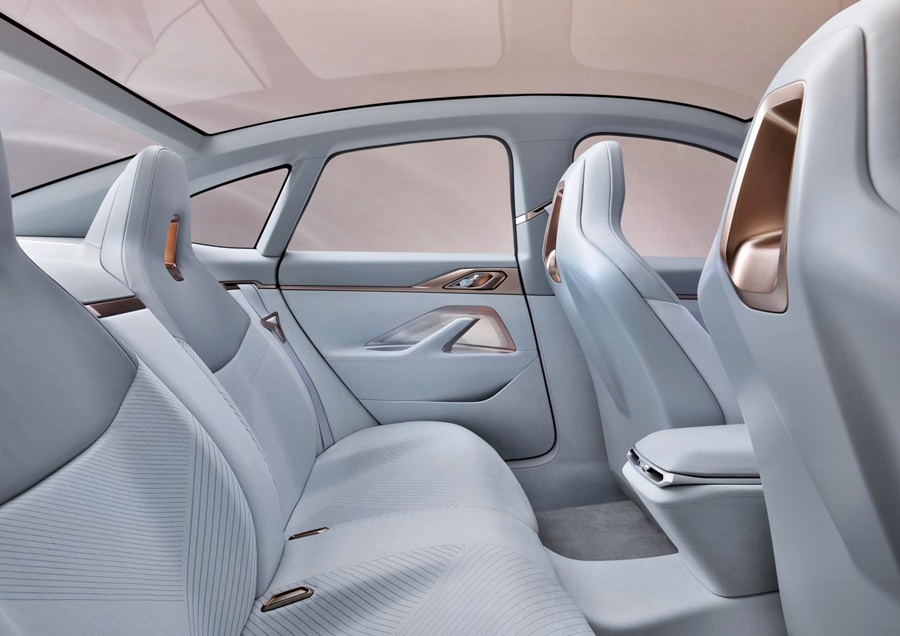
Rear-seat passengers are greeted by a generously-sized compartment offering levels of headroom and legroom that exceed expectations of a coupe. The cut-out in the head restraints is a classy detail that references sporty BMW models from the current line-up.
The rear seats extend the horizontal graphic emerging from the doors to create a lounge feel in the rear. Meanwhile, the outer seats reprise the dynamic form of the front seats, heightening the sporting flavour. They also use very little stitching, which further emphasises the clean and modern feel.
The sound of the Concept i4
The Concept i4 is not only characterised by its individual design but also by its own visionary and unique sound. It was developed under the brand name of BMW IconicSounds Electric by world renowned composer Hans Zimmer together with BMW Sound Designer Renzo Vitale.
BMW IconicSounds Electric aims to emotionalise BMW’s electric vehicles and make them audible using individual sound worlds. The sound combines BMW’s past and future, ranging from the driving sounds in ‘Core’ mode to the more intense and pronounced sounds of ‘Sport’ mode. Also included are the sounds of the door opening and the starting scenario.
Fifth-generation BMW eDrive technology
The electric motor, power electronics, charging unit and high-voltage battery use fifth-generation BMW eDrive technology. These are all-new developments enabling the BMW Group to take another significant step forward in the field of electrified drive systems. The electric motor developed for the i4 generates maximum output of up to 390 kW (530 ps), which ranks it alongside a current BMW V8 combustion engine.
Electrical energy is drawn from a newly designed high-voltage battery pack with the very latest battery cell technology. The version of the battery developed for the i4 has extremely slim construction and optimised energy density. It weighs roughly 550 kgs, has an energy content of around 80 kWh and can provide an operating range that is claimed to be up to 600 kms.
A new BMW brand identity
BMW is unveiling the brand’s new look for the first time. The new logo for communications also provides the basis for the badge on the Concept i4. Its two-dimensional and transparent design ensures seamless integration and brings the special exterior colour shade to even greater prominence.