
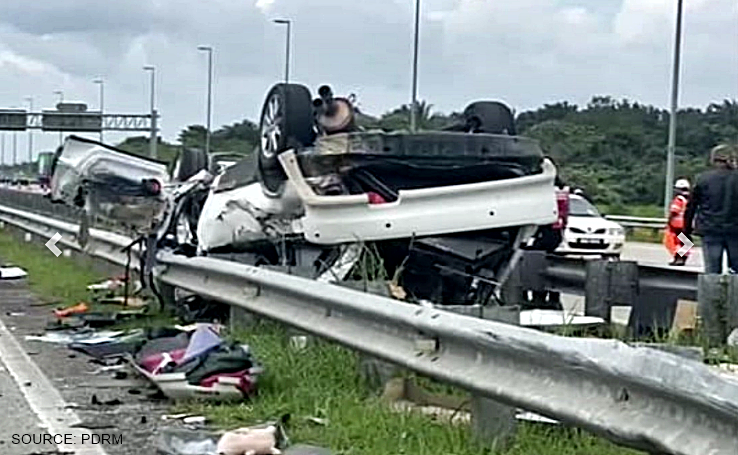
The vast majority of road accidents in Malaysia are the result of human behaviour rather than faulty infrastructure, according to Works Minister Datuk Seri Alexander Nanta Linggi, who cited recent data from the Malaysian Institute of Road Safety Research (MIROS).
According to Malay Mail, Nanta revealed that over 80 per cent of traffic incidents stem from driver-related factors, such as recklessness and distraction, while only 12 to 13 per cent are attributed to road conditions, including surface damage or inclement weather. Out of more than 500,000 recorded accident cases, 12,000 resulted in serious injuries, while 6,000 ended in fatalities, with motorcyclists accounting for approximately 4,000 of those deaths.
Nanta raised concerns over a prevailing public narrative that often attributes accidents to infrastructure shortcomings. He emphasised that although damaged roads exist throughout the country’s extensive federal road network, spanning over 20,000 kilometres, such issues are seldom the root cause of major crashes.
He noted that public perception needs to shift away from placing automatic blame on road conditions. Many, he said, are unwilling to acknowledge personal error as a contributing factor. This tendency to deflect responsibility is an obstacle to meaningful progress in improving road safety.
The minister called for a broader push in public awareness and driver education, particularly around the importance of adhering to speed limits and avoiding distractions, such as mobile phone usage while driving. He argued that such behavioural changes are critical to reducing accident rates.
The minister’s remarks follow a tragic incident in June involving a Universiti Pendidikan Sultan Idris (UPSI) bus in Gerik, Perak, which resulted in the deaths of 15 students. Initial speculation pointed to road conditions as a possible cause, but investigations by the Ministry of Transport, supported by dashcam footage, concluded that the accident was the result of excessive speeding. The bus was recorded travelling at 117km/h in a zone limited to 60km/h, nearly double the permissible speed.
While acknowledging the need for ongoing maintenance and better road monitoring, Nanta stressed that improvements to infrastructure alone would not be sufficient. Addressing driver behaviour and fostering a culture of accountability, he said, are essential steps toward safer roads.