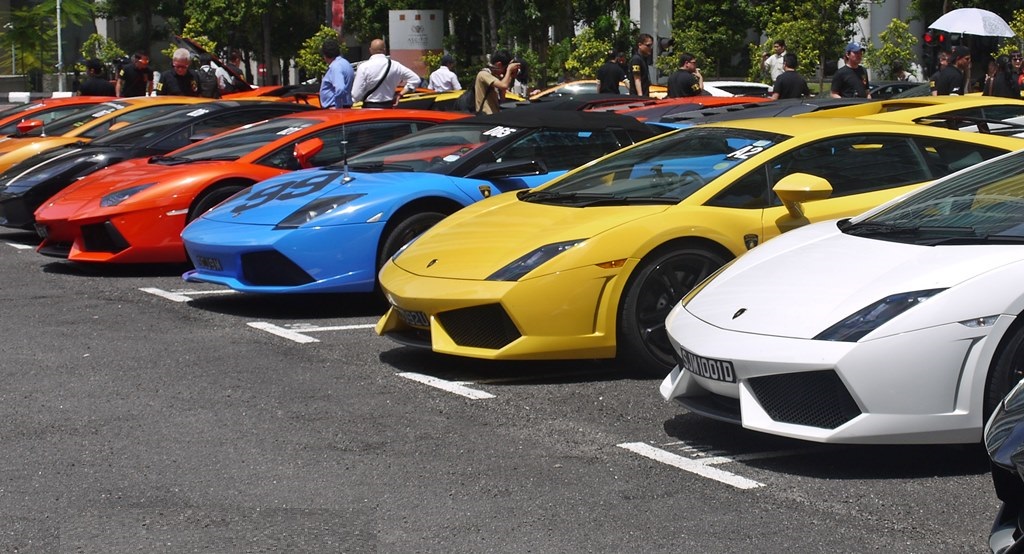
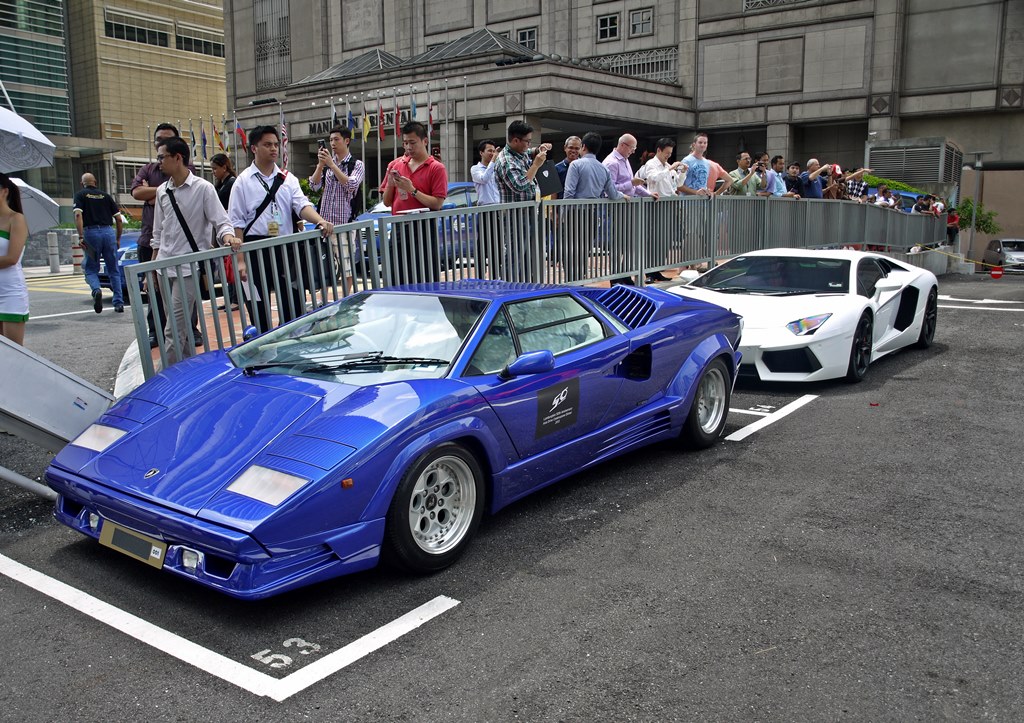
In May 2013, a parade of 77 Lamborghini supercars assembled in Kuala Lumpur, setting a record in the Malaysian Book of Records for the largest number of Lamborghinis at an event. Almost a decade later, the Lamborghini Owners Malaysia (LOM) will try to surpass that feat.
Announcing the attempt for this historic achievement, Dato’ Roslan Rosdi, President of LOM, said the timing could not be more appropriate. “Throughout LOM’s history, we have organised many events, be it short day trips or long overnight drives where, on many occasions, they involve a charity element, mostly making donations to orphanages and taking them for a ride in our cars for some excitement,” he said.
“As we can all gather now safely, we wanted to celebrate the joy of a leisurely drive and will be doing so by attempting to break the record set 9 years ago as part of Lamborghini’s legendary 50th anniversary drive,” he added.
The Lamborghinis arriving for the event in 2013 when 77 of the supercars were gathered at one location.
LOM members will gather at the KLCC’s open-air car park in front of the Mandarin Oriental Hotel on June 11, near the site where the original record had been set. Not only will this event recapture the excitement from 2013’s event, but the assembly will also mark the eagerness of LOM members to return to travel and navigate the idyllic highways of Malaysia after a period of forced isolation.
“This record-breaking event which includes a drive element is being organised by LOM members for its members. Once we have officially trumped the record, we will then travel to the Chateau, Bukit Tinggi where a gala dinner, dubbed ‘Bulls Ball’, will be held,” said Dato’ Roslan.
Members of the public will be able to view the supercars assembled at a site near KLCC.
According to said Dato’ Rakesh Sachdev, LOM Organising Committee Chairperson, the biggest challenge for the attempt is aligning the timing of Lamborghini owners who are all captains in the industry. “Our members however are more than happy to gather for a good cause,” he said, adding that the goal is to raise a minimum of RM40,000 from members and partners for 4 charities.
The public can view the cars gathered which are expected to include rare versions as well as the latest models such as the Gallardo MLE, Huracan Spyder, Urus and Aventador SVJ.
For the protection of all road-users, there is a law which is applied in most countries for all motor vehicles and that is insurance coverage. In order to use a motor vehicle on a public road, it must have insurance coverage that provides for compensation to other parties involved in an accident with it. The minimum is what is known as third-party insurance which compensates only other parties but not the vehicle owner.
Under Section 90 (1) of the Malaysian Road Transport Act 1987, the owner of a vehicle operated on public roads must have insurance coverage for the vehicle. Not doing so means there can be a fine of up to RM 1,000 and even going to jail for up to 3 years. So every year, motorists (and motorcyclists) renew their insurance policies which is also required in order to get another year of roadtax. But there are some who either forget (a weak excuse) or simply do not have insurance coverage for their vehicle, perhaps because they don’t want to spend the money (or cannot afford it).
All vehicles used on public roads must have insurance coverage, which is also mandatory in order to obtain for roadtax renewal.
Compensation for victims
It may seem like that’s their problem if their car is involved in an accident and has to be repaired since they will have to pay from their own pocket. But what about the other party, if they crashed into another vehicle or worse, knocked someone down? If their vehicle is insured, then the other party can claim for compensation from the insurance company. If there is no insurance coverage, who to claim from? The only people who get anything will be the police who collect the fine, which does not go to the victim anyway.
There are no statistics available to show how many vehicles involved in accidents have had no insurance coverage but for someone who is the victim involved, it can be a nightmare since there is no one to claim from. You could get a lawyer to sue the vehicle owner but that will take time and money and he might not be able to pay too.
The Motor Insurers Bureau of West Malaysia
Fortunately, in Malaysia, there is a way to get some form of compensation and that is from the MIB (no, not the Men in Black!) which is the Motor Insurers Bureau of West Malaysia. This bureau, which is not an insurance company, was established in January 1968 after an agreement was signed between the general insurance companies and the Transport Ministry to provide compensation for accidents involving uninsured vehicles. Apparently, the agreement includes Singapore and East Malaysia as well.
The aim of establishing the MIB was to ensure that victims get some compensation and assistance for their injuries resulting from the accident if the vehicle was uninsured.
The MIB will receive claims for compensation but as with any claim, there are procedures to be followed and the claim must be made within 3 years from the date of the accident. The claimant must also notify the MIB about the case within 30 days of filing the action and must furnish all the relevant documents. These would be a description of the accident, police reports, medical report and so on. Details of the vehicle that hit you or your vehicle must also be provided.
However, an important thing to note is that the compensation is for injuries you sustain to your body and there is no compensation given for repairs to the damaged vehicle. And if your phone was damaged as a result of the accident, that too won’t be compensated by the MIB. The aim of having the MIB is to ensure that victims are still provided with compensation to help them with medical expenses, which could be substantial in some cases.
The compensation from the MIB does not cover repairs for the damaged vehicle or for losses or damage to any property inside.
How to contact the MIB
The address of the Motor Insurers Bureau of West Malaysia is Wisma PIAM, No. 150-3, 3rd Floor, Jalan Tun Sambanthan, Brickfields, 50782, Kuala Lumpur. Phone: 03-2274 7395. You do not need a lawyer to submit your claim, but you will be asked to make a payment of RM100 to cover their admin and investigation costs.
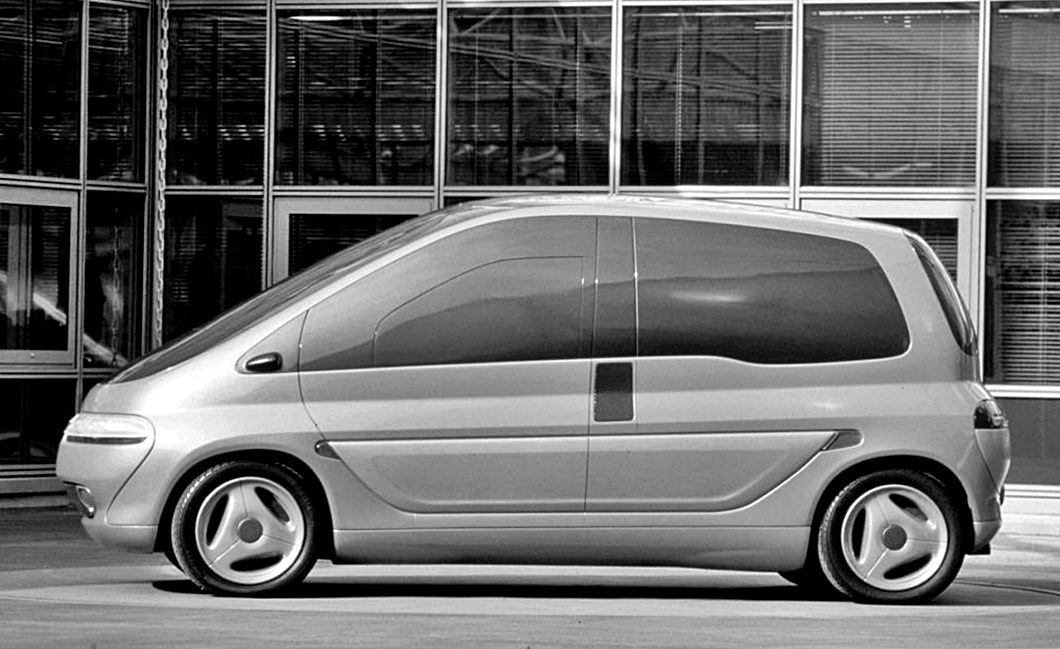
In 1991, Renault displayed a concept car that was the forerunner of compact MPVs with its novel management of the interior layout to comfortably accommodate a whole family. The model was called the Scenic concept, and its format would be used in a new generation of models that also used the same name.
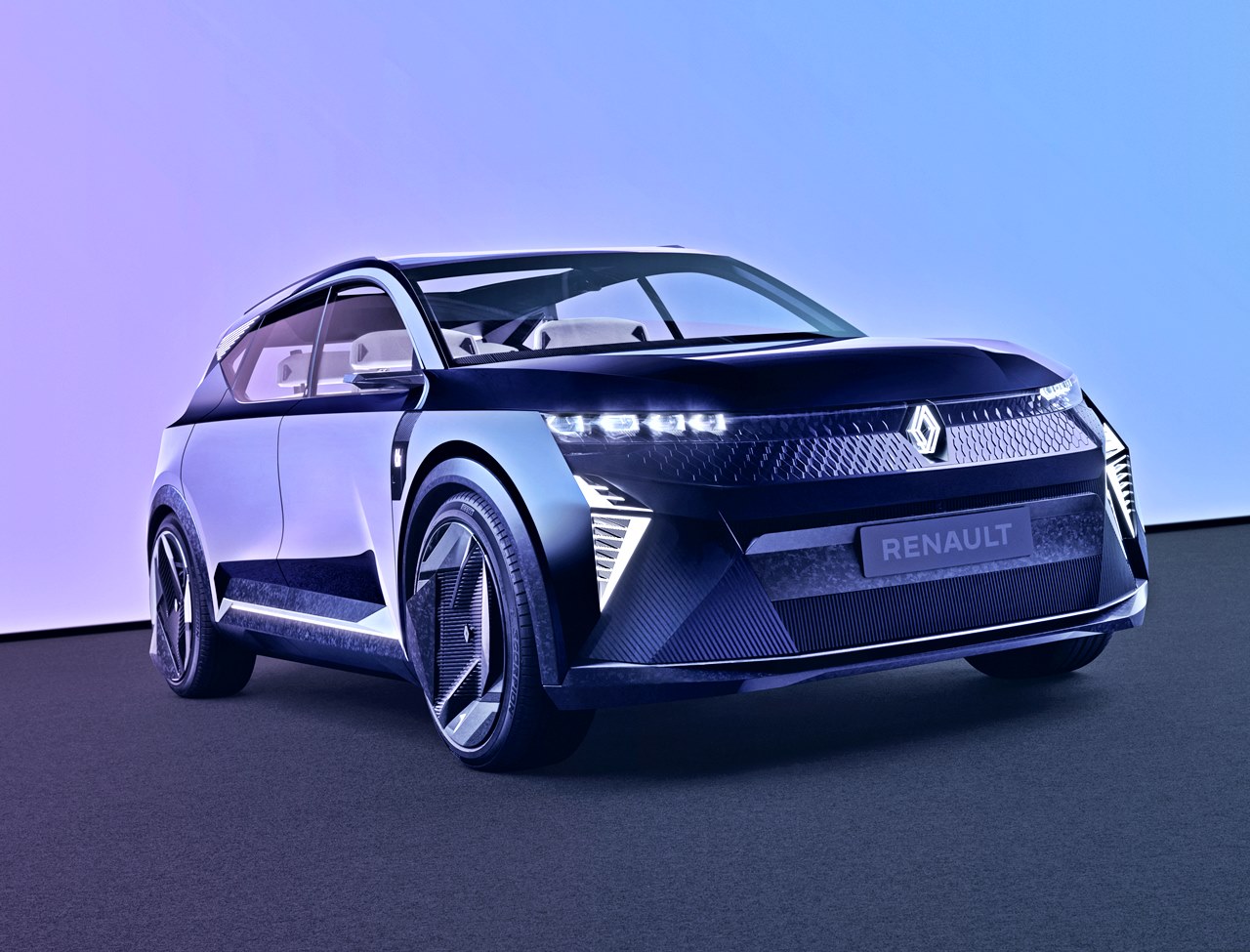
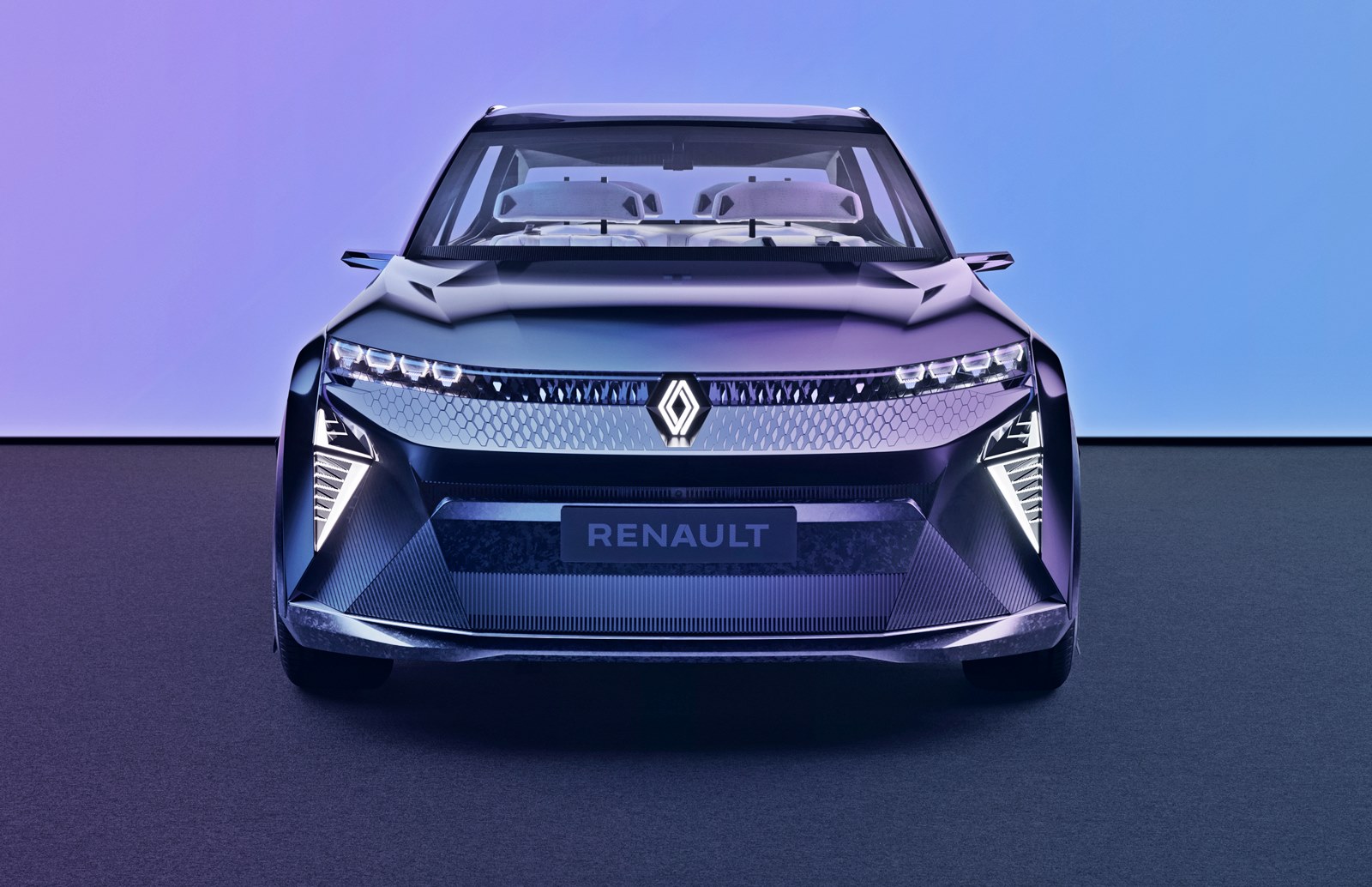
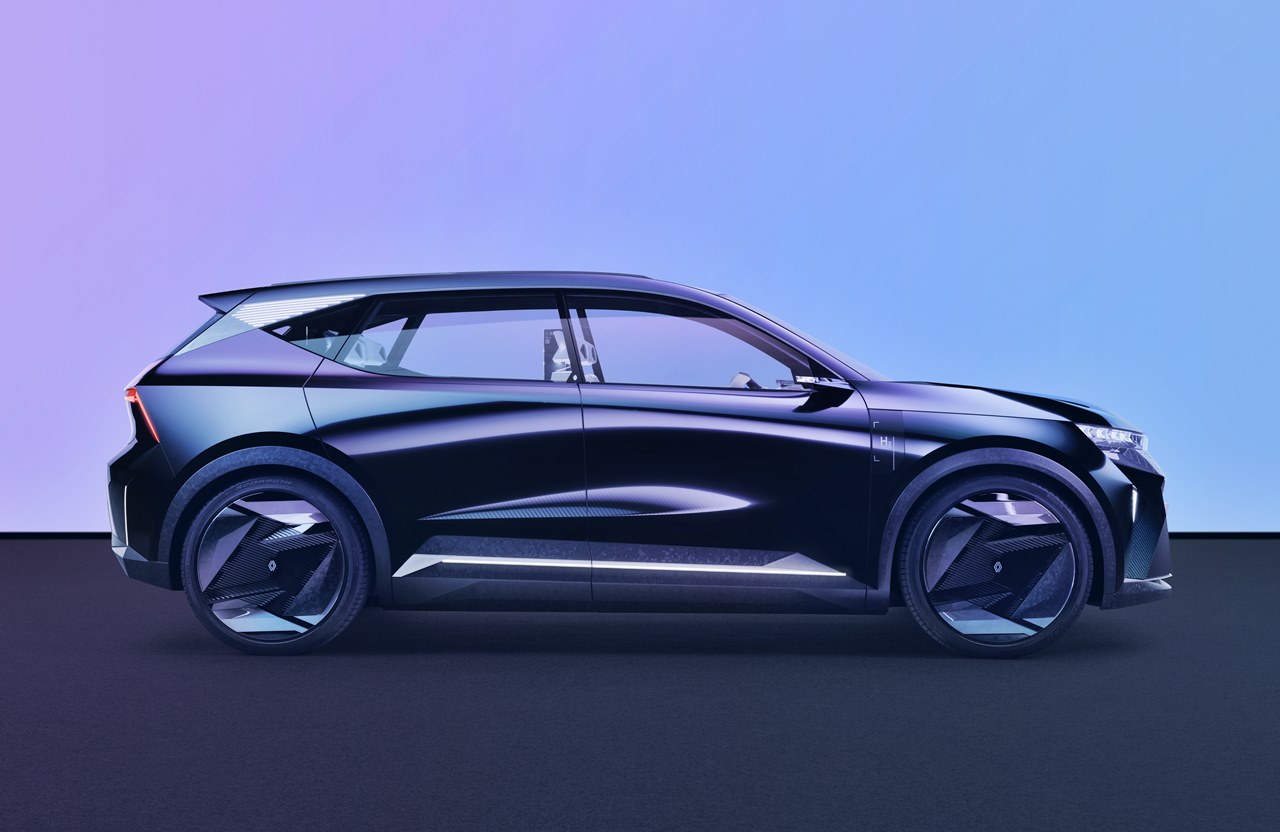
31 years later, the French carmaker is again using the name and as before, the new model starts a new chapter in its history. Known as the Scenic Vision, the new concept car embodies the brand’s sustainable development commitments and encapsulates them in a single vehicle. Its intelligent design and manufacture incorporate methods that the Renault Group and its brands will use to achieve carbon neutrality in Europe by 2040 and worldwide by 2050.
Previous Scenic concept introduced the compact MPV format to the world in 1991.
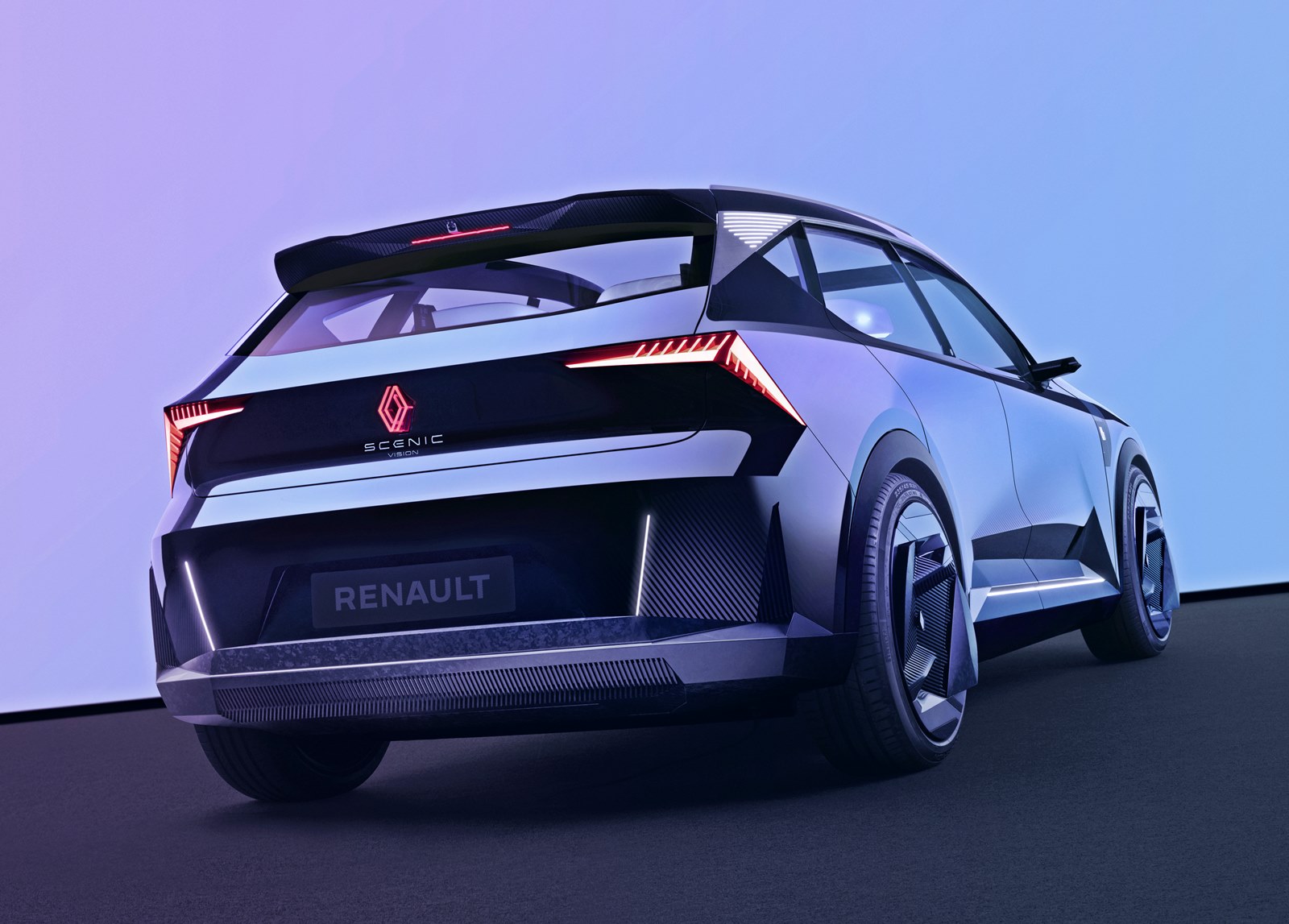
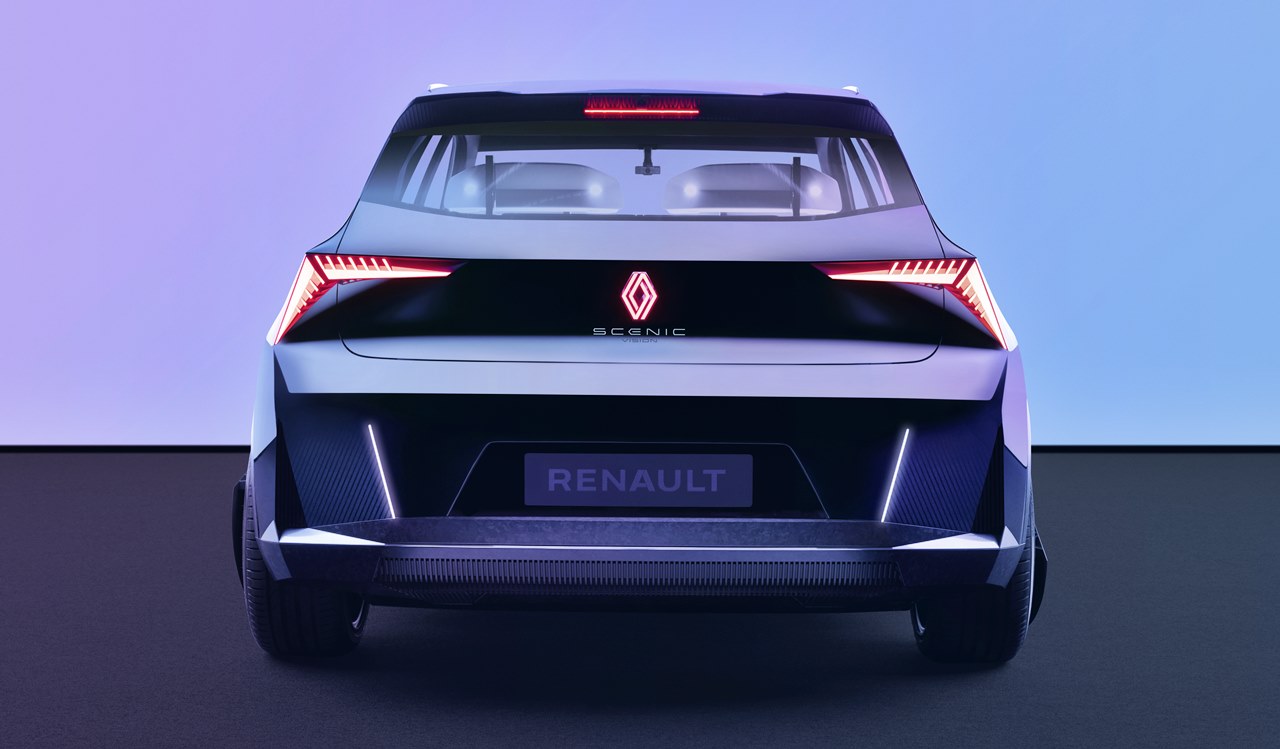
With the Scenic Vision, Renault is proposing ‘a car for life and for living’, with a new vision for the family car. Its exterior design, measuring 4.49 metres in length, provides a preview of an all-electric model in the C-segment that will be unveiled in 2024.
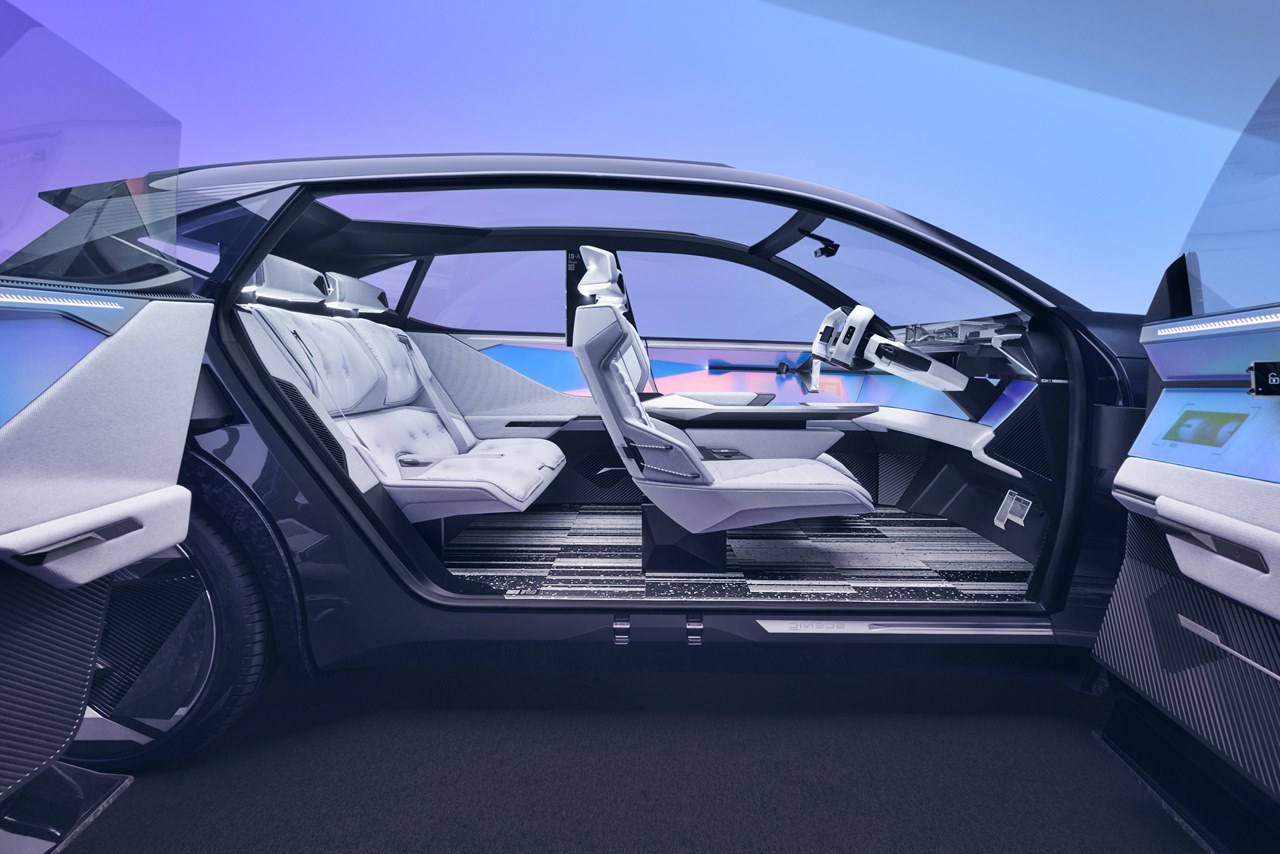
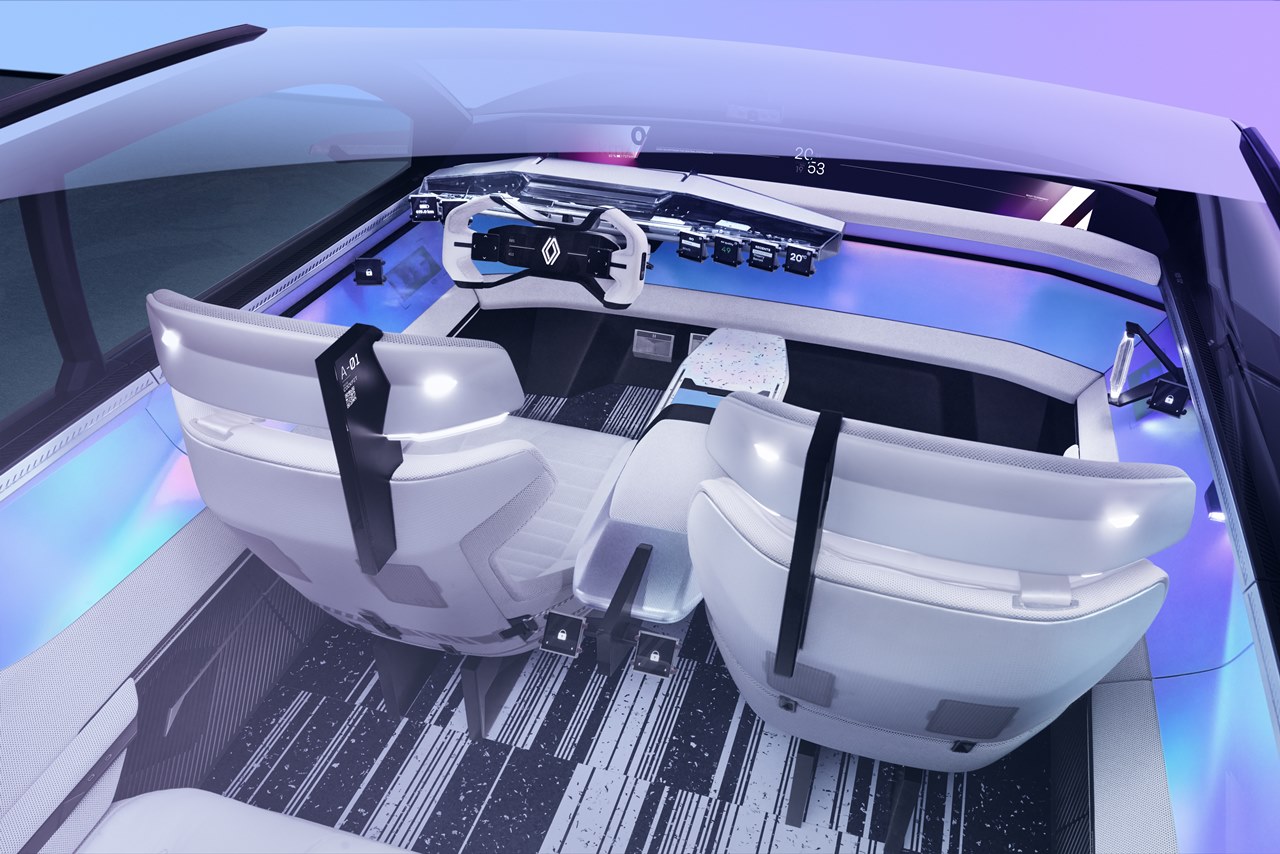
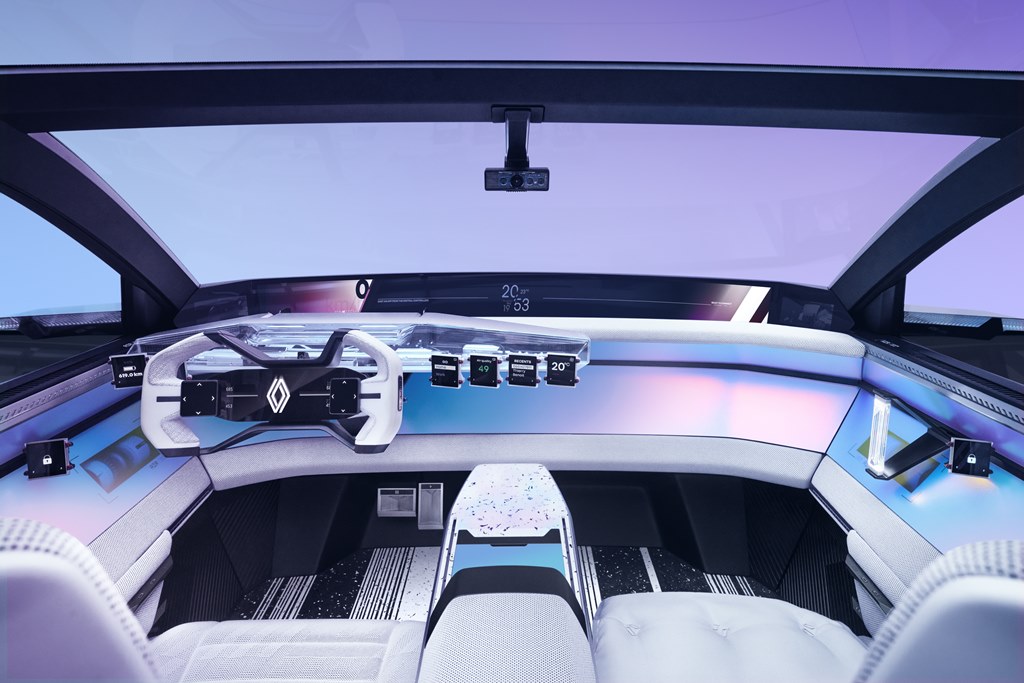
The unique design is enhanced by the choice of colours, where black and white create a singular graphic universe. Shades of black on the outside, and white on the inside, offer a contrast of light and dark that reflects the design team’s wish for this concept car to be a work of art where artistic expression takes to the fore.
Fuel cell powertrain
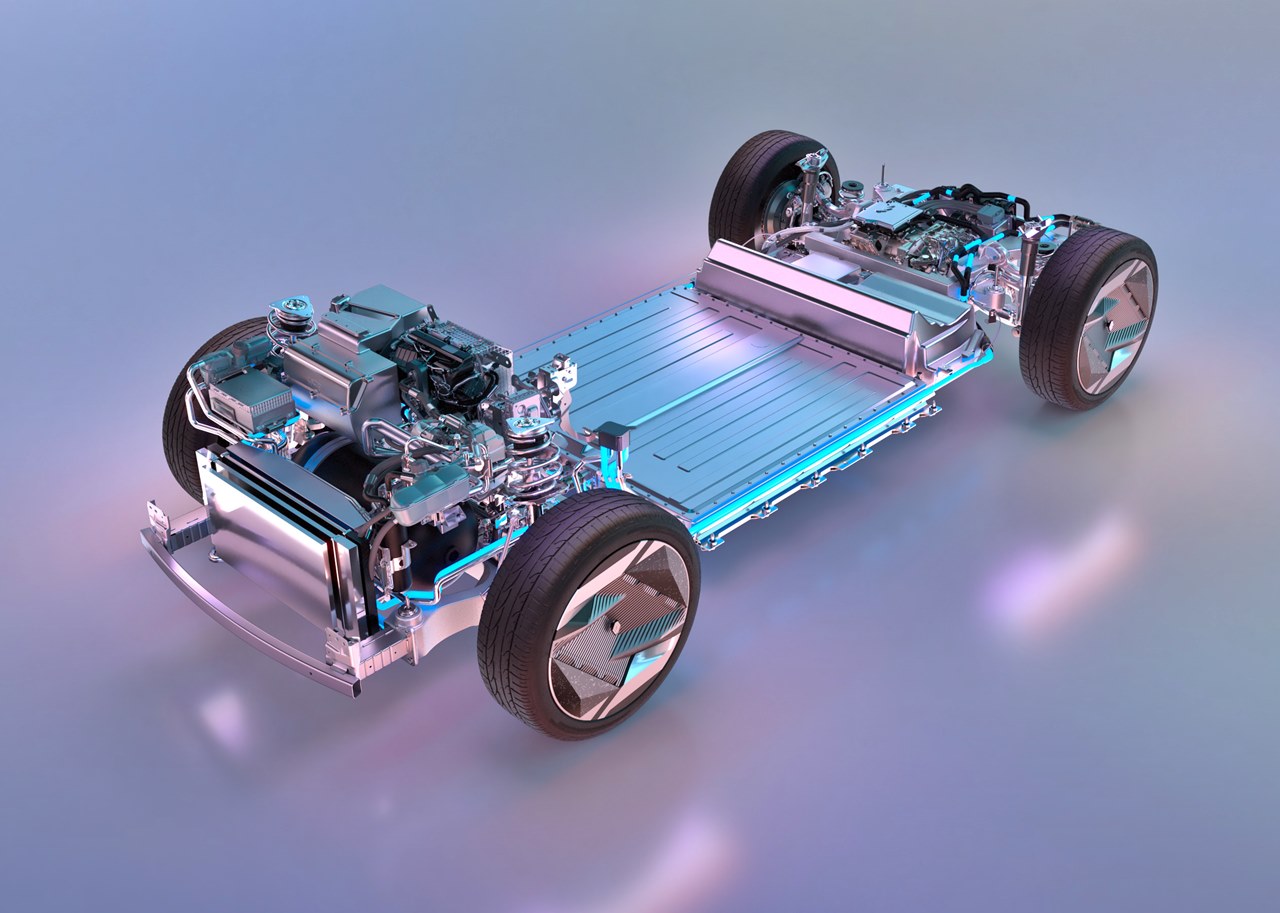
The Scenic Vision is proposed with a fuel cell that generates electricity for a new-generation motor. The 160 kW motor derives directly from the latest Megane E-Tech Electric’s motor and uses no rare-earth elements. This helps to reduce its carbon footprint and create a responsible and sustainable ecosystem.
The 40 kWh battery pack is recyclable and will be made in France by 2024 at the Renault ElectriCity Gigafactory. It is lighter, smaller and costs less than a battery pack for a similar electric vehicle. The 15 kW fuel cell will recharge it during long drives and thus extend its range. In 2030 and beyond, once the network of hydrogen stations is large enough, it will be possible to drive up to 800 kms, with the hydrogen tank able to be refilled in 5 minutes or less.
The all-new platform used by the Scenic Vision is currently in the prototyping phase. It is purpose-designed to fit all the components – electric motor, hydrogen engine, battery, fuel cell and hydrogen tank. The engine is at the rear, so there is enough space for the 2.5-kg hydrogen tank at the front; the fuel cell is under the floor, at the back of the platform, behind the battery.
Optimal travel times
This propulsion system’s operation is simple and efficient. The car can be driven as a conventional electric vehicle, without using the fuel cell, on daily trips. When there is a requirement to travel longer distances, a route planner calculates the power the fuel cell needs to supply to keep the battery charged for longer, so that there is no need to charge it on the way.
The point of using the fuel cell on long journeys is that it’s quicker to top up the hydrogen tank than to charge the battery. This way, there is no need to charge the battery until the car reaches its destination. When the weather is cold, the hydrogen range-extender also keeps the battery at the right temperate for optimal operation and extra range.
95% recyclable
A full 95% of this concept car’s materials – including the battery – are recyclable. This new approach to design looks beyond the vehicle and includes previously unexplored ventures and technologies. The exterior materials (steel, aluminium, carbonfibre and plastics) can all be recycled at the end of their life.
Everything inside is also designed responsibly. For example, the foams, fabrics and stitching on the light beige seats are made of the same material, produced from fully recycled and recyclable plastic.
Estimates suggest that the number of electric vehicles on Europe’s roads will increase tenfold between now and 2030, from 10 million to 100 million. The Renault Group is the first carmaker to work on the full battery lifecycle, and has developed solid expertise in increasing their durability and using them for a wider variety of purposes. Once a battery is no longer fit to power a vehicle, its energy can be reused in stationary storage solutions in homes or offices, or elsewhere (in boats, refrigeration systems, machinery or airport logistics, etc).
The steel in the vehicle’s structure is made from 95% recycled steel, while all the aluminium parts in the structure (housings, battery casing, seats) and trims (console, cockpit) are made from 100% recycled aluminium. All the carbonfibre is recycled from aviation industry scrap via a partnership with Airbus, and the hydrogen tank is made with carbonfibre produced from paper-industry waste.
Elsewhere, 70% of the interior and exterior plastics are recycled, with 100% of the textile fabrics made of recycled materials. It is also entirely leather-free, while the floor is made of 100% recycled plastics from food and industrial waste
Help for safer motoring
The Scenic Vision previews technology and systems which will provide assistance to drivers, enabling them to better avoid risky situations, and reduce stress behind the wheel. The multiple ADAS (Advanced Driver Assist Systems) and 3 on-board systems – Safety Score, Safety Coach, and Safe Guardian, are designed to provide extra safety for all, as well as a unique level of both physical and psychological comfort.
New Renault models will soon come with a ‘Safety Score’. Using data collected by sensors mounted on the vehicle, it analyses the driver’s driving style – acceleration, smoothness, inattention, speed management, and driver distractibility. It then gives personalised driving tips to each driver based on a safety score calculated at the end of each trip.
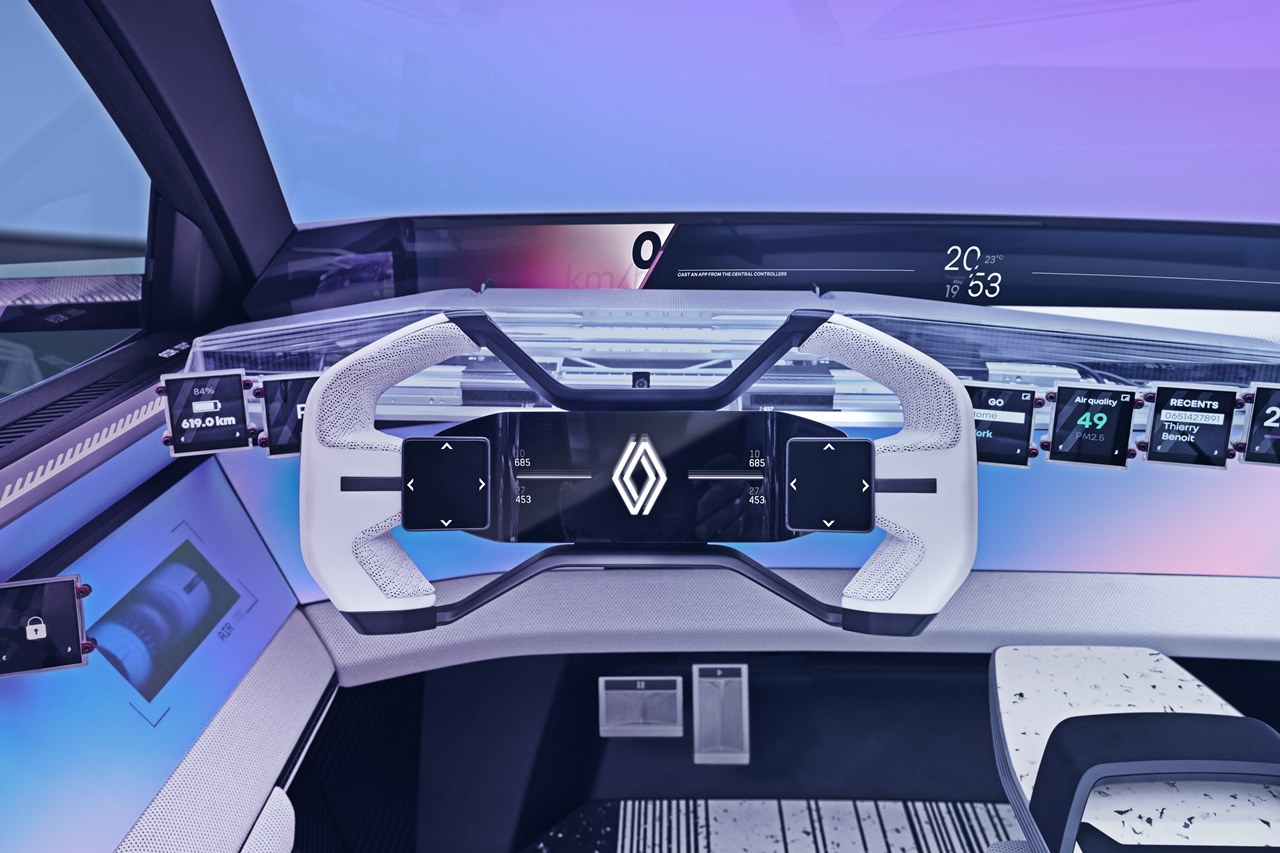
To further aid drivers, the vehicle comes fitted with an array of health monitoring systems. A heart rate sensor placed in the steering wheel and a camera serve to detect signs of driver fatigue or inattentiveness. Should a problem arise, warning signals are sent to the driver and passengers, and emergency services are alerted automatically.
The Scenic Vision has been designed with a new architecture that features an extra-large screen located where the dashboard meets the windscreen. It displays the car’s immediate environment, thanks to an array of on-board cameras located at the front of the vehicle. The system increases the driver’s field of view by 24% due to a visual widening of the windscreen and a front bonnet that ‘disappears’.
New technological solutions help rescue services at the scene of an incident. The Fireman Access and Rescue Code are two such systems already featured on production vehicles, with the former featuring a specialised access hatch to the core of the battery that means it now only takes a few minutes to extinguish a battery fire instead of up to 2 hours.
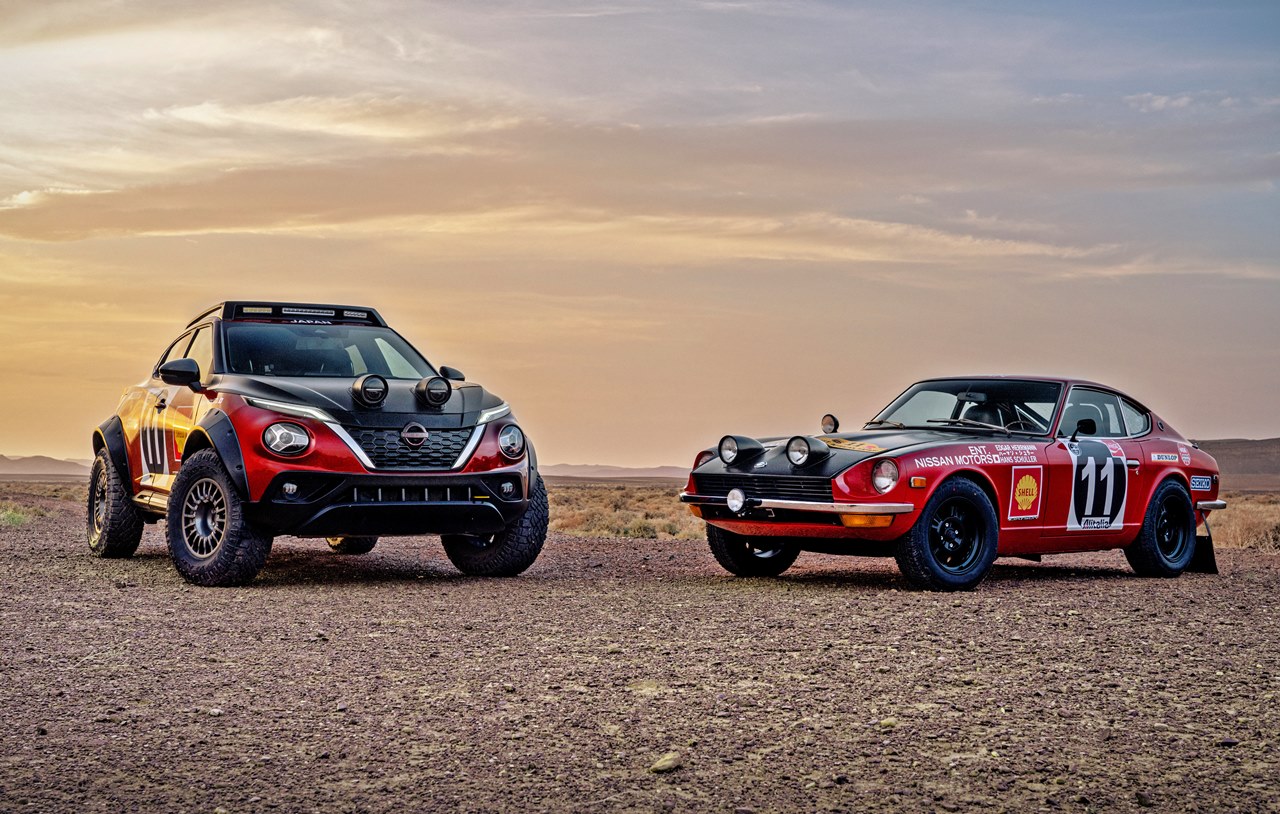
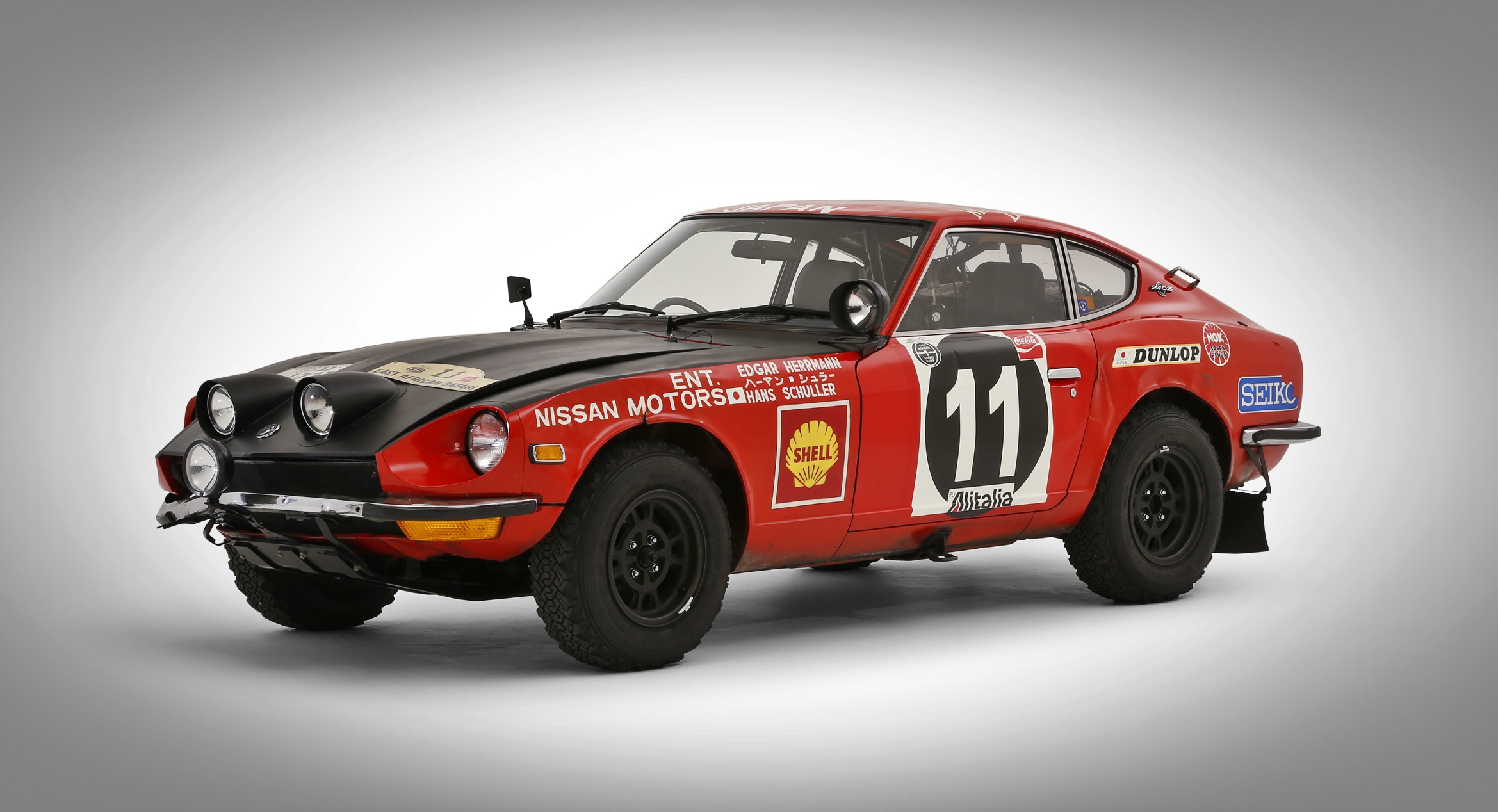
Nissan started participating in the Safari Rally in 1963 and in 1966, a Bluebird entered by the team became the first Japanese car to win its class in the gruelling event. Other victories followed and by 1970, Nissan finally took top honours, winning all three prizes – overall (with a Datsun 1600 SSS), class and team. In 1971, a Datsun 240Z won to give the brand its second consecutive overall victory in the rally.
The original Datsun 240Z which won the Safari Rally.
From concept sketch to one-off model
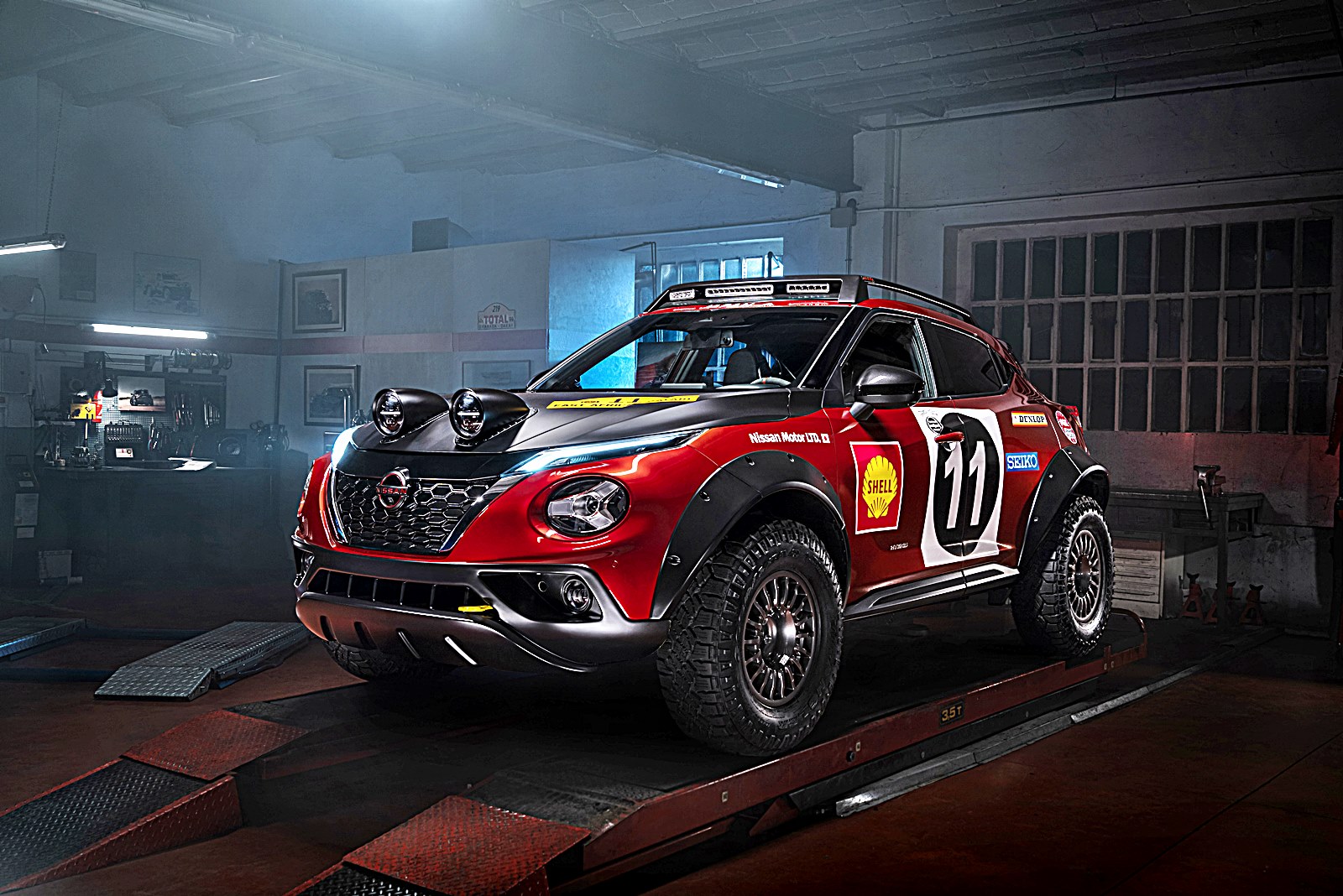
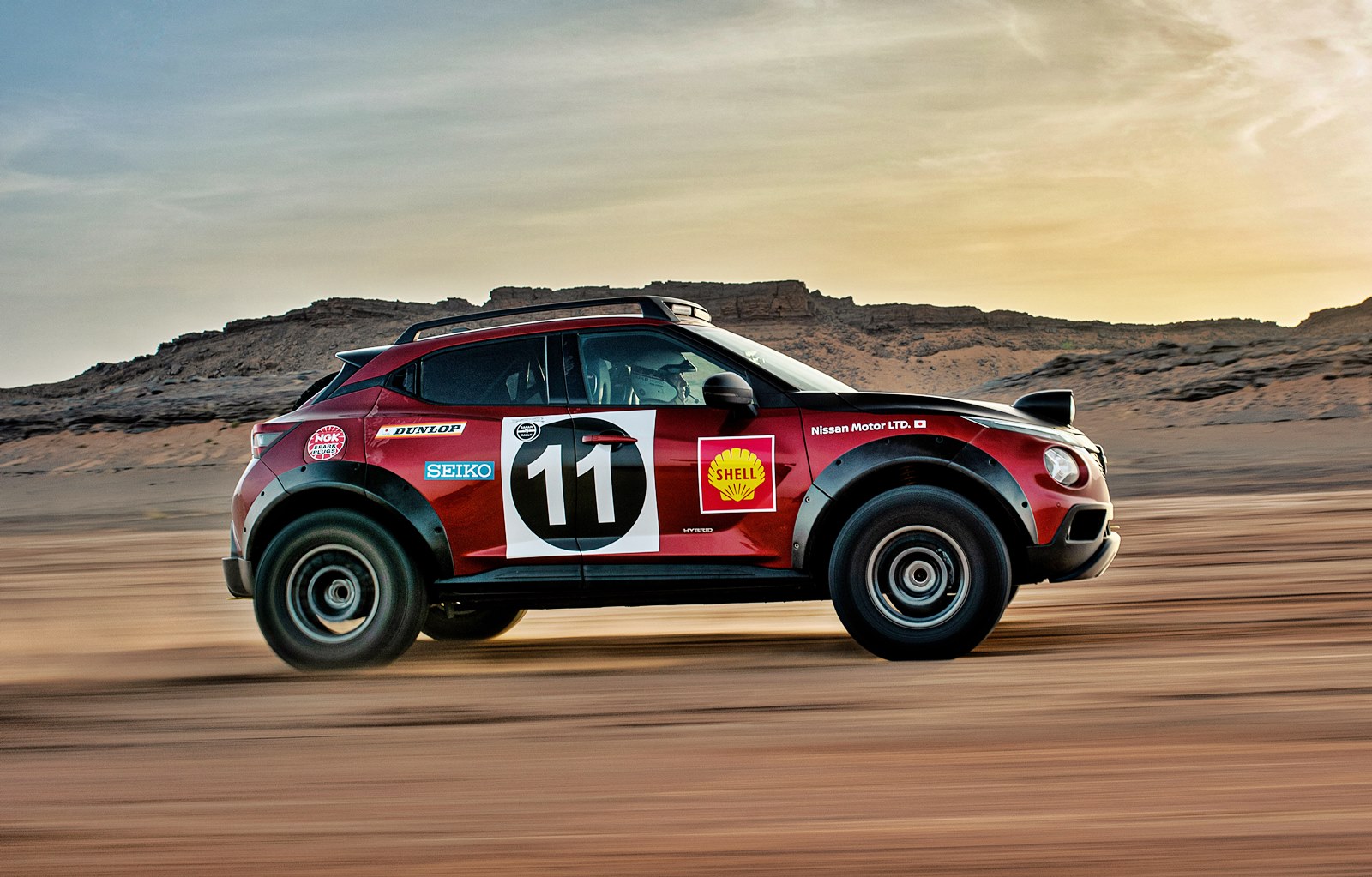
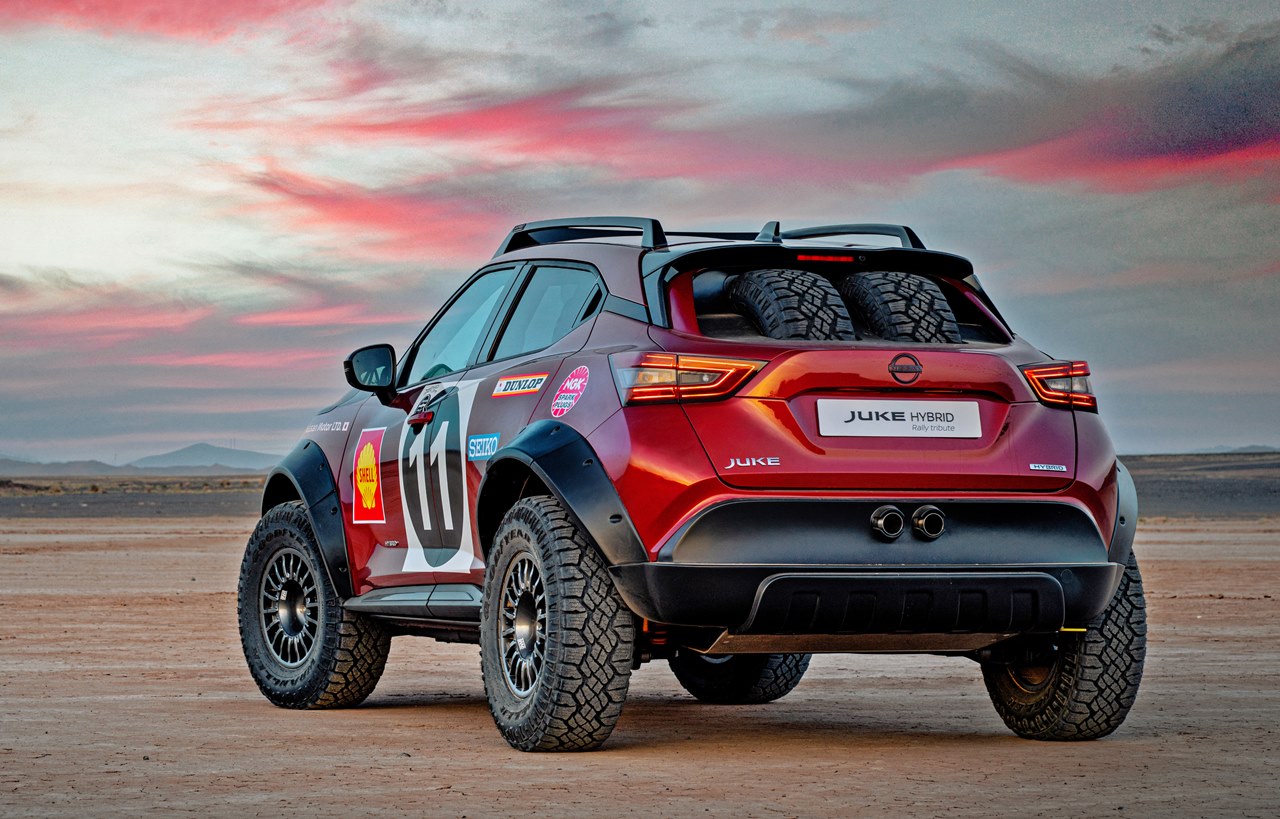
Paying tribute to the successes in the legendary rally half a century later is the Nissan JUKE Hybrid Rally Tribute. The special model has now moved to become a fully operational one-off vehicle following the overwhelmingly positive reaction to the original concept images. Its unveiling previews the European introduction of the JUKE Hybrid soon.
“The JUKE Hybrid Rally Tribute represents our optimism and daring mindset. We are currently preparing an exciting new chapter of JUKE history in advance of the introduction of the new JUKE Hybrid in the summer. It will offer the excitement and agility customers would expect of our iconic crossover, with both improved performance and efficiency. The JUKE Hybrid Rally Tribute takes its playful character to a new level. “Speaking about the decision to bring the JUKE Hybrid Rally Tribute to life,” said Coralie Musy, Vice-President, Brand and Customer Experience of Nissan’s AMIEO region.
Advanced hybrid powertrain
The JUKE Hybrid powertrain consists of a new generation Nissan internal combustion engine specifically developed for working in a hybrid powertrain application. It produces 69 kW (94 ps) and 148 Nm of torque.
The main electric motor produces 36 kW (49 ps) with 205 Nm of torque, while there is a 15 kW contribution from a high voltage starter/generator, all of which is fed by a 1.2 kWh water-cooled battery. The net result is a powertrain providing 25% more power than the current petrol engine option, with a claimed fuel consumption reduction of approximately 40% in the urban cycle.
Smart automatic gearbox
Also carried over from the production version of the JUKE is an advanced low friction multi-modal gearbox that provides optimal use of the propulsive power, whether electric, petrol engine, or both. To reduce friction, this motorsport-inspired gearbox uses dog clutches instead of conventional synchroniser rings to shift the 4 ICE (internal combustion engine) gears and 2 EV (electric vehicle) gears.
Additionally, to reduce friction, this gearbox does not use a clutch. All vehicle starts are 100% electric, and the 2 EV motors are used in combination to synchronise the gears, delivering smooth, connected and responsive acceleration.
The gearbox is controlled by an advanced algorithm, managing the shift points, battery regeneration, as well as the advanced series-parallel architecture. The powertrain can seamlessly navigate through different hybridisation combinations (series, parallel, series-parallel) according to acceleration and power requirements and without any driver input.
Rally-inspired modifications
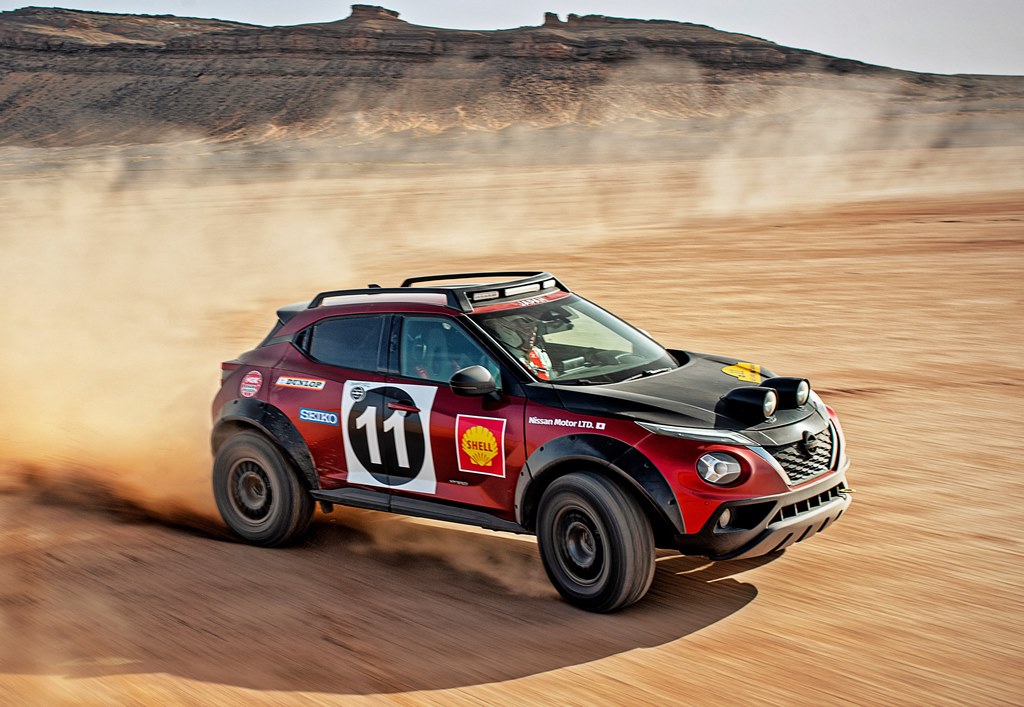
Like the Gripz concept car that was displayed at the 2015 Frankfurt Motorshow, the JUKE Hybrid Rally Tribute takes its design cues from the iconic 240Z that competed so successfully in the desert rally over 50 years ago.
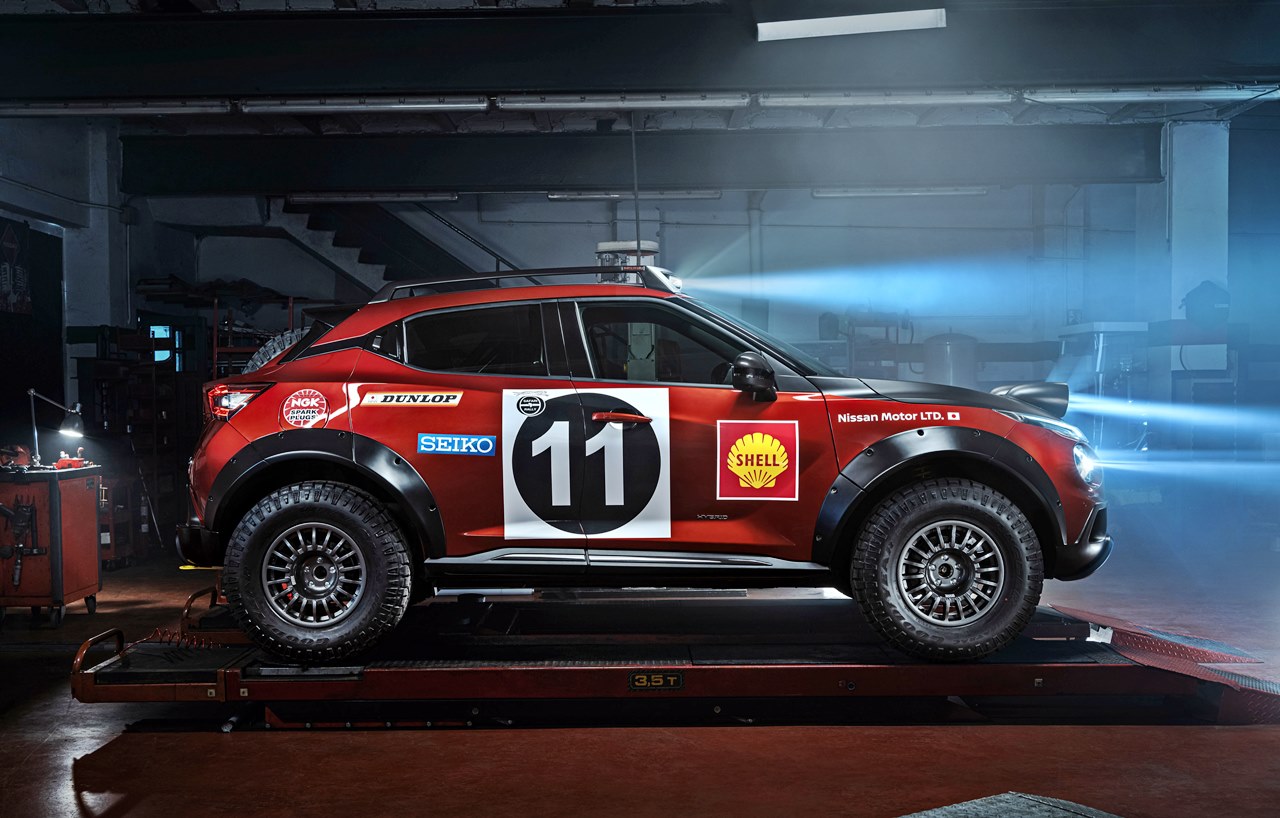
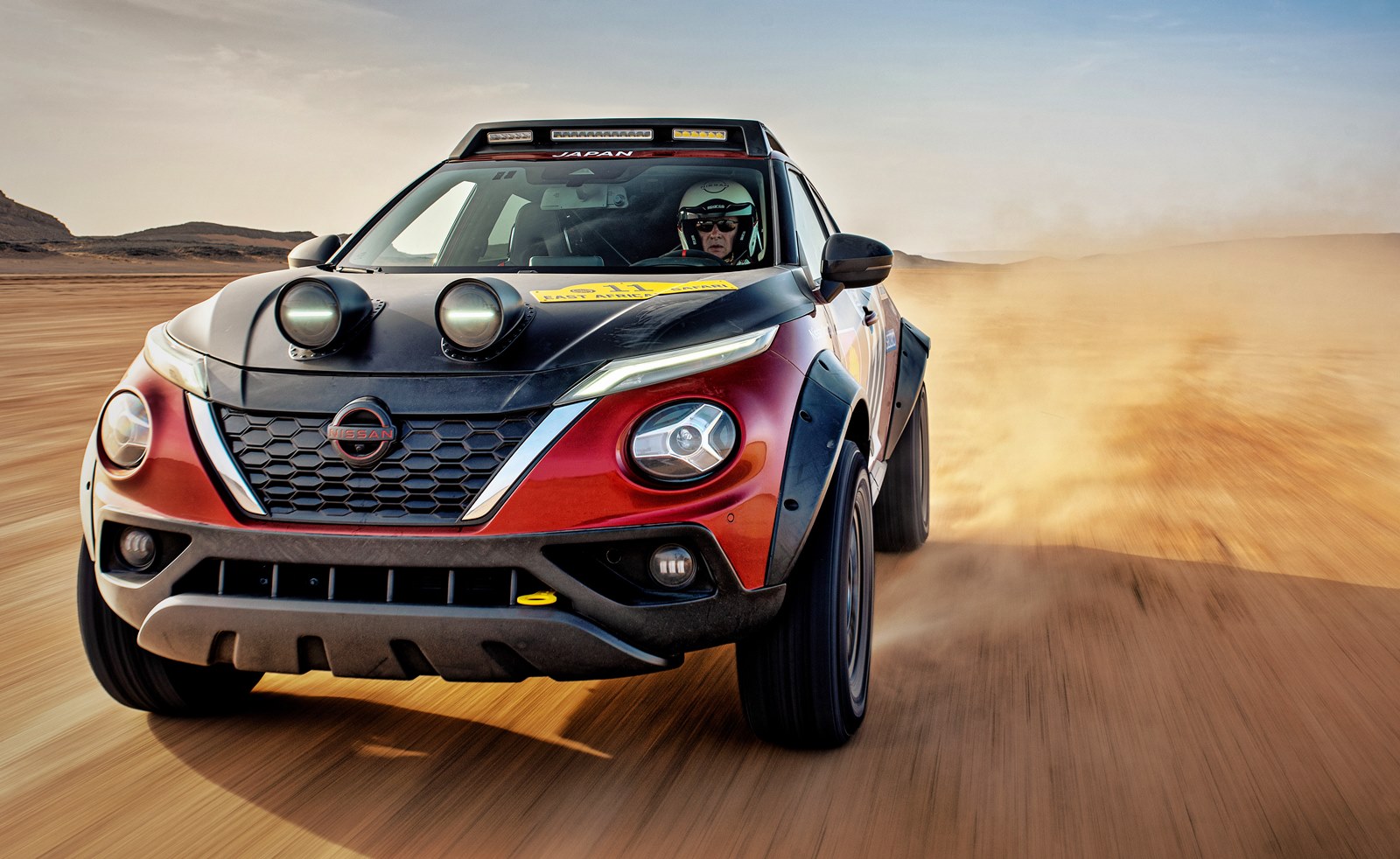
The most obvious modification are the enlarged wheelarches to accommodate the tailor-made off-road tyres, while the additional lights mounted on the bonnet and roof echo those of the 1970s era.
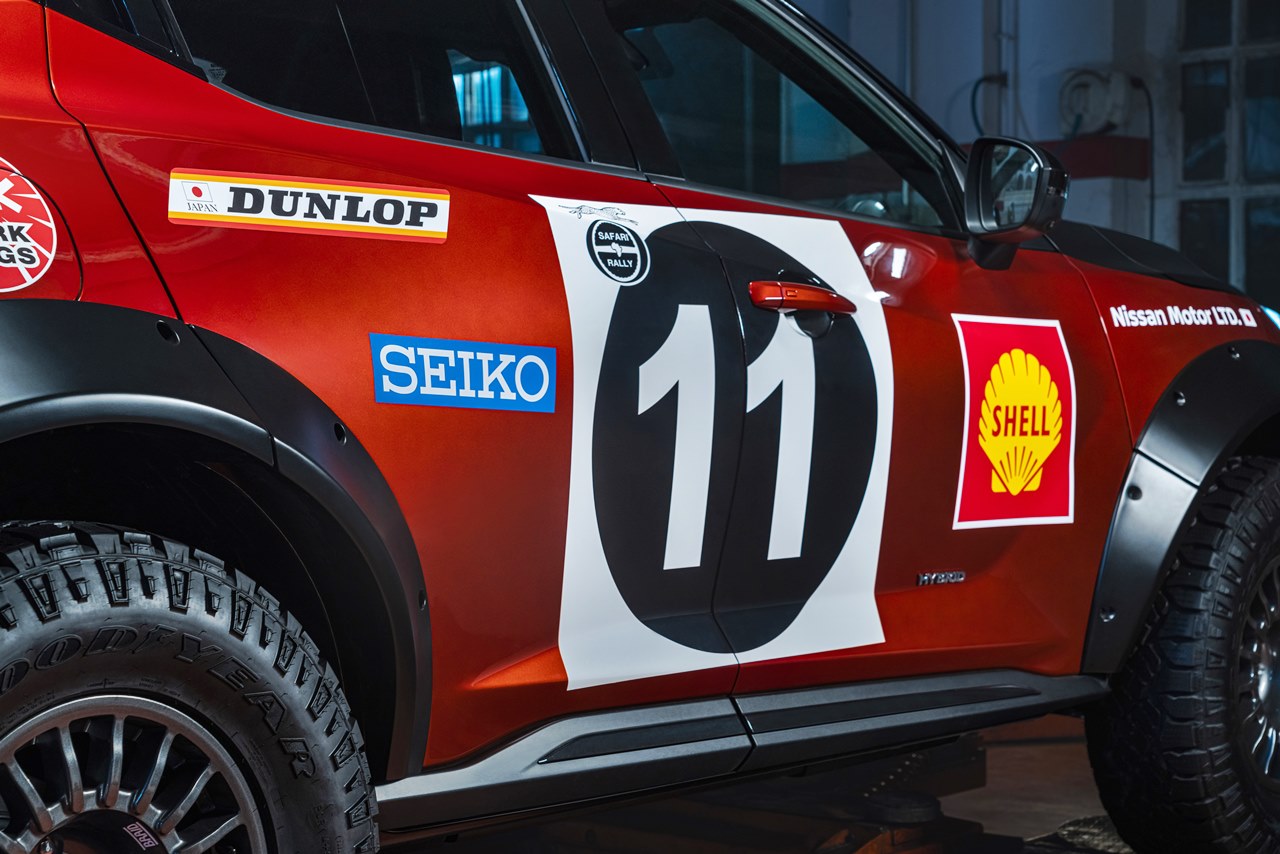
Similarly, the black of the bonnet and enlarged black wheels are a visual homage to the 1971 rallycar. To further provide period accuracy are vintage sponsor logos and the number 11, while the additional reinforced plates under the front and rear valances offer protection to the vehicle’s underside. Reinforced and long-travel suspension has been fitted all-round, while the tyres are 265/70 R16.
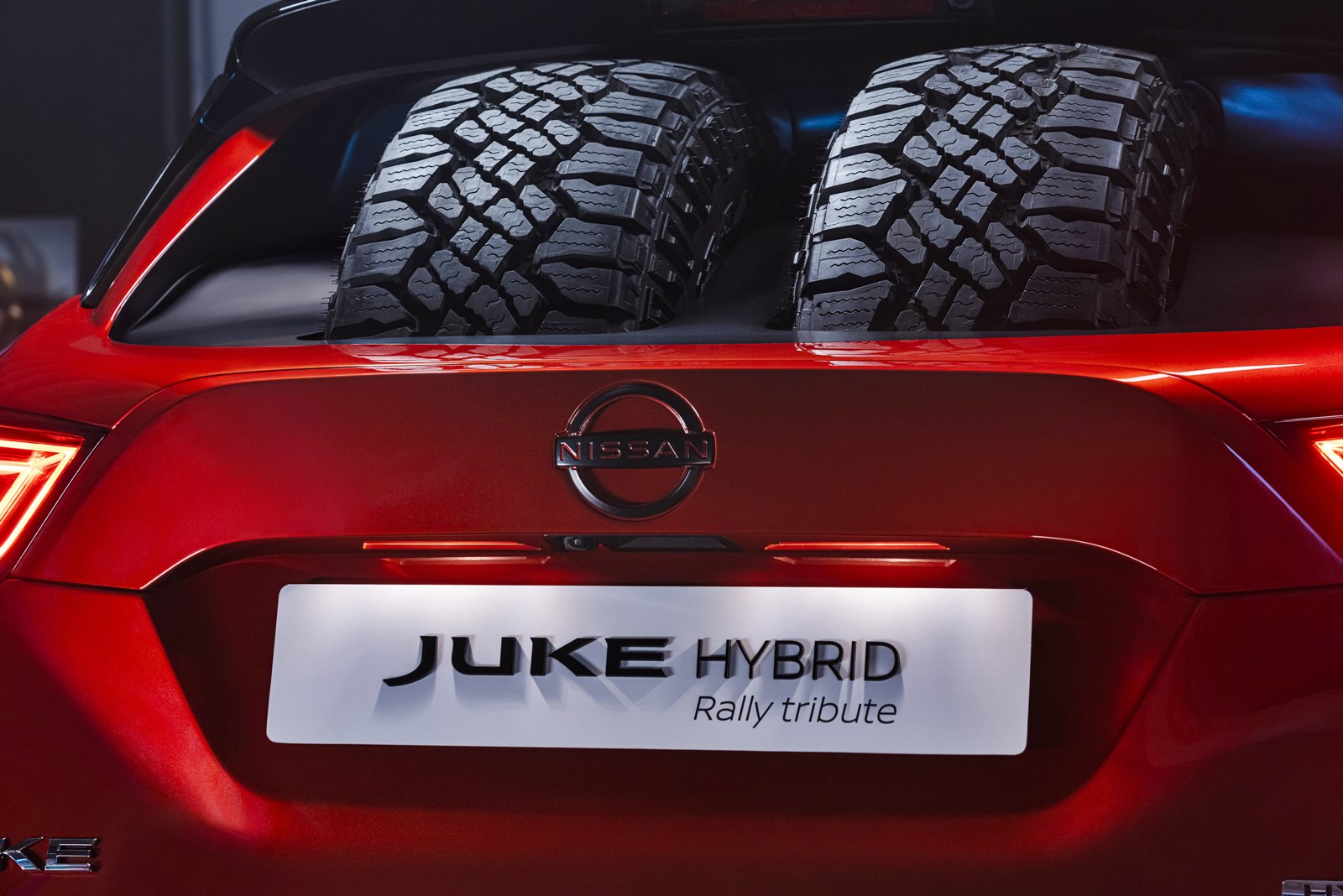
Inside, the cabin has been modified with the fitment of a tubular cage to stiffen the bodyshell and to offer protection in the case of an incident at speed in the challenging desert environment. The rear seats have been removed to provide space for spare wheels and 4-point harnesses have been added to secure the driver and navigator safely in their racing seats.
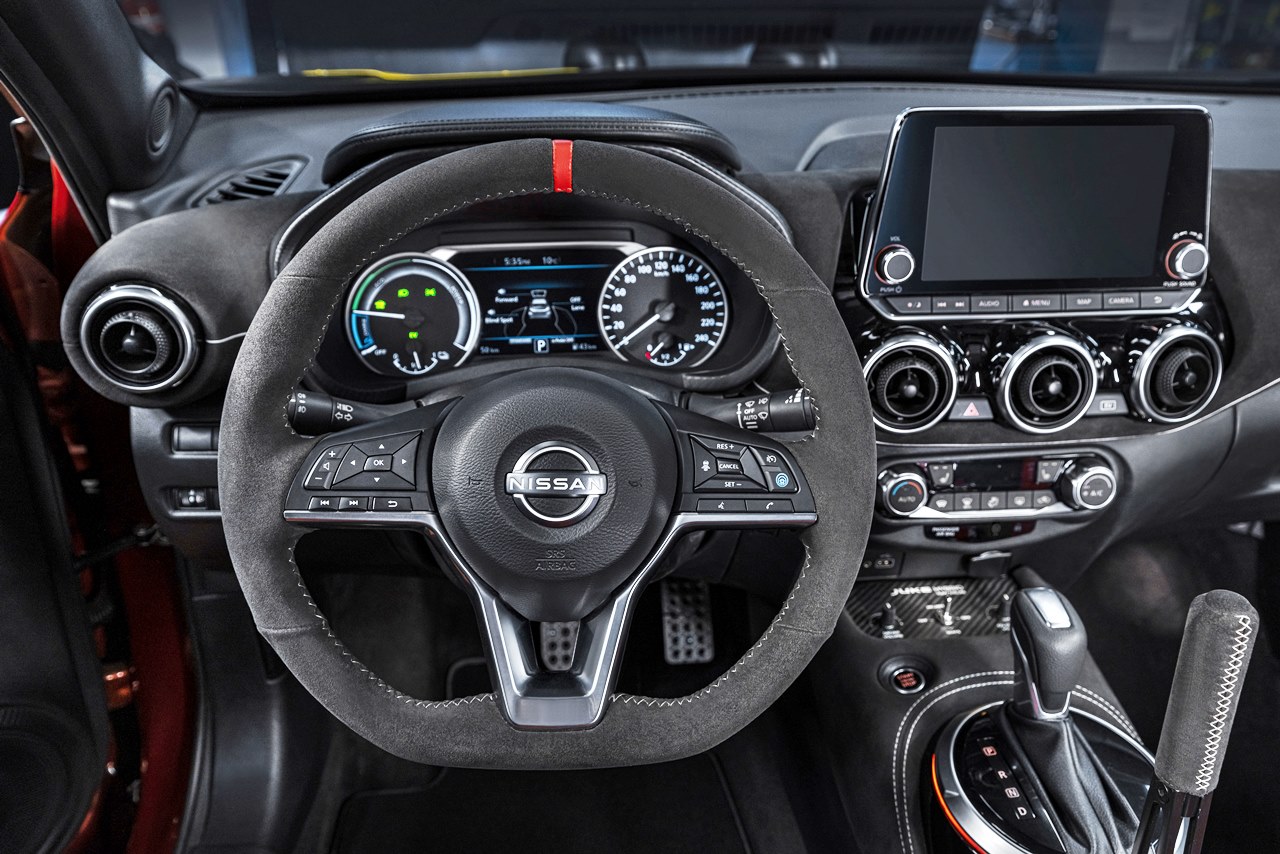
Other modifications to the interior include the fitment of a competition fire extinguisher, an intercom system with a pair of headphones (though the JUKE Hybrid Rally Tribute would be much quieter than the rallycar), the fitment of Alcantara trim on the steering wheel, and a hydraulic handbrake with a high-reach handle.
As part of the Juke Hybrid Rally Tribute project and in line with exploring rallying while being as eco-conscious as possible, the powertrain uses liquids and biofuels provided by Shell, Nissan’s partner for the 1971 East African Rally.
While Castrol is a leading name in the automotive and motorsports world as one of the leading lubricant companies, the brand also has a presence in non-automotive events such as the FIFA World Cup and UEFA European Championship. With its sponsorship of such world-class events, supported by various campaigns and activities, the brand has had exposure globally along with its versatile range of high-performance lubricants.
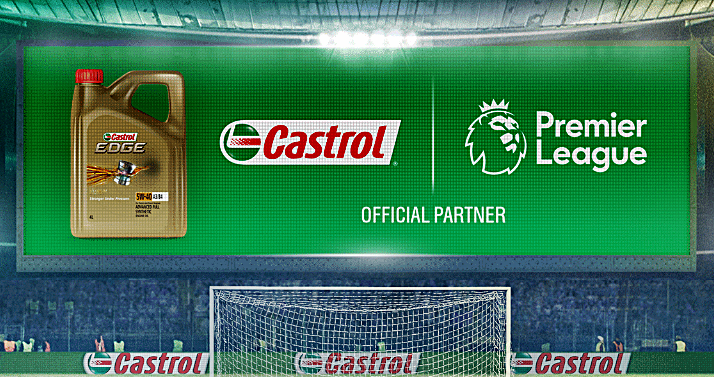
This year, Castrol’s presence in the football world will grow even further with the signing of an exclusive sponsorship with the English Premier League (EPL) for 2½ years, commencing from January 2022. As the most-watched football league on the planet, the EPL is broadcast in 212 territories to over 543 million homes, with a potential viewership of 4.7 billion.
Through this sponsorship, Castrol aims to showcase its evolving serve and maintenance business and provide an avenue to many customers to engage in two things they are passionate about – automotive and football.
Castrol subsidiaries around the world will also be having activities relating to the EPL sponsorship and in Malaysia, there will be various digital activations for the digital presence of Castrol Malaysia. One such activity will invite Malaysians to share their individual recreations of memorable football moments on social media in the ‘Castrol EPL Original Moment’ contest. There will also be bi-weekly activities for social media users where questions and games related to football matches will be asked. Through these events, football fans will be able to show off their knowledge in an engaging and fun way.
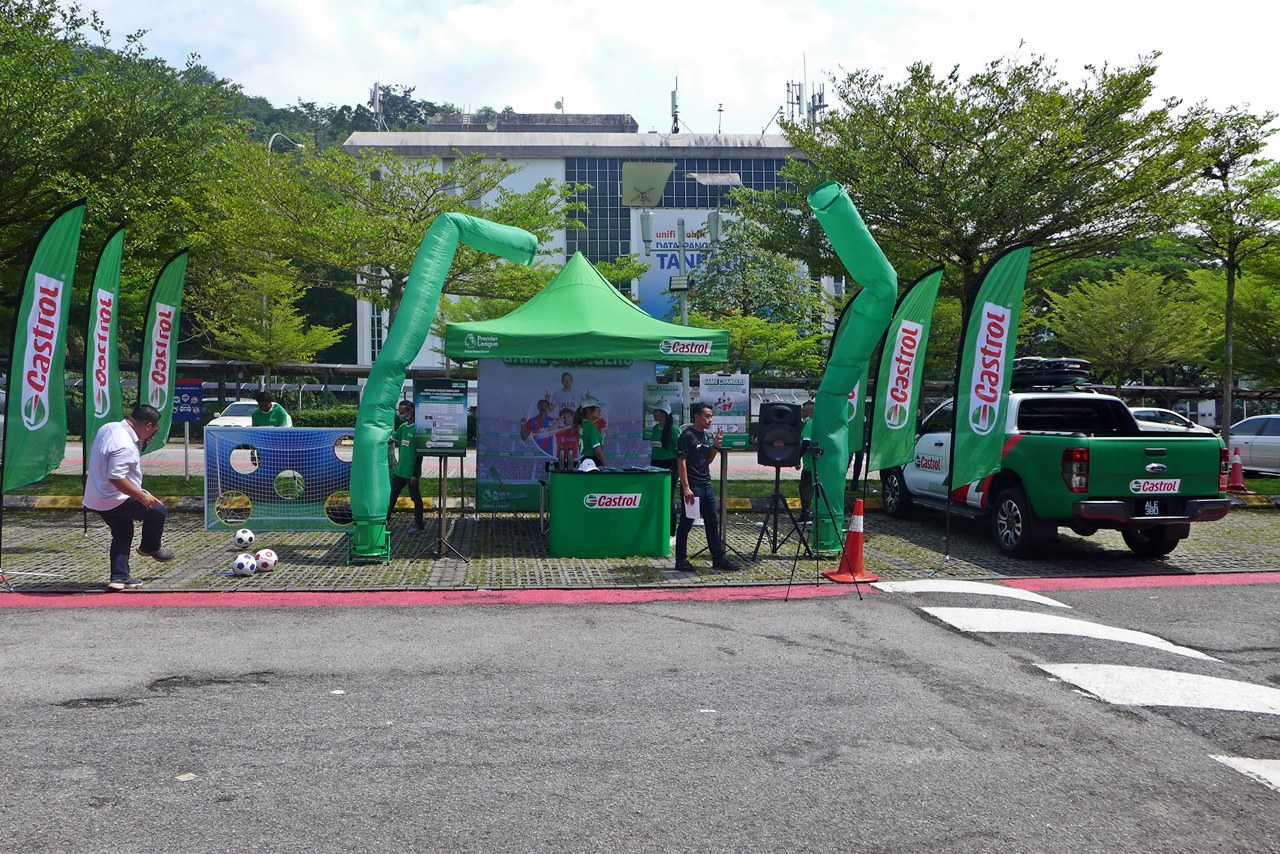
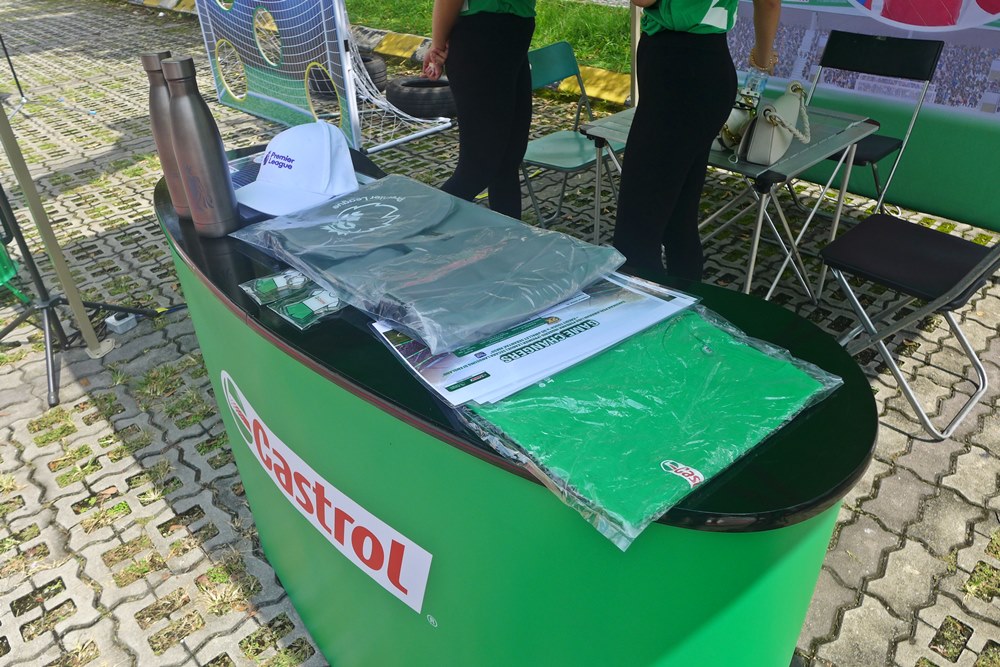
Some of the exclusive merchandise that can be won at booths promoting the Castrol Game Changers Contest.
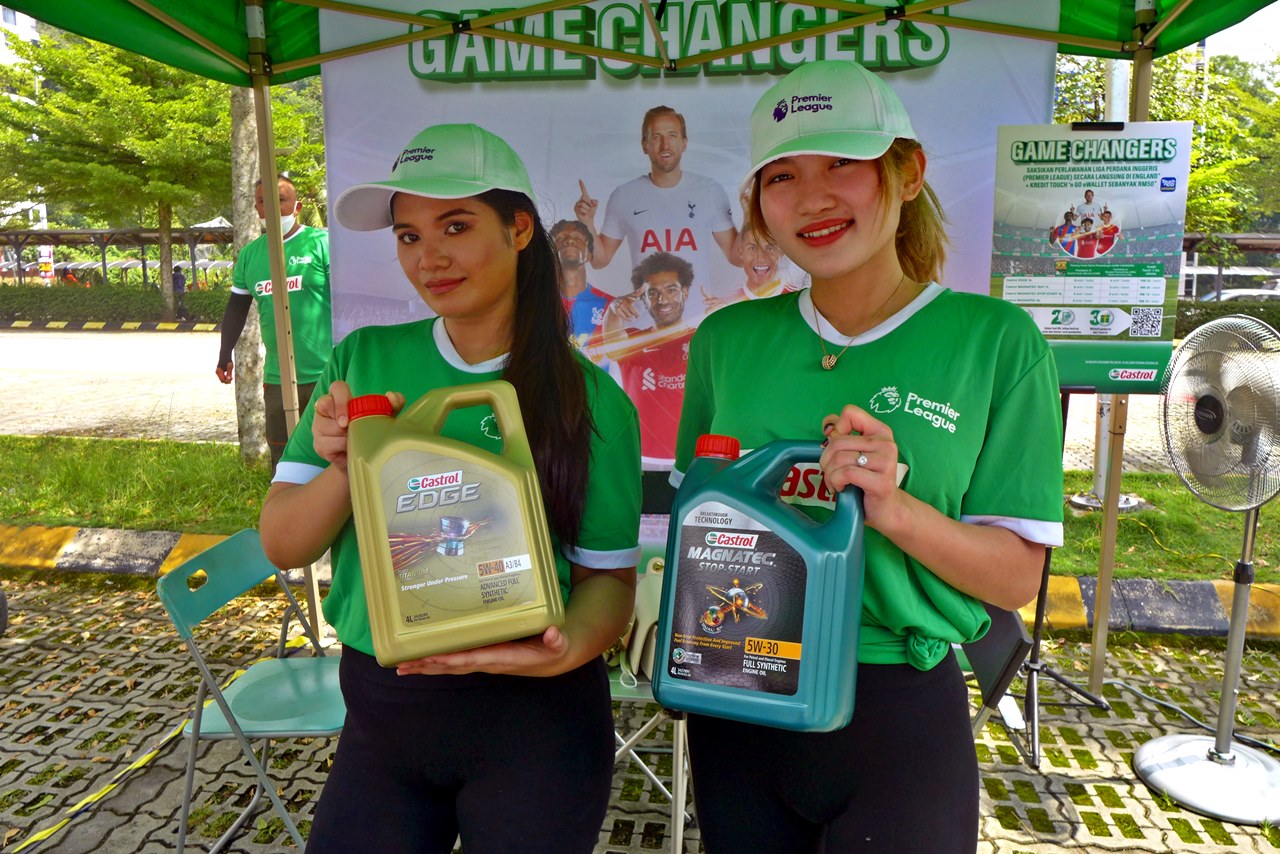
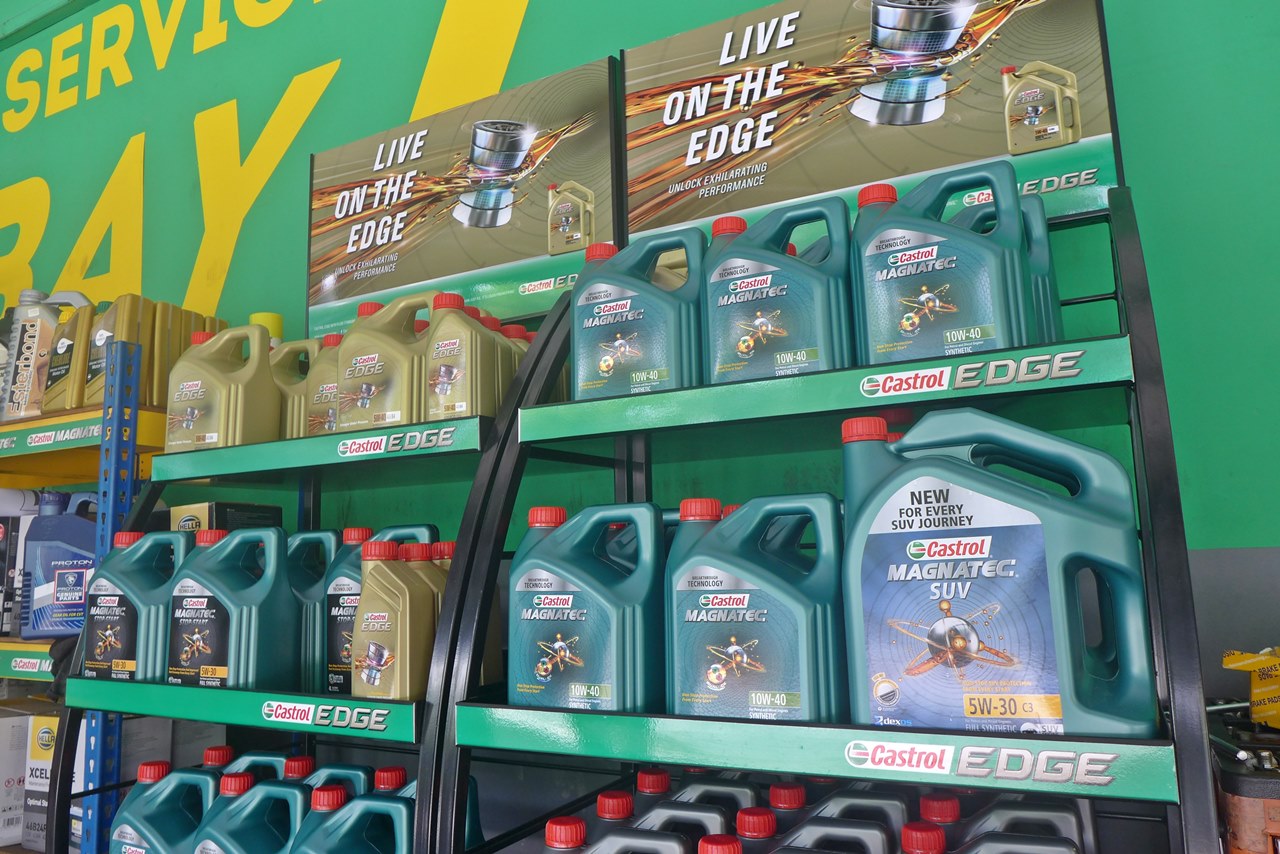
Throughout the year, there will also be other on-site campaigns which will include the Castrol Game Changers Contest. An exclusive Castrol X EPL Rover will be at key locations nationwide between May and September to promote the contest. At the various venues, members of the public will have a chance to win Castrol X EPL merchandise when they purchase Castrol MAGNATEC or Castrol EDGE engine oils.
Following the Castrol Game Changers Contest, 20 lucky participants (and their partners) will be selected from the entries to take part in a Race Off event. The top 8 teams that win the Race Off will proceed to the next and final level of the contest which will be a 2-on-2 futsal match. There will be two Grand Prizes of 4 tickets to watch an EPL match live in England in 2023.
For Castrol Malaysia, this year is of historic significance and there will be various celebrations throughout the year. One of them which has already been run in March was Castrol Hari Mekanik, which returned in a big way for the fourth consecutive year. Castrol Auto Service (CAS) is also celebrating its 20th anniversary this year and there are great promotions and deals for customers.
This is an exciting era for Castrol Malaysia and Singapore. The EPL sponsorship adds another feat to Castrol’s long list of milestones, particularly in our collaborative efforts with football organisations worldwide. This alliance will further showcase Castrol’s range of products and services to its audience and create a platform for us to engage with them, as well as appreciate them for being with us all this while. We are very excited to kick off the celebrations soon,” said Keow Mei-Shan, Marketing Director of Castrol Malaysia & Singapore.
To know more about Castrol products and services in Malaysia, click here.
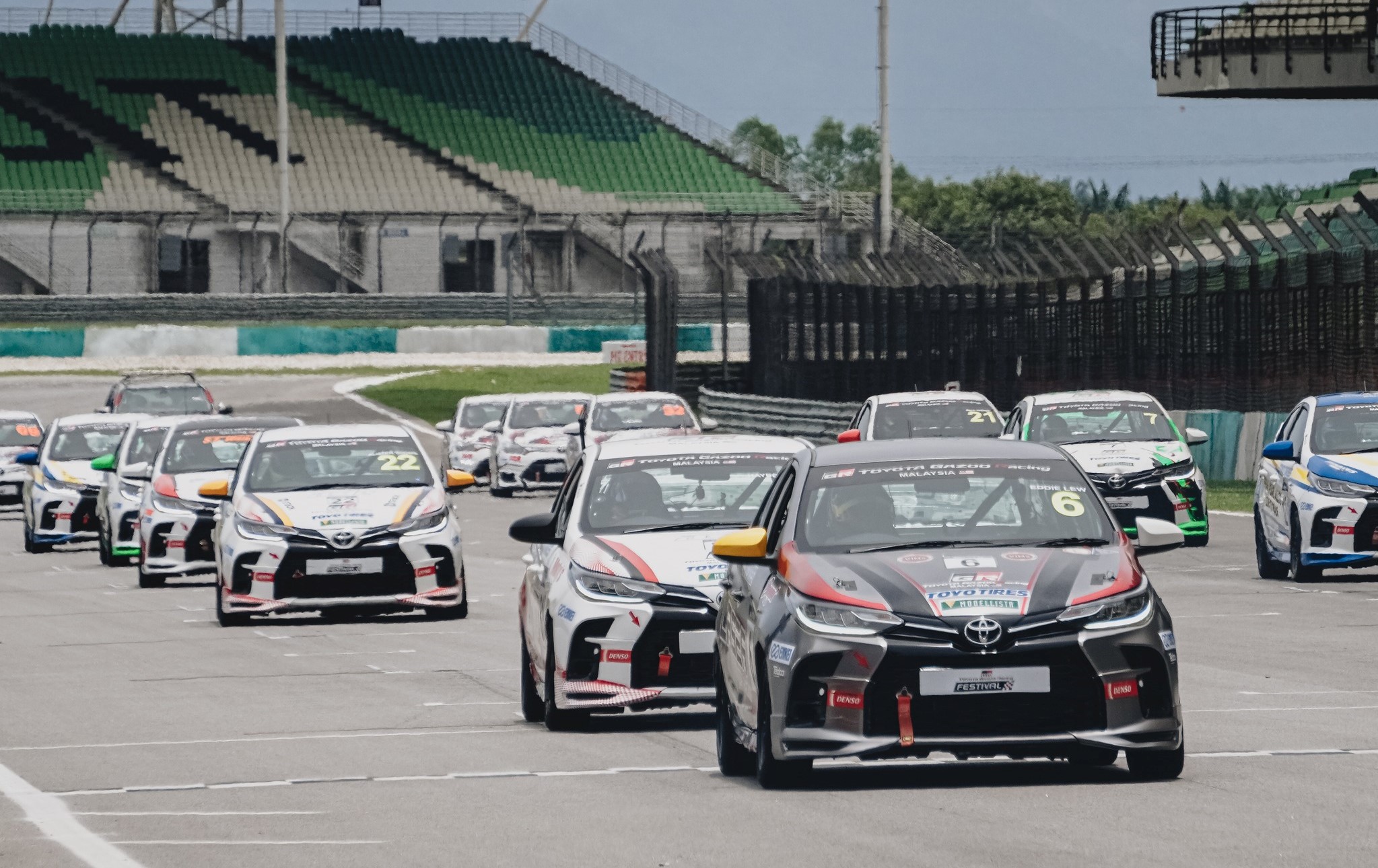
Now a firmly established event on the country’s motorsports calendar, the Vios Challenge, which originated as part of the TOYOTA GAZOO Racing Festival (TGR Festival), is the most lucrative motorsports event in the country. In total, more than a half a million ringgit in prize money is offered by organisers UMW Toyota Motor and GAZOO Racing Malaysia.
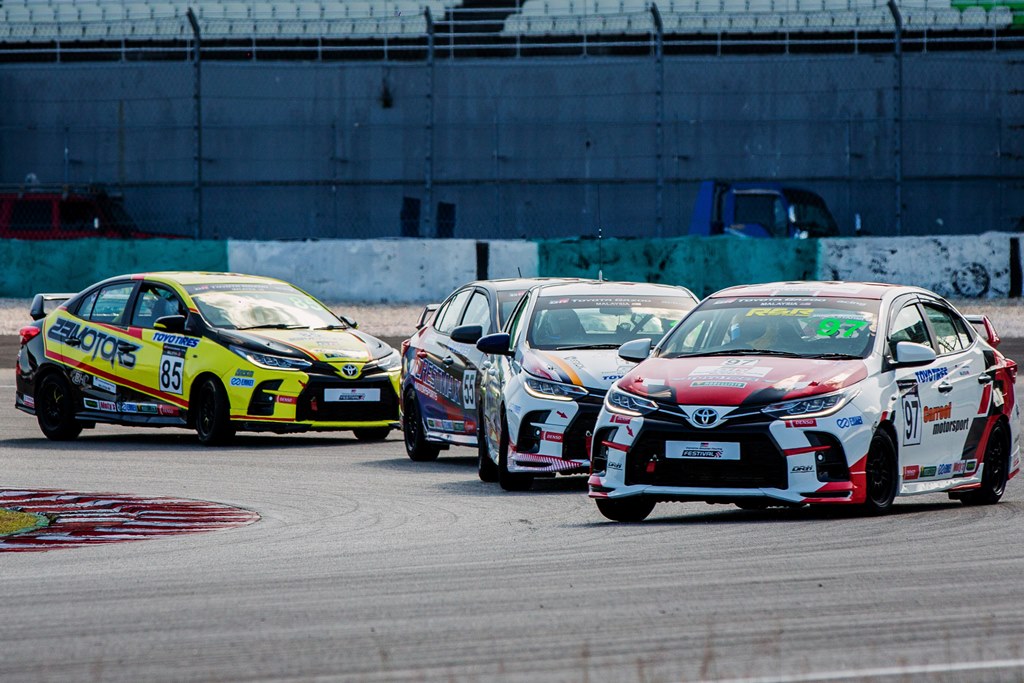
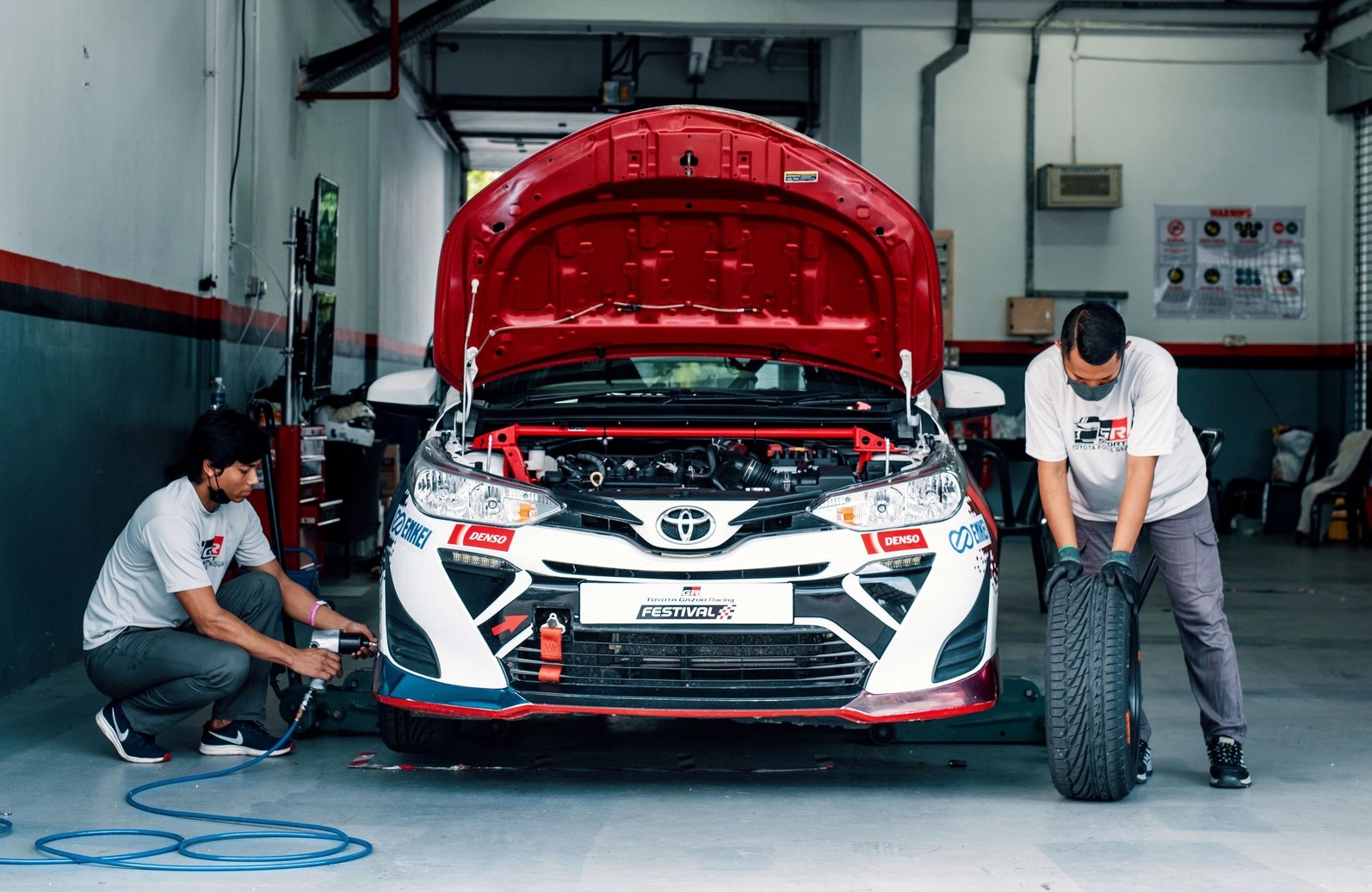
After 5 seasons of the one-make series, there now exists a large base of Toyota Vios cars in Malaysia which have been specially prepared to meet the regulations of the series. These regulations strictly require all the cars to be identical in specifications with stock standard drivetrains as well as suspension and tyres. The aim is to equalise the performance aspect of the machine and make the races about driving skills and experience.
The large base of race-ready cars had encouraged UMW Toyota Motor and GAZOO racing Malaysia to broaden the activities so that the owners have more races to participate in. One of the additional races on this year’s calendar is the GAZOO Racing Vios Sprint Cup in the Malaysia Championship Series (MCS) this weekend (May 21/22) at the Sepang International Circuit.
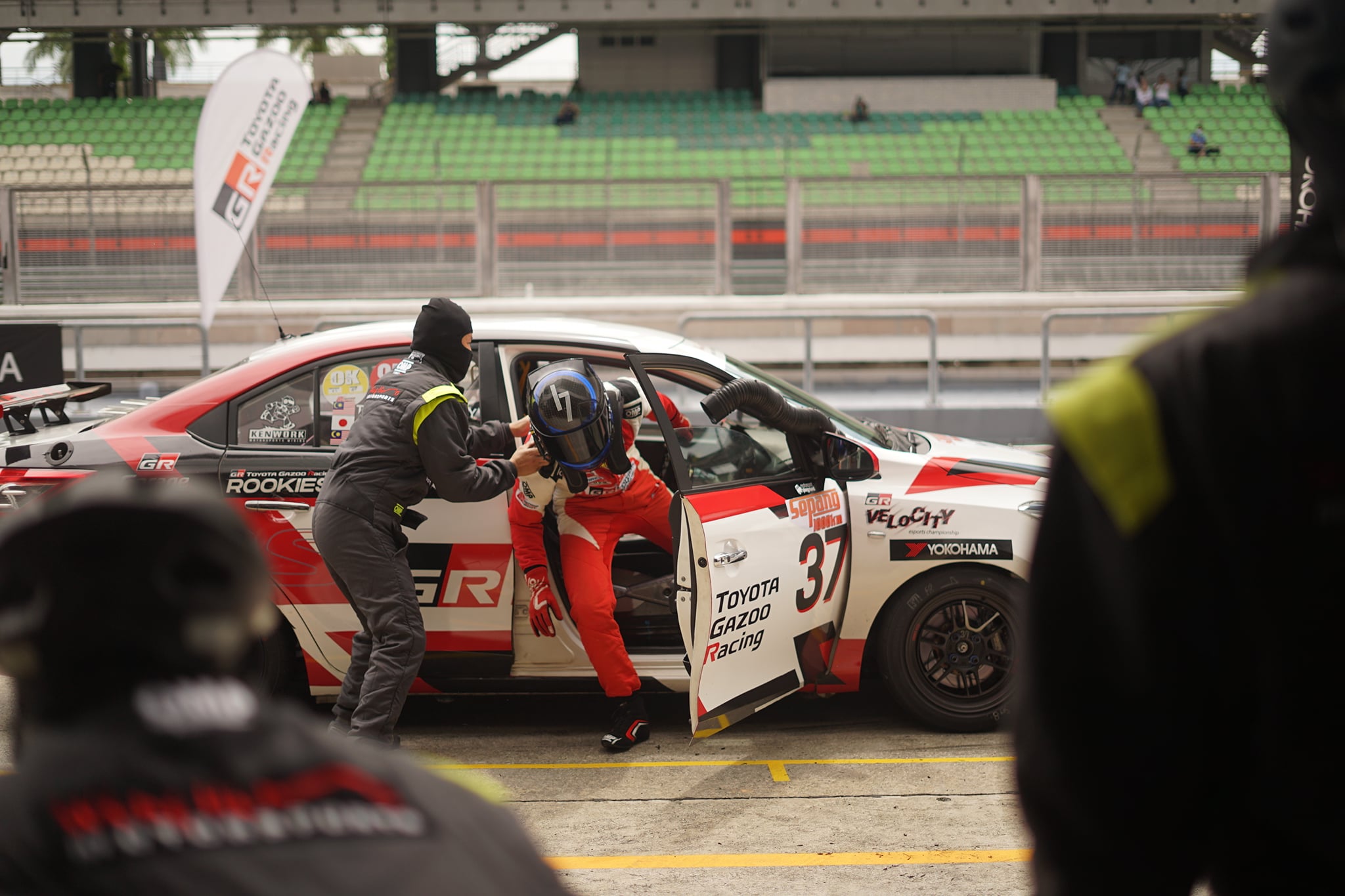
A total of 38 drivers will start the first ever running of the GR Vios Sprint Cup, which will have two 1-hour races on Saturday and Sunday, with two-driver teams competing in 3 generations of Vios vying for total prize monies amounting to RM60,000.
The GR Vios Sprint Cup is run independently of the Vios Challenge, and there will be 2 rounds within the MCS, with each round offering two races. However, the regulations for the GR Vios Sprint Cup are similar to those of the Vios Challenge with regard to all the cars being identical in specification and preparation, with the only differences being the driver behind the wheel and the paint scheme on the bodywork.
All the cars are standard Vios models and prepared identically for racing so that they have similar performance levels. Winning a race is therefore dependent on driver experience and skills, rather than the power of the car.
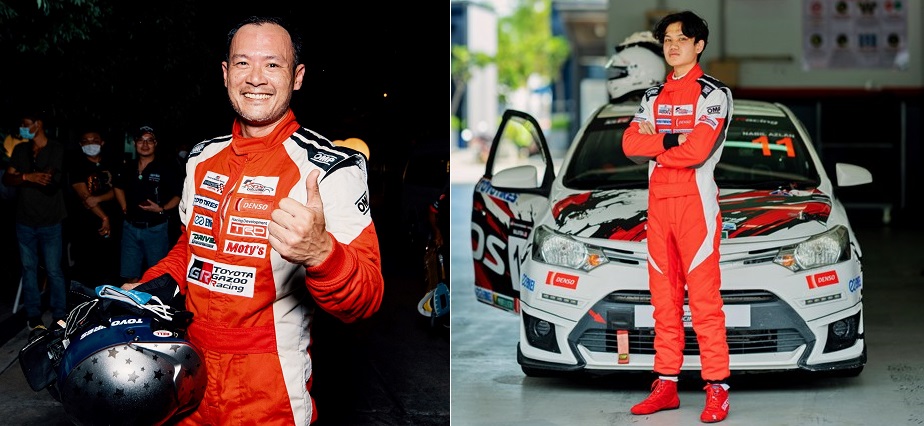
Not surprisingly, the event has attracted many top local racers with varying levels of experience, virtually all of whom have taken part in the Vios Challenge. These include experienced contenders like Tengku Djan Ley, Mark Darwin, Mohd Fariqe Hairuman, Eddie Lew, Boy Wong and William Ho, as well as what can be regarded as the next generation of racers. These are drivers like Naquib Azlan, Hayden Haikal, Mika Hakimi, Nabil Azlan, Bradley Benedict Anthony, Timothy Yeo and Alister Yoong.
The GR Vios Sprint Cup will see drivers with varying experience – from veterans like Tengku Djan Ley (left) to rookies like Nabil Azlan (right).
To level the playing field further, the race prohibits 2 experienced drivers from racing together in the same car. Driving for Prima Pearl TD Racing, Tengku Djan will thus partner teenager Mika Hakimi this weekend, while Mark Darwin, another strong contender, will team up with another teenager, Bradley Benedict Anthony for Laser Motor Racing.
Axle Motorsports meanwhile, will field 2 all-teenage teams with the first pair of drivers consisting of Hayden Haikal and Naquib Azlan, and the second car driven by Alister Yoong and Muizz Musyaffa.
Race 1 of the GR Vios Sprint Cup on Saturday will see both drivers driving in two separate qualifying sessions, with the faster driver required to start the 1-hour race before making a mandatory pit-stop for a driver change. In Race 2 on Sunday, which will start as a reverse grid order based on the results of Race 1, the slower driver of the pair will start the 1-hour race and again required to make a mandatory pit stop. Both races will be a rolling-start format.
“Unlike the Vios Challenge which is usually confined to approximately 30 minutes of racing, the GR Vios Sprint Cup is designed to up the ante and to double the excitement on the track. In a full-blown endurance race, racers will pace themselves, but this is a 1-hour sprint to the finish which means the drivers will be going all out for 60 minutes from the very first corner in order to maintain an edge,” said UMW Toyota Motor’s President, Ravindran K.
“Since UMW Toyota Motor began committing itself to motor racing in 2017, the objective has always been to see how we can contribute to not only the growth but to make Malaysian motorsports even more vibrant. The format of a one-make race has proven to be an incredibly successful formula, attracting not only professionals and experienced racers, but also newcomers and young talent. The GR Vios Sprint Cup continues this tradition but by changing the dynamics of the race, continues to generate enormous interest and participation which we hope will help to create more excitement in Malaysian motorsports,” he said, adding that there will also be the GR Vios Enduro Cup in conjunction with year end’s Sepang 1000Km Endurance Race.
Like the Vios Challenge which is the most lucrative motorsports event in Malaysia, the GR Vios Sprint Cup offers a large sum of prize money.
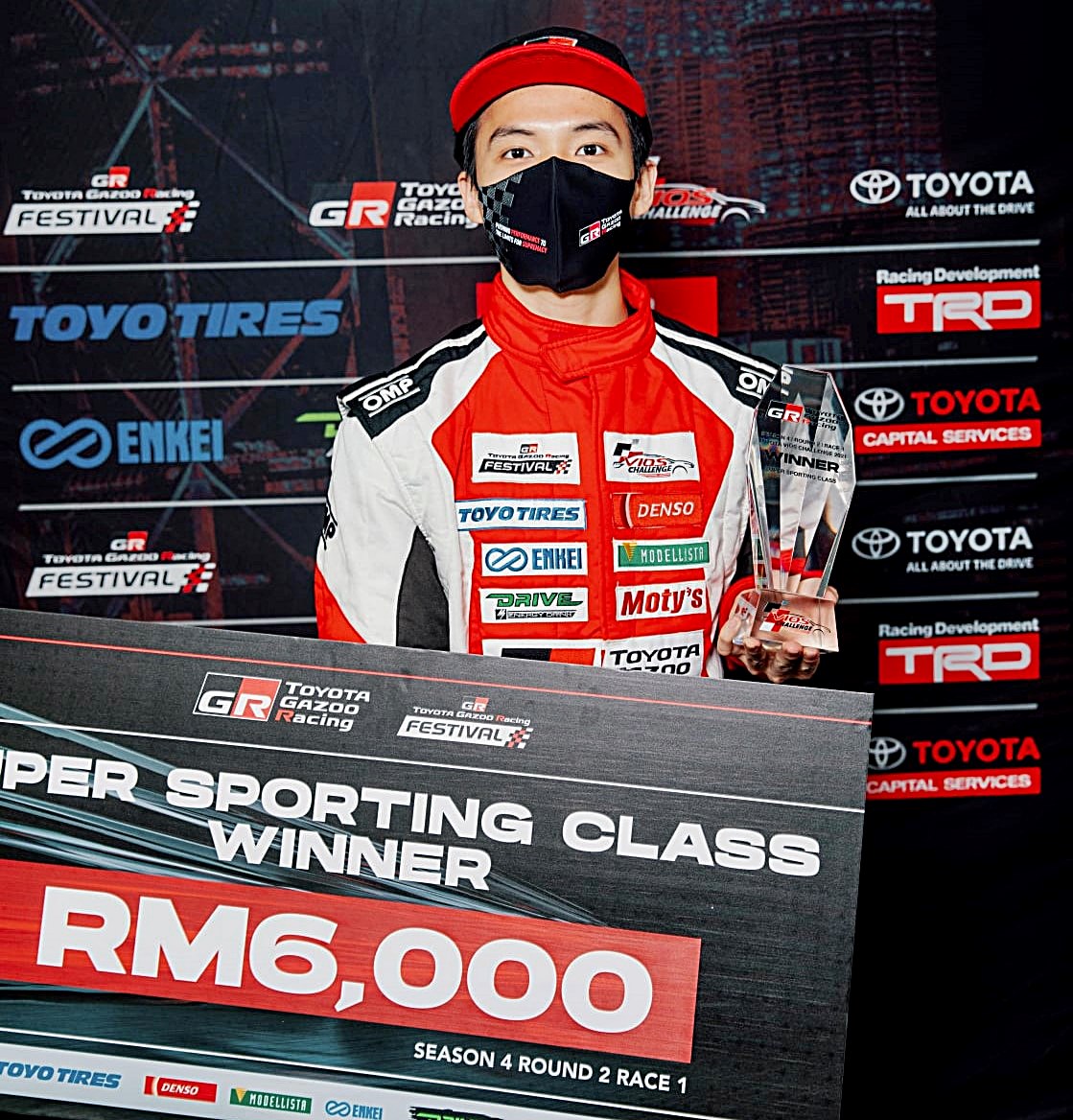
The overall champion in each of the 2 races at the GR Vios Sprint Cup stands to win RM10,000 cash, followed by RM8,000 for the first runner-up, RM6,000 to the third-place winner, and RM4,000 and RM2,000 for the fourth and fifth placed winners, respectively. In total, the Vios Sprint Cup offers prize monies amounting to RM60,000 per round.
UMW Toyota Motor is also putting up an additional RM30,000 in prize monies for its Toyota dealer teams making the GR Vios Sprint Cup the second most lucrative racing event in Malaysia next to the Vios Challenge.
With pandemic-related restrictions now eased, spectators are allowed to be at the racetrack to watch the races this weekend. Or you can also watch the live broadcasts UMW Toyota Motor’s Facebook page from the comfort of home. Click here for more information on GAZOO Racing Malaysia’s activities.
A Ferrari is already an exclusive machine when it leaves the factory but virtually none are ‘stock standard’ as every owner will want to personalise their car in some way. After all, when you have paid that much, what’s a little bit more to add something to make it unique? That’s what Ferrari’s bespoke Tailor Made department offers – an exclusive programme for those who wish to customise any element of their car.
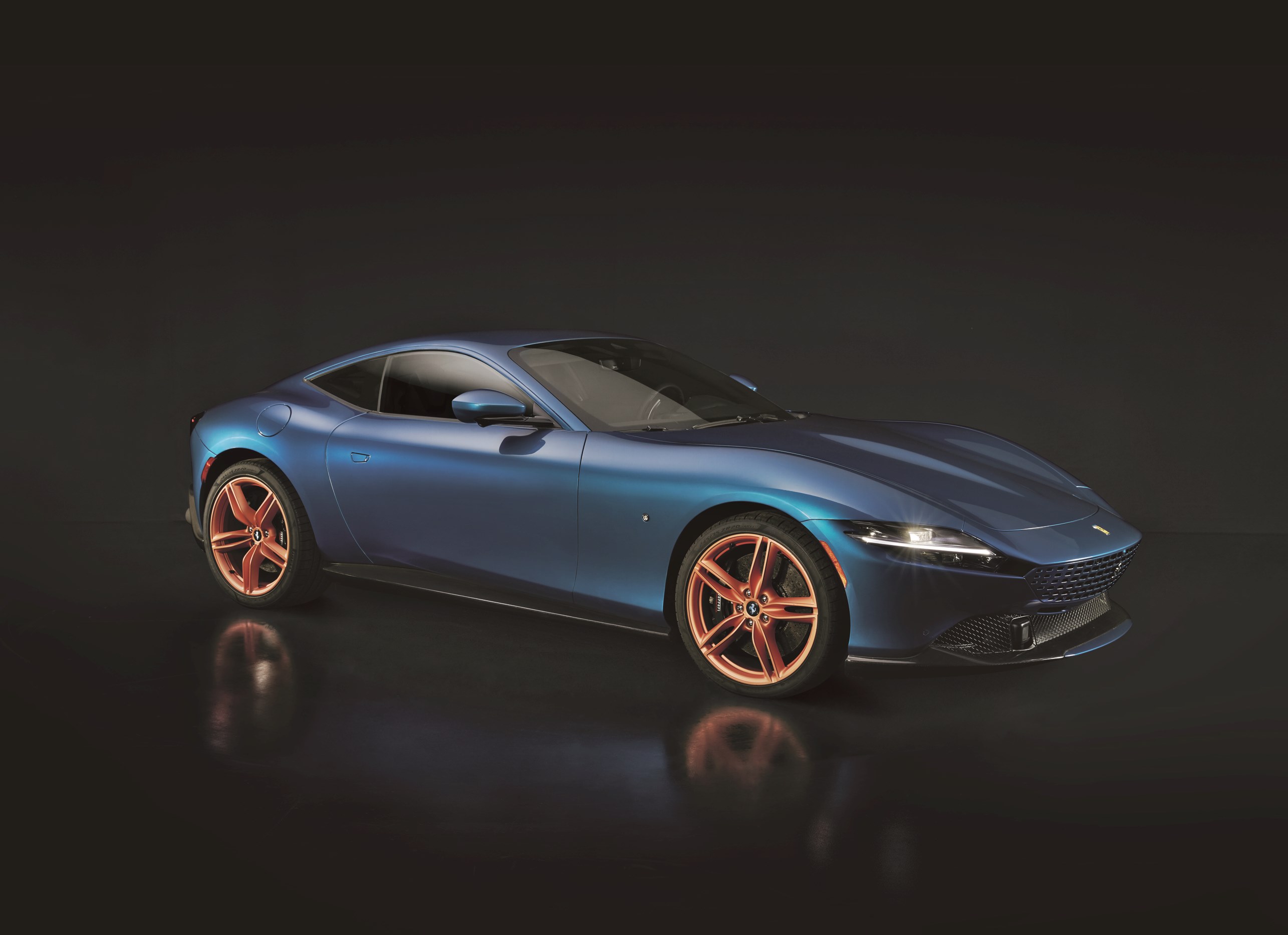
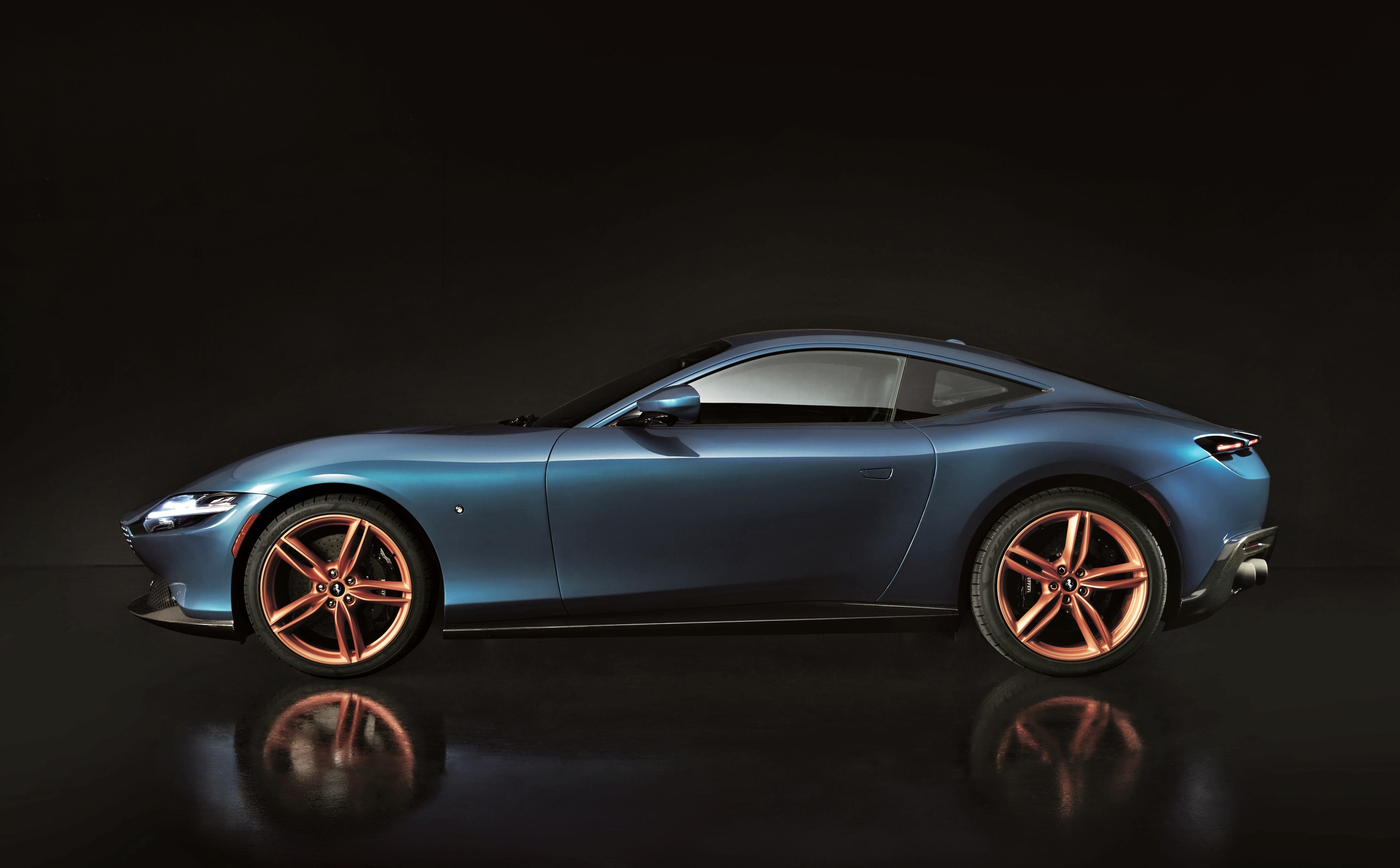
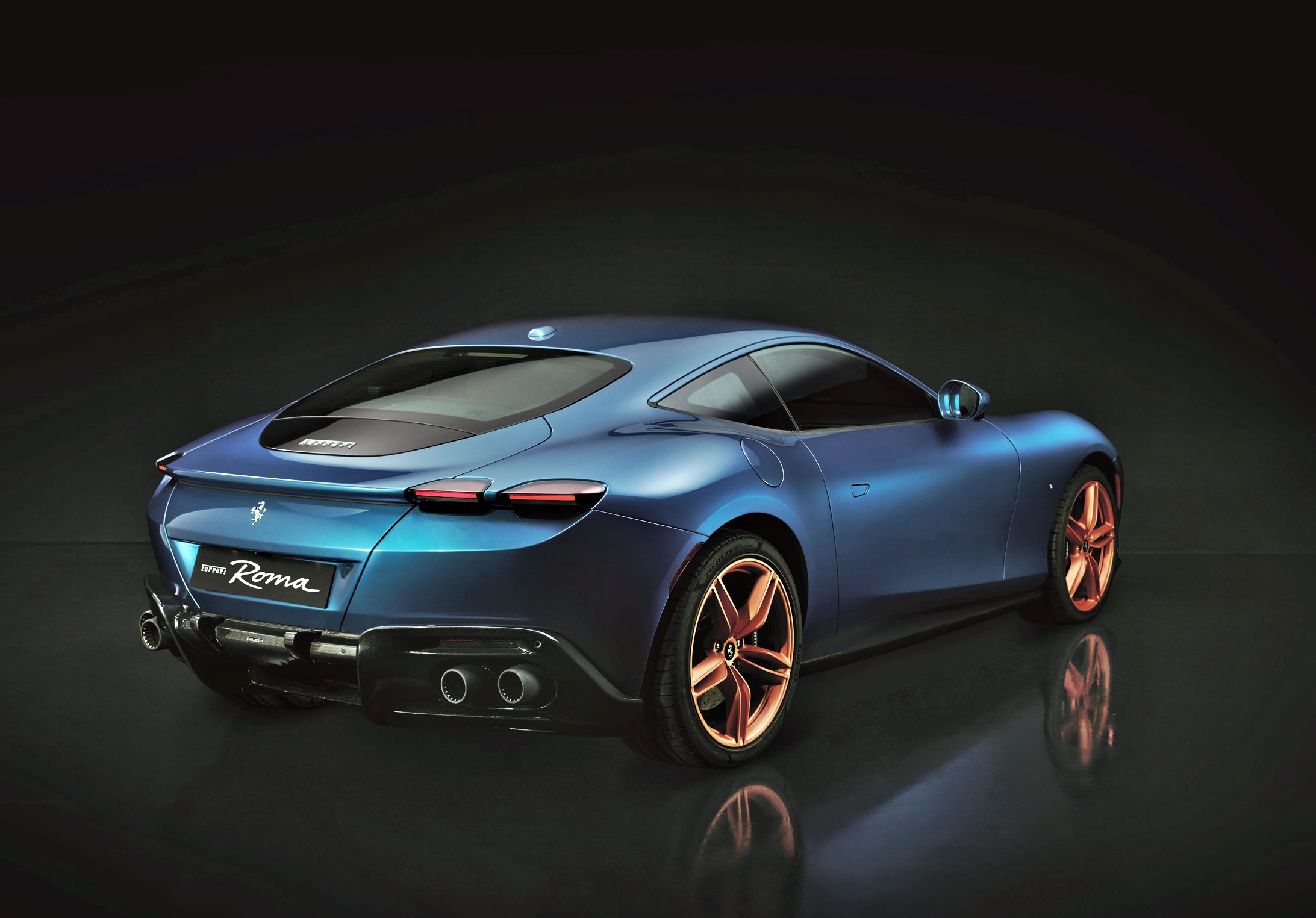
Many of the cars that the Tailor Made department works on are not publicised as the owners may prefer the privacy, but there are also some cars that do become public and this one-of-a-kind Roma model is one of them. Crafted with exquisite traditional Japanese-inspired detailing while retaining the clean, sophisticated elegance of the original car.
This particular car’s story began when Evan Orensten and Josh Rubin, the founders of the American publication COOL HUNTING, were offered, and accepted, the opportunity of customising a Ferrari Roma. The idea was to explore how far Ferrari’s bespoke personalisation programme could go and really push the boundaries.
The project started off two years ago with the first of several research trips to Japan where they immersed themselves in the country’s traditional crafts and artisanal methods. Then they proposed bringing some of those ideas and unique materials into the Tailor Made journey as envisioned by COOL HUNTING, and conveyed this to Flavio Manzoni, Ferrari’s Chief Design Officer, at the Ferrari Tailor Made showroom in New York.
Manzoni and his team were inspired by the parallels between Italian and Japanese culture and design philosophy: a single-minded devotion to quality, an emotional involvement with the client, and exquisite skills in craftsmanship that have been passed down from generation to generation.
An idea formed – to create a Ferrari featuring some of the unique materials developed from traditional Japanese techniques while employing Ferrari’s customary innovation to modify them to accommodate the requirements of durability and functionality that a modern high-performance car demands.
Traditional Japanese indigo dyes inspired the Roma’s colour scheme, particularly the vivid blue exterior paint which was specially developed for this car and named Indigo Metal. This vivid colour perfectly enhances the purity of the Roma’s shape – light appears to flow over its bodywork, accentuating its lines through highlights and shade.
Indigo features prominently in Japanese design culture, and the traditional dye is produced naturally. COOL HUNTING had visited Toyama, one of only 5 remaining indigo farms in Tokushima, Japan’s traditional indigo-growing region. They learned that the dye comes from a green plant which, when harvested and fermented, becomes sukumo, traditional dried Japanese indigo that is mixed with lye, sake and limestone powder to create authentic Hon-Ai indigo dye. Because of its anti-microbial properties, it was traditionally used for linens, bedding and clothing.
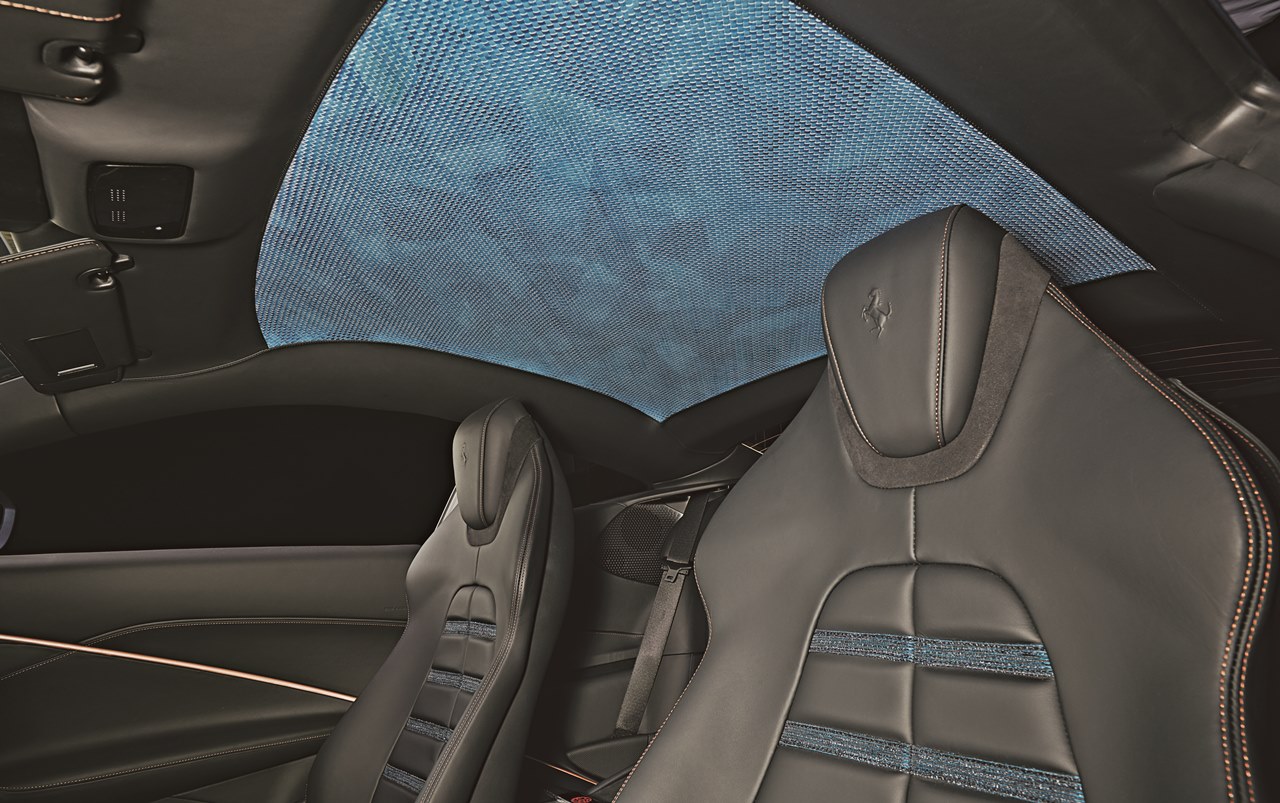
The same colour palette is used to tie together the vehicle’s exterior and interior into one subtle, holistic statement. The indigo shade is also found in the sakiori fabric used for the seat trim inserts and the carpets.
Sakiori is one of the world’s oldest examples of upcycling, dating from the 1700s when cotton and silk were available only to Japan’s nobility and the very wealthy. Worn-out kimonos were disassembled, their fabric cut into strands and rewoven with new fibres, creating a material that was both warm, comfortable and durable. The word comes from the Japanese saku (to rip up) and oru (to weave).
An innovative solution was identified in making sakiori a viable material. Two vintage kimonos originally made in Amami Oshima, an island in Japan’s southern archipelago were used — an indigo-dyed kimono approximately 75 years old and one approximately 45 years old, dyed in both indigo and the island’s celebrated Amami Oshima Tsumugi mud-based dye.
The indigo theme is carried through to the Roma’s headlining – a beautifully detailed piece of craftsmanship and design which is exclusively experienced by those sitting in the car. It is made up of two indigo-dyed hides made – one with a unique solid colour crafted to match the car’s colour scheme, and a hand-painted hide using a method which can be traced back to the 8th century.
The hides were then sent to Italy, where they were cut into strips and hand-woven by Italian artisans in a process called intreccio, forming an elegant one-of-a-kind work of art.
The Roma’s interior door handles also take their inspiration from Japan – they are enclosed in tightly hand-woven strips of black leather in an homage to tsukami, the ancient art of wrapping the grips of Katana swords.
The COOL HUNTING team were further inspired by a visit to Kaikado, a Kyoto-based family business known for its iconic copper tea canisters. Now made by the fifth and sixth generations of the family, the canisters are so skilfully crafted that they form a vacuum seal as the lid gently falls onto the body. The copper also adopts a unique natural patina with use.
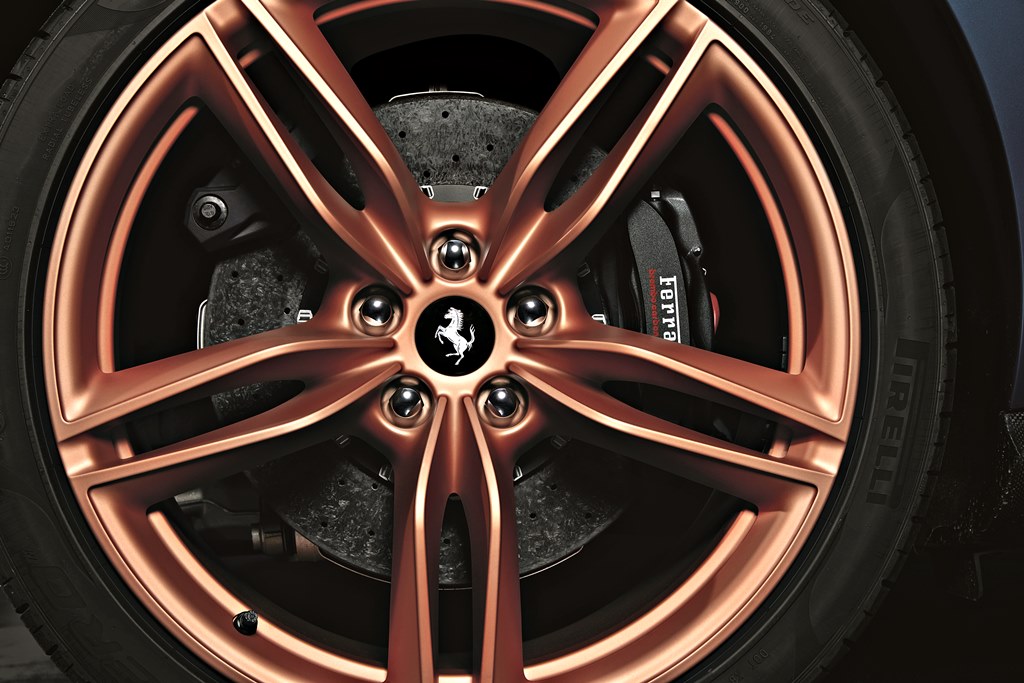
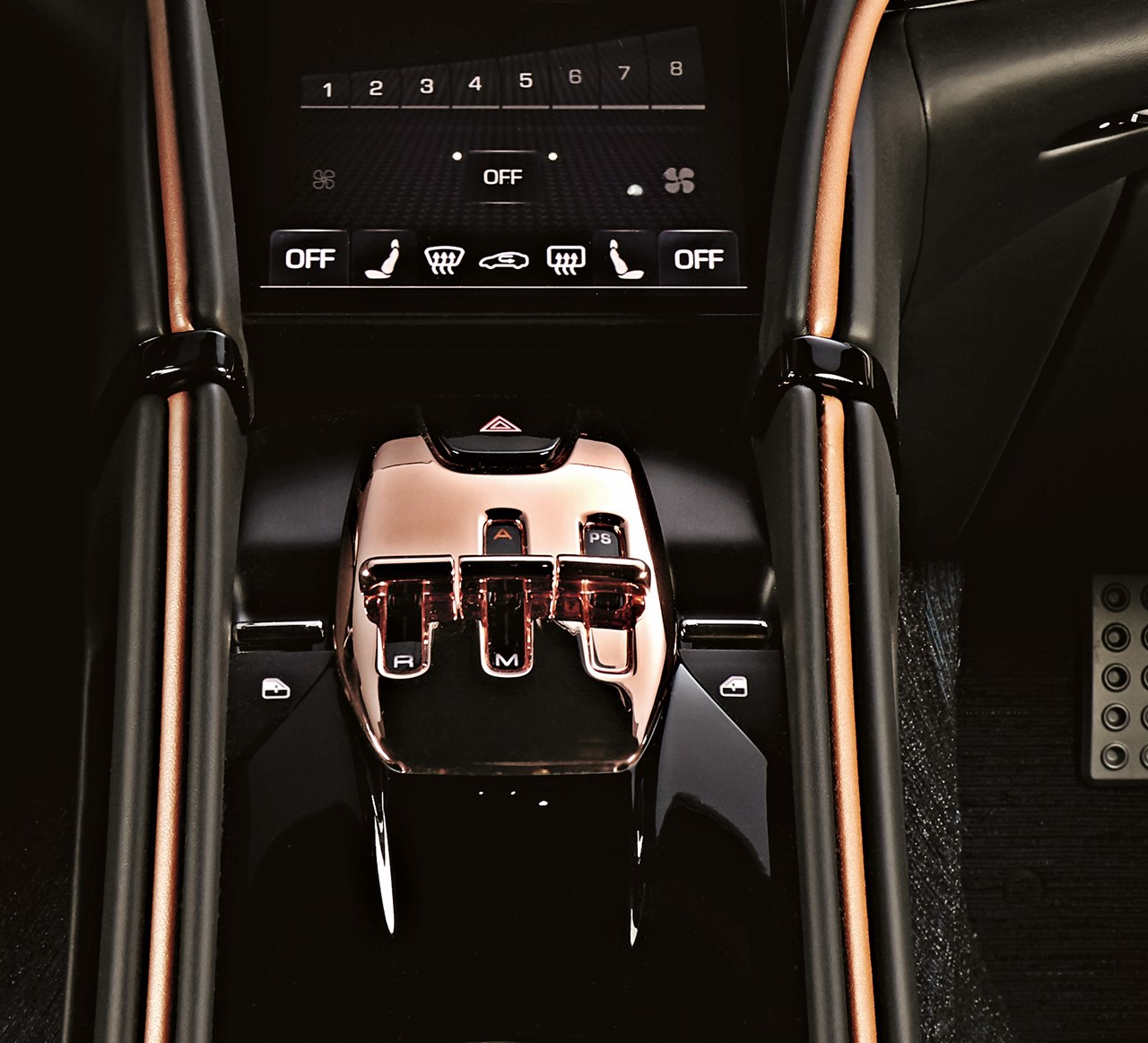
Inspired by this, copper plating is found in details on the Roma’s gearshift gate surround and levers, which were plated in Japan. The outline of the dual cockpits, the wheel rims and the kamon are also made in this colour.
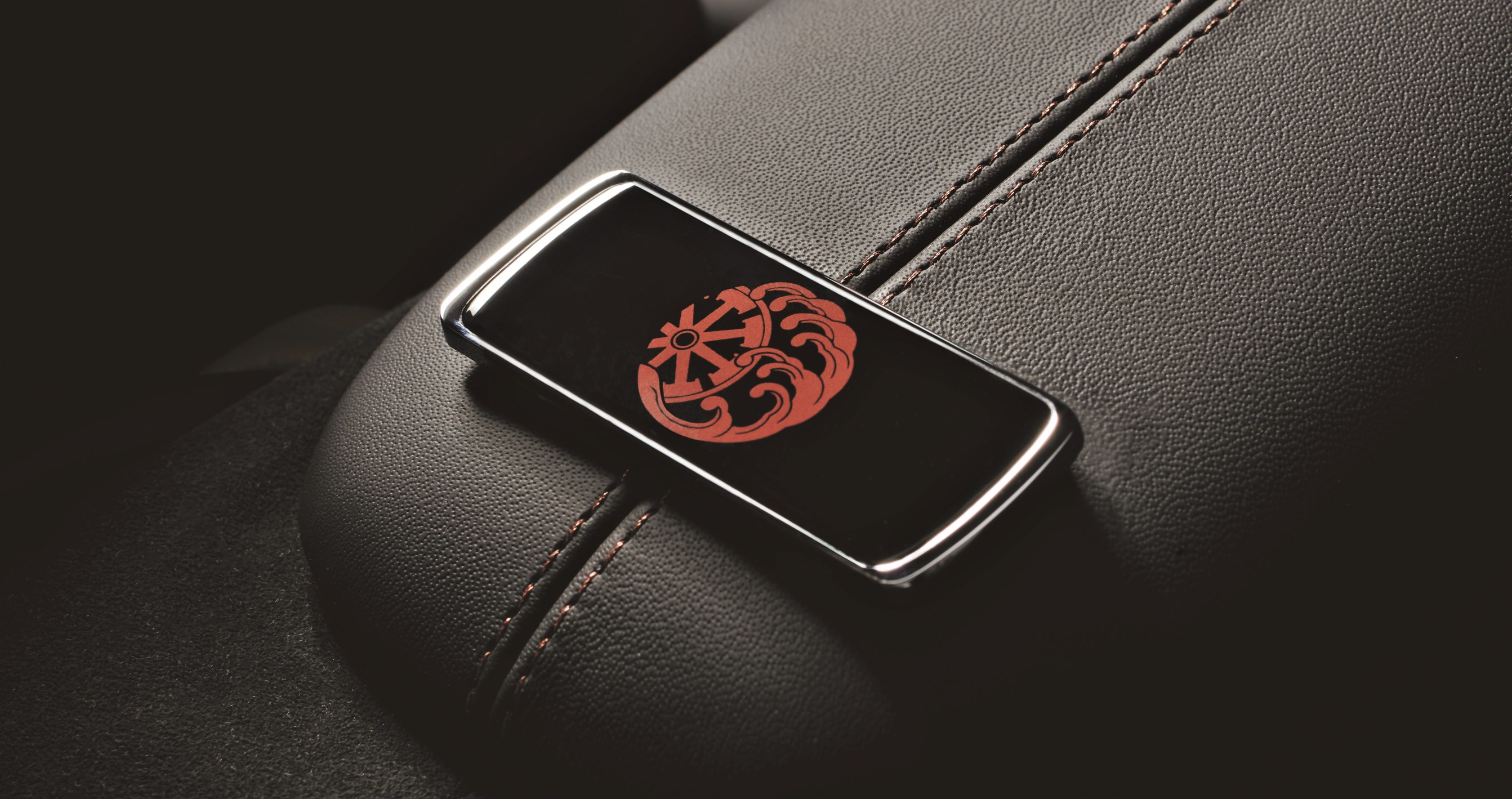
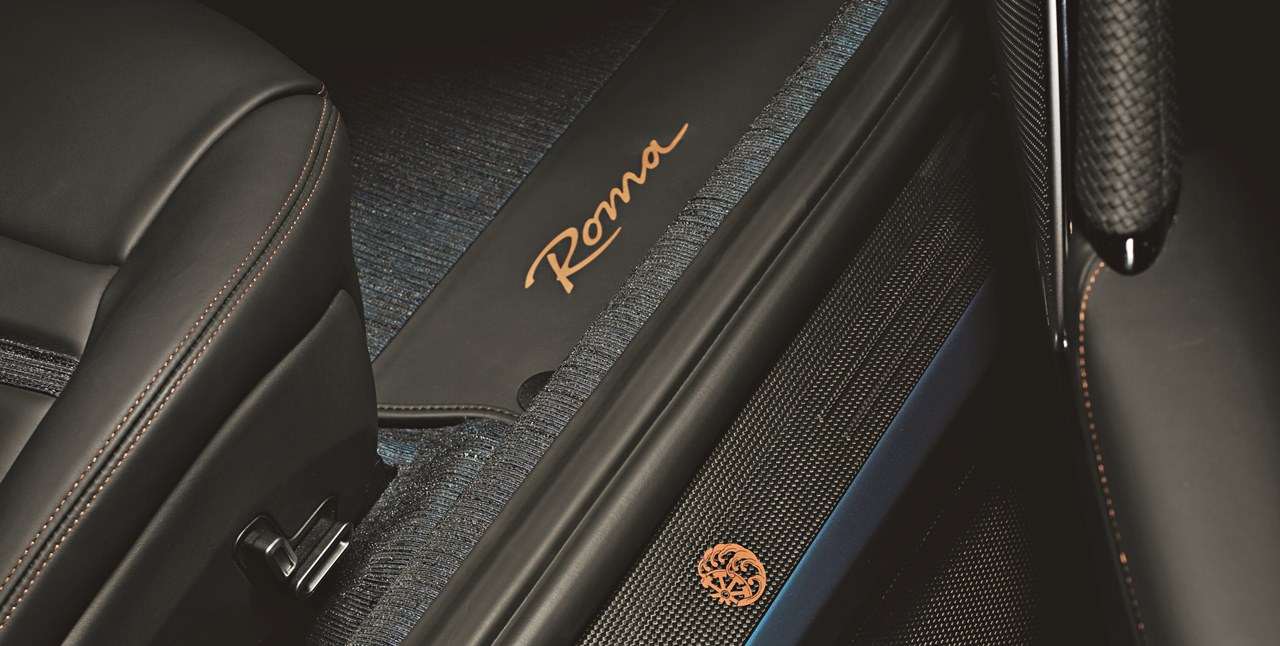
The unique crest on the car’s dedication plate on the central armrest and door sills is a custom-made ‘kamon’, a symbol passed down from generation to generation in Japan. Designed by Kyogen, it represents a wheel from an ox-drawn carriage (popular transportation among aristocrats during the Heian period between 794 and 1185) combined with the 8 pistons of the Roma’s V8 engine forming its spokes. The numeric theme is continued in the eight wave crests that encircle the wheel – symbols of good luck, power and resilience.
The phased motor insurance de-tariffication process liberalises the fixed pricing for motor insurance that has been in place in Malaysia for over 30 years. In this new environment, the insurance industry has been gaining the flexibility to offer motor insurance coverage with new features at market-based pricing based on the risk behaviour of the policyholders.
This means, in time to come, motorists will benefit from varying coverage limits customised to match their individual risk profiles. As is the case in a number of countries around the world, credit scoring plays a part in allowing those with good credit scores to enjoy lower premiums for their car insurance.
CTOS, the well known credit reporting agency in Malaysia, aims to enter the car insurance industry by expanding its range of services to provide insurance coverage for motor vehicles. Its subsidiary company, CTOS IDS Sdn Bhd, has launched CTOS Car Insurance, an online platform for car insurance and road tax renewal.
The new service is in collaboration with PolicyStreet.com. which is operated by Polisea Sdn Bhd, an insurance technology company. CTOS Car Insurance is said to provide a fast, hassle-free opportunity to make price comparisons of policies from more than 10 insurance providers within minutes, allowing motorists to find the best deals in the market.
By comparing quotes from a large range of insurers, CTOS IDS says that motorists will be able to find savings of up to RM1,000 from their current deals.
“The strategic partnership between CTOS and an insurance technology company is the first of its kind in Malaysia. We are proud to have partnered with CTOS and believe the collaboration will pave way to more innovative, customised and inclusive insurance protection, leveraging on credit scores and big data for all Malaysians,” said Wilson Beh, Co-Founder of PolicyStreet.com.
In this new collaboration, the CTOS Car Insurance platform will offer motorists policies from leading insurance providers such as Allianz General Insurance Company (Malaysia) Berhad, Etiqa General Takaful Berhad, Zurich General Insurance Malaysia Berhad as well as other leading companies in the country.
Terms & conditions apply.
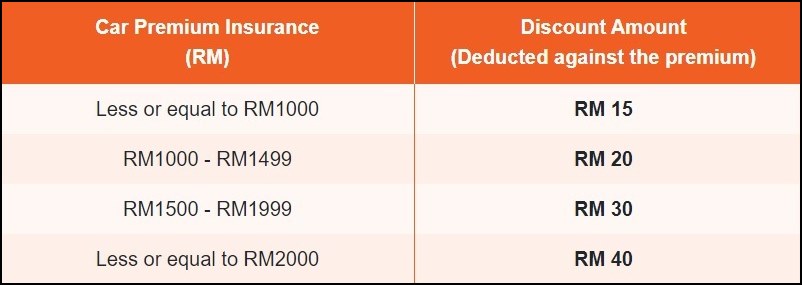
Besides roadtax renewal, the new service also comes with further other benefits. Customers who successfully renew or purchase their insurance via the platform will be able to get a free MyCTOS Score Report to stay on top of their credit health. There will also be further discounts on car insurance quotes based on the value of premiums selected.
“A one-stop centre to get an insurance policy and road tax saves time, provides more choice, and ultimately, allows consumers to make more informed decisions. CTOS Car Insurance reflects how we are focusing our partnership efforts to offer consumers end-end digital solutions in increasingly varied industries. Also, in time, we hope to be able to offer even more value by taking into account credit scores to present consumers better prices, in line with the motor insurance de-tariffication process started by Bank Negara in 2016,” said Eric Hamburger, Group CEO of CTOS Digital Berhad, the parent company of CTOS IDS.
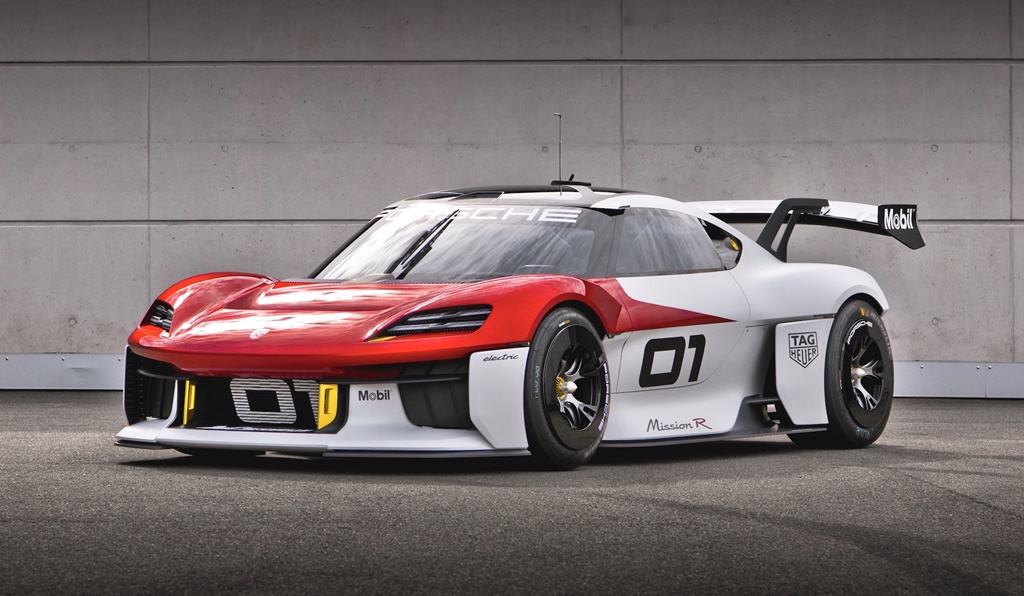
At the 2021 IAA Mobility event in Germany last year, Porsche displayed a conceptual study that was the vision of a fully-electric GT racing car. Called the Mission R, it was intended to show a possible model for customer motorsport in the future.
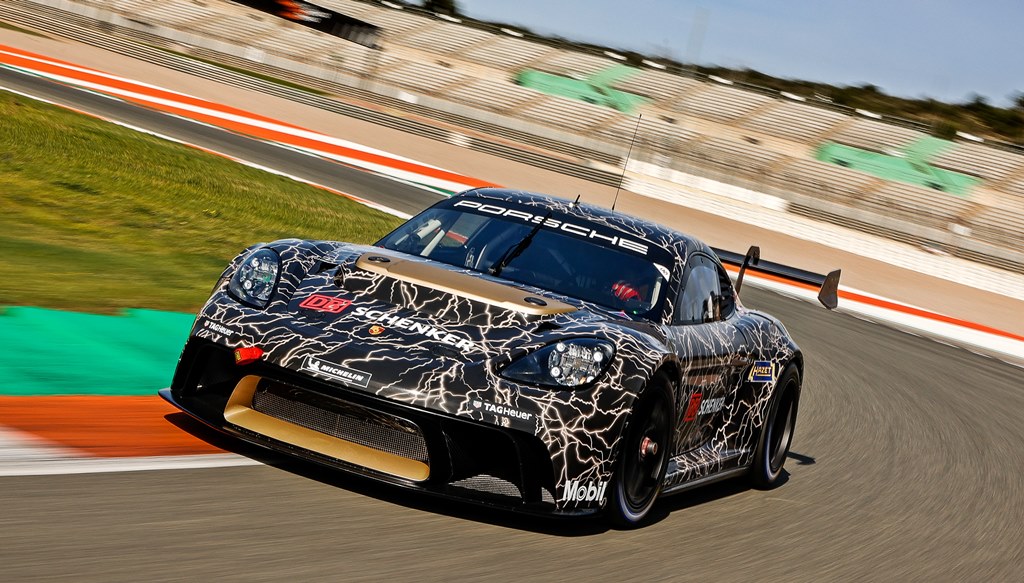
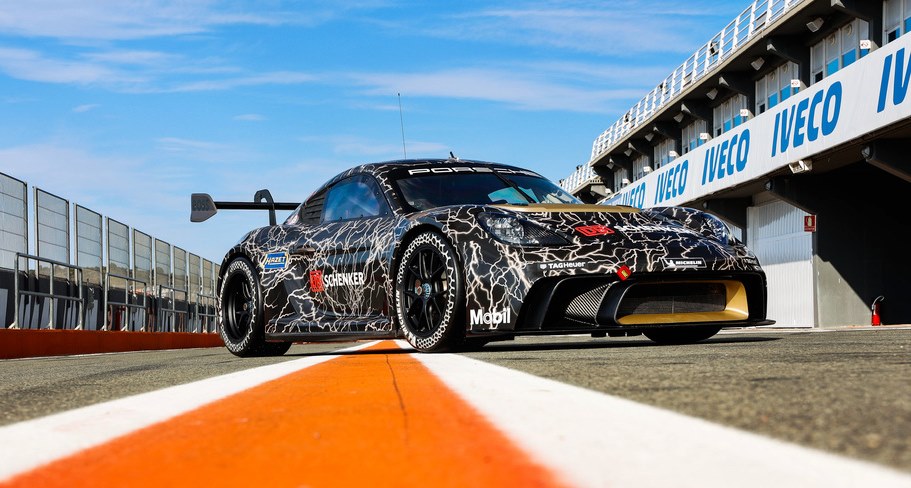
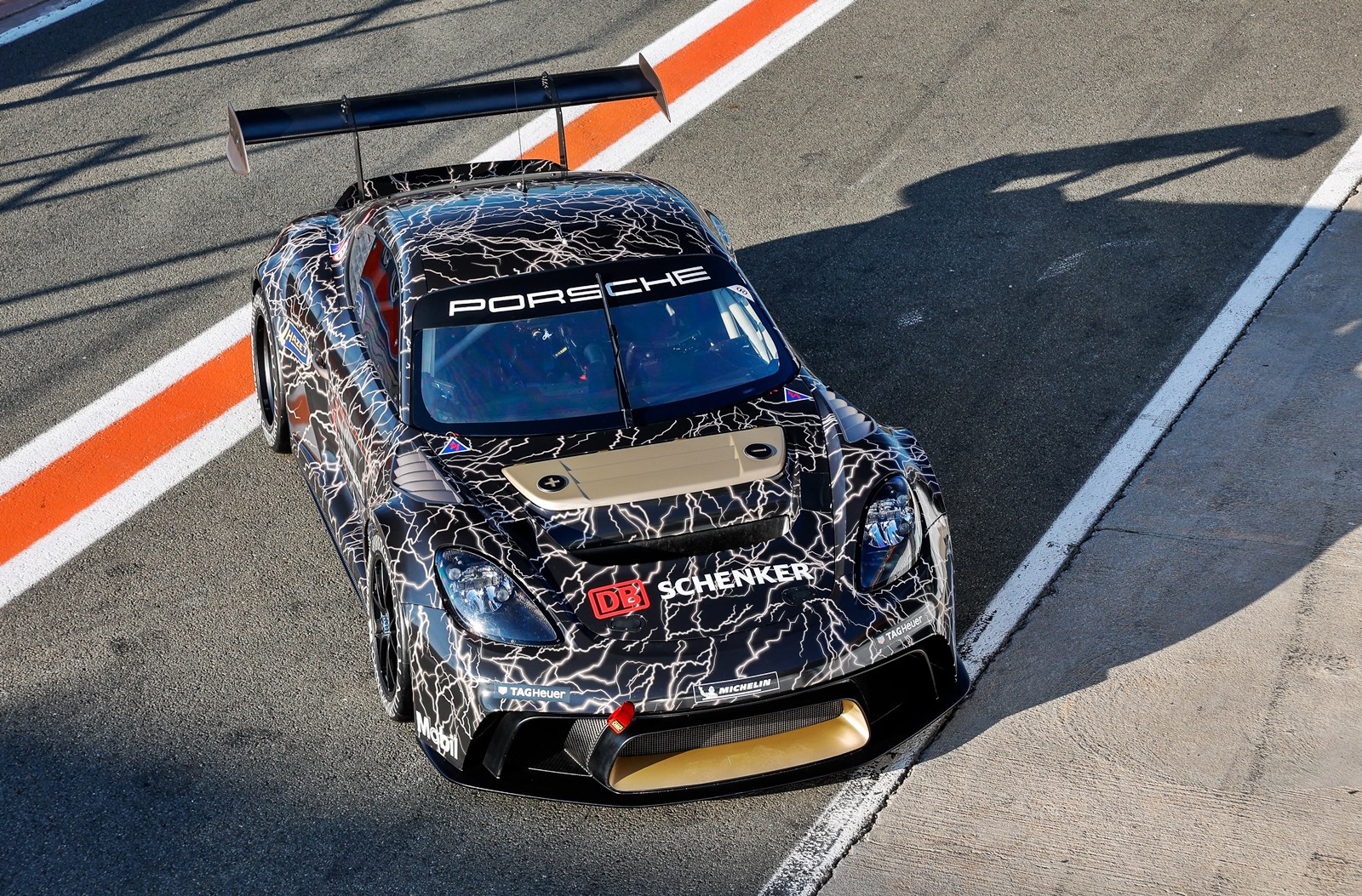
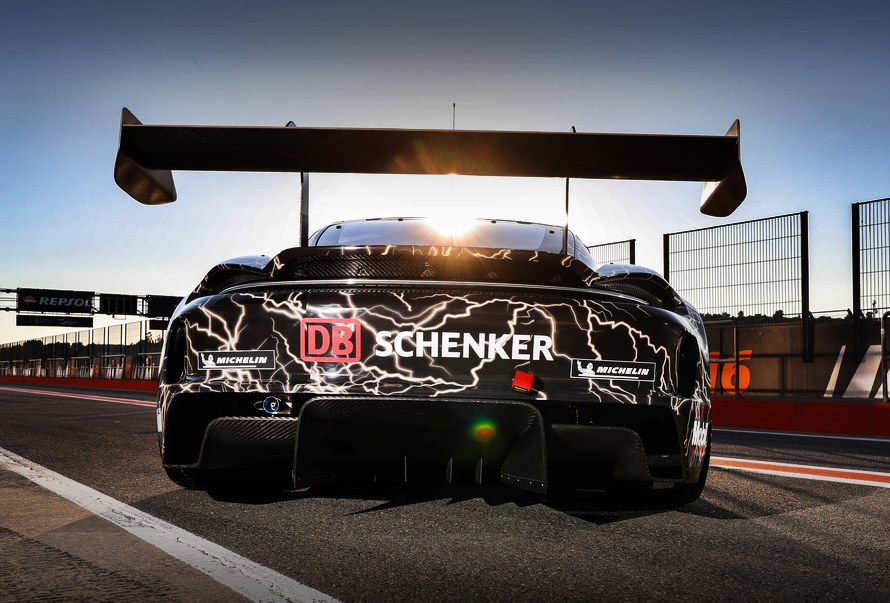
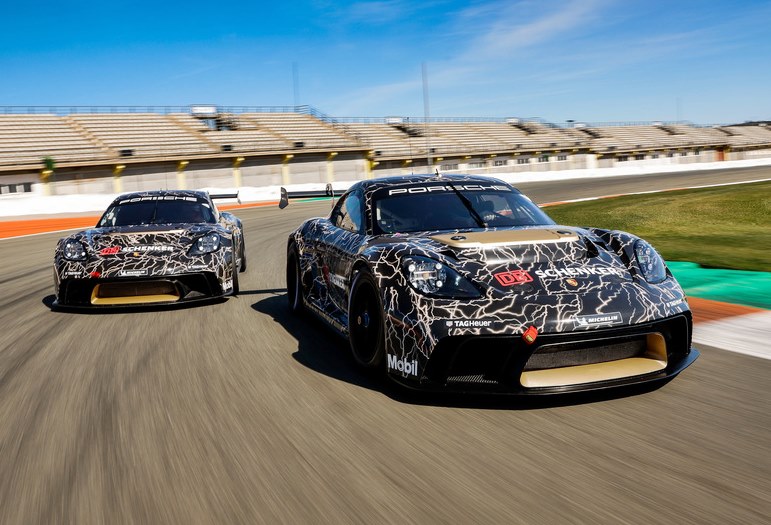
The sportscar maker has now begun testing the technology components of the Mission R with the 718 Cayman GT4 ePerformance as a test vehicle. Like the Mission R, the all-wheel drive racer uses the chassis of the 718 Cayman GT4 Clubsport with the entire electric motor and battery technology from the IAA conceptual study.
Mission R
The powertrain has a maximum output of 735 kW (1,000 ps) and can generate still more. In simulated racing, a steady 450 kW (612 ps) is available for 30 minutes – equivalent to the duration of a Carrera Cup race. In terms of lap times and top speed, the 718 Cayman GT4 ePerformance is on par with the performance of the current 992-generation 911 GT3 Cup.
“With the Mission R, we’ve shown how Porsche envisages sustainable customer motor racing in the future. The 718 Cayman GT4 ePerformance now demonstrates that this vision works impressively on the racetrack,” revealed Matthias Scholz, GT racing vehicle project manager. “We’re very excited about the response because a one-make cup with electric racing cars would be an important addition to our existing customer racing programme.”
By 2030, Porsche aims to be CO2 neutral across the entire value chain and lifecycle of its new cars sold. By then, the proportion of all new vehicles featuring all-electric drive should be more than 80%. This development is there important in the light of moving towards greater electrification.
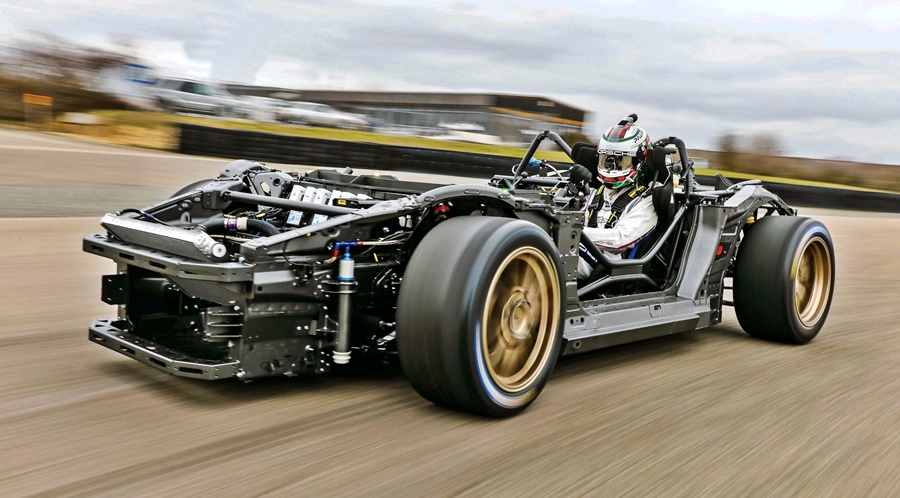
The fully-electric drivetrain has electric motors on front and rear axles for all-wheel drive. The direct oil cooling of the e-motors and battery pack developed by Porsche counteracts thermally induced derating.
“The integration of oil cooling has significantly impacted the vehicle concept,” explained Bjorn Forster, GT4 ePerformance project manager. “With experts in the fields of aerodynamics and thermodynamics as well as high-voltage and bodywork specialists, the development team created an architecture to tap the full potential of the battery cells for the first time, since there is no thermal derating. In this way, the power output in racing mode remains constant for half an hour.”
Mission R drivetrain has e-motors on front and rear axles for all-wheel drive.
Thanks to 900-volt technology, the state of charge of the battery at full charging capacity jumps from 5% to 80% in about 15 minutes. This is important in future races which may have long durations.
Under the direction of designer Grant Larson, a team from Porsche Style came up with the shape of the 718 Cayman GT4 ePerformance. The racing car is 14 cm wider than a 718 Cayman GT4 Clubsport. About 6,000 parts were designed from scratch and the body is made of natural fibre composite materials. The production is intended to generate fewer emissions than the production of comparable synthetic materials. Recycled carbonfibres are also used for testing purposes.
Compared to the 718 Cayman GT4 Clubsport, the flared fenders allow more room for the wider 18-inch racing tyres from Michelin. Renewable materials make up a particularly high proportion of the tyres.
The GT4 ePerformance Tour
The 718 Cayman GT4 ePerformance will make a dynamic debut at the Goodwood Festival of Speed next month. At the famous motorsport festival in southern England, the concept racing car will take part in the traditional 1.9-km hillclimb event.
Its second outing will be in August at the Porsche factory in Leipzig on the occasion of the factory’s 20th anniversary. The facility boasts a 3.7-km circuit with sections reproducing world-famous racetracks.
The two 718 Cayman GT4 ePerformance demo vehicles will travel through various European countries before heading to North America in early 2023. The world tour concludes in the Asia-Pacific region where it will tour until mid-2024. It’s almost a certainty we will see it at the Sepang International Circuit which is frequently used by Porsche for events.
“The 718 Cayman GT4 ePerformance blazes a trail to Porsche customer racing with electrically-powered racing cars. As a first step, we will unveil this concept to our global partners,” says Oliver Schwab, Project Manager Sales of the 718 Cayman GT4 ePerformance. “With drivers, teams, organisers, authorities and other interested parties, we’re also gathering ideas for Porsche racing formats in the future.”