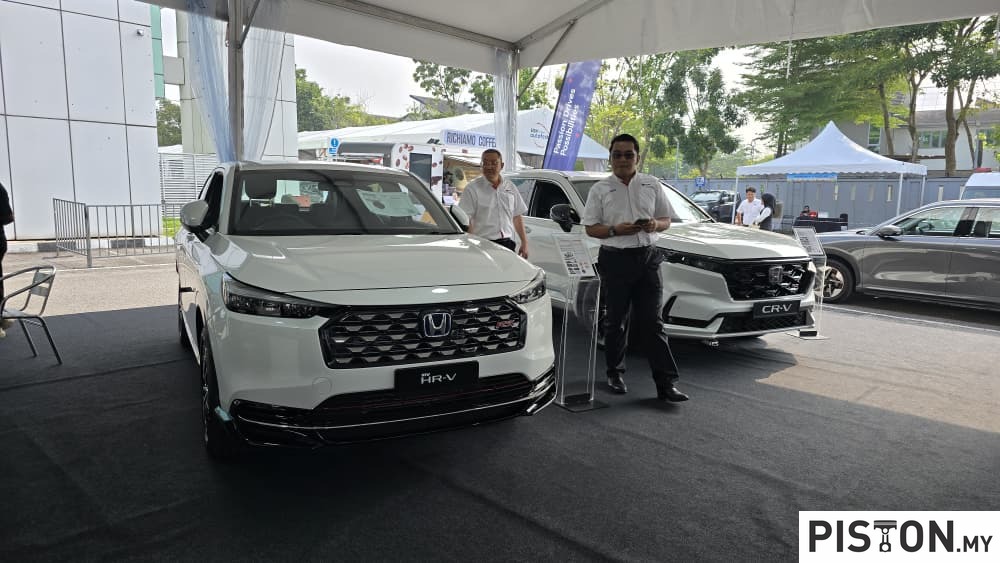
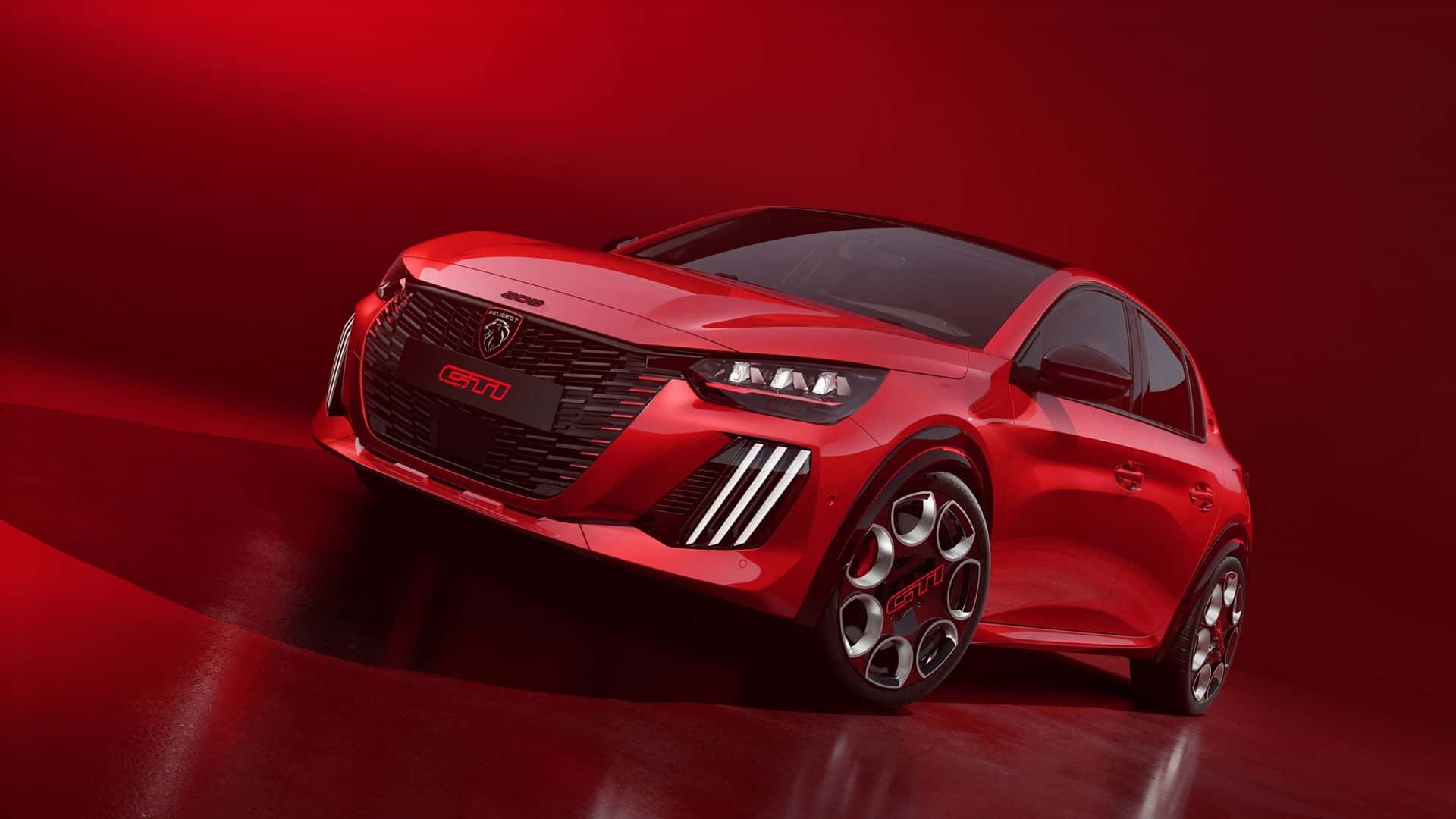
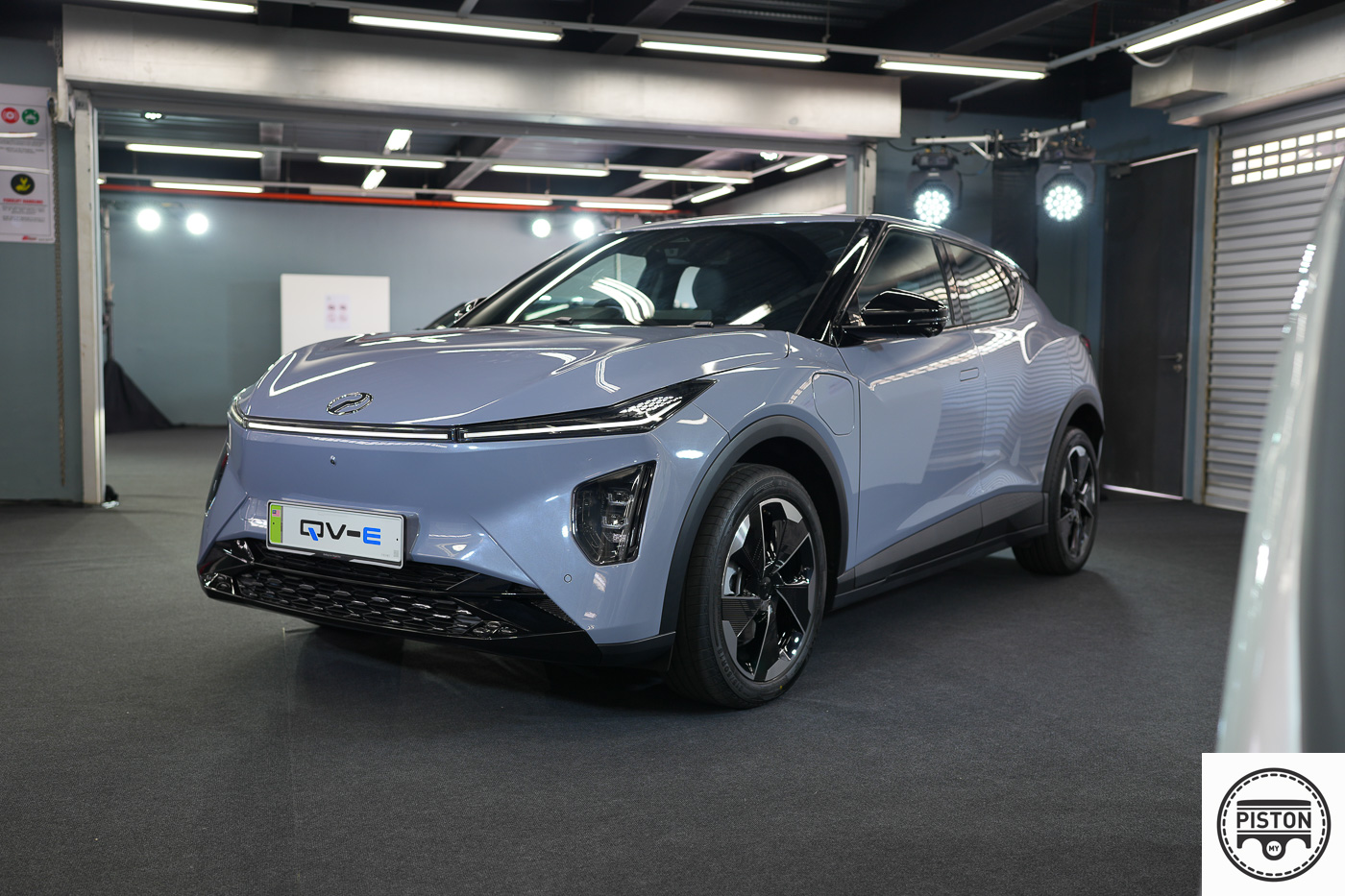
Edaran Otomobil Nasional (EON), anak syarikat DRB-HICOM Berhad dan salah satu peneraju utama dalam ekosistem automotif pelbagai jenama serta penyedia penyelesaian mobiliti terkemuka di Malaysia, hari ini secara rasmi melancarkan EON & Sahabat Autofest 2025. Ini merupakan penganjuran kali kedua acara utama yang menggabungkan elemen automotif dan gaya hidup, yang sedang berlangsung sehingga 10 Ogos 2025 di EON Glenmarie, Shah Alam..
“EON & Sahabat Autofest 2025 menampilkan kekuatan ekosistem luas kami, termasuk kemudahan kepada pelanggan dengan mengumpulkan pelbagai jenama kereta di bawah satu tempat. Berurusan dengan EON bukan hanya sekadar satu transaksi – ia adalah permulaan hubungan jangka panjang yang dibina atas kepercayaan yang berterusan melangkaui pembelian kenderaan anda,” kata Akkbar Danial, Ketua Pegawai Eksekutif EON Berhad.
Penganjuran Autofest tahun ini menandakan transformasi EON sebagai rakan mobiliti moden, dengan pengenalan identiti jenama baharu yang diperbaharui dan disatukan untuk keseluruhan Kumpulan Syarikat EON.
Berteraskan pengenalan slogan baharu EON, “Semangat Memacu Aspirasi”, yang melambangkan usaha syarikat untuk memberi nilai kepada pelanggan melalui perkhidmatan yang bersemangat, inovasi, dan mobiliti yang mudah diakses. Slogan ini disokong oleh visi jenama EON iaitu “Menerajui mobiliti masa hadapan, dipacu dengan hati,” yang menunjukkan komitmen syarikat terhadap penyelesaian masa depan yang progresif dan berfokuskan pelanggan.
Edaran Otomobil Nasional (EON), a subsidiary of DRB-HICOM Berhad and a key player in Malaysia’s multi-brand automotive and mobility landscape, has officially launched the second edition of its flagship event — the EON & Sahabat Autofest 2025. The automotive and lifestyle showcase is now open at EON Glenmarie in Shah Alam and will run until 10 August 2025.
This year’s Autofest marks a pivotal moment in EON’s transformation, reinforcing its identity as a contemporary mobility partner. The event serves as the launchpad for the group’s refreshed and unified brand identity. Central to this rebranding is EON’s new tagline, “Passion Drives Possibilities,” which embodies its mission to deliver innovation-driven, customer-centric services. Alongside this, EON’s updated brand vision, “Leading the future mobility, powered by heart,” underscores its commitment to providing progressive and human-centred mobility solutions.
The branding overhaul consolidates EON’s entire network of outlets, services, and digital platforms under one cohesive identity. The initiative is designed to strengthen customer trust while enhancing operational cohesion across its ecosystem.
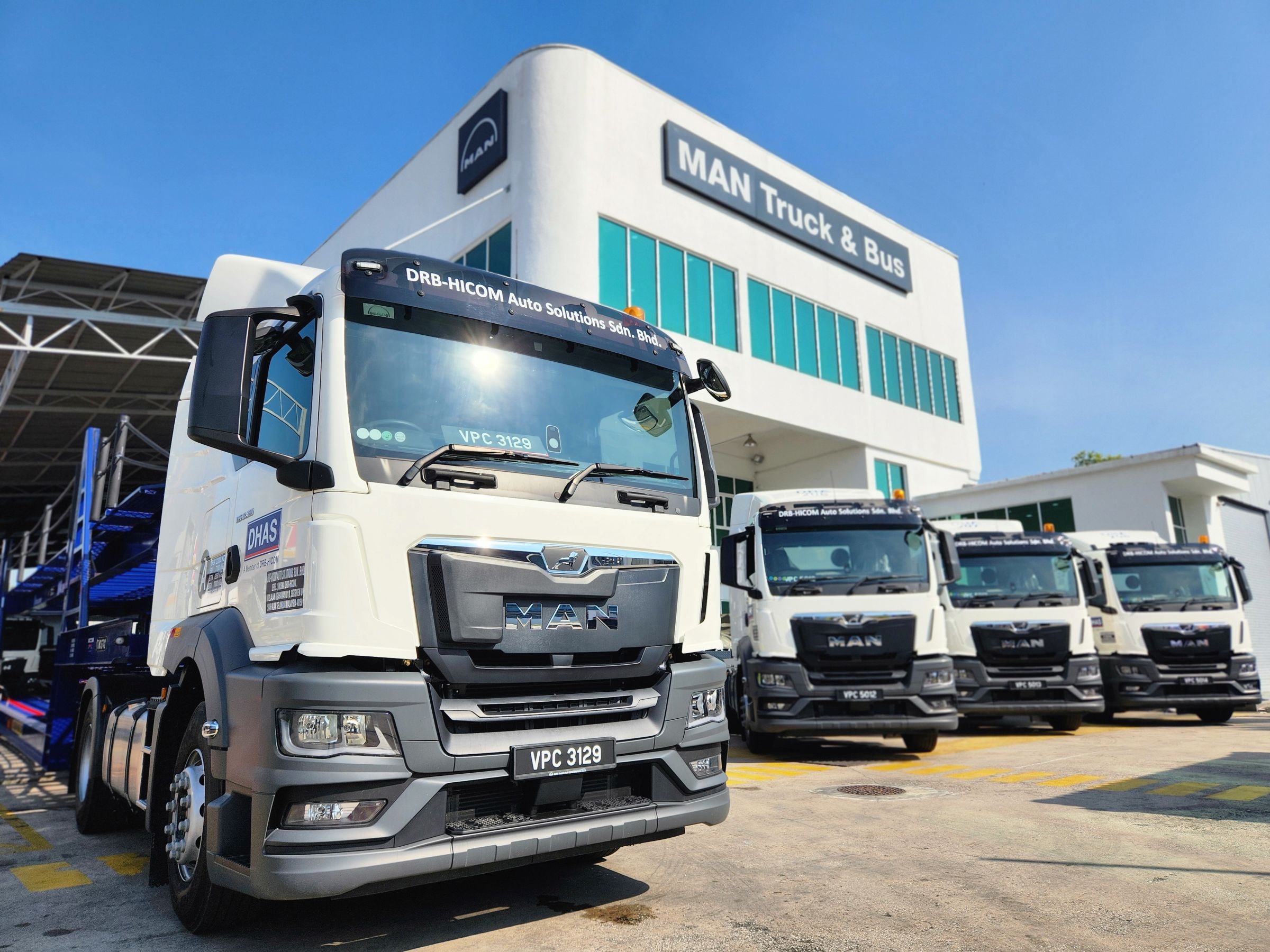
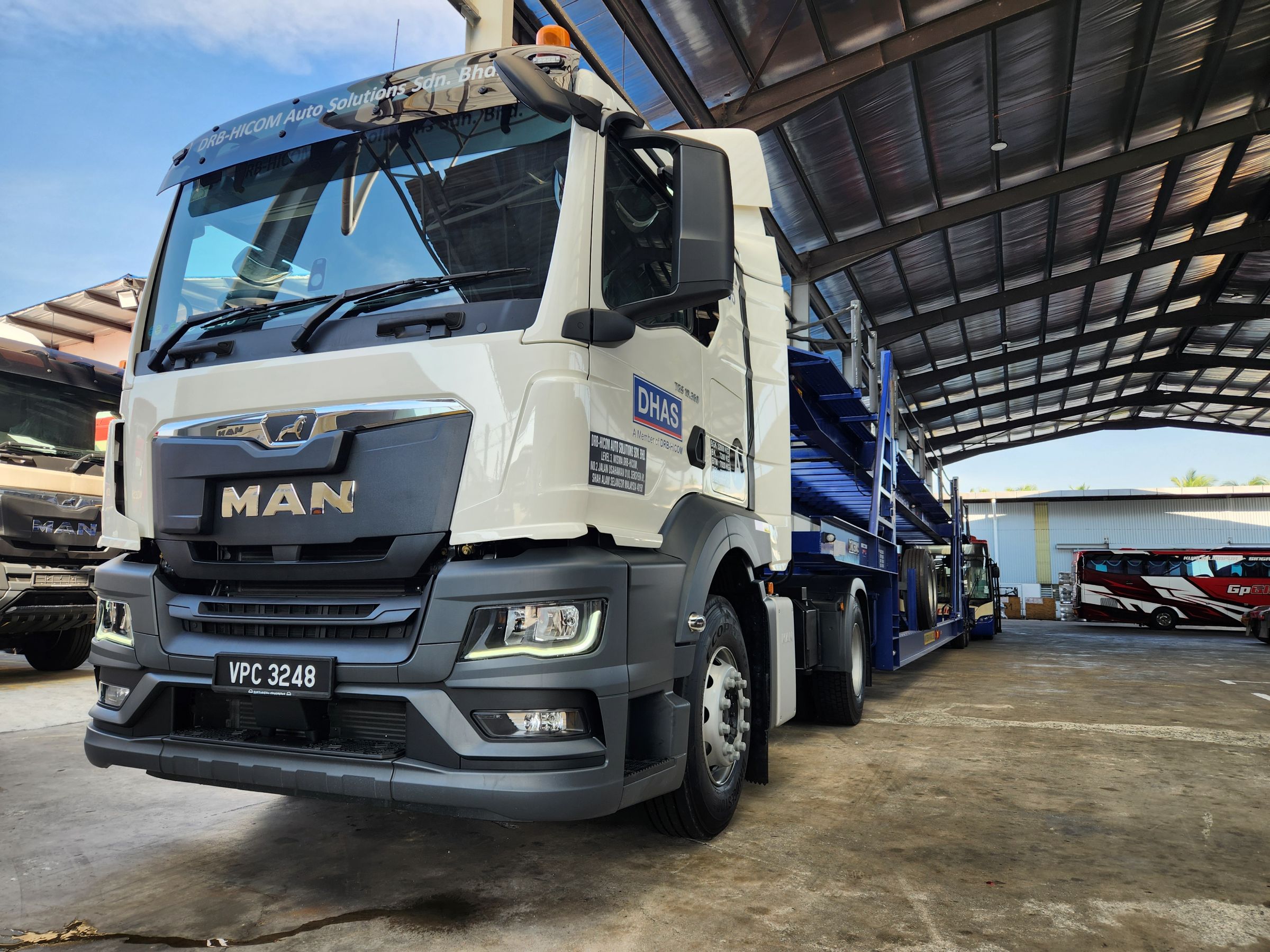
DRB-HICOM Auto Solutions Sdn Bhd (DHAS), a subsidiary of DRB-HICOM Berhad and a key player in Malaysia’s automotive logistics sector, has expanded its operational capacity with the addition of seven MAN TGS 18.360 4×2 prime movers. These new units will serve as the foundation of DHAS’s in-house fleet of car carriers, marking a strategic shift from its prior reliance on third-party transport providers and a small group of leased Japanese prime movers.
Founded in 2006, DHAS has grown in tandem with the country’s rapidly evolving automotive landscape, particularly in response to the increasing production and importation of electric vehicles (EVs). The company now supports logistics operations for over 20 automotive brands in Malaysia, positioning itself as a preferred logistics provider within the industry.
As demand rises, DHAS is scaling its operations to enhance reliability and maintain long-term business sustainability. Chief Executive Officer Fawzi Ahmad stated that the decision to adopt the Euro V-compliant MAN TGS trucks followed a comprehensive assessment across several key metrics. He explained that the model was chosen based on its strong performance in areas such as safety, vehicle specification, operational efficiency, pricing, aftersales support, and environmental considerations. He also highlighted the truck’s user-friendly integrated telematics system, which supports efficient fleet management, and added that drivers have responded positively to the vehicle’s modern design and spacious, comfortable cabin.
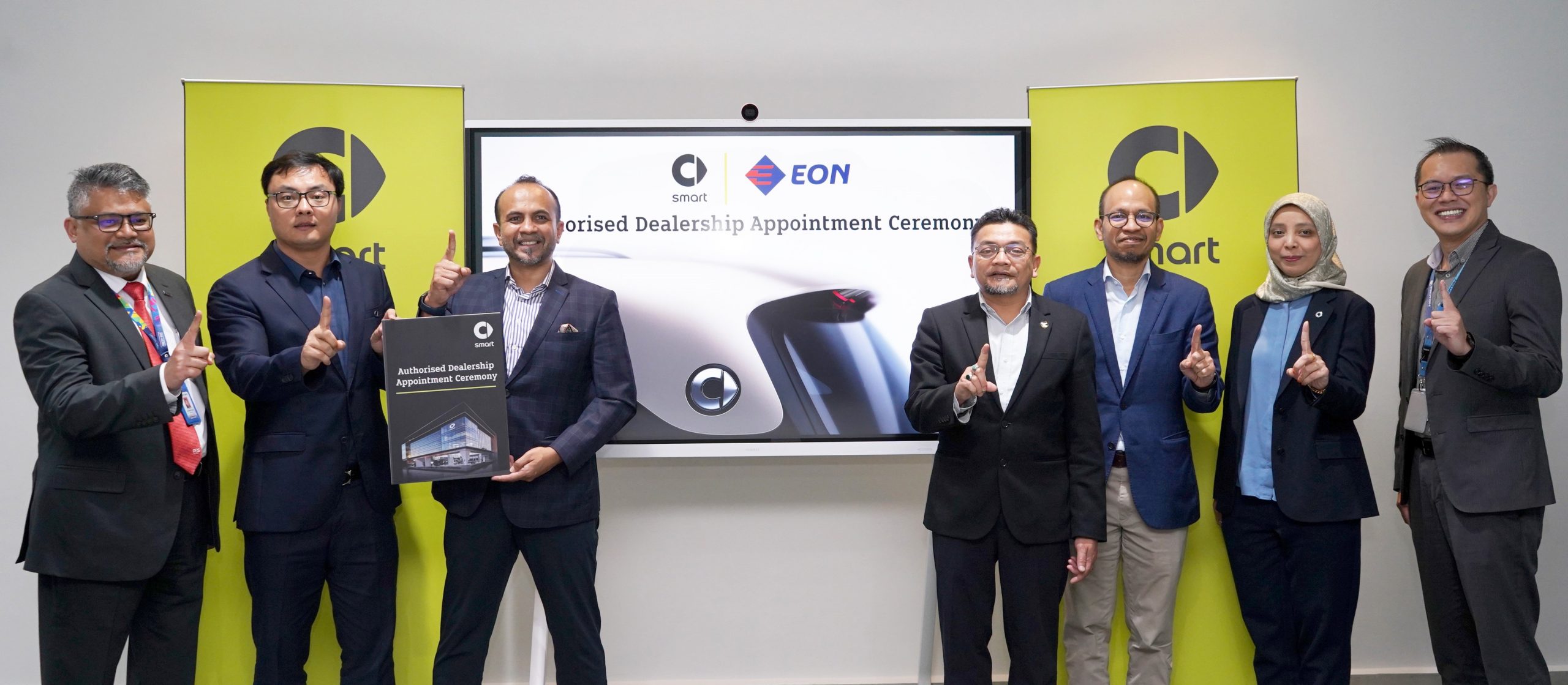
Edaran Otomobil Nasional Berhad (EON), the automotive retail division of DRB-HICOM, has been named an official smart Malaysia dealer by Proton New Energy Technology Sdn Bhd (PRO-NET).
Following a signing ceremony with Hap Seng Smart earlier this month and the addition of EON to the smart Malaysia stable, PRO-NET has now hired five additional dealerships. Five more dealership appointments will be made public in the near future.
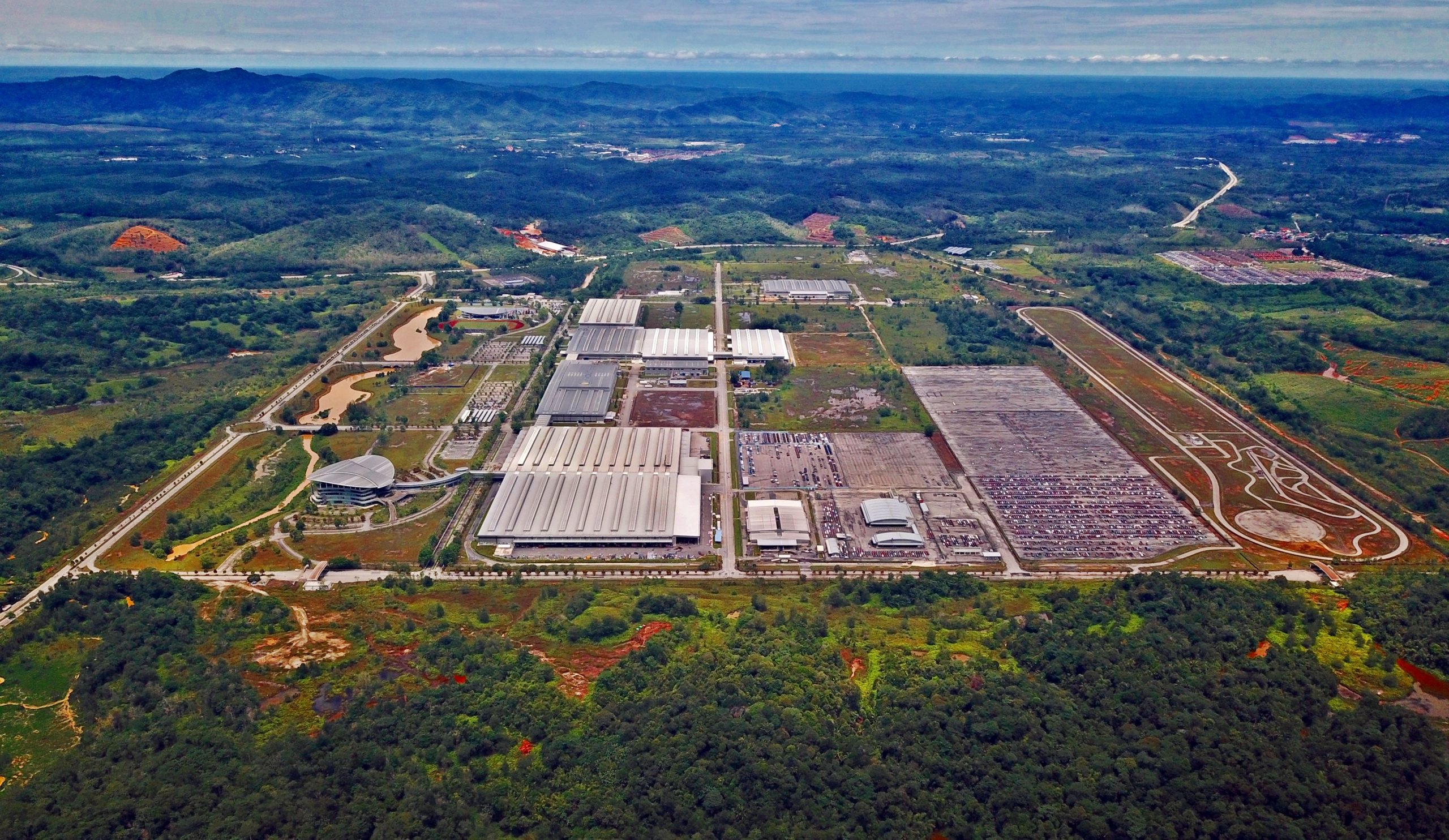
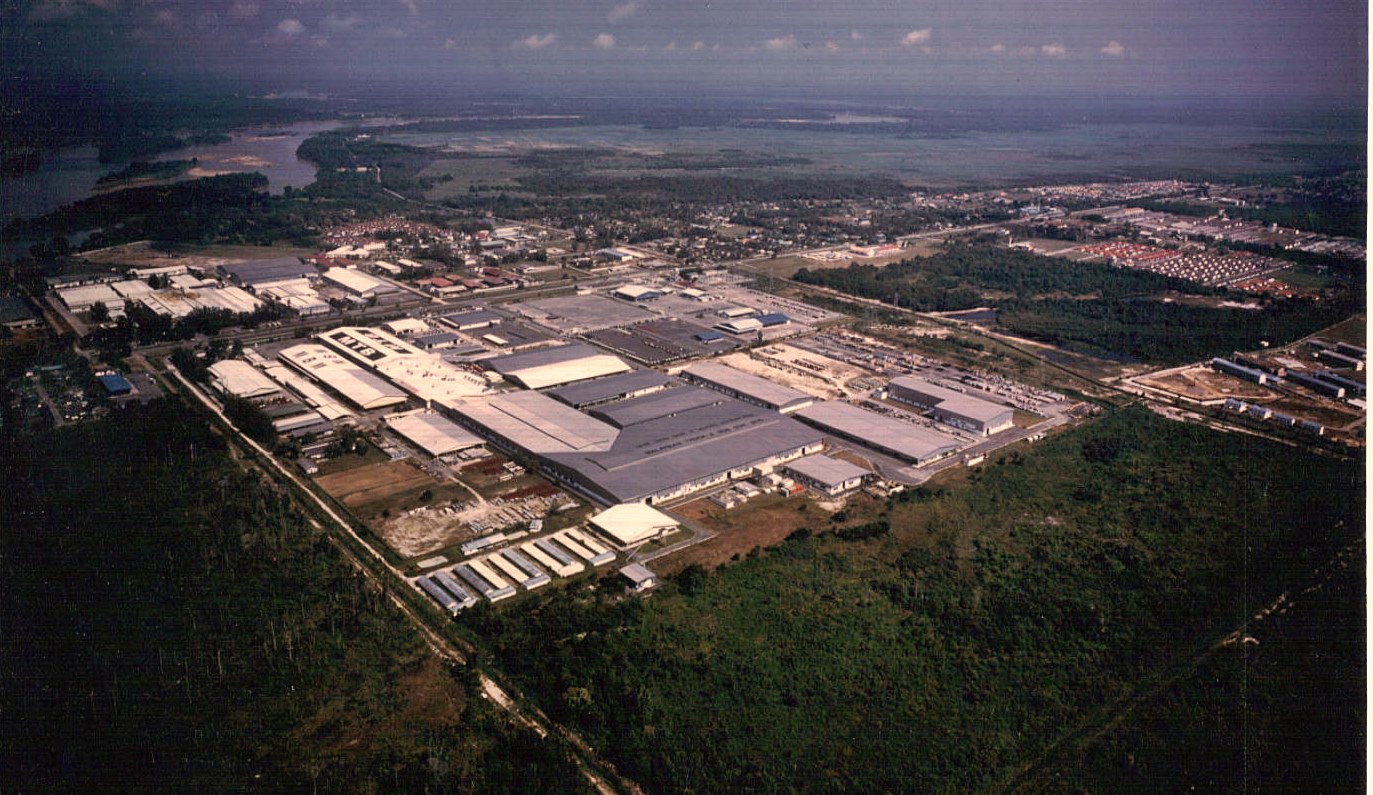
20 years ago, Proton established a second factory in the Tg. Malim area of Perak with a plan to develop a ‘Proton City’. This was to be an automotive zone with suppliers nearby to provide parts and systems directly to the factory. Parts of that original plan were realised but not to the grand plan envisaged as a production hub.
But the idea has not been forgotten and a year ago, DRB-HICOM announced its intention to develop an Automotive Hi-Tech Valley (AHTV) in the Tg. Malim area with the aim of becoming an industry hub for the ASEAN region.
Besides supporting Proton, the AHTV is expected to attract businesses which are involved in new technologies and systems relevant to the global automotive industry. These would include electrification, Artificial Intelligence, autonomous technologies and advanced connectivity.
The DRB-HICOM Group – via its subsidiary, Edaran Otomobil Nasional Berhad (EON) – is venturing into aftersales services with the establishment of a joint venture with Petromin Express, a subsidiary of Saudi Arabia’s Petromin Corporation. Petromin Express is the world’s fifth largest fast-fit service brand and operates in the Middle East, Africa and is looking to new markets in Asia.
The joint-venture company, which will be 51:49 shared between Petromin and EON, is expected to commence pilot operations of the business in January 2023, with 4 outlets during the 18-month pilot run. The pilot will enable management to derive a longer strategic roadmap for the business including capital requirements for expansion.
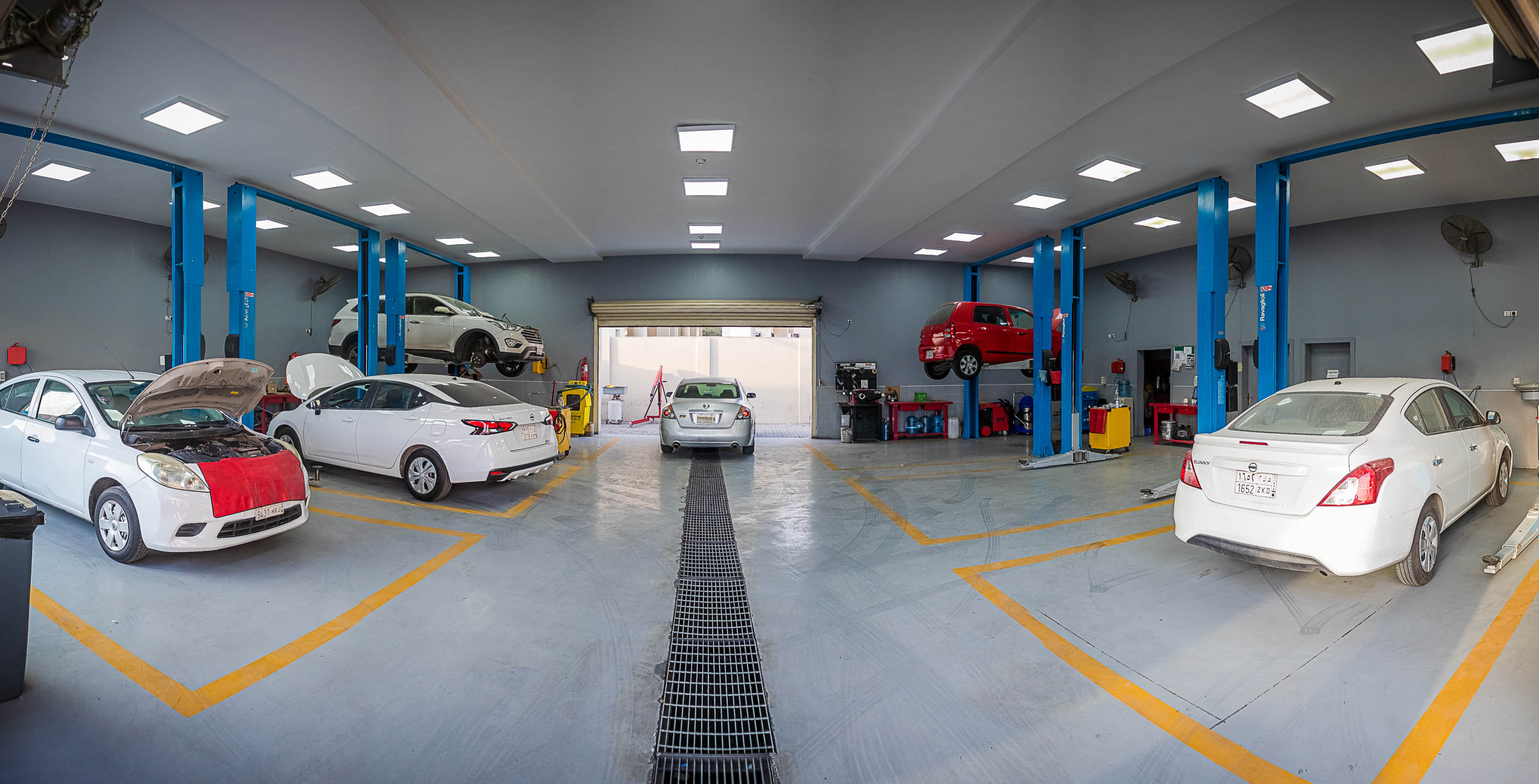
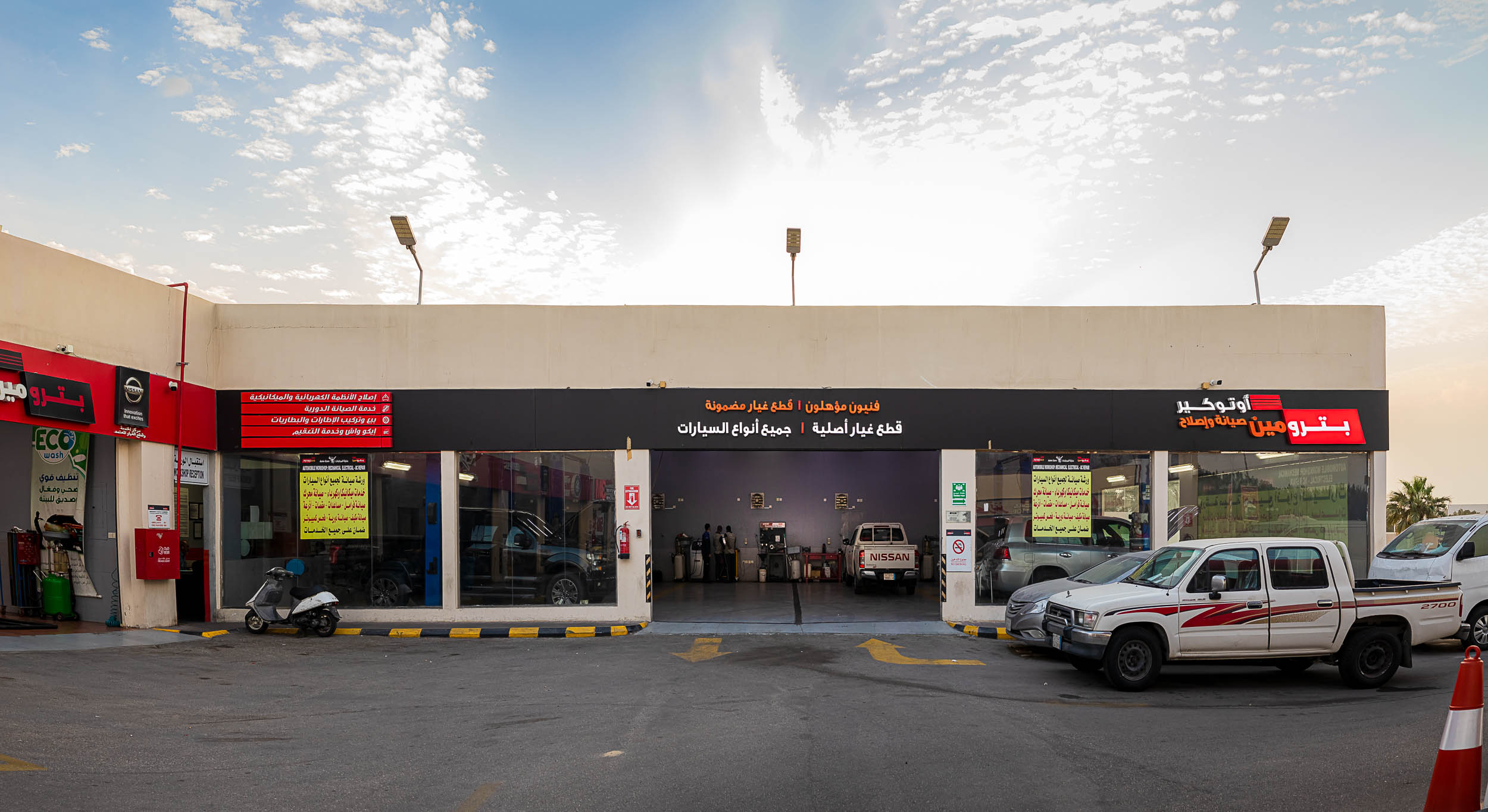
A Petromin Express service centre in Jeddah, Saudi Arabia.
Growing sector in auto industry DRB-HICOM’s move into the automotive aftersales market in Malaysia is timely as this is a large and growing area of business, especially with the population of vehicles in use. In 2021, this sector generated revenue of approximately RM42 billion.
Modelled after Petromin’s highly successful Petromin Express outlets in Saudi Arabia, the new company aims to offer Malaysian vehicle owners a unique experience of fast-fit aftersales services with a quick turnaround time.
While the services will be offered to all vehicles, the company will be targeting vehicles aged between 5 and 10 years which no longer have warranties in effect. Such vehicles will no longer be restricted by warranty conditions and can therefore be serviced by any other company.
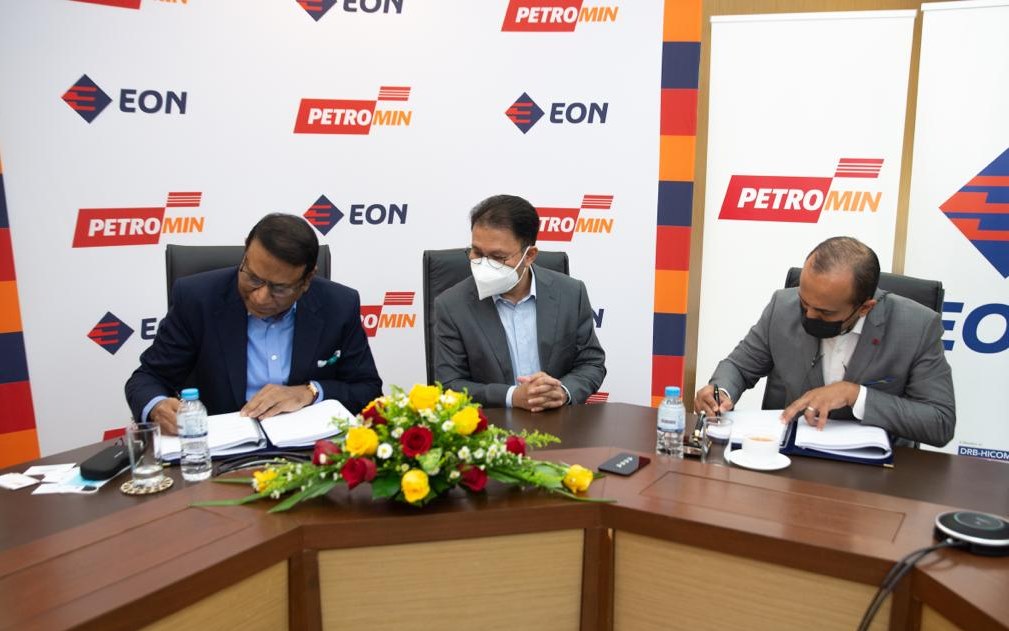
Kalyana Sundaram Sivagnanam, Petromin’s Group CEO (left) and Akkbar Danial, CEO of EON (right) signing the joint-venture agreement, witnessed by Dato’ Sri Syed Faisal, DRB-HICOM Group Managing Director, Dato’ Sri Syed Faisal Albar.
Complementary new business The collaboration complements DRB-HICOM’s existing and extensive automotive value chain. The group is already involved in automotive manufacturing via Proton, retails several foreign automotive brands under the EON umbrella, and also offers mandatory inspection services via PUSPAKOM.
“Petromin’s collaboration with DRB-HICOM will allow it entry into the lucrative Malaysian aftersales servicing market by partnering with Petromin Express, a well-established and trusted corporate brand in the automotive sector. Their vast know-how and operational expertise, coupled with DRB-HICOM’s market intelligence and extensive customer reach, will create an ideal synergy that will propel this partnership to great heights. At the same time, we are very excited to be offering a new, affordable and convenient service to Malaysians,” said DRB-HICOM Group Managing Director, Dato’ Sri Syed Faisal Albar.
Petromin’s businesses Besides its Petromin Express business with over 700 outlets across Saudi Arabia, Petromin has a substantial lubricants business with products exported to over 35 countries. It also operates operates petrol service stations and distributes Nissan vehicles in the Kingdom.
Commenting on the new partnership, Petromin’s Group CEO, Kalyana Sivagnanam, said: “After decades of transforming the mobility solutions landscape in the Middle East and North Africa region, Petromin is looking forward to helping in transforming and pioneering the aftersales service experience for the discerning customers in Malaysia and around the globe. We are optimistic that this relationship will yield significant impact on the market in the face of game-changing technological, economic, and societal trends.”
In the mid-1960s, when the Malaysian government started the auto industry with a call to manufacturers to assemble vehicles locally, the first ‘auto city’ began to form in the Klang Valley. Vehicle assembly plants were set up in the newly created Shah Alam industrial area of Selangor and related businesses also built factories nearby to supply them parts.
As the industry grew, other areas of the country also saw auto-related factories and businesses being developed. These were in the Tampoi area of Johor and also in Pekan, Pahang, where manufacturers like General Motors, Honda, Mitsubishi Motors, Fiat and Tata had their vehicles assembled.
Pekan in Pahang also has a small automotive manufacturing complex which was developed by DRB-HICOM since the 1980s. Carmakers such as Isuzu, Mercedes-Benz, Mitsubishi Motors and Volkswagen assemble their vehicles there today.
When the National Car project started in the early 1980s, the Proton factory was situated in Shah Alam, mainly because many suppliers were also in the Klang Valley which also has the largest concentration of new vehicle sales. Perodua, however, chose an area in northern Selangor near Rawang for its manufacturing complex but with the North-South Highway, it had easy connections to the Shah Alam area for suppliers to deliver parts.
By the late 1990s, the auto industry was booming and Proton was seeing rapid growth in volumes that it needed a second factory. Tanjong Malim in Perak was chosen and though far from the Klang Valley, the distance was no longer an issue with the highway connection that also went to Port Klang. DRB-HICOM even made plans to create a ‘Proton City’ which would be an ‘auto city’ like Toyota City in Japan and Detroit in the USA.
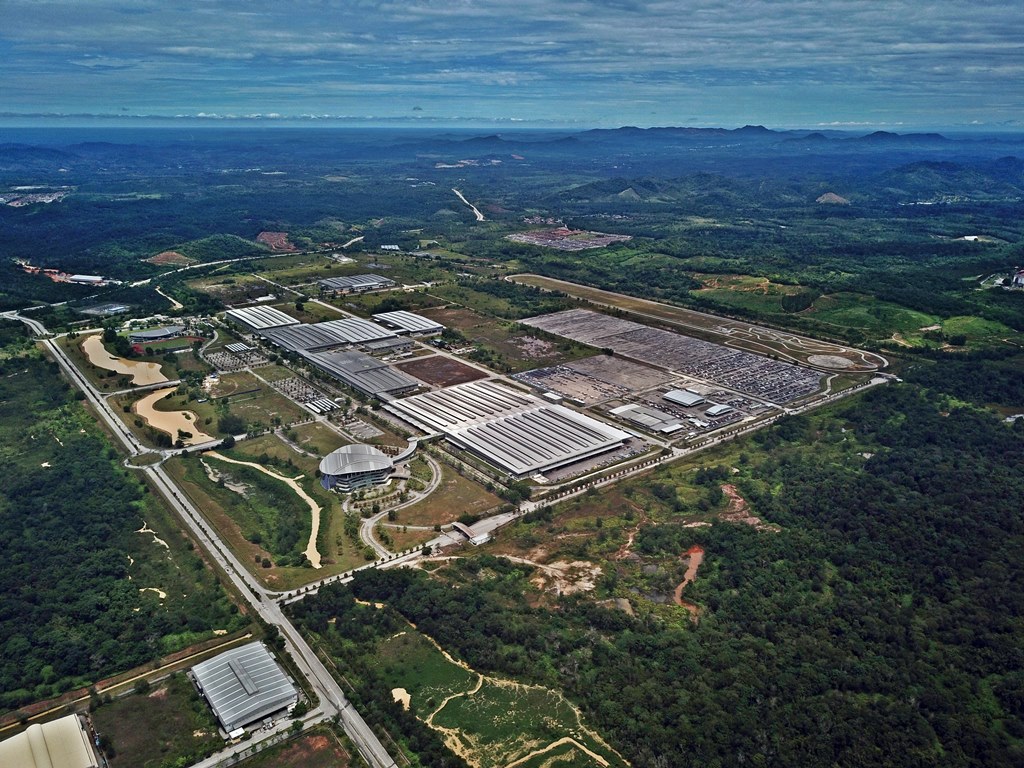
The Proton factory in Tg Malim, Perak.
However, the late 1990s saw the Asian Financial Crisis seriously affecting the country’s economy and projects like Proton City could not proceed as planned. It had been planned that suppliers would set up factories in the area to support the Proton factory which was designed to produce up to 500,000 vehicles. However, response was poor and with the severe downturn, the idea of Proton City could not take off although Proton began operations at its factory to make a new generation of models.
20 years later, the Proton City idea is restarting although this time, the concept has been updated to take into account changes in the auto industry. Rather than being just a ‘Proton City’, DRB-HICOM will develop the Tanjong Malim area into an Automotive Hi-Tech Valley (AHTV) with the aim of becoming an industry hub for the ASEAN region.
Besides supporting Proton, the AHTV is expected to attract businesses which are involved in new technologies and systems relevant to the global automotive industry. These would include electrification, Artificial Intelligence, autonomous technologies and advanced connectivity.
AHTV will be developed with an integrated ecosystem that will be a catalyst to revitalize domestic automotive sector in line with the direction of the National Automotive Policy 2020. Its aim is to bring Malaysia’s automotive industry to be on par, if not more advanced, than those in neighboring countries.
Perhaps it could help make Malaysia once again the best place in ASEAN to manufacture motor vehicles, which was the case in the 1970s. Back then, this country had the best infrastructure, a growing economy, well educated workforce and a level playing field which was attractive to investors.
An early supporter of the AHTV is the Geely Holding Group, which is also DRB-HICOM’s partner in Proton. The Chinese company has signed an MOU (Memorandum of Understanding) to jointly develop AHTV and collaborate to identify vendors and investors to the hub. The involvement of Geely, which has rapidly become a diverse global automotive group, will bring their technological strength in the automotive ecosystem as a boost for AHTV. This can be an impetus for auto and component manufacturers, especially from China, to invest in local production facilities, to create new business and export opportunities. Essentially, AHTV has the potential to become a gateway to ASEAN and other markets for companies that make it as their base. To date, there are already 17 vendors with facilities within the area.
DRB-HICOM has also signed another MoU with the Perak state government to jointly identify suitable additional land in the area for AHTV development. The current area surrounding the Proton factory measures 4,000 acres, with most already occupied by University Pendidikan Sultan Idris, factories of existing vendors, commercial premises and residential properties.
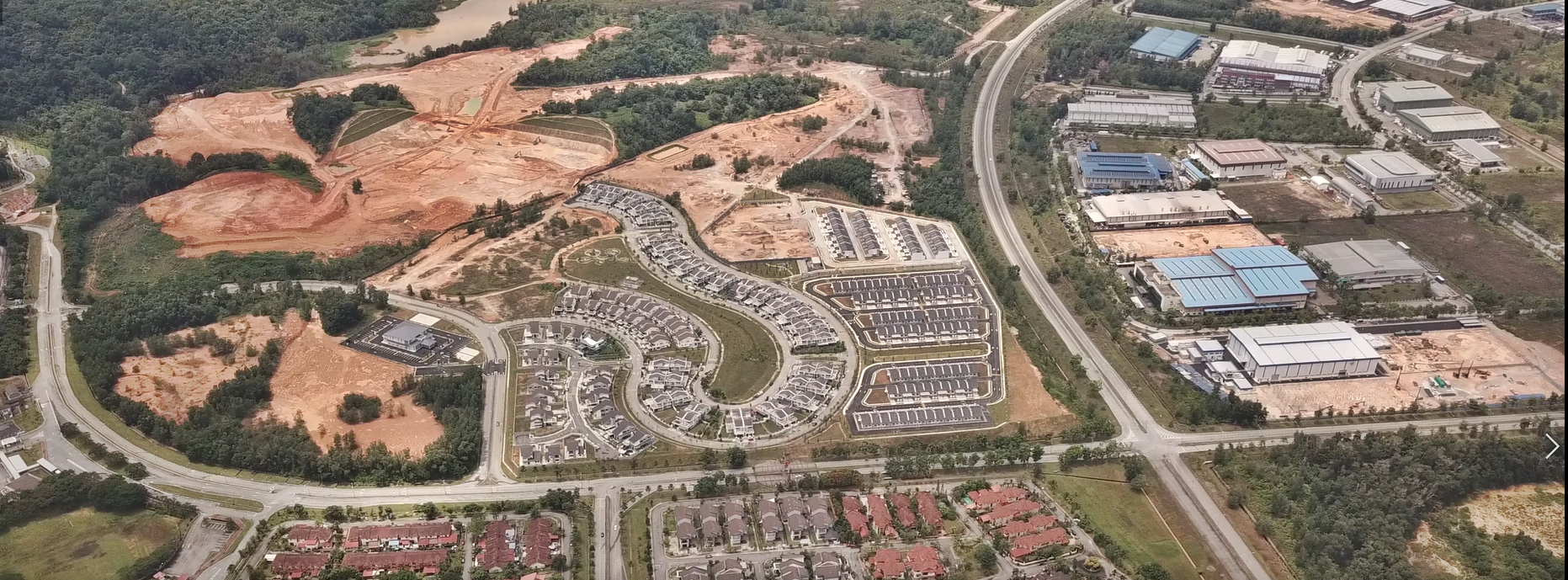
Part of the area originally developed as Proton City which will now be developed into the Automotive Hi-Tech Valley.
To boost the automotive talent pool in Malaysia, AHTV will establish a research university. This will create an educational framework to nurture a new generation of engineers for the automotive industry in areas of Engineering, IT, Design, Artificial Intelligence, Mobility Solutions & Software Development. This will strengthen local R&D capabilities and ensure competitiveness of local original equipment manufacturers.
The scale of the AHTV will see some 370,000 job opportunities being created in the area, with more than 160,000 opportunities during the first phase of development.
Malaysians know Edaran Otomobil Nasional Berhad or EON very well. After all, it was the company that was established together with Proton and given the responsibility to distribute and market the National Car. While things have changed over the years, EON (a subsidiary of DRB-HICOM Berhad) is still the largest dealer chain handling Proton products today.
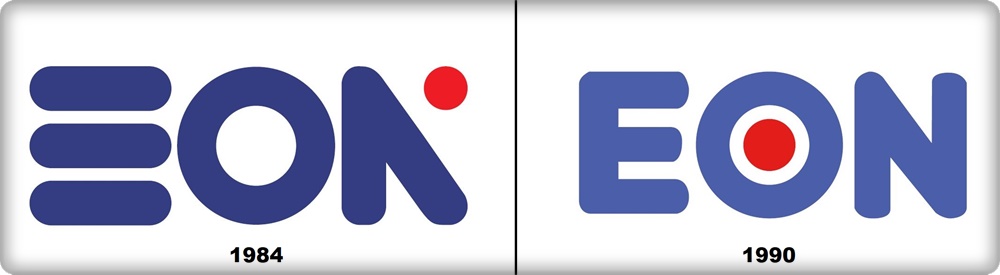
Over the years, EON has continuously evolved as times have changed. Even its logo has undergone refreshing periodically while its retail outlets and service centres have been upgraded.
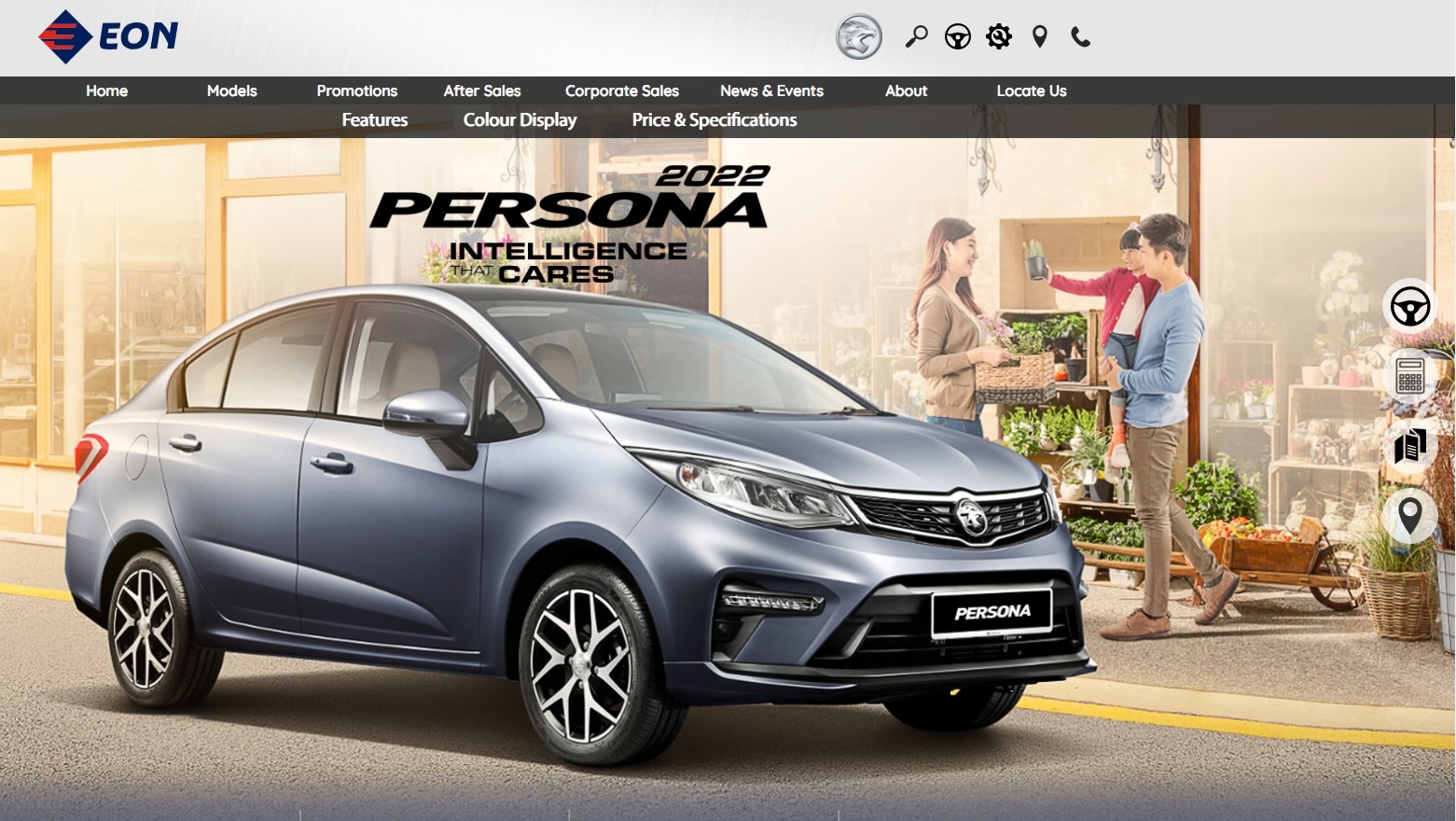
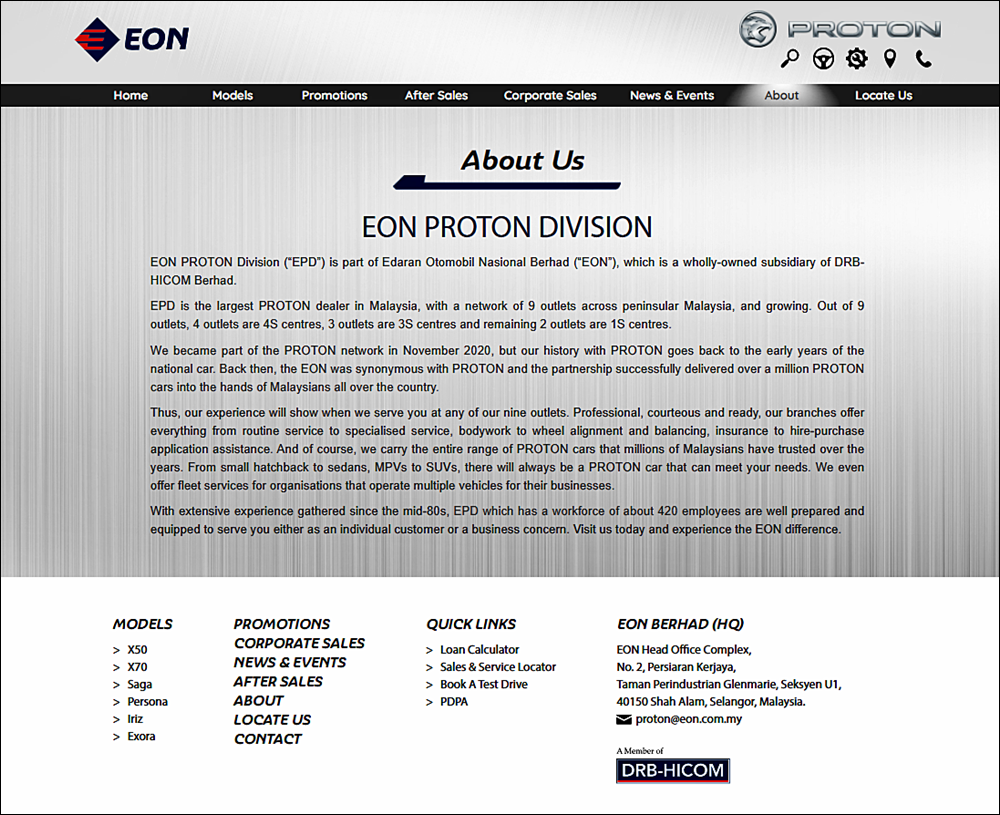
Although EON has been involved in other brands (such as Volkswagen, Audi and Mitsubishi), Proton is still its most important and in view of this, the company now has a dedicated Proton Division website. Created with the user experience in mind, the newly-designed website includes many features to help users quickly and easily navigate and browse for the many Proton models.
Everything to do with Proton
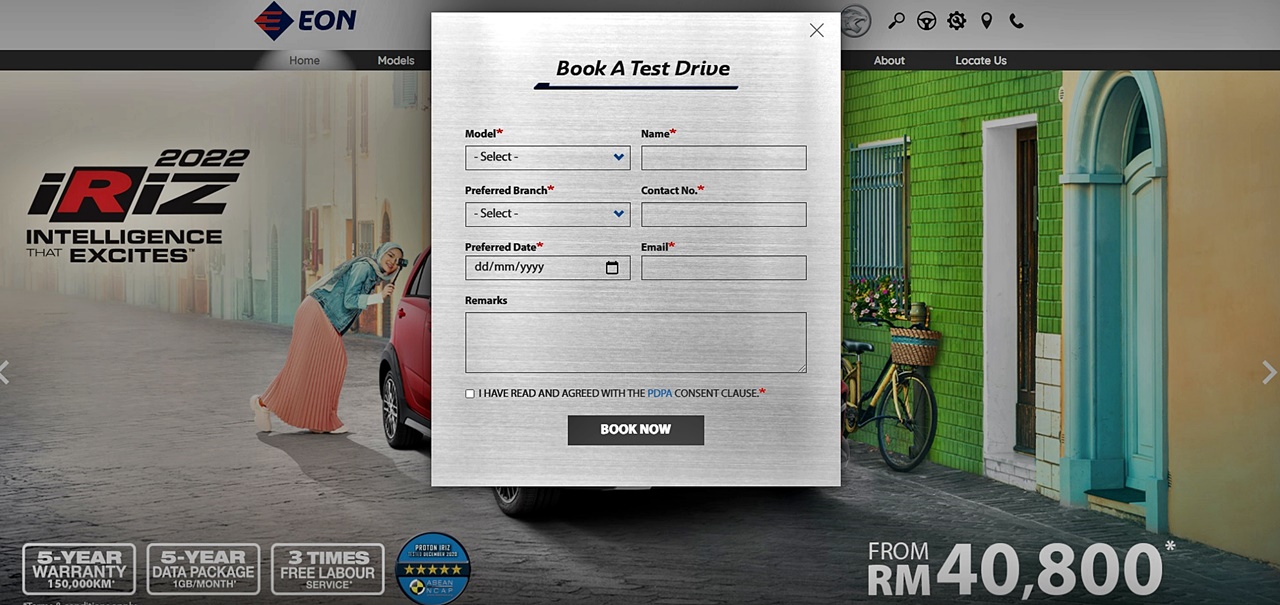
The integrated platform allows customers to find out about the latest promotions, book a test drive, reserve their next service appointment and even calculate monthly instalments for vehicle loans. They can do all this from a smartphone or tablet in the comfort of their home or office, or even a restaurant (when we can dine-in again).
Akkbar Danial, Head of Automotive Distribution of DRB-HICOM and Chief Executive Officer of EON, believes that the possibilities are endless for brands with a strong online presence as a website not only provides massive opportunity for business growth, but is also at the heart of the car buying process today.
“A new website was overdue. With over 80% of Malaysian car buyers doing their research online before making a purchase, it is only logical to have a website, and a good one that works well on personal computers, smartphones and tablets,” he said, adding that there is also a virtual showroom to visit when showrooms are closed for any reason.
“As the single largest Proton dealer in Malaysia, we aim to be the preferred automobile dealer nationwide by positioning ourselves and bringing customers to the forefront of our ‘stores’. Through the website, the most accurate, up-to-date information and promotions regarding our products are easily accessible for our current and prospective customers to make informed car-buying decisions,” Encik Akkbar added.
Beyond distribution and an extensive after-sales network, EON also provides customised solutions for corporate clients under the Proton Fleet Programme, targeted at fleet operators.
Latest campaign from EON
In conjunction with the launch of the new website, EON is partnering with Shell Malaysia in a campaign that offers Shell Vouchers as a token of appreciation. The campaign is for all customers who place a booking and register their new Proton vehicle with EON outlets from August 1 until October 31, 2021. The vouchers, which can be used nationwide for purchases of fuel as well as items at Shell SELECT Stores (excluding tobacco products, e-Pay reloads and Touch ‘N Go top-ups), will be valid until February 28, 2022.
While Proton has continued to buck the local industry trend with steady growth in 2020, its export activities have also seen some momentum upwards. This is in spite of the extremely challenging conditions brought on by the COVID-19 pandemic that have impacted the auto industry. The carmaker’s exports have grown 10.6% so far this year and it is looking forward to selling even more vehicles outside Malaysia in 2021.
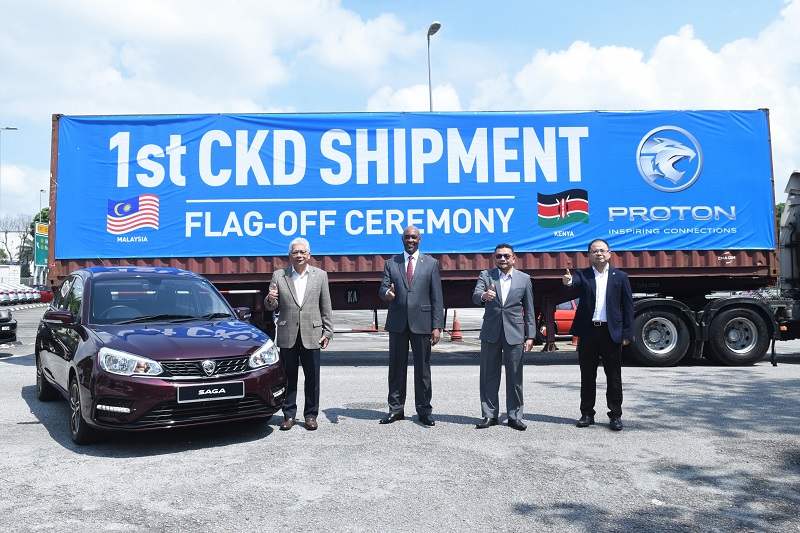
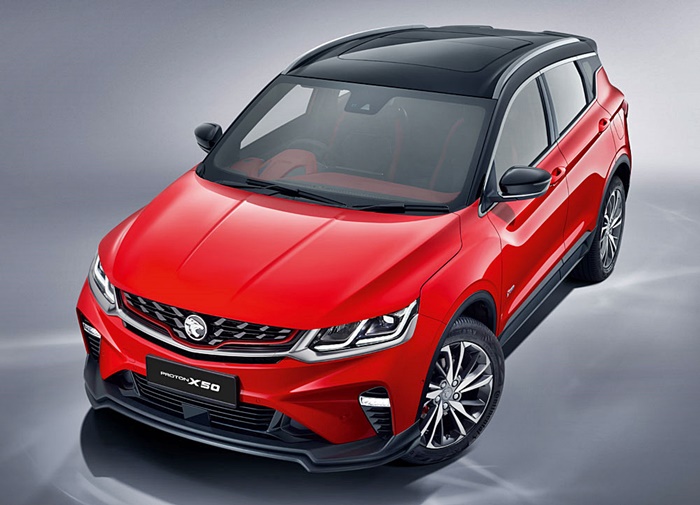
An unprecedented launch schedule has been planned with as many as 5 market introductions to take place in the coming weeks. One of these events will be the export market debut of the Proton X50 in Brunei, and another two will see the start of local assembly and sales of Proton vehicles in Kenya.
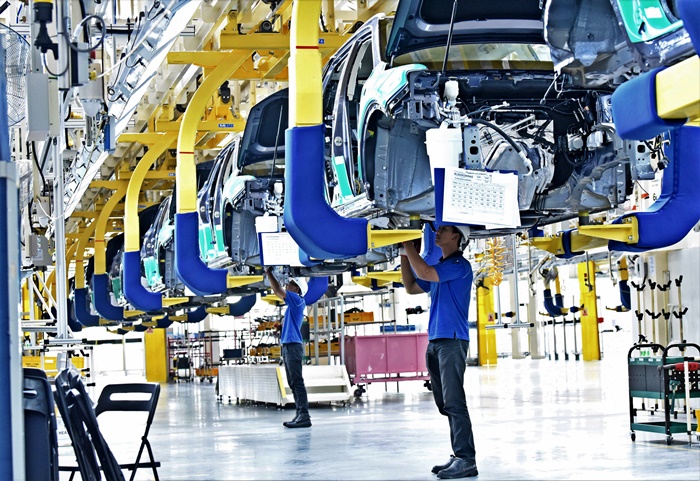
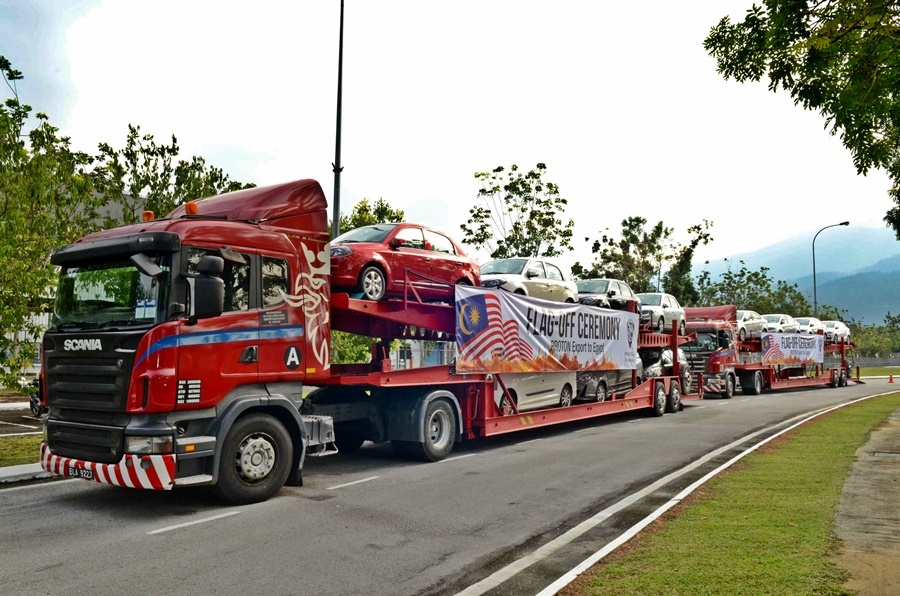
Proton began exports of CKD packs to Kenya in August this year and the first cars will roll out of the assembly plant this month. Brunei will be the first overseas market to start selling the X50 SUV (below).
nbn
“While local market leadership is one of our targets, it is equally vital for the Proton brand to build up its presence internationally, representing both the company and Malaysia. This was part of the 10-year plan that was devised at the beginning of our strategic partnership with Geely,” said Dato’ Sri Syed Faisal Albar, Chairman of Proton Holdings Berhad.
“However, parts of the export plans were affected by the COVID-19 pandemic as each country had different responses and restrictions. Still, thanks to our diligent work and the strong support of various government agencies, we are finally getting back on track,” he added.
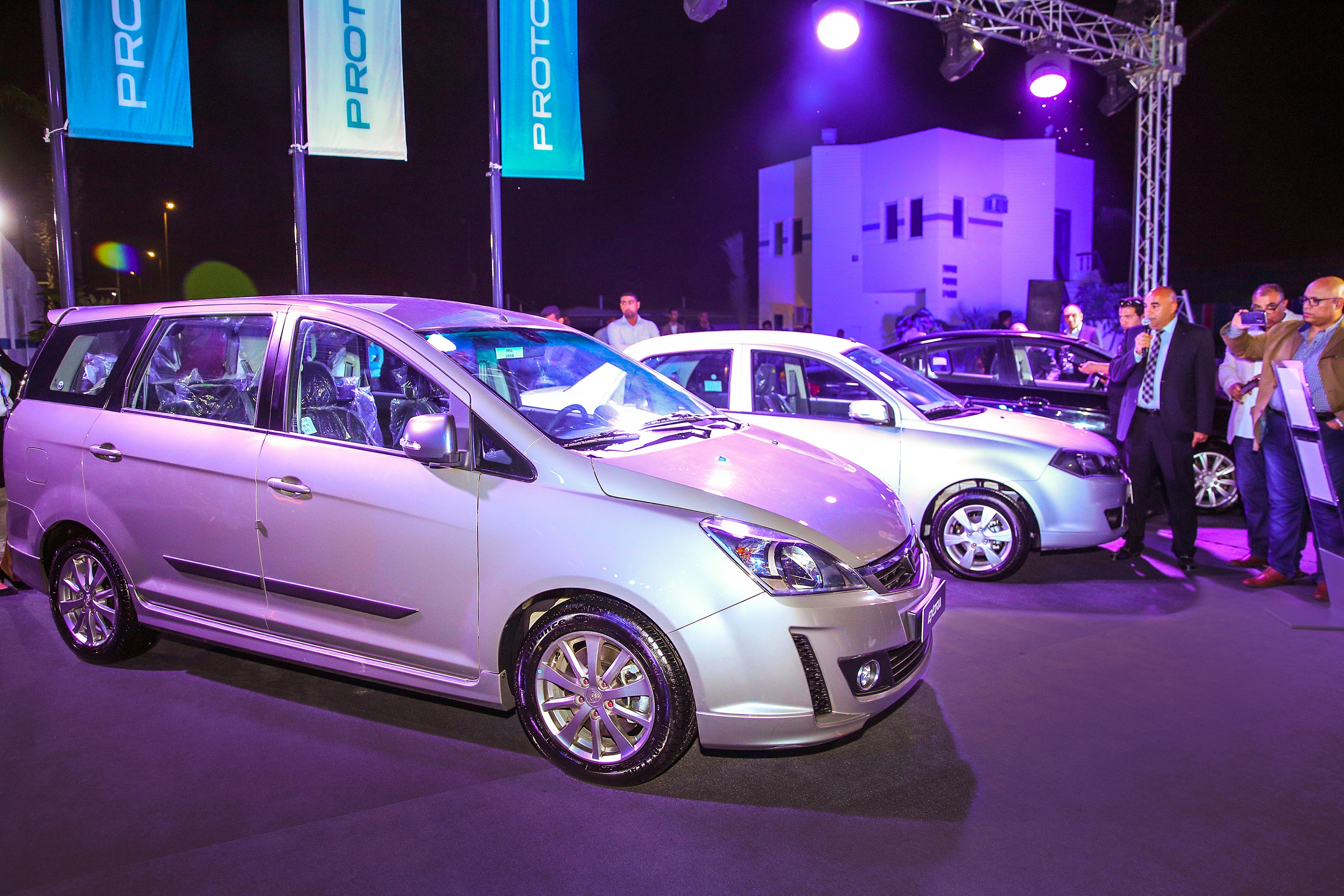
Introduction of Exora and Saga in Egypt at the end of 2018.
Additionally, Proton importers in Bangladesh and Egypt will also be hosting virtual product launches for the latest Saga before 2020 ends. This will be followed by a similar launch in Nepal just as the year draws to a close.
History of Proton exports
In the early years of Proton’s existence, its focus was on the domestic market which took virtually every car it made. Export markets, though established, were not given great attention and even Mitsubishi Motors, its partner, suggested that it concentrate on developing its skills in making cars and about the business before embarking on overseas sales.
Nevertheless, Proton began exporting just one year after the first Saga went on sale in Malaysia. Its early targets were those which were ex-British colonies, like Malaysia, and where traffic went on the left side of the road like us. This would make it unnecessary to develop a lefthand drive variant so soon.
Proton Wiras have also been spotted in North Korea though there is no official mention of exports to North or South Korea, so they may have been brought in by a private importer.
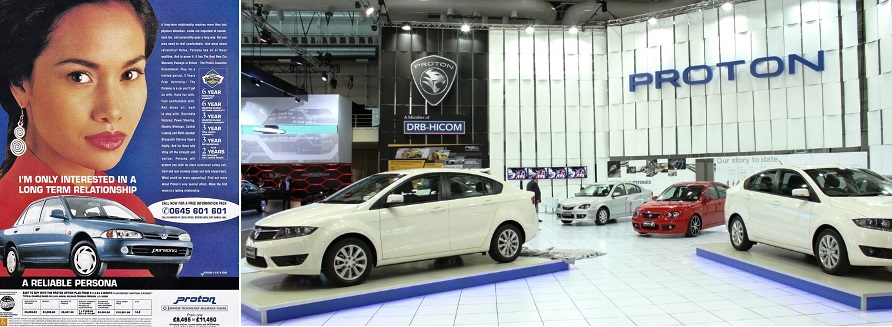
A Proton advertisement for the UK market in 1994 (left) and a display at the Sydney Motorshow in Australia in 2012.
The UK market was considered a market with great potential then, and it was hoped that the Malaysian origins of the Saga would appeal to the British who had lived in Malaysia in the pre-Merdeka period. The first model was introduced at the Birmingham Motorshow in 1988 and initially, Proton received some preferential taxation as it was a small volume brand entering the market. This allowed it to sell at attractive prices and it was well received. The growth in sales in the UK led to a subsidiary being established to handle import and marketing activities, and that market was at one stage, Proton’s biggest export market.
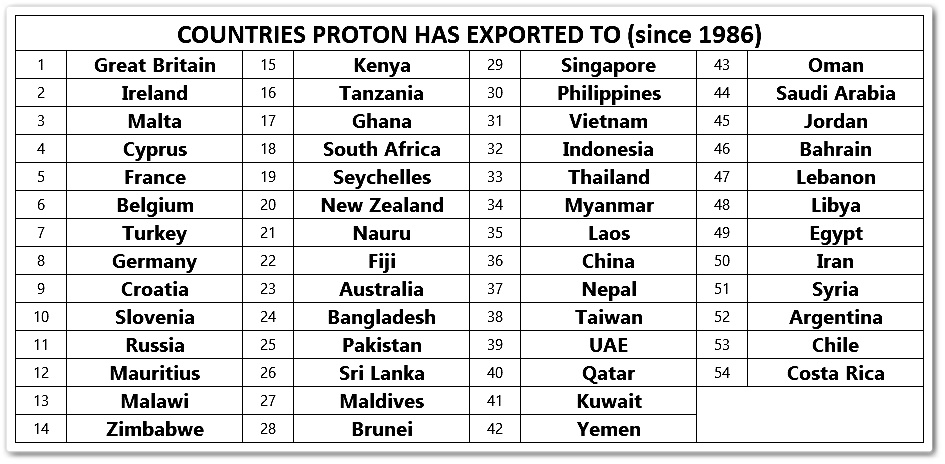
As the only Muslim country in the world to develop its own car and have an automotive brand, Protons from Malaysia were expected to be popular in other Muslim countries. In fact, the first export market was Bangladesh where the Saga first went on sale in 1986. Egypt has also been a strong market for Proton since it entered in 2004.
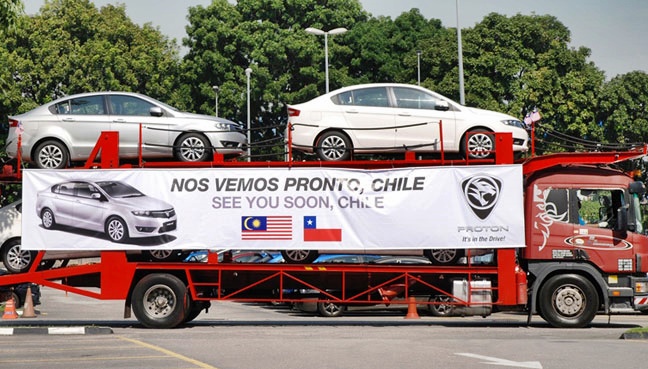
Chile was one of the early markets that Proton entered but stopped for 20 years before returning in 2016.
By 2001, Proton had appeared in over 50 countries around the world, some in significant numbers and some just a handful. It had tried to enter the US market in the late 1980s, appointing a business partner called Global Motors which created a unit known as ‘Proton America’ to get the necessary approvals. Two units of the Saga modified to lefthand drive and with 1.8-litre engines were sent to a motorshow in Las Vegas in 1988 in what was meant to be a prelude to exporting the first batch of 30,000 cars to the USA for sale. However, things didn’t work out as expected and no further attempts were made to enter the biggest car market in the world at that time.
Like many manufacturers, Proton also considered local assembly in some markets and it did so for a while in the Philippines and had a project going for Iran. It also had a joint venture company with Mitsubishi Motors in Vietnam and the deal was that for models above 1600 cc, Mitsubishi’s models would be used, and Proton would provide models below 1600 cc. But things didn’t proceed as planned and Proton never got to assemble any model.
Proton’s distributor in Turkey, Ulu Motor, has been selling the Exora, Preve, Saga FLX and Persona.
From 2001 onwards, Proton had a new range of models and hoped to grow its exports, especially as the domestic market was supposed to be ‘opening up’ and competition would become more challenging. It even built a new factory in Tanjung Malim, Perak, with a capacity of up to 500,000 units in anticipation of an export offensive regionally.
However, for various reasons, export activities diminished and in Europe, as the emission and safety regulations got tougher, Proton’s aging platforms and engines became unacceptable. By 2010, even the ‘father of Proton’, Tun Mahathir Mohamed, acknowledged that perhaps Proton had not given sufficient thought to the need to make its cars suitable for global markets and only focussed on the domestic market because it was big enough. Dealerships in many of the 50 markets slowly stopped selling Proton which was not so helpful at a time when the company was also facing a decline in domestic sales.
The low export volumes since 1986 – around 406,000 units in total – are obviously not acceptable and exports are vital if the carmaker is to grow further. While being a significant global player would be too ambitious and unrealistic, the aim is to become No. 3 in ASEAN besides becoming No. 1 in Malaysia in due course.
“We are exploring all opportunities to grow export volumes for Proton,” said Dr Li Chunrong, CEO of Proton. “We are also leveraging on Geely’s extensive overseas network operations to increase the cost-effectiveness of Proton’s operations. Geely can support us in these initiatives and there is a lot of experience within the Group so we hope to leverage on it to enable us to sell more cars outside of Malaysia.”
A number of companies, even global ones, have changed their corporate logo over the past year and Edaran Otomobil Nasional, a subsidiary of DRB-HICOM Berhad, joins them this month.
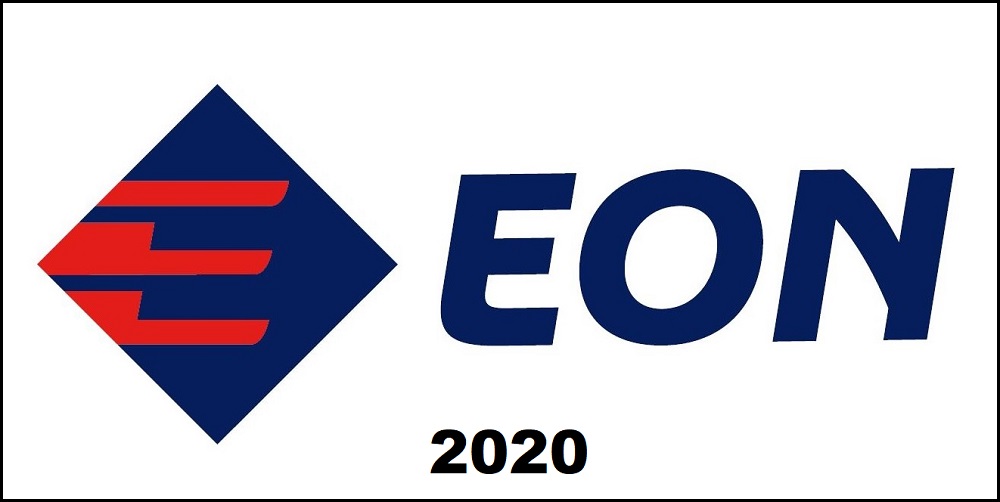
The new logo is the third one for the company, better known as ‘EON’, since it was established in 1984. The first change after that was in 1990. The new logo is a total departure from EON’s previous logo. It sports a stylised red ‘E’ that sits within a blue diamond, showing a forward-movement motion.
‘Coming of age’
The company’s acronym ‘EON’ also appears on a more modern font. The company says this signifies the brand’s coming of age after more than 30 years in the automotive distribution business in Malaysia.
The red ‘E’ is said to depict the boldness of the brand that retails a number of automotive brands in Malaysia. The blue diamond is a show of strength for the 36-year-old brand, as well as the typical traits that are associated with the colour blue: loyalty and wisdom.
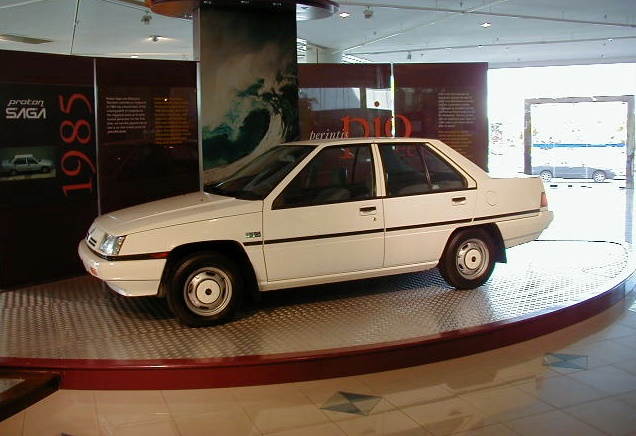
EON was originally set up the handle distribution and marketing activities in the domestic market when the Proton Saga was launched.
EON was originally established to handle domestic distribution and marketing of Proton cars. When the role was taken over by Proton Edar, which was a subsidiary of Proton, EON became a super dealer chain as it had the most Proton outlets in the country.
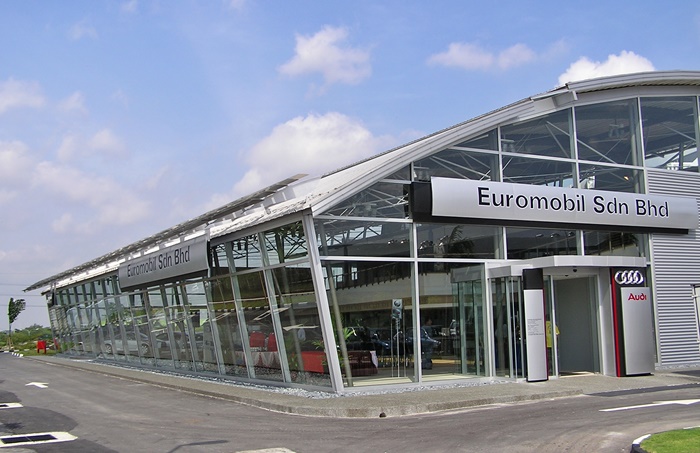
With the change in its role, EON took on other brands to represent, namely Audi, Volkswagen and Mitsubishi. The other brands are sold by subsidiaries of EON. Additionally, the company also operates the Avis car rental and leasing network in Malaysia.
Euromobil, an EON subsidiary, handles Audi.
9 Proton outlets
Along with the new logo, EON has announced the commencement of their Proton retailing business. EON now owns nine Proton dealerships, including four 4S (sales, service, spares and spray-painting) centres and three 3S outlets. Four branches are in the central region, while there are two each are in Johor and Penang. The outlets were formerly owned by Proton Edar.