

Piston.my

Ferrari

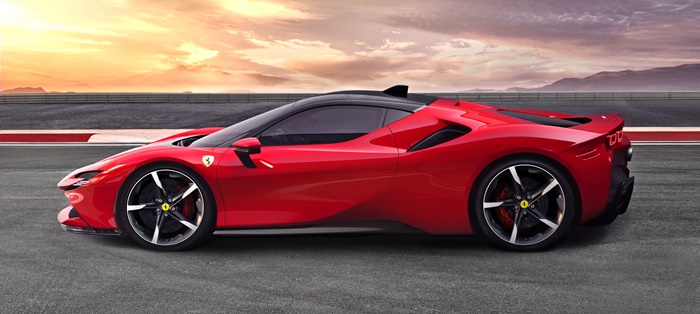
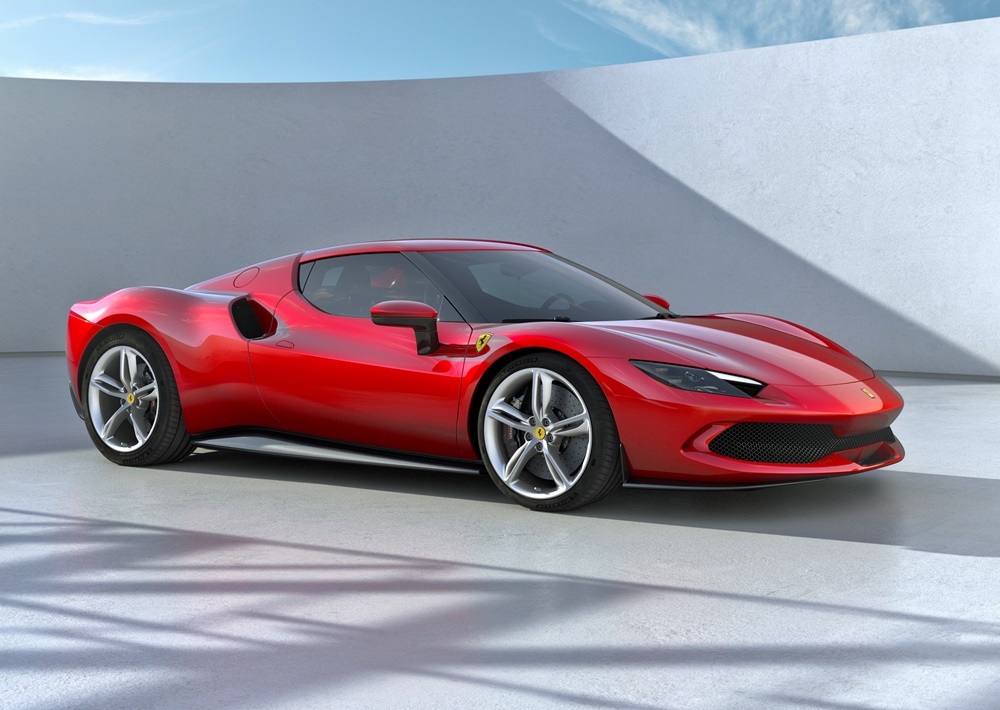
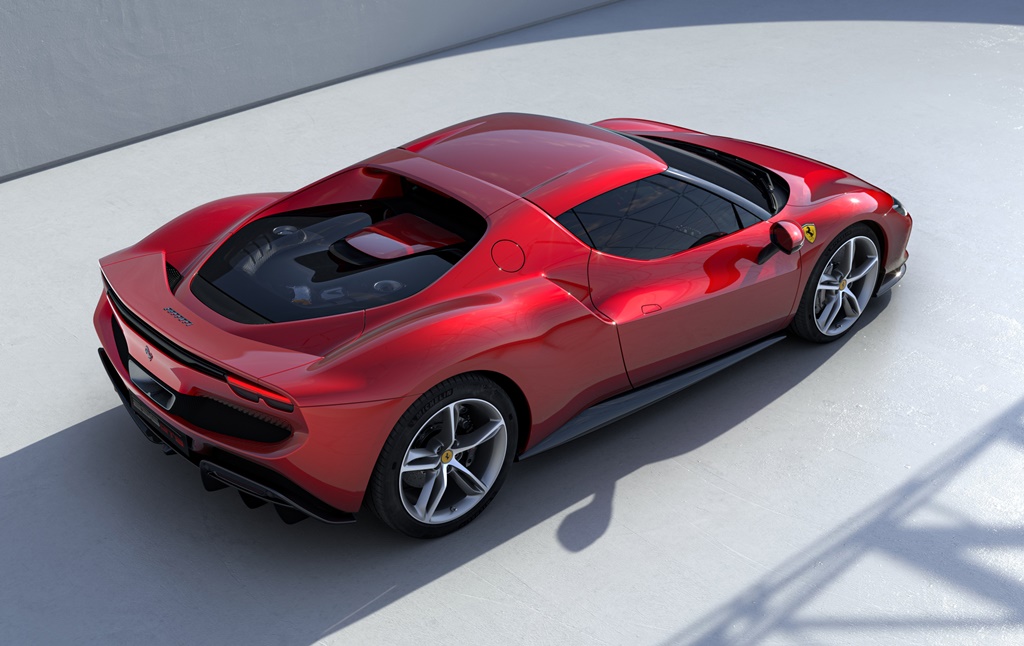
With the pace of electrification accelerating, especially in Europe, it’s time for Ferrari to get more serious. Thus far, the company has already put a few hybrid models into the market – like the LaFerrari and SF90 Stradale – and with the new 296 GTB, the latest evolution of their mid-rear-engined two-seater Berlinetta gets a new hybrid engine as well.

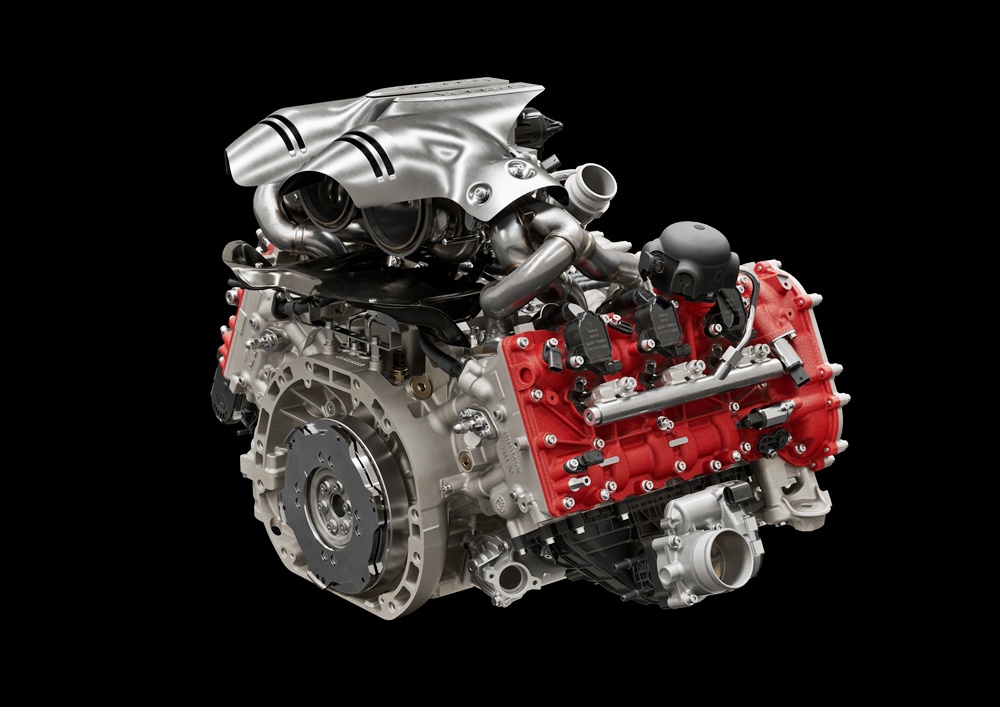
All-new hybrid V6 engine
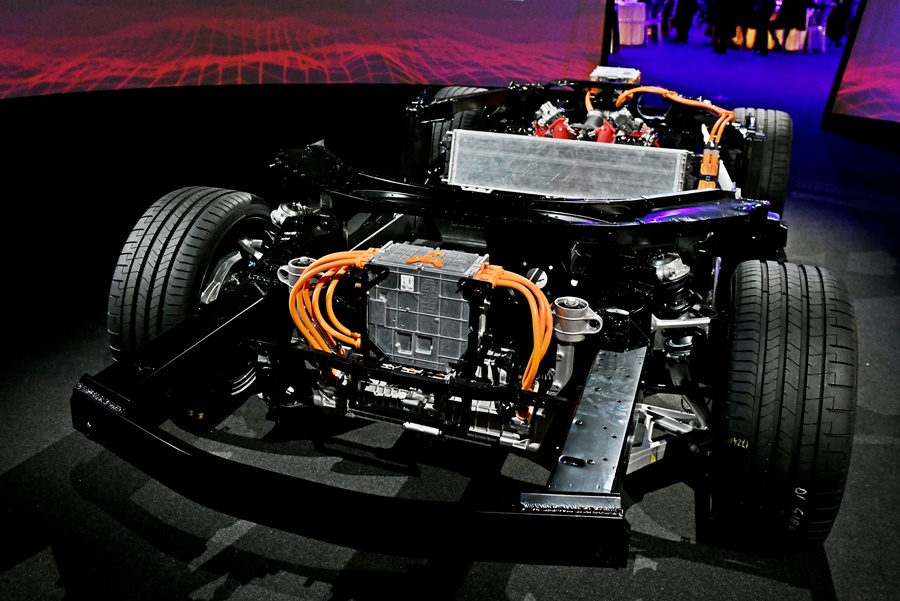
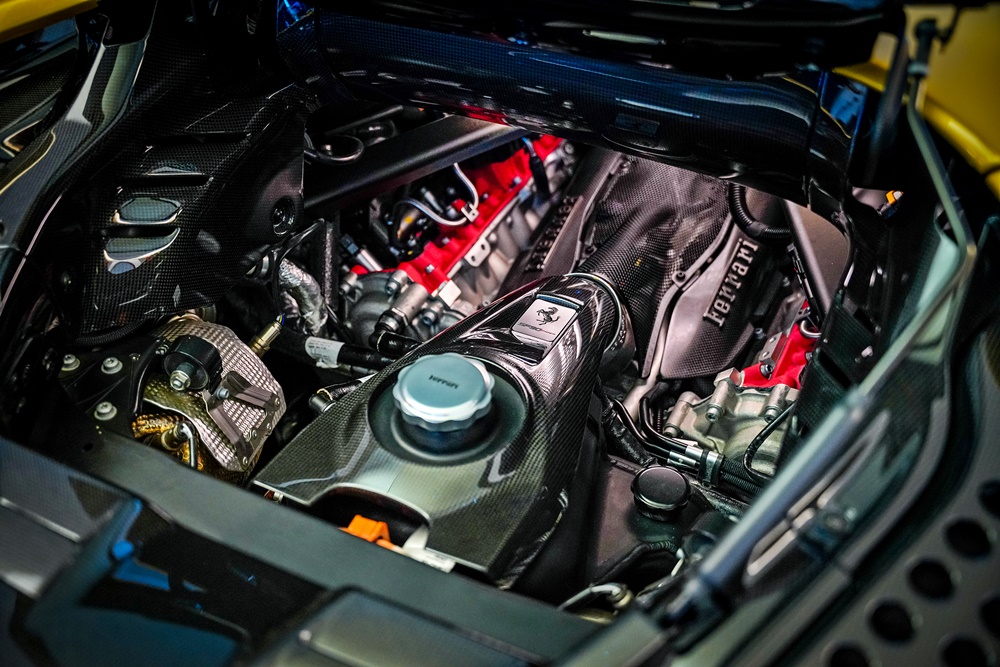
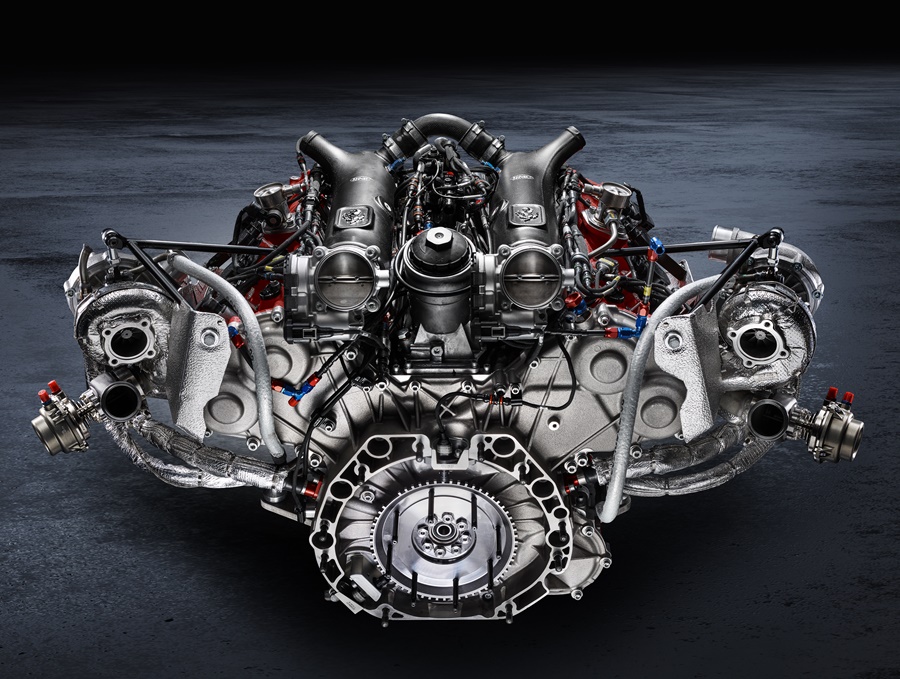
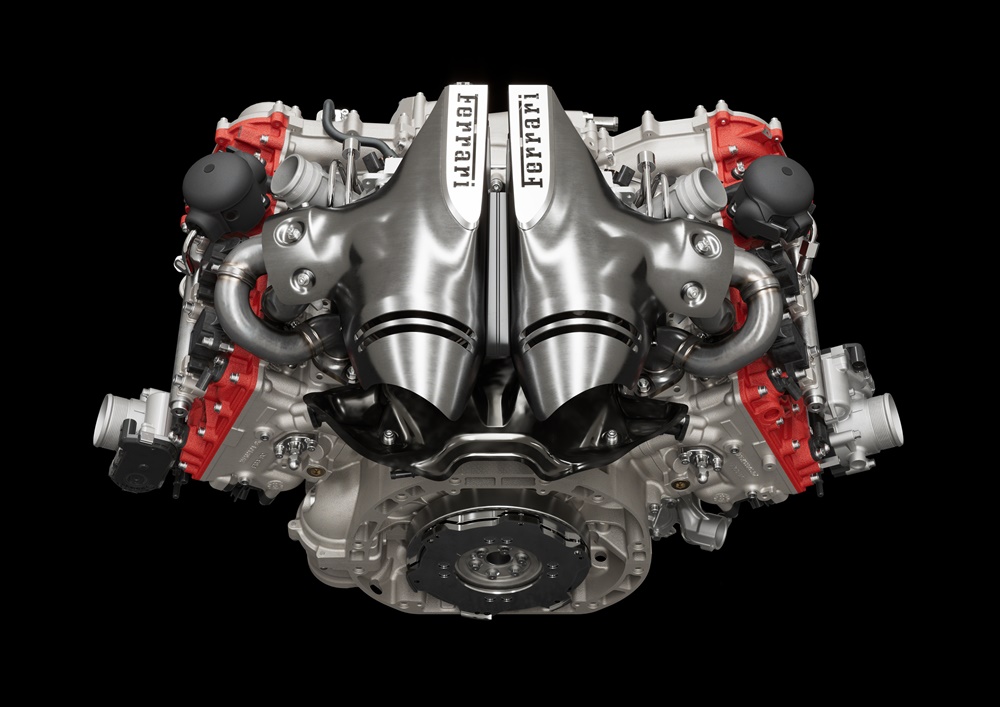
The engine is new – neither 8-cylinder nor 12-cylinder – but a 663 cv (553 ps) 120° V6 coupled with an electric motor that adds 122 kW (166 ps), giving a total system output of 830 ps. This is the first 6-cylinder engine installed on a Ferrari road car although the brand has had V6 engines going as far back as 1957 but only for its racing cars. The very first Ferrari V6 has 65° architecture and debuted on the 1500 cc Dino 156 F2 single-seater. V6 hybrid architecture has been used on all Formula 1 single-seaters since 2014.
2021 Ferrari 296 GTB

In the case of the 296 GTB (the badge number is composed of its total displacement and the engine cylinders), the hybrid system is a plug-in (PHEV) type which can provide up to 25 kms of running on just electric power, it is claimed.

This new V6 has been designed and engineered from a clean sheet by Ferrari’s engineers specifically for this car and is the first Ferrari to feature the IHI turbos installed inside the vee. Aside from bringing significant advantages in terms of packaging, lowering the centre of gravity and reducing engine mass, this particular architecture is said to help deliver extremely high levels of power.
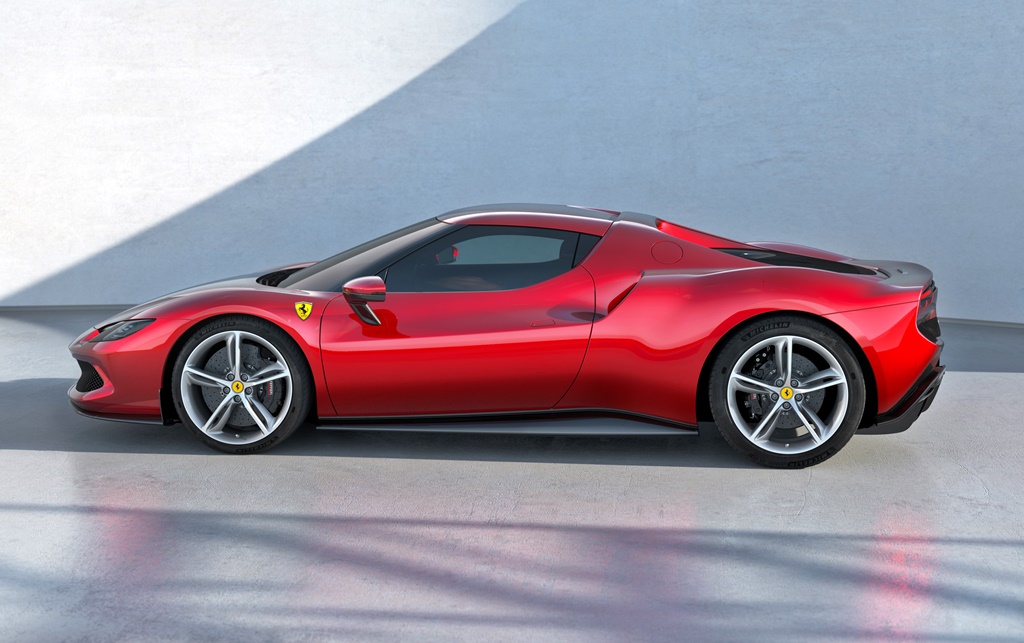
2021 Ferrari 296 GTB

2021 Ferrari 296 GTB

The result is that the new Ferrari V6, which has an 8-speed DCT, has set a new specific power output record for a production car and the maximum power output puts it at the top of the rear-wheel drive sportscar segment.

Sound-wise, the 296 GTB rewrites the rulebook by harmoniously combining two characteristics that are normally diametrically opposed: the force of the turbos and the harmony of the high-frequency notes of a naturally-aspirated V12. Even at low revs, inside the cabin, the soundtrack features the pure V12 orders of harmonics which then, at higher revs, guarantee that typical high-frequency treble.
2021 Ferrari 296 GTB

Aerodynamic innovations
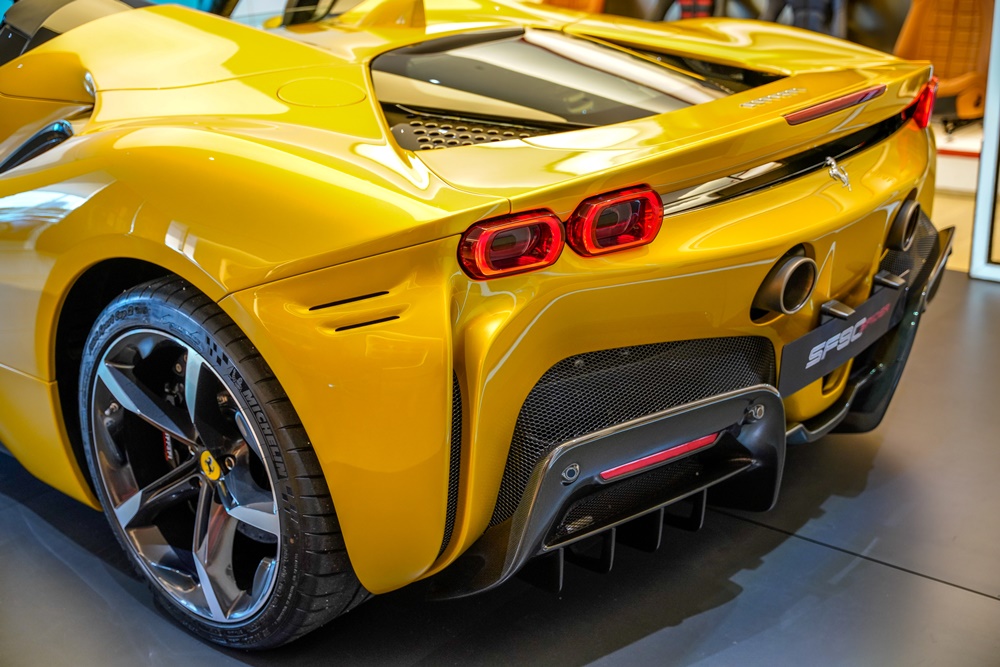
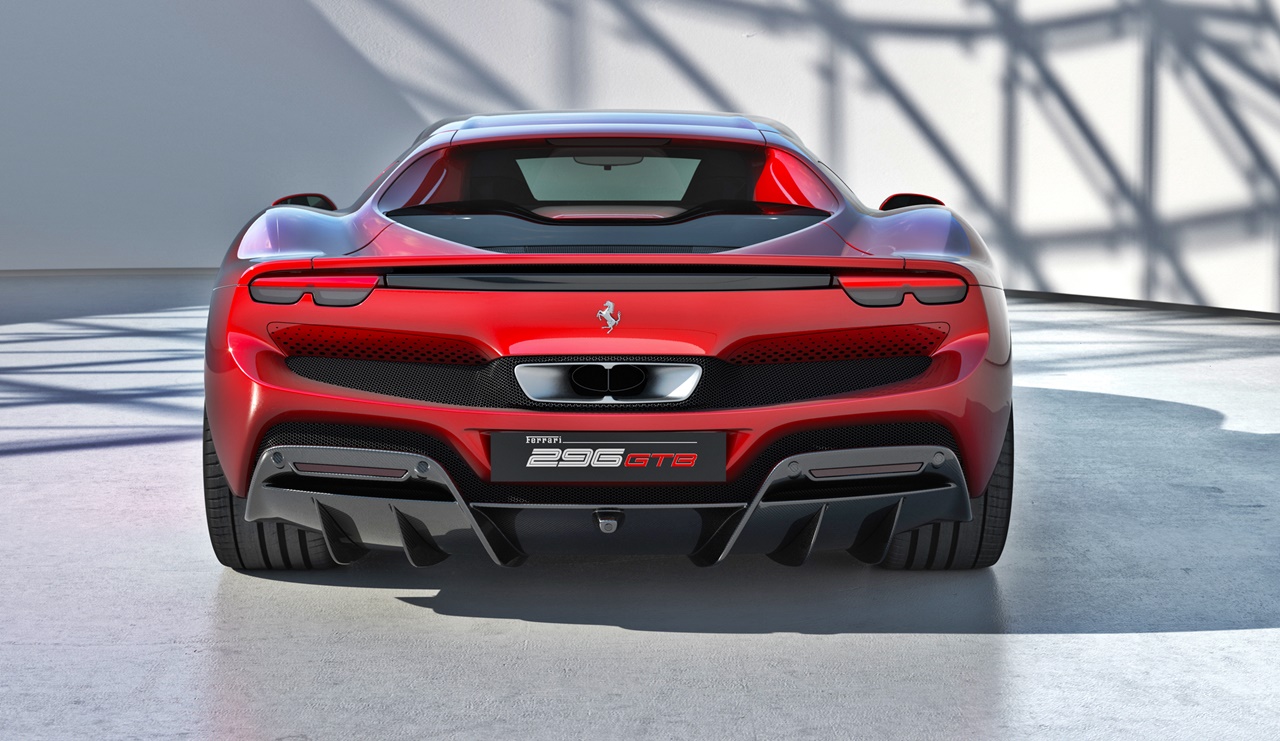
Apart from the powertrain innovation, the 296 GTB also has aerodynamic innovations that include, for the first time, an active device is being used not to manage drag but to generate extra downforce. The LaFerrari-inspired active spoiler integrated into the rear bumper allows the 296 GTB to generate a high level of rear downforce when required – up to 360 kgs at 250 km/h in high- downforce configuration with the Assetto Fiorano package.

The brake cooling system was developed around the Aero calipers introduced on the SF90 Stradale with ventilation ducts integrated into their castings. This brake cooling concept requires a dedicated duct to correctly channel cool air coming in through the air intakes on the front bumper through the the wheelarches. In the case of the 296 GTB, the intake has been integrated into the headlight design.
2021 Ferrari 296 GTB

The styling of the tail shows a break from traditional Ferrari coupe design by adopting an architecture that creates a spider-like discontinuity between roof and rear engine cover. This choice makes the 296 GTB both unique and instantly recognisable and, from an aerodynamic perspective, led to the addition of a new wing profile on the roof which extends into two side fins that hug the edges of the rear engine cover.

Cabin evolved from SF90 Stradale
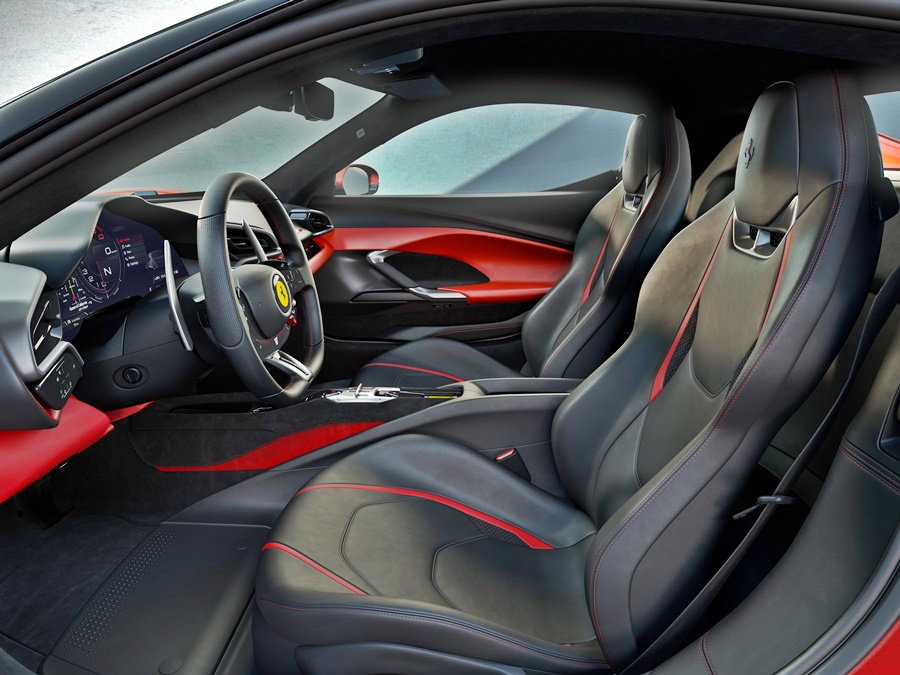
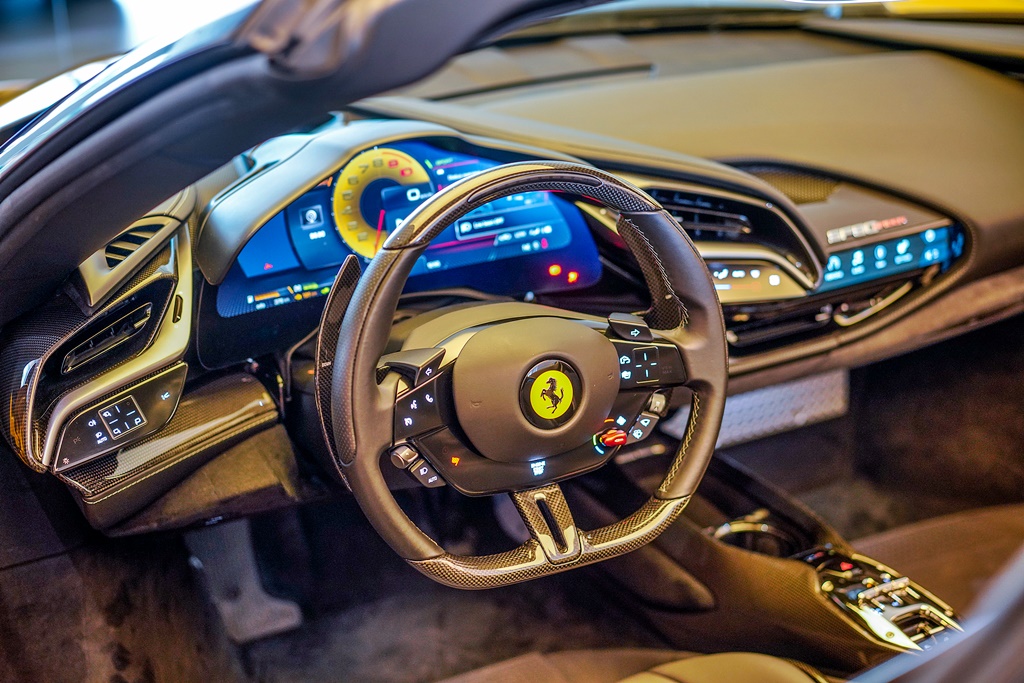
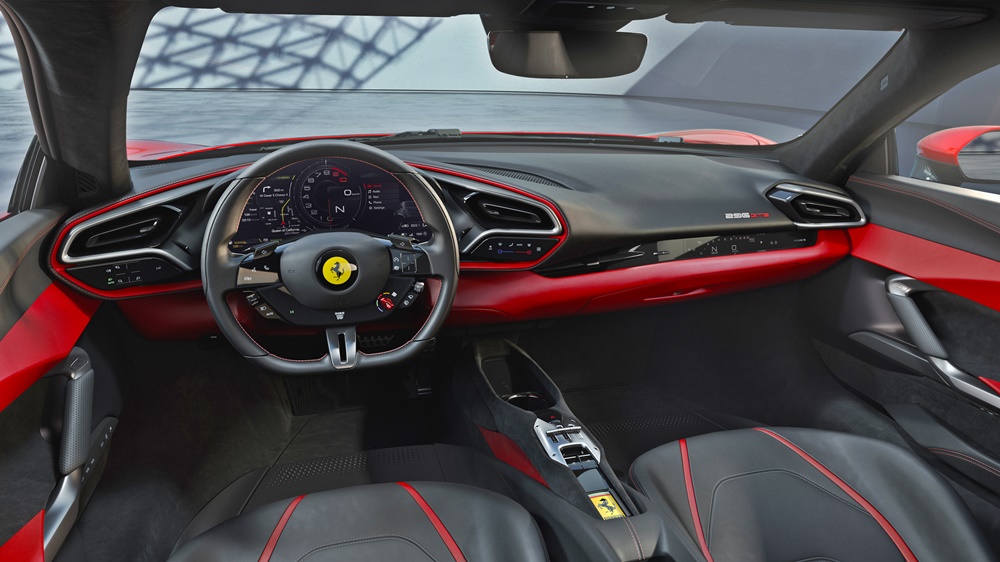
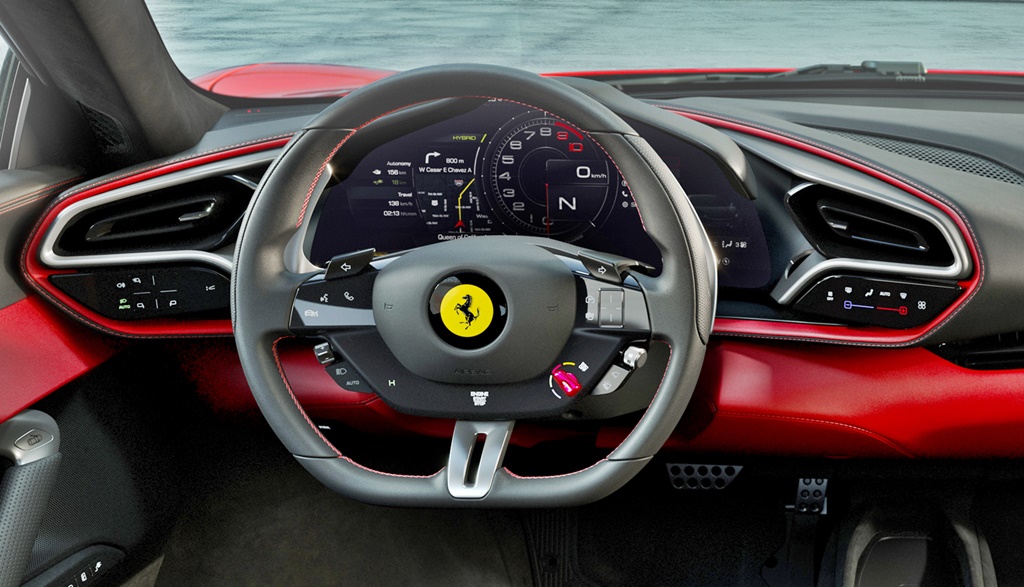
The 296 GTB’s cabin area was developed around the new concept of an entirely digital interface which was first adopted by the SF90 Stradale. With the SF90 Stradale, the interior designers wanted to highlight the presence of the advanced technology and underscore a clear break with the past; in the case of the 296 GTB, the idea was to clothe that technology in a sophisticated way. The result is a pure, minimalistic connotation characterised by a powerful elegance that, on an aesthetic level, perfectly mirrors the design of the exterior.
2021 Ferrari 296 GTB

2021 Ferrari 296 GTB

2021 Ferrari 296 GTB

2021 Ferrari 296 GTB

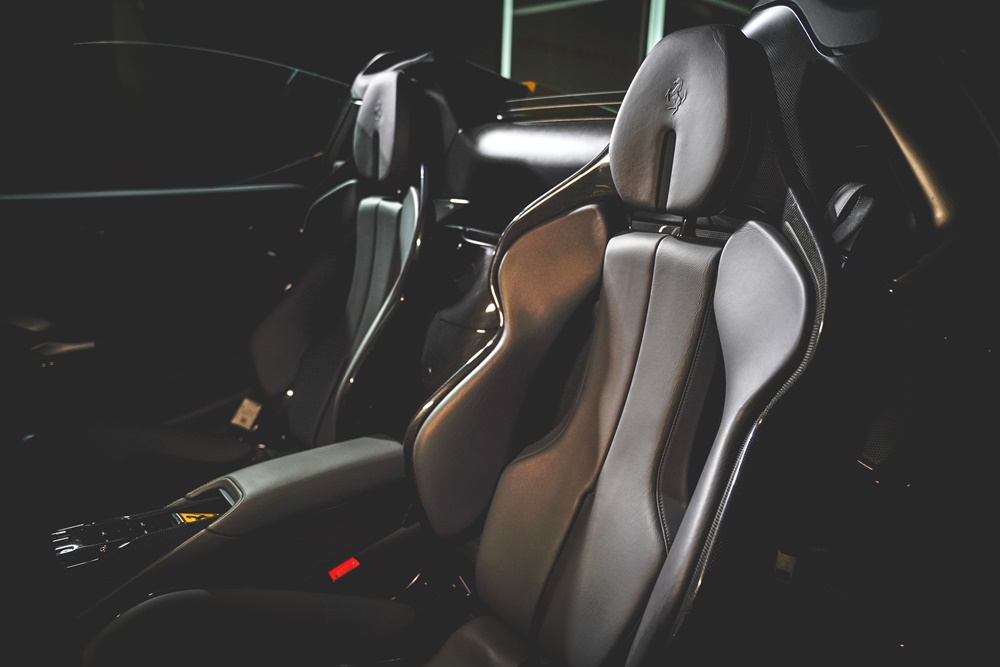
The 296 GTB’s cabin raises the concept of the formal purity of the functional elements to new heights. From a formal perspective, when the engine is off, the onboard instruments go black, enhancing the minimalist look of the cabin. Exclusive Italian leather trim to the seats and trim is further enhanced by the noble technical materials used on the functional components. The sculptural door panels are seamless continuations of the dashboard in terms of both materials and colour.

Assetto Fiorano package
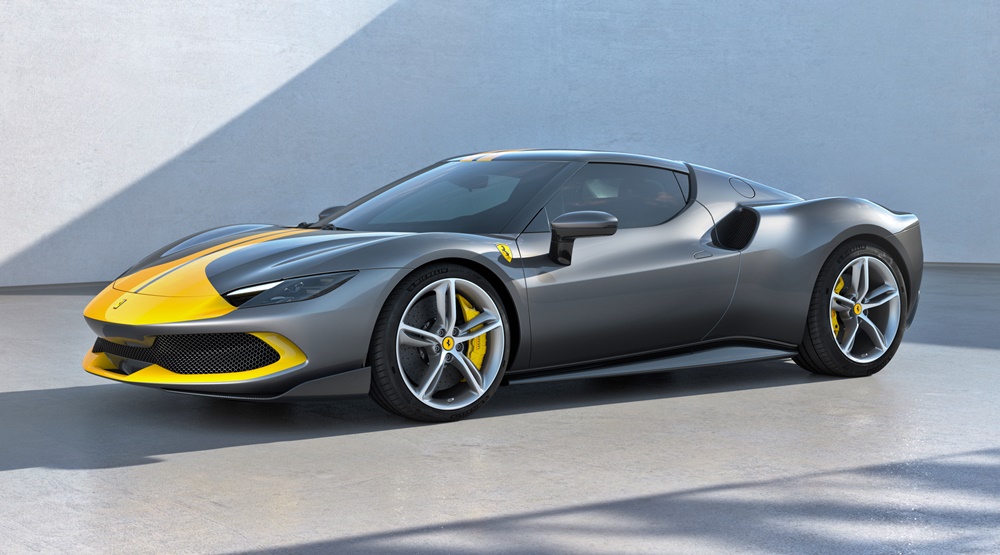
For customers who want to experience the full performance of the car, the Assetto Fiorano package is available and provides significant weight reduction and aero content. It includes special GT racing-derived adjustable Multimatic shock absorbers, high downforce carbonfibre appendages on the front bumper, a Lexan rear screen, and more extensive use of lightweight materials such as carbonfibre for both cabin and exterior.
2021 Ferrari 296 GTB

The Assetto Fiorano package involves much more than simply replacing elements. Some components require the standard basic structure to be redesigned, including the door panel, resulting in an overall weight-saving of 12+ kgs.
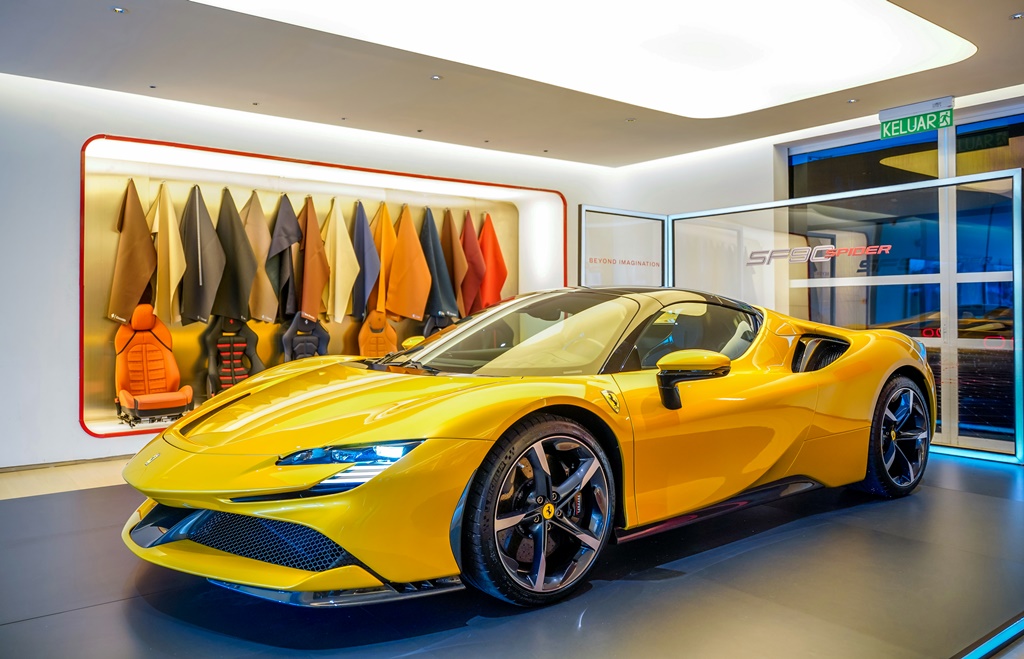

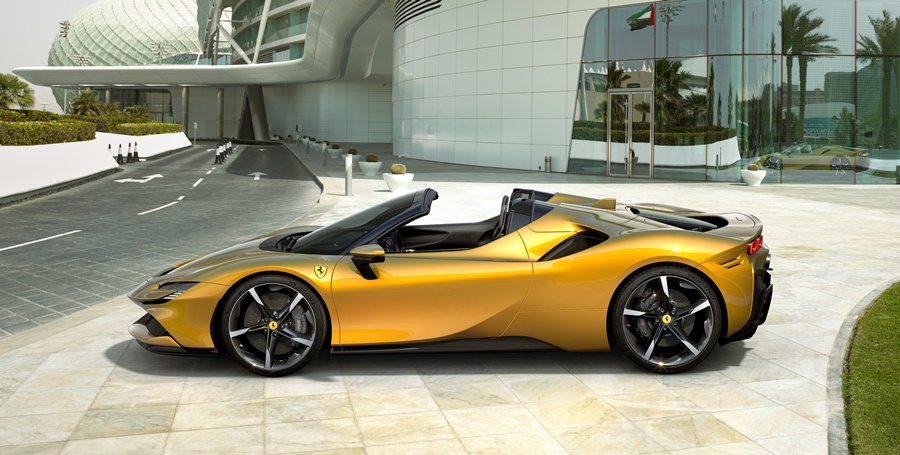
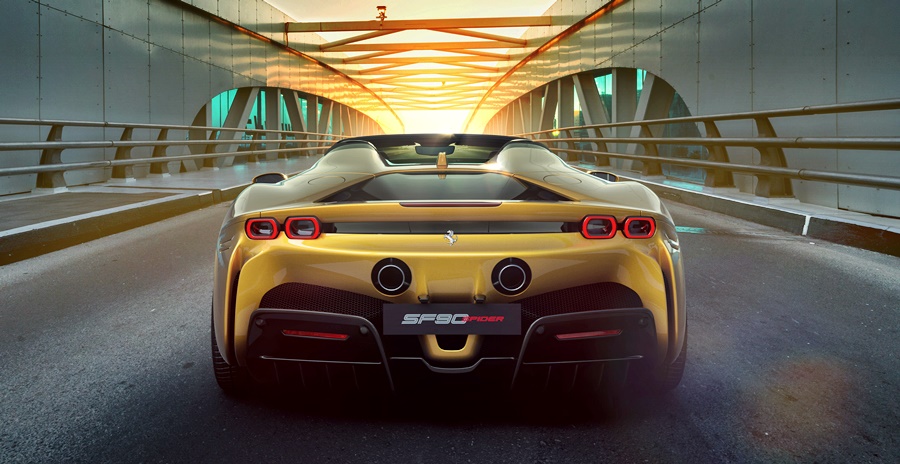
Ferrari had prototypes of hybrid powertrains over 10 years ago and last year finally put a plug-in hybrid (PHEV) into production as the SF90 Stradale – the Italian carmaker’s first hybrid supercar. Together with the Stradale came the SF90 Spider, its first hybrid supercar with a retractable hard top (RHT) and this new model is now available in Malaysia from RM2,088,000 (excluding duties, taxes and insurance).

2021 Ferrari SF90 Spider

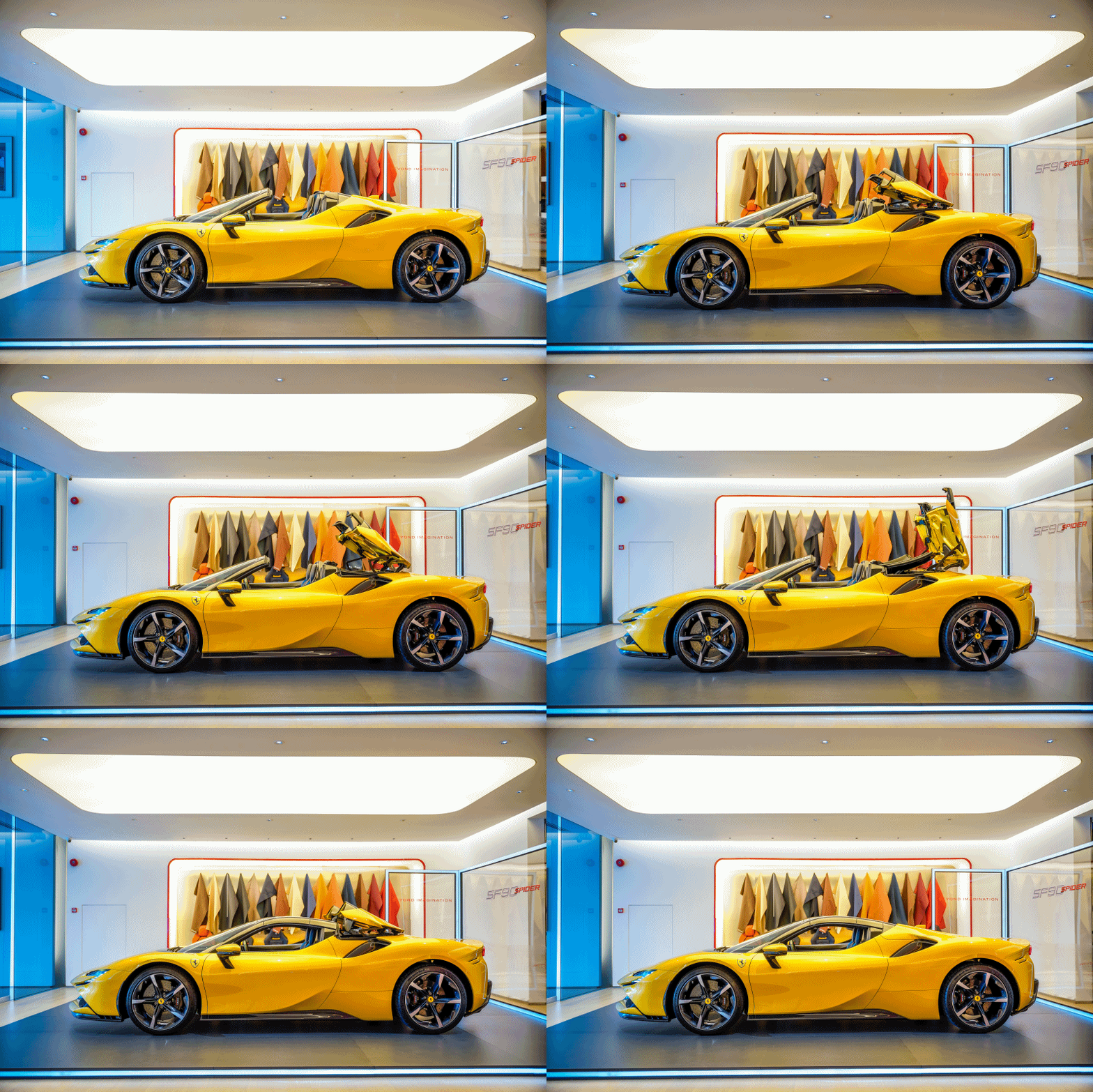
Simple and light RHT
The RHT is simple in design and can open or close within 14 seconds, with operation possible even when the car is on the move. The use of aluminium in its construction also means that it is around 40 kgs lighter than a conventional retractable hardtop while taking up less storage space. Its compactness requires just 100 litres of space, rather than the 150 – 200 litres required by a traditional system.

Ferrari guarantees optimal noise insulation and protection from the elements when the RHT is raised, and it will not deform at high speeds. An adjustable electric rear window also enhances occupant comfort, even when the RHT is lowered at higher speeds.

2021 Ferrari SF90 Spider

Hybrid architecture
In a first for a Ferrari production spider, the SF90 Spider has plug-in hybrid architecture in which the internal combustion engine is integrated with two electric motors at the front and one at the rear derived from and named after the MGUK (Motor Generator Unit, Kinetic) used in Ferrari’s F1 cars. The synergy between the turbocharged V8 petrol engine and the electric motors generates a maximum of 1,000 ps/900 Nm, more than any other V8 turbo engine ever built by Ferrari.

The hybrid architecture proved a challenge in terms of weight management. While the extra 270 kgs of the hybrid system was amply compensated for by the extra power delivered, extensive optimisation and weight reduction work was also required on the rest of the car to keep overall weight down to 1,670 kgs.
Just as the SF90 Stradale redefined the aerodynamic performance levels of the Ferrari range, the SF90 Spider is pushing the limits of the results delivered still further. The goals that drove the aerodynamic development of the car from the very earliest stages were maintaining the SF90 Stradale’s performance levels with the RHT deployed, minimising aerodynamic turbulence and noise with the RHT retracted, and optimising power flows. Up to 390 kgs of downforce can generated in cornering at 250 km/h (with the special Assetto Fiorano specification).

1,000 ps/900 Nm V8
The synergy between the turbocharged V8 petrol engine and the electric motors generates a maximum of 1,000 ps/900 Nm – 60 ps more than any other V8 turbo engine ever built by Ferrari. To deliver this output, Ferrari’s engineers completely redesigned the intake and exhaust systems. To improve internal fluid dynamics, the ducts are now all horizontally lined up at engine head height, the turbo charger assembly has been lowered, and the exhaust line is higher.

This rationalisation also produced both a lower centre of gravity and a reduction in overall weight thanks to the use of Inconel instead of steel for the exhaust manifold.

The 8-speed, oil-bath, dual-clutch gearbox used in the SF90 Stradale has been redesigned for the spider version. Despite the addition of an eighth gear and the need to transmit a maximum torque of 900 Nm (an increase of more than 20% on the current 7-speed), the gearbox’s overall weight is actually 10 kgs lower than its predecessor. The clutch’s performance is 35% higher than the 7-speed, transmitting up to 1,200 Nm in dynamic torque during gear shifts.

Much attention was given to sound quality when redesigning the exhaust system as the soundtrack is one of the pivotal factors in the exhilarating pleasure of driving a Ferrari. The introduction of a ‘hot tube system’, which transfers sound more directly to the cockpit, has produced fuller, richer harmonics across the entire frequency range, improving both in-car sound quality and intensity as revs rise compared to previous Ferrari V8s.

To make full use of the powertrain’s output, the engineers improved the vehicle dynamics systems to allow the driver to enjoy the maximum potential, and not just in terms of pure performance and lap times.

Digital instrumentation with HUD
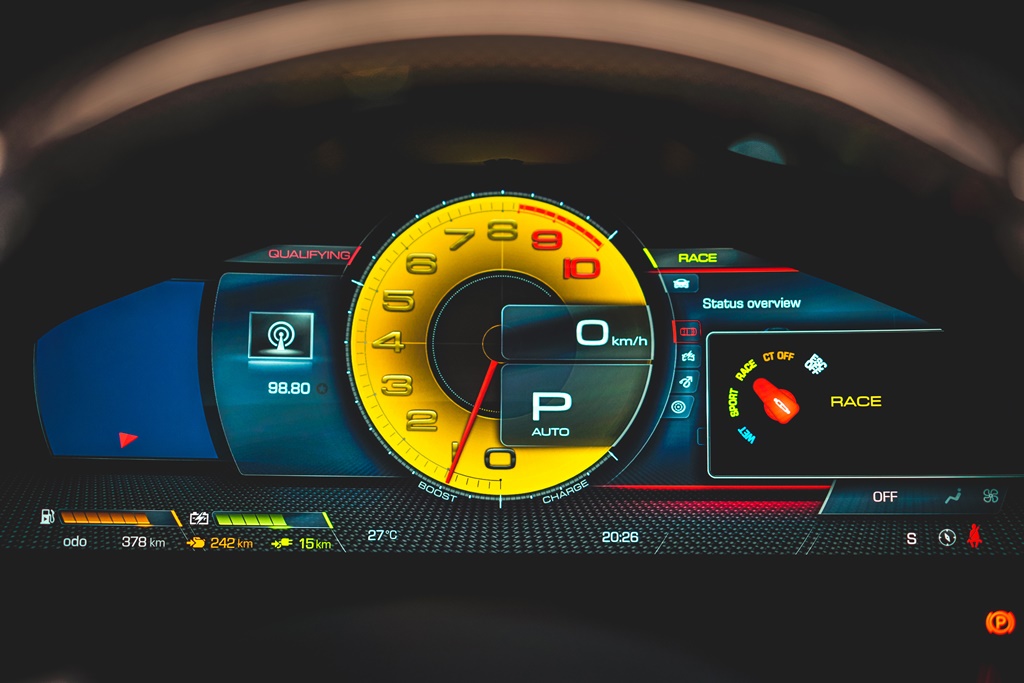
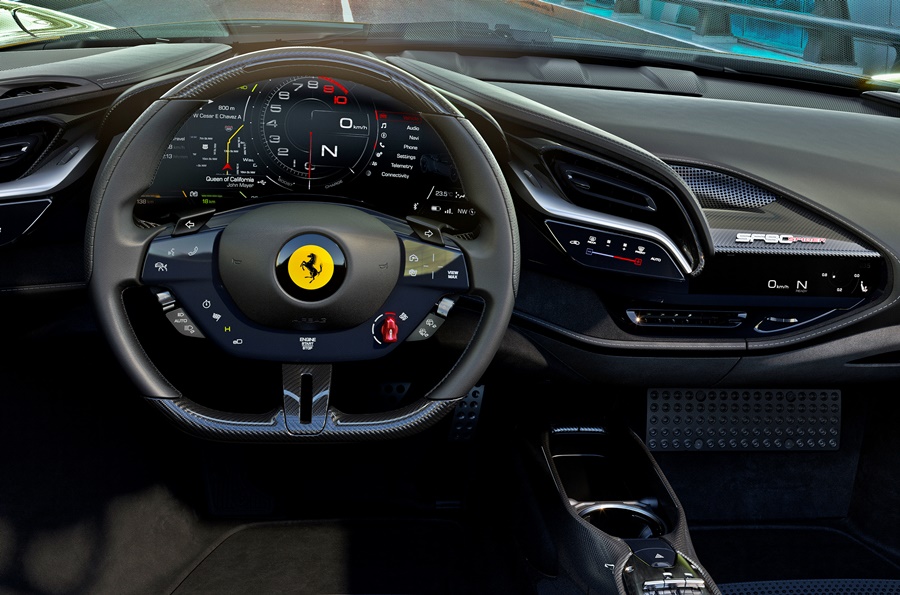
The look and feel of the cabin was driven in large part by the complete redesign of the HMI (Human-Machine Interface). The instrumentation is now predominantly digital with all the screens going completely black when the car is not running. The central instrument cluster comprises a single 16-inch HD screen, complemented by a head-up display (HUD).

2021 Ferrari SF90 Spider

2021 Ferrari SF90 Spider

The steering wheel completes that transfer process from the competition world and also ushers in a new era by introducing a series of touch commands that allow the driver to control virtually every aspect of the car without ever taking the hands off the wheel.

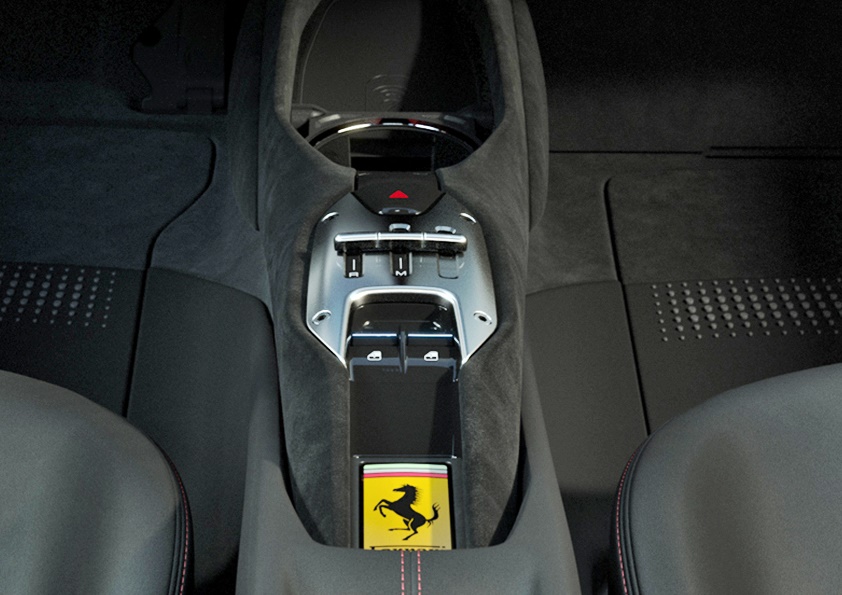
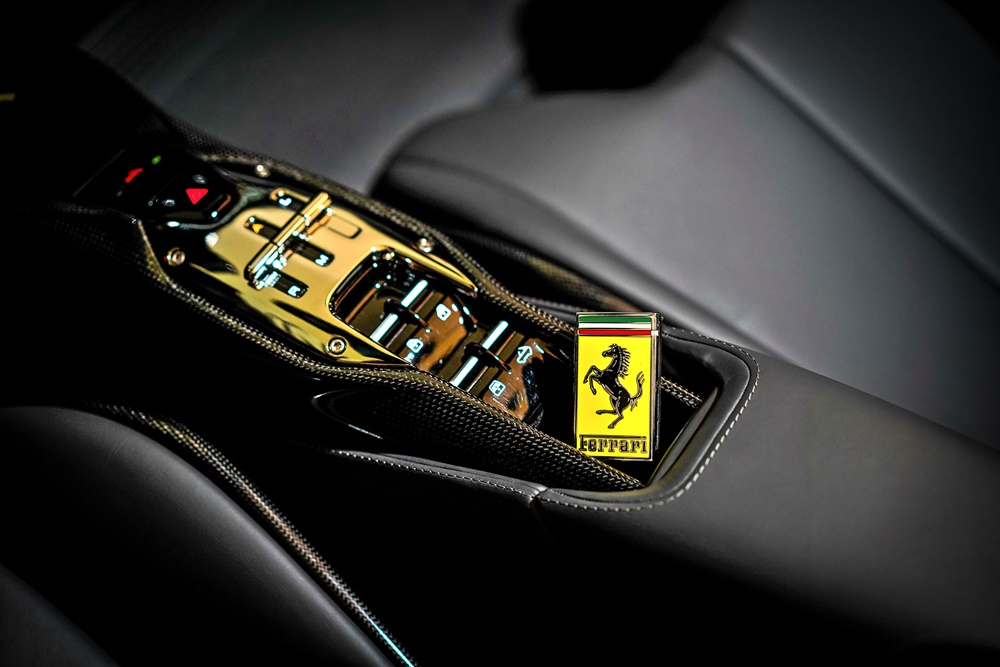
The F1 bridge, a signature on the previous models, has now disappeared from the central tunnel and been replaced by a modern take on the gearshift gate, an iconic feature of Ferrari’s manual gearboxes. In the new gate, however, the gearshift grille is digital as befits an automatic transmission.

Assetto Fiorano upgrades
As with the SF90 Stradale, the SF90 Spider is also available with an additional specification option for owners that want to push its track car capability to the extreme. The Assetto Fiorano pack includes a list of exclusive upgrades that include Multimatic shock absorbers derived from the Ferrari’s GT racing experience and optimised for track use.


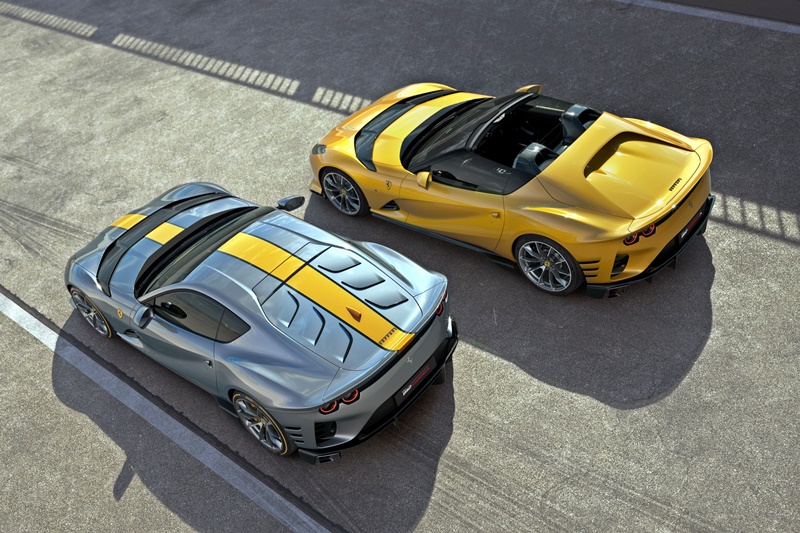
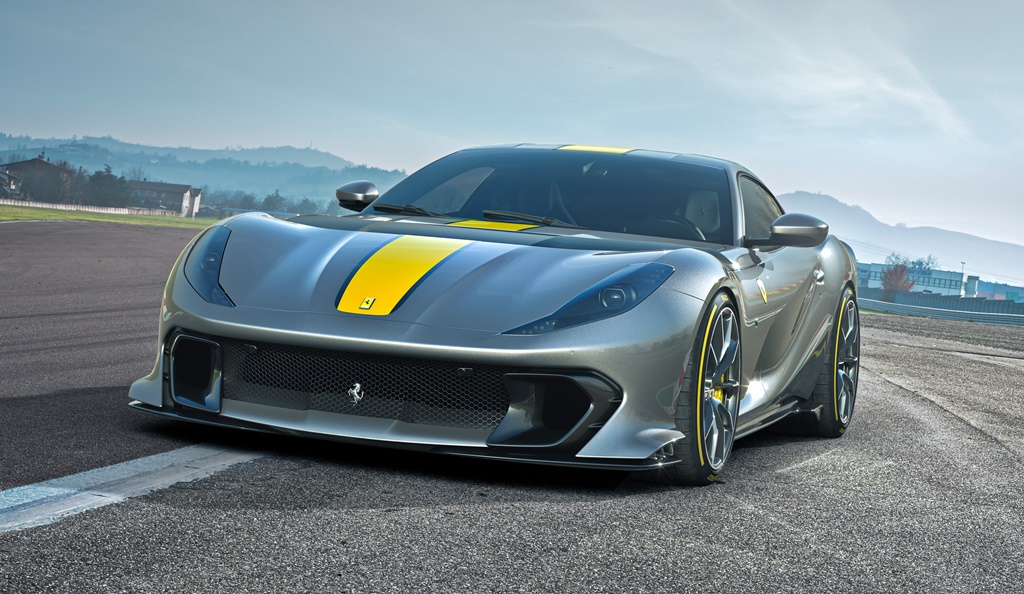
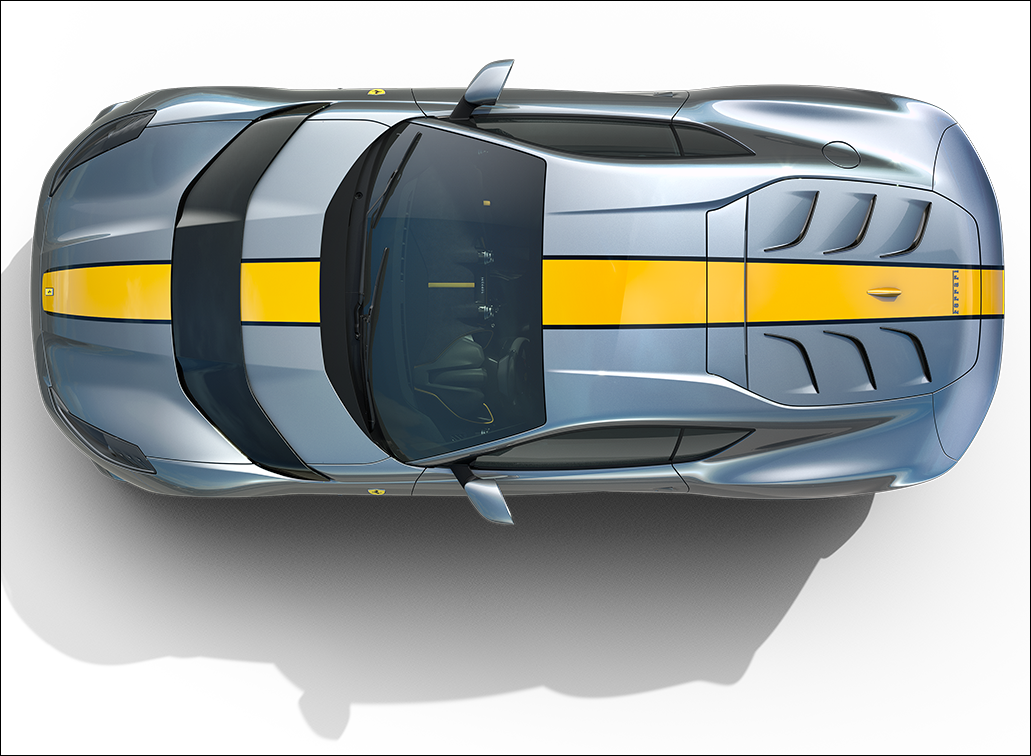
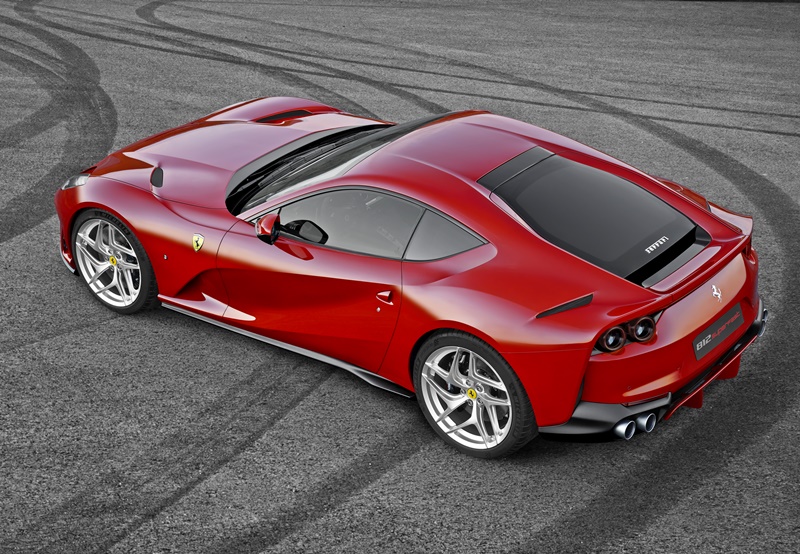
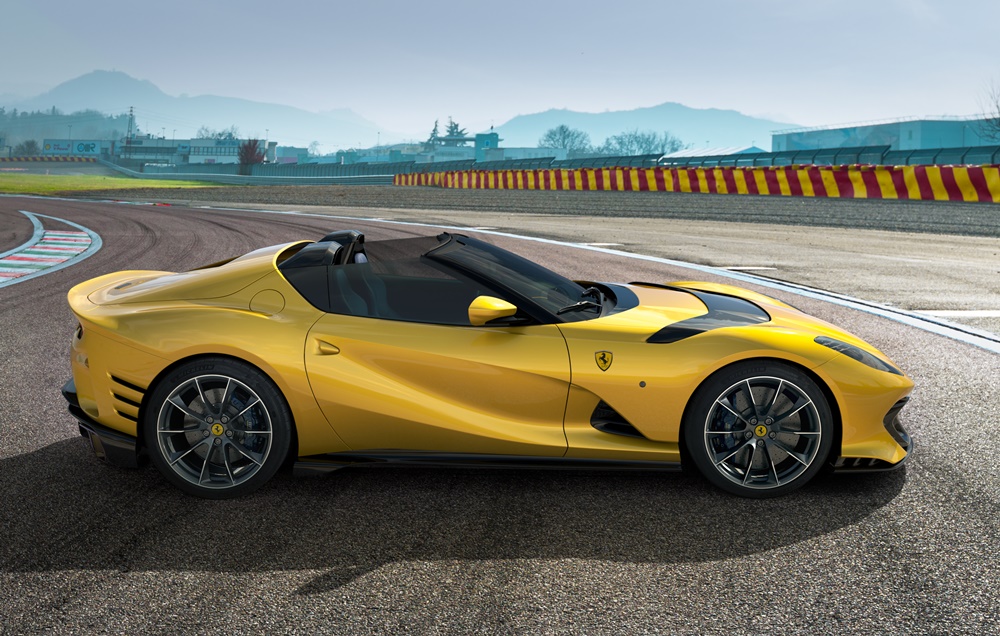
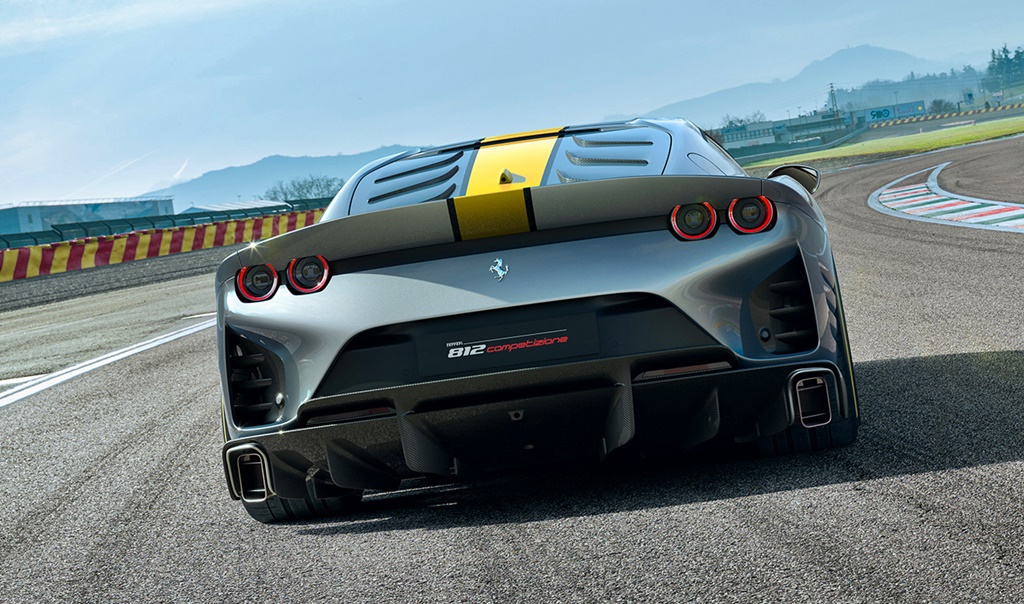
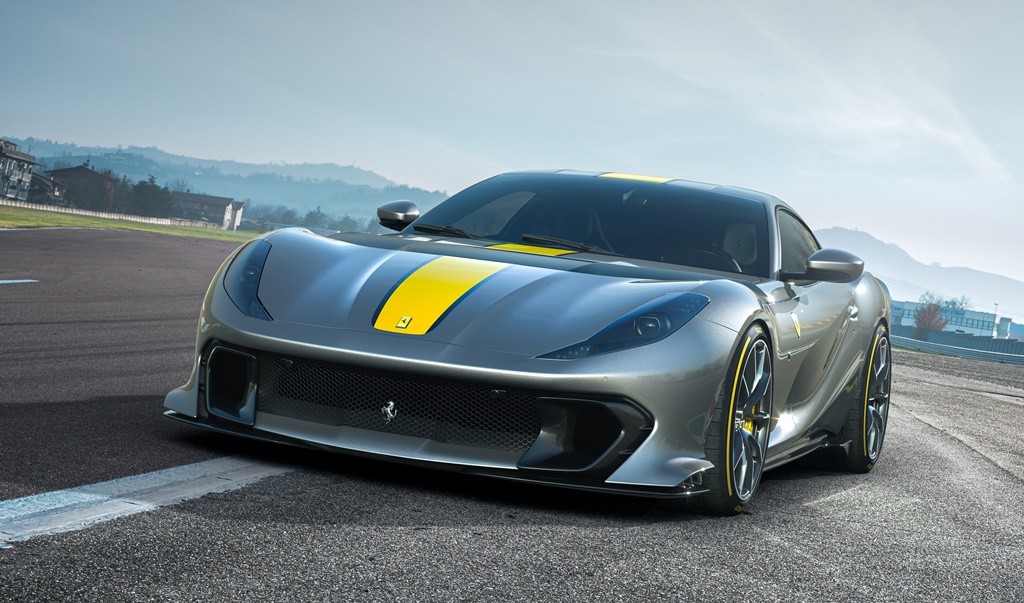
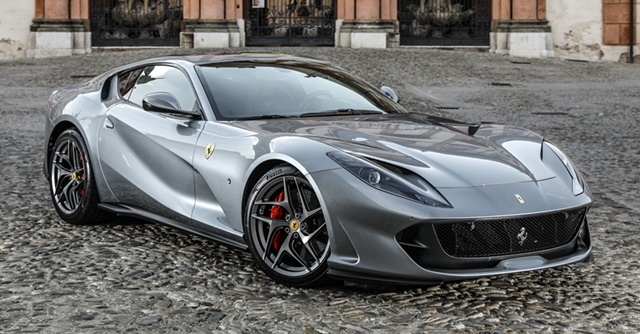
Described as ‘the ultimate expression of Ferrari’s concept of an extreme front-engined berlinetta’, the limited-edition special series 812 Competizione takes the 812 Superfast to a higher level than ever before. Unveiled to the world from the recently-opened GT Sporting Activities Department located alongside the Fiorano track at the factory, the 812 Competizione was accompanied by the targa-top 812 Competizione A which is also produced in a limited series.

2021 Ferrari 812 Competizione

2021 Ferrari 812 Competizione

Re-engineered V12 engine
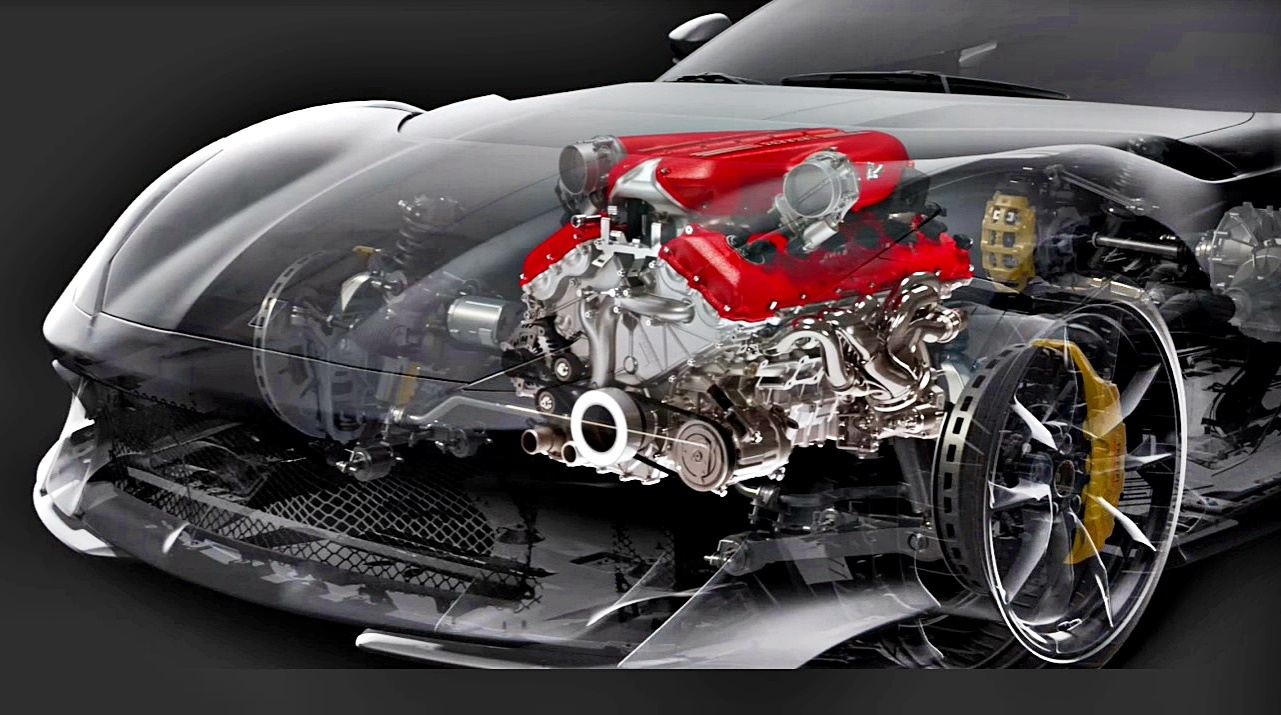
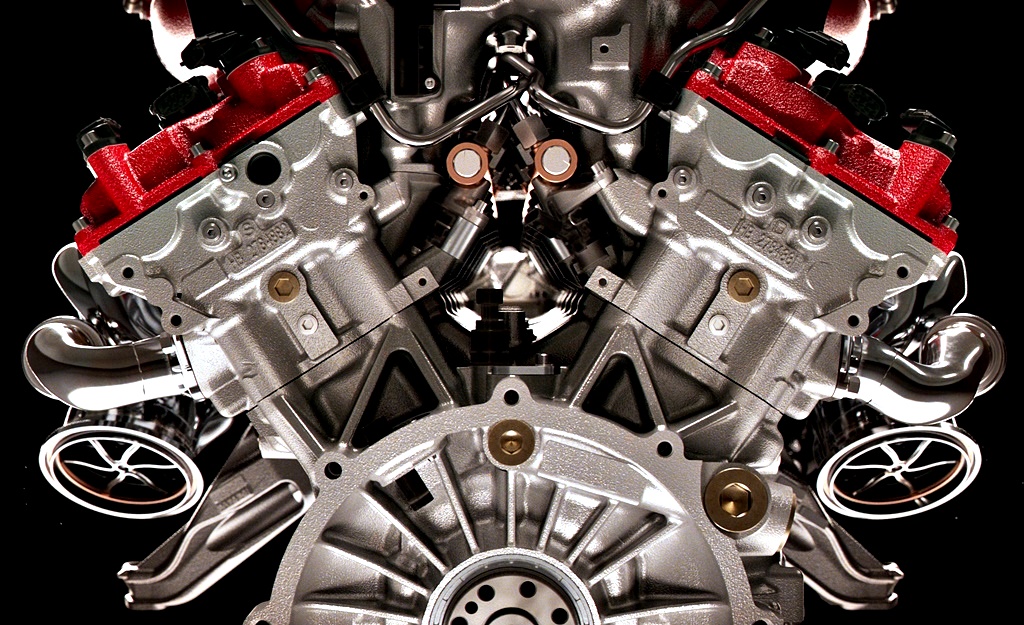
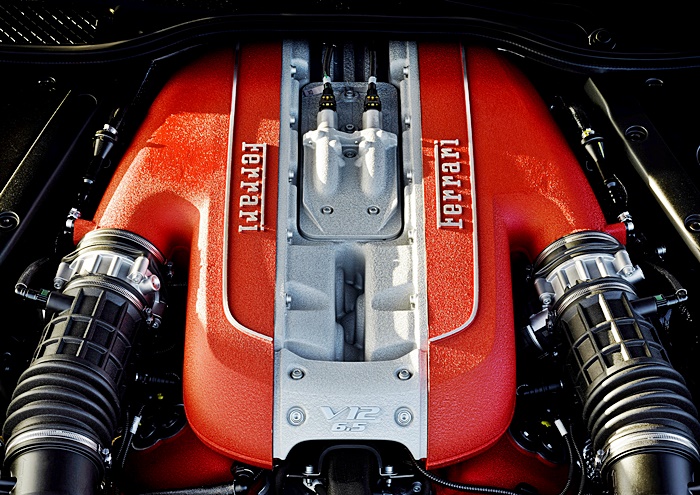
Both Competizione cars have similar 6.5-litre V12 engines which can produce up to 818 bhp at 9250 rpm, with 692 Nm generated at 7000 rpm. Though derived from the Superfast, several areas have been significantly re-engineered while optimising the fluid dynamics of the intake system and combustion,  and reducing internal friction.

Ferrari engineers revealed that there has been meticulous redesign of key engine components such as the con-rods, pistons, crankshaft and distribution. The titanium con-rods are 40% lighter than steel versions whilst delivering the same mechanical resistance; the piston pins, on the other hand, have been given a diamond-like carbon coating (DLC) to reduce the coefficient of friction to the benefit of performance, fuel consumption and wear. These modifications are combined with a rebalanced crankshaft, which is also 3% lighter than the previous version.

2021 Ferrari 812 Competizione and Competizione A

The most significant improvements, however, are to the distribution and the cylinder heads, which have both been completely redesigned. The cams (which now also have the DLC coating) now action the valve stems via DLC-coated steel sliding finger followers, which are derived from Ferrari’s F1 experience and were developed specifically for this engine to provide a higher lift profile.

To maintain the traditional V12 engine sound, whilst simultaneously introducing a GPF (Gasoline Particulate Filter) to the exhaust system that ensures compliance with the very latest emissions regulations, the engineers added a new exhaust tailpipe. This unusual and innovative design solution reinstates the medium-high frequency sound muffled by the use of the GPF. Work was also carried out on the intake tract to which a second pair of resonators was added to enhance specific frequencies, creating the perfect melding of the sound from the exhaust and from the intake system.

2021 Ferrari 812 Competizione and Competizione A

Both the 812 Competizione and 812 Competizione A use a 7-speed dual-clutch gearbox with calibration of the control strategies reducing shift times by a further 5%. Although it retains the same gear ratios as the 812 Superfast, the shifts are even more sporty, thanks to the extra 500 rpm in maximum revs.

0 – 100 km/h in 2.85 seconds
Together with the significantly improved aerodynamics, the claimed top speed is over 340 km/h with 0 to 100 km/h said to be bridged within 2.85 seconds. Like on the 812 Superfast, the front diffuser is equipped with a passive mobile aero system which opens when running over 250 km/h, allowing the car to reach its maximum speed.

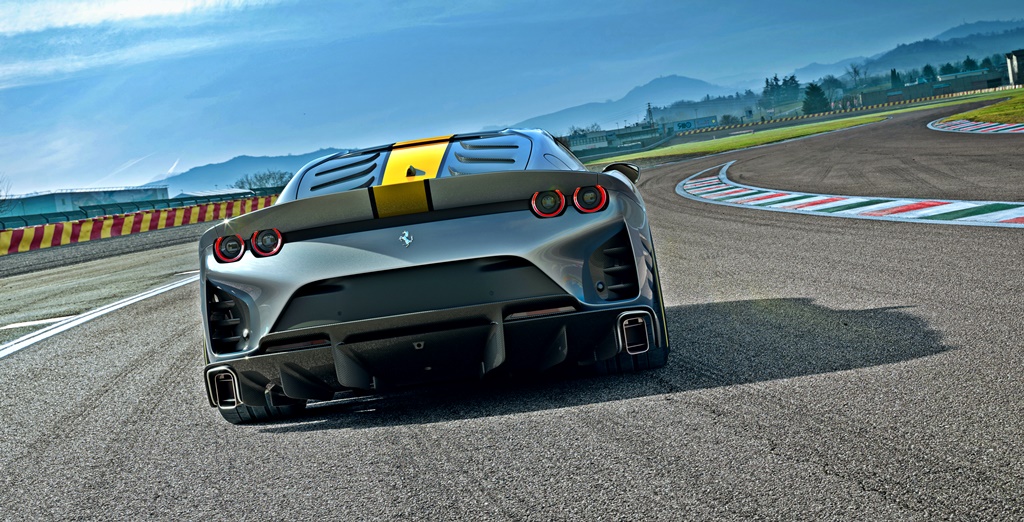
The rear screen, for the first time on a production model, is completely closed and allowed the engineers to explore some unprecedented aerodynamic solutions. It has been equipped with three pairs of profiled elements which protrude from its surface and act as vortex generators. From the LaFerrari onwards, vortex generators of this type have been used on production cars to maximise downforce generated by the flat underbody. However, this solution was applied to the rear screen on the 812 Competizione to distort the flow and thus redistribute the rear axle’s pressure field.

2021 Ferrari 812 Competizione

Ferrari 812 Superfast

Focus on boosting overall performance levels
The guidelines in the development of the 812 Competizione’s performance strategy were to boost overall performance levels, improve driving pleasure in lateral dynamics and a specific focus on the handling characteristics of a special version. This called for the development and use of many innovative components and contents. Specifically, these include the first use of independent 4-wheel steering, the evolution of the Side Slip Control (SSC) system to version 7.0, and the development of the dedicated new Michelin Cup2R tyres.

The fact that the car is faster into corners demanded an improvement in braking power. Compared to the 812 Superfast, the brake cooling concept was completely redesigned around the new front Aero caliper which debuted on the SF90 Stradale and which has an air intake integrated into its casting.

Lightweight strategy
Particular attention was also paid to making the car as light as possible, which resulted in 38 kgs being slashed off its overall weight compared to the 812 Superfast. The areas primarily involved were the powertrain, running gear and bodyshell. Carbon-fibre was used extensively on the exterior, especially on the front bumpers, rear bumpers, rear spoiler and air intakes.

2021 Ferrari 812 Competizione A

Much attention was also given to the design of the cockpit with the extensive use of carbonfibre trim, lightweight technical fabrics and a reduction in soundproofing. There are also dedicated sporty, lightweight forged aluminium rims and titanium studs. All-carbonfibre rims are also being made available for the very first time on a Ferrari V12 and can offer a total weight reduction of 3.7 kgs.

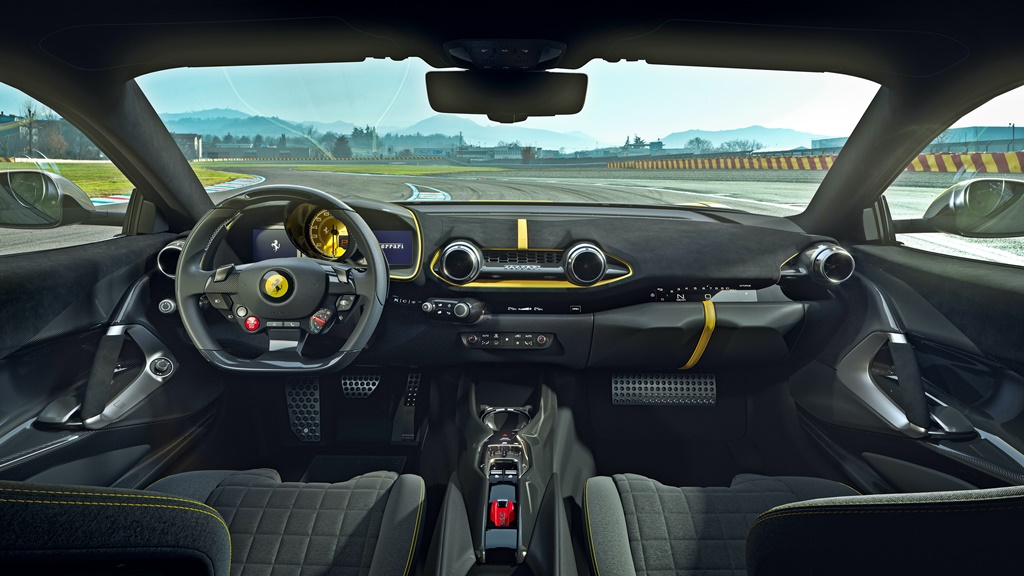
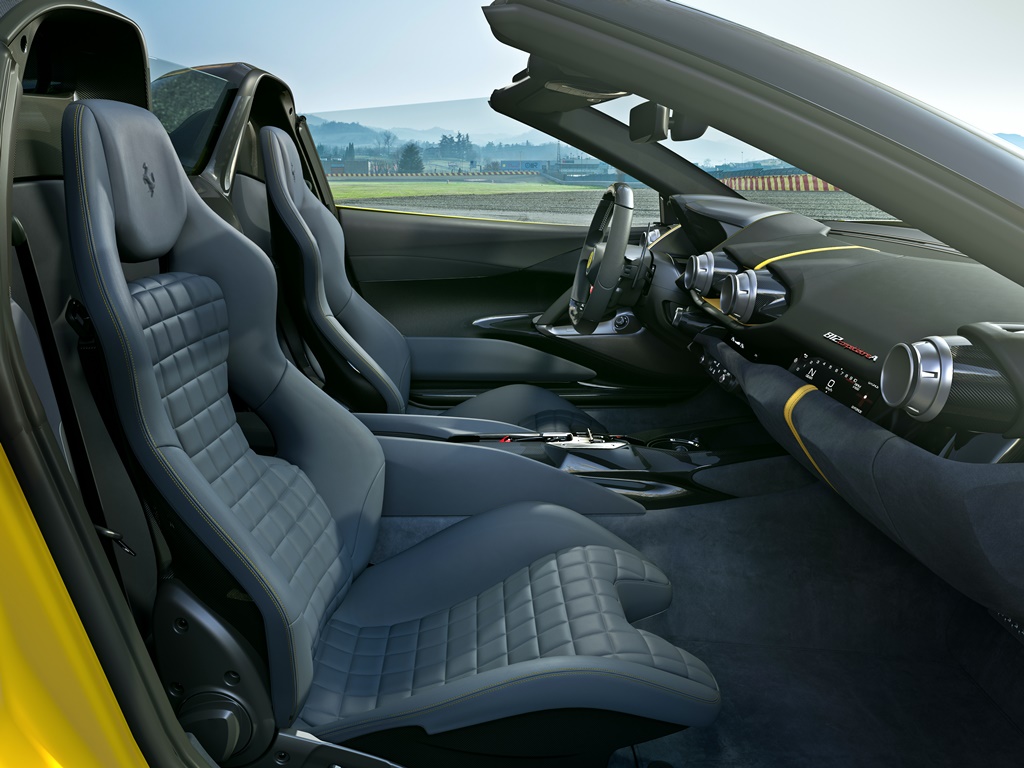
In terms of its interior architecture, the 812 Competizione has remained faithful to the 812 Superfast, retaining the same general parameters and main dash and door panel interfaces. The door panel itself has been lightened overall both formally and in terms of actual weight to underscore the sportiness of the cockpit.

2021 Ferrari 812 Competizione and Competizione A

Occupant comfort in targa top version
Occupant comfort in the targa-top configuration is ensured by the introduction of a flap integrated into the windscreen header rail which deflects the energised, incident flow upwards so it won’t cause turbulence for the occupants. This extends the bubble that covers the entire length of the cockpit, thereby also avoiding excess pressure in the area behind the occupants’ heads.

The targa top is made from carbonfibre to create a sense of aesthetic continuity with the roll-bars. It is stowed in a compartment with the same design shape as the targa itself. With the top stowed, the roll bars partly jut out above the rest of the bodywork but because they are carbonfibre, they become secondary visual elements and so do not compromise the broader, more squat stance buy instead amplify the visual lowering of the side view.

2021 Ferrari 812 Competizione

Pricing and production schedules have not been announced although it’s a sure bet that potential customers have already been informed and would have placed their orders. In fact, given their limited-edition status, these two cars are unlikely to be in showrooms except when an owner is kind enough to allow the dealer to display it for a while before it is taken away.

Ferrari Omologata – very unique and very exclusive

The National Vaccination Program in Malaysia is free of charge.

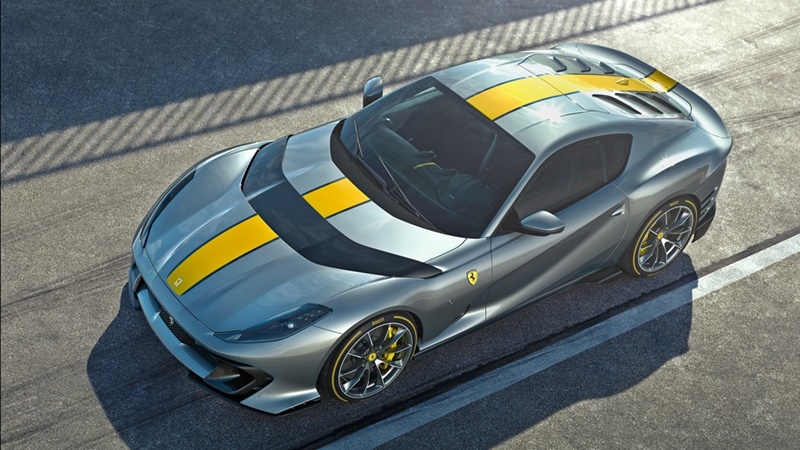
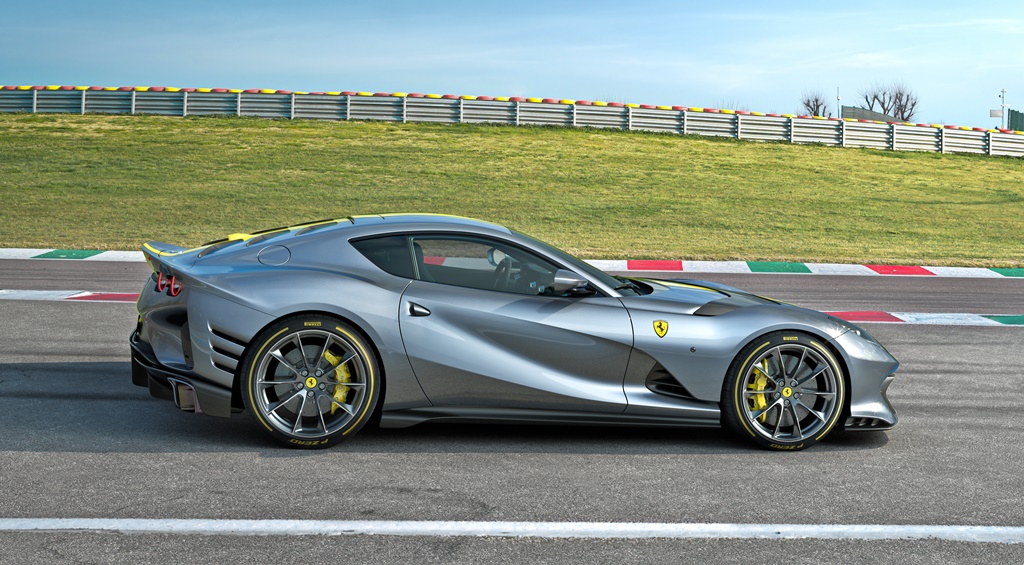
While its name remains a secret (until May 5), Ferrari has released the first official images of its latest limited-edition special series, described as ‘the ultimate expression of Ferrari’s concept of an extreme front-engined berlinetta’. It encapsulates and epitomises the company’s 70+ years of experience on racetracks around the world as well as draws on thoroughbred sportscar DNA to offer numerous uncompromising engineering solutions and innovations.

As is the case with all of Ferrari’s cars, the most striking feature lies at its very heart: the latest evolution of the legendary 65° V12 engine. It will produce the highest output of any Ferrari road-car engine – 830 cv (181.3 bhp) – and spin up to 9,500 rpm, also the highest of any Ferrari combustion engine.

New Ferrari V12 2021

Redesign of key components
The use of state-of-the-art materials, redesign of many of the engine’s key components, a new valve timing mechanism, and a new exhaust system are some of the technical solutions that contribute to delivering performance levels that are said to be unprecedented in the V12 segment.

The powertrain is paired with class-leading vehicle dynamics control systems to allow the driver to fully exploit the performance and have maximum driving pleasure. The adoption of independent steering on all four wheels enhances the feeling of agility and precision when cornering as well as providing greater responsiveness to steering inputs.

Lower overall weight
Another noteworthy engineering achievement is the development work undertaken to reduce the car’s overall weight compared to the 812 Superfast. This was achieved in particular by extensive use of carbonfibre, both on the exterior and in the cockpit. Lastly, the new model premieres version 7.0 of the renowned Side Slip Control vehicle dynamics system.

New Ferrari V12 2021

In-depth aerodynamic research
One of the most striking aspects of this new model is how in-depth aerodynamic research has altered the car’s lines. Working in close synergy with the Ferrari Styling Centre, the aerodynamicists have adopted solutions that are extreme in form and featuring profiles that are unprecedented for a road-legal car. The aerodynamic redesign of the whole car was aimed at maximising downforce levels – from the new front air intakes, rear diffuser and exhaust configuration to the patented design of the rear screen which now hosts vortex generators.

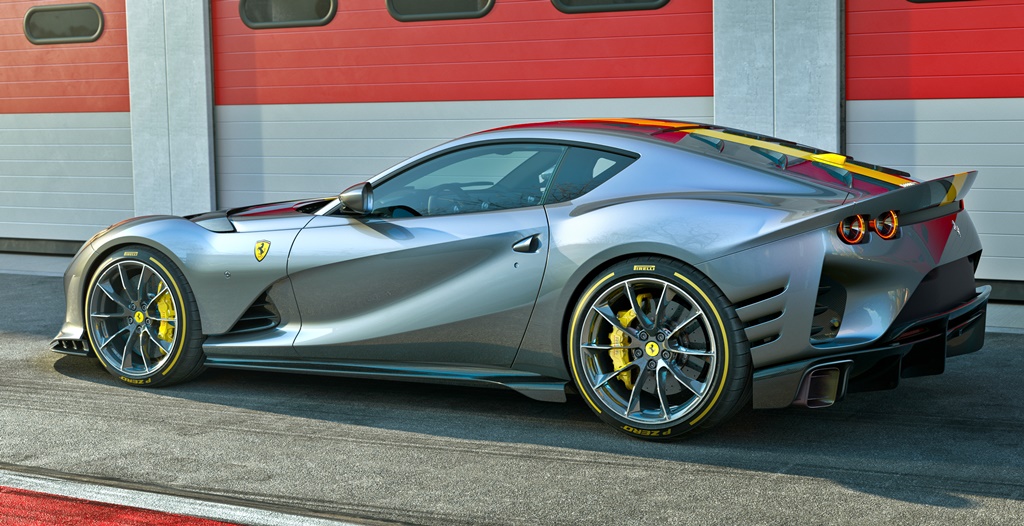
From a design point of view, this new special series has a strong personality that differentiates it significantly from the 812 Superfast on which it is based. This was achieved by choosing styling themes that further enhance the architectural design and dynamism of the 812 Superfast.

New Ferrari V12 2021

Vortex generators instead of glass screen
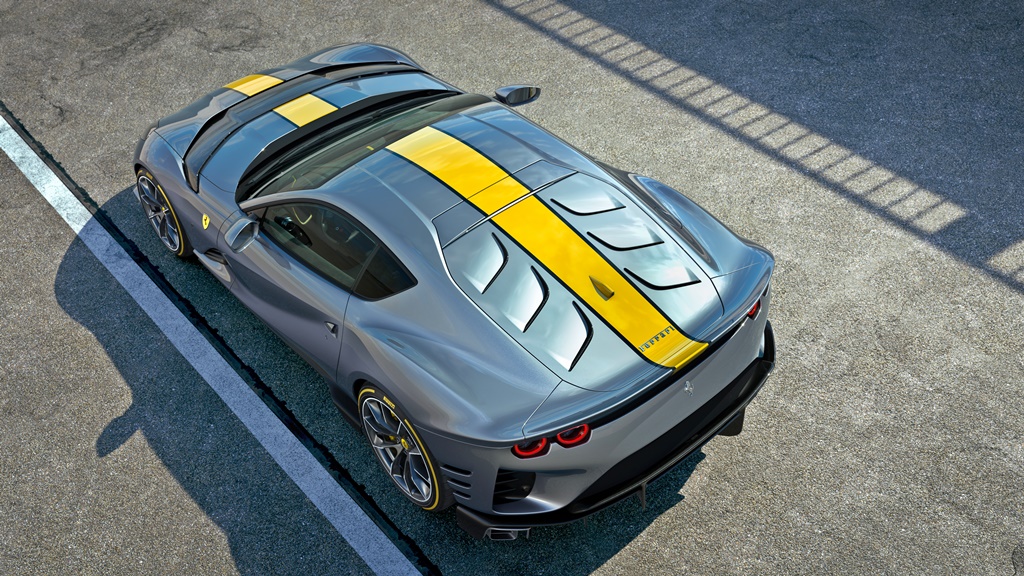
One example of this is the decision to replace the glass rear screen with a single-piece aluminium structure. The vortex generators incorporated improve the car’s aerodynamic efficiency but the design solution chosen, which is fully integrated with the roof, simultaneously creates a backbone effect that underscores the car’s sculptural forms.

Together with the carbonfibre blade that traverses the bonnet, this motif changes the overall perception of the car’s volumes. The bonnet seems shorter, emphasising the width of the car, and the tail now has a more powerful, fastback look, thus making it appear more compact and competition-like despite it sharing the 812 Superfast’s silhouette, proportions and formal balance. Even the rear spoiler now looks more imposing: it is higher but the specific design treatment used also makes the tail look very wide, almost horizontal.

New Ferrari V12 2021

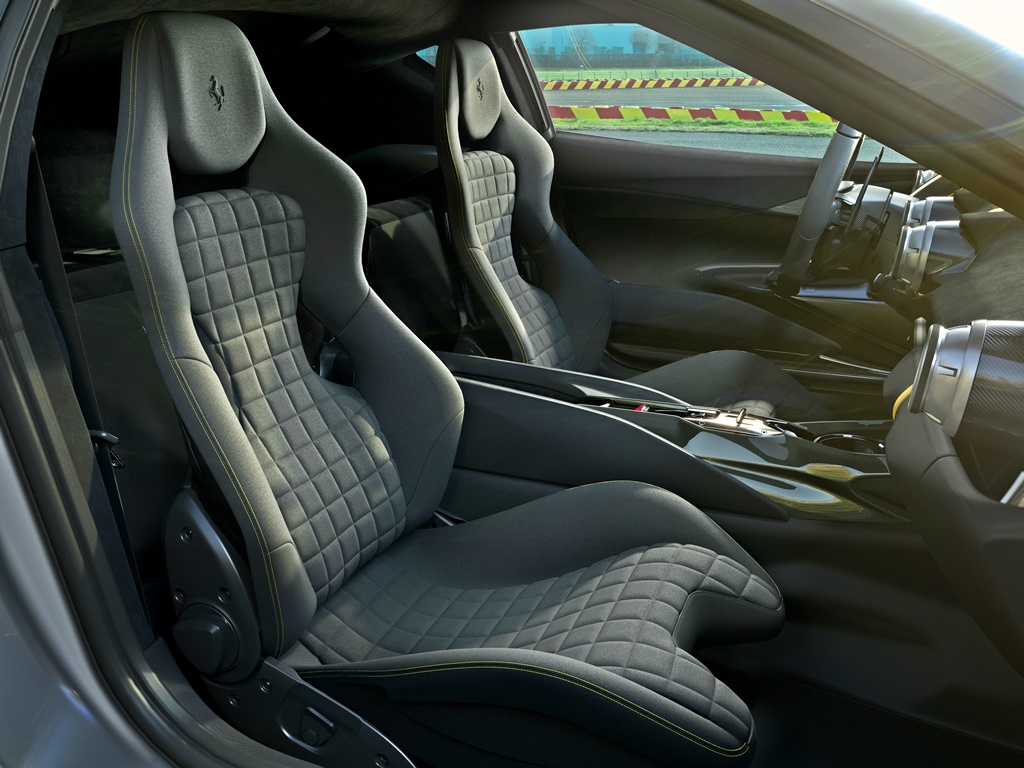
The interior architecture very much reflects that of the 812 Superfast, retaining the main dashboard and door panel interfaces and volumes, including the signature motif. Along with other elements of the interior, the door panel has been redesigned to reduce weight and, combined with the introduction of the H-gate theme on the tunnel, this lends the cockpit a sportier, more modern edge that reflects the car’s racing spirit.

New Ferrari V12 2021

2021 Ferrari 488 GT Modificata (w/VIDEO)

COVID-19

Visit www.bhpetrol.com.my to know more about promotions at BHPetromart.

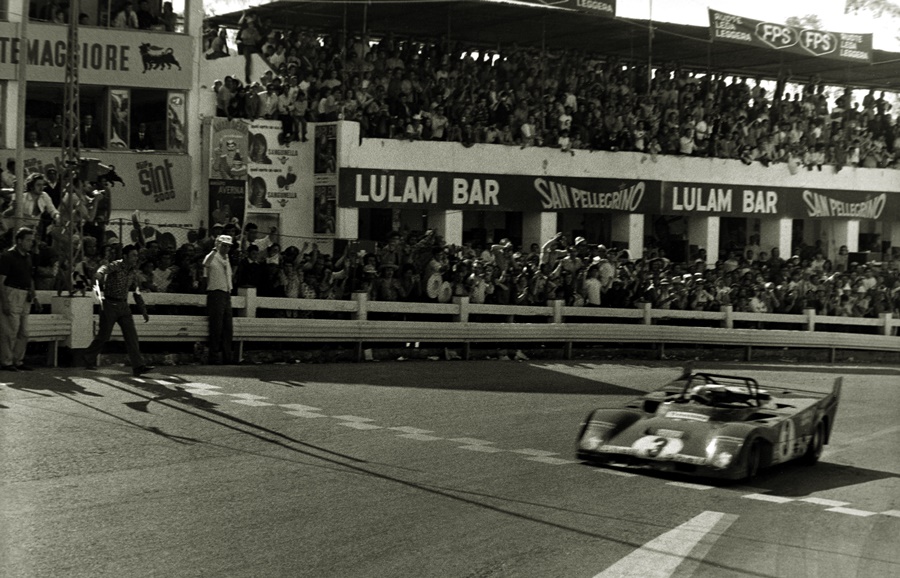
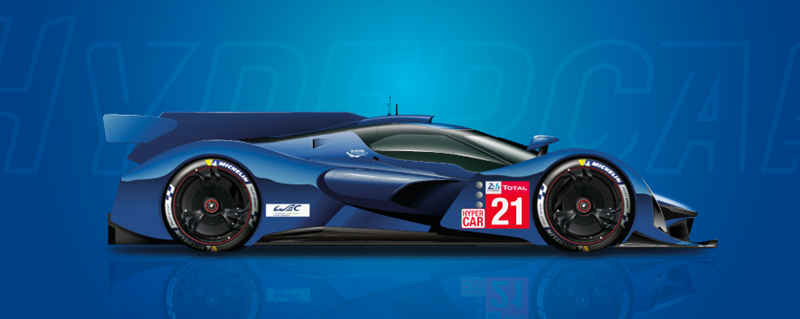
Ferrari will join the Le Mans Hypercar (LMH) class from 2023. This is a new class which has attracted the interest of manufacturers and it will be the top class of the FIA World Endurance Championship (WEC). Companies that have announced vehicle development programmes include Porsche, Peugeot, Audi, and Toyota – all veterans of the WEC with championship victories at different periods in time.

Following a period of study and analysis, Ferrari confirmed its participation and has started a development programme for an all-new LMH car. It is known that there is already a design and simulations have been run in  recent weeks.

The time-frame for building running prototypes has not been mentioned, nor the name of the car and the drivers who will make up the official crews.

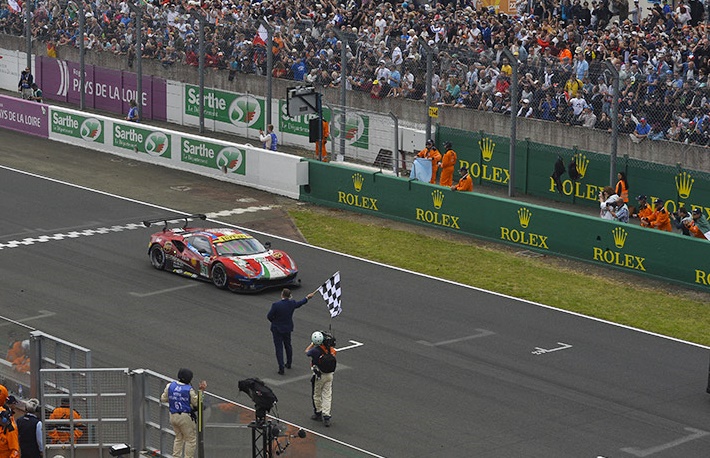
While Ferraris are regularly seen racing at Le Mans, it has been almost 50 years since the factory’s last official participation in the premier class of the World Sports Car Championship. It has a respectable record in closed-wheel competition with 24 world titles (most recently in 2017) and 36 victories in the 24 Hours of Le Mans.

“In over 70 years of racing, on tracks all over the world, we led our closed-wheel cars to victory by exploring cutting-edge technological solutions: innovations that arise from the track and make every road car produced in Maranello extraordinary. With the new Le Mans Hypercar programme, Ferrari once again asserts its sporting commitment and determination to be a protagonist in the major global motorsport events,” said Ferrari President, John Elkann.

Overview of the Le Mans Hypercar class
The LMH ruleset represents a major shift in philosophy compared with the LMP1 class it is replacing. It allows for a greater variety both in terms of technical approaches as well as the aesthetics of the cars, at the same time ensuring sporting equality and preventing cost escalation through the concept of ‘performance windows’.

Technical Regulations are focused on controlling performance outcome, instead of setting design or geometrical restrictions, allowing manufacturers to choose cost-effective solutions as significant expenditures will not bring performance gains.

The autonomy also allows them not only to replicate brand identity and genuine architecture, maintaining the spirit of the brand and remaining relevant to their road car philosophy, but also to express true potential in terms of creativity and innovation. Less rigid aerodynamic constraints established for the cars give them the option to incorporate styling elements to the design.

Similarly to the LMP1 class, both hybrid or non-hybrid power units with transmission to either rear or both axles are allowed.

Social distance

As avoiding cost escalation is one of the key targets behind the LMH concept, several other cost-saving measures have been undertaken. With the 2021 season being the first one in the LMH homologation cycle, testing is supervised. The use of expensive materials and technology is greatly limited. The minimum weight for gearbox is set at 75 kgs, with the use of magnesium or aluminium casing and bellhousing mandatory.

The suspension is also simplified, with a double-wishbone design compulsory and aids such as active systems and mass dampers forbidden. There is also a single aero kit permitted, without the distinction for Le Mans and the other races.

In order to avoid development costs, the tyres are exclusively supplied by Michelin with different dimensions dedicated to rear and 4-wheel-drive cars. Furthermore, lower power output results in lower power unit development costs.

“Le Mans Hypercar should please both manufactures and fans, resulting in spectacular cars and high level of competition. We’ll see greater variety across the competitors while the more cost-effective regulatory approach is something much needed in the current economic climate,” said Richard Mille, FIA Endurance Commission President.

Peugeot Hybrid4 500KW to power Peugeot hypercar for endurance racing in 2022

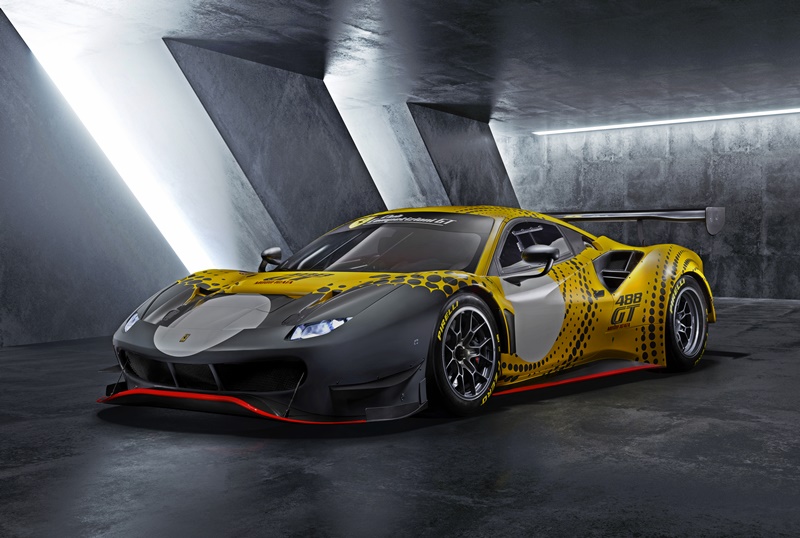
Taking the technology developed for the 488 GT3 and 488 GTE, Ferrari has developed the new 488 GT Modificata which does not necessarily meet international motorsport regulations to exploit its full potential. It can therefore only be raced at Ferrari’s own Club Competizioni GT events.

If you are an especially valued customer of Ferrari, perhaps you will be able to also buy one but the 488 GT Modificata is intended only for drivers who, in recent years, have participated in Competizioni GT with Ferrari or Club Competizioni GT.

2021 Ferrari 488 GT Modificata

Greater power for the legendary V8
‘Modificata’, in Ferrari terminology, means designs that have been evolved for better performance. Possessing the already impressive performance of the 488 GT3 and the 488 GTE, the 488 GT Modificata gets new technologies linked mainly to a powertrain no longer limited by the FIA Balance of Performance.

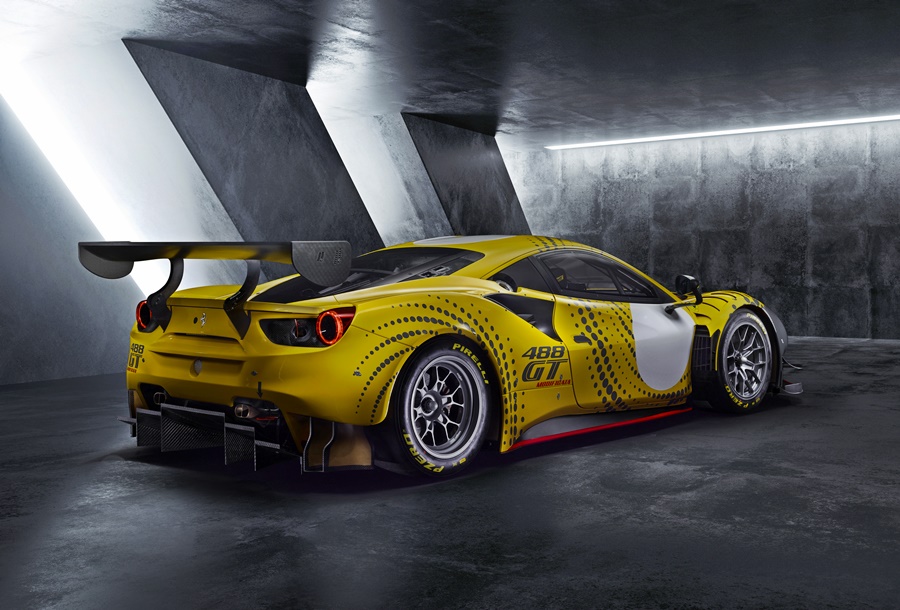
2021 Ferrari 488 GT Modificata

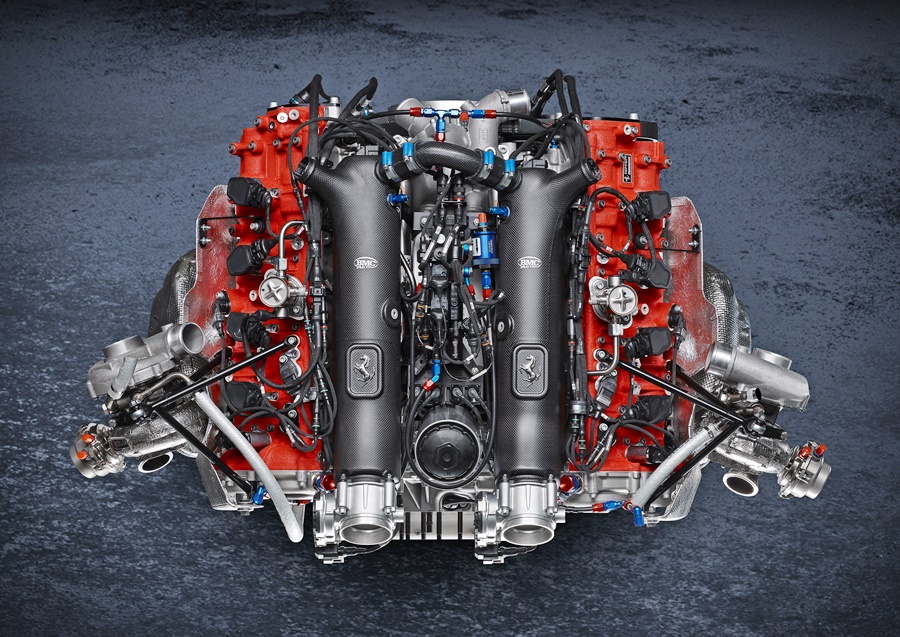
The legendary twin-turbo V8 has received specific components and materials from the racing engine, with more extreme and high-performance mapping. Maximum power delivered is now around 700 ps, flowing through a gearbox available with different transmission ratios and a carbonfibre clutch  which copes with the increased power and torque.

2021 Ferrari 488 GT Modificata

The bodywork has completely revamped high-downforce aerodynamics, shifting the pressure centre forward. This generates higher downforce at the front without increasing overall drag, making for better efficiency and sensitivity to changes in rear wing angle.

Apart from the aluminium roof and uprights, the bodywork is entirely in carbonfibre like the 488 GTE. This contributes to a downforce of over 1,000 kgs at 230 km/h.

Enhanced driving dynamics
The engineers opted to use the 488 GTE’s suspension, with the braking system developed in partnership with Brembo. It features the low residual torque calipers that are fitted to world championship cars, coupled with an ABS system borrowed from the 488 GT3 Evo 2020, with settings customised. This synergy is said to provide drivers with formidable handling and powerful, stable braking with limited fading.

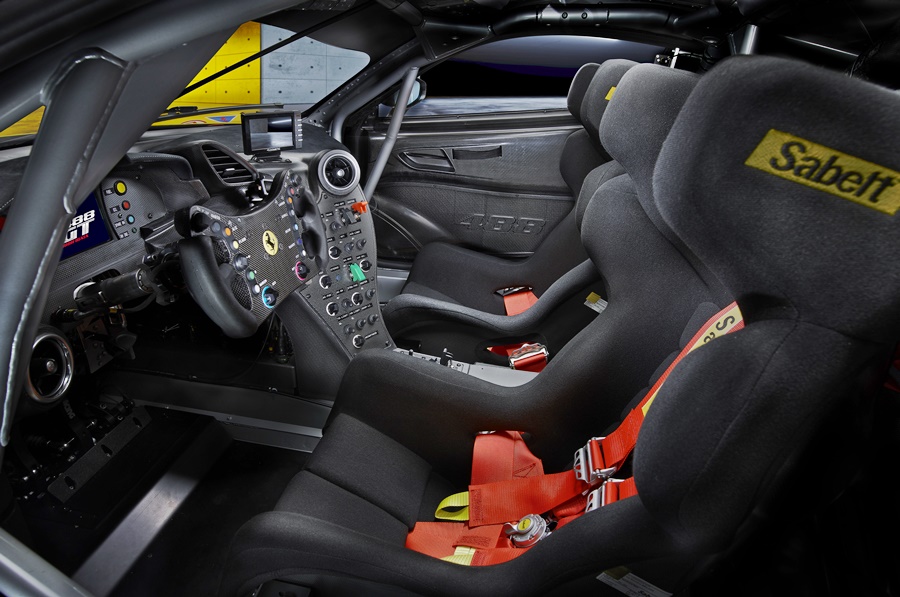
Although not meeting motorsport regulations, the car is nevertheless engineered to high safety standards, and fitted with the relevant safety equipment like a roll-cage, safety harnesses, etc.

2021 Ferrari 488 GT Modificata

2021 Ferrari 488 GT Modificata

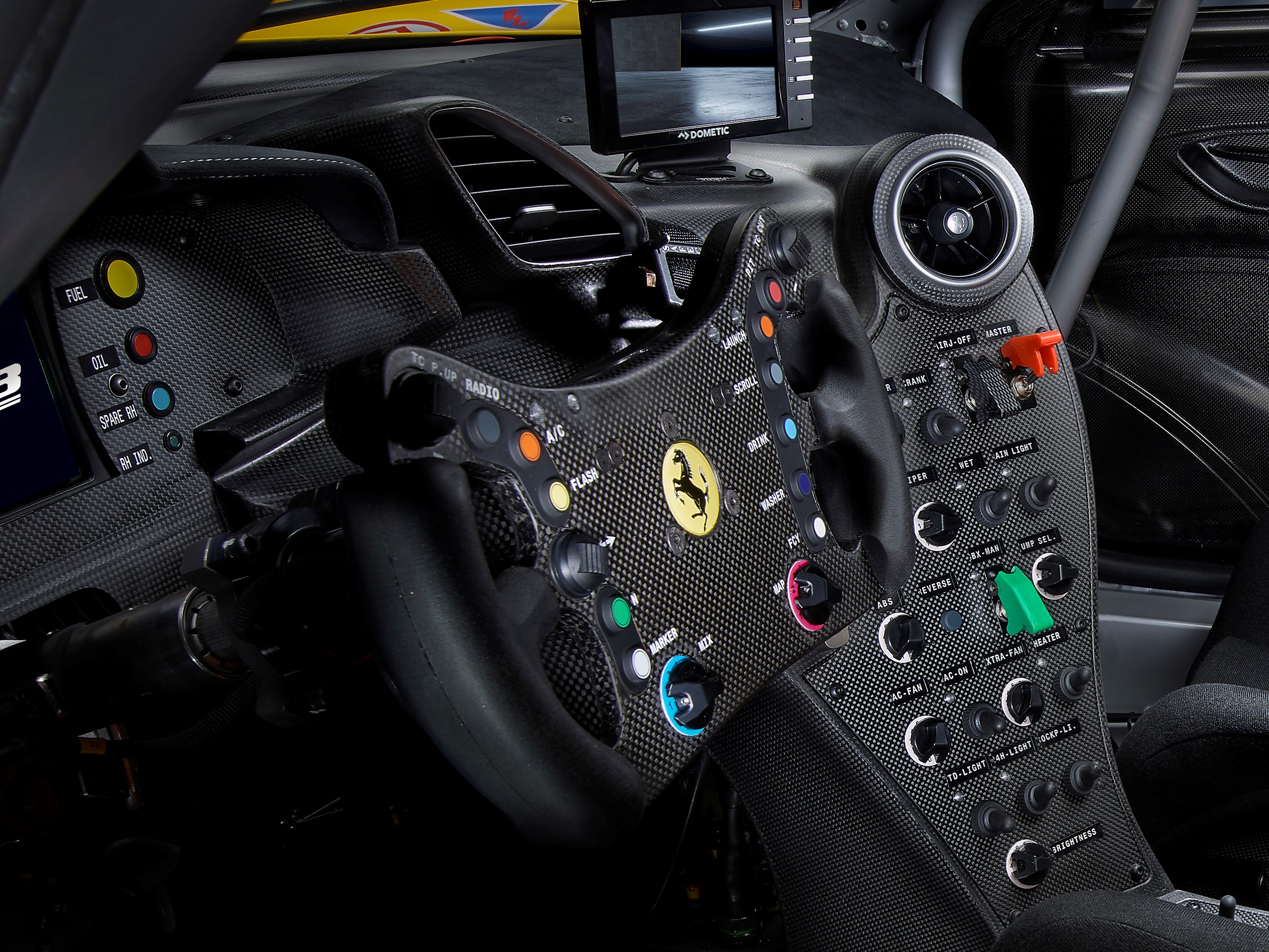
The extensive standard equipment of the 488 GT Modificata includes a V-Box acquisition system, which is combined with Bosch’s telemetry data acquisition system. The expandable system allows data to be downloaded directly onto a USB stick. The high-resolution rearview camera, second seat and TPMS system for measuring tyre temperature and pressure also come as standard. Interestingly, even though the car is intended only for track use, there is air-conditioning installed.

Full personalisation available
Only a limited number will be built, and each car can be extensively customized on exterior and interior. The 488 GT Modificata will be admitted to Club Competizioni GT events which aims to bring back to the track the most significant and successful cars in the recent history of Ferrari closed-wheel racing.

In 2021, customers will have the chance to participate in 5events on tracks such as the Virginia International Raceway, Monza, Watkins Glen, Suzuka and Nürburgring, as well as the Finali Mondiali.

Ferrari Omologata – very unique and very exclusive

Social distancing

Social distance

BHPetrol RON95 Euro4M

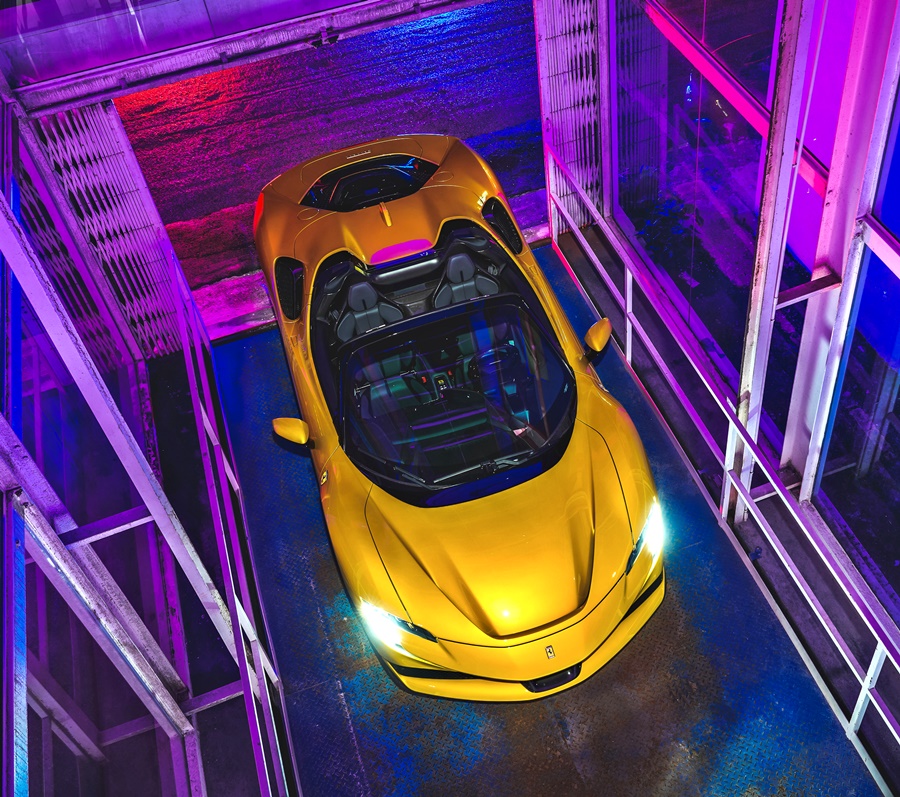
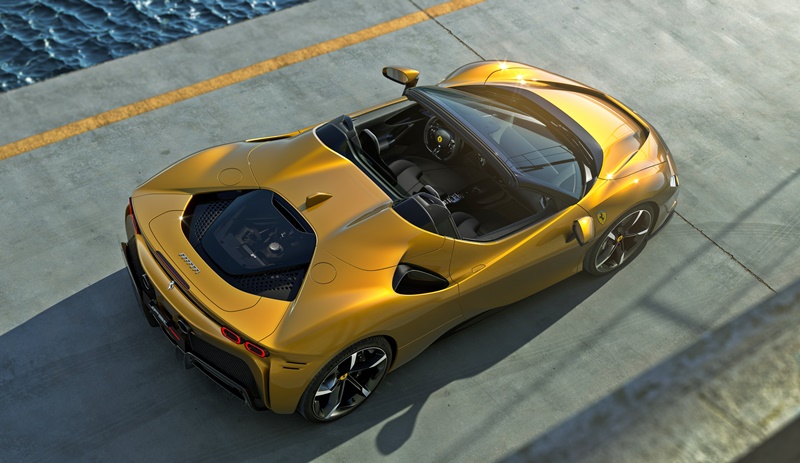
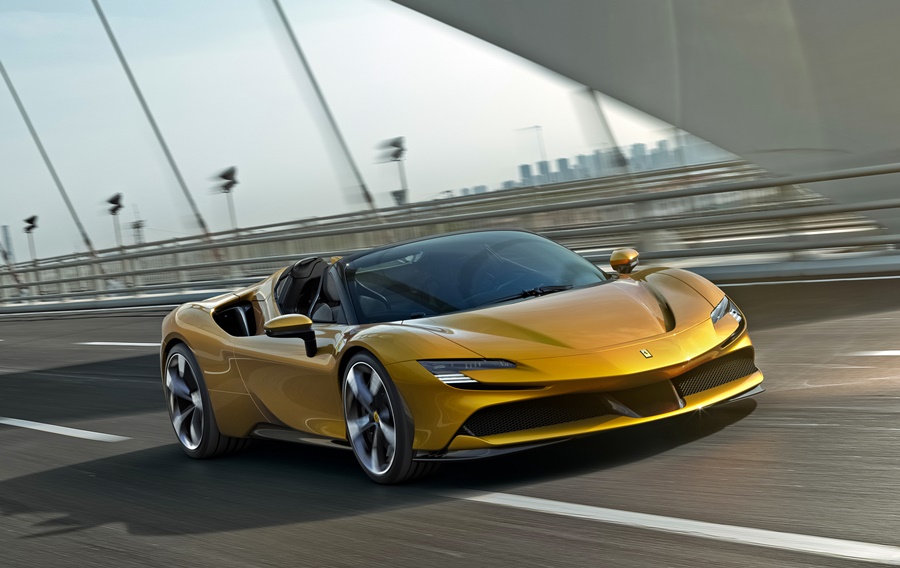
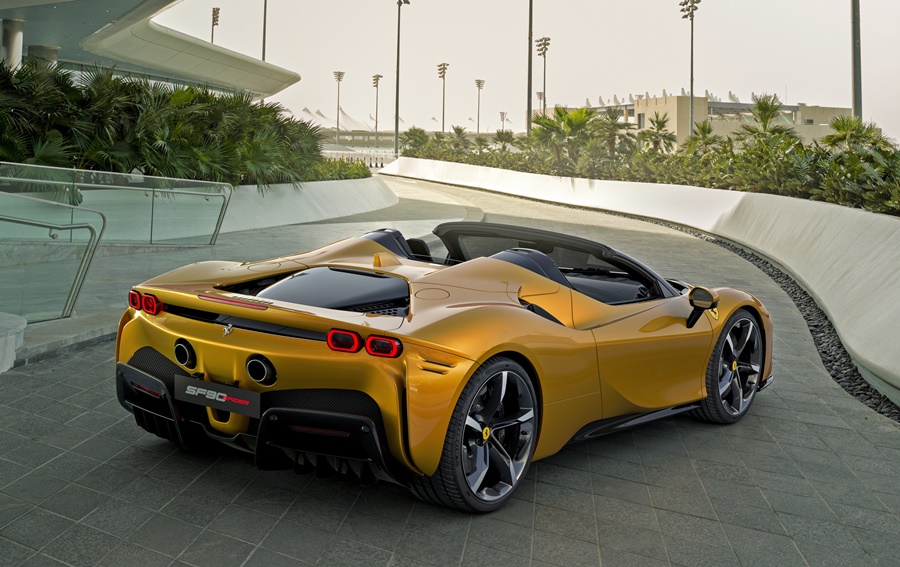
The SF90 Stradale, Ferrari’s hybrid plug-in electric vehicle (PHEV), has been joined by a topless version – the new SF90 Spider. Just as the SF90 Stradale was the brand’s first PHEV, the SF90 spider is its first production PHEV spider.

Though it loses its roof (when desired), the SF90 Spider’s performance is not compromised and it has the same extreme supercar specification. The retractable hard top (RHT) is the latest version of Ferrari’s signature retractable hardtop architecture.

2021 Ferrari SF90 Stradale Spider (2)

2020 Ferrari SF90 Stradale
SF90 Stradale, available in Malaysia priced from RM1.91 million.

14-second operation
The RHT is so simple that it can open or close within 14 seconds, with operation possible even when the car is on the move. The use of aluminium in its construction also means that it is around 40 kgs lighter than a conventional retractable hardtop. Its compactness requires just 100 litres of space, rather than the 150 – 200 litres required by a traditional system.

Ferrari guarantees optimal noise insulation and protection from the elements when the RHT is raised and it will not deform at high speeds. An adjustable electric rear window also enhances occupant comfort, even when the RHT is lowered at higher speeds.

2021 Ferrari SF90 Stradale Spider

The hybrid architecture proved a challenge in terms of weight management. While the extra 270 kgs of the hybrid system was amply compensated for by the extra power delivered, extensive optimisation and weight reduction work was also required on the rest of the car to keep overall weight down to 1,670 kgs.
Just as the SF90 Stradale redefined the aerodynamic performance levels of the Ferrari range, the SF90 Spider is pushing the limits of the results delivered still further. The goals that drove the aerodynamic development of the car from the very earliest stages were maintaining the SF90 Stradale’s performance levels with the RHT deployed, minimising aerodynamic turbulence and noise with the RHT retracted, and optimising power flows.
2021 Ferrari SF90 Stradale Spider

Unmatched downforce and aerodynamic efficiency
The downforce and efficiency figures are said to be unmatched by any other car in the category. The main features in the SF90 Spider’s aero design include the shut-off Gurney at the rear, an active control system that varies downforce over the rear axle, the front underbody with vortex generator strakes, and forged wheels with wing profiles. The results: a massive 390 kgs of downforce generated in cornering at 250 km/h (with the special Assetto Fiorano specification).
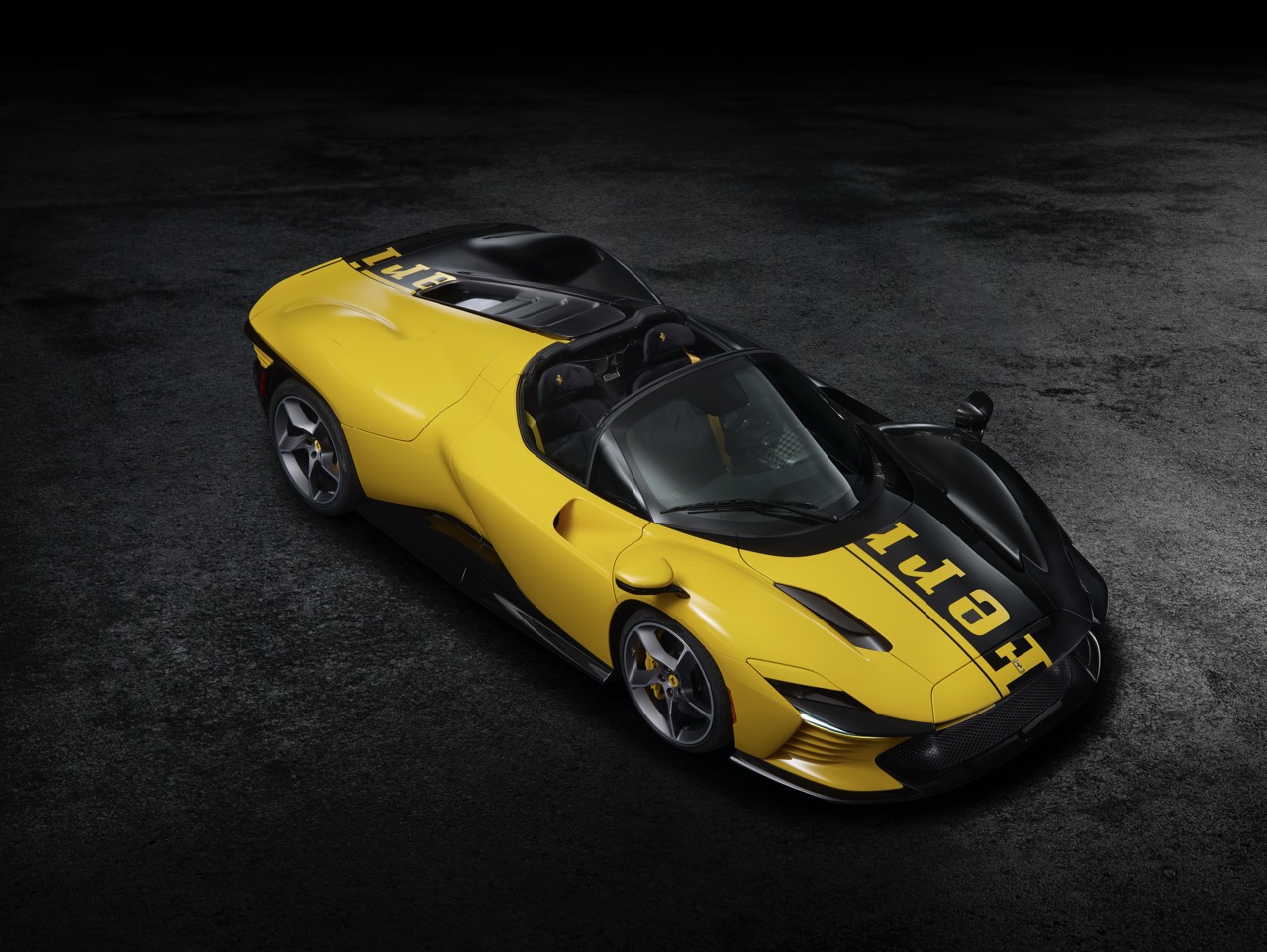

In a first for a Ferrari production spider, the SF90 Spider has plug-in hybrid architecture in which the internal combustion engine is integrated with two electric motors at the front and one at the rear derived from and named after the MGUK (Motor Generator Unit, Kinetic) used in Ferrari’s F1 cars.

2021 Ferrari SF90 Stradale Spider

Most powerful Ferrari production V8
The synergy between the turbocharged V8 petrol engine and the electric motors generates a maximum of 1,000 ps/900 Nm, with 60 ps more than any other V8 turbo engine ever built by Ferrari. The 8-speed, oil-bath, dual-clutch gearbox used in the SF90 Stradale has been redesigned for the spider version.

Much attention was given to sound quality when redesigning the exhaust system as the soundtrack is one of the pivotal factors in the exhilarating pleasure of driving a Ferrari. The introduction of a ‘hot tube system’, which transfers sound more directly to the cockpit, has produced fuller, richer harmonics across the entire frequency range, improving both in-car sound quality and intensity as revs rise compared to previous Ferrari V8s.

2021 Ferrari SF90 Stradale Spider

To make full use of the powertrain’s output, the engineers improved the vehicle dynamics systems to allow the driver to enjoy the maximum potential, and not just in terms of pure performance and lap times. The new hybrid architecture required extensive integration work on the car’s many different control logics, which  led to the development of the new eSSC (electronic Side Slip Control) vehicle dynamics control system.

2021 Ferrari SF90 Stradale Spider

2021 Ferrari SF90 Stradale Spider

Digital instrumentation with HUD
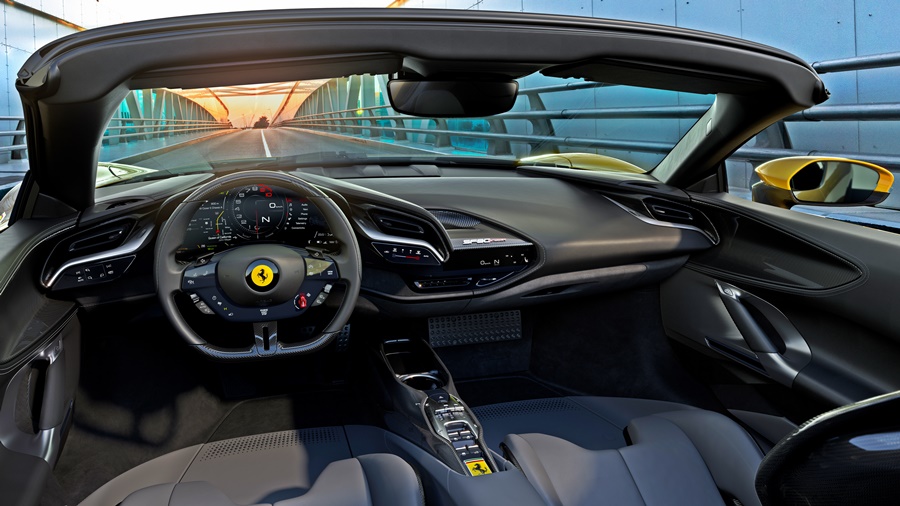
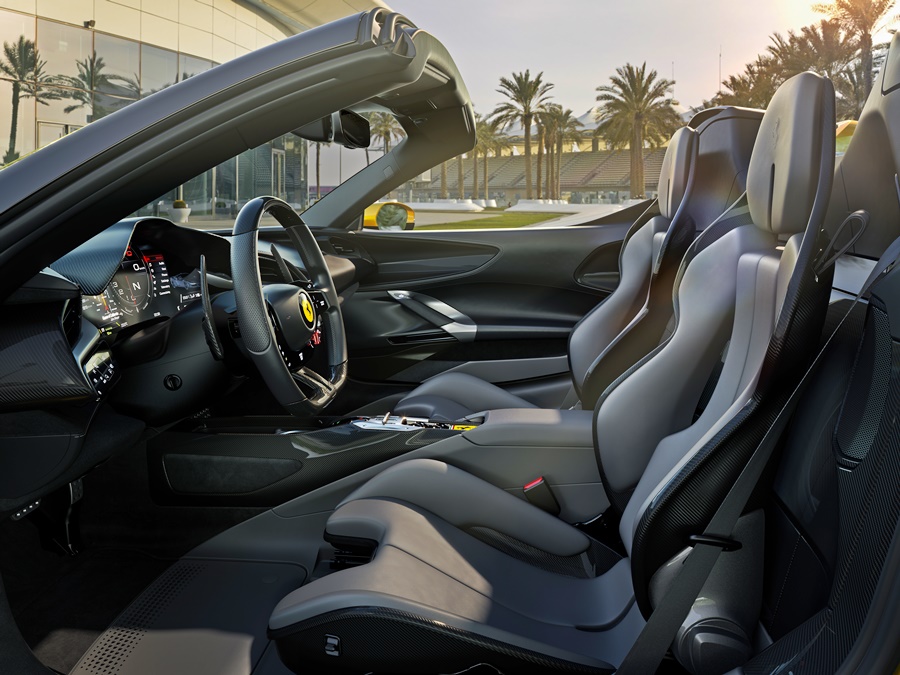
The look and feel of the cabin was driven in large part by the complete redesign of the HMI (Human-Machine Interface). The instrumentation is now predominantly digital with all the screens going completely black when the car is not running. The central instrument cluster comprises a single 16-inch HD screen, complemented by a head-up display.

The steering wheel completes that transfer process from the competition world and also ushers in a new era by introducing a series of touch commands that allow the driver to control virtually every aspect of the car without ever taking the hands off the wheel.

2021 Ferrari SF90 Stradale Spider

2021 Ferrari SF90 Stradale Spider

The F1 bridge, a signature on the previous models, has now disappeared from the central tunnel and been replaced by a modern take on the gearshift gate, an iconic feature of Ferrari’s manual gearboxes. In the new gate, however, the gearshift grille is digital as befits an automatic transmission.

Going to the limits
As is the case with the SF90 Stradale, the SF90 Spider is also available with an option for owners who want to go right to the edge of the performance envelope. They can specify the Assetto Fiorano pack with upgrades such as Multimatic shock absorbers. Others include the adoption of high-performance materials (such as carbonfibre and titanium), a carbonfibre rear spoiler and road-homologated Michelin Pilot Sport Cup 2 tyres designed to improve track performance in the dry.

2021 Ferrari SF90 Stradale Spider

The first customers of the SF90 Spider can expect to get their cars during the second quarter of 2021. Each of them will pay prices that start from €473,000 (around RM2.3 million) in Italy.

Ferrari SF90 Stradale PHEV starts new era for The Prancing Horse, priced from RM1.91 million

COVID-19

BHPetrol RON95 Euro4M

The Ferraris that most people read about or see on the roads are the ones that the company makes in ‘large’ numbers. However, there are also many cars which are not publicised – and we’re not talking about the prototypes that are going to be future models. Ferrari, like other high-end niche carmakers, also offers extensive customisation services to its customers who want unique and exclusive models.

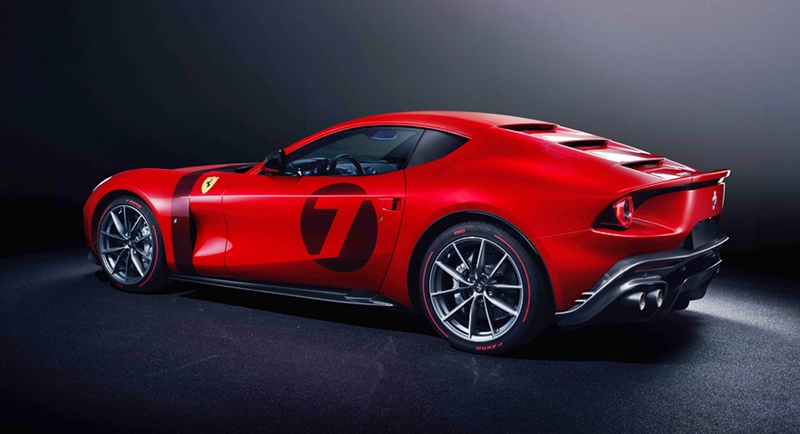
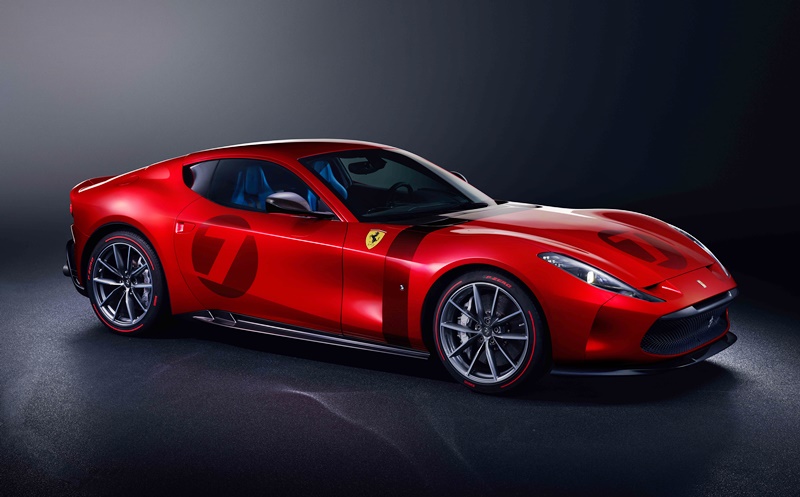
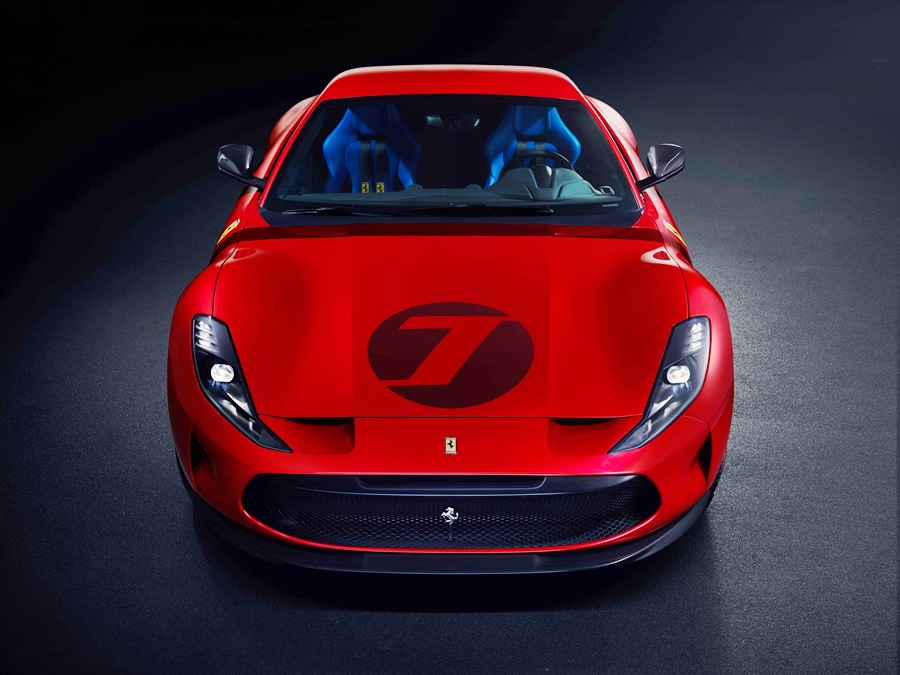
The Omologata (unusual name but actually means ‘homologation’ in Italian) is one such car and the project was commissioned by a customer in Europe. Representative of Ferrari’s line of unique one-off models, it took a little over 2 years to complete.

2020 Ferrari Omologato

The initial presentation of sketches started with images that covered a variety of inspirations, from racing heritage to sci-fi and references to modern architecture. The idea from the onset was to create a futuristic design with distinctive elements reinterpreted in a fresh manner to provide potential for a timeless shape that is certain to leave a lasting impression.

Ferrari 812 Superfast
812 Superfast

812 Superfast as the basis
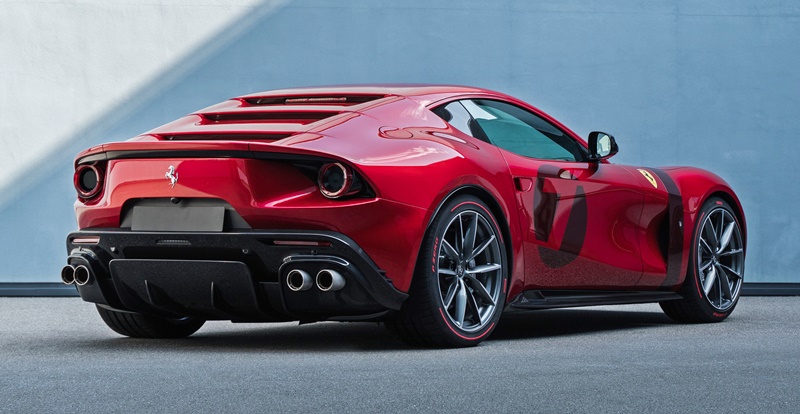
To achieve this, the designers used the underlying package of the 812 Superfast, keeping only the windscreen and headlights as existing bodywork elements. The objective was to exploit the proportions of the mid-front layout to deliver a very sleek design defined by smooth volumes and undulating reflections. The trickiest aspect was striking the ideal balance between expressiveness and restraint, projecting street presence whilst maintaining a very pure formal language.

A tapering front volume defines the flattened oval grille, with the rounded section over the front wheelarches emphasized by a contrasting stripe wrapping across the bonnet. Rearwards of the door, the flank develops into a very potent rear muscle that neatly blends upwards into the three-quarter panel.

2020 Ferrari Omologato

2020 Ferrari Omologato

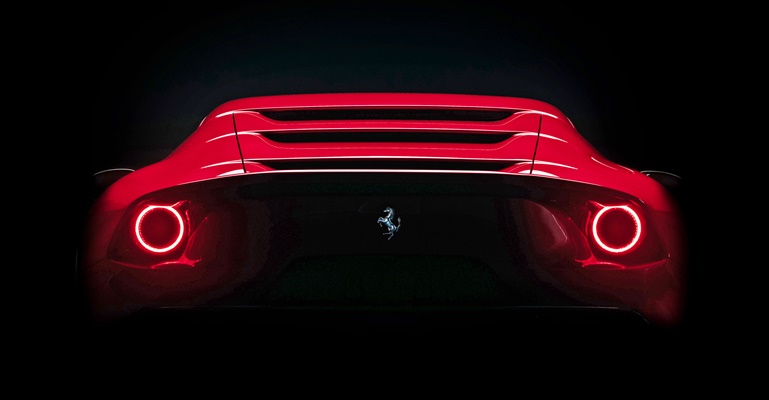
The entire volume is rendered deliberately imposing through the elimination of the rear quarter light, while three horizontal transversal cuts in the fastback volume visually lower the rear mass. The tail is surmounted by a prominent spoiler which adds not only downforce, but a more aggressive, sporty stance.

Making it road-legal
Meeting every safety requirement to ensure a Ferrari is road-legal is always a huge challenge for the design team, more so when starting from an existing platform. And ‘Omologata’ was indeed a keyword that resonated throughout the development of this, the 10th front-engined V12 one-off Ferrari has delivered since the 2009 P540 Superfast Aperta.

2020 Ferrari Omologato

Beyond the clear instructions coming from the customer and down to every detail on the car, the designers effectively took into account countless variables to make this a very exclusive model through and through. The quest for the ultimate touch went as far as developing a new shade of red just for the livery, to match the fiery triple-layer Rosso Magma over a darkened carbonfibre finish.

Link to Ferrari’s racing heritage
Inside the car, numerous trim details suggest a strong link to Ferrari’s rich racing heritage. In fact, the Omologata can be seen as a clear descendent of Ferrari’s great GT tradition spanning 7 decades of history.

2020 Ferrari Omologato

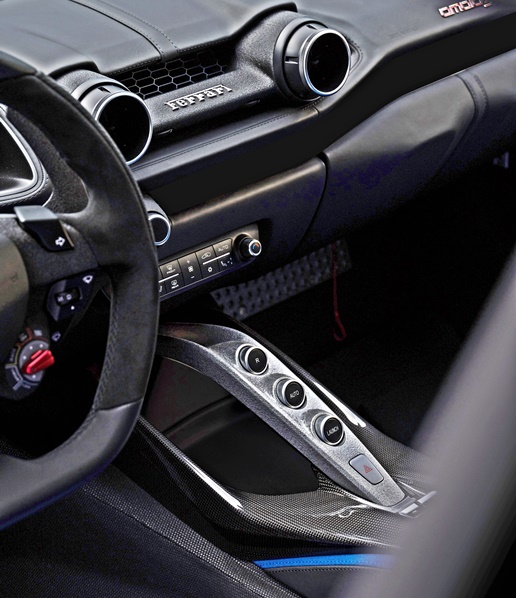
The electric blue seats, finished in a combination of leather and Jeans Aunde fabric with 4-point racing harnesses, stand out against a full black interior. In the absence of rear quarter lights and screen, the atmosphere in the cabin is purposeful, reminiscent of a bygone era.

Metal parts on the dashboard and steering wheel are finished with the crackled paint effect associated with the great GT racers of the 1950s and 1960s as well as with Ferrari’s engine cam covers. A hammered paint effect so often used in cars such as the 250 LM and 250 GTO can also be seen on details such as the inner door handles and on the Ferrari F1 bridge.

2020 Ferrari Omologato

Ferrari Portofino M – the evolution of the 2+ GT spider

COVID-19

PISTON.MY

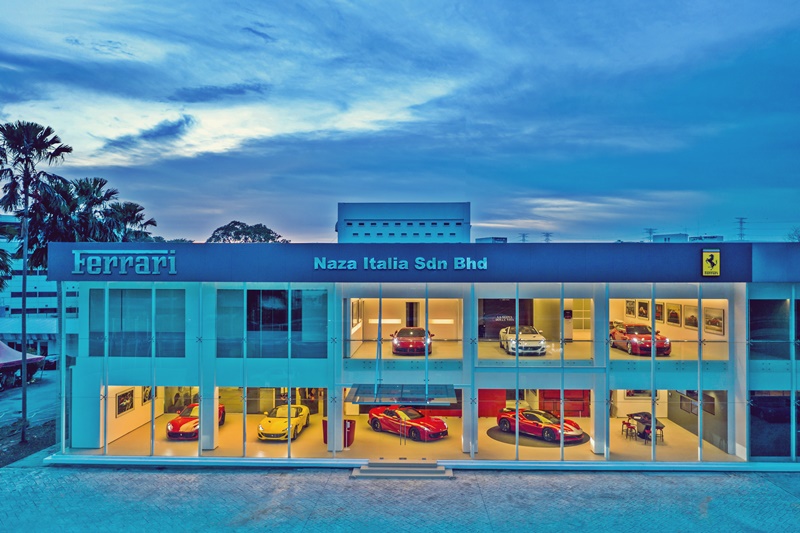
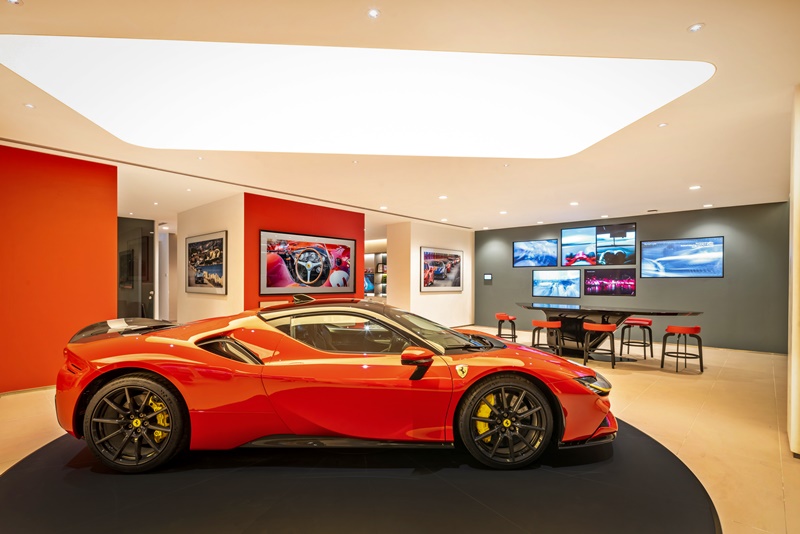
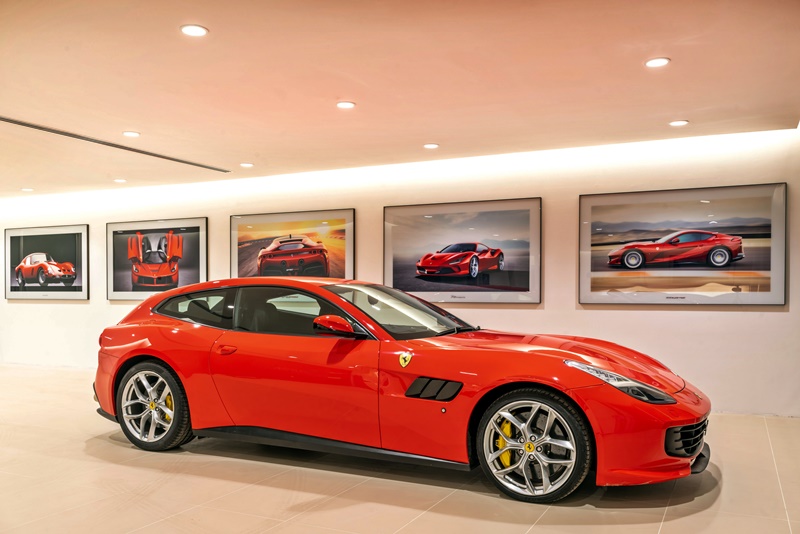
The Ferrari showroom in Petaling Jaya, Selangor, has undergone renovation which brings its appearance in accordance with the Italian brand’s latest Corporate Identity (CI) design. A total of RM3.5 million was spent for the renovation and refurbishment of the showroom which has been at the location since 2009. It is among the first few in Southeast Asia to incorporate the new CI.

Naza Italia Ferrari Showroom

‘Exclusive club’ for customers and owners
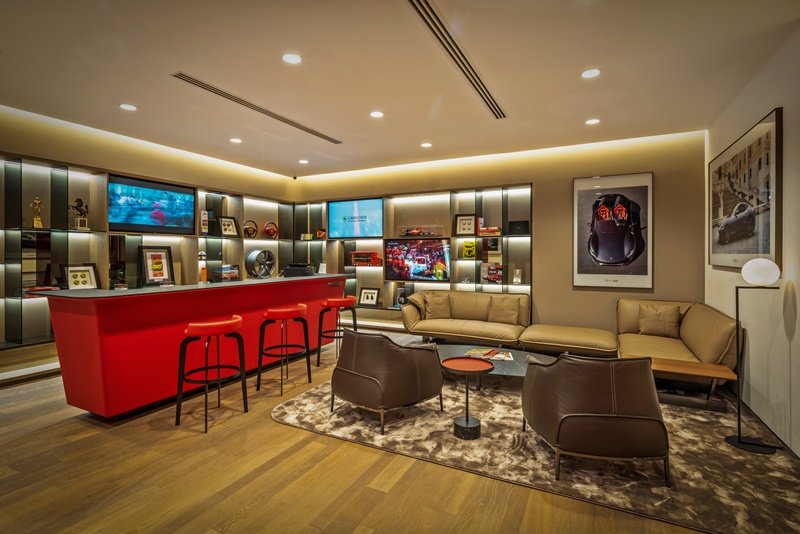
The showroom has two floors, covering a total of 11,900 sq ft, and can accommodate up to 7 cars. On the ground floor is the main display area which showcases the latest Ferrari models available for the Malaysian market. A customer lounge, finely furnished and equipped with a coffee bar, provides customers with a luxurious space that has a community feel and a sense of being at an exclusive club.

Naza Italia Ferrari Showroom

Naza Italia Ferrari Showroom

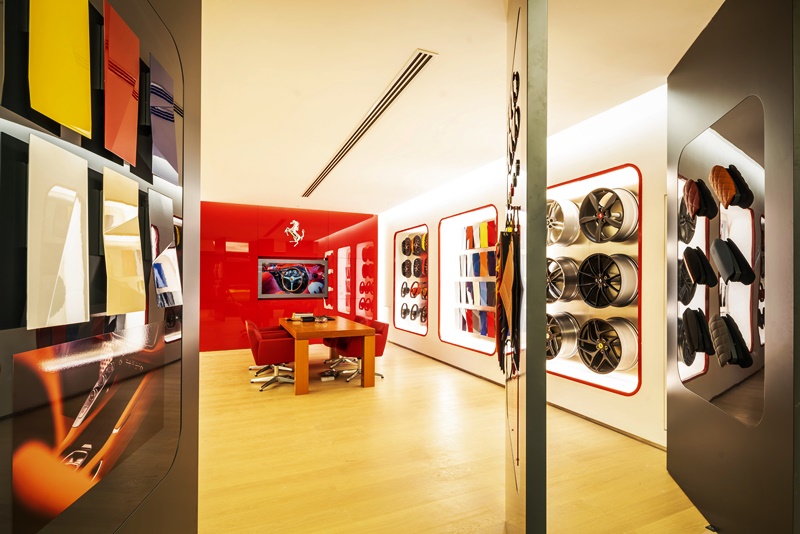
The Configuration Room
In the Configuration Room is a broad selection of materials and options as well as the exclusive ‘atelier’ panels which rotate and allow for the room to be closed off when discerning customers would prefer to design their Ferrari with peace and privacy. The experience provided is said to be comparable to that offered to Ferrari customers at the factory in Italy.

Also located on the ground floor is a brand experience video wall and a private consultation room. For those taking delivery of their car, a delivery area has been thoughtfully designed for owners to celebrate the occasion.

Ferrari Approved
The first floor is partially dedicated to Ferrari Approved, the brand’s pre-owned certification programme. The pre-owned models go through a meticulous 190-step check and are prepared to ensure that their new owners receive a Ferrari in world-class condition.

Naza Italia Ferrari Showroom

A Heritage Wall and library offer a glimpse into Ferrari’s history, legacy and the brand’s evolution into the automotive powerhouse that it is today. Last year, Ferrari claimed the title of the world’s strongest brand, according to the Brand Finance Global 500 report. Its strength was determined through a review of marketing investment, stakeholder equity, and business performance.

Ferrari Classiche Academy lets you experience driving supercars before the electronic age

PISTON.MY

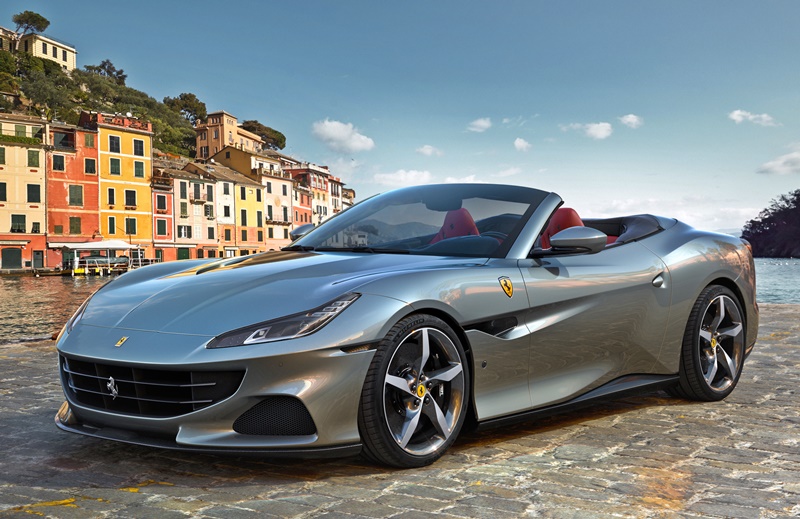
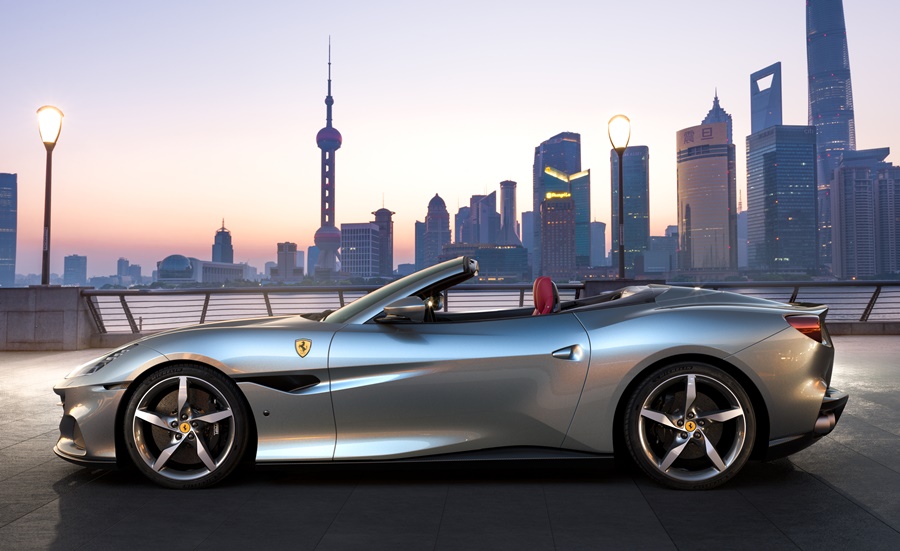
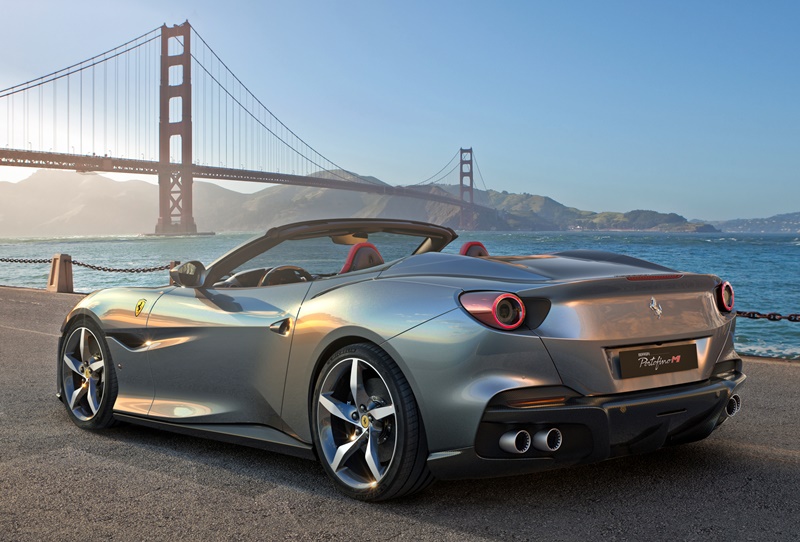
Ferrari’s evolved 2+ GT spider model, the Portofino M, is the first Ferrari to be presented in the wake of the company’s temporary closure due to the COVID-19 pandemic. It is therefore a symbol of a ‘voyage of rediscovery’ in a way, in constant pursuit of innovation.

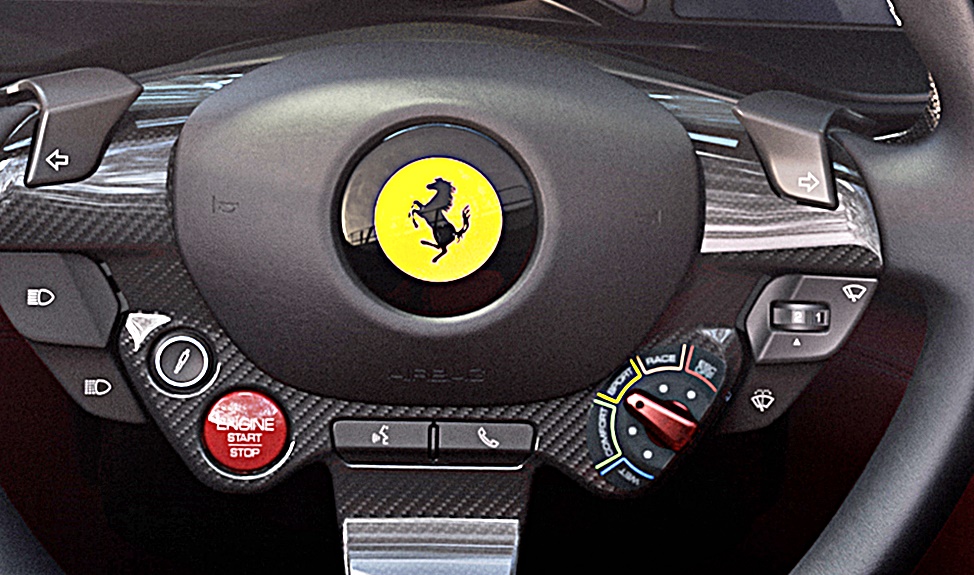
The ‘M’ in its designation refers to ‘Modificata’, which at Ferrari refers to cars that have undergone an evolution that has significantly boosted their performance. In the case of the Portofino M, the most notable aspect is its redesigned powertrain with a brand-new 8-speed gearbox. There is also the 5-position Manettino that includes a Race mode, an absolute first for a Maranello GT spider.

2020 Ferrari Portofino M

Uprated engine with new gearbox
The Portofino M’s 3855 cc engine belongs to the V8 turbo family voted ‘International Engine of the Year’ on 4 consecutive occasions (2016-2019). The power unit can generate up to about 620 ps at 7,500 rpm, 20 ps more than the Portofino. To achieve these higher performance levels, the engineers developed new cam profiles that increase valve lift and optimise combustion chamber filling.

A speed sensor was also added to the turbocharger assembly to measure the turbine speed. This in turn allowed the maximum rpm of the turbine to be increased by 5,000 rpm.

2020 Ferrari Portofino M

The 8-speed gearbox is completely new compared to the previous 7-speed version and has a dual-clutch oil bath architecture. It also differs from the SF90 Stradale’s 8-speed transmission in its longer gear ratios and the introduction of a mechanical reverse gear. The new layout and integration of its components have also optimised the gearbox’s size and its installation in the car.

Like all the other turbo cars in the range and in line with the ‘zero turbo lag’ concept, the Portofino M delivers instantaneous throttle response throughout the rev range. Variable Boost Management, a control software developed by Ferrari, adjusts torque delivery to suit the gear selected. The result is increasingly powerful pick-up as revs rise, whilst optimising fuel consumption. The amount of torque delivered progressively increases all the way up to 760 Nm in 7th and 8th gears.

This has allowed the use of longer gear ratios in the higher gears, which helps keep fuel consumption and emissions down. On the other, adopting a steeper torque curve through the rev range in the lower gears makes for a feeling of smooth and powerful pick-up.

By tradition, every single Ferrari engine has its own particular soundtrack that makes it unique, and the Portofino M is no exception. The two rear silencers have been eliminated (which in addition to boosting sound also significantly reduces back-pressure in the tailpipes) and the by-pass valves are now oval in shape to enhance the exhaust sound.

Advanced and integrated control systems
The vehicle dynamics control system known as Side Slip Control (SSC) incorporates an algorithm that delivers an estimate in real-time of the side slip angle to all the various on-board control systems. The SSC coordinates all the vehicle dynamics interventions as the systems are all integrated using shared data.

2020 Ferrari Portofino M

Now in its sixth generation, the SSC integrates the E-Diff, F1-TCS, SCM-E Frs and the Ferrari Dynamic Enhancer (FDE) control systems. The FDE is a lateral dynamics control system that uses Ferrari software to adjust the hydraulic brake pressure at the calipers on all four wheels. On the Portofino M, it is available only when the Manettino is in Race mode.

When the top is down
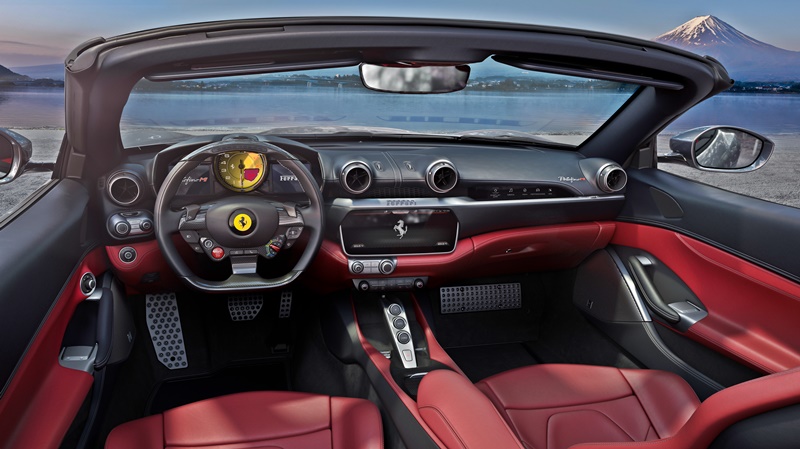
With the top down, the Portofino M reveals a multi-level dashboard structure comprising an upper half and then an intermediate gap designed to lighten the perceived mass of the lower half. This approach allowed the designers to organise the technical elements and in-car devices to very rational effect while simultaneously defining a signature full-width architecture.

2020 Ferrari Portofino M

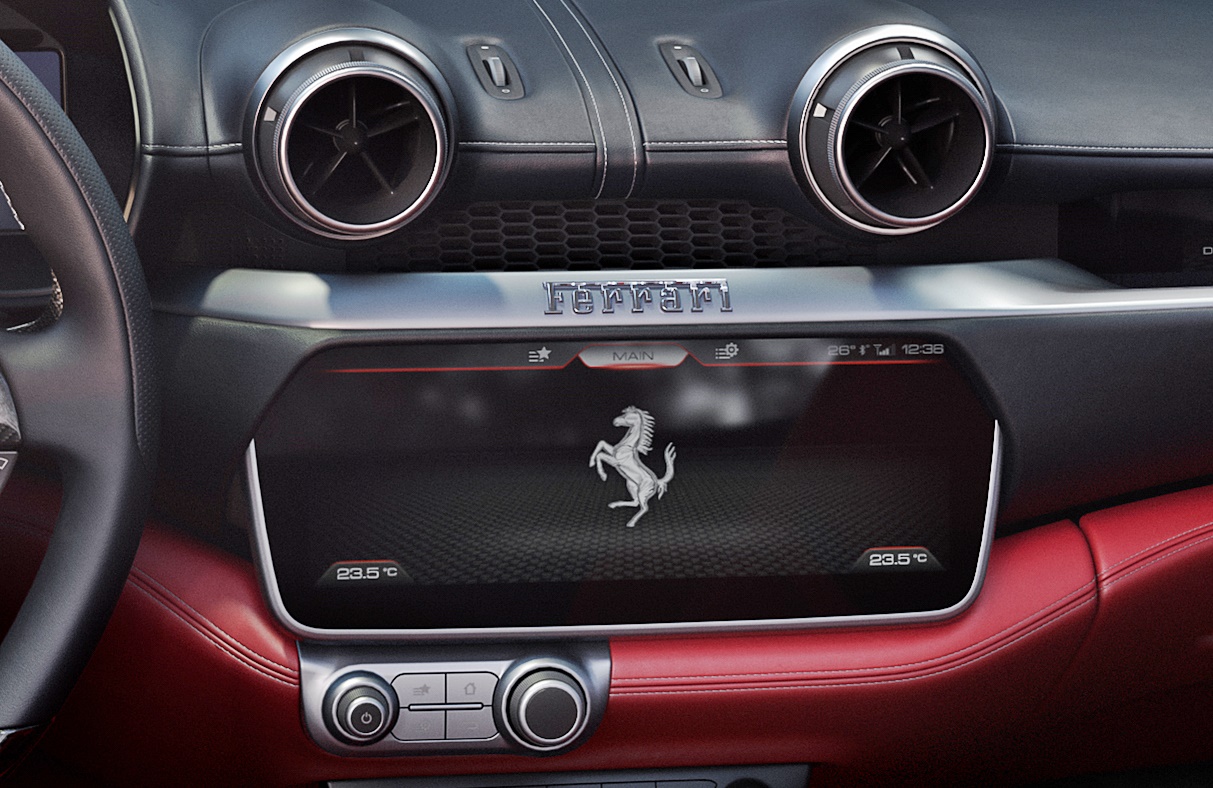
A central horizontal aluminium blade divides the instrument panel, air conditioning vents and passenger display into separate areas in the upper section. The other control functions are located in the scooped section below, with a large 10.25-inch touchscreen at the centre.

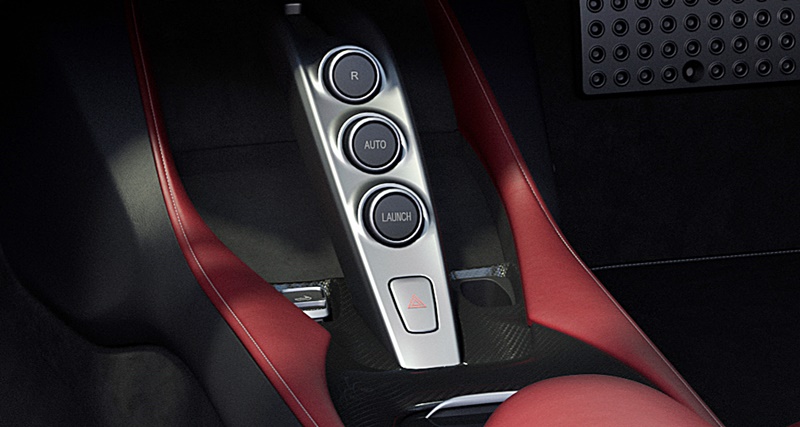
Seen in plan view, the cockpit’s symmetrical arrangement and the ample rear seat space are clear. From a construction perspective, the interior – and the dashboard architecture, in particular – feature two shells incorporating all of the technical components and a bridge that visually connects the instrument panel area with the central tunnel.

The seats are the product of a special research project and have an innovative magnesium structure. Different density padding and an ultra-compact seatback profile have freed up space for rear occupants too.

2020 Ferrari Portofino M

The passenger participates too
The Portofino M’s HMI (Human-Machine Interface) centres on a digital cluster with dual TFT displays arranged around the analogue tachometer in a generous circular, anti-glare binnacle. Located on exactly the same axis as the multifunctional steering wheel, this cluster allows the driver to interact more easily and intuitively, both visually and physically, with the car by delivering optimal driving feedback.

The passenger has an optional dedicated capacitive display on the dashboard too. It is directly linked to the main screen providing all information relating to car speed, rpm and gear engaged. This 7-inch colour full HD and Full Touch display also allows the passenger to interact with the car’s on-board systems. It is thus possible for the passenger to becomes a participative co-driver.

2020 Ferrari Portofino M

2020 Ferrari Portofino M

Click here for other news and articles about Ferrari

Social distance

PISTON.MY

Archive

Follow us on Facebook

Follow us on YouTube