

Piston.my

English

There is a scientific theory that a ‘Big Bang’ occurred at the beginning of the universe. Likewise, it was many ‘bangs’ which were at the beginning of a development in the automobile’s history which would save thousands of lives. These were the tests conducted by the engineers at Mercedes-Benz in the 1960s to develop the airbag system which almost every car sold today must have.

“We used missile technology,” Helmut Patzelt, one of the founding fathers of the airbag and an expert in pyrotechnics, remembered. “A missile receives its thrust from discharged gas, and we applied this very principle. The only difference is that we trapped the gas – inside an airbag.”

At the moment of a frontal collision, the airbag starts to inflate at over 300 km/h and immediately after it is fully inflated, the pressure is released to have an absorbing effect. The entire process takes place in the blink of an eye and is certainly much quicker than what this animation shows.

It was with this type of triggering test that Mercedes-Benz began to develop the idea of the airbag in 1967, prompted by two developments which affected automobile design: the rapidly spiralling number of accidents during the 1960s and a resultant series of new laws in the USA, one of which required an ‘automatic occupant protection system’ for every car in the USA from 1969 onwards. “We can no longer tolerate unsafe automobiles,” declared Lyndon B. Johnson, the President of the USA then.

And so it was that previously ignored inventions – for which patent applications had been submitted by German Walter Linderer and American John W. Hedrik as early as 1953 – suddenly took on a whole new meaning. “A folded, deployable receptacle which inflates automatically in the event of danger” was a fascinating idea; yet, at that time, the technology required to make it happen simply did not exist. This was the cue for the automotive engineers to commence their explosive experiments.

By 1970, the pressure on the developers increased when the newly-formed US highway safety authority (NHTSA) stipulated that driver airbags would be a legal requirement for all new cars – starting as early as January 1, 1973. No sooner had it been made a requirement than the airbag became the subject of a long-running dispute. “The airbag will kill more people than it saves,” claimed critical voices that joined the debate in the USA.

As a consequence, the introduction date was changed to 1976. And even after that, the production launch had to be postponed on several other occasions. Alarmist statements and uncertainties had people wondering if the airbag was just ‘a lot of hot air’. Hansjurgen Scholz, who was then project manager for passive restraint systems at Mercedes-Benz, remembered that period only too well: “When a fatal accident involving an airbag occurred in the USA in 1974, most of those involved deserted the project like a sinking ship!” All of a sudden, the development team at Mercedes-Benz found that they were left on their own, without any outside support. Other German manufacturers also failed to see the potential of the life-saving airbag at the time.

But the team of engineers was not ready to give up. “We had recognised the enormous potential of the air cushion. And we were not going to throw away our trump card,” said Professor Guntram Huber, a former director of development for passenger car bodywork at the German carmaker. He  would later be awarded the ‘Safety Trophy’ by the American Department of Transportation for his role in the introduction of the airbag.

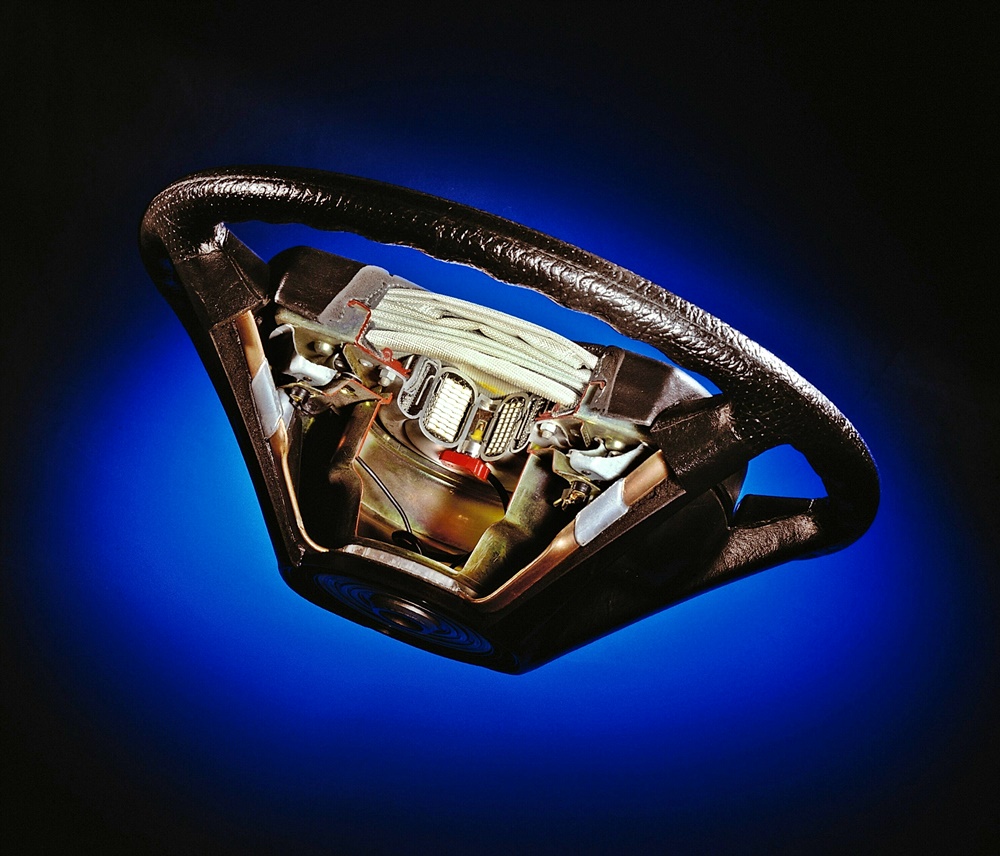
The inside of a steering wheel with an airbag system. The white section is the folded airbag and below it are the pellets which reaction to generate a gas that inflates the airbag at very high speed – like the firing of a rocket exhaust.

And so it was that, in 1974, Mercedes-Benz decided to go ahead and put the airbag into production, regardless of the seeming negative sentiment in the US market concerning airbags. What’s more, the idea was to offer the safety device in the world market and not just the US alone.

The technological challenges that had to be overcome when developing this innovation, which finally led to the unveiling of the world’s first driver airbag in December 1980, were immense. A new product had to be created entirely from scratch. Problems that required solutions included the sensor-triggered deployment mechanism, the gas generation process, the tear-resistance of the airbag fabric, the effects on health and hearing, functional reliability and the crucial issue of how to prevent unintentional activation. Given the intrepid test methods employed – they were, after all, based on missile technology – the authorities were quick to offer resistance, at first putting the triggering mechanism used to inflate the airbag in the same category as fireworks. In Malaysia too, early perception of airbag systems by the authorities was similar and required companies to have rooms akin to bomb shelters to store airbag systems! For this reason, all those involved in the development of the airbag had to attend an explosives course. Following initial tests with liquid gas cylinders, the breakthrough was finally achieved by using a solid fuel for firing the airbag.

Toxicologists also had their say, querying the emissions left behind inside the car after deployment of the airbag. But the developers were able to allay these fears as well, since the solid fuel pressed into tablet form – consisting of sodium azide, calcium nitrate and sand – left behind predominantly non-hazardous nitrogen gas and small quantities of hydrogen and oxygen. It did, however, get smoky inside the cabin, leading people to sometimes fear that a fire had started.

In their efforts to overcome the technical hurdles before them, many of the ideas the engineers came up with were highly unconventional. Since the sound of the deploying airbag was above the pain barrier but only lasted for 10 milliseconds, the effect on the eardrums could not be clearly ascertained at first. The engineers therefore installed a cage containing 15 canaries in a test car to determine the harmful effects of the noise, gas emissions and air pressure during deployment of the airbag. Not only did all the canaries survive the test, they also remained their usual lively selves…

Testing airbags under development in 1969.

Some 250 crash tests on complete vehicles, around 2,500 sled tests and thousands of component tests provided the airbag pioneers with invaluable knowledge to help the airbag on its way to full series production. The primary concern in all the tests was stopping the car airbag from deploying unintentionally – a horror scenario for the developers. In early tests, the airbag would sometimes go off even when the vehicle was at a standstill, meaning that the engineers also had to develop the electronic system from scratch. The sensor only had a few milliseconds in which to deploy the airbag – still very much a fanciful idea in those days. As if that were not enough, the sensor had to be able to function reliably for several years at extremely low or very high temperatures with constant fluctuations in humidity, depending on the country.

Some 600 test cars took part in road tests, off-road trials and rally events, clocking up in excess of 7  million kilometres, in order to ensure that the sensor could perform its vital, life-saving function. In addition, the engineers, technical experts and office staff had to literally put themselves in the firing line. They sat at the steering wheel to gauge the effects of the airbag as it deployed in an emergency, all under the watchful eye of the project team who recorded the results.

Last but not least, another issue which had to be resolved before the first airbag was allowed to be installed a production car in December 1980. Even 40 years ago, Mercedes-Benz was thinking of the environment and had to consider disposal of airbags; in other words what to do with the airbag when the car reached the end of its life or after it actually did its life-saving work.

Following the world premiere of the driver’s airbag in a W126 S-Class in 1980 (above), the specialists in the safety development department set about building upon their lead, using their know-how to further develop the safety system. This led to the installing a second airbag for the front passenger which was introduced in 1988. Then, in 1992, all Mercedes-Benz models were fitted with a driver’s airbag as standard globally, with the passenger airbag eventually becoming standard as well in 1994.

A further milestone in passenger car safety was achieved in 1995 when the side airbag made its debut in the E-Class following a development period of around 10 years. The side airbag against each front door presented new challenges for the developers as it only had 20 milliseconds in which to deploy following a crash. In contrast, the front airbag enjoyed the comparative ‘luxury’ of around 40 milliseconds (a millisecond is one-thousandth of a second… quicker than even a blink of an eye).

Mercedes-Benz Airbag Story
Today, most Mercedes-Benz models have multiple airbags systems around the cabin to provide maximum protection during an accident, even from collisions against the sides.
The next milestone in airbag history – the windowbag – came in 1998. In the event of a side impact, it inflates across the side windows to form a curtain, its large dimensions providing a wide area to protect the heads of both the front occupants and the rear passengers. Windowbags can prevent the head from hitting the side window, roof pillars or roof frame and are also capable of catching any fragments of glass or other objects propelled into the interior following a collision or subsequent roll-over, which constitute an additional injury hazard. They can also prevent people from being ejected during a violent impact.

An early concern was the presence of a childseat on the front seat – a very dangerous situation which manufacturers warn drivers of. The powerful impact of a deploying airbag can force the childseat against the backrest and cause serious injury to the child in it and it will be lethal if the child is facing forward. For this reason, Mercedes-Benz engineers developed automatic child-seat and front-passenger recognition systems which enable the ideal airbag response given the situation in hand. Similarly, the front airbag, sidebag and belt tensioner on the front passenger side are deactivated when the seat is not occupied.

The development of airbag systems has not stopped at Mercedes-Benz. On the contrary, new technologies have improved performance and functions. Today, the airbag has evolved into a highly complex and sensitive electronic system – a high-tech product that adapts to suit the seat occupant and the accident situation, responding accordingly before the driver has even had time to fully register any precarious accident situation. This lightning-fast reaction time is down to electronic triggering sensors and gas generators which allow the front airbags to deploy in stages, depending on the severity of the accident.

The life-saving air cushion will continue to be a vital component at the heart of the safety equipment package for all Mercedes-Benz vehicles. And apart from regulatory requirements, which Mercedes-Benz has always met or exceeded, many future features and improvements will also be guided by what happens in real-life accidents. For the engineers, this means making airbags effective enough to cover a wide range of accident scenarios and ensuring that they can be deployed in accordance with the severity of the accident.

Mercedes-Benz S 680 GUARD 4MATIC comes with protection against bullets and explosives

In future, the Porsche you drive could have an invisible ‘twin’ in the digital world. No, it’s not something to do with science fiction and parallel worlds but a possibility being explored by researchers at the German sportscar company. With continuously improving performance of integrated sensors, networking and data processing capabilities, it may become possible to create a virtual copy of an existing object – like a car. This will allow data-driven analysis, monitoring and diagnostics without the challenges and constraints of real-world tests.

The digital twin of a vehicle comprises not only the operating data it collects but also any related data, such as information collected during planned maintenance work and unexpected repairs. Elements of this digital twin already exist in control unit memories and in the databases maintained at Porsche Centres.

Centralised intelligence system
The main advantage of digital twins is the fact that they can be networked and the data combined with a centralised intelligence system. Conclusions that benefit every single vehicle and therefore every individual customer can be drawn from data relevant to an entire field. For example, an algorithm can compare big data against sensor data from a specific vehicle’s powertrain and chassis to identify a customer’s driving style.

The algorithm can then recommend not only the optimal time for service work on the vehicle but also the required scope of that work. This data makes it possible to customise service intervals and allow servicing for specific components as needed, based on how the customer uses their vehicle.

For instance, with this approach, the hardworking suspension bushes of a sportscar that spends most of its time on a racetrack could be replaced at exactly the right time. By contrast, service work on the engine is more important for vehicles predominantly driven for long distances on motorways. Another even more important benefit of this approach is the fact that potential component wear and even faults can be identified before they have actually occurred, which is a significant advantage from a safety perspective.
For the past 3 years or so, software specialists at Porsche have been working on a digital twin concept that focuses on the chassis, known as a ‘chassis twin’. This project is now being managed by CARIAD, the standalone automotive software company within the Volkswagen Group. In addition to data from Porsche vehicles, the project now has access to data from all Volkswagen Group vehicles, which increases the data pool by a factor of 20.

High importance of the chassis
The reason for focusing on chassis components is clear. On a Porsche, the chassis is subjected to the highest loads, particularly when the vehicle is used on racing circuits. Sensor technology in the vehicle and the intelligent neural algorithms used for centralised analysis allow the load on the chassis to be detected within the vehicle and conveyed to the driver. This intelligent use of data makes the vehicle safer for its passengers because any specific faults are identified immediately, even before the driver or the workshop notices a problem signified by noise or vibration.

The digital chassis is already being used for its first practical testing scenario: monitoring the components in the air suspension of the Taycan EV. This project is primarily for collecting data about body acceleration in this initial stage. The data is evaluated and transferred via Porsche Connect to the central backend system.

This system continuously compares the data from each vehicle against the fleet data. The algorithm calculates thresholds based on this comparison and, if these are exceeded, the customer is notified via the onboard Porsche Communication Management (PCM) system that the chassis may need to be inspected at a Porsche Centre. While this approach ensures that wear does not go beyond specified limits, early repairs also help to prevent consequential damage.

Artificial intelligence with data privacy
Artificial intelligence within the vehicle and within the centralised intelligence system continuously improves contingency planning and the accuracy of the algorithms. Data privacy during the testing phase and after the model’s launch is the top priority so customers are prompted via the PCM to provide their consent to data being collected anonymously. Around half of all Taycan customers have agreed to take part in this pilot project, which has pleased Porsche.

The first version of the digital twin will be launched next year and only sensor data directly from mechatronic components will be evaluated. Other functionality will be added in the future, such as functions that allow wear on specific components to be calculated without the need for physical gauges to be used. For example, if multiple vehicles require adjustments to their wheel alignment or a track rod replacement and multiple sensors have already detected corresponding deviations, this information can indicate a pattern. If the same data is then identified on a further vehicle, the driver will accordingly be told to visit a Porsche Centre.

Early diagnostics in this format can prevent consequential damage which, in this example, would be worn tyres caused by track misalignment. The fault-finding process at the workshop will be faster, because the specific components responsible for a fault can be replaced, thereby reducing throughput times in the workshop and lowering costs for customers.

The digital twin offers other benefits for customers beyond operation of their vehicle. Digital vehicle records can be used to show the residual value of a vehicle, making the process of buying and selling used vehicles more transparent. In addition, manufacturers could consider offering an extended approved warranty based on seamless documentation of component status updates, and even a certificate with a price recommendation for selling on the vehicle.

Designing the Porsche interior of the future

Japanese carmakers built their reputation on reliable, economical and affordable small cars and for most of the world (with the exception of America), they captured big market shares. However, in Europe, while their small cars were successful and popular, they faced a big challenge in the supermini A-segment. This was where European carmakers had popular products and were pretty well entrenched.

Prior to the 1990s, some European countries like France, Spain, Portugal and Italy had formal and informal quotas on imports of Japanese cars to limit their threat. As in America, the Japanese carmakers began to build factories in Europe as a way to get behind the barriers. Eventually, as the World Trade Organisation forced upon countries the requirement to drop barriers, the issue of quotas became less pursued.

First generation of the Aygo

But the market had also changed by the beginning of the 21st century and collaboration was necessary as it was very costly to develop a model and then to have sufficient volumes to justify the investments. Even Toyota, which had often chosen to control its destiny alone, found it pragmatic to cooperate with other carmakers.

One of these joint ventures was with Groupe PSA, the parent company of Peugeot and Citroen, which saw the opening of a factory in the Czech Republic. Established in 2002, the factory, owned 50:50, was known as Toyota Peugeot Citroen Automobile Czech (TPCA) and was used to produce a supermini that would be marketed by Peugeot, Toyota and also Citroen. The model, jointly developed, was known as the Aygo and Peugeot called theirs the 107 while Citroen’s was badged as the C1.

The factory in the Czech Republic, which started as Toyota Peugeot Citroen Automobile Czech but is now Toyota Motor Manufacturing Czech Republic after the Japanese carmaker took over Groupe PSA’s 50% share in January this year.

The combined sales volume of the three models reached a peak of almost 340,000 units in 2009 and it sold well enough that a second generation was introduced in 2014. However, this will be the last generation of the common model as Groupe PSA (which is now in the Stellantis Group) has decided to cease the collaboration. At the same time, TPCA was also taken over entirely by Toyota in January this year.

2022 Toyota Aygo X

Having been in the market for 7 years now, the Aygo might seem like it’s reaching the end of its generation cycle but that has not stopped Toyota from coming out with a brand new variant. This is the Aygo X launched this week and it is a response to the continuing demand for crossovers.

Designed mainly in Europe, it’s still a city car but has additional versatility. As with many of the latest Toyota models, it also uses TNGA – Toyota Global New Architecture – and specifically the GA-B platform first introduced with the latest European Yaris and more recently, the Yaris Cross.

2022 Toyota Aygo X

“Since the Aygo first arrived in the market in 2005, not only has it been Toyota’s most accessible car in Europe, it also delighted customers with its youthful and fun character. Not only has it brought many new customers to Toyota. It also fulfils our mission to provide everyone with the right mobility solution,” said Andrea Carlucci, Vice-President, Product & Marketing, Toyota Motor Europe, adding that the A-segment is very important to the company.

The Aygo X is the production version of the Aygo X prologue shown in March this year. The concept car was developed at Toyota’s European Design and Development (ED2) in France. Feedback on the concept car helped the designers at Toyota Motor Europe’s styling division in Belgium to fine-tune the product and take it from concept to reality.

The Aygo X uses the dramatic spice colour concept of the prototype with a bi-tone black roof to create a unique graphic profile. A wedged roofline also increases the dynamic feeling for a sportier image. In the front, high-tech lamps hug the upper bonnet to form a wing-like shape, while lower to the ground, the large grille, foglamps and skidplate all build on the double trapezoid theme that is part of Aygo’s identity.

“The bi-tone of the Aygo X immediately grabs people’s attention. It’s clearly not just a detail. It’s an integral part of the design,” explained Anastasiia Stoliarova, Aygo X Product Planner.

The spice theme is not just on the exterior as interior highlights match the bodywork’s spice colours to give a distinctive design to the cockpit, including the dashboard and centre consoles. On the seats can be seen an ‘X’ symbol discreetly stitched right into the fabric. The Aygo X model name is also subtly echoed in the keen look headlamps to provide a strong and coherent identity.

Toyota isn’t offering an ‘Edition 1’ (as some carmakers do) but, for the first 6 months after going on sale in 2022, there will be a ‘spicier’ limited edition Aygo X in Cardamom. This features additional matte Mandarina accents in orange throughout the car with accent stripes on the exterior and on the bespoke 18-inch matte black alloy wheels. The Mandarina theme is also carried through the interior panels and seat fabric design.

As with other Aygo models, the Aygo X is powered by a 1-litre, 3-cylinder engine. Coupled to a new S-CVT transmission, it is claimed to be able to do 21.3 kms/litre.

2022 Toyota Aygo X

In adapting the GA-B platform for the Aygo X, the A-segment contender has evolved into a credible  crossover product. It has a modified and downsized rear chassis section with reduced front and rear overhangs. The 3700 mm long Aygo X has less front overhang than the Yaris, and has an exceptionally small turning circle of 4.7 metres.

The total body width is 125 mm more than an Aygo, which has allowed the front seats to be moved 20 mm further apart and increasing shoulder space. Luggage space is claimed to be segment-leading with 125 mm more floor length and a smart space design behind the rear seats. Up to 231 litres of cargo volume is available.

2022 Toyota Aygo X

The ‘Pagoda’ roof design maintains compact overall dimensions, while providing comfortable, spacious cabin for driver and passengers. And the sky’s the limit, so to speak, with the optional retractable canvas top, a first for an A-segment crossover. The canvas top, of high quality materials,  offers improved water and dust protection and has a wind deflector structure.

Hyundai-Sime Darby Motors (HSDM) has been quick to respond to the exemption of all import and excise duties for electric vehicles (EVs) announced just last Friday by the government for the proposed 2022 Budget. The exemption will certainly make fully electric vehicles more affordable, hopefully spurring interest among Malaysians to switch to them.

2021 Hyundai Kona Electric EV
The Kona Electric has a different front end from the version with a combustion engine (below) as there is no need for the traditional grille since there is no radiator to cool.

More attractive pricing without taxes
Later this month, HSDM will begin selling the Hyundai Kona Electric, the fully electric version of the Kona SUV already sold in Malaysia since April this year. With the exemptions (normally a privilege given to royalty and diplomats), the model is expected to cost less than RM150,000 in standard form. This compares favourably with the version using a 2-litre Smartstream petrol engine that are priced at RM119,888 and RM136,888 (without insurance and 50% exemption on sales tax).

Customers will have a choice of two lithium-ion battery packs (at different prices, of course). The more powerful one will have storage capacity of 64 kWh for longer range while the alternative pack  will have 39.2 kWh. With a fully charged pack, range claims are 484 kms and 305 kms, respectively, although this would depend on driving style and conditions, just like with combustion engines.

2021 Hyundai Kona Electric EV

47 minutes recharging time

What would be of more importance to owners would be recharging time, something which will have to be a daily practice – just like charging your phone overnight. Hyundai claims that it should take around 47 minutes to recharge from 10% to 80% using a 100kW direct current (DC) fast charger.

The Kona Electric also has an optional 11-kW 3-phase on-board charger. This allows for significantly shorter charging times using public 3-phase AC charging stations or with a private compatible wall box at home. Drivers also have the option of charging their car at a compatible regular household power socket using the ICCB-cable (in-cable control box).

2021 Hyundai Kona Electric EV

Things to consider buying an EV
Owning an EV will have to be carefully considered by those interested in having such vehicles. While you will certainly save on fuel costs and help save the planet, your personal circumstances will be a factor. If you live in a condo complex or apartments, you may not have a place to recharge your vehicle if the property owner does not provide convenient power points. Then you will have to rely on public recharging stations which, at this time, are not exactly plentiful. The situation will change in coming years, but it cannot be predicted how fast the private sector will develop the recharging network.

Visually, the Kona Electric resembles the other versions but has its own bumper, wheel and headlight designs. The front end is also more ‘sealed’ since the traditional grille is not needed for cooling purposes.

2021 Hyundai Kona Electric EV

2021 Hyundai Kona Electric EV

The interior has a similar horizontal layout as the other versions with new ambient lighting. The instrumentation reflects the EV-nature of the vehicle, with the tachometer space occupied by a meter showing the battery charge and power levels. There’s also a gauge to let the driver know how much range is left with the energy in the battery pack.

Performance-wise, the electric motor of the Kona Electric can generate 150 kW (equivalent to 204 ps) of power and 395 Nm of torque. You don’t get the sub-5 second times that you often read about with EVs, but it can go from 0 to 100 km/h in a claimed 7.9 seconds. The strong point about EVs is that all the torque is available from standstill so acceleration is exceptionally quick.

2021 Hyundai Kona Electric EV

The Kona Electric is one of the early models in the growing range of EVs by Hyundai. The Korean carmaker plans to introduce 12 new fully electric models by 2025 and reach a sales volume of 560,000 EVs annually. Its entire line-up will be electrified globally by 2040, by which time it expects to capture 8% to 10% of the global EV market.

Hyundai Kona Electric gets listed in Guinness World Records for altitude achievement

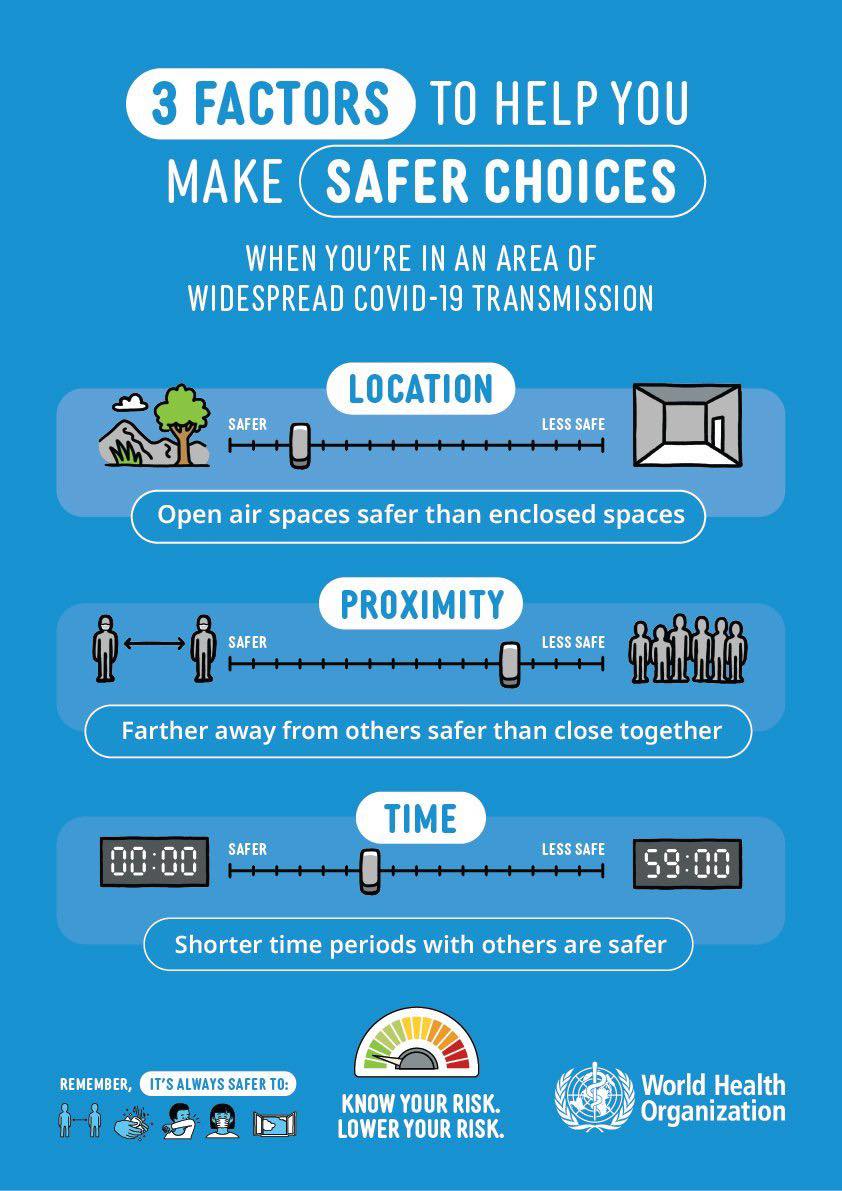
Vaccination does not make you immune to COVID-19 infection. You can still get infected and although you may not show symptoms, you could spread the coronavirus to others. Do not stop taking protective measures such as wearing a facemask, washing hands frequently and social distancing.

The Toyota IMV (Innovative International Multi-Purpose Vehicle) range which has been in the market since 2005 has continuously received updates over the two generations produced. The range consists of the Hilux pick-up, Fortuner SUV and Innova MPV, all conceived within the same development programme although the platforms differ due to the different operating requirements.

Another round of updates has taken place and the latest models have been announced with the following prices (without insurance):
Toyota Hilux (5 variants) – from RM92,880
Toyota Fortuner (3 variants) – from RM169,167
Toyota Innova (3 variants) – from RM115,553

Orders are now being accepted at all authorised Toyota showrooms nationwide and while the Hilux pick-up is readily available, deliveries of the Fortuner SUV and Innova will commence only in January 2022. With the extension given by the government, customers can still enjoy the full sales tax exemption next year for the Fortuner and Innova but the Hilux, being a light commercial vehicle, does not qualify for the exemption. All the models are assembled locally at the ASSB plant in Shah Alam, Selangor.

The engines have been retuned to meet stricter exhaust emission standards that will be introduced in Malaysia next year.

The updates  improve convenience and comfort, with the petrol engines tuned to meet stricter emission control standards in advance of implementation of the Euro4 standards in 2022.

“The IMV range of products has been a great success in Malaysia and other markets around the  world, providing durable and reliable mobility for thousands. The Hilux, in particular, has been the  best-selling pick-up in Malaysia for many years and even today, we see demand exceeding supply.  Rest assured that our assembly plant is rushing to fulfil outstanding orders but as always, without  sacrificing quality,” said UMW Toyota Motor President, Ravindran K.

New Hilux
Malaysia’s best-selling pick-up truck is available in 5 with a choice of 2 turbodiesel 4-cylinder engines with 2.4-litre and 2.8- litre displacements. Both engines are fuel-efficient and extra fuel-saving can be achieved with the use of an ECO mode.

2021 Toyota Hilux

The passenger-oriented double cab variants – Hilux 2.8 Rogue, 2.4 V and 2.4 E – have 6-speed  automatic transmissions and a dual-range 4×4 system. The other variants – Hilux Double Cab 2.4 G and Single Cab 2.4 – are equipped with 6-speed manual transmissions but both also have 4×4  drivetrains. These are intended more for customers who require vehicles for heavy-duty work.

The Hilux is well equipped with a wide range of features and equipment for convenience and safety. For the latest Hilux 2.8 Rogue and 2.4 V, the front air-conditioning system is upgraded to a dual zone type in place of the single-zone type. With the dual-zone feature, the driver and front  passenger can set their preferred temperatures separately.

New Fortuner
The Fortuner is a 3-row 7-seater SUV which took over the role of the Land Cruiser in ASEAN markets, The medium-sized SUV is available in three variants – Fortuner 2.8 VRZ, Fortuner 2.7 SRZ and  Fortuner 2.4. Responding to market demand, the Fortuner 2.4 is now made available throughout  Malaysia, together with Fortuner 2.8 VRZ and 2.7 SRZ.

2011 Toyota Fortuner

Like the Hilux, the front air-conditioner of the latest Fortuner 2.8 VRZ and 2.7 SRZ  have a  dual-zone feature to allow separate temperature settings for the driver and front passenger. A  wireless charger pad for compatible smartphones is now standard for all variants. The rear USB  port for the Fortuner 2.8 VRZ has also been changed to the newer Type-C port, making it more  convenient to recharge for those with the newer generation of smartphones.

The same proven and reliable powertrains are used with 6-speed electronic automatic  transmissions and dual-range 4×4 systems. The 2.7-litre petrol engine has been retuned so that it can meet stricter emission control standards, upgrading to Euro4 from Euro2 standards.

New Innova
The Innova offers seating for 8 persons with generous storage space.  Currently in its second generation, this Toyota MPV is available in three variants – Innova  2.0X, 2.0G and 2.0E. While all three variants have the same 3-row cabin, the Innova 2.0X comes with generously sized Captain’s Seats in the middle (so the occupancy is reduced by one person).

For those who have compatible smartphones, a wireless charging pad is now standard in every variant. This makes it simpler to recharge a compatible phone as no cables are needed. Multiple USB ports are also available around the cabin, making it  easier to charge phones and tablets.

The fuel-efficient and reliable 2-litre 16-valve petrol engine for all three variants has also been upgraded  to meet the stricter Euro4 emission control standards.

5-year warranty
All three models come with a 5-year warranty with unlimited mileage for the Fortuner and Innova,  and a maximum of 150,000 kms for the Hilux (terms and conditions apply). UMW Toyota Motor also offers a wide range of financing plans, including subscription plans, to suit different needs. There are also financing and leasing programs for those who are purchasing vehicles for  commercial use.

For more information, visit www.toyota.com.my.

Enhanced ownership experience with new Toyota Loyal-T Programme

The Audi A8 is one of the German carmaker’s older models with a history going back to 1994. Asa a flagship model, it typically introduced pioneering technology and the first A8 was built with a significant innovation – an aluminium monocoque structure called the Audi Space Frame (ASF) which brought weight down without losing structural strength. The weight savings were of great value to a large limousine like the A8.

Since then, the model has had four generations, the current one having been introduced in 2017. An update has therefore been due and the enhanced A8 makes it debut this week. Noticeable exterior changes are the new advanced headlights and taillights, new elements which give a sharper design, while also adding presence and authority.

2021 Audi A8 L

Advanced headlight systems
Comparable with video projectors, the Digital Matrix LED headlights use DMD (digital micromirror device) technology. Each headlight has approximately 1.3 million micromirrors, which disperse the light in tiny pixels and precisely control them.

One new function is lane and orientation lights for highways. The new A8 comes with Digital OLED rear lights (OLED = organic light emitting diode) as a standard feature. When ordering the car, there are two rear light signatures to choose from – three with the S8. In conjunction with the assistance systems, the digital OLED rear lights have a proximity indication feature.

Beyond the basic exterior, Audi is offering its customers a chrome exterior package and, for the first time in the A8, the new S line exterior package. The look is even more defined with the additional black appearance package.

Reduction as a design medium
The architecture of the interior is strictly horizontally oriented to emphasize the car’s width. In the dark, the ambient light package plus stages the interior and the reading lights in the rear use Matrix LED technology.

2021 Audi A8 L

The range of seats and seat equipment is varied;– especially for the back seats, many options are available. The relaxation seat in the A8 L is the most luxurious with numerous adjustment options and a footrest on the back of the passenger seat. Passengers can use it to have the bottoms of their feet warmed and massaged to various degrees.

Navigation and Audi connect
MMI Navigation plus is standard and supported by the third generation modular infotainment toolkit (MIB 3). The likewise standard online and Car-2-X services from Audi connect augment the navigation system. They are divided into two packages: Audi connect Navigation & Infotainment and Audi connect Safety & Service with Audi connect Remote & Control.

2021 Audi A8 L

Customers can also choose various infotainment hardware. The new screens in the back are tailored to the usage needs of today’s rear-seat passengers. That means two 10.1-inch displays with full HD resolution and full connectivity options.

Three different driver assistance systems
There are about 40 driver assistance systems available for the enhanced Audi A8. Some of them – including the Audi pre sense basic and Audi pre sense front safety systems – are standard. The options are clustered into the ‘Park’, ‘City’, and ‘Tour’ packages. The assistance package plus consolidates the packages. Features like the night vision assistant and surround view cameras are available separately.

2021 Audi A8 L

Engine range
For this generation, there are three powertrain options.  Apart from the 3.0 TFSI as a V6 engine, the 4.0 TFSI, which is available for the A8 and the S8 in various output levels, distributes its 4 litres of displacement to 8 cylinders with cylinder on demand technology. The A8 is also available with a turbodiesel engine and a plug-in hybrid model will follow.

2021 Audi A8 L

All engines use an 8-step Tiptronic and with an electric oil pump, the automatic transmission can change gears even when the combustion engine is not running. The constant all-wheel drive quattro with the self-locking centre differential is also standard, and can be optionally supplemented with the sport differential (standard in the S8 ). It actively distributes torque between the rear wheels during fast cornering and thereby makes the handling even sportier and more stable. The adaptive air suspension with controlled damping is standard. Progressive steering is another standard feature but dynamic all-wheel steering is an option.

As for the S8 S8 TSFI quattro – the sporty top version of the flagship family – the biturbo V8 generates 571 ps/800 Nm and has mild hybrid technology. This uses the A8’s 48-volt main electrical system. Only in the S8 comes with predictive active suspension, sport differential, and dynamic all-wheel steering built.

A8 L Horch for China
Exclusively for the Chinese market is the A8 L Horch. This is 5.45 metres long, which is 13 cm longer than the standard A8 L. Inside, the expanded diamond quilting, logo embossing in the cushions, and deep-pile floor mats in the back emphasize the exclusivity of this version for the largest car market in the world. On the exterior, there is a specially designed Singleframe with vertical braces as well as the Horch badge and the ‘H’ crown. For the first time in the D segment, customers in China will be able to order their car  with a 2-color finish.

Audi grandsphere concept shows Audi’s future electric flagship and technology

Following a successful October when sales grew by 28.7% compared to the previous month, Proton has now exceeded the cumulative volume that was achieved for the same period of 10 months in 2020. With 13,362 units sold in October, the cumulative volume has reached 86,379 units, 1.6% higher than the same period in 2020 when 84,999 units were sold.

“Proton’s sales in October can be summarized as a story of strong buyer demand and unrealized sales potential. While we are happy with the continued popularity of the Proton Saga and our achievement with the two SUVs, we missed out on adding more units to our final tally as we continue ramping up our supply of components. Market demand however is expected to remain strong towards the end of year, so we are working diligently towards closing 2021 on a high note,” said Roslan Abdullah, CEO of Proton Edar.

Proton’s performance is in contrast to the overall market which has fallen by an estimated 4.7% despite selling more than 65,000 units for the first time in 2021 in October. Proton’s total sales volume in October is expected to be represent a 20.5% market share, while the cumulative volume should put the brand’s share at 22.7%.

As has been the case for every month in 2021, the Saga has been the bestseller. 5,107 units were sold in October, the third time the model’s sales volume has exceeded 5,000 units during the year. According to Proton, the Saga has been the A-segment sedan volume leader in 2021.

Two other volume leaders for the company are both the SUVs, the X50 and X70. The B-segment X50 managed achieved its best month since launch with 3,839 units sold, while the larger X70 had its best month of sales since March this year with 2,165 units sold.

As for the rest of the model range, the evergreen Exora continued to dominate the C-segment MPV market with 359 units sold. However, the latest Iriz and Persona were badly affected by microchip shortages that limited their production volumes and delaying deliveries.

Proton, like other companies, is happy that the government has made the decision to extend the exemption of Sales and Service Tax (SST) another 6 months until June 30, 2022. This benefits both the car companies which are still recovering and need every sale they can get, as well as car-buyers who can save money.

“Customers who have been patiently waiting for their vehicles no longer need to worry about missing out on the incentives if their deliveries can only be made next year. The extension gives us a chance to fulfil the bookings we have already received and doesn’t unfairly penalize customers who are waiting due to circumstances beyond their control,” said Encik Roslan. “We predict the extension will also help to spur sales through the first half of next year when there could be more new models introduced to the market.”

Proton launches new range of Genuine Oils

Toyota has made many sportscars over the years and some of them have become legendary and are still sought after decades after production ceased. One of them is the model that was in the fifth generation of the Corolla family in the 1980s. It had the model code of ‘AE86’ and in the Japanese market, it was known as Levin or Trueno (the name used for the Sprinter sister version) and as Corolla GT in most export markets. Today, it is also referred to as ‘hachi-roku’ which is Japanese for ‘86’.

Because of the many units of AE86 still in use around the world, replacement parts are still circulating, mostly by aftermarket suppliers. Now TOYOTA GAZOO Racing (TGR) has made the decision to include the model in its GR Heritage Parts Project which reproduces spare parts that have been discontinued and sells them as genuine parts.

Fifth model for heritage parts project
TGR has already been reproducing spare parts for the A70 and A80 Supra, the 2000GT, and the 40-Series Land Cruiser. Now owners of the AE86 will be able to get parts which would have the same high quality and durability as genuine parts.

Of course, unlike when the car was still in production, the reproduced parts will not be the entire list of thousands of parts. From market studies, TGR has identified parts which are in demand and for now, it will offer rear brake calipers, steering knuckle arms and rear driveshafts (from December).

Limited production run
The production run for the parts will be limited so they will be available until stocks run out. The parts will be sold by authorized Toyota dealers in various countries in the same way as normal genuine parts.

The AE86 has been amazingly enduring, with well maintained units that are over 30 years old able to have values similar or even higher (if they have performance parts added) than what the original customers paid for them in the 1980s. Even the engineers of the team that developed the model were surprised by how the car is still in demand by enthusiasts. When they developed it, the AE86 was just another variant of the world’s most bestselling car.

The ‘Initial D’ series, which featured a Trueno prominently, also helped to boost the car’s popularity.

One of the first models to used 4A-GE
It was one of the first models to use the 4A-GE LASRE (Lightweight Advanced Super Response Engine), a 1600 cc DOHC all-aluminium 16-valve engine with 4 valves per cylinder (later versions had 5 valves per cylinder). The engine, which was developed in collaboration with Yamaha (which had also helped Toyota develop earlier high-performance engines) had a high output of 130 bhp. But it was the handling of the car that made it popular, especially among those who used it for drifting.

In Malaysia, UMW Toyota Motor imported a small number for sale (at prices under RM50,000!) as well as for use by its rally team in the 1980s, where it won many events. It was something of a ‘giant killer’, able to take on more powerful cars like the Nissan 240RS, although that was also largely due to having skilled drivers like Y.S. Khong behind the wheel. In later years, many used units would be brought in and readily sold.

UMW Toyota Motor’s rally team in the 1980s used the Toyota AE86 with much success.
Toyota 86 introduced in 2012 is the spiritual successor of the original ‘hachi-roku’.

AE86 reborn
The AE86 was reborn in the modern Toyota 86 model in 2012, adopting new technologies but also inherited the culture and tradition of the ‘hachi-roku’. This has been followed by the GR86 which went on sale last month in Japan.

In the 1970s, a company called Asia Motor was the first distributor of Mazda and Peugeot cars in Malaysia. It handled the two brands (and even assembled some models at its own plant) until the late 1980s when other companies took over each brand. Then in the early 2000s, both brands somehow ended up being taken on by the same company – Cycle & Carriage – which sold their cars till 2008. Mazda was then taken up by Bermaz while Peugeot went to Nasim Motors.

An advertisement from the 1970s when a company called Asia Motor sold both Peugeot and Mazda cars.

Now, history seems to be repeating itself as the Mazda and Peugeot brands are again being handled by the same company or rather, the same group. Late last year, Bermaz formed a new joint venture company with Berjaya Corporation known as Berjaya Auto Alliance Sdn Bhd (BAASB) which was appointed to the new role of Peugeot distributor. The BAASB name has since changed to Bermaz Auto Alliance Sdn Bhd and the company which imports the vehicles is Mega Galeri Sdn Bhd. While BAASB and Bermaz Motor are separate companies, the core people are the same and they are veterans in the auto industry.

Following its appointment, BAASB was busy setting up the new business which was interrupted by the pandemic and long lockdown period, delaying some plans. But since mid-August when the government began to relax restrictions and businesses could operate again, BAASB has been busy preparing to launch new models.

Meanwhile, in January this year, Peugeot’s parent company, Groupe PSA, had merged with the FCA Group (which has Chrysler and a number of Italian brands) to form Stellantis. While this did not really affect BAASB, it did see the change of ownership of the plant in Kedah which was originally bought over from the NAZA Group by Groupe PSA. The intention was to use the plant as a regional hub for Peugeot models and this was already underway.

Peugeot 5008
Peugeot 3008

2008 to join locally-assembled range
Currently, three models are being assembled at the plant – the 3008, 5008 and 2008, the latter to be launched in the near future. With no more restrictions on gatherings and crossing borders, BAASB wasted no time organizing a media event to introduce themselves, the Stellantis people and the new 3008 and 5008 with a quick drive to Genting Highlands and back.

Both the SUVs are not new to the market, the 3008 having been introduced in second generation form in 2017, and the 5008 in 2018. However, they have received updates since their original introductions which adopt the latest design language of the carmaker. While the overall styling is unchanged, the notable differences can be seen in the front end. The grille is new with a large mass of textured elements and no frame.

The Peugeot Lion is also new and unlike previous ones, only its head is now shown (for corporate materials but the full body remains on the products). This is 11th time since the 1850s (although the original company was founded in 1810) that the brand identity and logo have been changed and the recreated emblem is said to ‘a shift in stance; a new state of mind, and a new lifestyle’. Above the Lion, on the edge of the bonnet, is the model identifier.

As their first digit indicates, the 3008 and 5008 are positioned at different levels in the market with the ‘double 00’ used for models that have a taller body structure, which means SUVs and crossovers. Comparing the two, the 3008 has a sleeker profile with bold lines whereas the 5008, being a 7-seater, is essentially an MPV but can also pass as a SUV. Both cars certainly have a premium appearance which is not unexpected of European brands.

Same engine for both models
To simplify production, both models use the same engine (for now at least) which is the same 1.6-litre THP 4-cylinder unit that came with the original introduction. Power output is 167 ps with 240 Nm of torque and the 6-speed automatic transmission is also the same one supplied by Aisin. To optimize grip on different surfaces, there are 5 modes which the driver can choose using a rotary dial.

Known as Advanced Grip Control, the system has been available in some Peugeot models since 2013 and adjusts the grip and torque to the front wheels. It helps most on very slippery surfaces when there is a need to be more sensitive with the throttle and a computer can do that better than a human foot. In most cases, drivers can probably leave it in standard mode which will be fine for most conditions.

Peugeot i-Cockpit
The highlight of the interior which Peugeot usually starts off with is the i-Cockpit. First introduced in 2012, this dashboard concept has evolved over the years and in the 3008 and 5008, it has been fully digitized. Peugeot calls the 12.3-inch digi-graphic instrument panel a ‘head-up instrument panel’ which might have people looking for the head-up display (HUD) on the windscreen ahead. However, what Peugeot’s designers have done is to position the panel in such a way that it allows the driver to keep his head up to watch the road ahead as well as still see the information on the panel.

An important contributor to the effectiveness of this arrangement is the steering wheel which is compact and flat at the top and bottom (looks like something from a racing car). It allows a clear view of the display and though compact, there is surprising ease of maneuverability. With the arms no longer needing to be so open and wide to hold the steering wheel, the actual amount of movement during maneuvers is reduced. Incidentally, for the 5008, there are also paddle shifters.

The third element of the i-Cockpit is a display in the middle of the dashboard. Resembling a tablet, this has a high-resolution full colour screen which is now 10 inches instead of 8 inches wide. It provides supplementary information and can be accessed either by touching the screen or by using the row of ‘piano keys’ below.

Connectivity is extensive with conventional cable ports, Bluetooth and Apple CarPlay/Android Auto compatibility (for Android Auto, a cable is needed and, of course, the app installed in the smartphone). Those who have the latest smartphones with wireless charging will also be pleased to find that there is a wireless charging pad added to the vehicles.

Comprehensive equipment list
With the Mazda range, the Bermaz team has always made it a point to offer the most comprehensive equipment level possible to give the best value for money. The same thinking seems to have gone into the 3008 and 5008 (available only in one version) as standard equipment includes a panoramic sunroof, handsfree powered tailgate, power adjustments for the front seats, leather upholstery, and dual zone air-conditioning.

The differences in overall length – 4670 mm for the 5008 and 4510 mm for the 3008 – are indicative of the different occupant capacity. In the case of the longer model, there is a third row of two seats which can be folded flat when not needed. While being flat when not in use is good, it does not mean that the seat is sitting right down on the boot floor with limited legroom.

The extra length of the 5008 gives it a minimum of 952 litres of boot volume, 361 litres more than the 3008. At maximum volume with the rear seats folded down, the 3008’s volume can go up to 1,670 litres while the 5008 has an expansive 2,042 litres.

As for safety, both models have been rated the maximum of 5 stars by EuroNCAP and should certainly be able to achieve the same if assessed by ASEAN NCAP. There are extensive active and passive safety systems which assist the driver but no integrated system which we are seeing in many other cars these days.

BRIEF DRIVING EXPERIENCES
We had a chance to try both models driving Genting Highlands and back to the BAASB headquarters at Glenmarie, Selangor. Although it’s been a while since being behind the wheel of these French cars, there was still a familiarity in feel that Peugeots uniquely have. It’s a feeling of stability and supple ride that you do not expect of a car that also handles well. A Peugeot engineer once suggested that it’s long experience in suspension tuning that has achieved that and something to do with damper valving.

The driving dynamics are competent and confidence-inspiring with a solid feel at all speeds. The THP engine delivers strong midrange which made for easy overtaking and the transmission’s operation was fairly unobtrusive. Between the 3008 and 5008, the smaller model felt nicer to drive with less roll and a bit more nimbleness. This could be largely due to the 100+ kg difference in weight more than the body size.

But unlike older Peugeots (and older cars in general), today’s new generation of cars have a lot of electronic systems and because electronics do not take up much space, many more features are crammed in. To use them, you need to spend a little while figuring out which button to press or how to bring up the menu on the screen.

It can be daunting at first and European manufacturers have different control approaches to the Japanese. So if you are switching from a Japanese model to a Peugeot, be prepared to have to relearn many things! But having said that, once you become familiar with all the controls, then they make driving more convenient.

The i-Cockpit layout – specifically the instrument panel – is ergonomically sound in concept but also needs a bit of getting used to as it is located differently from conventional instrument panels. The display can be configured from minimal to maximum information, depending on your preference.

One thing that is disconcerting is the tachometer and this has been the case since the first i-Cockpit. The sweep of the pointer does not follow convention, ie from left to right. Instead, for some sort of visual symmetry, it sweeps from right to left. In the early versions with traditional meter displays, it was sometimes disturbing to see the pointer somewhere at the 2 o’clock position which would usually mean you are running at high revs but actually, the revs are around 3,000 rpm.

With the latest graphic display, this is less disturbing because the calibrations are not show entirely and only a small segment before and after are shown. But as mentioned earlier, it’s a matter of getting used to this difference and after a while, an owner will be okay. For us who spend only a couple of hours with the car, that familiarity is not always achieved.

It’s the same as having signal stalks on the left side or right side and getting into a car where it is on the opposite side to what you are used to. You keep activating the wipers and curse a lot for a while but after a week or so, you no longer have that problem.

Want to buy one?
Both models are offered with a choice of three common colours (Amazonite Grey, Pearl White and Nera Black) and Cuprite Brown exclusively for the 3008, with Emerald Crystal only for the 5008. Pricing starts from RM161,616.66 for the 3008 and RM177,311.90 for 5008 without insurance. As they are both assembled in Malaysia, the government is exempting the full amount of sales tax until June 30, 2022 so you save some money.

For those who are wondering about aftersales service, we feel sure that the BAASB team will certainly be making sure that it is of the high quality appropriate to the brand. They’re giving free maintenance for the first 3 years (or maximum of 60,000 kms) as well as a 5-year warranty or maximum of 100,000 kms.

2021 Peugeot 3008 5008

Information on showroom locations can be found at www.peugeot.com.my and if you are already owning a Peugeot, BAASB would really like to get your contact details. This will enable them to keep in touch with you and provide the aftersales support, especially if there are any technical updates available for your car.

Peugeot owners in Malaysia asked to update information with new company handling the brand

Archive

Follow us on Facebook

Follow us on YouTube