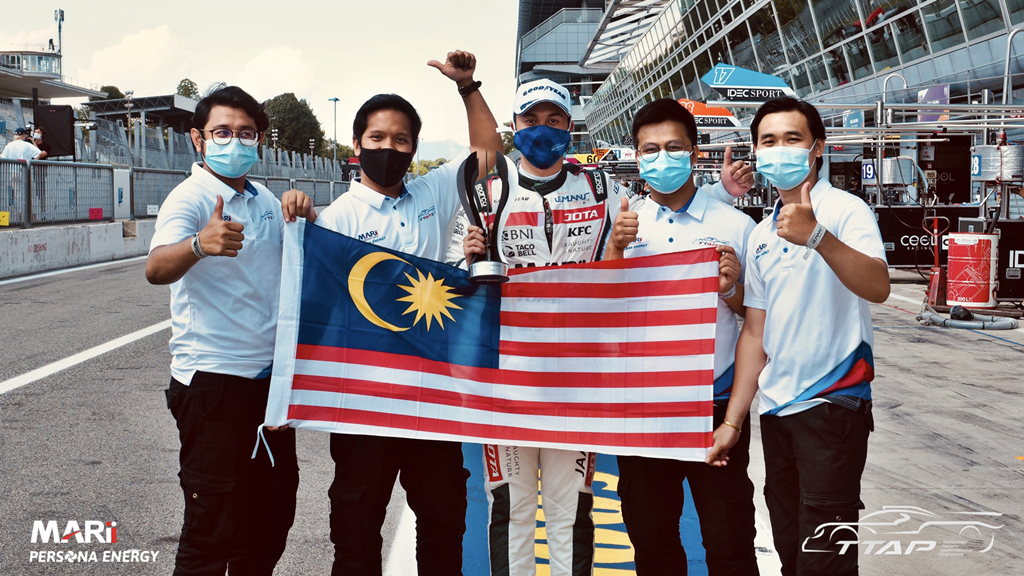
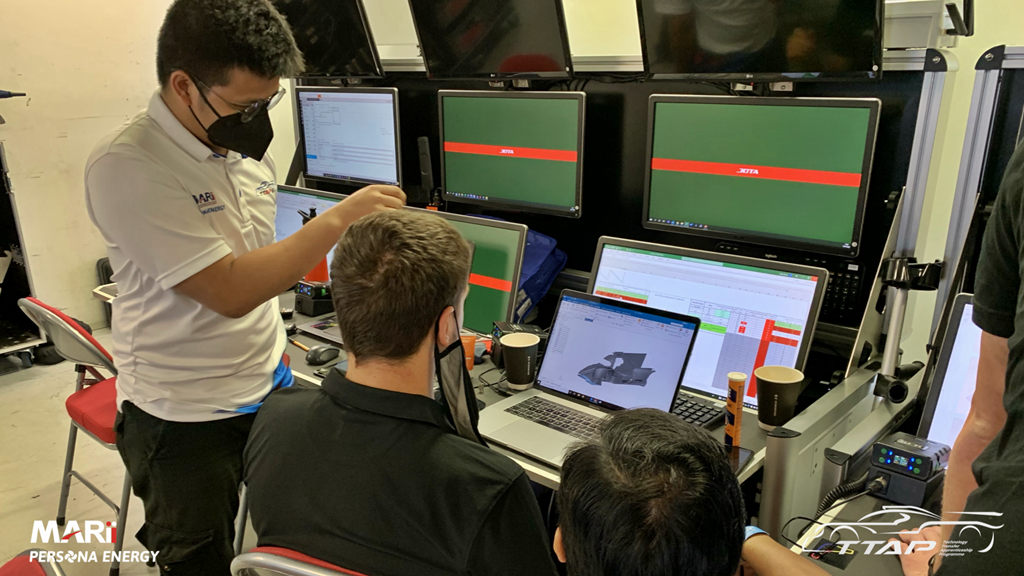
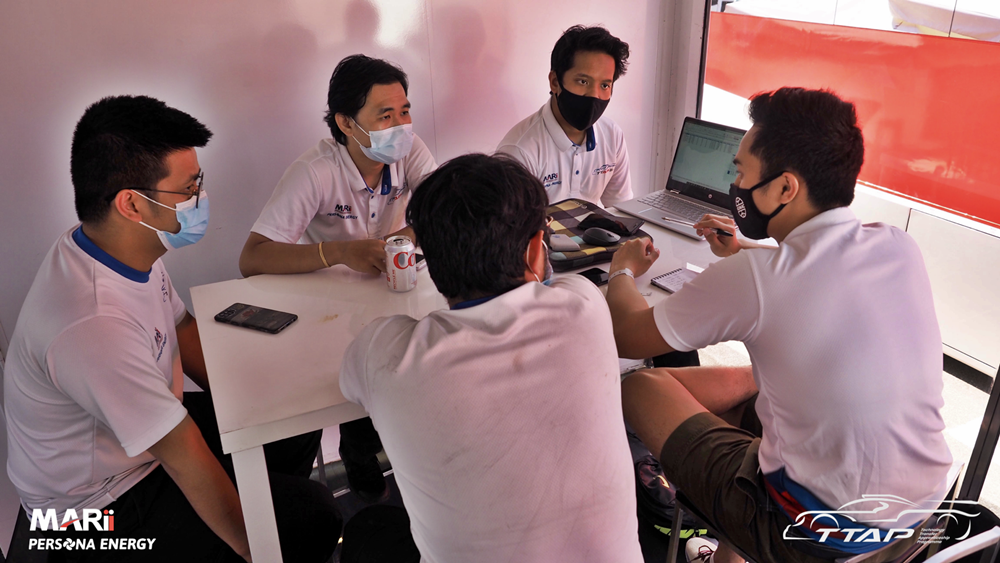
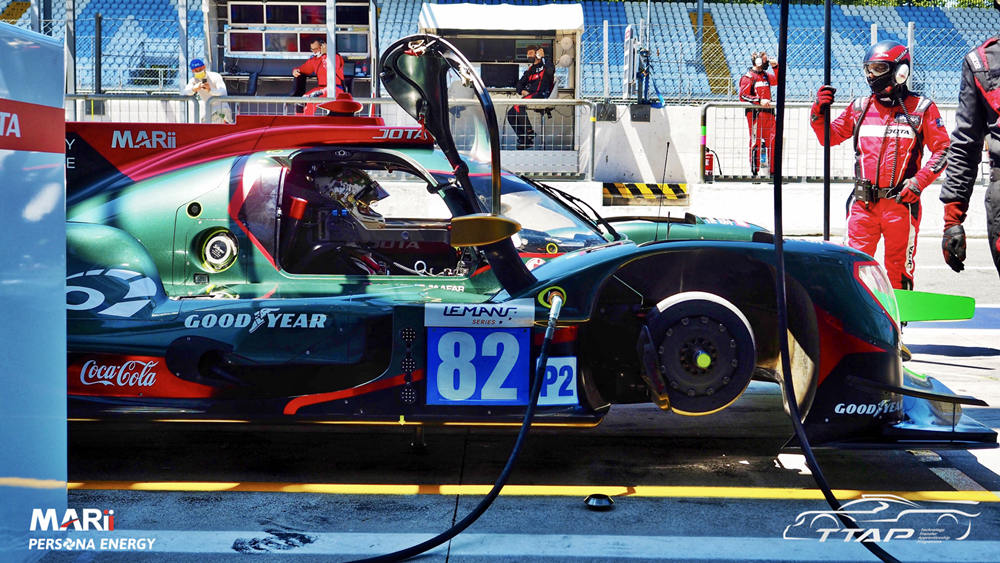
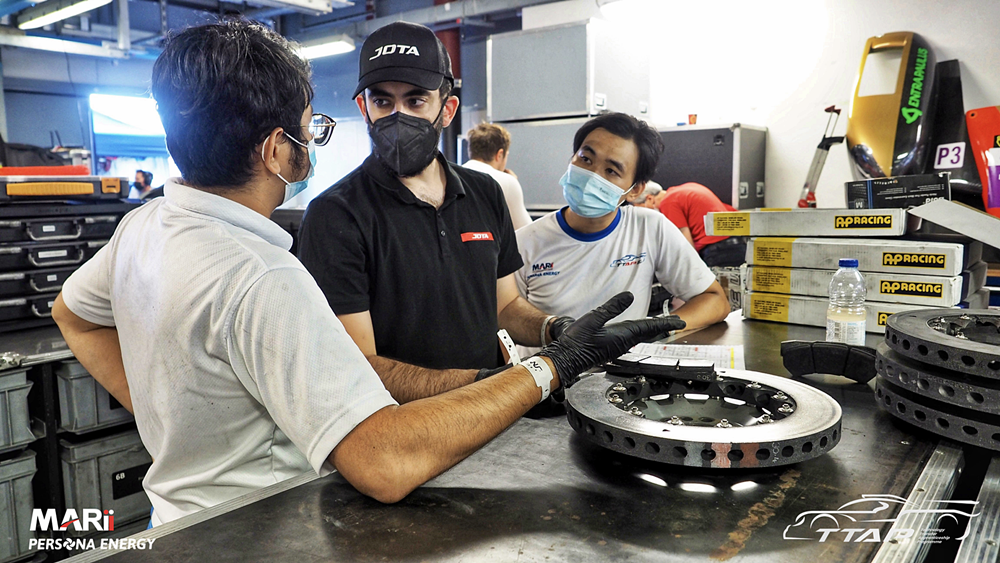
The Technology Transfer Apprenticeship Programme (TTAP) developed by Malaysia Automotive Robotics & IoT Institute (MARii) and Persona Energy Sdn Bhd reached its completion through the TTAP appreciation awards and handover ceremony, held at the Ministry of International Trade and Industry (MITI), recently.
The TTAP is a unique technology transfer programme to develop local automotive talent, expertise and technology value chain through apprenticeships of selected local engineers to procure important engineering insight within endurance racing technology at the FIA World Endurance Championship (WEC).
In June this year, 4 TTAP apprentice engineers were sent to be part of the JOTA team at the 2021 FIA World Endurance Championship, to enhance automotive skills and knowledge of local talents through apprenticeships with experienced race engineers, in international racing events with professional motorsport teams.
Throughout the programme, the apprentices are considered as team members, and were given real-time engineering responsibilities on certain segments of vehicle development for each race. These responsibilities include collection and analysis of the performance of race car components, design and layout of workshop equipment and tools during races, repair and maintenance of race cars, and other engineering activities that are required during the development and race day.
An important aspect of TTAP is the collection of vehicle data during the six legs of races throughout the WEC, which provides important information from high performance vehicles that can be utilised in the development of future vehicles and components. This data includes durability, performance, and many other forms of information that can be used in engineering analysis of future vehicle technology including autonomous and electric vehicles.
As technology in motorsports are far more advanced than that in the manufacturing line, such information procured through the TTAP program will bring a new dimension to the development of the automotive dan mobility sector, either at the vehicle assembly level, or component manufacturer.
At the WEC, the JOTA team clinched a 1-2 finish in the 8 Hours at Portimao leg in Portugal, and achieved a podium finish in every race in the WEC.
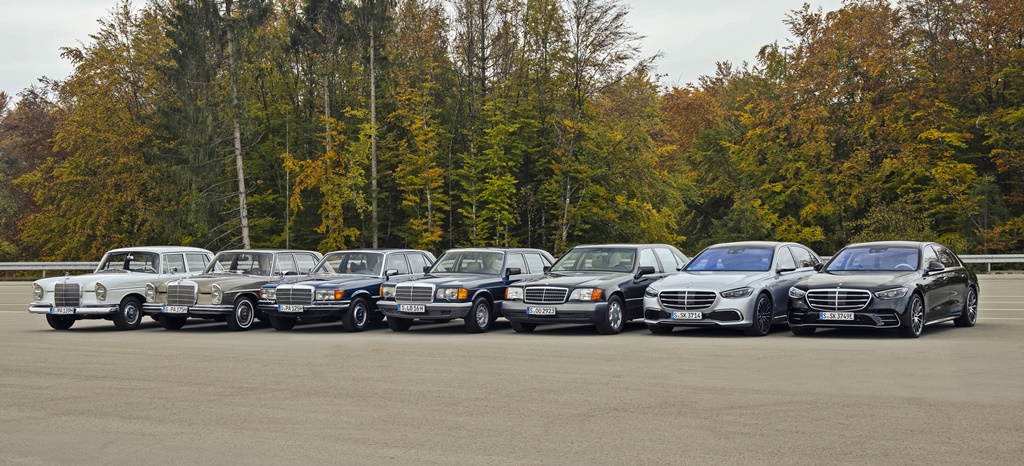
As the flagship of the Mercedes-Benz range, the S-Class has typically been the centerpiece of the brand. Each generation since the W 187 of 1951 has introduced new technologies, advancing safety, performance, comfort and quality. The pioneering technologies have influenced automotive engineering of its era, eventually trickling down as they became more affordable.
More than 4 million S-Class limousines have been delivered worldwide since the early 1970s when the ‘S-Class’ designation was used. Over 18,000 of those have been sold in Malaysia, where the model has been assembled locally for the past few generations. Assembled under contract in earlier years, the model has been assembled at Mercedes-Benz Malaysia’s own production facility in Pekan, Pahang, since 2007.
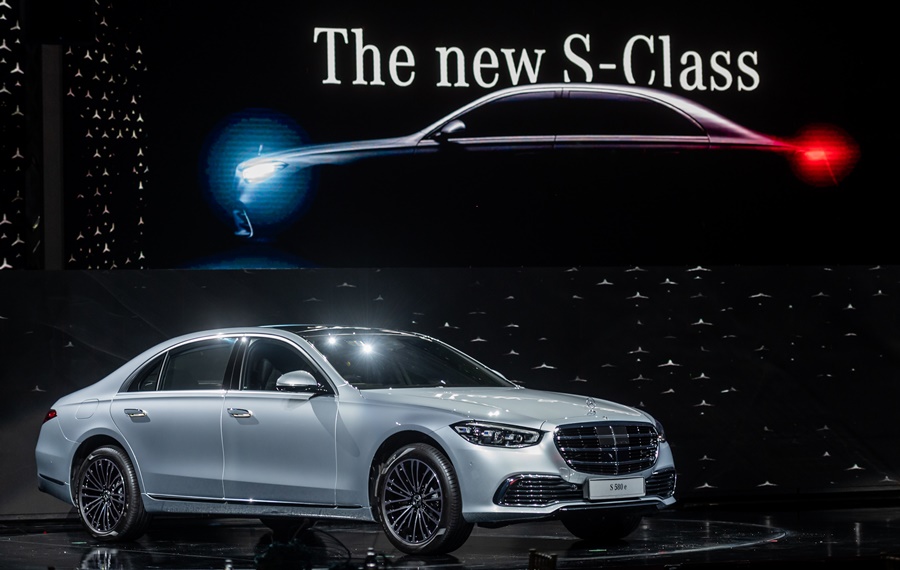
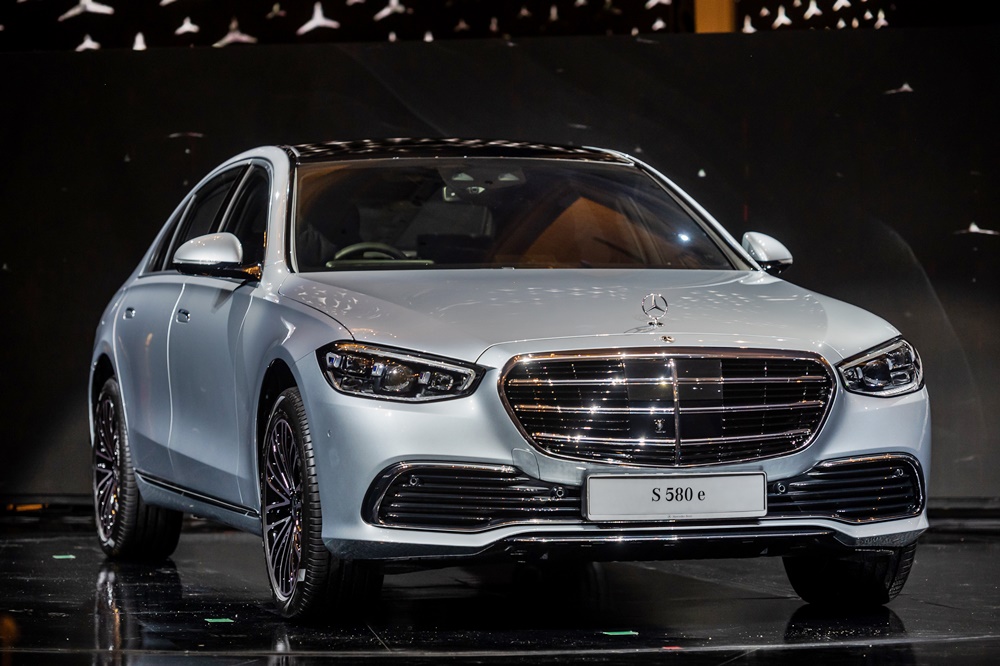
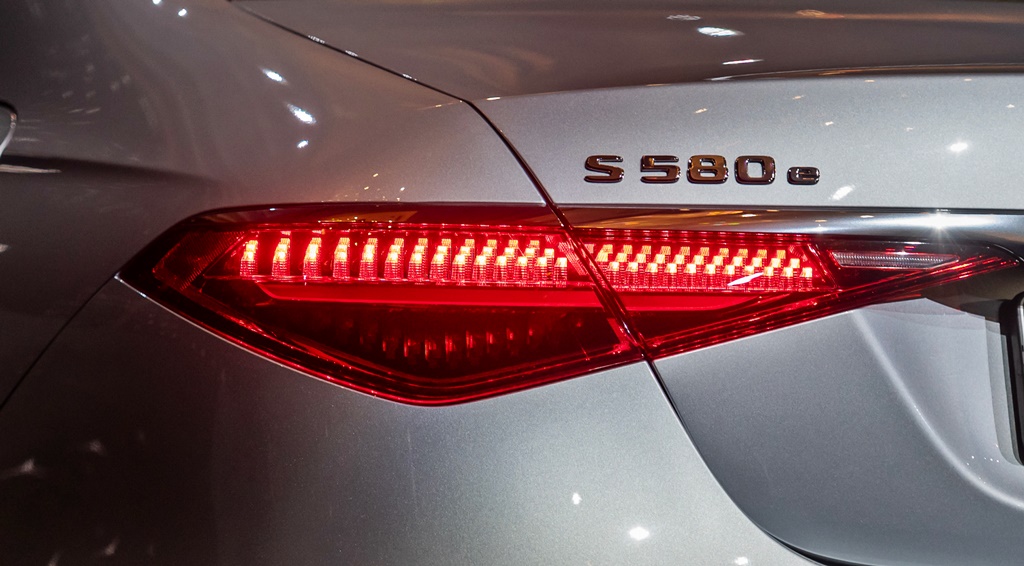
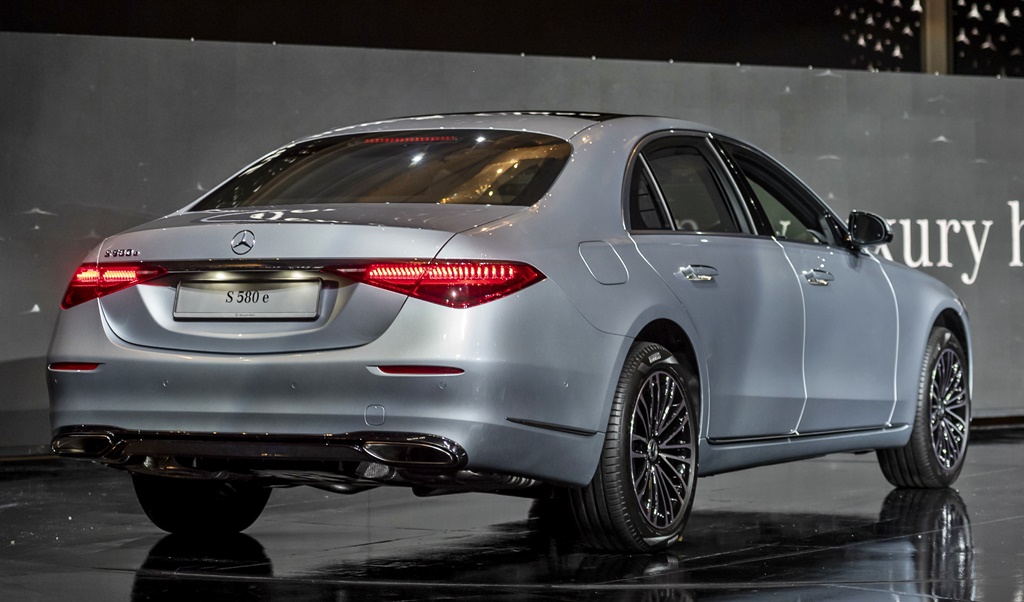
Today, the seventh generation of the model – also assembled at the Pekan plant – arrives in the market, a bit over a year after it made its global debut in Germany. Only one version is current offered – the S 580e – which is a long-bodied version. The price could not be confirmed in time for the launch although it will be more than the previous generation, according to Michael Jopp, Vice-President, Sales & Marketing Passenger Cars, at Mercedes-Benz Malaysia. He added that first deliveries will start from mid-January, but the waiting period is already stretched to the end of the first quarter of 2022.
‘580’ doesn’t mean 5.8 litres
The number of the model designations of many of today’s German cars no longer indicate displacement or cylinders as they once did. For instance, with the old 380SE, at least you knew the engine size was 3.8 litres. But with the new ‘580’, it is not 5.8 litres and the engine is actually an in-line 6-cylinder petrol engine of 3 litres and it is part of a plug-in hybrid powertrain (PHEV) with an electric motor.
The engine’s output is 367 bhp/270 kW with 500 Nm of torque available between 1,500 and 4,500 rpm, while the motor generates 110 kW with 440 Nm that comes on almost instantaneously. The combined output can propel the S 580e from 0 to 100 km/h in a claimed 5.2 seconds and up to a top speed of 250 km/h. If conditions permit, it is possible to run only on electricity for up to 100 kms. When the battery is empty, ‘refuelling’ will take up to 2.5 hours, depending on the charging method.
Hybrid powertrains are not new to Mercedes-Benz models in Malaysia and the company has sold them, even in the S-Class, some time. One concern owners have is the cost of the battery pack if it needs to be replaced as it is pretty expensive. But for the first 8 years or a maximum of 100,000 kms, Mercedes-Benz will provide warranty coverage which should offer some peace of mind.
Showcase for new technologies
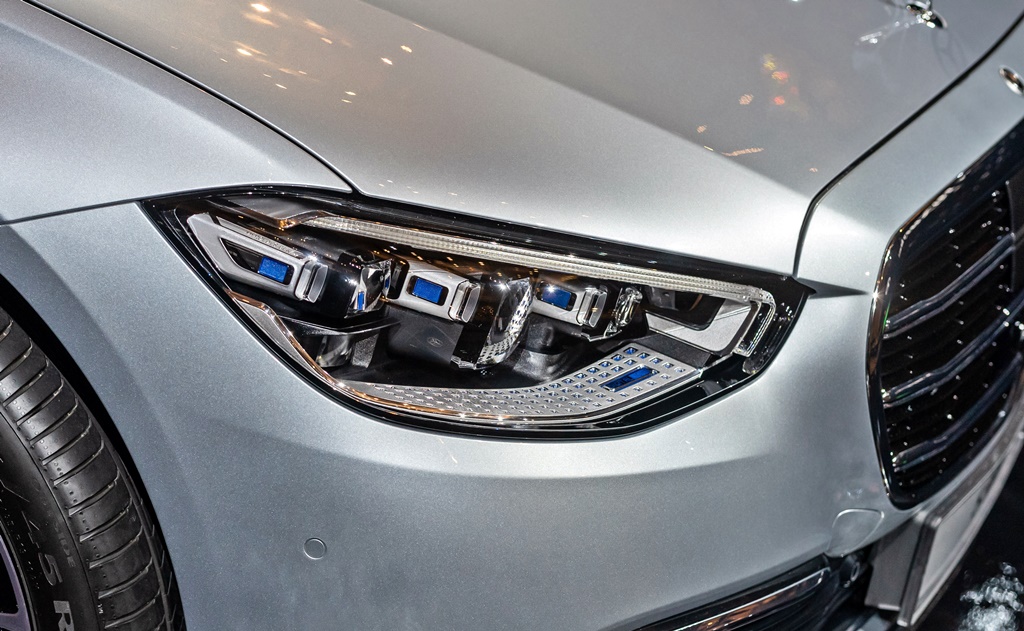
As with every generation before, the new S-Class brings with it new and advanced technologies. One of them is DIGITAL LIGHT, which emanates from each headlamp. The light module has 3 extremely powerful LEDs with light that is refracted and directed by 1.3 million micro-mirrors. The resolution is therefore more than 2.6 million pixels per vehicle, allowing highly precise light distribution.
DIGITAL LIGHT also makes Highbeam Assist over 100 times more precise than 84-pixel light when excluding oncoming traffic or road signs from the light beam. Light/shadow graduations and the light distribution of all the other adaptive light functions are also realised with considerably more precision, optimising illumination in all ambient lighting conditions.
The aerodynamic efficiency is also very impressive, considering the size of the car. It is 0.22 Cd, which is one of the lowest figures in the world for a production sedan. The lower wind resistance of the shape means more power can be used to move the car, something that is highly beneficial with hybrid and electric powertrains. This has been achieved by lengthy wind tunnel research and then applying aerodynamic measures to various areas of the body, underbody and detachable parts.
Not visible are improvements in aeroacoustics; the new model’s quietness is said to be even better than the e previous generation which already excelled with a very high level of interior noise comfort. The high rigidity of the bodyshell provides the basis for this achievement, and is enhanced with fine-tuning.
Some examples are the apertures for the cable grommets in the firewall which have double seals, effectively stopping noise from the engine bay seeping through. To achieve an engine sound that is perceived as refined and unobtrusive in the interior, the firewall insulation has been extended into the side areas of the A-pillars and the floor area. Acoustic foam in certain bodyshell sections is also used for the first time.
Even with local assembly, Mercedes-Benz Malaysia follows the brand’s global policies to promote sustainability. This is possible as environmental aspects were already taken into account in the conceptual phase. More than 98 kg of components, derived from resource-conserving materials, are used in the S-Class. The number of components containing recyclates is now 120 – more than twice as many as in the preceding model. Another 40 kgs or so are made from renewable raw materials.
‘Third place’ lounge-like interior
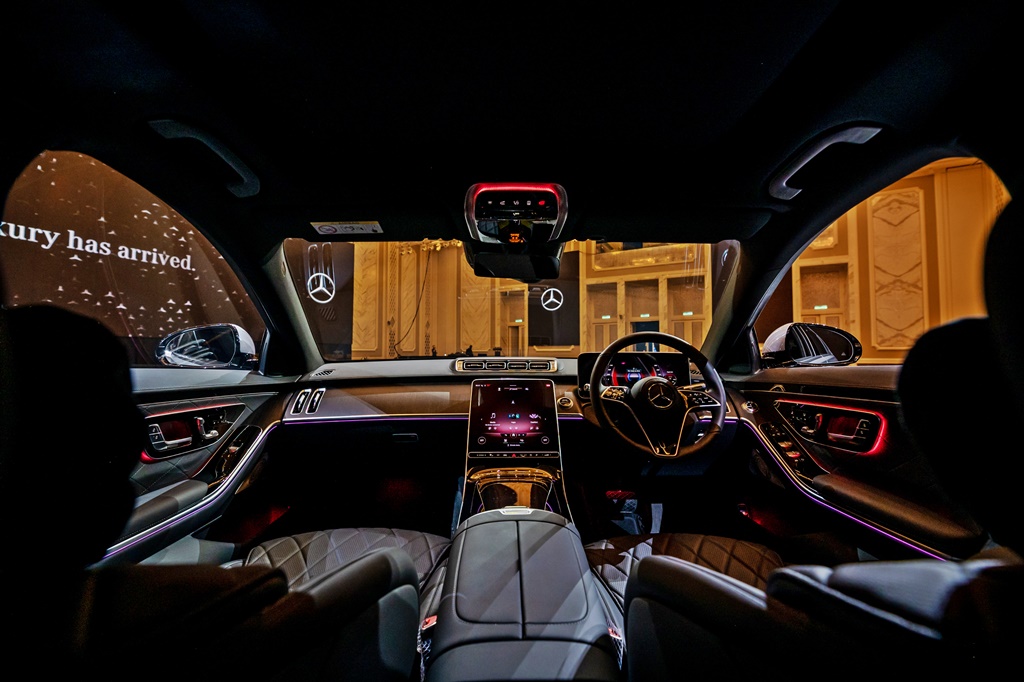
The S-Class, with its limousine proportions, has always offered its occupants comfortable travel in a relaxing environment. With the new generation, the interior has fully evolved into a ‘third place’, a refuge between the home and workplace which many spend a lot of time in (at least in the pre-pandemic days when travel to and from office was the daily norm).
As with all Mercedes-Benz models in recent times, MBUX (Mercedes-Benz User Experience) is a highlight. Interestingly, it was one of the few significant new technologies that did not start in the S-Class but in the new A-Class launched in 2018. Since then, it has continued to evolve and gain more sophistication.
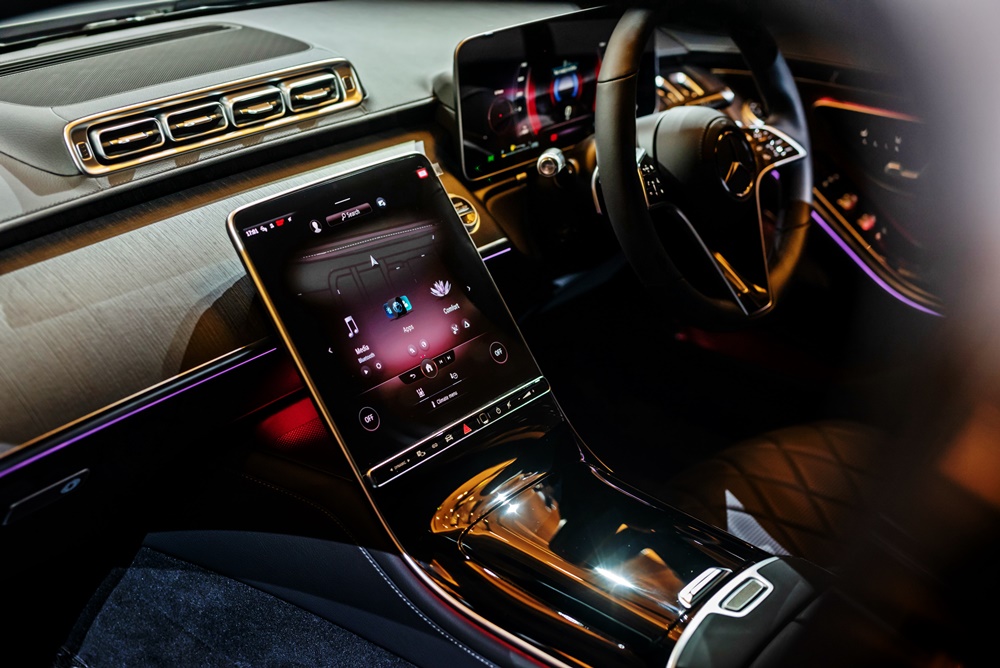
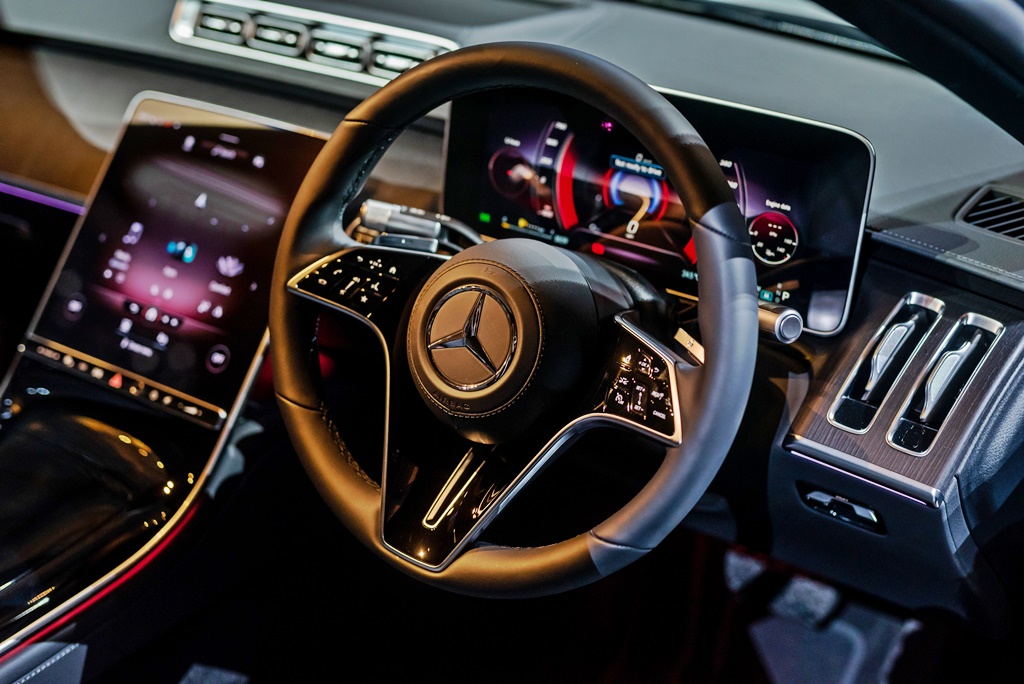
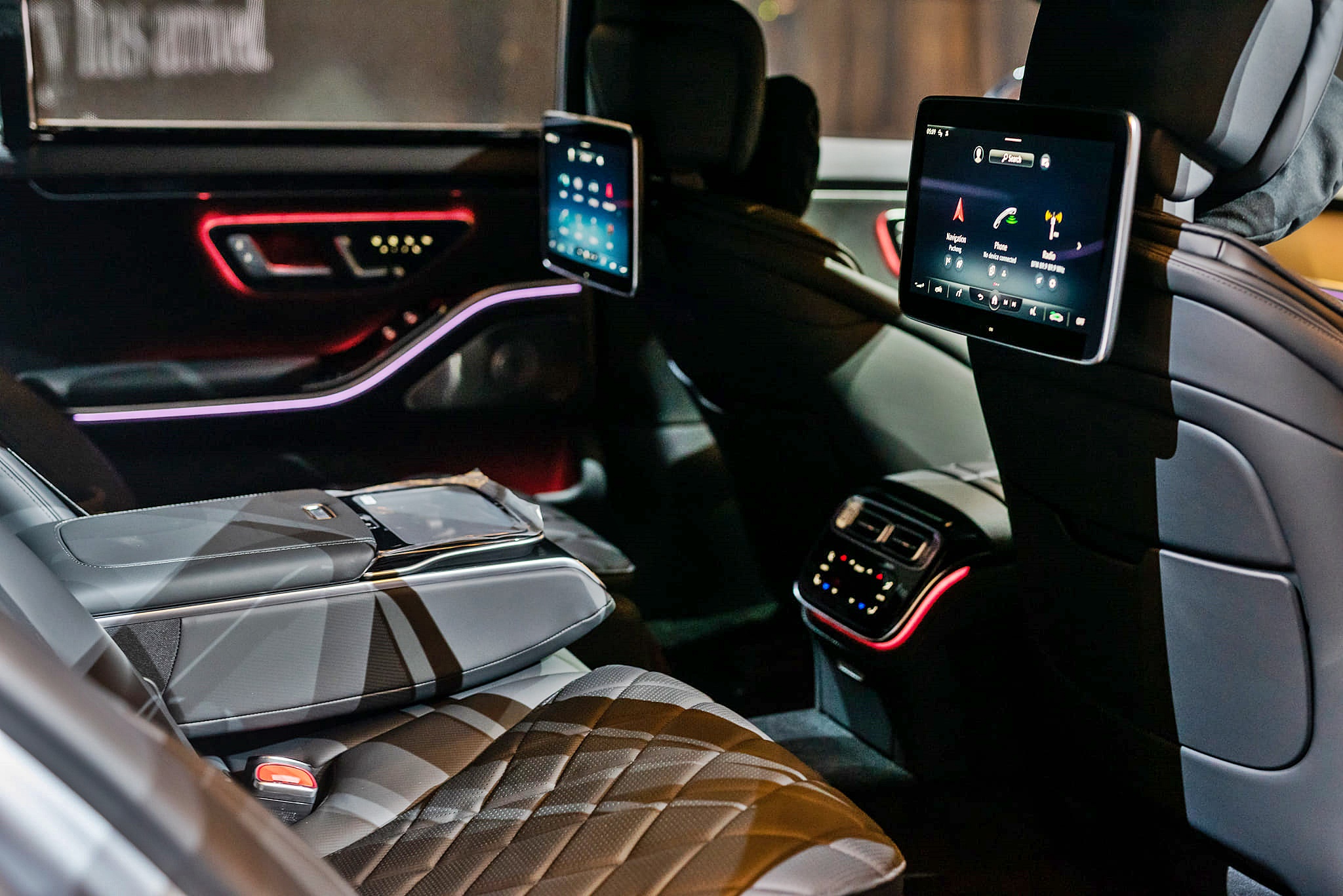
The second generation of this learn-capable system now debuts in the new S-Class. The possibilities for personalization and intuitive operation have become far more extensive, especially in the rear. Both the hardware and software have made great advancements with brilliant displays on up to 5 large screens (in part with OLED technology). The new 3D driver display allows a spatial view at the touch of a button for the first time – a real 3-dimensional effect without having to wear 3D glasses.
Using cameras in the overhead control panel and learning algorithms, MBUX Interior Assist recognizes and anticipates the wishes and intentions of the occupants. It does this by interpreting head direction, hand movements and body language, and responds with corresponding vehicle functions. As well as enhancing operating convenience, MBUX Interior Assist improves safety. Even before the journey begins, it notifies the driver if the camera has detected a child seat on the front passenger seat but the seatbelt is not fastened, for example.
The system now has a fingerprint scanner just below the central display which unlocks access more conveniently, yet securely, than entering a PIN. Also available is the MBUX Augmented Reality Navigation which connects the virtual world with the real world. The technology incorporates graphical navigation instructions and traffic information into live images to ensure drivers will reach safely and stress-free,
The voice assistant ‘Hey Mercedes’ is constantly learning, by activation of online services in the Mercedes me App. Moreover, certain actions (like accepting a call) can be performed even without using ‘Hey Mercedes’ which, incidentally, can also be activated from the rear.
Revolution in interior design
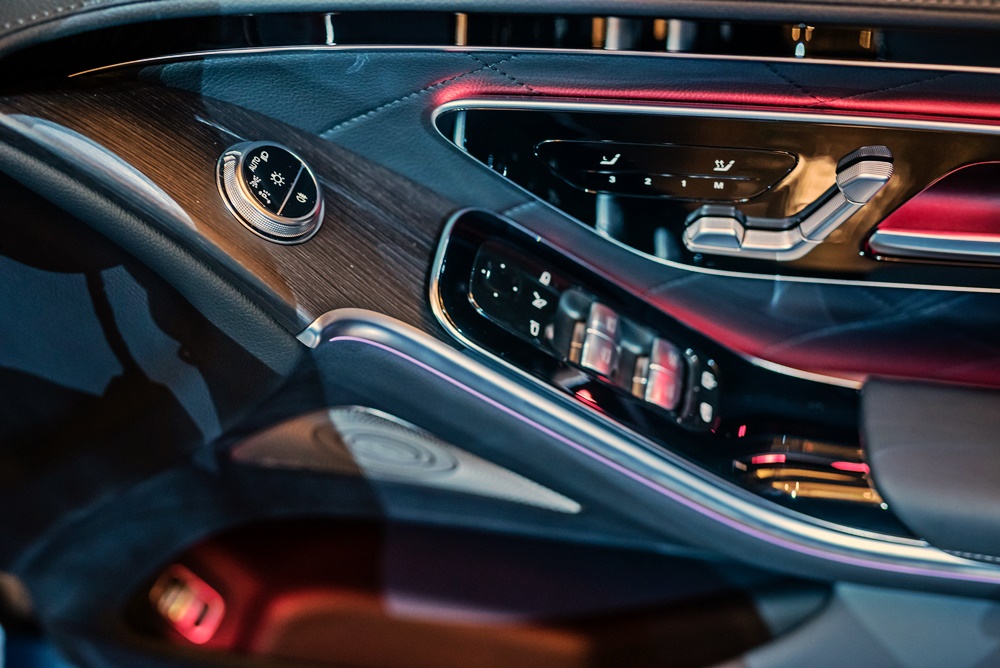
Just as with introducing new technologies to the car, the interior designers have also strived to create a revolutionary interior design, including associations with interior architecture and yacht design elements. The sculptured look of the dashboard, centre console and armrests appears to float above an expansive interior landscape. The systematic reduction in the number of controls underscores the minimalist appearance of the interior. A fine divide between the upper section of the dashboard and the large trim element structures the area and creates horizontal breadth.
The driver display and media display offer a comprehensive aesthetic experience. The appearance of the screens can be individualized with a choice of four display styles (Discreet, Sporty, Exclusive, Classic) and three modes (Navigation, Assistance, Service). New design elements include the flat, 4-square centre vents with horizontal nacelles, rather than the sportier turbine-like vents in other models.
Besides 5 screens, other highlights in the cabin include large areas of trim in the dashboard and in the rear. These flow around the passengers and are a systematic further development of the wrap-around effect. The Anthracite open-pore poplar wood trip lends the interior an individual look.
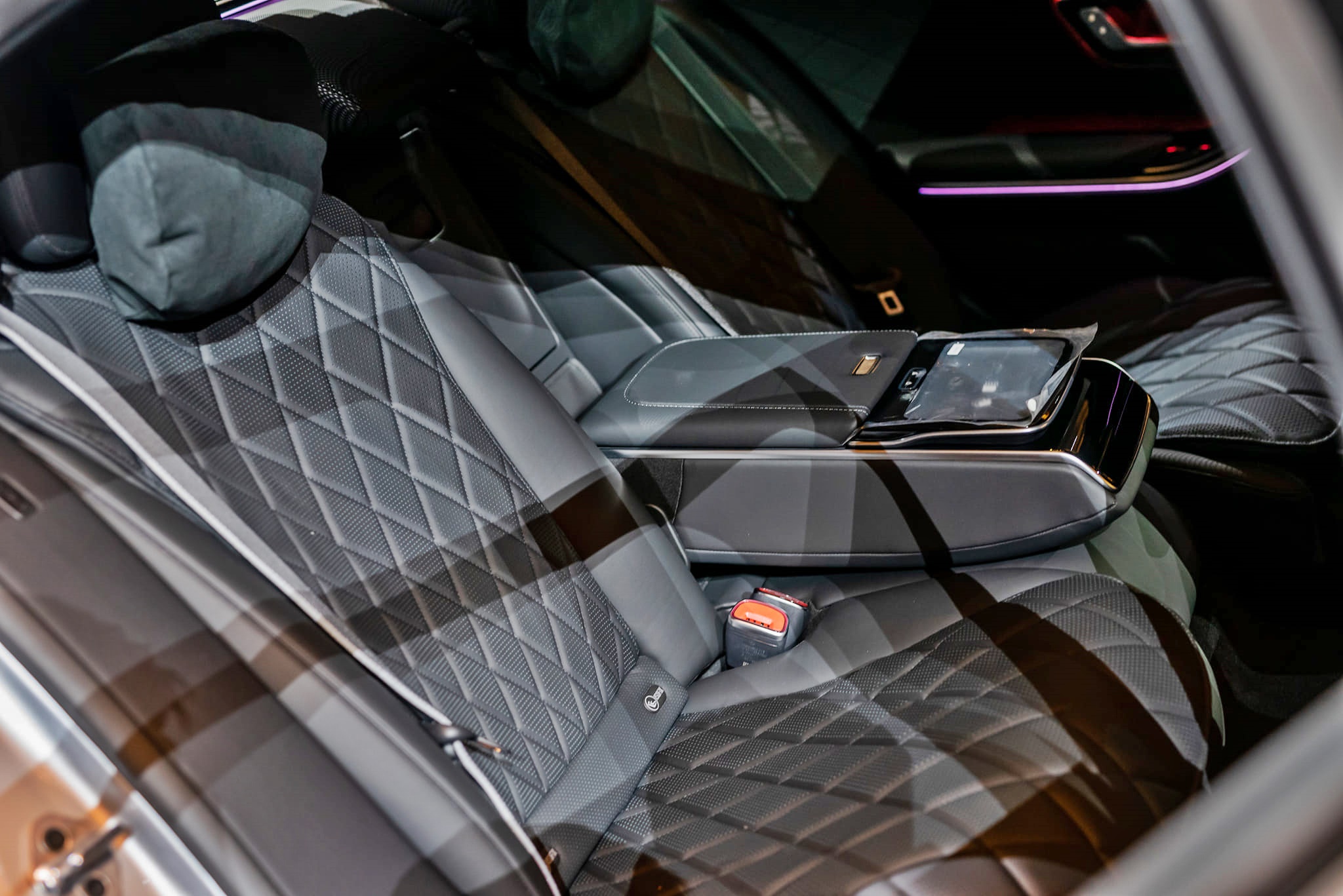
Even in the seats, Mercedes-Benz has made such they qualify as technological benchmarks for long-distance comfort. The complex technology inside the seats uses multiple motors for adjustments in the tiniest dimension. The flowing, 3-dimensional layer design theme gives an impression of lightness with its nappa leather upholstery. The adjustment range and angle of the front passenger seat in the chauffeur configuration and the reclining seat behind it have been improved as well.
Thanks to LED technology, the new S-Class has also taken a leap forward in its interior lighting with interactive interior lighting for the first time. The active ambient lighting supplements ambient lighting with an additional layer of light. It is integrated into the driving assistance systems, and is able to reinforce alerts visually. This also makes corresponding feedback possible for the comfort systems. This applies to the climate control system or the ‘Hey Mercedes’ voice assistant.
Offered as standard with the new S-class is a Burmester 3D surround sound system. The German specialist in audio systems has been providing custom-developed sound systems for Mercedes-Benz model since 2013. The sound emanating from the high-quality speakers can be specifically optimized for the front and rear seats to give a very personalized listening experience.
Continued leadership in safety
In the area of safety, Mercedes-Benz has certainly held a leadership position, often developing and introducing more advanced safety features and systems. The S-Class, being the flagship, has had the honour of being the first model with new safety technologies. One example is the airbag, which made its first appearance in a production car in 1980 when the S-Class (W126) was launched. It was initially only for the driver and then the passenger also got one, and today, there are airbags on the sides of the cabin as well and one to protect the driver’s knees.
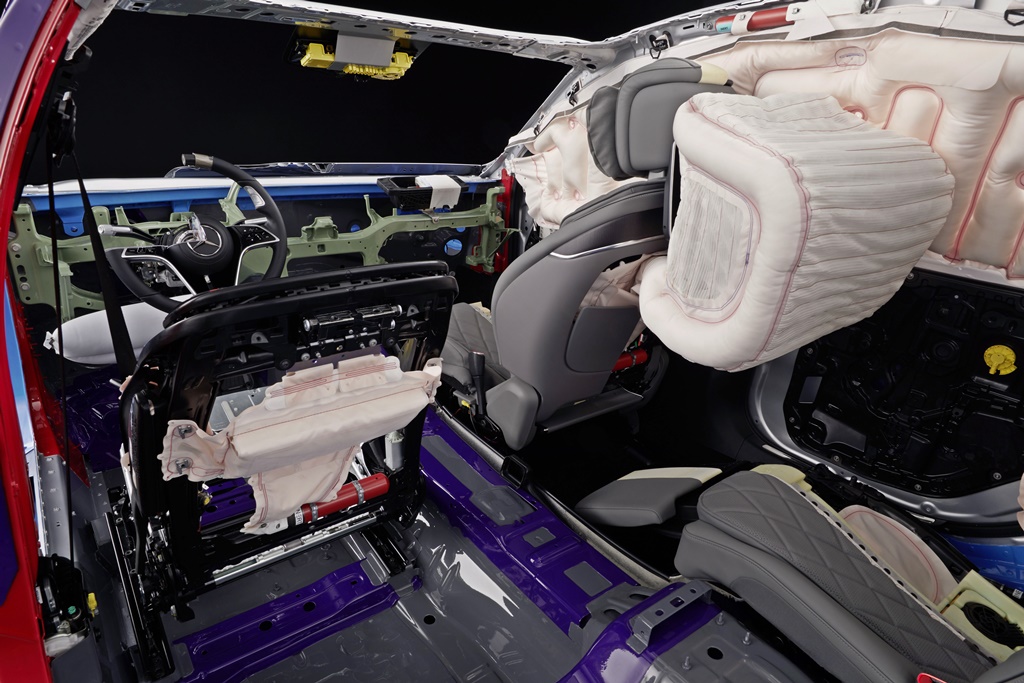
The new S-Class again takes a pioneering role by having the world’s first rear airbags. These are integrated into the backrests of the front seats and deploy in a severe front impact. They deploy gently and protect strapped-in outer rear seat passengers against contact with the front seats. The loads on the head and neck can thus be reduced significantly.
With the new S-Class, Mercedes-Benz comes another big step closer to its vision of accident-free driving. The driver is supported by numerous new or extended driving assistance systems that reduce the driving workload in daily motoring and fatigue on long journeys. This leads to better alertness behind the wheel and therefore safer motoring.
However, there may be situations where the driver might not react in time, and this is where the assistance systems come in. They can detect other vehicles and (at very high speeds) determine the possibility of an accident, and activate the brakes if no action is taken by the driver. The emergency braking functions serve to protect other road-users, too. The operating principle of the systems is made visible by a new display concept in the driver display. Thanks to improved environmental sensors, the parking systems also give the driver even better support when maneuvering at low speed.
The PRE-SAFE system, which has been present for some time in Mercedes-Benz models, has comprehensive protective measures to reduce injuries during accidents. Upon detection of a likely impact, it can prepare the occupants for a side-on collision and reduce the risk of injury. Like a bodyguard, it pushes the driver or front passenger away from the danger zone towards the inside. The impulse is created by the movement of the seat side bolsters in the front backrests.
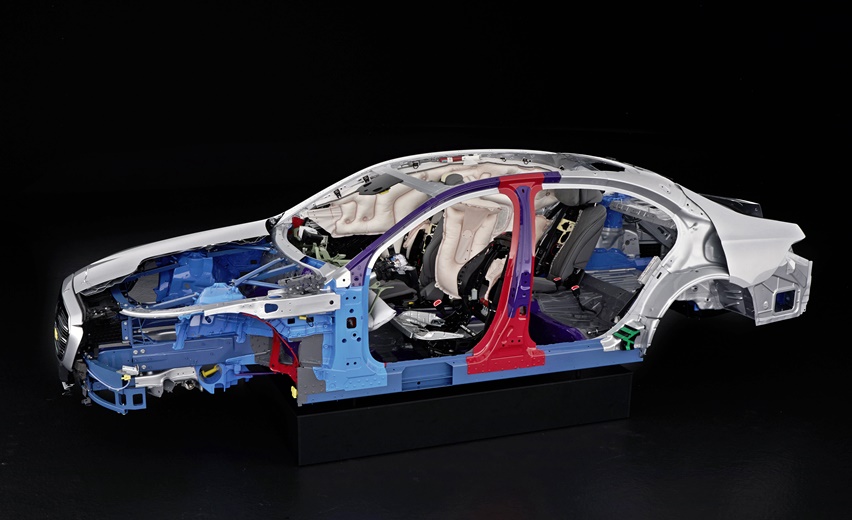
Besides innovations in restraint systems, the intelligent bodyshell design uses a new aluminium hybrid body shell. The content of the lightweight material exceeding 50% meets numerous requirements while lowering weight and contributing to better handling and ride comfort.
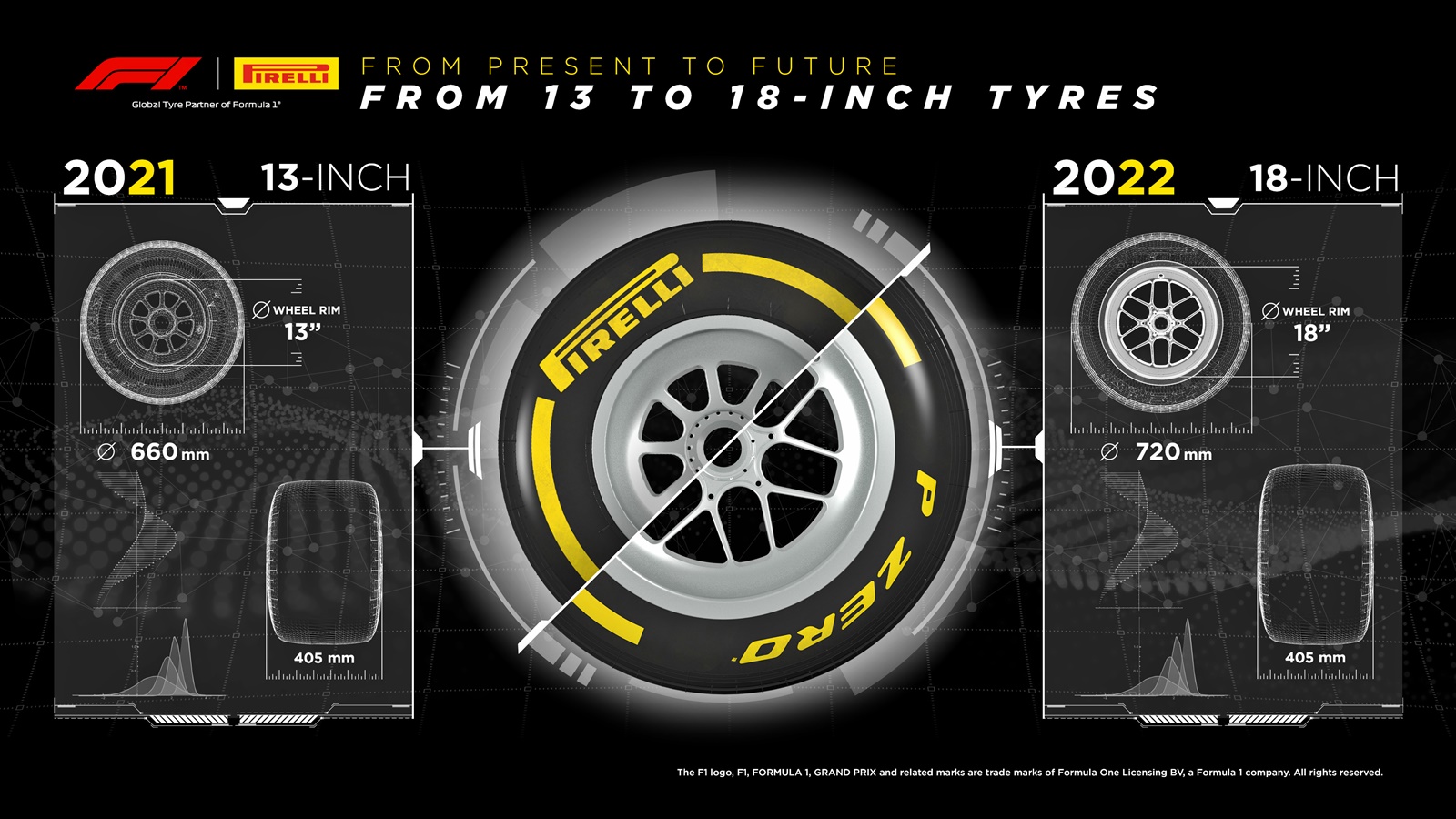
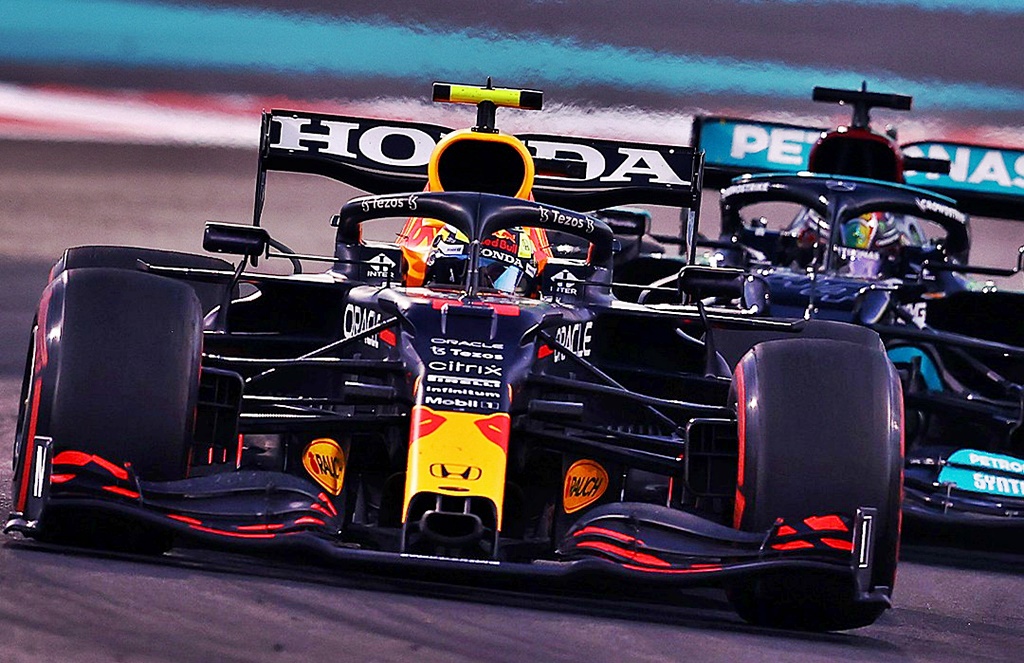
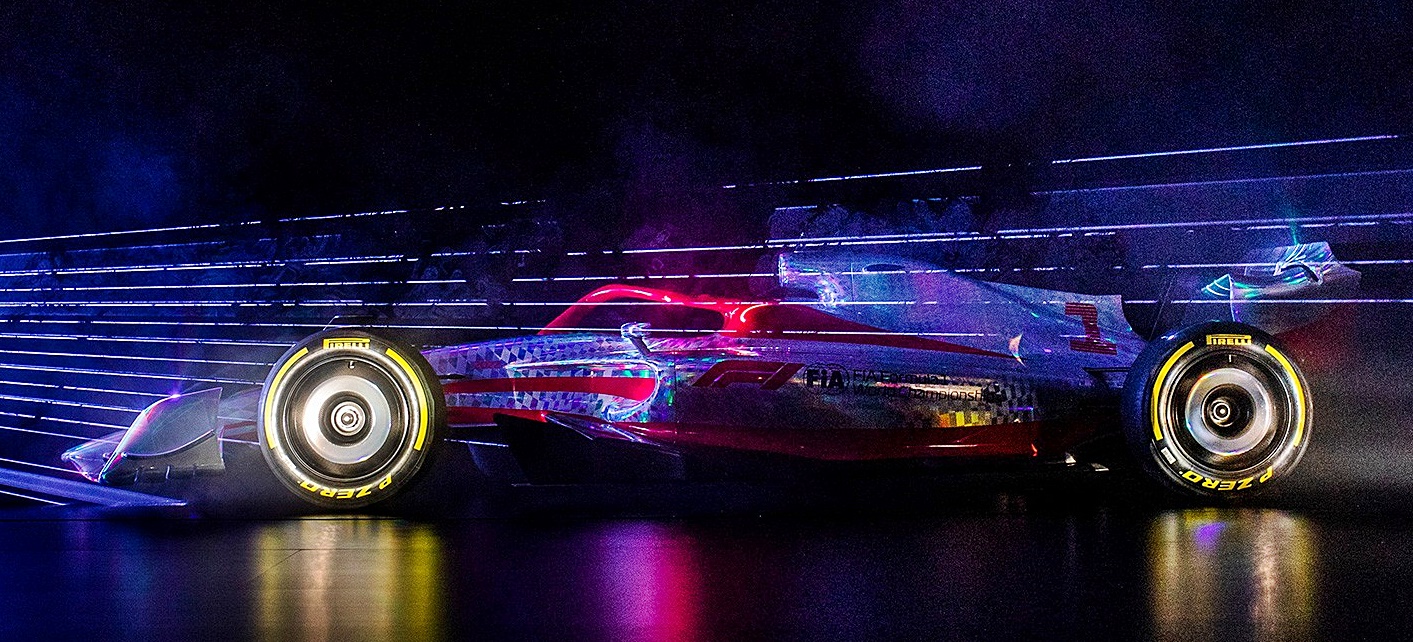
The 2022 Formula 1 World Championship will see the biggest changes in technical rules in some 4 decades. Among those changes – which are expected to contribute to close racing with more overtaking – are the switch 18-inch wheel rims from the current 13 inches. This means installing new low-profile tyres from Pirelli, which continues to be the tyre-supplier for F1.
13 inches since 1960s
Tyres in 13-inch size have raced for nearly the entire history of the championship to date, from the 1960s. Nonetheless, at the time – and into the subsequent decade – there was still a lot of regulatory freedom around wheel size. In the 1980s, 13 inches finally became the definitive size.
Pirelli first ran a 13-inch tyre in Formula 1 at the 1981 San Marino Grand Prix with the Toleman. Then, in the same season (Michelin and Goodyear supplied tyres then) and subsequent ones, other teams adopted the Italian tyres for their cars. Since 2011, Pirelli has been the sole tyre-supplier for the sport.
The first win for Pirelli’s 13-inch tyres came at the 1985 French Grand Prix, fitted on Nelson Piquet’s Brabham-BMW. Pirelli brought in a new generation of 13-inch tyres from 1989 (two years after the P Zero name was born) which were used until 1991. As Global Tyre Partner from 2011, Sebastian Vettel was the first to claim a championship for a Pirelli 13-inch tyre with Red Bull.
Wider tyres, faster lap times
In 2017, Pirelli innovated by introducing tyres that were 25% wider than they had been previously, providing a bigger footprint and more grip, which in turn resulted in lap records being lowered all over the world.
Since becoming sole supplier, more than 400,000 13-inch tyres have been produced from the Pirelli factories at Izmit in Turkey and Slatina in Romania.
Testing since 2014
The 18-inch tyres have been tested on F1 cars since 2014 when Pirelli first ran such tyres at a test at Silverstone with Lotus reserve driver Charles Pic. Initially, it was the intention to adopt 18-inch tyres from 2021 as part of a package of new technical regulations, but this was deferred to 2022 due to the disruption of the COVID-19 pandemic.
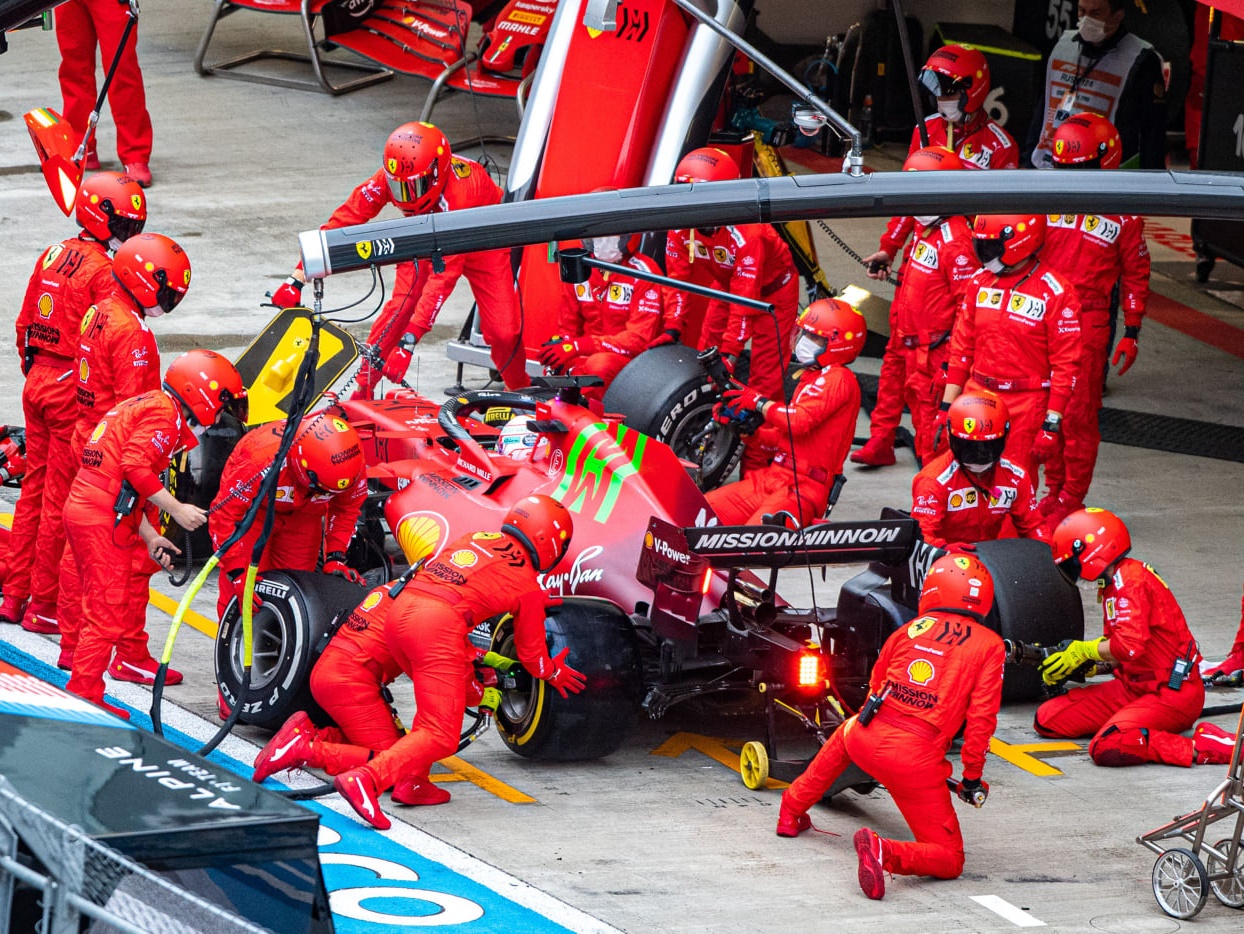
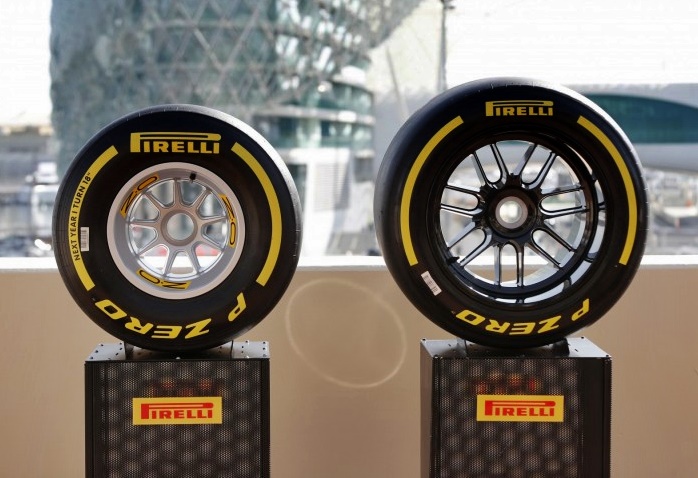
In the meantime, Pirelli successfully ran 18-inch tyres in Formula 2 since the 2020 season and completed 36 days of 18-inch testing with Formula 1 cars that were modified to accommodate the new size. It’s actually the size of the rim that changes, adding 5 inches (127 mm) to the diameter that has been a constant in GP racing since the 1960s. This has been characterized by compact, very wide tyres featuring a ‘pot-bellied’ sidewall seen on four corners of the racing cars.
With a bigger emphasis on technological proximity to the road car as well as aesthetics, the brand new P Zero F1 tyre has the same tread width as before (305 mm at the front and 405 mm at the rear) but a slightly bigger overall diameter, which grows from 660 mm to 720 mm. The most significant change is a reduction in the sidewall, which now resembles that of the low-profile Pirelli tyres that, for years, have been seen on many performance road cars.
Less turbulence, closer racing
This new profile will change the behaviour of the racing cars, making them more precise when changing direction. From the tests carried out so far – in both dry and wet conditions – the drivers’ feedback has been positive, and the new tyres will contribute to even more competitive races, with cars that are less sensitive to aerodynamic turbulence while following behind one another (so racing can be closer). The lower sidewall also means that the tyre will flex less, meaning that it will have less impact on the overall aerodynamics of the car.
The compounds for the 18-inch tyres will also be completely new, to ensure maximum consistency and less overheating. Five compound grades will be available for the 2022 championship, three of which will be chosen for each race weekend (as has been the case this year).
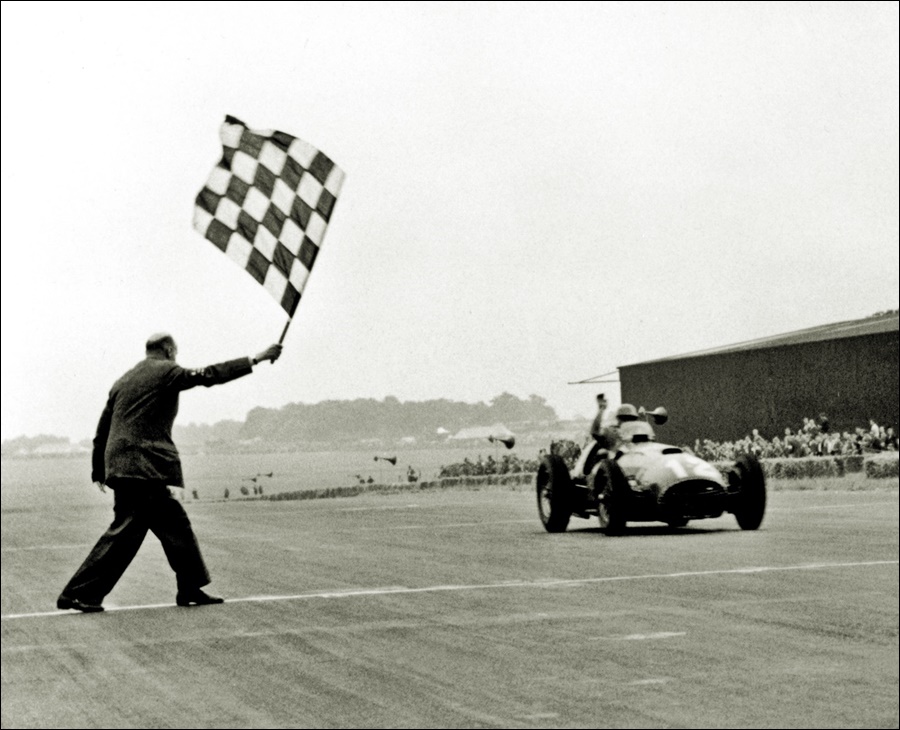
Pirelli tyres were on the racing cars during the first years of Formula 1 in the 1950s,
By going from 13-inch to 18-inch, Pirelli is the only tyre manufacturer that has competed in Formula 1 with all the wheel sizes that have been part of the World Championship’s history. It’s a story that began in 1950, with its first wins and titles with Alfa Romeo, Ferrari and Maserati. Those were front-engined racing cars that ran on tall and narrow tyres.
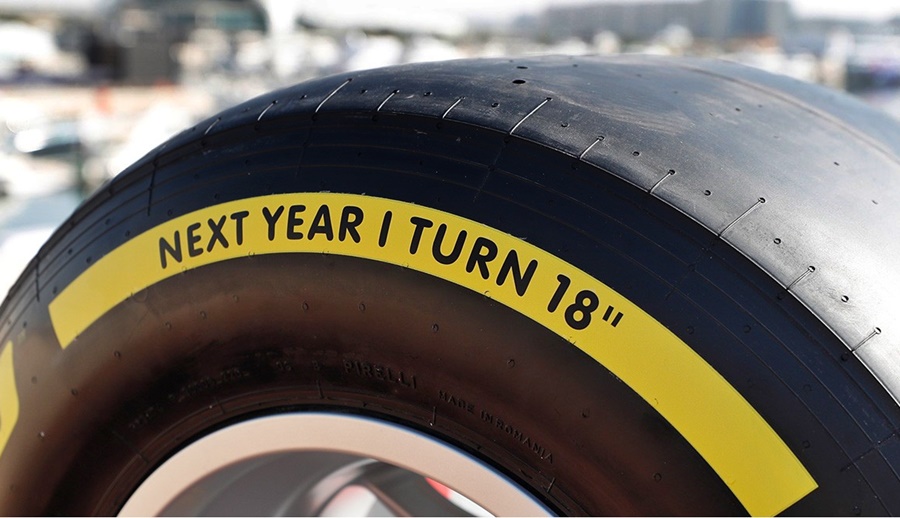
The Abu Dhabi Grand Prix at Yas Marina over the weekend was the last race in F1 history where the cars ran on 13-inch tyres. To celebrate the ‘changing of the guard’, all the 13-inch slick tyres used in the race had a special logo on the sidewall: ‘Next year I turn 18’.
While Toyota has expressed a view that suggests it will not stop producing internal combustion engines so quickly – to provide customers with greater choice and not leave any customer behind – it is no less committed to electrification of its products in the quest to achieve carbon neutrality. As a pioneer in hybrid electric vehicle (HEV) technology, having introduced the first mass-produced car with a hybrid powertrain in the late 1990s, the carmaker has naturally been promoting the technology which also contributes to reducing toxic exhaust emissions and fuel consumption.
Long history of EV developments
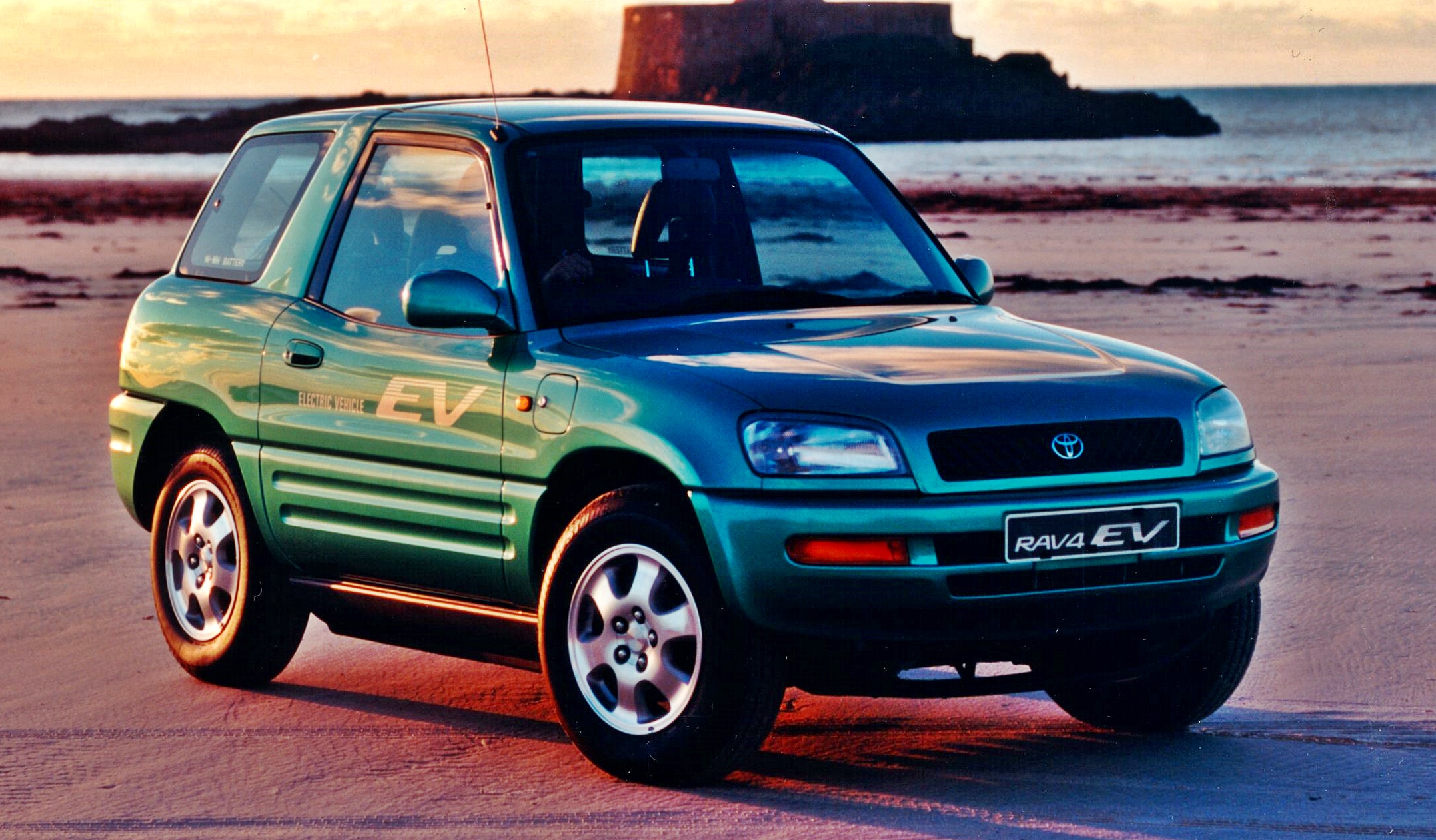
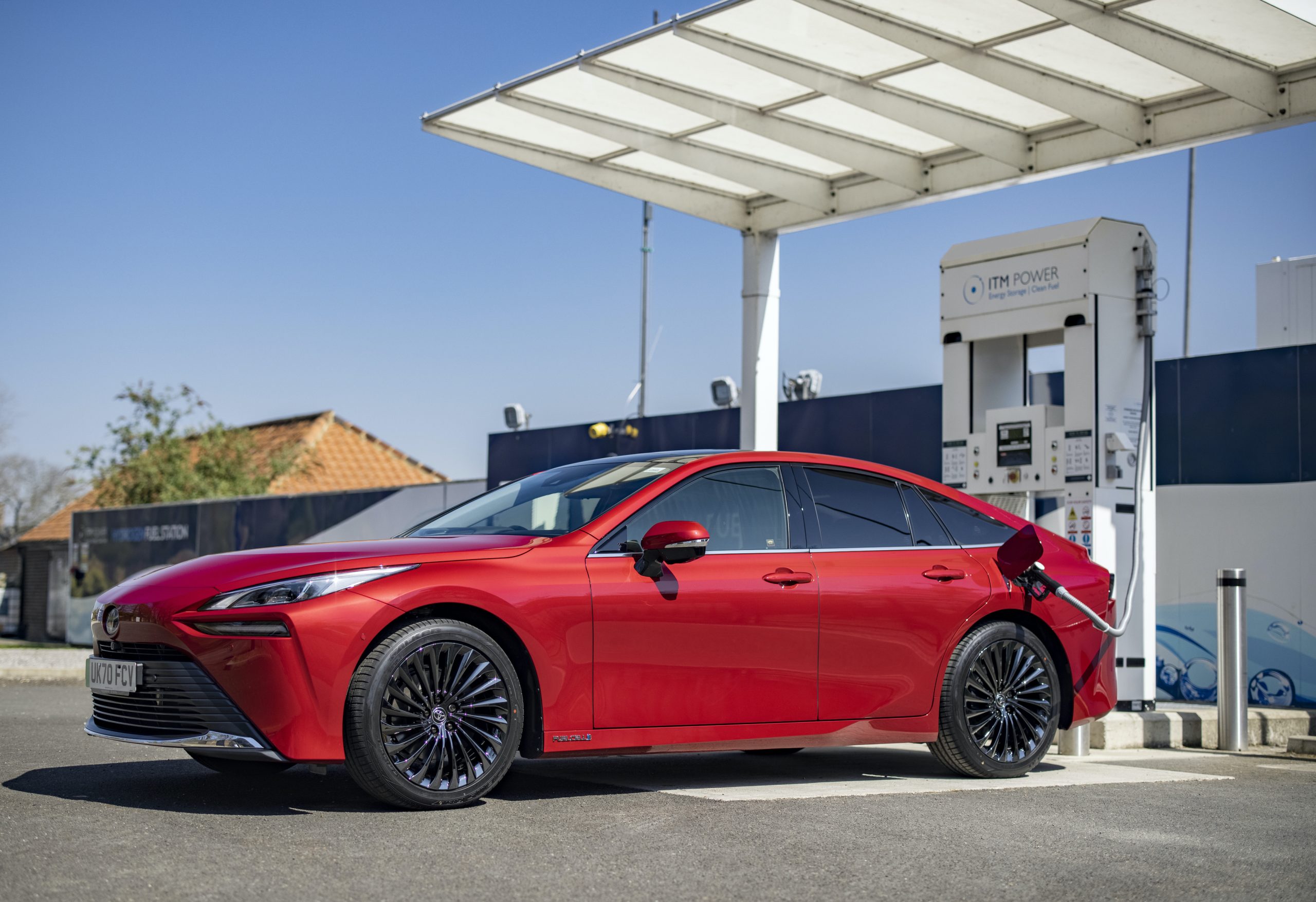
However, in the longer term, fully electric vehicles are going to become mainstream products, beginning with battery electric vehicles (BEVs) and progressing to fuel cell electric vehicles (FCEVs). In fact, the company has an EV development division since 1992 and an early production EV that went on sale in 1996 was the RAV4 EV, Today, besides a wide range of HEVs, Toyota already offers BEVs and even FCEVs, the latter now in the second generation with the Mirai.
Toyota sold (in limited numbers) a fully electric model – the RAV4 EV – in 1996 and today, it has even begun selling electric vehicles powered by hydrogen fuel cells like the Mirai (below).
The crucial technology
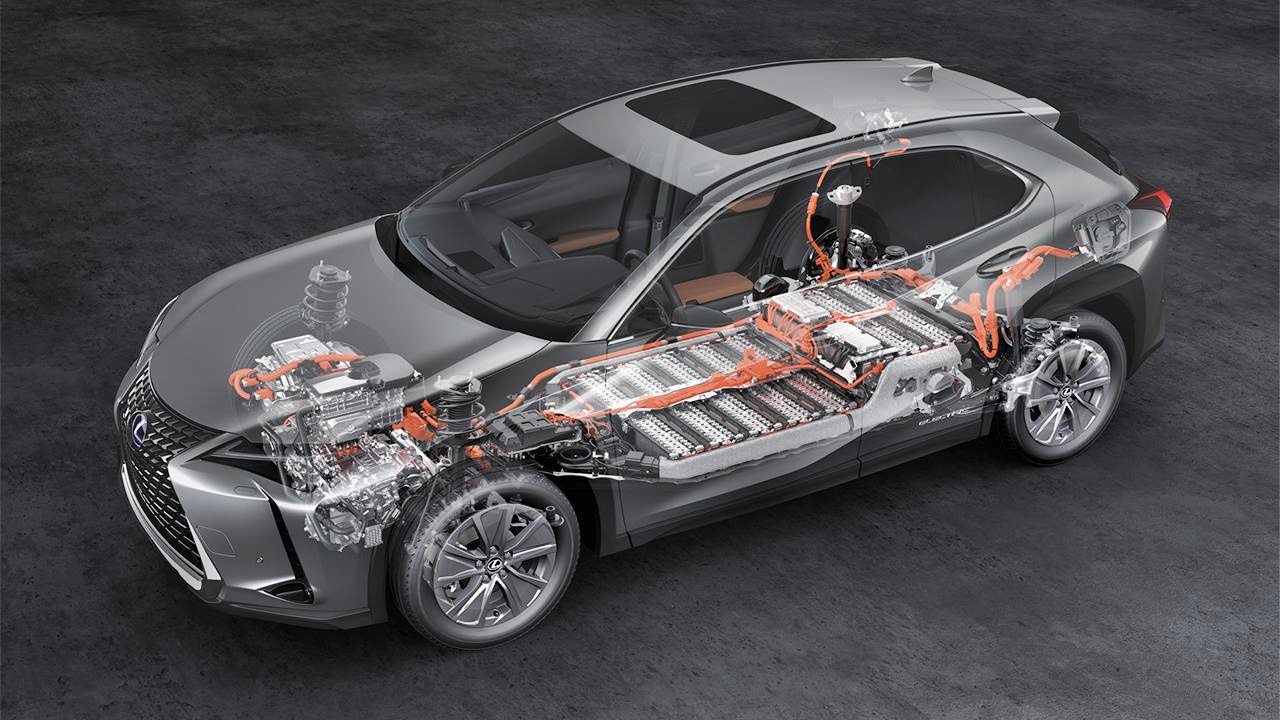
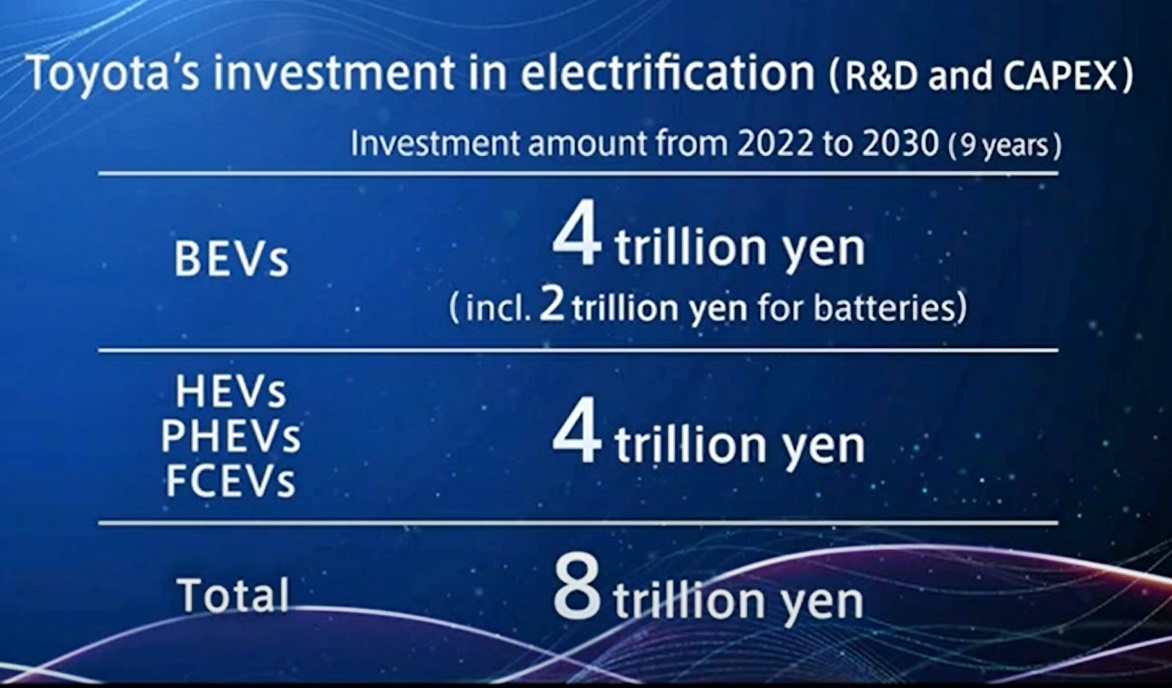
Battery technology is obviously crucial for every carmaker and Toyota will invest greatly in R&D for this area as well as in the supply system. The carmaker has had a subsidiary fully involved in battery development and manufacturing and has aimed to bring about cost reduction of at least 50% per vehicle during this decade. At the same time, safety, longer service life and high quality will be advanced.
Battery technology is a crucial area for electric vehicles and Toyota will be spending heavily to develop more advanced technologies as well as push battery cost down.
“Over the past 26 years, we have invested nearly 1 trillion yen and produced more than 19 million batteries. We believe that our accumulated experience is an asset that gives us a competitive edge. Going forward, we will increase our new investment in batteries from the 1.5 trillion yen announced in September to 2 trillion yen, aiming to realize even more-advanced, high-quality, and affordable batteries,” said Akio Toyoda, President of Toyota Motor Corporation, at a press conference in Tokyo this afternoon.
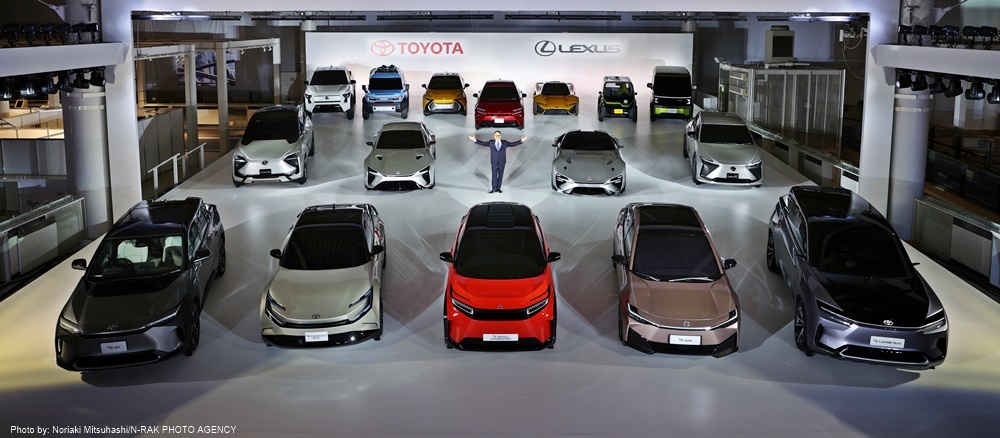
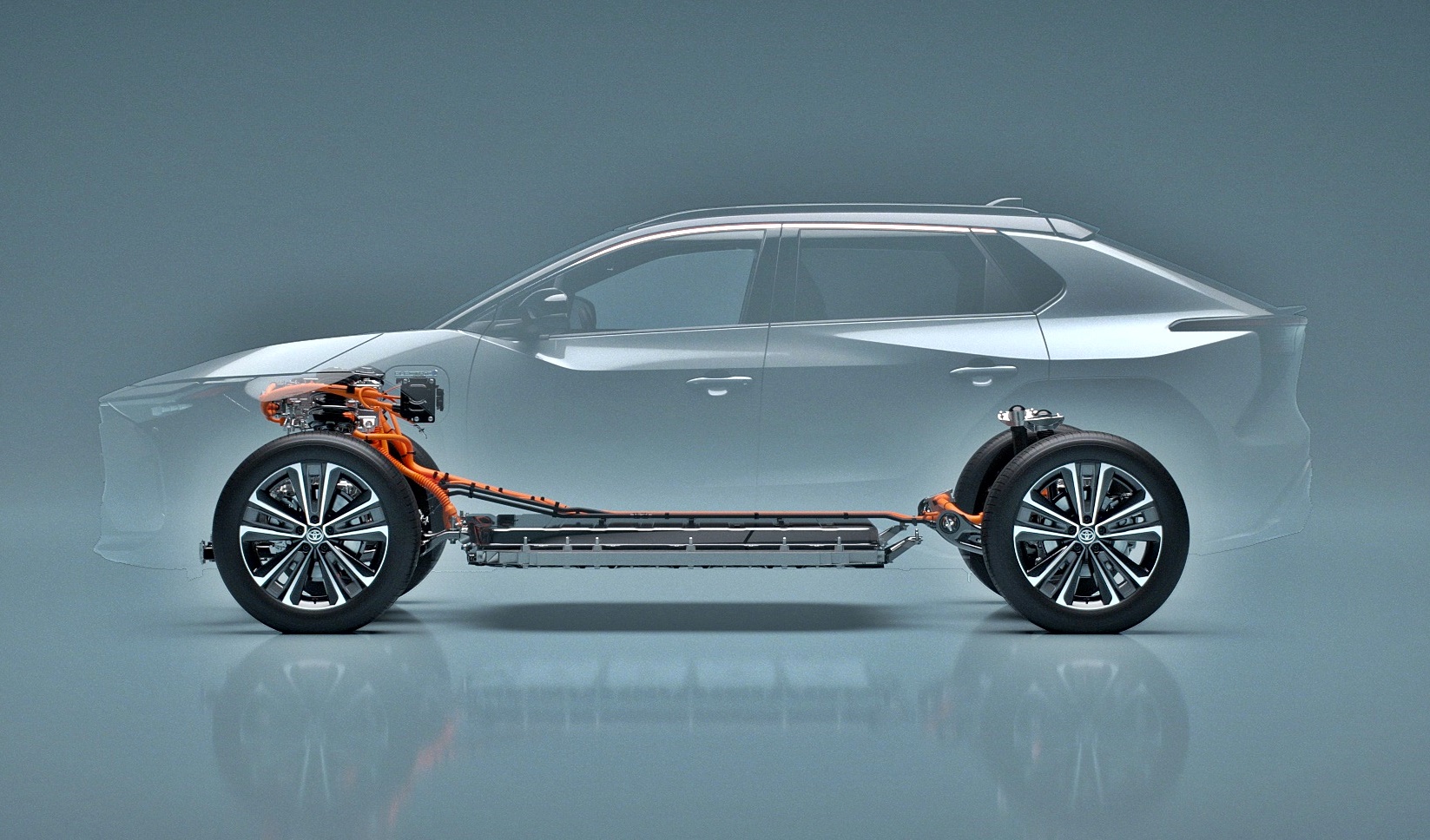
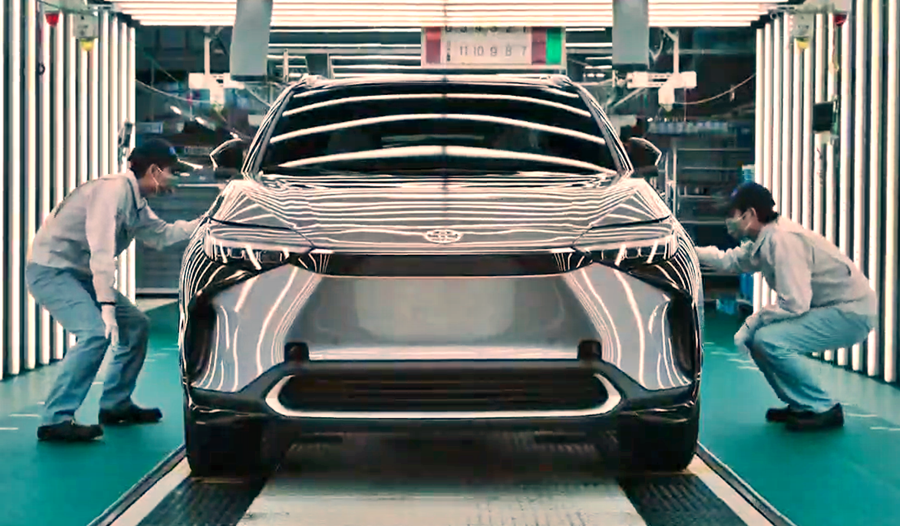
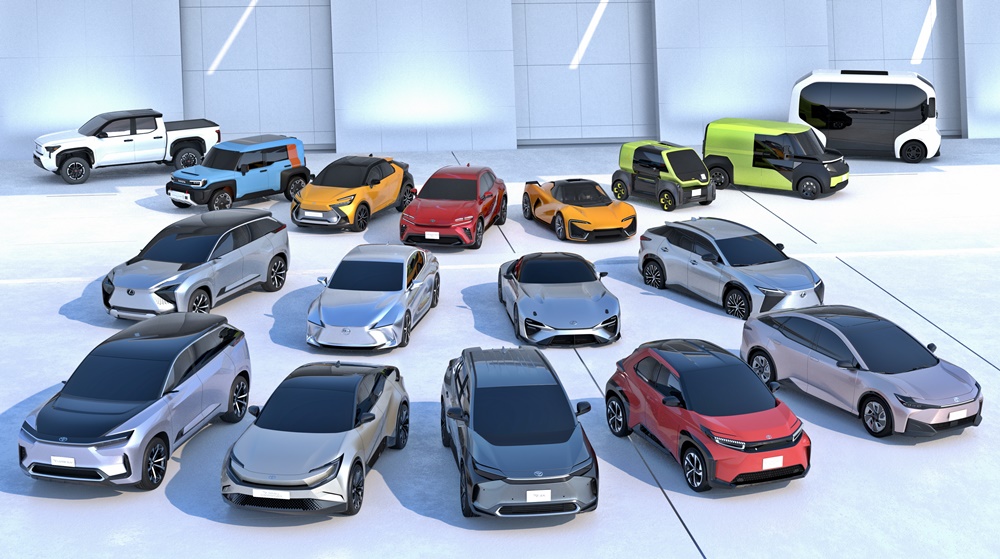
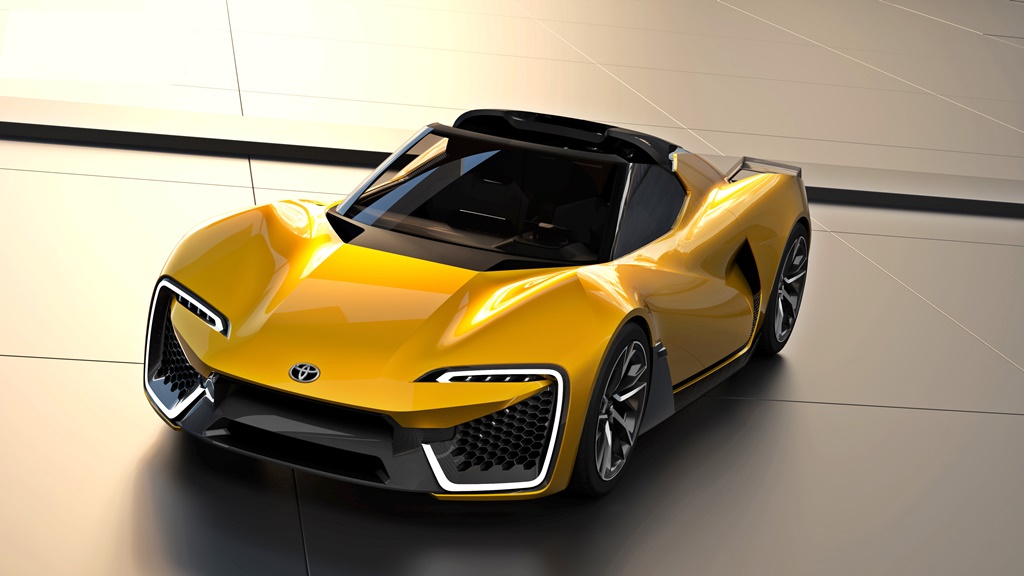
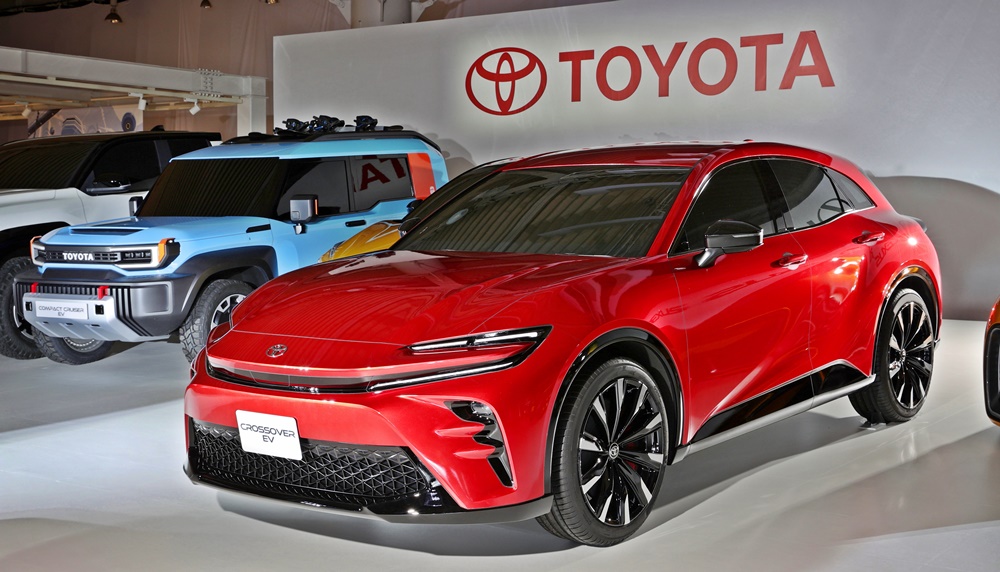
1 trillion yen = approximately RM37.2 billionThe bZ4x is the first of the new range of BEVs and production is now underway with sales set to begin in 2022.Toyota’s range of BEVs by the end of the decade will look something like this.As long as Akio Toyoda is leading Toyota, we will still get sportscars – even if they run on electricity instead of petrol (although the company is now exploring use of hydrogen as a fuel in combustion engines).
Sales volume of BEVs raised
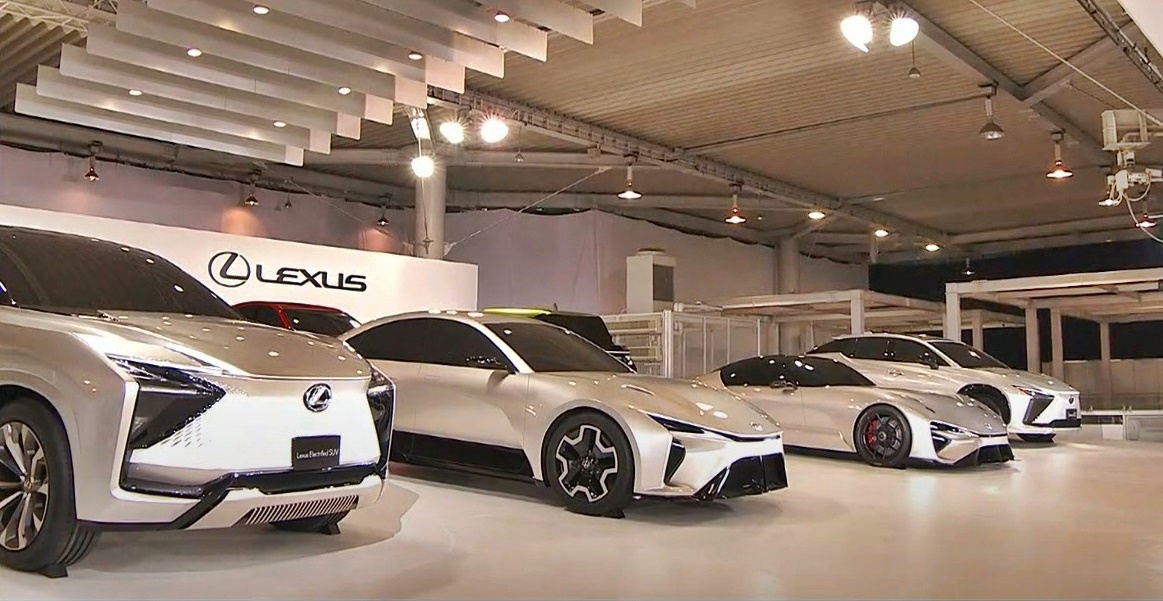
Besides outlining the company’s BEV strategies, Mr. Toyoda also revealed 16 Toyota and Lexus BEV models that it is readying for market launch, starting with the Toyota bZ4X which has already had been shown in production form and will begin sales in 2022. By 2030, the company is going to roll out 30 BEV models and is anticipating sales of 3.5 million BEVs globally. This is an increase of 75% on the previous annual sales projection of 2 million BEVs mentioned in May this year. The Lexus brand aims to have BEVs, which will be in every segment, account for 100% of the total sales in Europe, North America, and China by 2030.
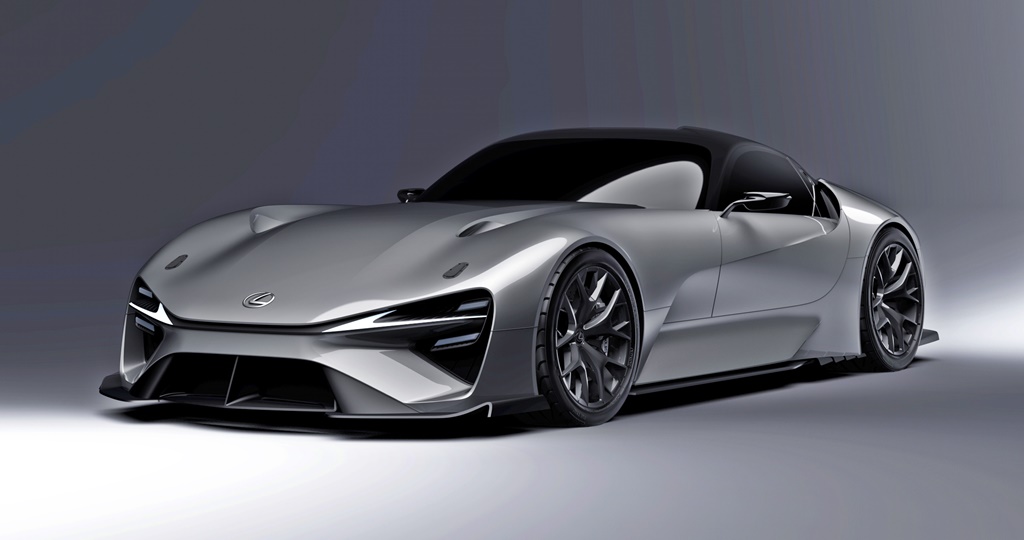
Lexus will develop a full range of electrically-powered models, including sportscars that may look like the one below.
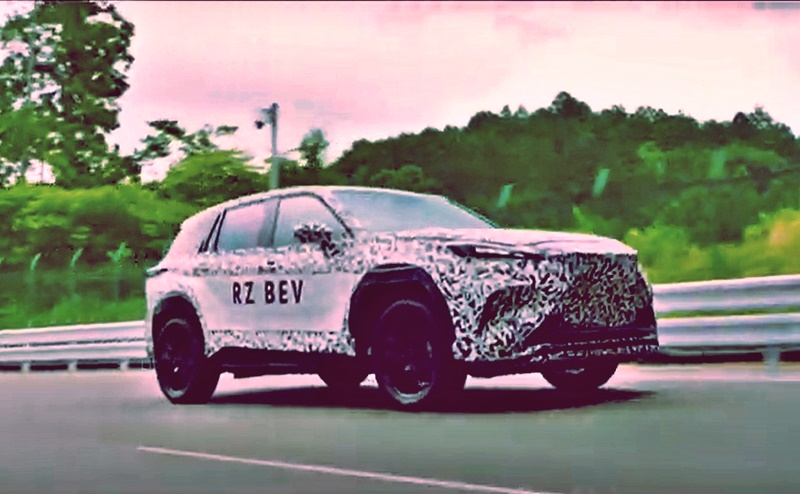
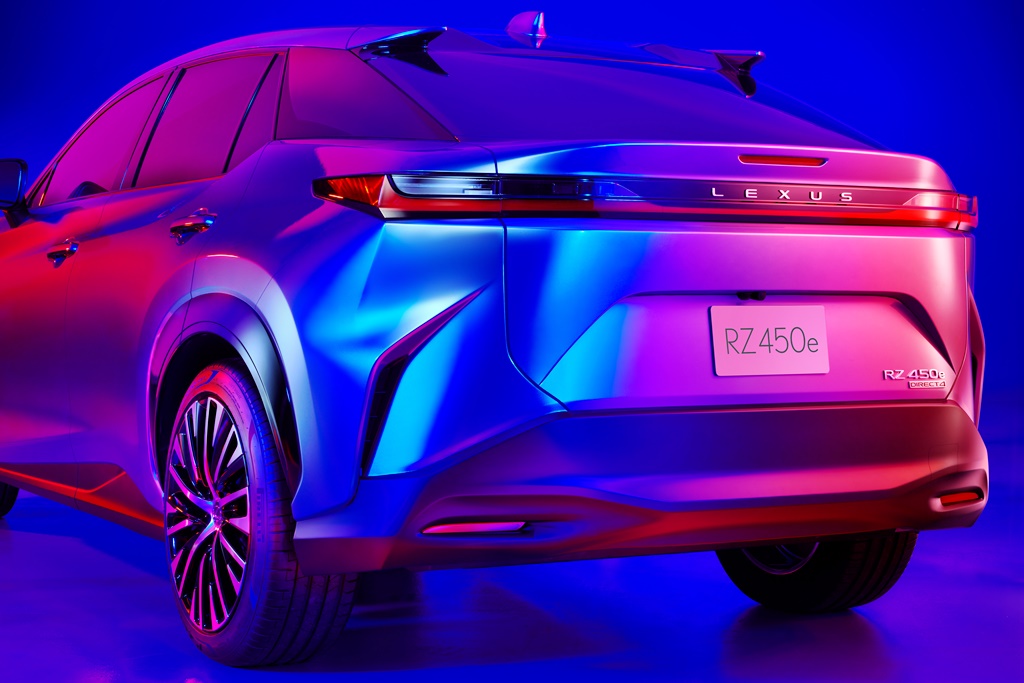
Lexus RZ BEV prototype during development testing. First teaser image of production model shown below. It will go on sale in 2022.
In this diversified and uncharted era, it is important to flexibly change the type and quantity of products produced while keeping an eye on market trends. At the same time, energy plays a critical role in achieving carbon neutrality. For this reason, Toyota wants to provide a diversified range of carbon-neutral options to meet whatever might be the needs and situations in every country and region.
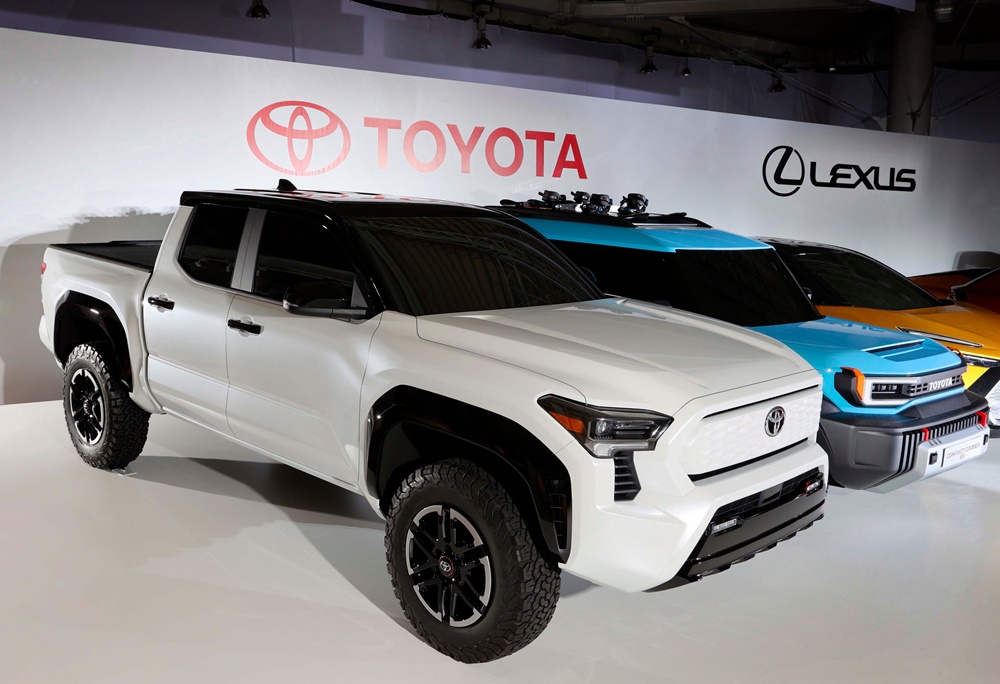
Toyota Hilux BEV of the future?Just like today, Toyota will have something for every segment of the market to suit different requirements and conditions.
Markets and customers decide
“It is not us but local markets and our customers who decide which options to choose. As for why we try to keep so many options, in terms of business management, one might think it would be more efficient to focus on fewer choices. However, we believe that quickly adapting to changes in the future is more important than trying to predict the future, which is uncertain. That is why we want to keep options available for our customers until the right path is clear,” said Mr. Toyoda.
“When people think of a Honda, there’s a very good chance they will think of the Civic.”
Words by the Head of Sales and Marketing of Honda Malaysia, which I thought couldn’t be more true.
The Civic has come to cement itself as the de facto go to car once a person makes enough money to afford moving up to a six figure sedan.
It is also a status symbol of sorts.
I once knew someone who did not want to marry her boyfriend until he bought a Civic.
Such is its appeal.
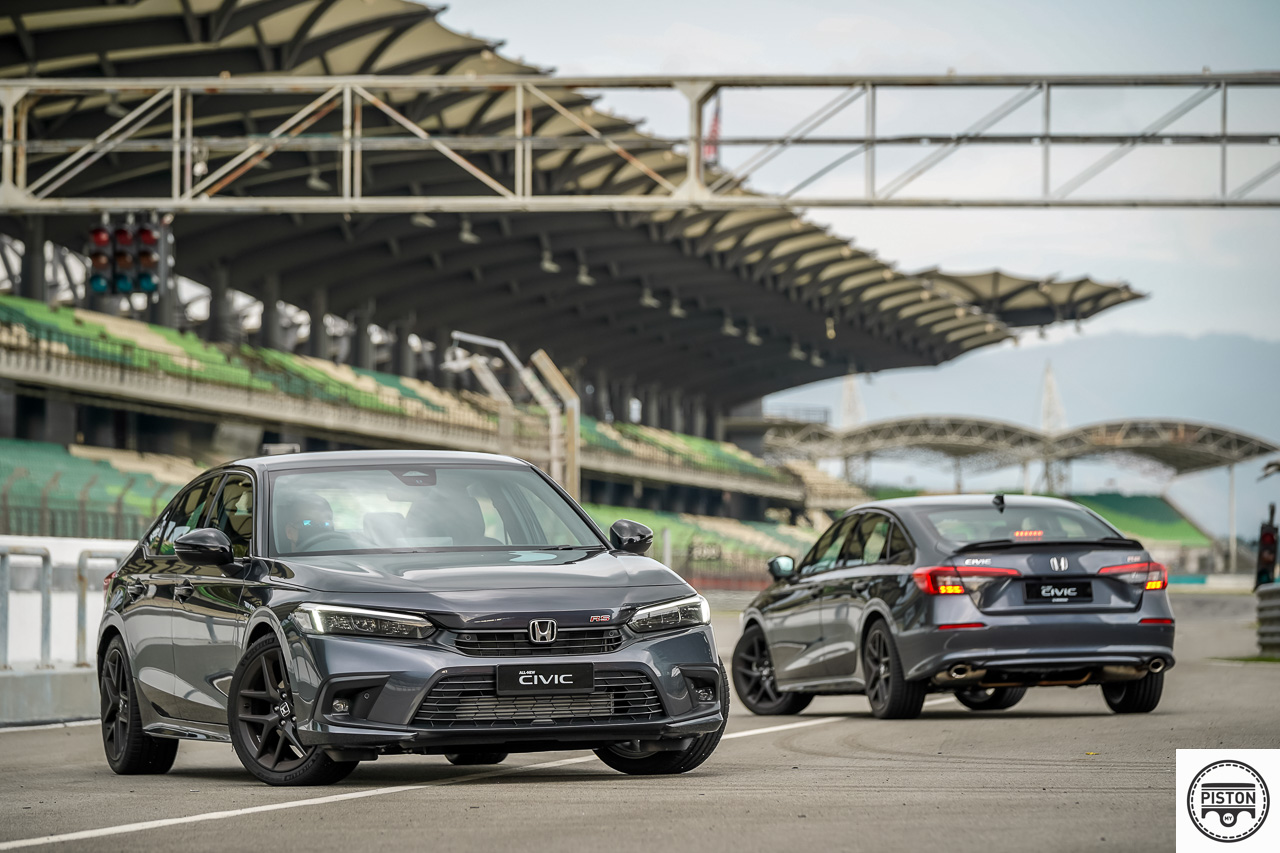
So when Honda announced that it was introducing an all-new Civic, naturally the media went into a frenzy.
And when photos were published, Honda fanboys (and girls) simply melted.
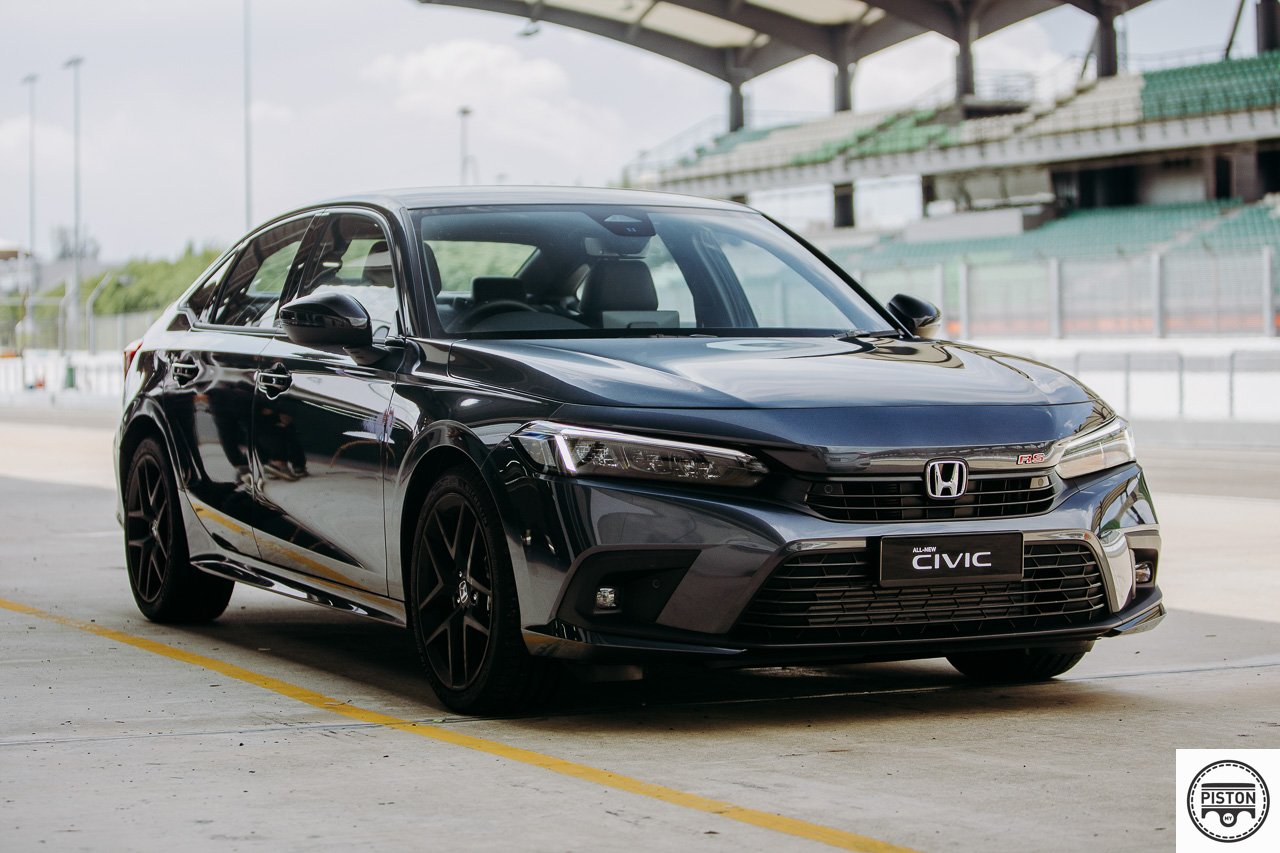
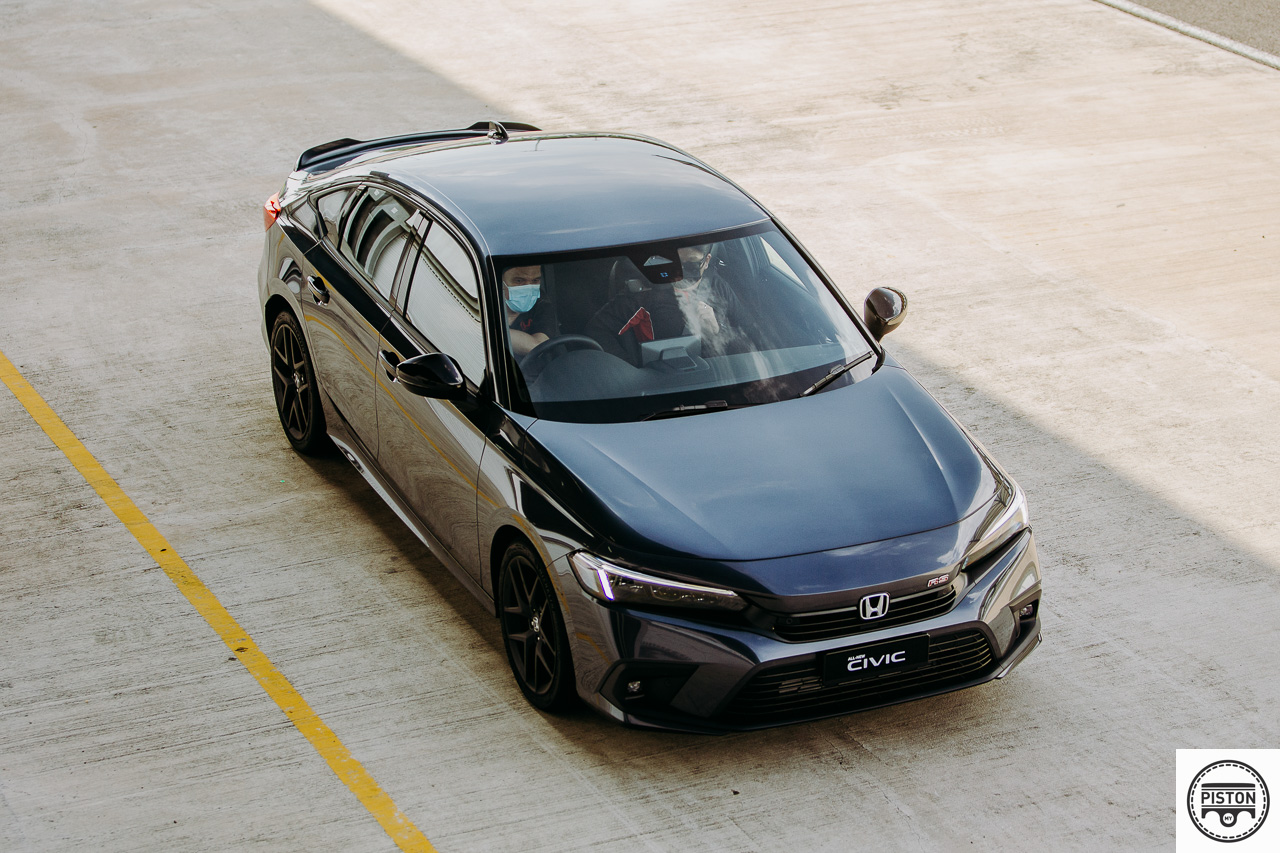
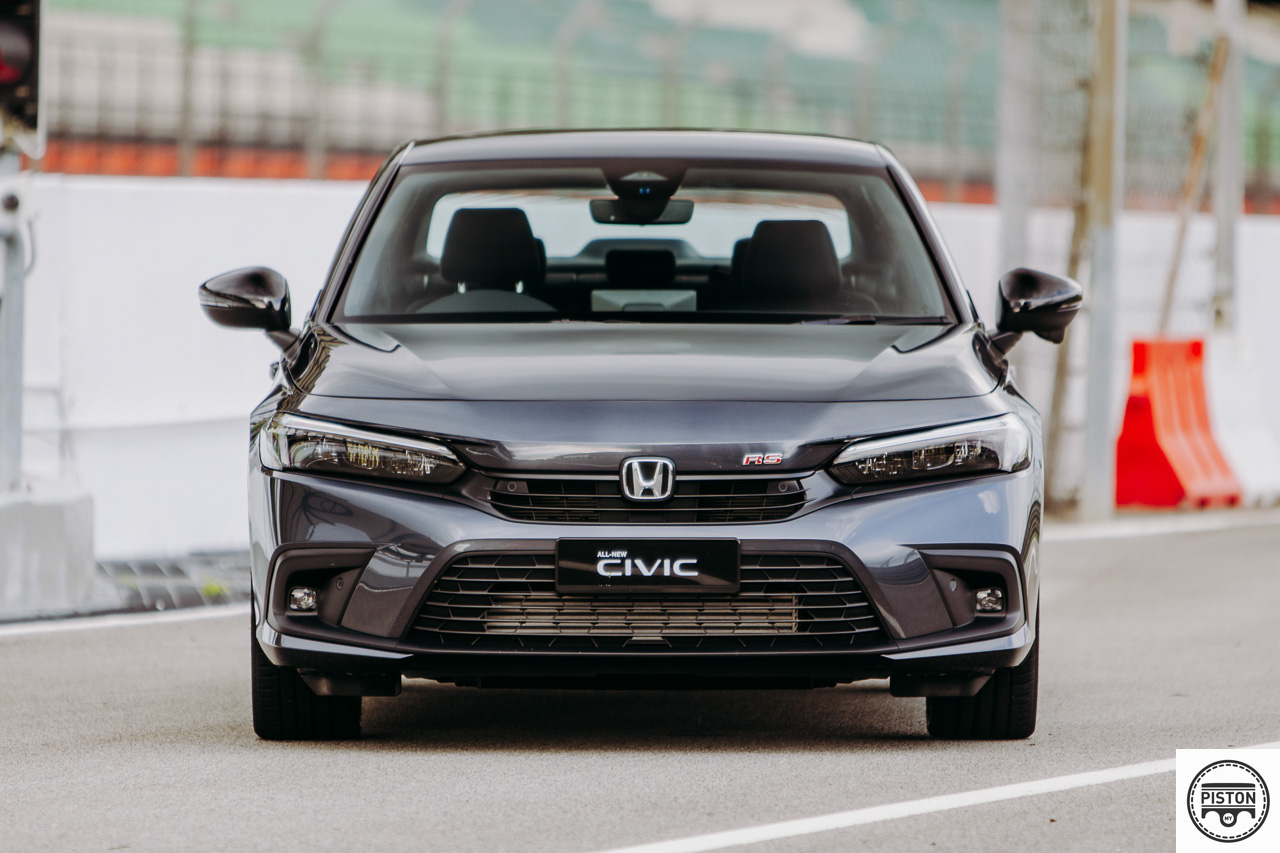
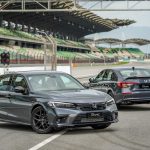
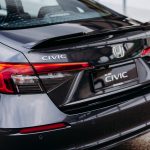
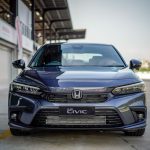
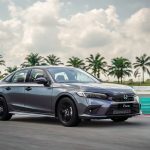
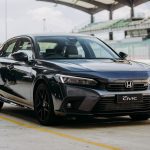
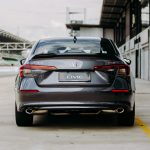
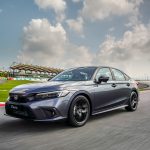
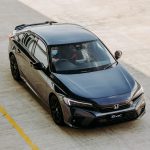
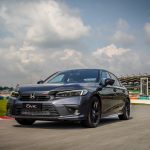
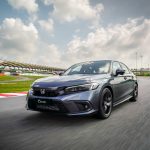
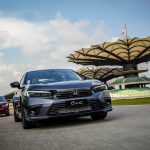
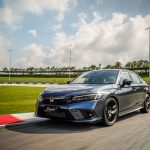
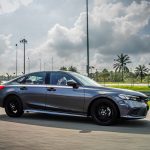
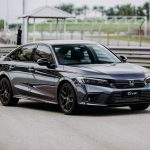
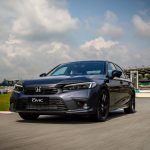
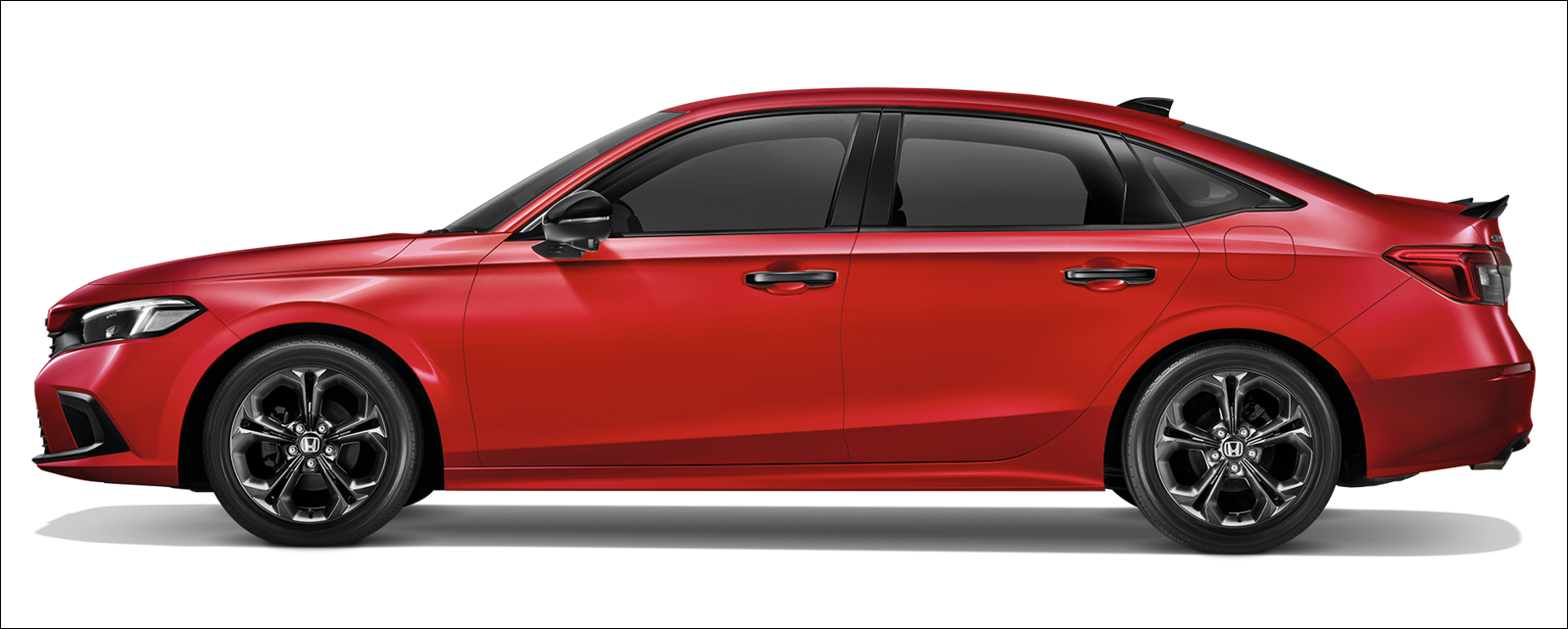
The latest generation Civic is elegant in its design, more spacious than ever, and though we are not allowed to show you interior photos until after its launch, we can say that the interior is nicer that you can imagine.
Both in terms of quality and design.
How does it drive?
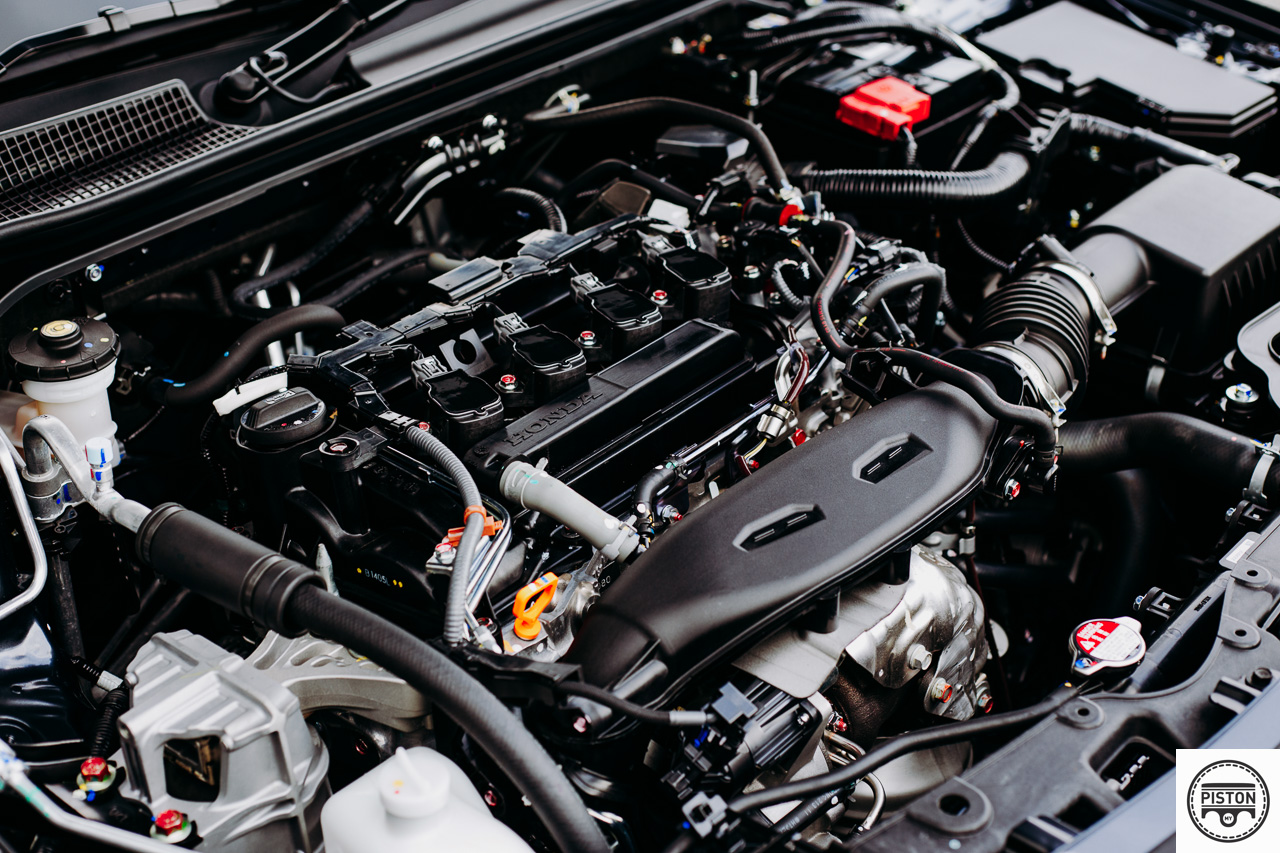
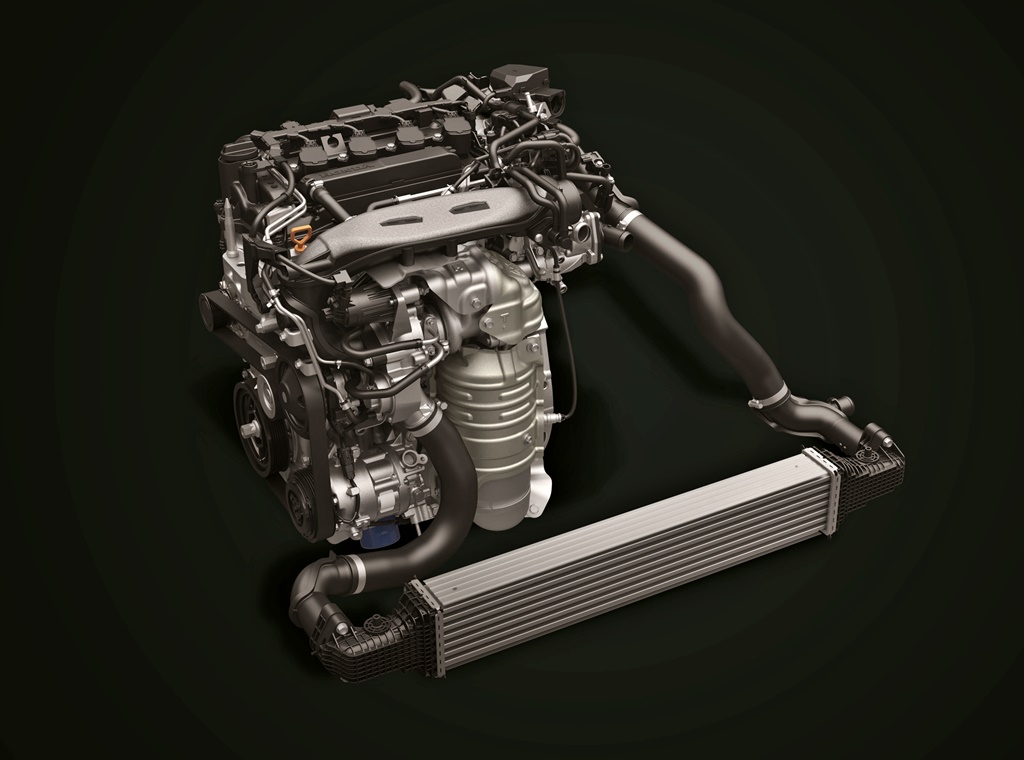
Powering the new Civic is the same 1.5-litre turbocharged engine that is in the current generation Civic and CRV.
But this time it has been tuned up to produce 10PS and 20Nm more torque.
In total, the Civic puts out 182PS and 240Nm of torque, which is plenty for a C segment car.
But it is the way the Civic puts down this power that is even more impressive.
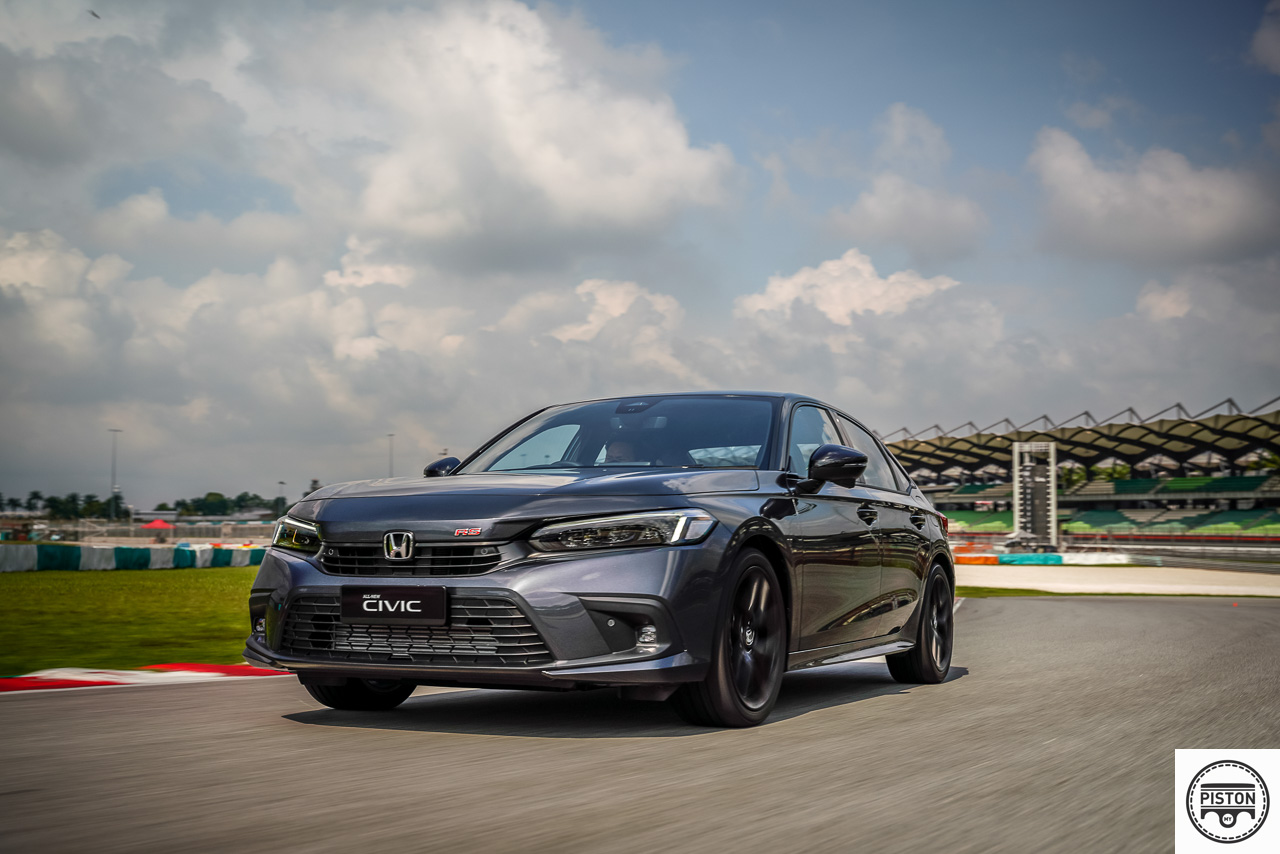
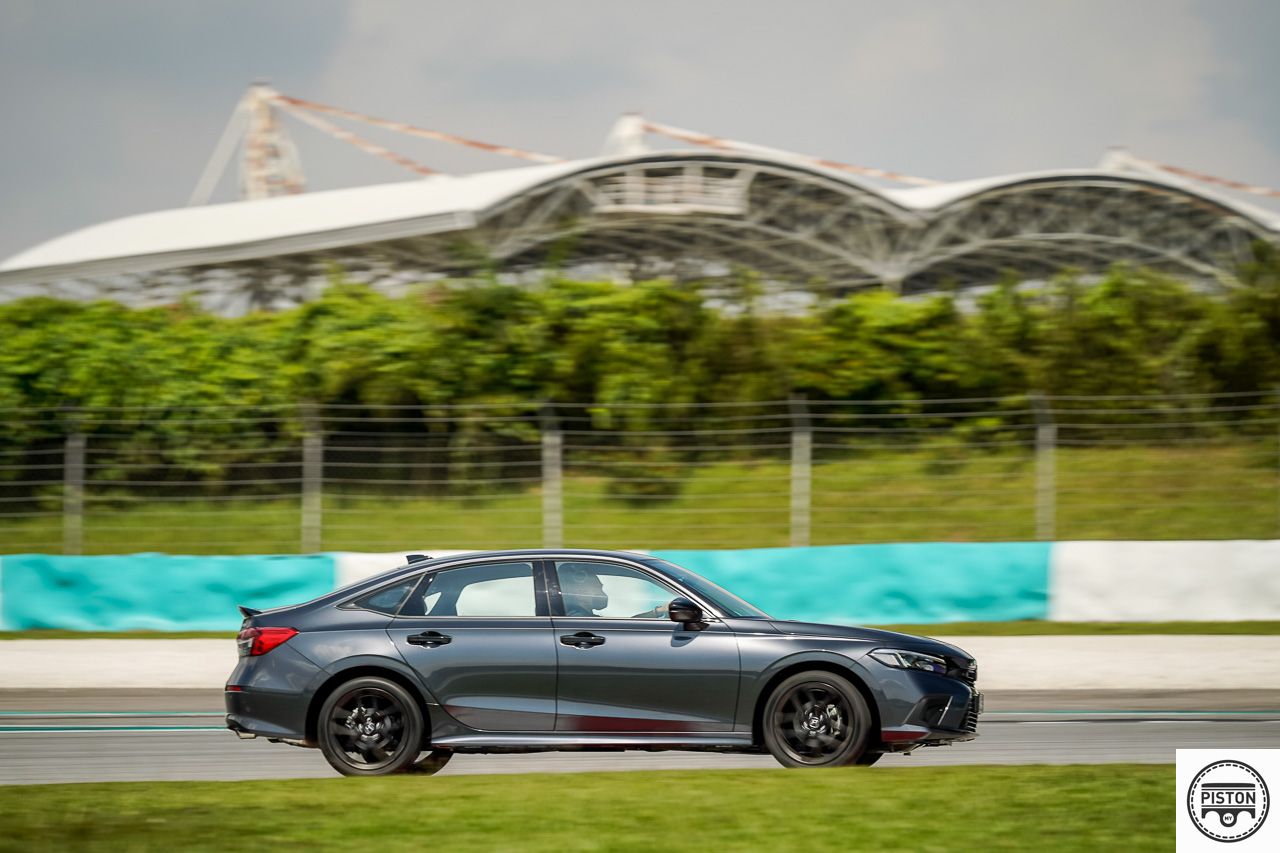
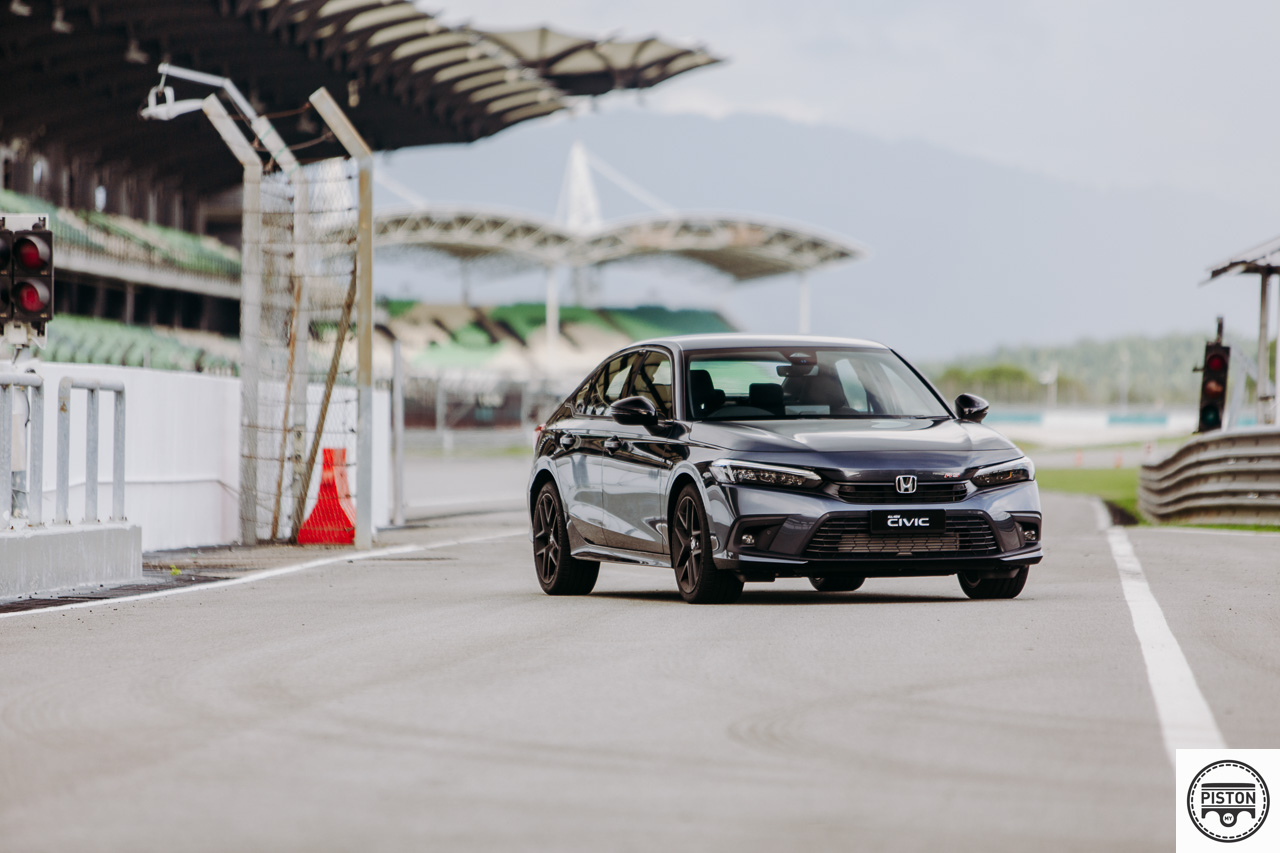
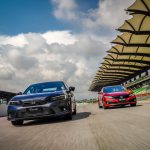
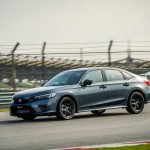
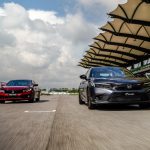
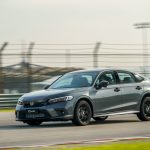
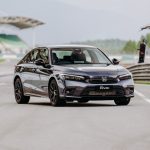
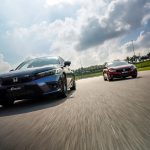
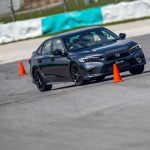
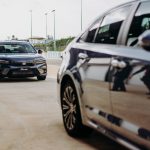
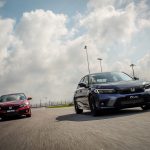
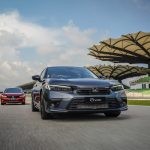
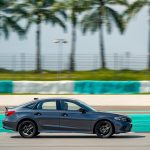
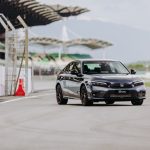
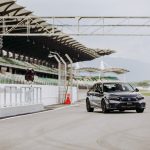
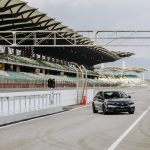
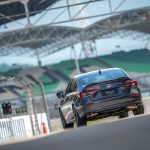
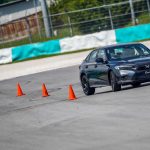
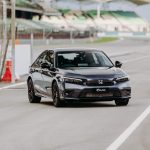
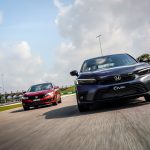
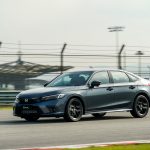
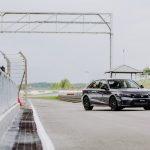
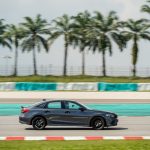
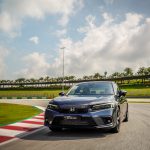
Honda Malaysia invited a select group of journalists to drive the car around the South Track of the Sepang International Circuit.
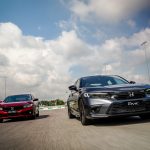
But they also provided a Toyota Corolla Altis and the current generation Civic as a reference point.
The new Civic felt more eager to respond to the throttle while the handling was sharper around a slalom test.
Body roll was obviously reduced over the previous generation Civic as well.
But what was truly impressive though was how refined the drive was.
The engine is mated to the same CVT gearbox as before, but this time the droning noise that is so typical of such gearboxes has been turned down a couple of notches.
The noise and vibration insulation is also a couple of notches better, and you don’t feel any vibrations from the tarmac in the seats either.
You could argue that the tarmac at Sepang Circuit is smoother and does not reflect real-world driving conditions, and you would be right.
And you would be right. But you can usually feel some powertrain vibrations in your bum from a C segment car, but that is no longer there.
And this is proof that the Civic has matured into a more family oriented car without forgetting its sporting roots.
Very much like a 90s or early 2000s BMW 3-Series.
The new Civic is also a lot sportier in nature, and that is largely thanks to a new Drive Mode Selector – a feature that is available for the first time in a Civic.
This gives you access to three different modes – Eco, Normal and Sport.
Each does what it is named after and controls things like throttle response, steering heft and the overall character of the car.
What’s so nice about it?
I would say the interior and the way the powertrain is packaged.
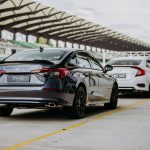
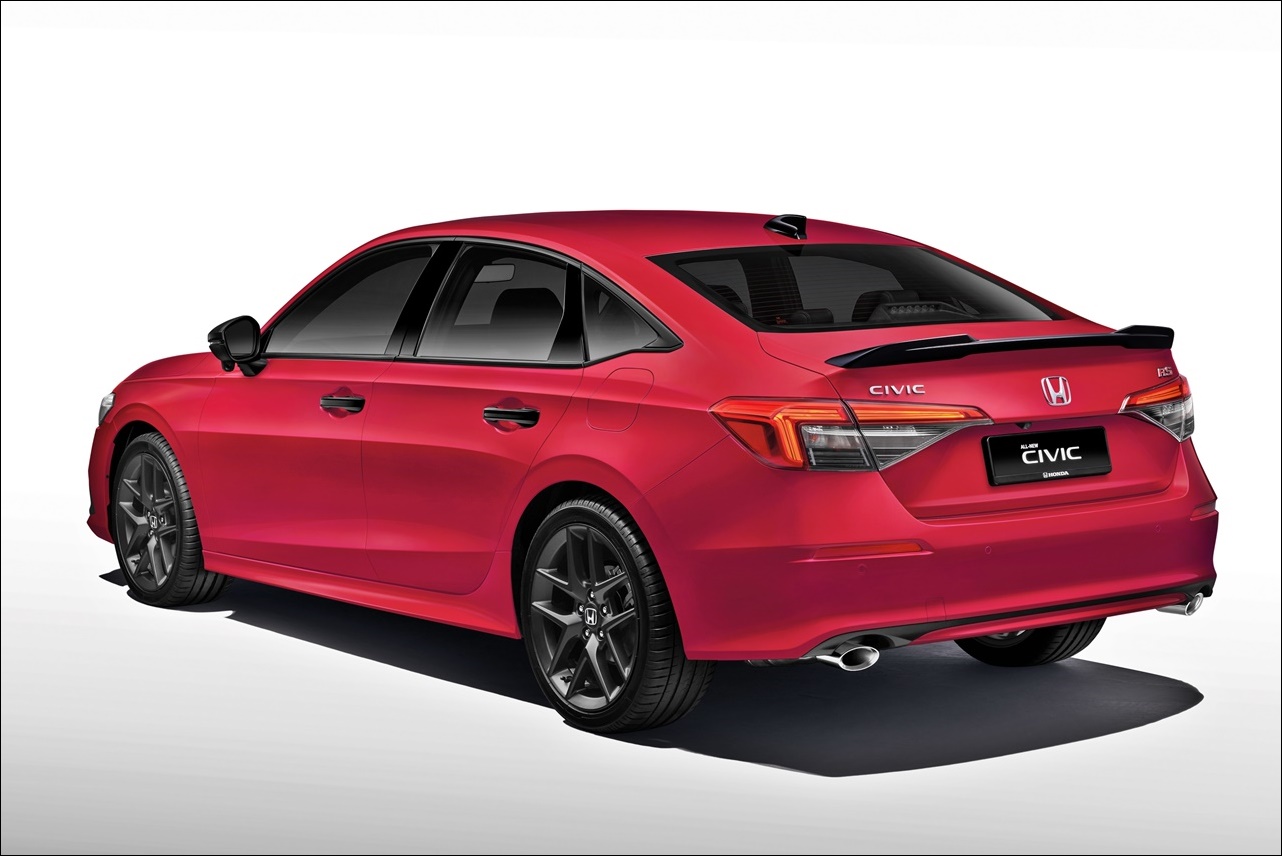
The exterior design is also a much welcomed departure from the obviously aging design of the current generation Civic.
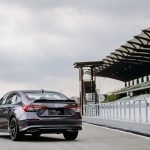
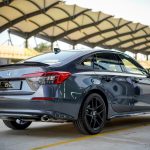
It isn’t as dramatic as the FD was or the FC for that matter, but the new FE generation Civic is elegant and understated now.
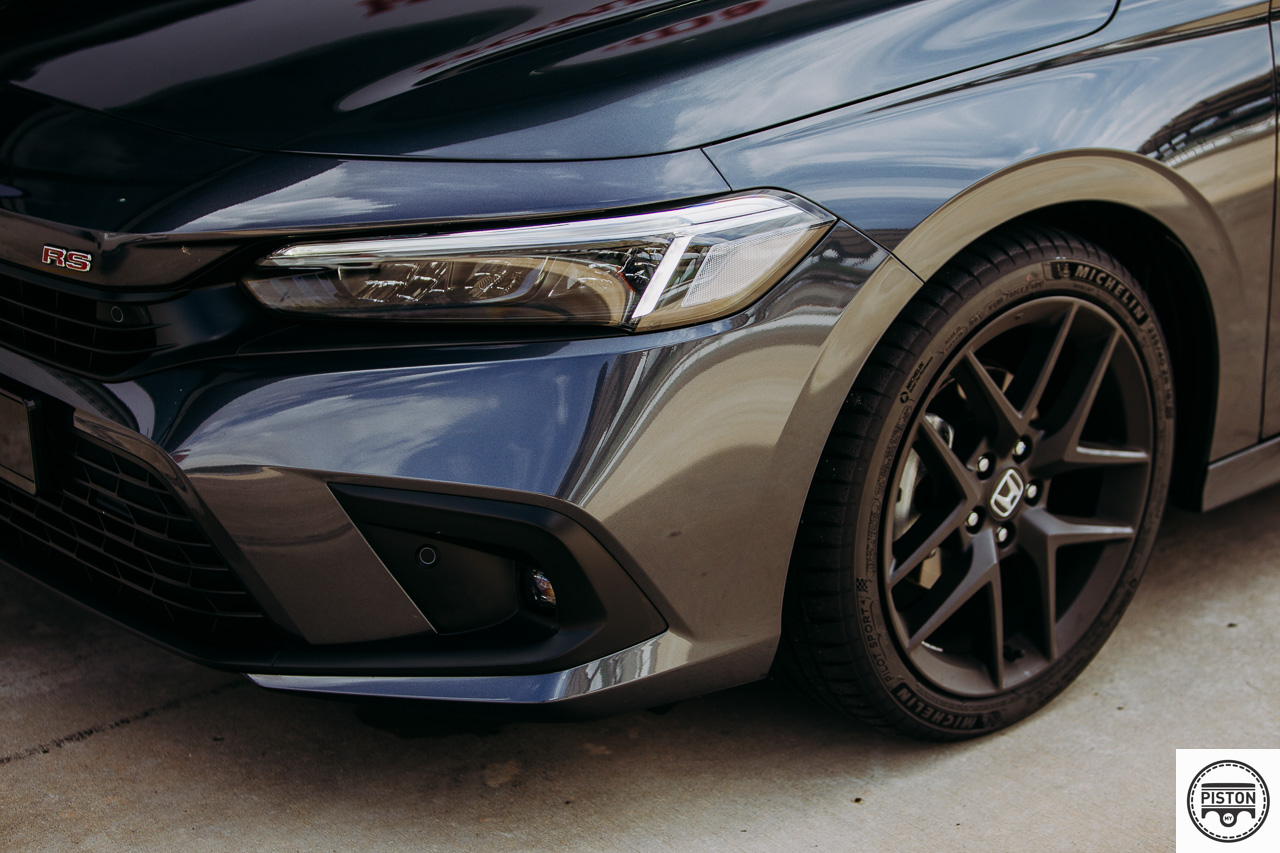
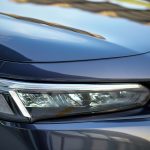
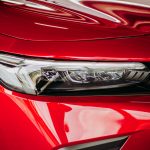
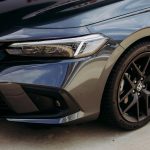
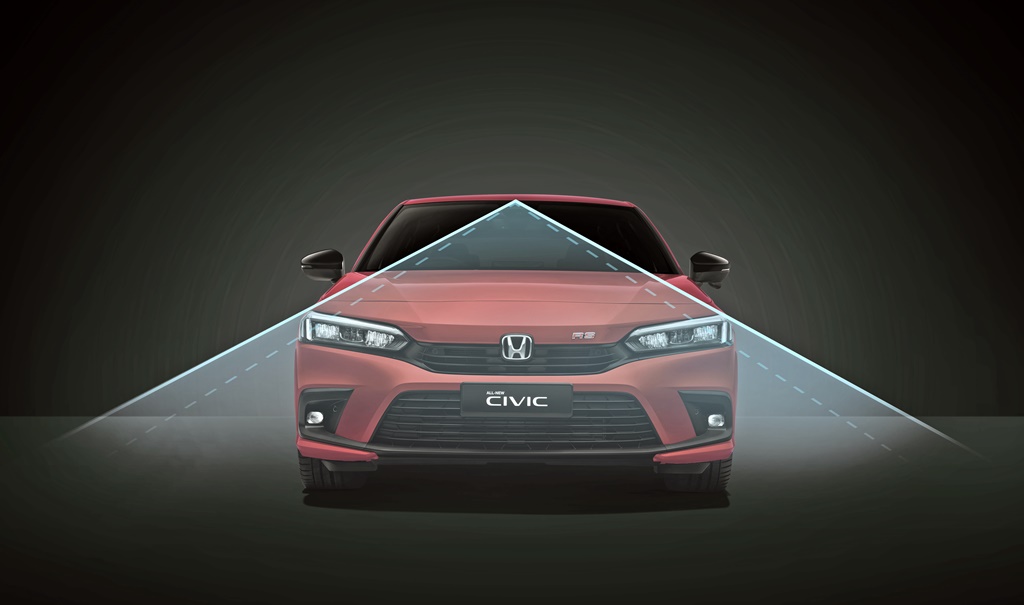
And those gorgeous daytime running lights will help it stand out from the crowd.
I know that looks are subjective, but I am quite sure thousands will love the interior of the new Civic.
The honeycomb design that spreads across the dash, subtly hiding the air-conditioning vents are an original touch unseen in any other car. Honda or otherwise.
The steering wheel too is thicker and feels luxurious in your hands.
The quality of the switches feel like they belong in a continental car rather than an affordable mass-produced C-segment Honda.
The seats in the Civic have always been among the best in the segment, and still are. This time though the padding is supple for added plushness while overall support has been extended to the bottom of your thighs and shoulders.
And because the car is now much bigger in overall proportions, the interior is spacious.
The dramatically rising a-pillars and the wider c-pillars allow more light into the cabin via larger windows, further accentuating the sense of spaciousness.
The spaciousness extends into the booth as well, which now seems like it can accommodate three golf bags.
What about technology?
You wouldn’t expect anything lesser of a Honda, and so the Civic comes brimming with tech.
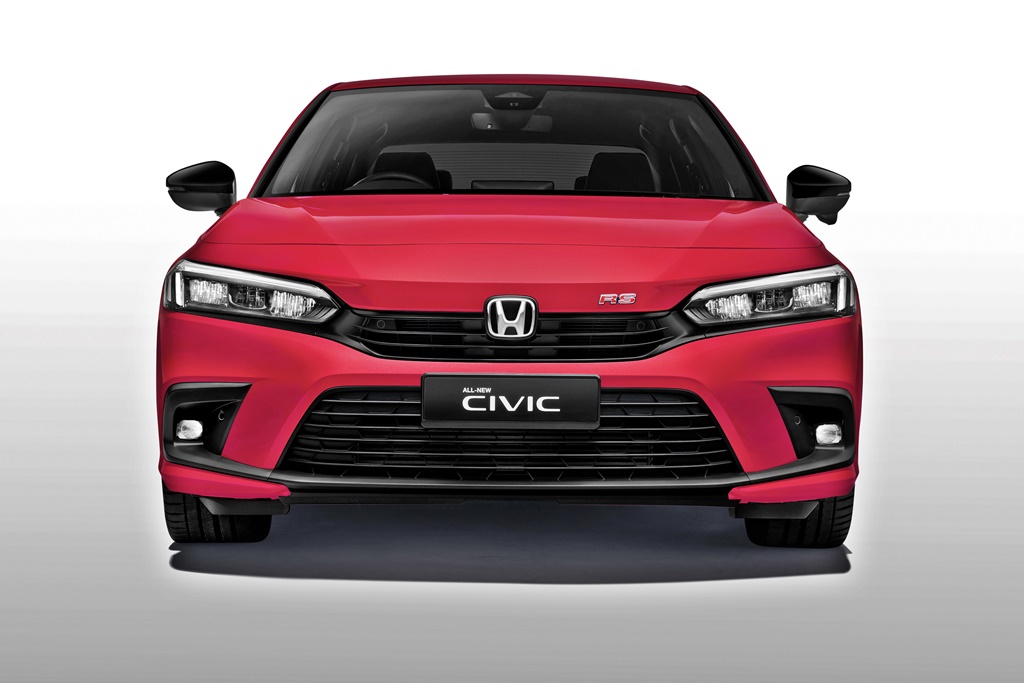
The RS variant we drove came with an updated Honda SENSING that now features something called Lead Car Departure Notification System.
This system alerts the driver when the car ahead has moved ahead, perfect when in traffic or at a traffic light when most drivers are either on their phone or simply dreaming.
The full suite of enhanced Honda SENSING safety features in All-New Civic RS are as below:
Lead Car Departure Notification System (NEW)
Adaptive Cruise Control (ACC)
Low-Speed Follow (LSF)
Collision Mitigation Braking System (CMBS)
Forward Collision Warning (FCW)
Lane Keep Assist System (LKAS)
Road Departure Mitigation (RDM)
Lane Departure Warning (LDW)
Auto High Beam (AHB)
It is unclear if this will make it down to other variants of the Civic, but in typical Honda Malaysia fashion, only the top two models will receive Honda SENSING. And this will then trickle down to other variants as the model goes through its life cycle.
But of course, that’s not all the new Civic comes loaded with, it also features plenty of other safety features as well, such as:
Honda LaneWatch
Six Airbags
Vehicle Stability Assist (VSA)
Agile Handling Assist (AHA)
Emergency Stop Signal (ESS)
Anti-lock Braking System (ABS)
Electronic Brake Distribution (EBD)
Auto Brake Hold (ABH)
Hill Start Assist (HSA)
Walk Away Auto Lock
Remote Engine Start
And a new safety feature for the Civic called Driver Attention Monitor that alerts the driver to take a rest if it detects erratic driving.
Should you buy it?
There is a shift in demand towards SUV’s, hence why cars like the HRV are selling so well. But there is a huge appeal in cars like the Civic as well.
There was a time where people wanted an SUV because it offered more space. But with the amount of space the new Civic offers, that argument is no longer valid.
It may not offer the higher up sitting position of an SUV, but if you want a sporty sedan with a well-built interior and a drive quality that is similar to a continental car, then yes, you should buy the Civic.
We can’t tell you anything about the price as Honda Malaysia did not reveal anything, but expect it to be similar in price to the outgoing model.
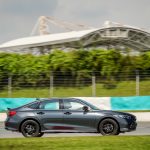
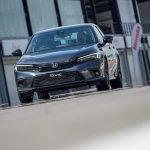
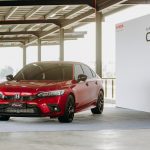
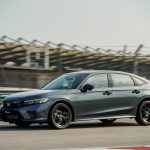
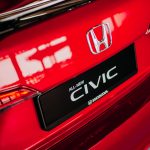
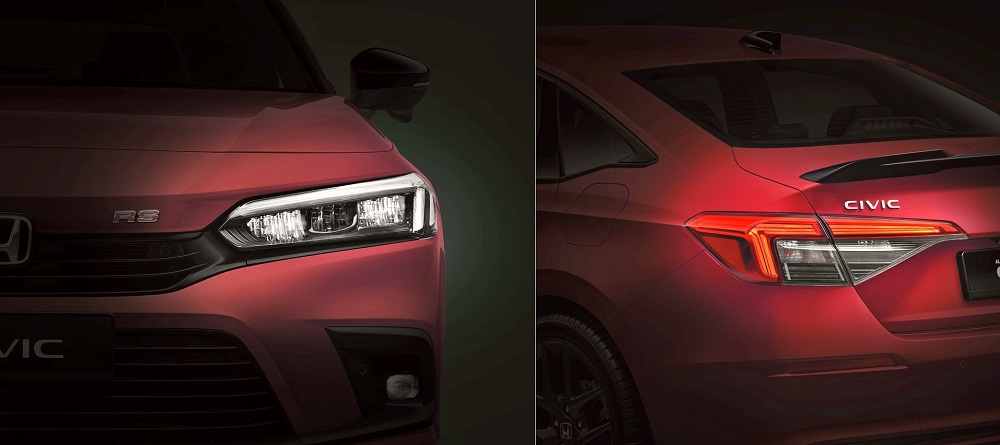
Even before the excitement with the all-new Honda City Hatchback has died down, Honda Malaysia is preparing to launch another all-new model – the 11th generation of the Civic. It will be launched in the first quarter of 2022, and those who want to be the first to own one can place a booking now at any authorized Honda dealer nationwide. Prices and variants have not been revealed (although we know there will be an RS variant for the first time), but sales tax will not be charged till after June 30, 2022.
Evolutionary styling changes
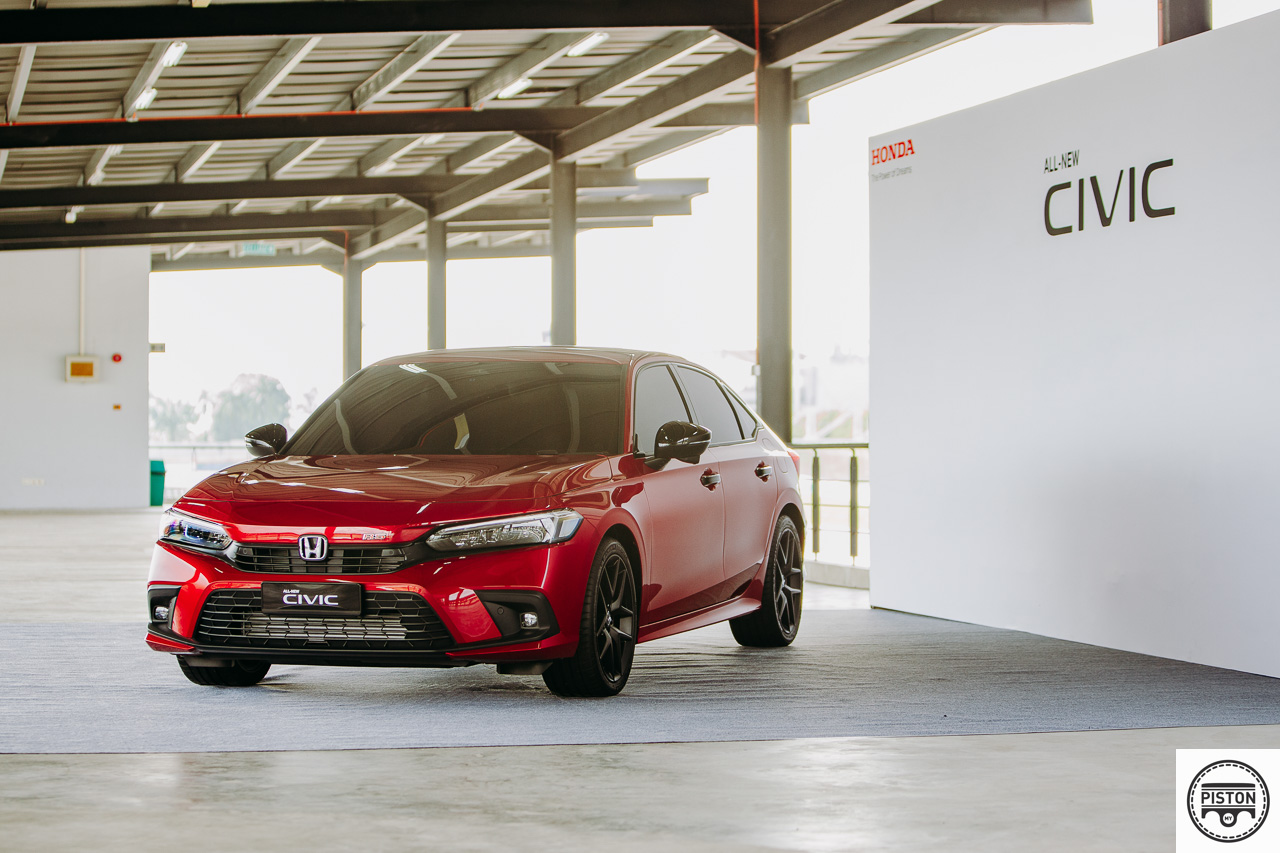
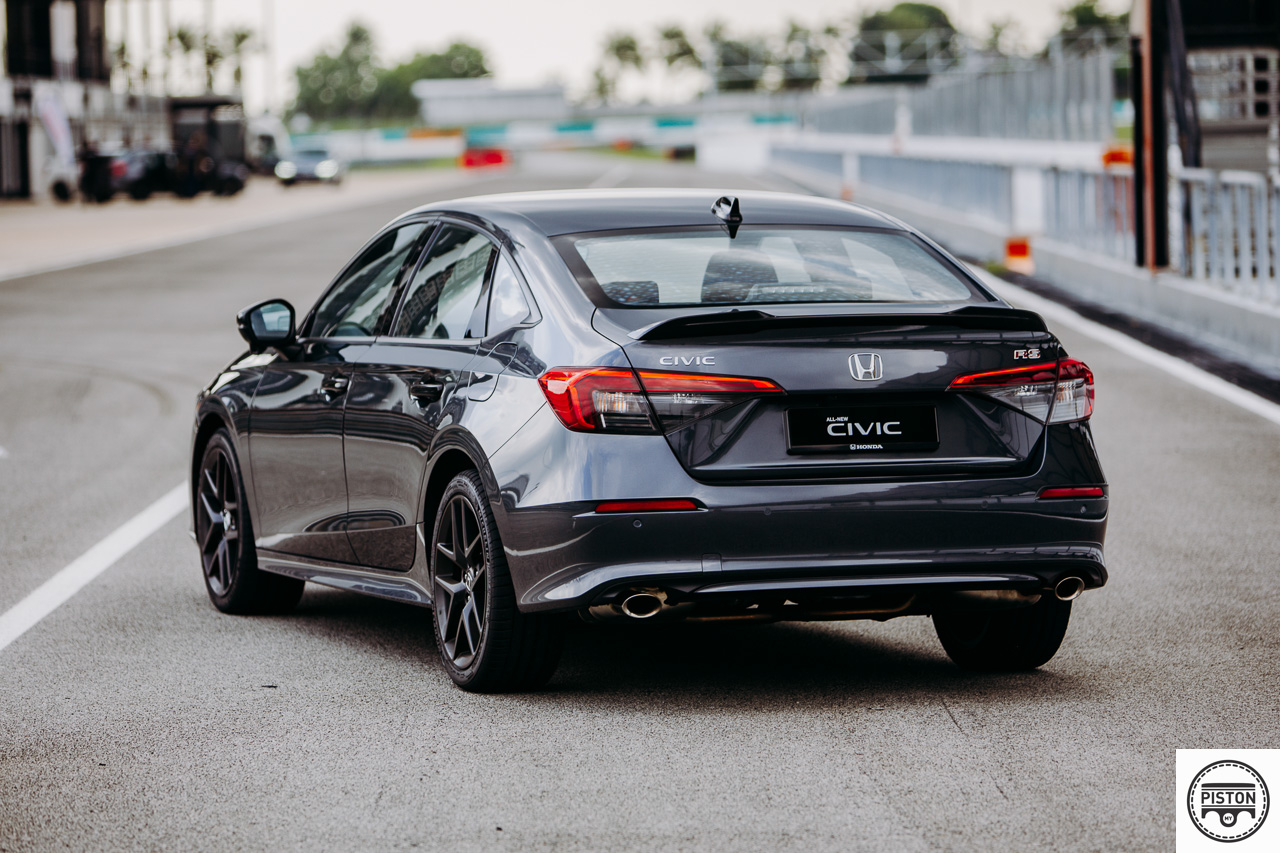
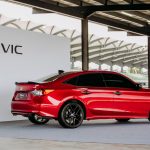
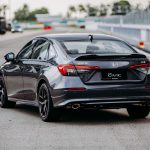
The new Civic has undergone an evolutionary styling change that gives it a ‘New Age Identity’. The focus on the new exterior design is to give the driver and occupants a more expansive view from within, enhancing the feeling of spaciousness. This has been achieved by expanding the glass area with windscreen pillars repositioned further back.
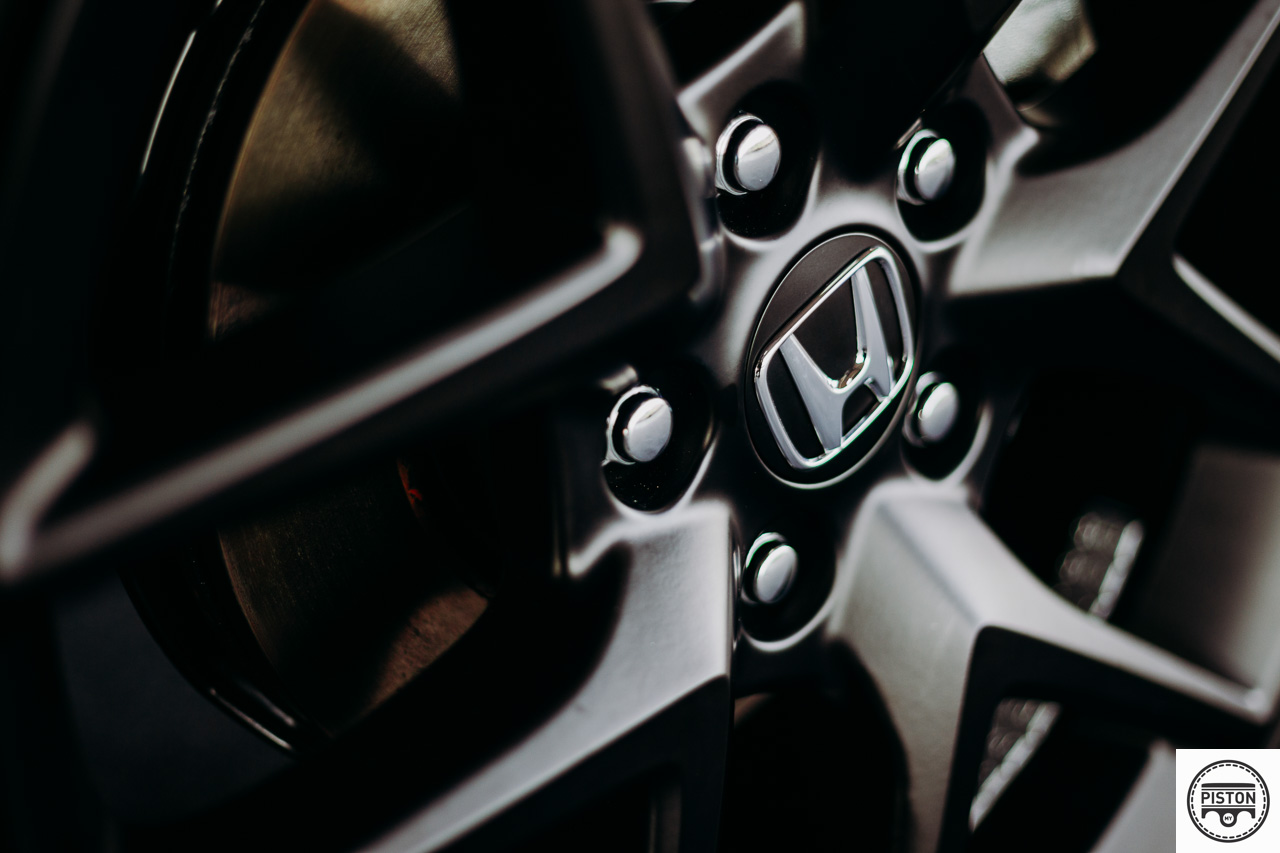
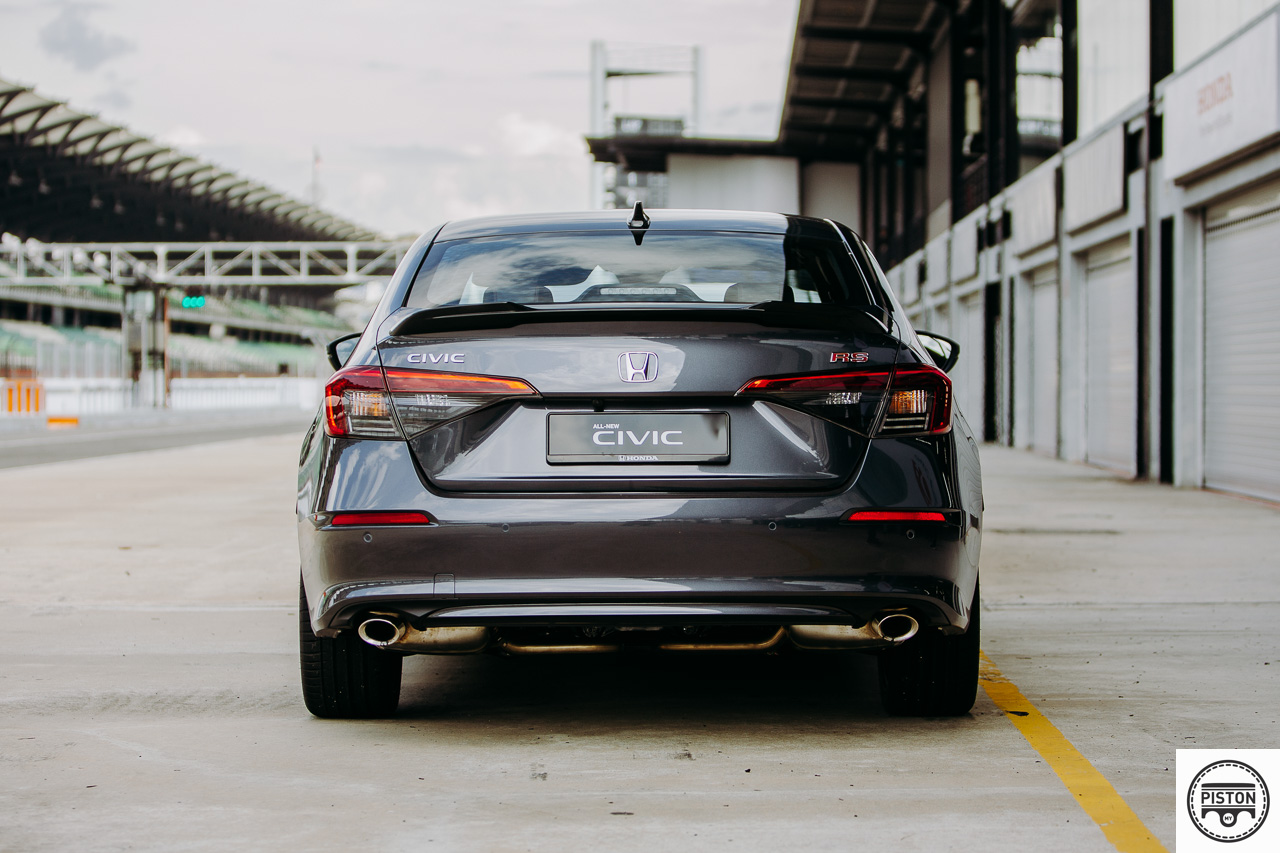
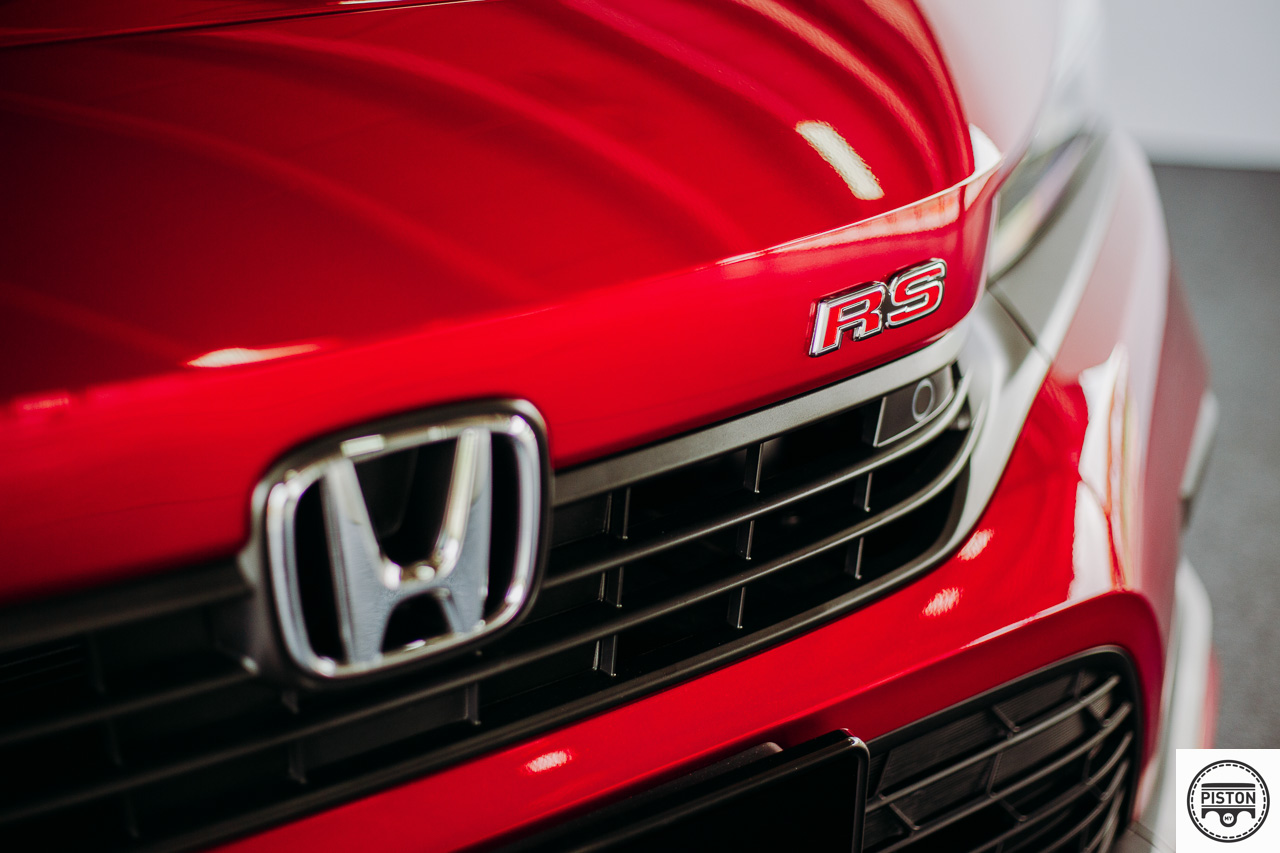
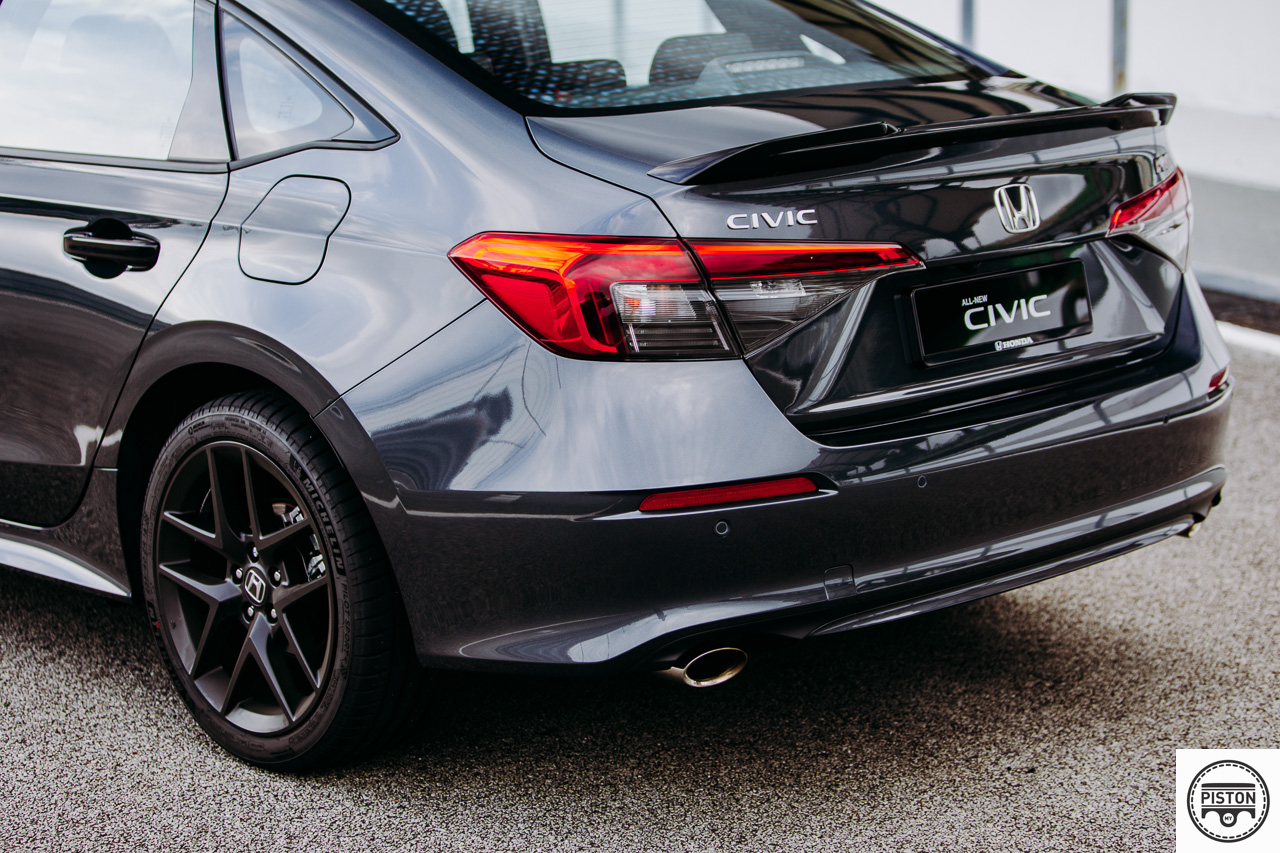
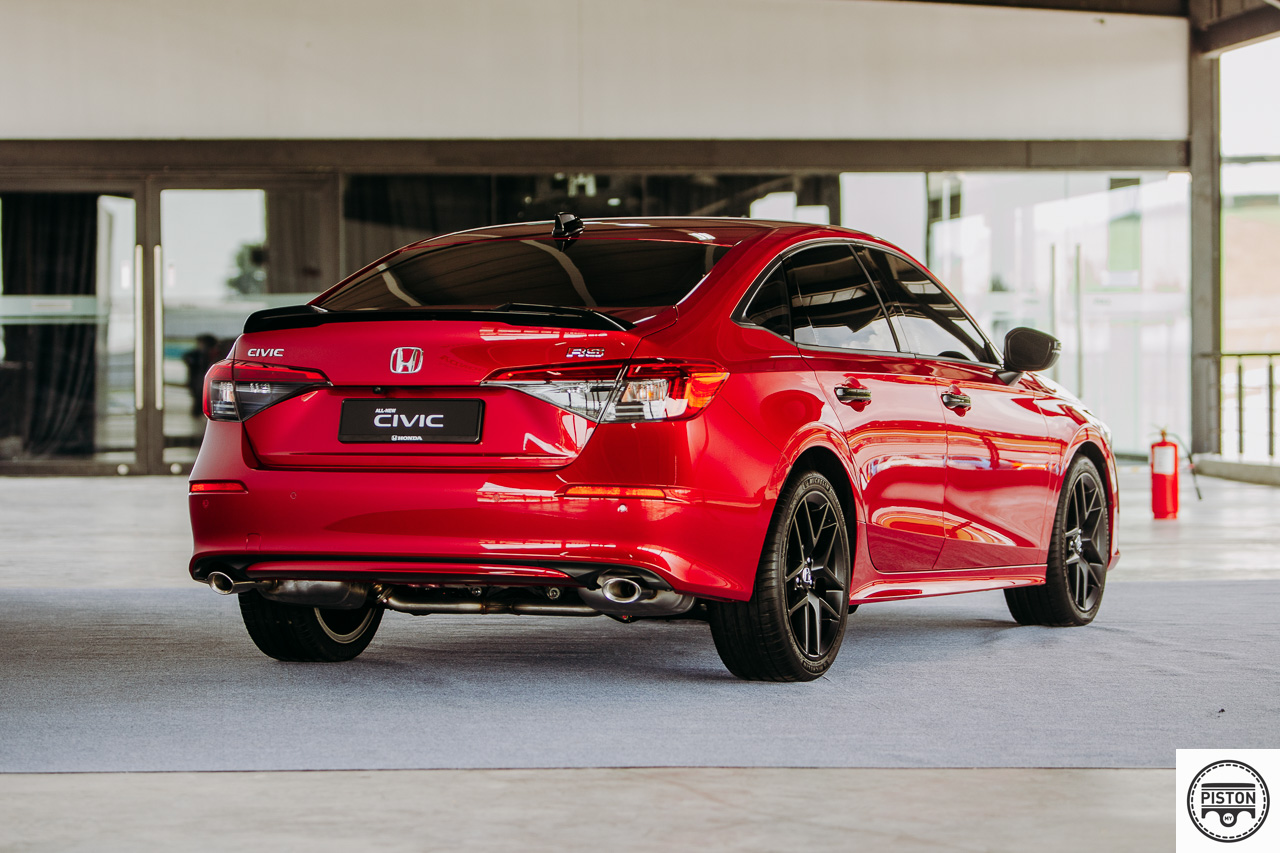
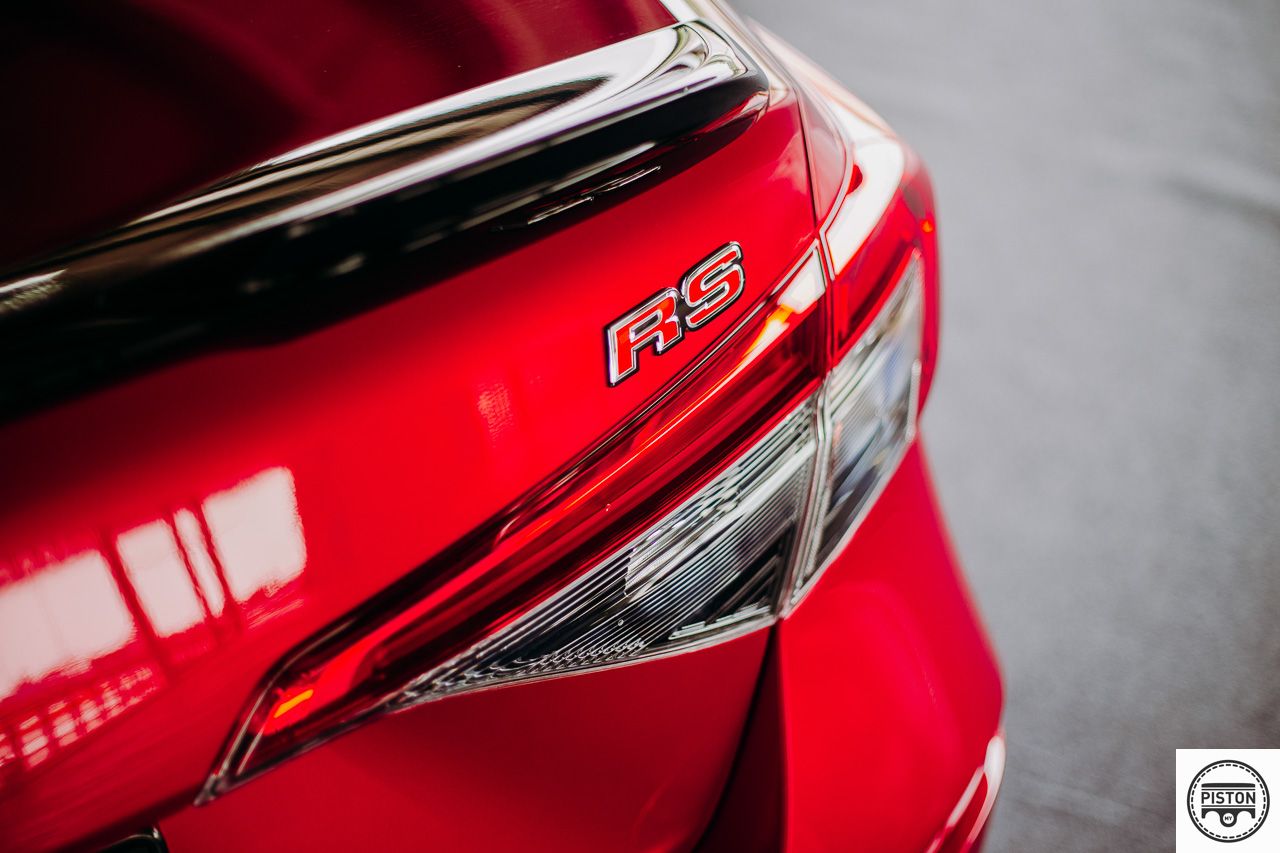
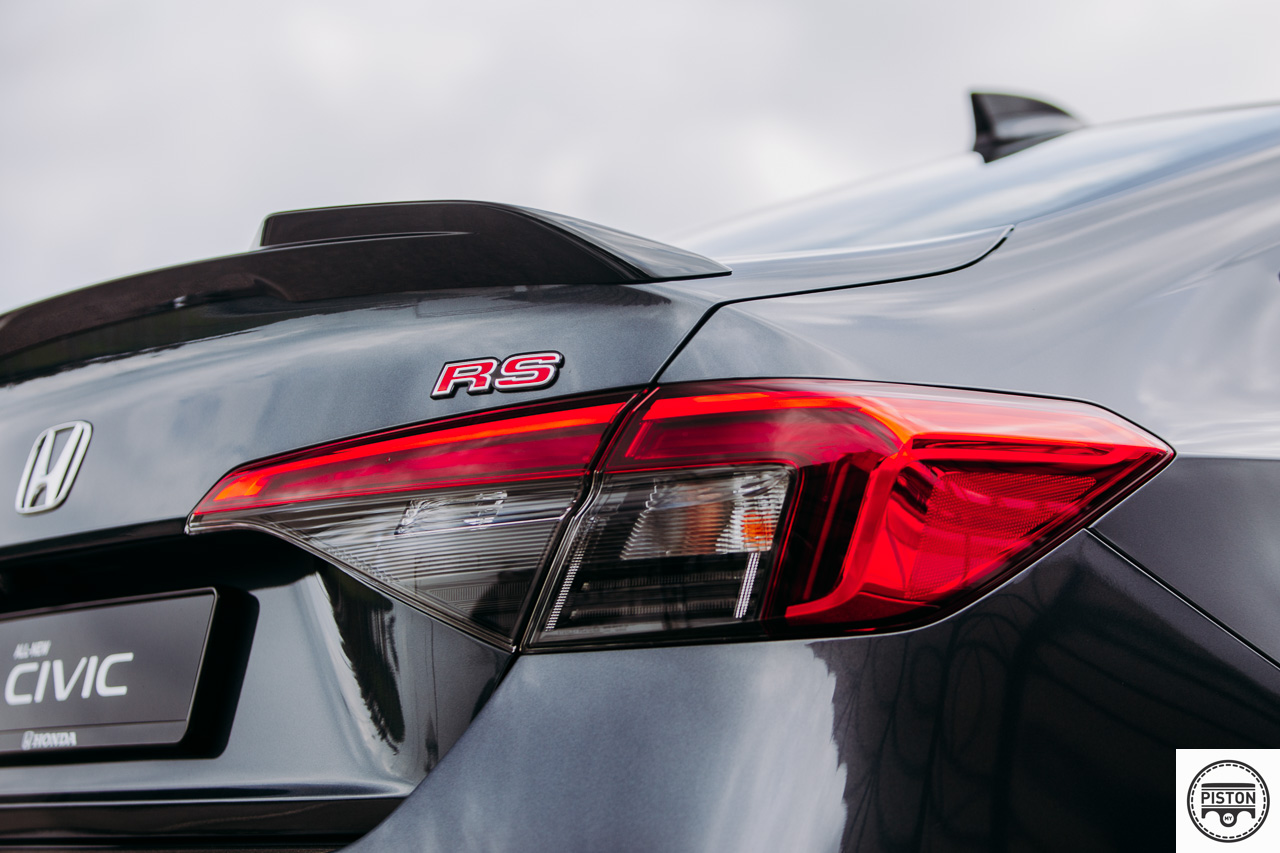
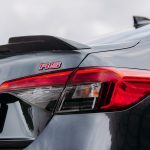
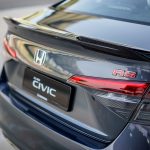
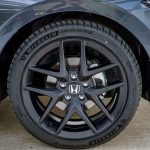
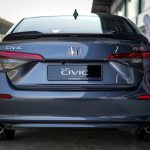
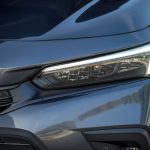
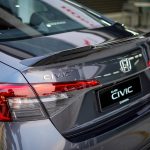
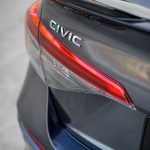
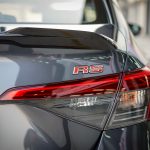
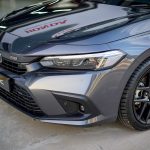
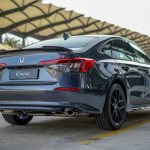
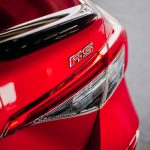
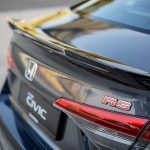
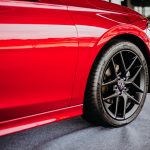
The Civic RS, flagship of the new range, will come with black finishing for the housings of the door mirrors, Shark Fin antenna, Outer Door Handles, boot spoiler and also the 18-inch alloy wheels. The new lighting units use LEDs and have new designs while the Civic’s styling DNA is reflected in the rear lights.
Longer and wider body
Measuring 4678 mm in length, 1802 mm in width, with a height of 1415 mm and a wheelbase of 2735 mm, the new Civic is larger and wider with the rear track also widened to provide a low and wide stance. The factory in Melaka will use Honda’s advanced manufacturing technique employing Lazer Brazing technology (a Civic-first) which gives a sleeker roofline and strengthens body rigidity.
The familiar and proven VTEC 1.5-litre turbocharged 4-cylinder engine will be used again. The latest version generates higher power output which is a maximum of 182 ps, with 240 Nm of torque. That’s even more powerful than the 2.4-litre engine that powered the Accord.
5 stars from ASEAN NCAP
ASEAN NCAP has already tested the new Civic and it received a maximum overall score of 5 stars. It is the first Honda model to be assessed under the new ASEAN NCAP 2021-2025 protocol which includes requirements for protecting motorcyclists.
Honda SENSING will be offered with the Civic RS and the driver assistance package is said to have improved functionality by offering natural and smooth steering operation. The Honda SENSING suite has 9 active safety systems which can help the driver avoid an accident or reduce the effects of one. A new addition is Lead Car Departure Notification System which alerts the driver when the vehicle ahead moves off. There is also a Driver Attention Monitor which will reduce the dangers of a fatigued driver losing attention by alerting the driver if unusual driving behaviour is noticed.
A segment leader
“The Civic has a strong identity and is one of the favourite Honda models for Malaysians who love a car with exceptional styling and powerful performance. Since 2001, we have sold close to 148,000 units of Civic and this legendary model continues to expand its fan base in the country. The iconic 10th Generation Civic, which was launched in 2016, has contributed more than 66,600 units to the total Civic sales and continues to lead in the C-segment with 71% market share as of October 2021,” said Honda Malaysia’s Managing Director and CEO, Madoka Chujo.
“The 11th Generation Civic, which is a modern interpretation of the classic, offers a piece of the future. It raises the benchmark of a C-segment sedan in every way while maintaining the best of the Civic DNA which is loved by Malaysians. The All-New Civic is truly A Legacy, Reborn!” she added.
To locate an authorised Honda dealership for more information or to make a booking, visit www.honda.com.my.
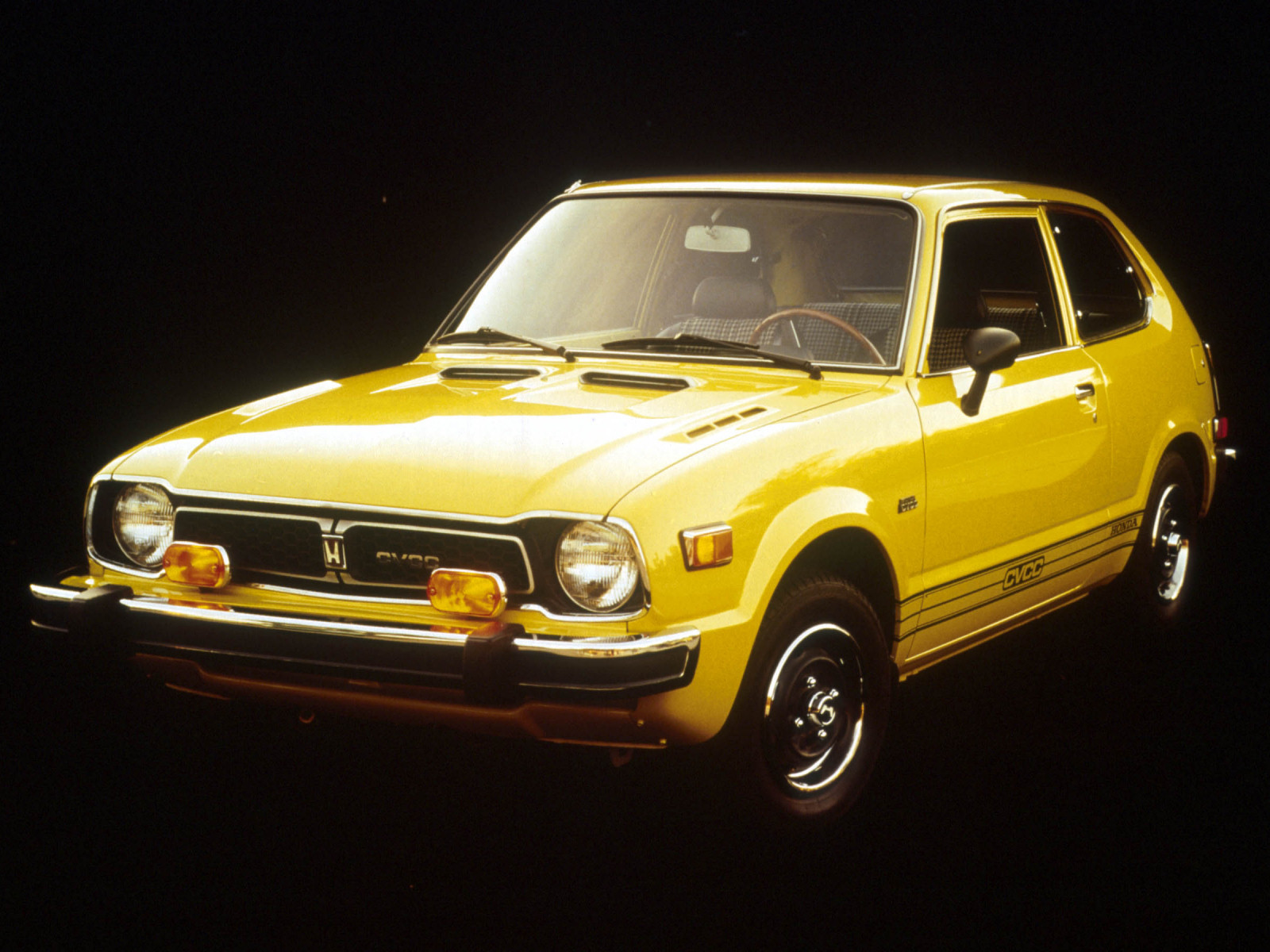
The Civic, launched in 1972, was Honda’s first global model and began life as a compact 3-door hatchback in its first generation.
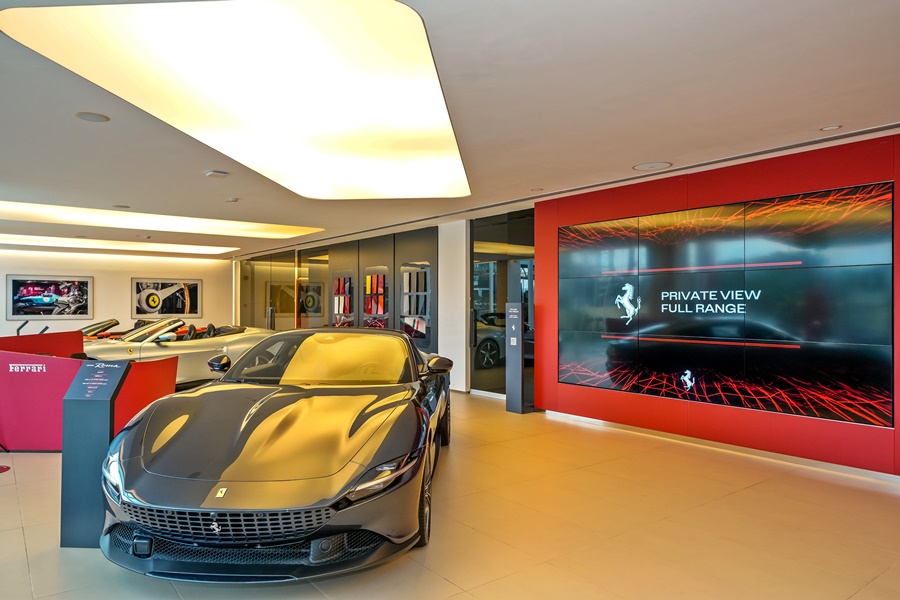
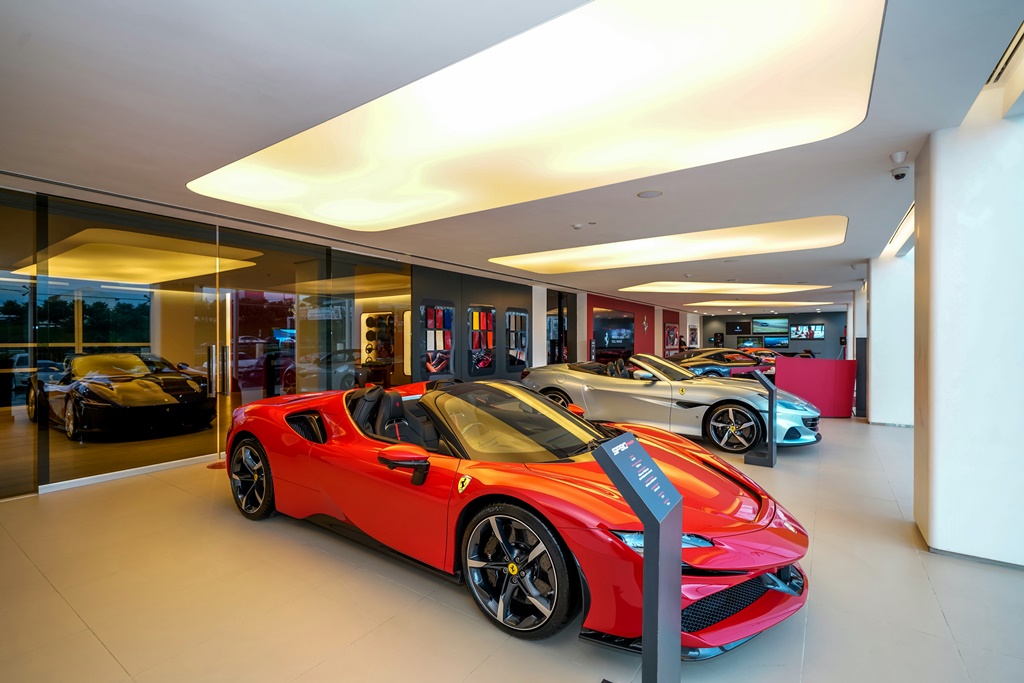
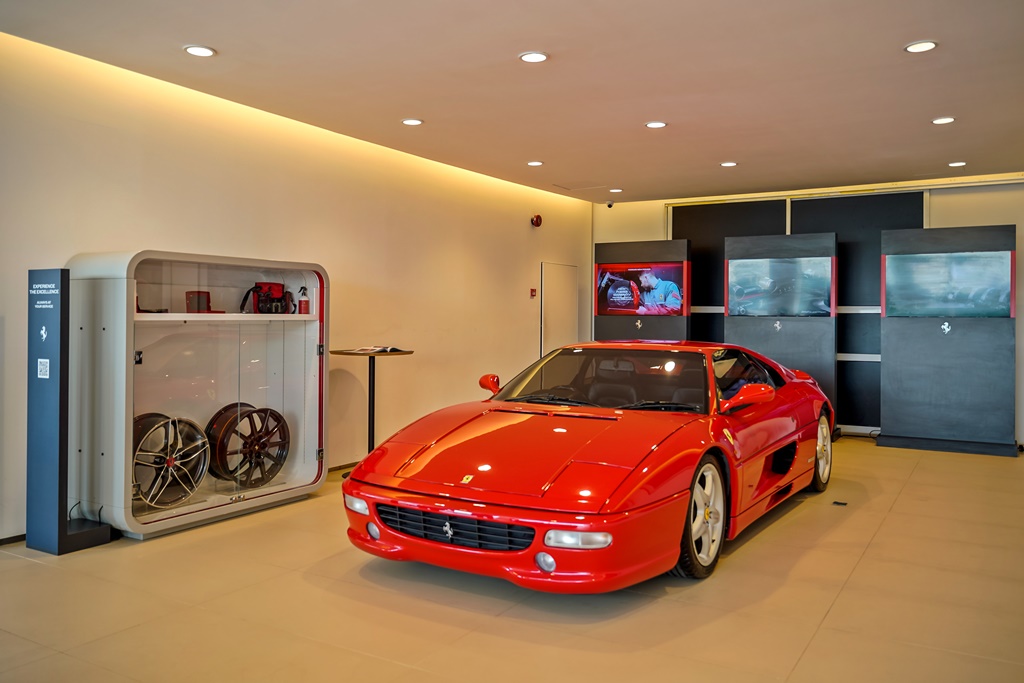
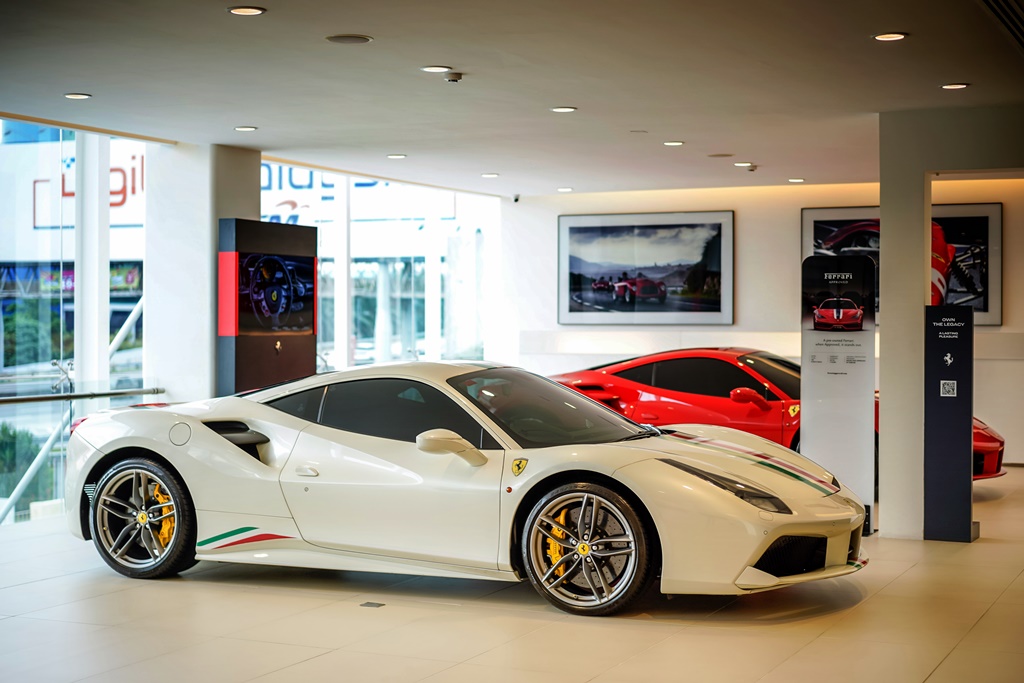
For Ferrari-lovers and those who are thinking of buying one, Naza Italia recently organized an event to take them on a unique ‘journey’ through the Ferrari universe. The 3-day private viewing event was an immersive experience, offering specially invited guests a glimpse of the brand’s full range and connecting them to the heart of Ferrari in Maranello via the latest technological innovation.
Using tablets and augmented reality (AR) gear, the guests went on a virtual tour as they moved through 6 different exploration zones where they saw the entire line-up of Ferrari models currently available worldwide. A ‘journey presenter’ accompanied them through each zone as well.
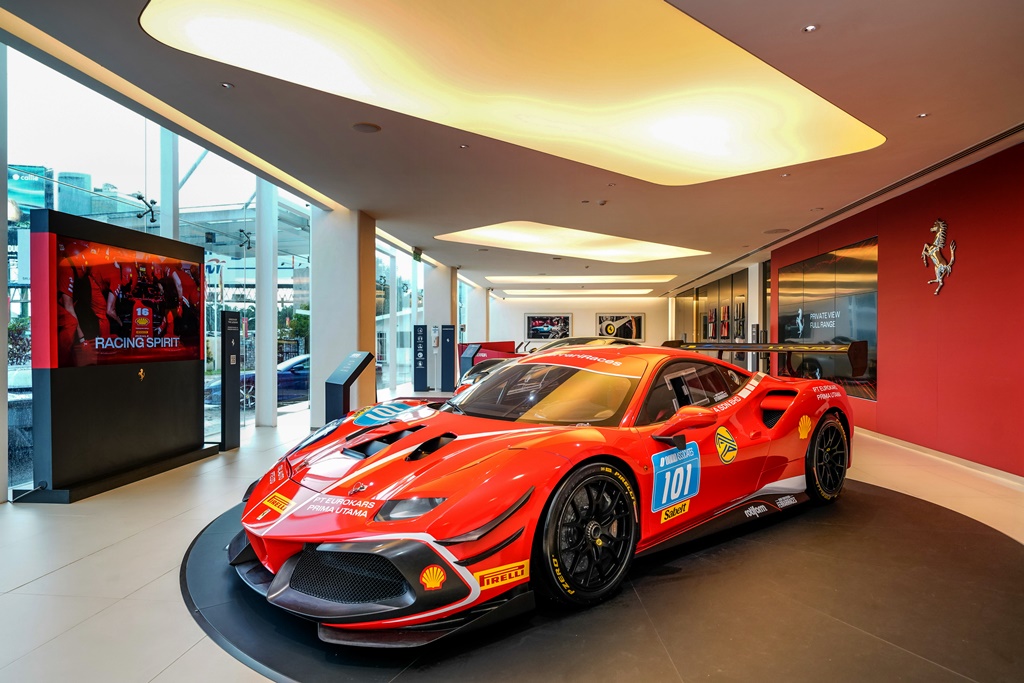
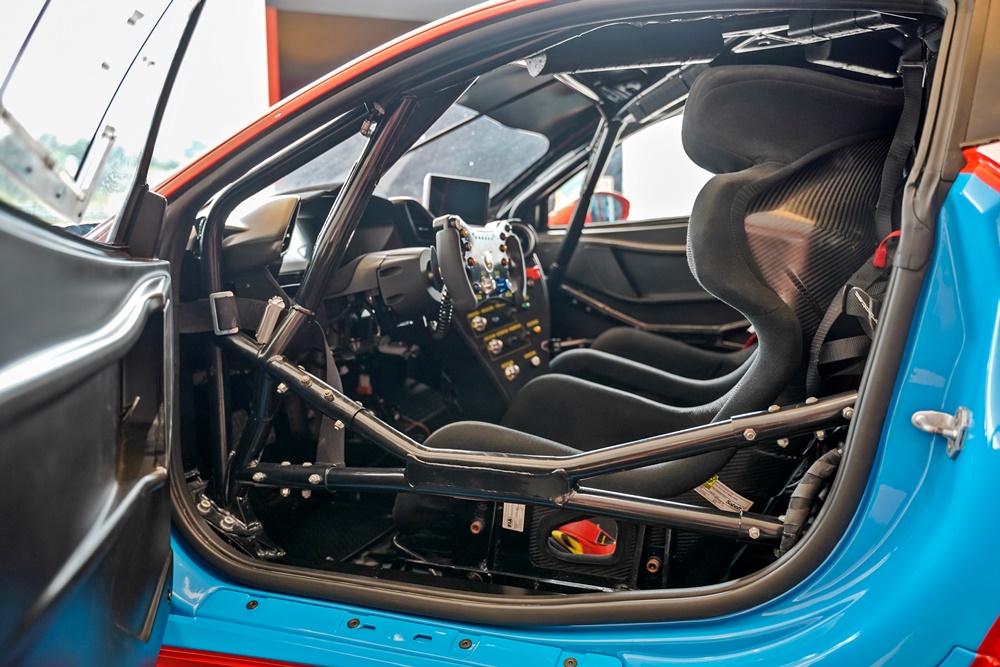
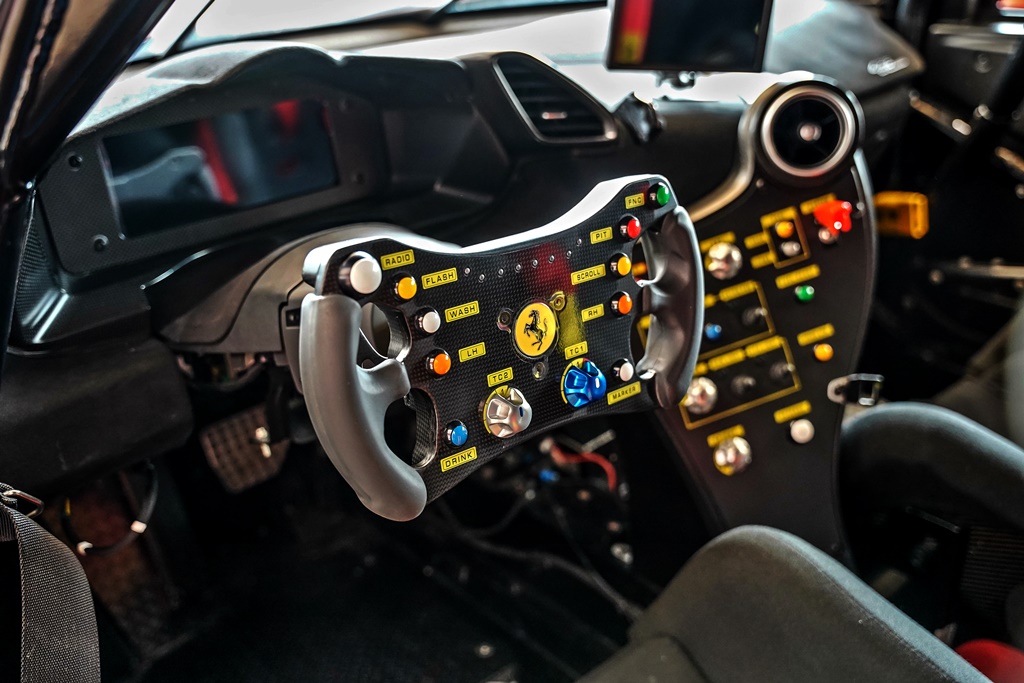
The tour included a close-up view of the 488 Challenge Evo and as an introduction to Ferrari’s DNA – its racing spirit, innovation and technology, commitment to craftsmanship, passion for performance and distinct design elements.
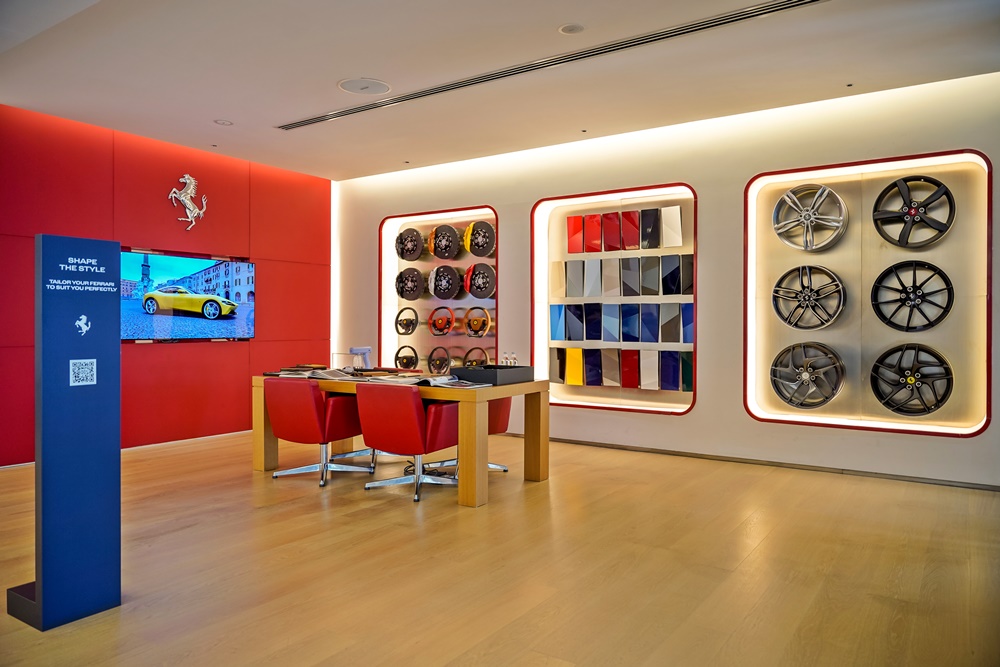
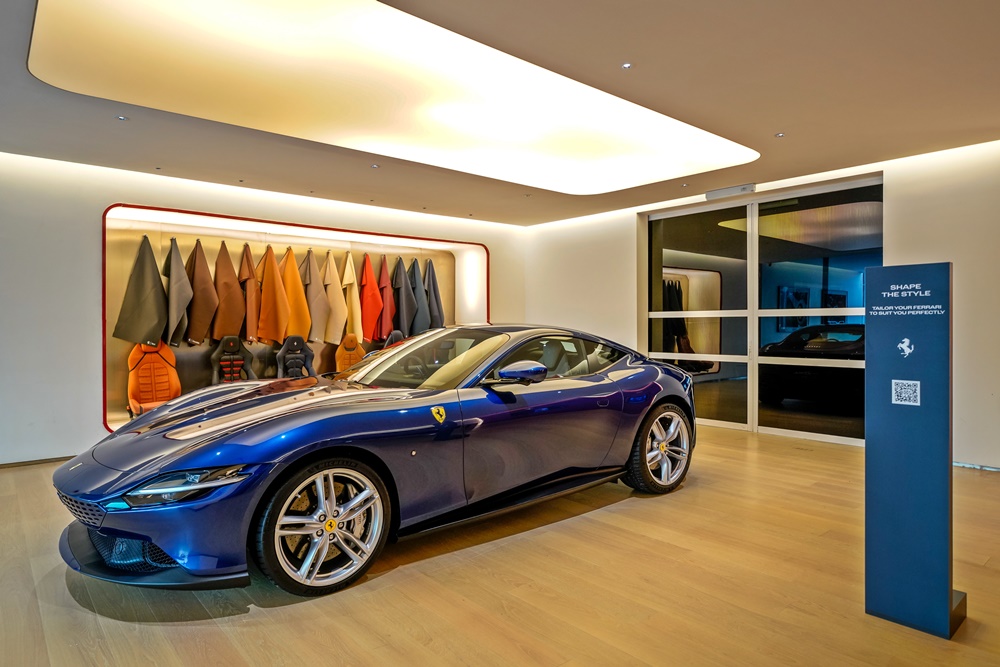
Another zone displayed the latest models available for purchase, such as the SF90 Spider, the Portofino M, and Roma. The personalisation zone was in the Atelier, where guests were encouraged to get creative and have a taste of what it feels like to customize their own Ferrari. They could look through a broad selection of materials and putting their designer skills to the test with the car configurator.
In the community area and lounge, guests could also have the ‘360 Factory Experience’. This allowed them to ‘visit’ the Maranello factory using the dedicated MyFerrari app. Here, with Ferrari’s world of superlative sporting experiences and activities, owners got to experience being part of the Ferrari family. They viewed the Corse Clienti, Passione Ferrari, Esperienza Ferrari and Calvacade events, among others.
For those considering a pre-owned Ferrari, there is Ferrari Approved, a certification programme that puts pre-owned Ferraris through a comprehensive 190-point check by the brand’s trained technicians. Ferrari Approved cars were on display for guests to view, and they could also learn about the Ferrari Genuine (Out-Of-Range) accessories and kits that are exclusively designed and developed to give Ferrari owners the ability to make their car unique.
The tour concluded with an in-depth look at the brand’s aftersales services and maintenance programmes such as Genuine Maintenance, MainPower and Ferrari Premium. Also showcased in this zone was a collection of Ferrari Genuine (In-Range) accessories.
When you pay over a million ringgit for a car, you would definitely want it to be special even though it is likely to be one of the few in the country. After all, if you can pay that much, what would be a few hundred thousand more to customize it to exactly how you like your car to be. The premium and luxury carmakers have such customization programs and now Bugatti also offers it officially with Bugatti Sur Mesure. The program is in response to ever-growing demand for personalized Bugatti creations.
Bugatti Sur Mesure, translated to English, means ‘tailored’, and it builds upon the marque’s distinguished history of coachbuilding, handcrafted interiors, paint finishes, embroidery and bodywork. The collective expertise of skilled designers and engineers is drawn upon for ultra-customized designs, materials and finishes.
As part of the official program, with one-to-one support from the Bugatti Sur Mesure Team, customers will be guided through the world of possibilities open to them. When configuring a Bugatti, the sheer number of exterior colours and leather finishes is nearly unlimited, but Bugatti Sur Mesure can take a further step and create a truly unique piece of personalized automotive art.
In recent years, Bugatti has showcased the depth of its ability to personalize its hyper sportscars to an ever greater degree. For example, in 2013, the Veyron ‘Les Legendes de Bugatti’ series saw 6 exclusive model editions, each personalized with unique exterior and interior finishes, celebrating individual heroes of the marque.
2019 witnessed the arrival of the Chiron1 ‘Zebra 1 of 1’ – a special commission for a customer in Qatar. Featuring an elaborate Titanic Blue and Gunpower Grey colour scheme, the car was hand painted by Bugatti’s talented craftspeople over the course of more than 3 weeks.
This year, the Divo2 ‘Lady Bug’ made its debut with a highly complex geometric-dynamic algorithmic fading pattern. The pattern was developed over 18 months for the Divo’s bodywork, illustrating how Bugatti will push the boundaries in making customers’ visions become reality.
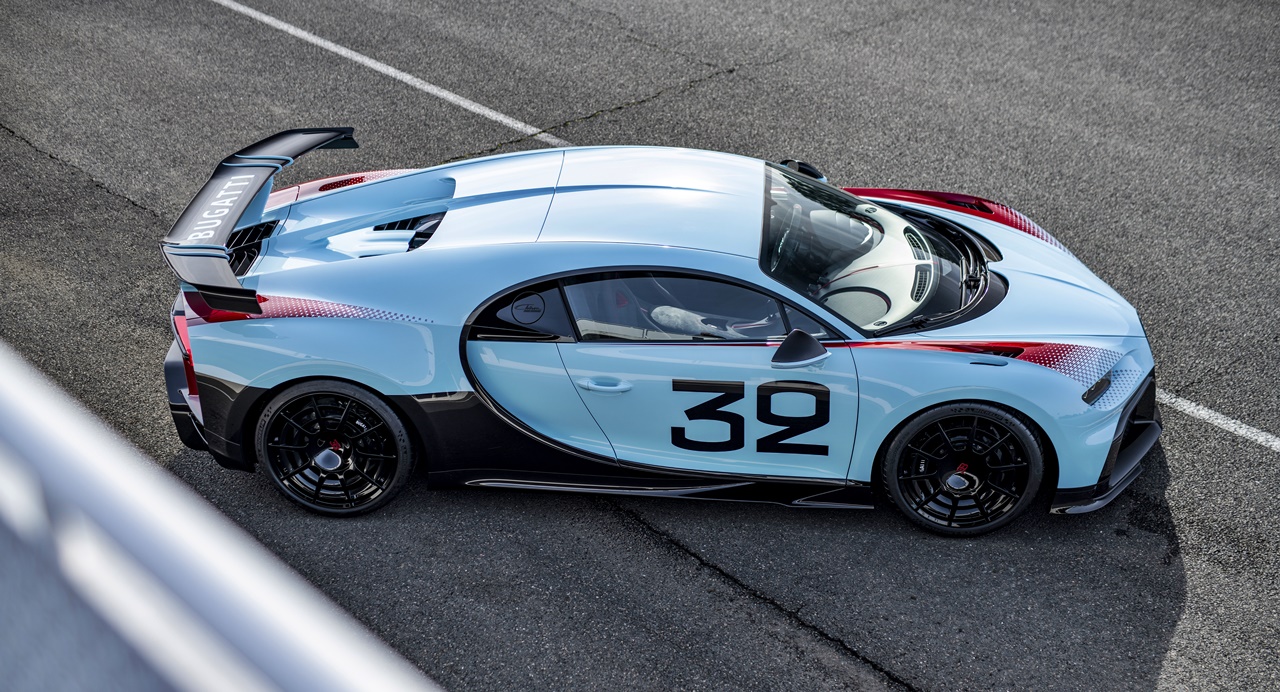
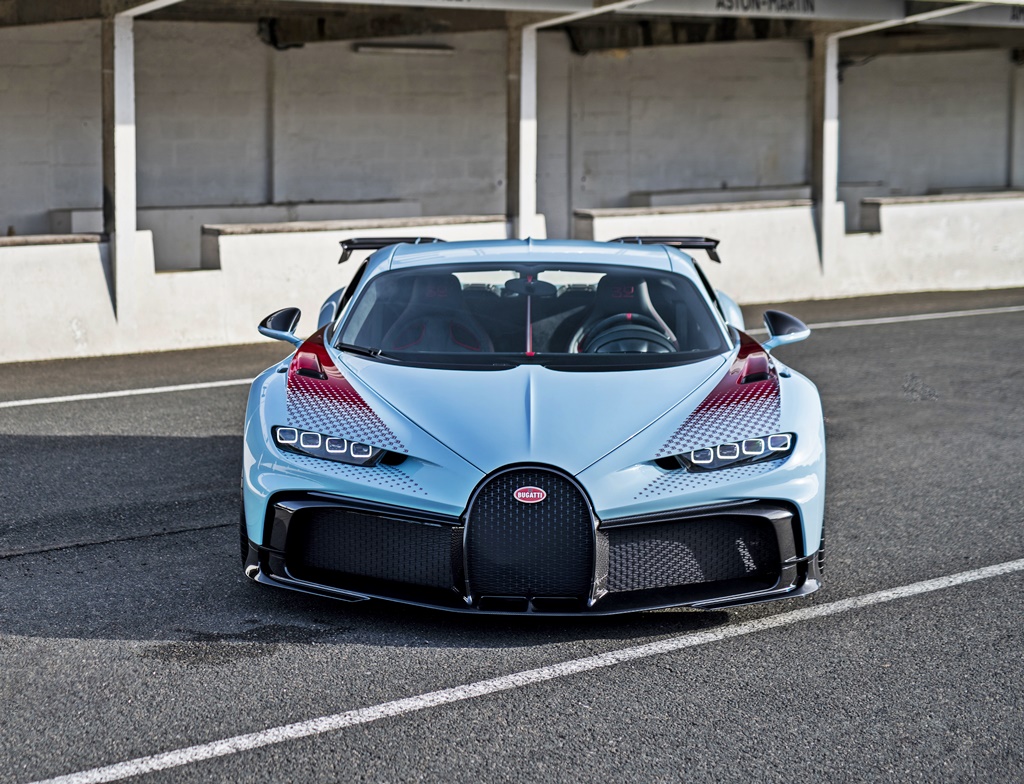
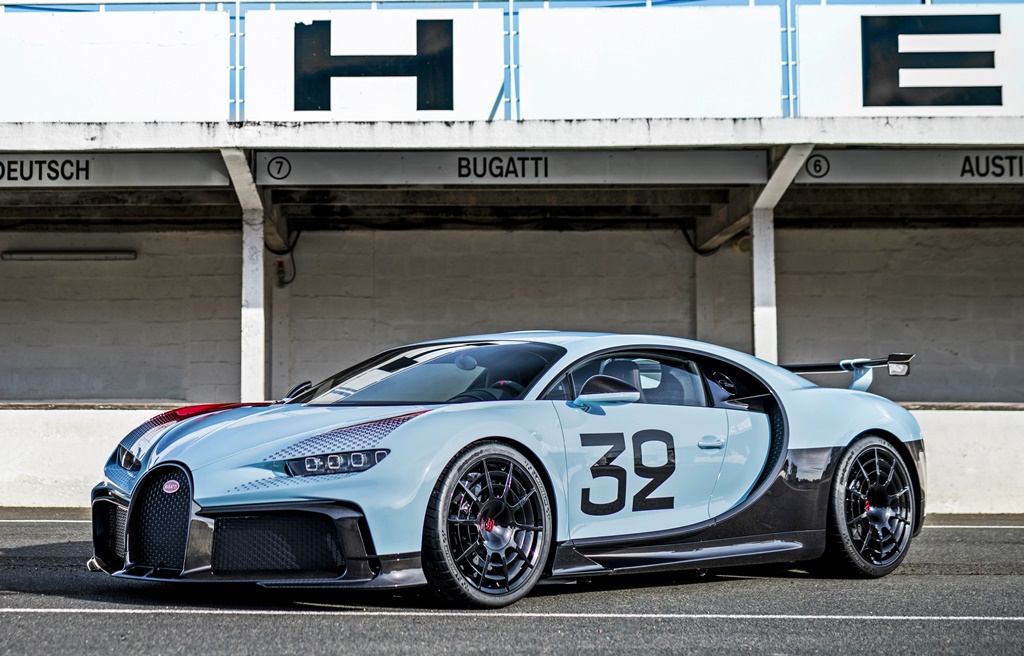
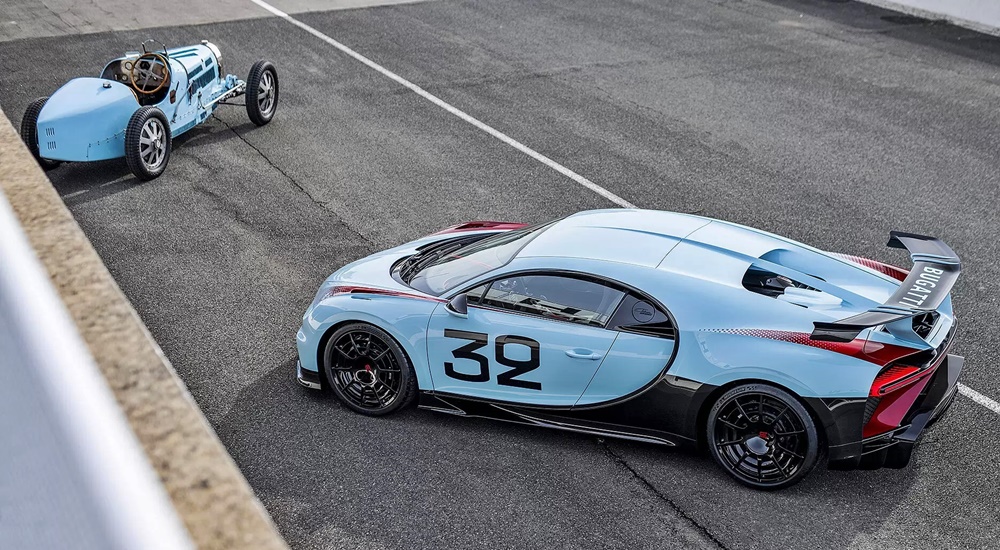
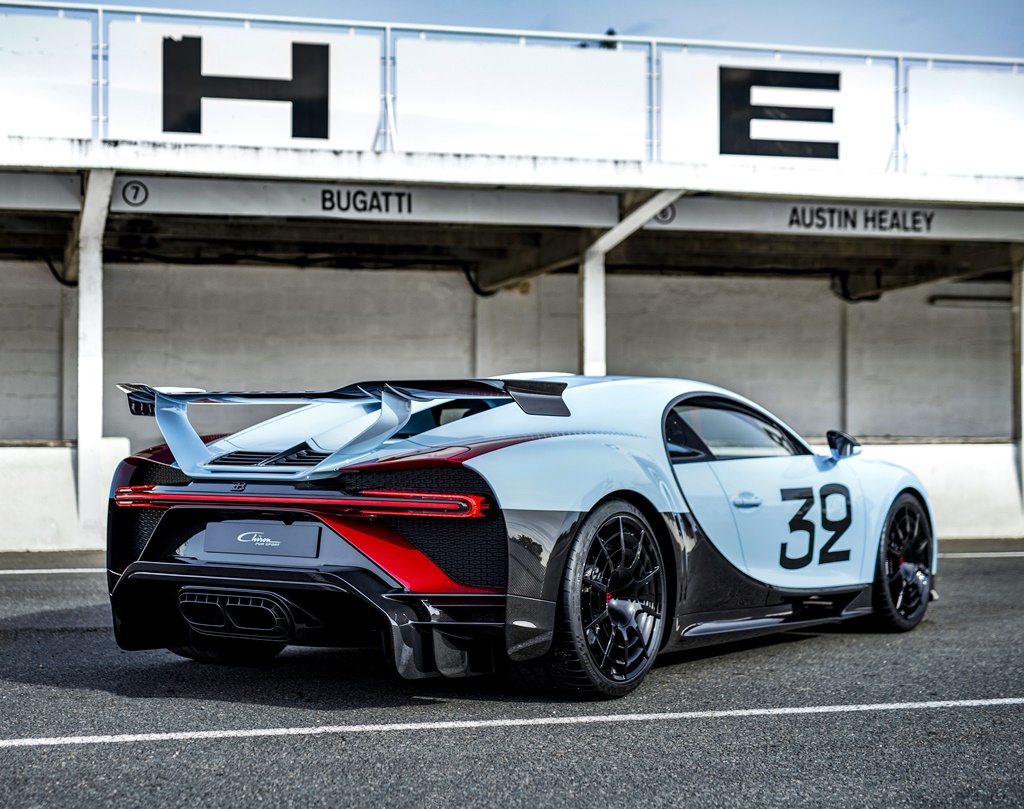
The first official ‘Sur Mesure’ creation for a customer is a Chiron Pur Sport inspired by the 20th century heroics of renowned racing driver, Louis Chiron. Early racing pioneers who piloted Bugatti’s prototype racing cars continue to fascinate and are admired for their bravery and talent displayed on-track. Today, their spirit lives on and is the very source of the custom design of the unique Chiron Pur Sport.
Among Louis Chiron’s countless victories at the wheel of a Bugatti was his legendary 1931 win at the French Grand Prix, together with Achille Varzi, in a Bugatti Type 51 emblazoned with the number ‘32’. This number – painted entirely by hand – now adorns the sportscar as just one of a number of custom-made elements developed especially for this customer.
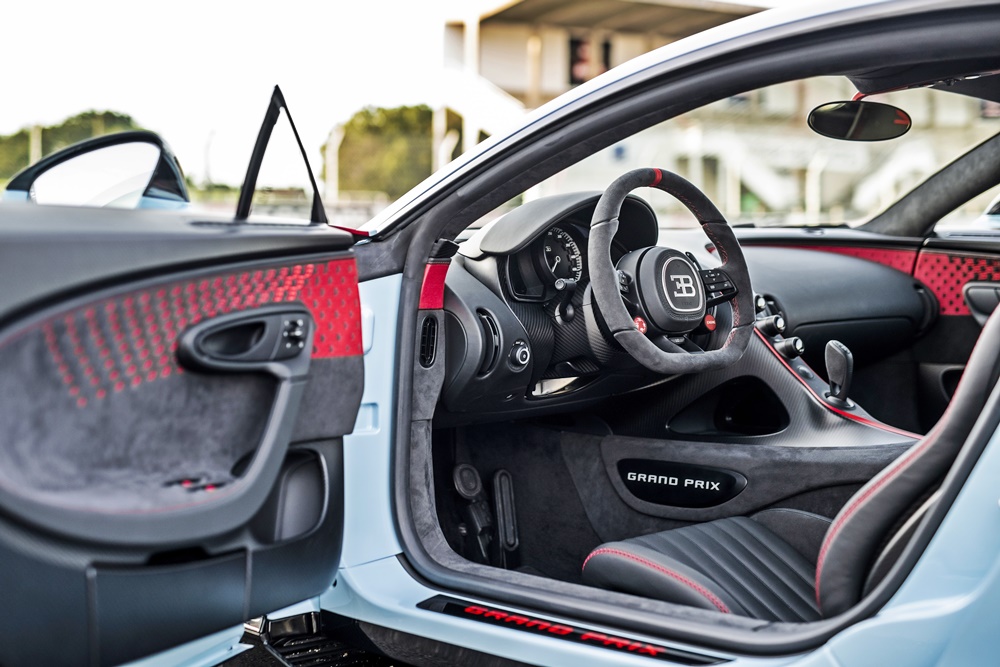
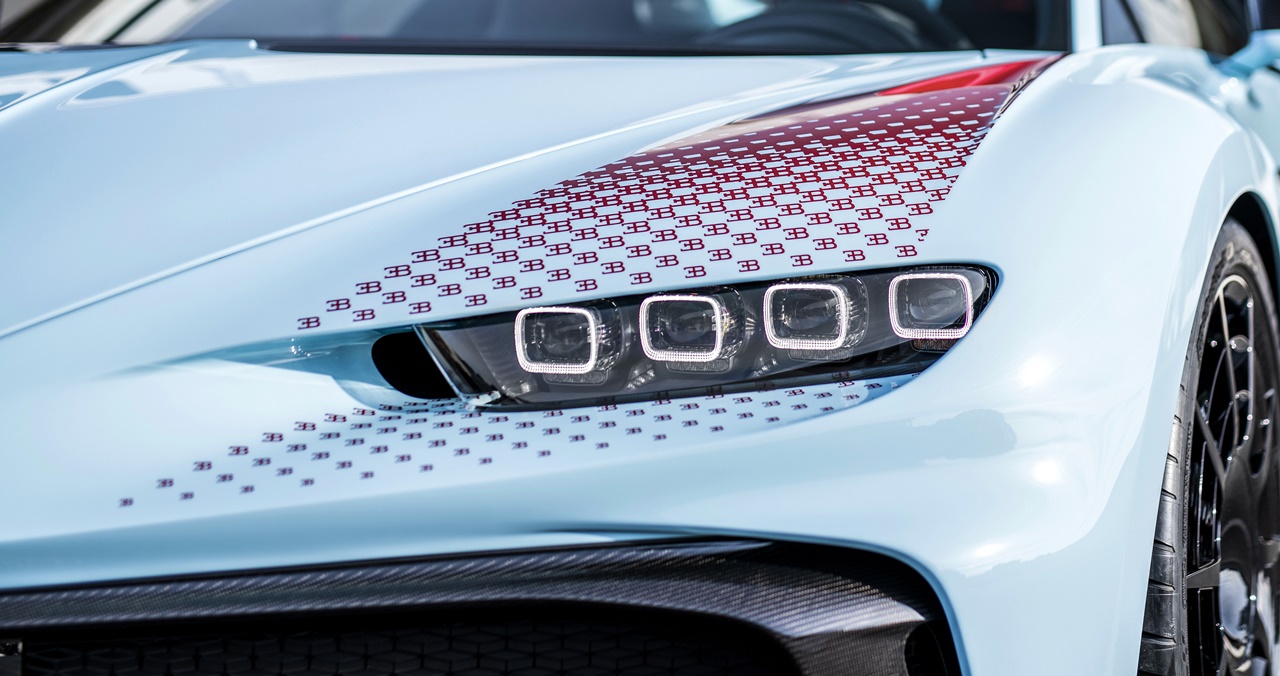
Two new exterior colours were created to pay homage to the legendary Grand Prix racing Bugattis of the 1920s and 1930s. The Bugatti Sur Mesure team also developed a new fading ‘EB’ painted pattern, applied meticulously by hand, which is complemented by a multi-layer stitched ‘EB’ motif on the door panels. Both required new techniques and processes to be developed.
The ‘32’ and ‘Grand Prix’ motifs continue throughout the cabin, including a special centre console inlay in black anodized aluminium, with a silver hand-painted inscription. The motifs extend to the door sills, headrests and entry lights. Subtle branding distinguishing the model as a rare and unique product of the program can also be found. Many of the customer’s ideas will also be available to more owners of the Chiron Pur Sport.
“For many years, we have worked with our clients to create their own personal vision of the ultimate hyper sports car. It has always been a highly tailored process but as an ever-increasing number of our clients request detailed and intricate customization, the launch of Bugatti Sur Mesure will ensure we can cater to their desires with the perfect level of detail required from a Bugatti,” said Hendrik Malinowski, Bugatti’s Managing Director for Sales and Marketing.
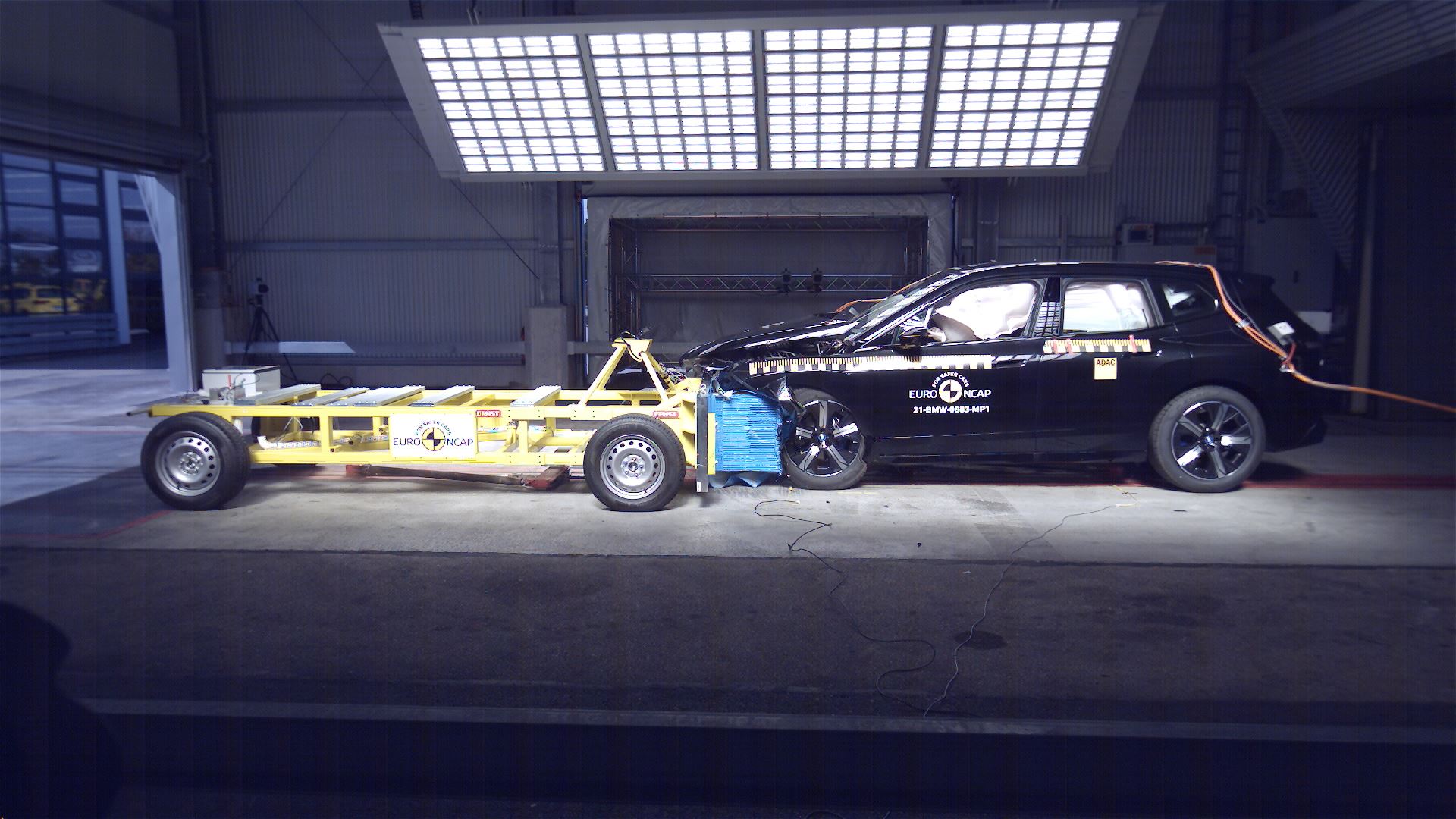
Before Euro NCAP (New Car Assessment Programme) came into existence, the safety performance of cars was not known to the public. While carmakers conducted their own tests, they did not necessarily share the results with the public. Of course, as responsible companies, they constantly aimed to make their products safer and to provide the best possible protection for occupants during an accident.
But just how safe was a car? That was not known until EuroNCAP was established in 1996 and began to crash new cars to see how they performed. EuroNCAP’s findings were made public in a standardized form so that comparisons could be made for car-buyers to make informed decisions. Cars that scored better would usually have better safety features, which added cost, and it was up to buyers if they wanted to pay more for the extra protection.
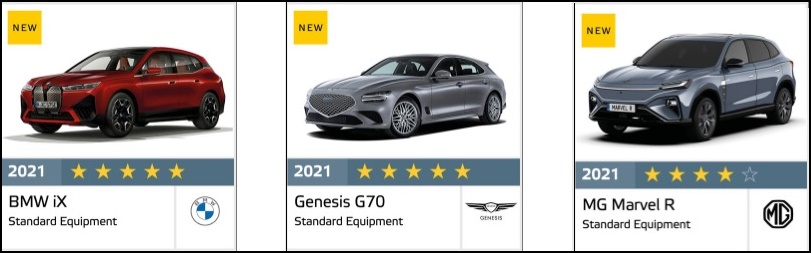
Most new models tested by EuroNCAP can score the maximum of 5 stars.
EuroNCAP focussed on new models sold in the European markets and for many years, their results were also used by carmakers when marketing the same models in other regions. In time, it was realized that due to overseas production of certain models, there could be differences in the safety performance due to engineering differences in some areas. This led to the establishment of NCAP organizations in other regions which focussed on models which were made and sold in those regions.
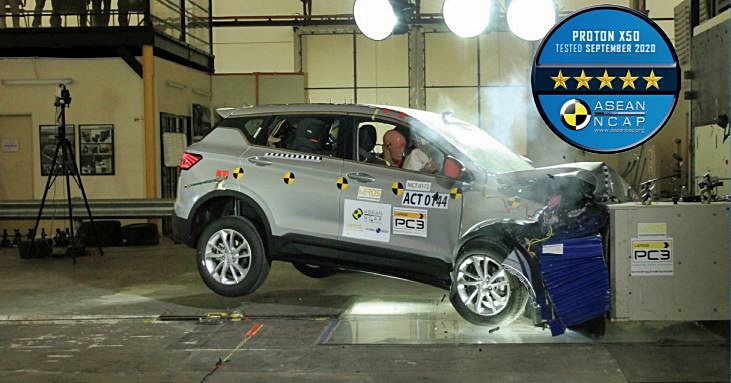
ASEAN NCAP is one of them and has been evaluating new models sold in the region for the past 10 years. In fact, ASEAN NCAP can be credited for pushing carmakers to raise safety standards with the addition of certain safety systems and features which are required in order to score the maximum number of stars.
The existence of these NCAP organizations has brought about discoveries of the differences in performance of some models in different regions. There have been cases of a model sold in Europe offering much poorer protection when built for sale in South American markets. Likewise, a number of cars in India have been found to scored poorly when subjected to crash tests.
With such information made public, manufacturers have had no choice but to make improvements to make their vehicles safer and more in line with global standards. Although NCAP results are not referred to when vehicles are inspected by local authorities in various countries, they are still important as car-buyers refer to them. A high score would give more confidence to a customer who in interested in a particular model, so manufacturers work hard to achieve the best score which is typically 5 stars.
Many new models can now score maximum stars and carmakers like Toyota have been recognized for offering the most models with 5-star ratings in ASEAN. It may seem that in this day and age, most new vehicles will be able to get a few stars, so it is shocking to know that there are some models that fail to get even a single star!
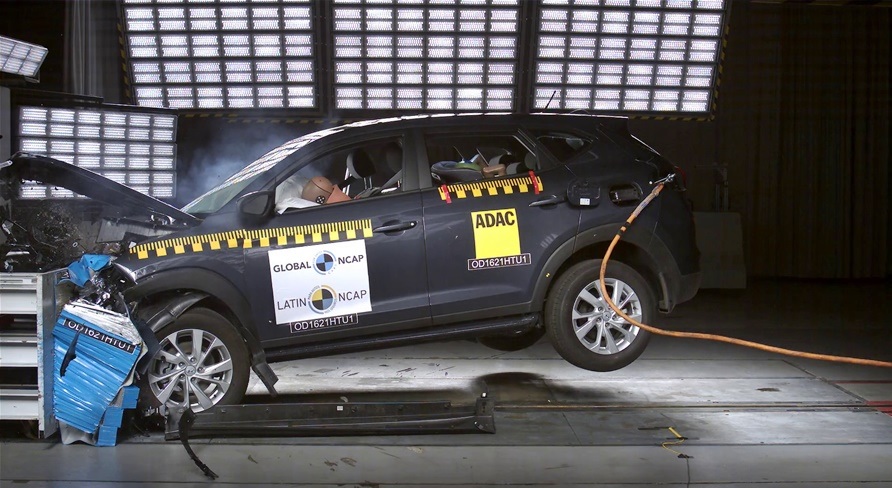
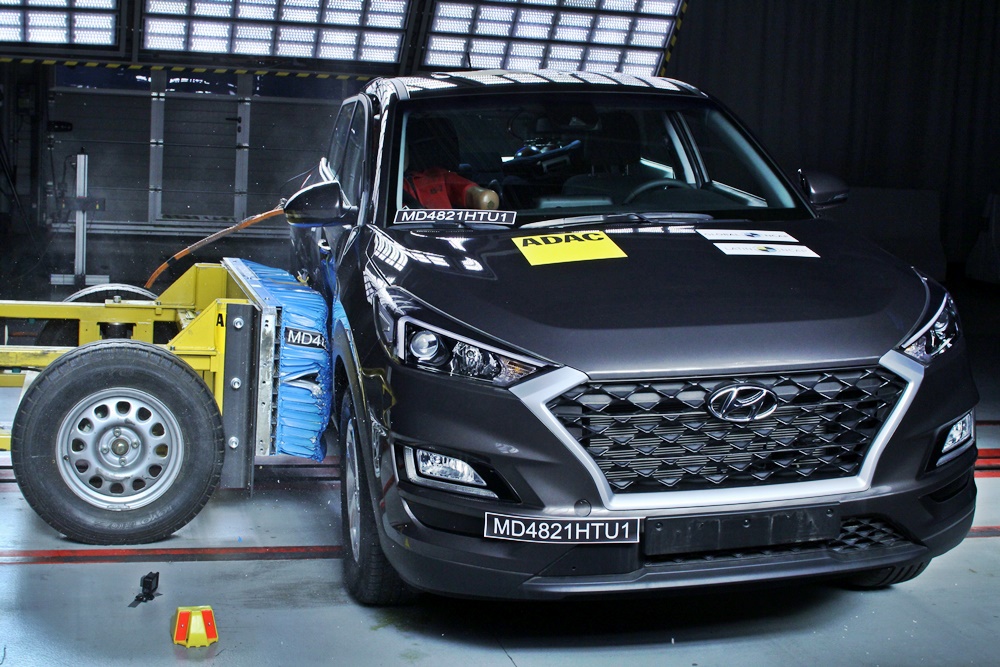
This has been the case with the latest Hyundai Tucson which was tested by Latin NCAP which evaluates models sold in the Central and South American markets. The model was unable to be given even a single star which was disturbing because a Tucson tested by EuroNCAP a month earlier had been able to get 5 stars. The initial reaction of many people was that the model built for Latin American markets was not engineered differently or lacked too many safety features. However, it was learnt that the model tested by Latin NCAP was actually an older fourth generation one, whereas EuroNCAP had tested the latest fifth generation model.
The Tucson tested actually scored well in adult protection for frontal and side impacts, as well as in whiplash protection as it at least has two front airbags. However, with no side airbags and inadequate chest protection as well as poor child occupant protection, its overall score could not even rate one star, not to mention that it also did not have any form of electronic stability control.
“Latin NCAP is disappointed by Hyundai’s attitude to Latin American consumers’ health and safety. It is unbelievable that an SUV like the Tucson does not offer side impact protection and ESC as standard. The long delay in replacement parts delivery is also concerning. We make an urgent call to Hyundai for a dramatic change in basic safety strategy in LAC and level it to its policy in Europe, Australia and USA, among others,” said Alejandro Furas, Secretary General of Latin NCAP.
“Once again, thanks to Latin NCAP, we can know the risks that certain corporations, mostly Latin Americans, expose us to due to the sale of low safety vehicles. Hyundai gives us an unpleasant surprise to see that one of its most popular models in the region, the Hyundai Tucson, which has had significant sales in our countries, gets 0 stars safety. This is one more example of the discrimination in vehicle safety that the inhabitants of the region have to suffer from some car manufacturers that use our region as a sub-standard market to maximize their profits,” added Stephan Brodziak, Chairman of Latin NCAP.
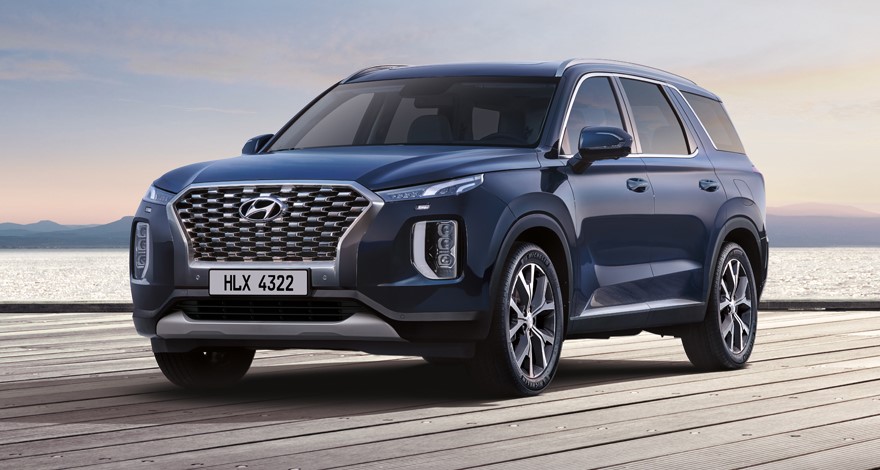
Hyundai models sold in Malaysia, like the forthcoming Palisade SUV (above), are high-scorers in NCAP tests as Malaysian regulations require high safety standards.
A zero-star result would certainly discourage most buyers and fortunately, this is not the case with Hyundai models sold in Malaysia. The Tucson is not currently sold (but has been in previous generations) but for the models imported to Malaysia, Hyundai Sime Darby Motors has been taking models with specifications comparable to those sold in Europe due to the tougher requirements of Malaysian regulations.
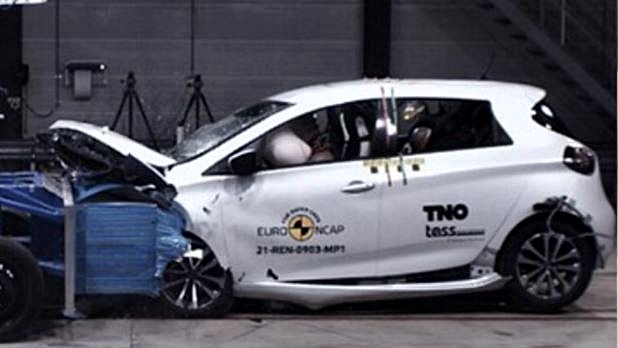
But while models sold in Europe may lead in safety performance when tested by EuroNCAP, this is not the case with every model. In its most recent series of tests, EuroNCAP found that the latest Renault ZOE EV was poorer than before – so poor in crash-tests overall, poor in vulnerable road user protection and lacking meaningful crash avoidance technology, that it was disqualified from getting any stars.
It would seem that while giving attention to improvements for the battery pack, Renault had compromised on safety elements. EuroNCAP noted that the seat-mounted side airbag which previously protected head and thorax has been replaced by a less effective thorax-only airbag, representing a degradation in occupant protection.
“Renault was once synonymous with safety. The Laguna was the first car to get 5 stars, back in 2001. But these disappointing results for the ZOE and the Dacia Spring show that safety has now become collateral damage in the group’s transition to electric cars. Not only do these cars fail to offer any appreciable active safety as standard, but their occupant protection is also worse than any vehicle we have seen in many years. It is cynical to offer the consumer an affordable green car if it comes at the price of higher injury risk in the event of an accident,” said Michiel van Ratingen, Secretary-General of Euro NCAP.