Piston.my

Formula 1

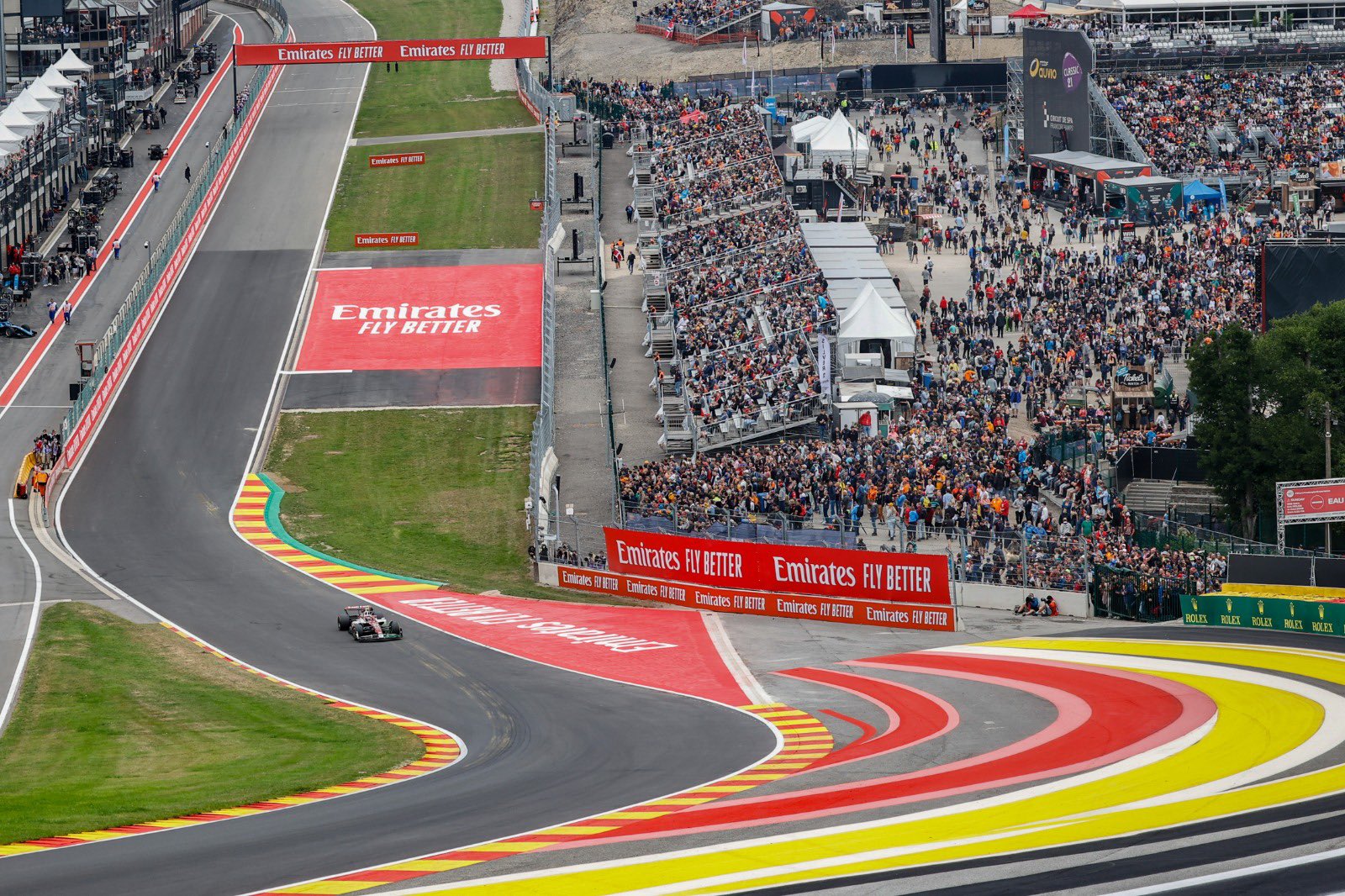
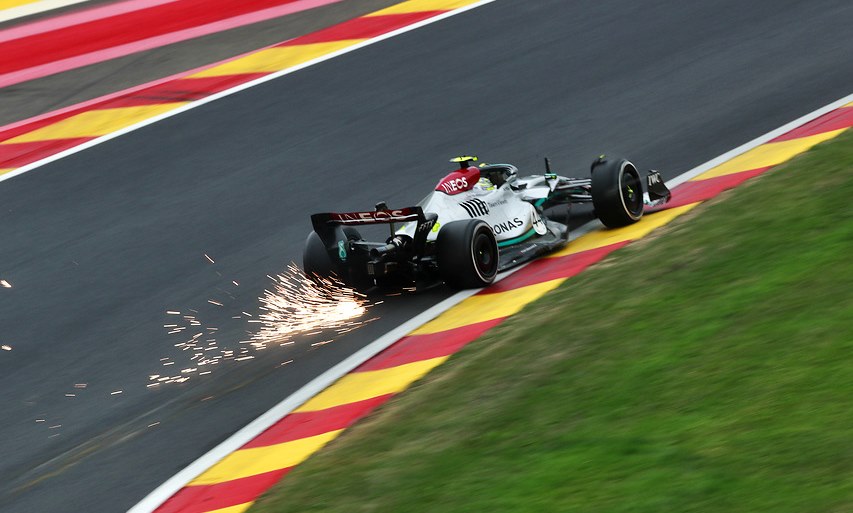
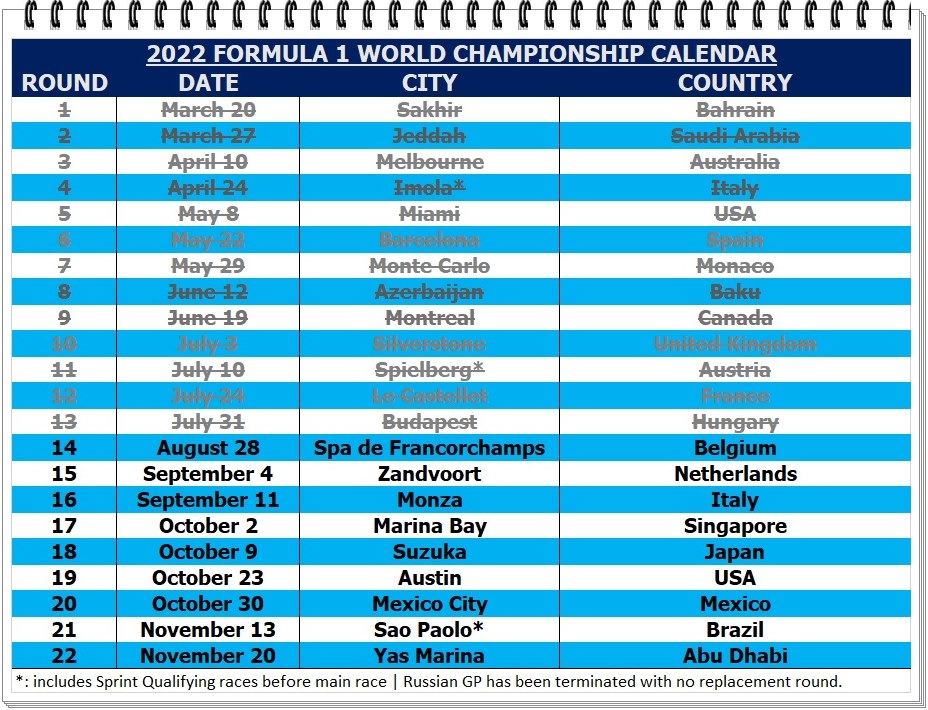
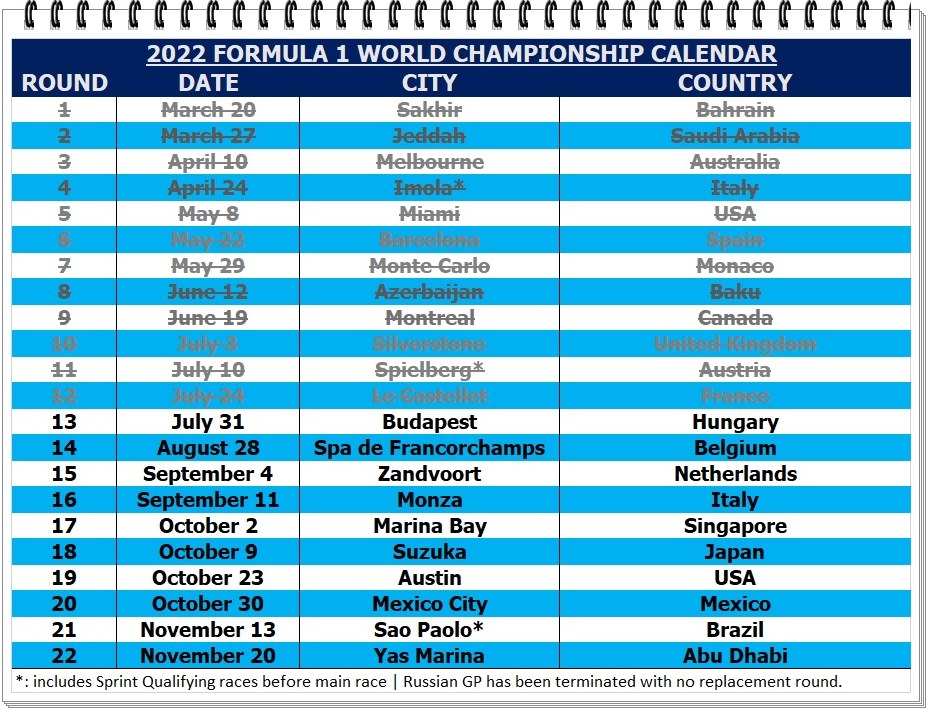
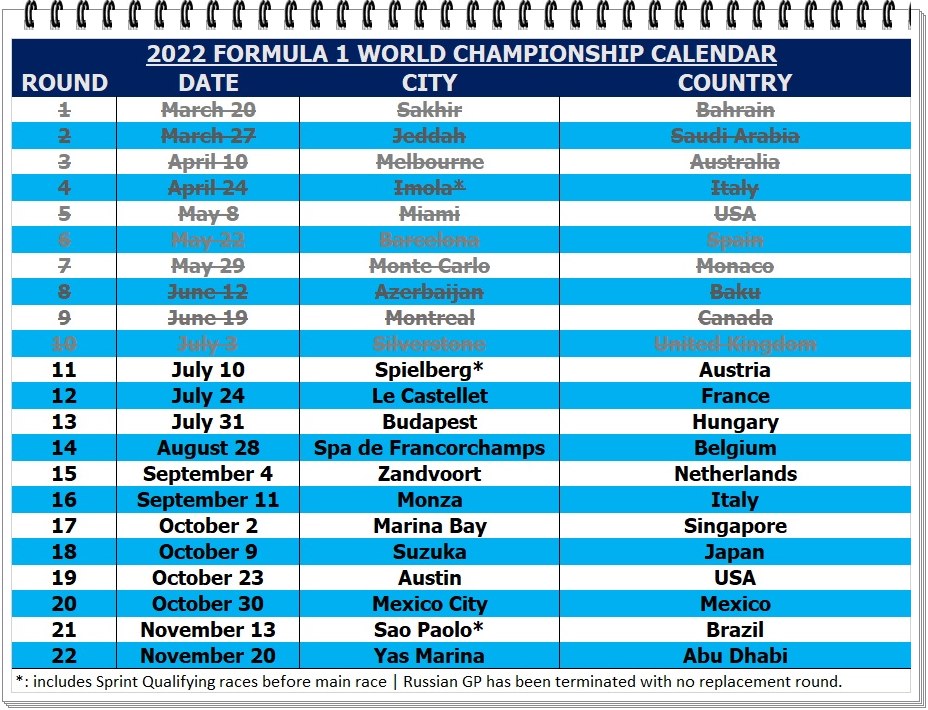
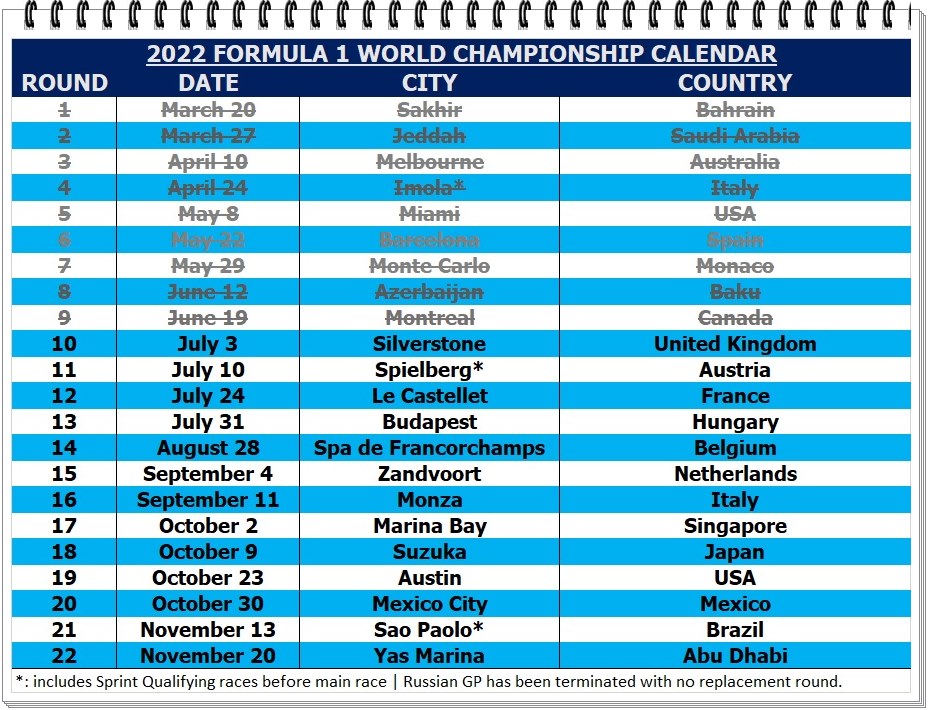
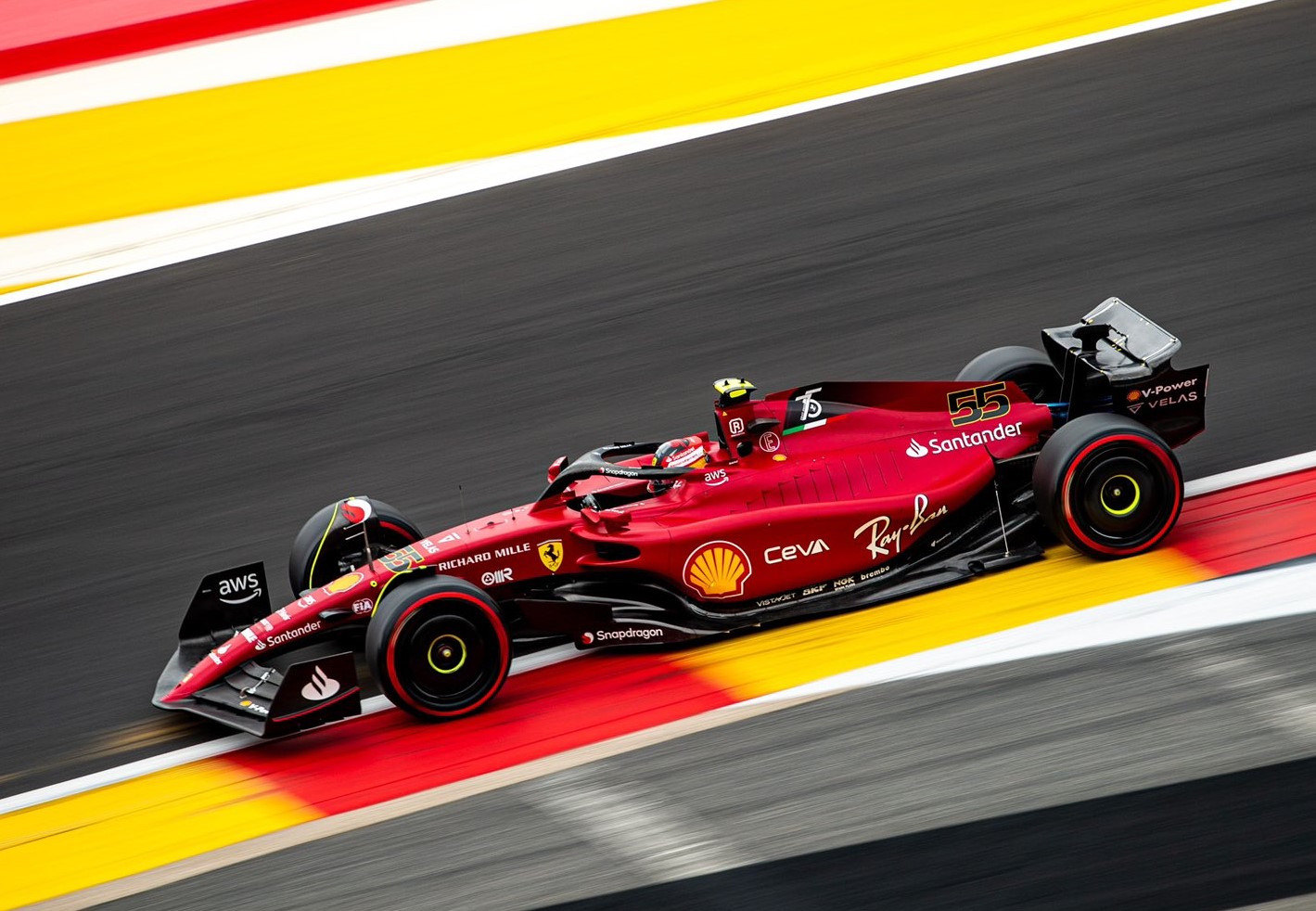
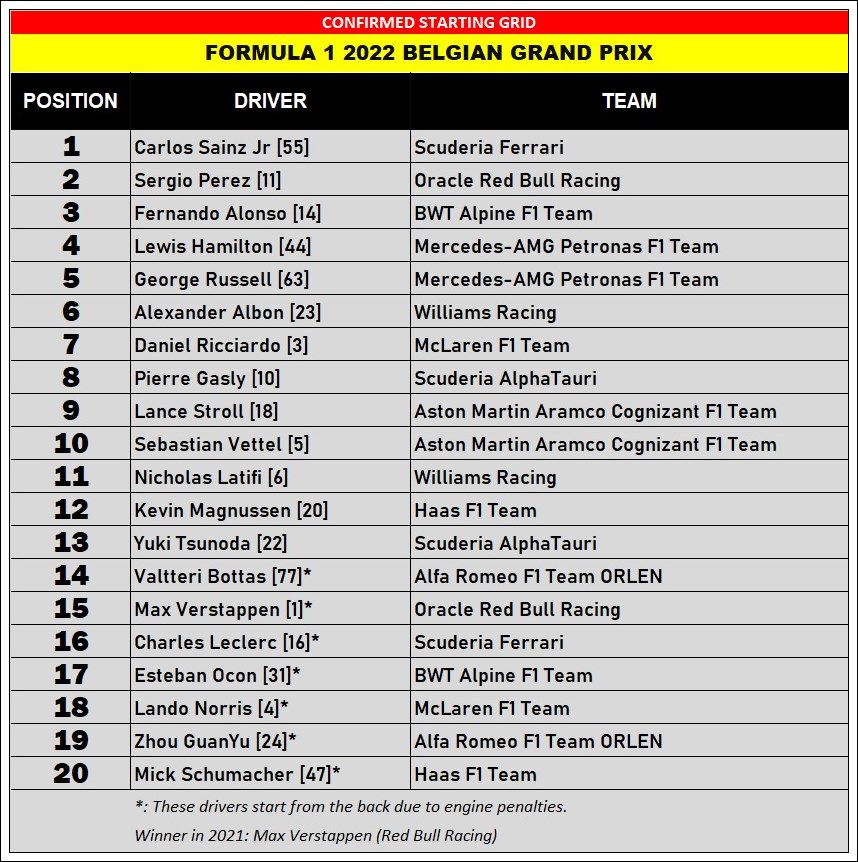
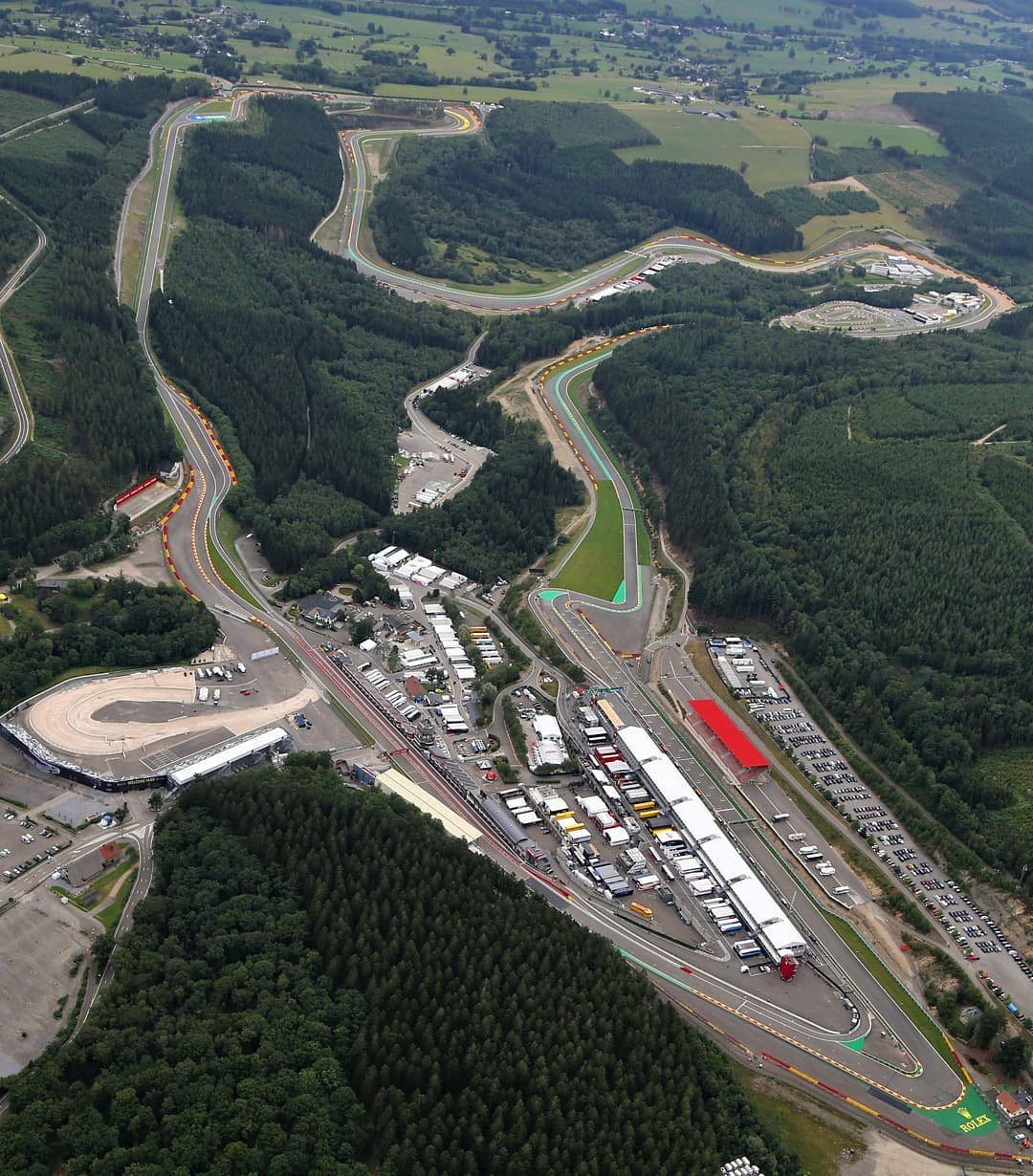
After the usual summer break, the 2022 Formula 1 World Championship resumes for Round 14, the 66th Belgian Grand Prix at the Spa-Francorchamps Circuit. Of the 66 times, Spa-Francorchamps has hosted F1 races 54 times, the other circuits being Zolder and Nivelles.

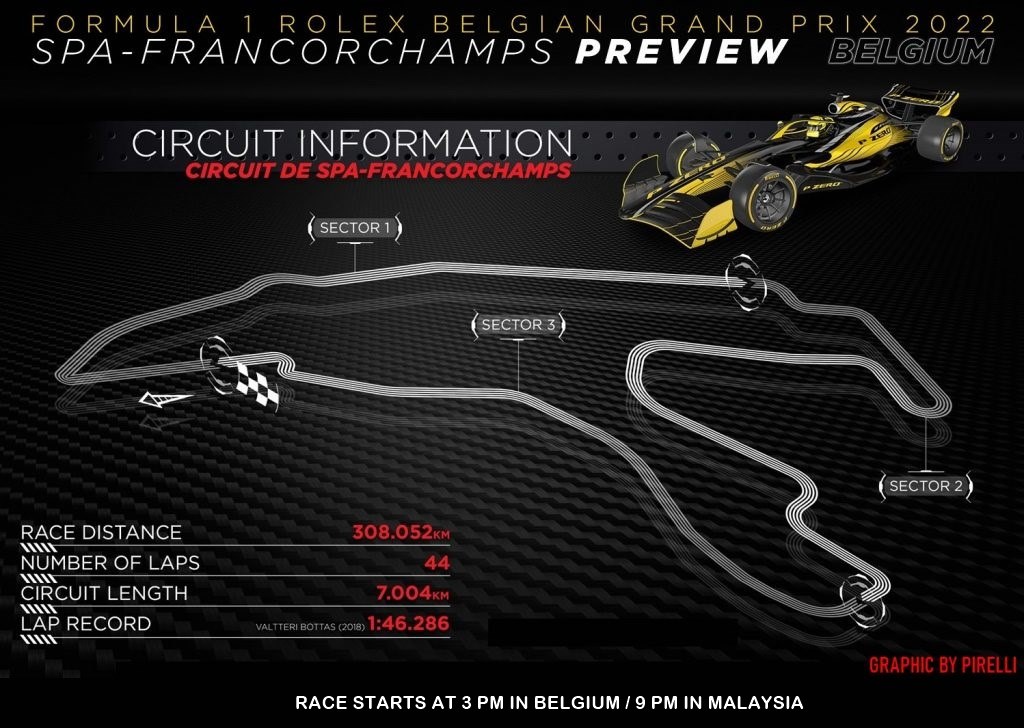
This circuit has the longest lap distance on the F1 calendar, with a length of 7.004 kms. As a result, it also has the least number of laps – just 44 – for the race to total 308.052 kms. For this year, the circuit has been modified with key changes but still retaining the challenges drivers have faced before. One of the reasons for the changes has been to bring back motorcycle racing and, in some sections, Turn 9, for example, there are two versions which satisfy the requirements of both car and motorcycle racing.
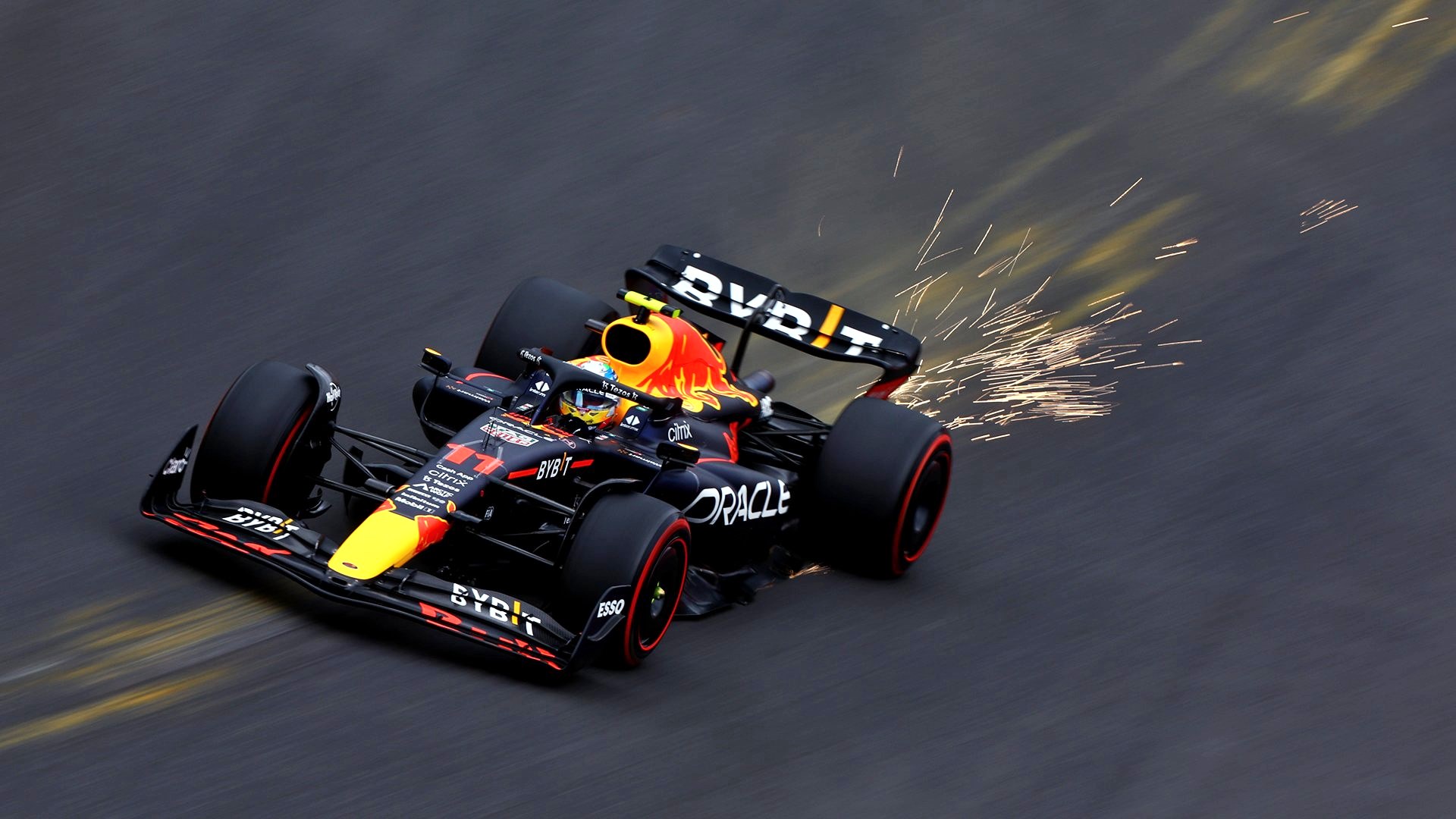
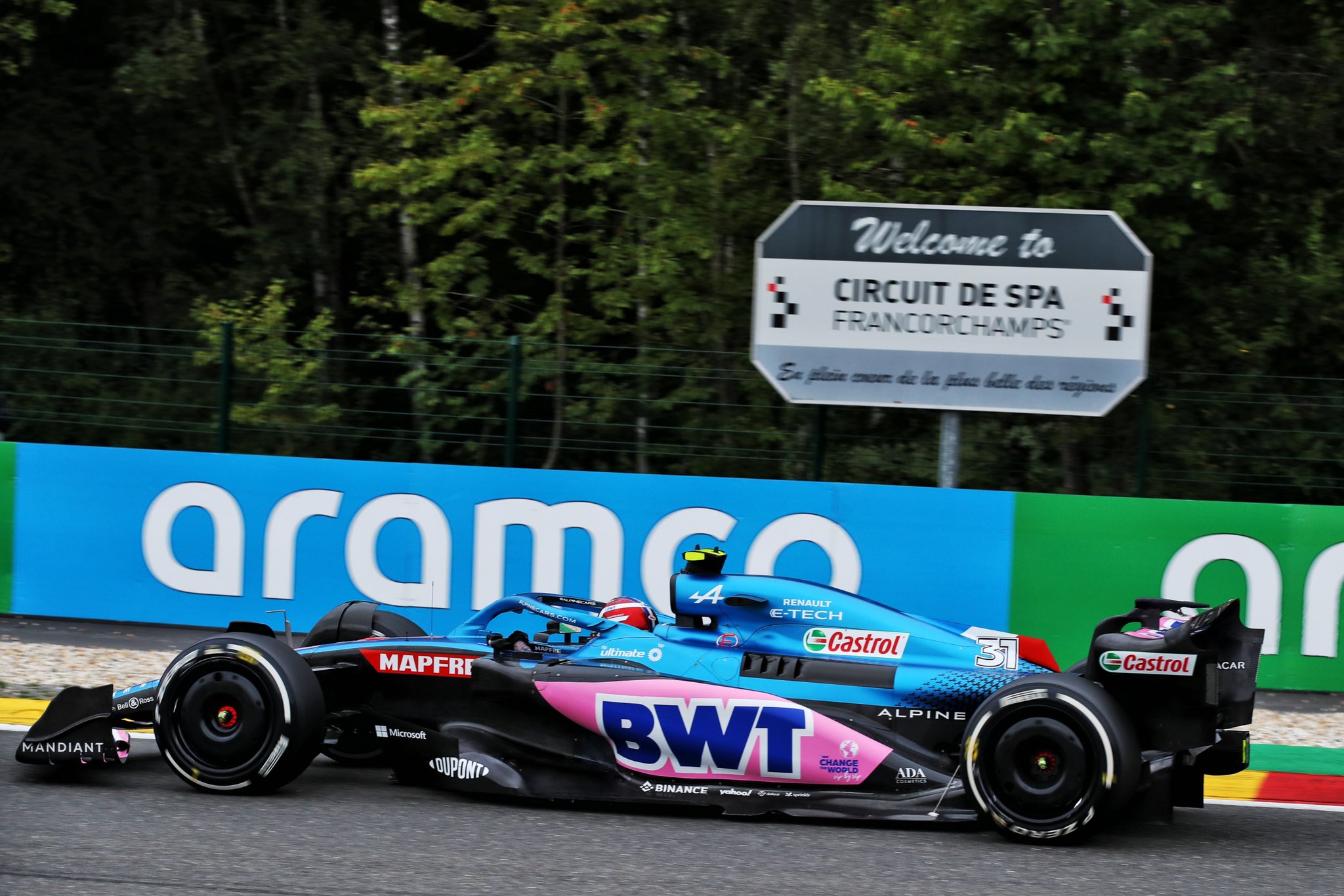
Besides resurfacing certain areas, there are changes to the run-off areas, realignment of barriers and fences and changes to kerbs. Additional gravel traps have been installed on mid-corner to corner exits to discourage drivers from exceeding track limits.
“Spa has undergone some of the biggest changes we have seen since we started going there in the modern era of Formula 1. But we know something of what to expect, thanks to the 24-hour race last month, as well as some asphalt samples that we have taken,” said Mario Isola, Pirelli’s Motorsport Director.
“In addition to some new asphalt on 5 corners, there are some new gravel traps on 4 corners, which are much closer to the side of the track. Drivers will need to pay more attention to track limits, and there’s also an increased chance of sharp gravel being dragged onto the surface. The epic nature of Spa remains unchanged though, with all the traditional challenges that make the circuit so exciting still in place,” he added.
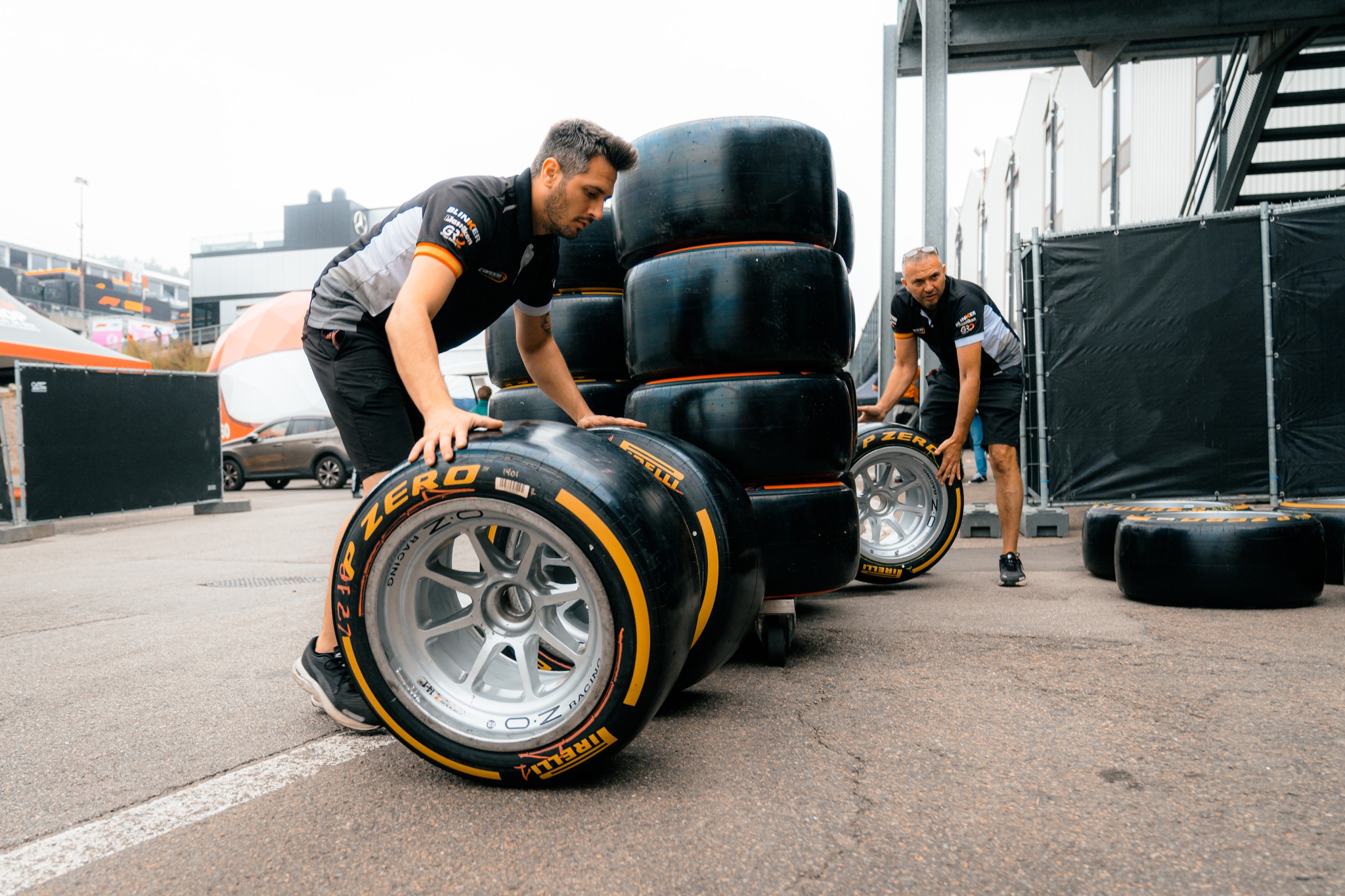
Spa-Francorchamps is one of the most demanding circuits for tyres on the F1 calendar, with its particularly high lateral loads. The famous Eau Rouge-Raidillon complex is just one of the places where tyres are subjected to multiple forces: pushed into the ground by downforce and compression, while cornering at the same time. Variable weather is always well known at Spa-Francorchamps, making an outing for the Cinturato Green intermediate or Cinturato Blue full wet tyre a distinct possibility.
According to Brembo technicians, the circuit is also demanding for brakes. On a scale of 1 to 5, it is rated 4 on the difficulty index. It is the most complete track in F1 because in just over 7 kms, it has corners and straights of all shapes and lengths. One of its distinctive features is the 3 braking sections of at least 2.5 seconds, something not shared by any other track on the calendar. ​
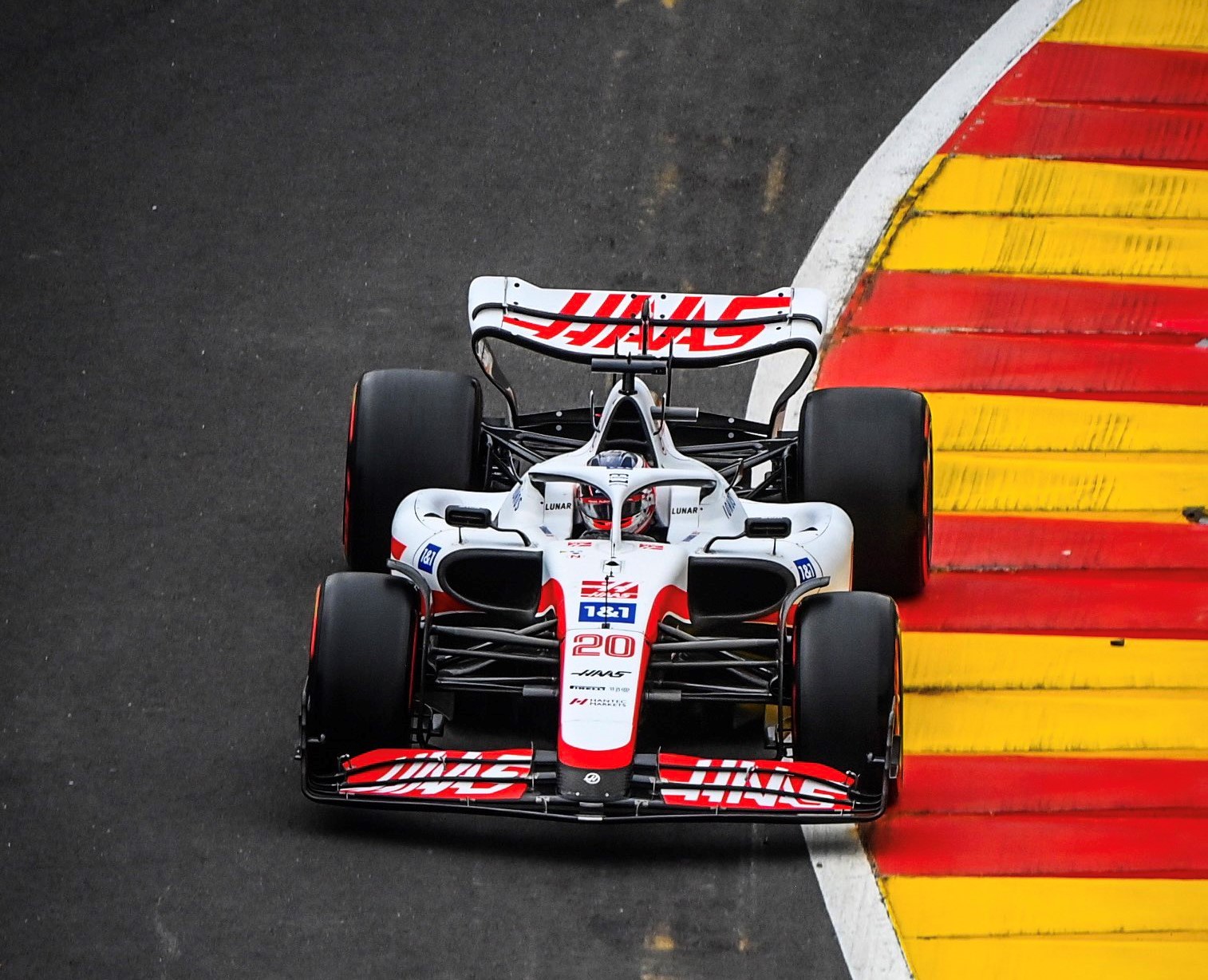
This year, as a result of the increase in wheel diameter from 13 to 18 inches on the new F1 racing cars, the diameter of the brake discs has also increased. The increased braking force required has also led to an increase in the size of the Brembo brake calipers made of aluminium alloy machined from billet and nickel-plated.

The dimensions of the calipers have increased on average 10% both at the front and the rear. This year, all the teams use 6-piston calipers at the rear too; the 4-piston rear calipers used by those who preferred their lighter weight have disappeared.

Despite being the longest track in the championship, the brakes are used just 7 times per lap. The brake system is used for just under 14 seconds on each lap, amounting to 13% of the total duration of the race. Although use of the brakes is reduced, when they are used, the strain on the brake system is very high.

“The long lap distance at Spa-Francorchamps brings with it a few unique challenges. For example, if a car gets damaged early in the lap, more time is lost getting back, and the weather is very changeable, so conditions can vary massively from corner to corner. And it means the lap takes longer to complete, therefore you can’t fit as many laps into practice and qualifying run plans to test different set-up configurations,” said Mercedes-AMG’s Toto Wolff.
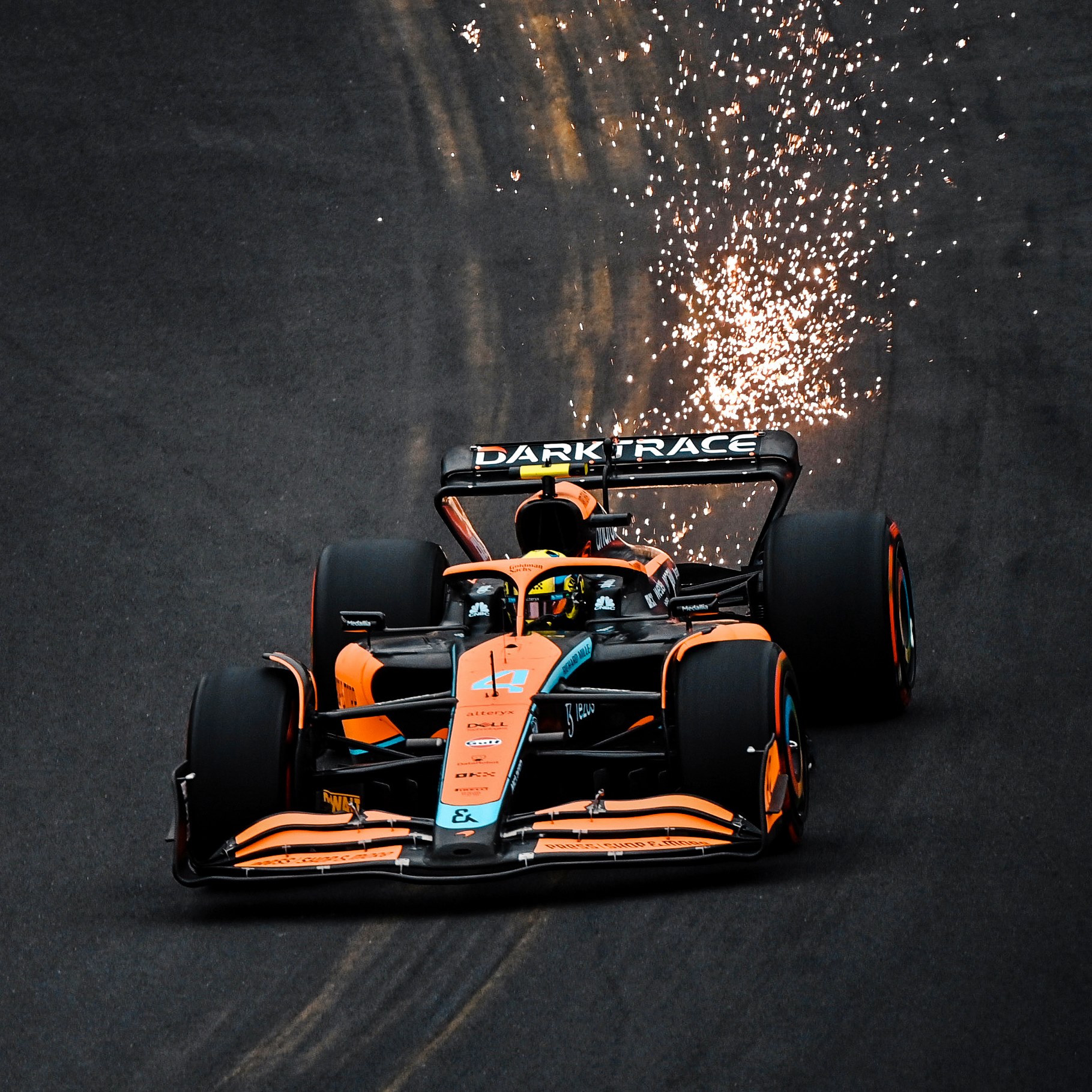
The teams have therefore to give much attention to set-up, balancing the desire for outright pace on the straights with enough downforce to optimize lap time in the more technically demanding second sector.

“A bigger wing will gain time in the middle sector but leave you vulnerable on the straights, while a smaller wing will provide less drag for the flat-out sections but not providing the same level of grip in the twisty corners. This is a similar predicament to Baku,” Wolff explained.

In the long history of the Formula 1 Belgian GP, Michael Schumacher has taken the chequered flag the most times with 6 victories between 1992 and 2002. His last team, Scuderia Ferrari, has also been the most successful with 18 wins, followed by McLaren with 4 less.

On the starting grid this year, there will be five previous Belgian GP winners – Lewis Hamilton (4 times), Sebastian Vettel (3 times) Daniel Ricciardo (1), Charles Leclerc (1) and Max Verstappen (1).
BHPetrol

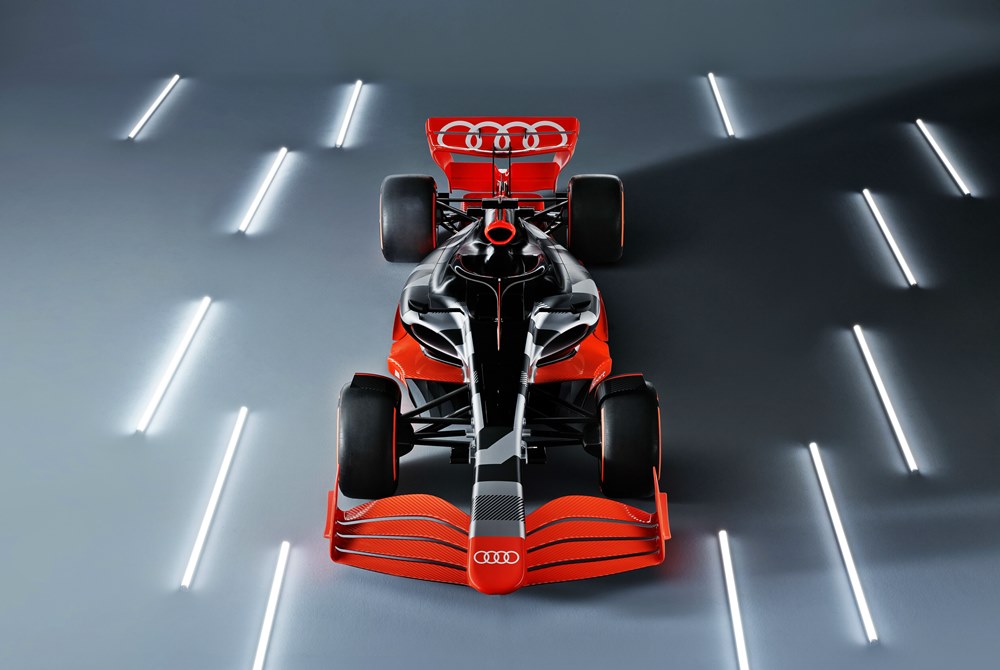
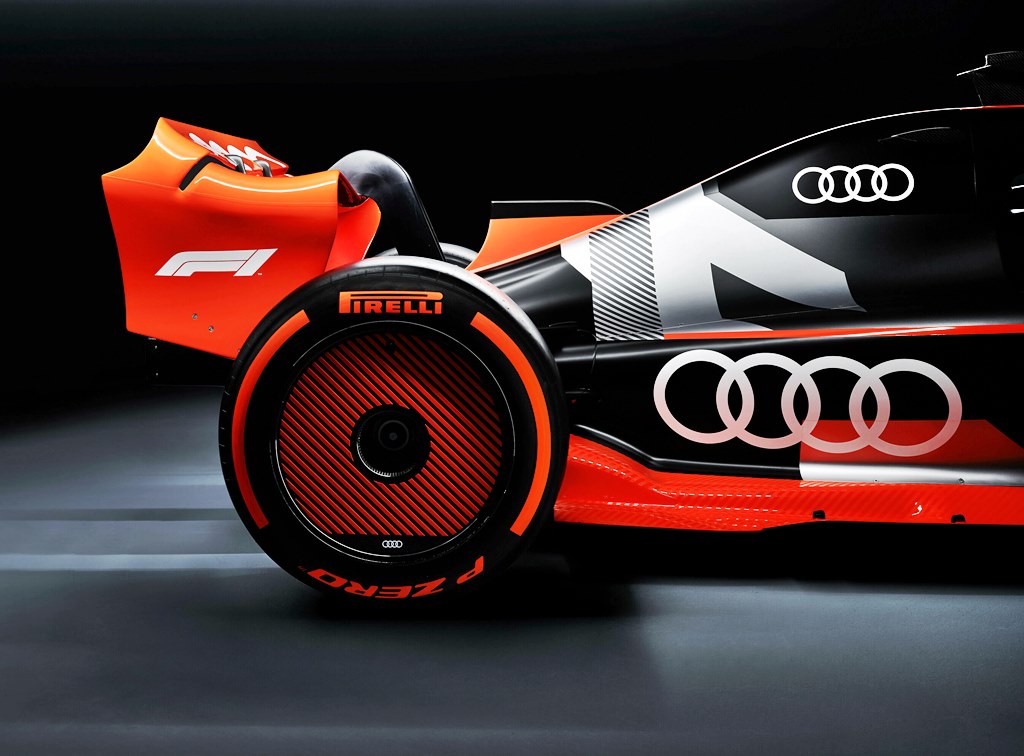
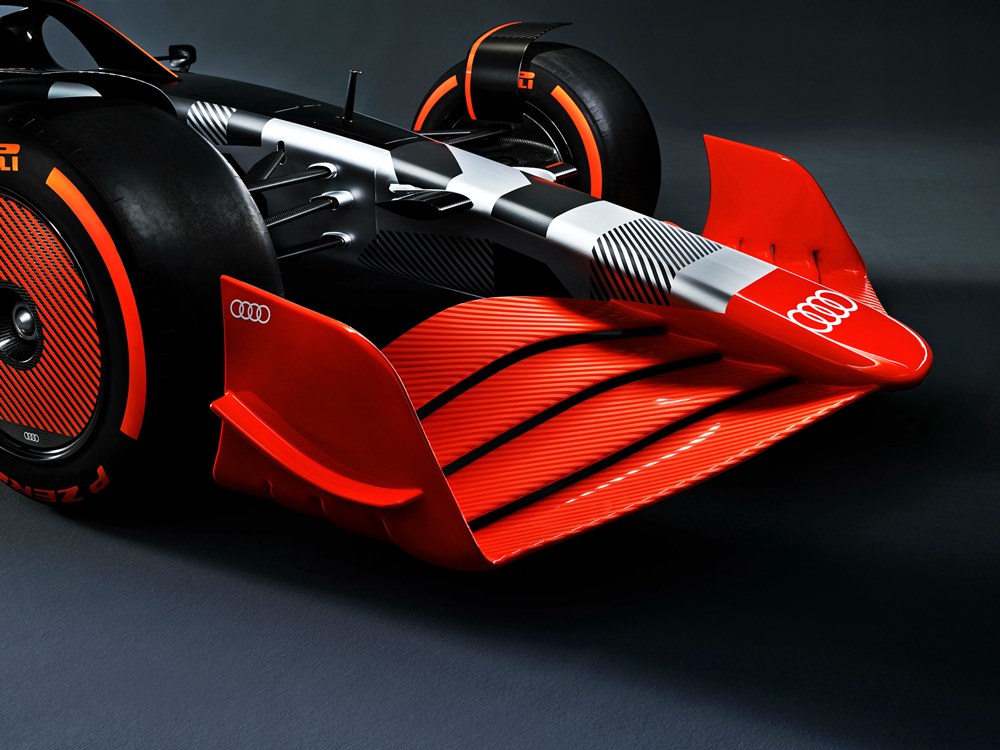
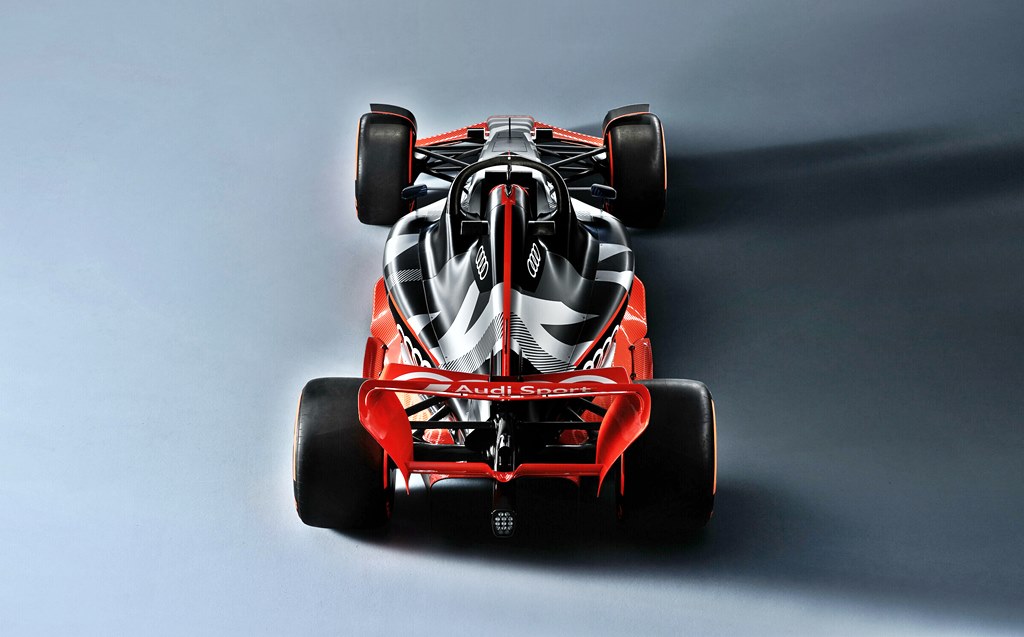
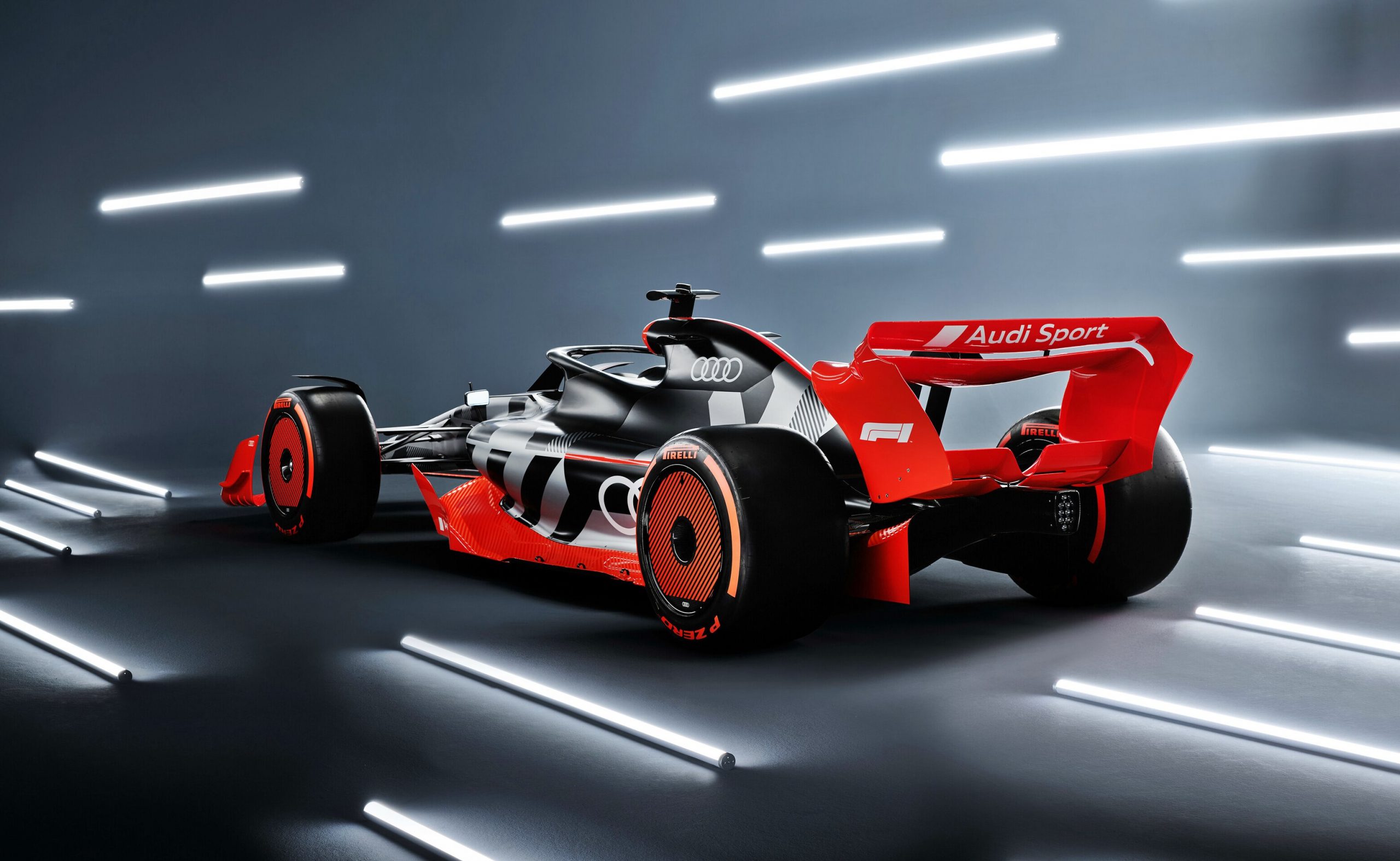
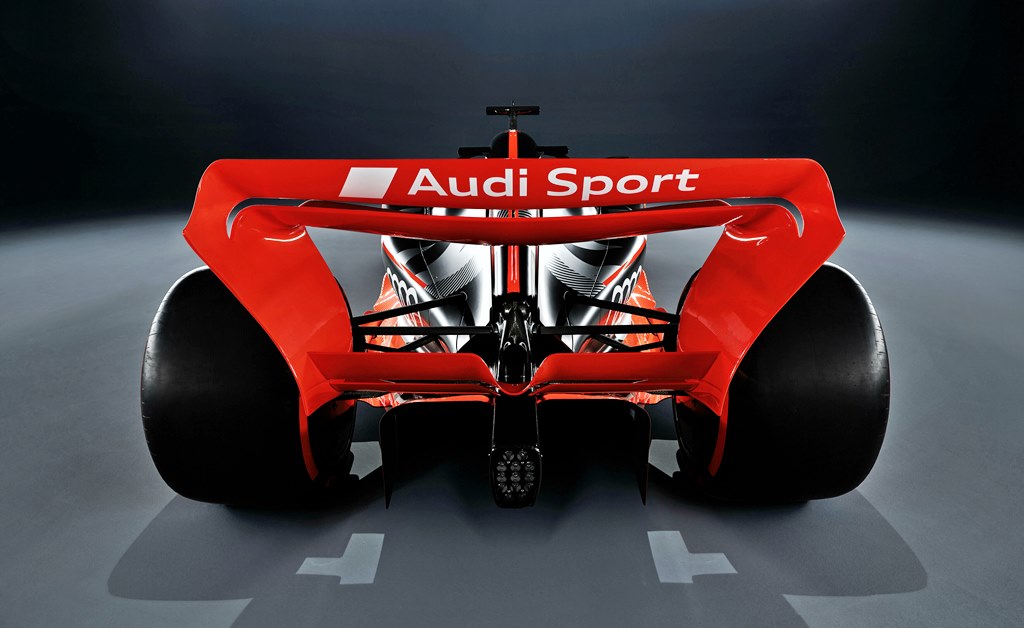
Audi has confirmed that it will race in the Formula 1 World Championship from the 2026 season, with Audi Sport being responsible for the activity. As a consequence, the high-performance division is discontinuing its LMDh project for endurance racing but will continue with the RS-Q e-tron project for the Dakar Rally. It will announce the team partner by the end of this year.

Audi recognizes Formula 1’s high popularity in its key markets as well as with young target groups. It has particular interest in the sport because it is seen as ‘a spectacular platform for the most demanding electrified racing cars in the world ‘and the brand will be able to show its ‘Vorsprung durch Technik’ in this highly competitive environment.

Formula 1 is watched globally and one of the sporting events with the highest reach in the world. In 2021, more than 1.5 billion TV viewers watched the races. On social media, Formula 1 is now experiencing the highest growth rates among the world’s most popular sports.

“Motorsport is an integral part of Audi’s DNA,” said Markus Duesmann, Chairman of the Board of Management of Audi AG. “Formula 1 is both a global stage for our brand and a highly challenging development laboratory. The combination of high performance and competition is always a driver of innovation and technology transfer in our industry. With the new rules, now is the right time for us to get involved. After all, Formula 1 and Audi both pursue clear sustainability goals.”

The key to getting involved is the world’s most popular racing series is the clear plan to become more sustainable and cost-efficient. The new technical rules, which will apply from 2026, focus on greater electrification and advanced sustainable fuel, areas which Audi has been active in developing.

In addition to the existing cap on costs for teams, a cost cap for power unit manufacturers will be introduced in 2023. Formula 1 has also set itself the ambitious goal of being a carbon-neutral racing series by 2030.

“In view of these major technological leaps that the series is making towards sustainability in 2026, we can speak of a new Formula 1. Formula 1 is transforming, and Audi wants to actively support this journey. A close link between our Formula 1 project and AUDI AG’s Technical Development department will enable synergies,” said Oliver Hoffmann, Member of the Board for Technical Development.

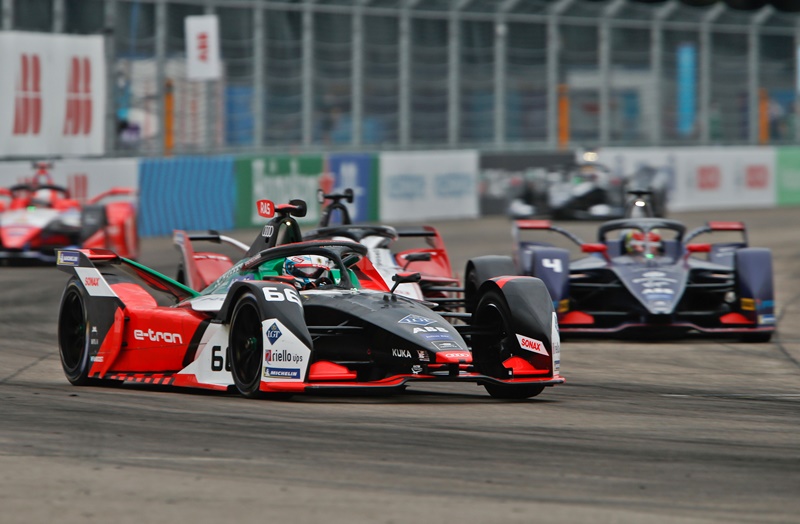
For 7 years (until 2021), Audi Sport was involved in the Formula E series with the ABT Schaeffler team. The team was the most successful in the all-electric single-seater series with 14 victories out of 84 races.

From 2026, the electric power output for the power units, consisting of an electric motor, battery, control electronics, and a combustion engine, will increase sharply compared to today’s Formula 1 drive systems. The electric motor will then be nearly as powerful as the combustion engine, which has an output of about 544 bhp. The highly efficient 1.6-litre turbocharged engines run on advanced sustainable fuel – also a prerequisite for Audi’s entry into the series.

Audi Sport to develop power unit

The hybrid power unit will be built at Audi Sport’s Competence Centre Motorsport in Neuburg an der Donau, not far from Audi’s headquarters in Ingolstadt, Germany. “For the development and manufacture of the Formula 1 powertrain, we will build on the valuable expertise of our motorsport employees, continue to invest in our motorsports center, and also recruit highly specialized professionals,” said Audi Sport Managing Director Julius Seebacht.

The facility already has test benches for F1 engine testing as well as for electric motor and battery testing. Additional necessary preparations are currently being made in terms of personnel, buildings, and technical infrastructure, with everything essential to be in place by the end of the year. A separate company was recently established for the power unit project as a wholly owned subsidiary of Audi Sport.

A new name was on pole position for F1 Round 13 – George Russell – and in his mirrors were two red Ferraris ready to outrun him to the first corner. But the young Mercedes-AMG F1 driver was ready and although Carlos Sainz was able to come up alongside as the cars moved off, Russell held on to his slight lead.

His team mate, Lewis Hamilton, starting from was able to slip past both on the first lap to move from seventh to fifth. The two Red Bulls also moved up two positions before the first turn. However, further back, there was an incident between Aston Martin’s Sebastian Vettel and Williams Racing’s Alex Albon which brought out the F1 Virtual Safety Car (VSC) for a while. The moment the VSC was deactivated, Russell was able to take advantage of the lull to open up a gap with Sainz.

Haas F1’s Kevin Magnussen had contact with McLaren’s Daniel Ricciardo and the former’s car sustained damage to the front wing. It was severe enough that Magnussen got the black and orange flag which required him to return to the pits to fix the damage.

By lap 11, Verstappen was up to fifth and taking on Hamilton for the position. McLaren’s Lando Norris was just ahead but both drivers were able to get past him and continued their duel for the fourth place Norris was displaced from. However, Verstappen was heard to be asking questions about an issue with his car which was alarming him. 8 seconds ahead, Ferrari’s Charles Leclerc was shadowing his team mate who was looking for a way past leader Russell.

Cars were being called in and on lap 17, Russell came in for mediums but Sainz, though called in, did not do so right away and stayed in the lead that the Mercedes-AMG driver had given up. But on the next lap, Sainz came in and Leclerc took over the lead with Hamilton in second and Russell in third, both not within striking distance. Hamilton too would come in on lap 20 for a change of tyres. The forecast for rain was 60% at that point.

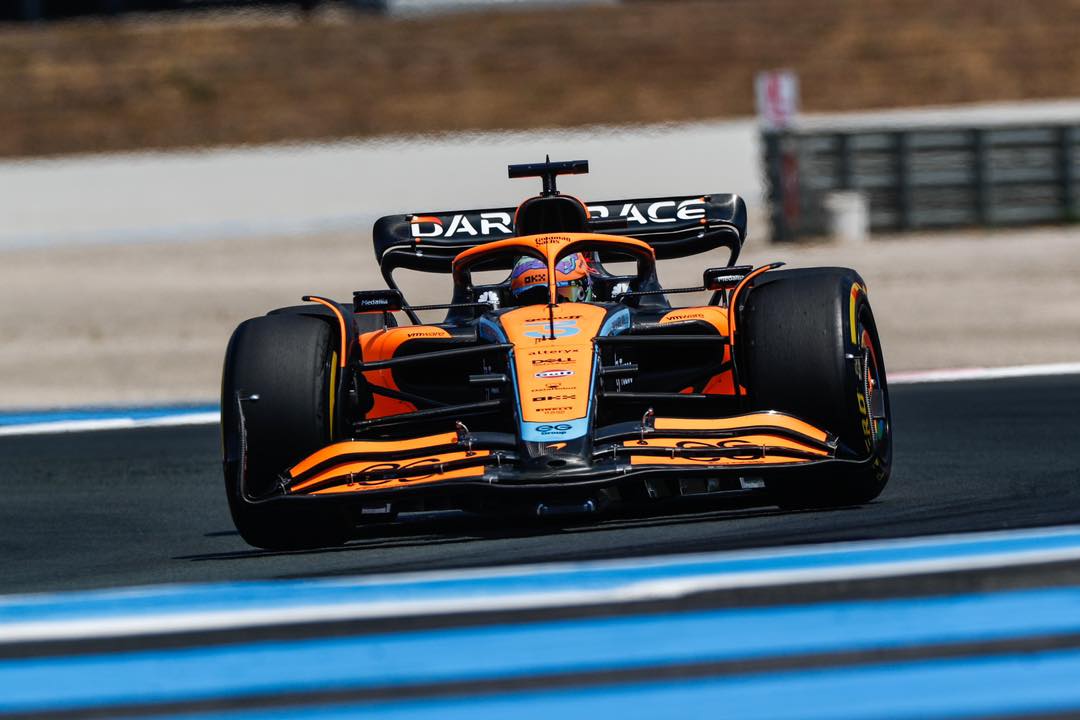
On lap 22, Leclerc finally came in, and Russell was back in the lead. When the Ferrari driver rejoined, he managed to slot in ahead of his team mate, which can’t have been a happy moment for Sainz. Leclerc was around 2 seconds behind Russell, while Sainz was 5 seconds and having to watch out for a hard-charging Verstappen. At the back of the top 10, Ricciardo had passed two cars to get back into the points.

On lap 28, Leclerc was close enough to challenge Russell in each corner but the British driver remained calm and held his lines. It took 3 laps for the Ferrari to pass and take the lead but Russell did not give that up easily either.

Leclerc didn’t waste time pulling away and left Russell to be dealt with by Sainz, who was getting closer. Verstappen was still a threat to Sainz but the Dutchman did not have to worry about Hamilton who was some distance behind.

As the 70-lap F1 race passed the halfway mark, all 20 cars were still running which was not always the case. Rain was also coming down lightly and could change things dramatically for the remainder of the race.

Scuderia Alphatauri’s Yuki Tsunoda spun at the chicane on lap 36, bringing out the yellow flags. But he was not immobilized and continued going but was in last place. Pirelli was expecting who went from medium to hard to probably do a one-stopper while everyone else would have to stop again.

Although he was within reach of Russell, Sainz had to go from attack to defence as Verstappen came up behind him. The second position would have to wait first while he held on to his third place. And then Sainz got a break when the Red Bull team called Verstappen in to put on mediums. When he rejoined, he was down to sixth behind his team mate, Sergio Perez. It was still drizzling and heavier rain was forecast by lap 62.

Leclerc gave up his lead on lap 40 to pit, and Russell followed him off the track as well, giving Sainz the lead. With the fresh tyres seemingly warmed up, Verstappen thought he was ready to fight and went flat out – and spun. He was able to recover quickly before Russell could take advantage and held on to his fourth place as he headed in pursuit of Leclerc, whom he passed on lap 45.

Hamilton took over the lead on lap 48 when Sainz came in to switch to soft tyres. It remained to be seen if that was the right move for Ferrari. With Red Bull pitting so early, they should have stayed out and put the soft tyres on later.

It was now Verstappen going after Hamilton in the lead, trying to close the gap of 6 seconds. Leclerc was 3 seconds behind the Dutchman with Russell in fourth and Sainz in fifth. On lap 51, it was Russell’s turn to try to displace Leclerc but the Ferrari driver was making it very difficult.

Hamilton rushed into the pits on lap 52 to get onto softs, rejoining in fifth between Sainz and Perez. Verstappen was now in his more familiar position at the front with a 6-second lead over Leclerc.

The F1 Stewards had finally decided on the Ricciardo – Stroll incident and it was deemed that the Aussie driver was at fault and he received a 5-second penalty.

Leclerc finally had to give way to Russell on lap 53 and the Mercedes-AMG driver took over second, with the 6-second gap behind Verstappen that wasn’t going to be easy to close. Having lost his position, Leclerc came in on lap 54 to get rid of the hard tyres and run on softs for the rest of the race. At that point, the top 5 were spaced many seconds apart and the order was likely to stay till the end. Barring unexpected incidents, the only battle for positions was likely to be between Russell and Sainz.

As 10 laps remained of the 13th F1 round, Verstappen looked comfortable in the lead and if rain came down, he could even benefit from it. It was an achievement coming into the lead from tenth at the start, and he did not have to worry about Russell being an immediate threat.

No more distractions for Hamilton as he pushed forward past Sainz and moved into third and a place on the podium right behind Russell. Now the question was whether Russell would let his team mate past but it did not seem to be so, although it would be Hamilton eventually finishing second. With two Mercedes-AMGs chasing him, Verstappen could not afford to make any mistakes – and also pray his car would not fail.

As 5 laps remained, rain slowly started coming down. At the end of the top 10, Vettel had managed to take over the last points-paying position from his team mate, Lancer Stroll.

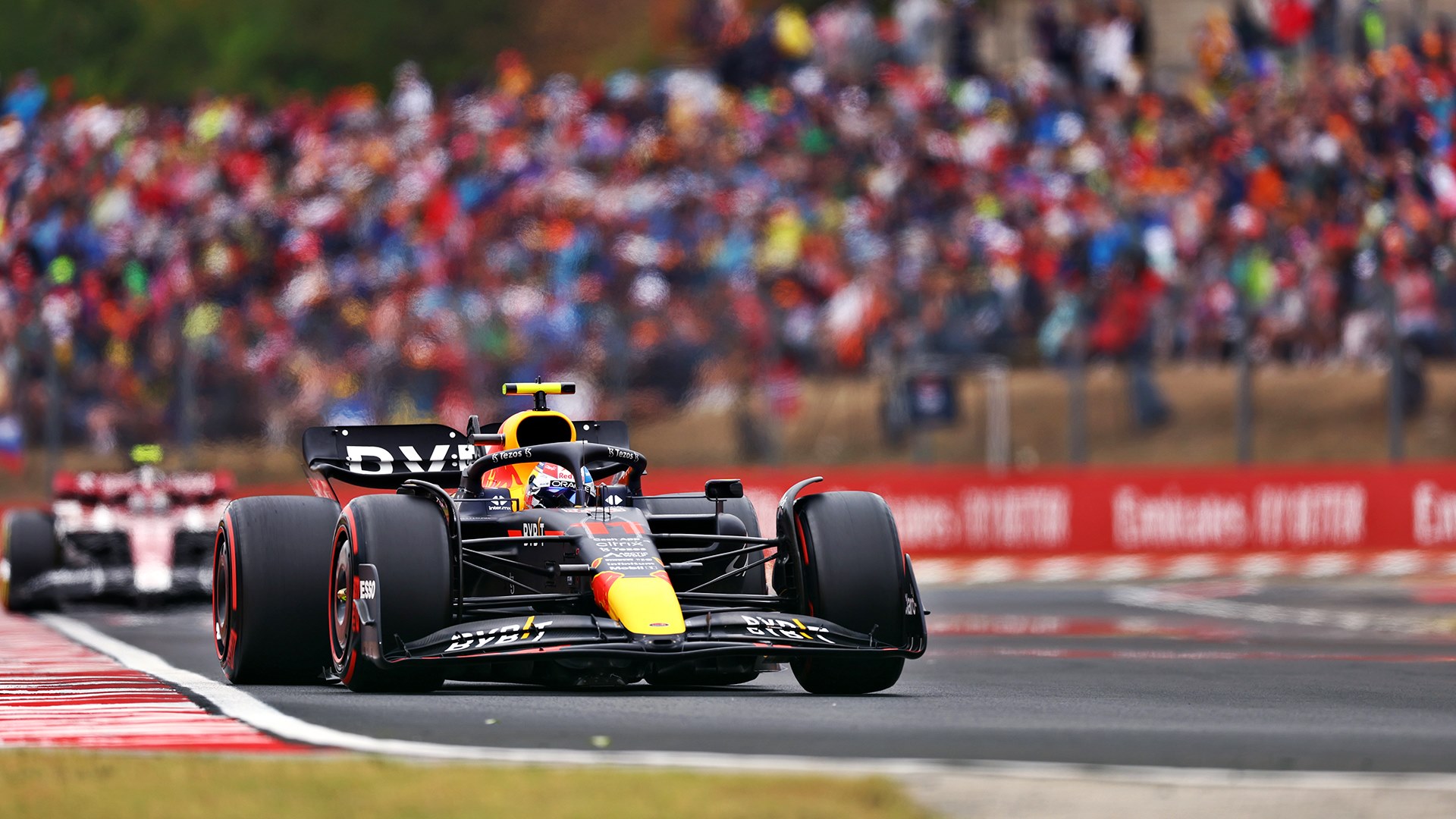
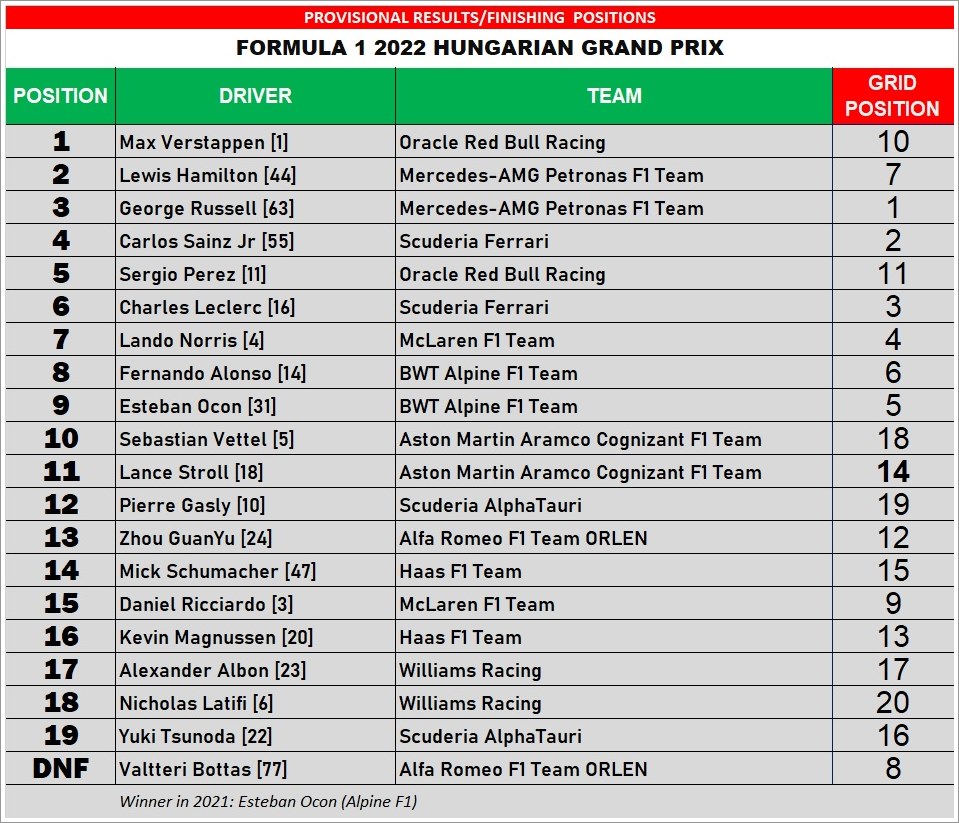
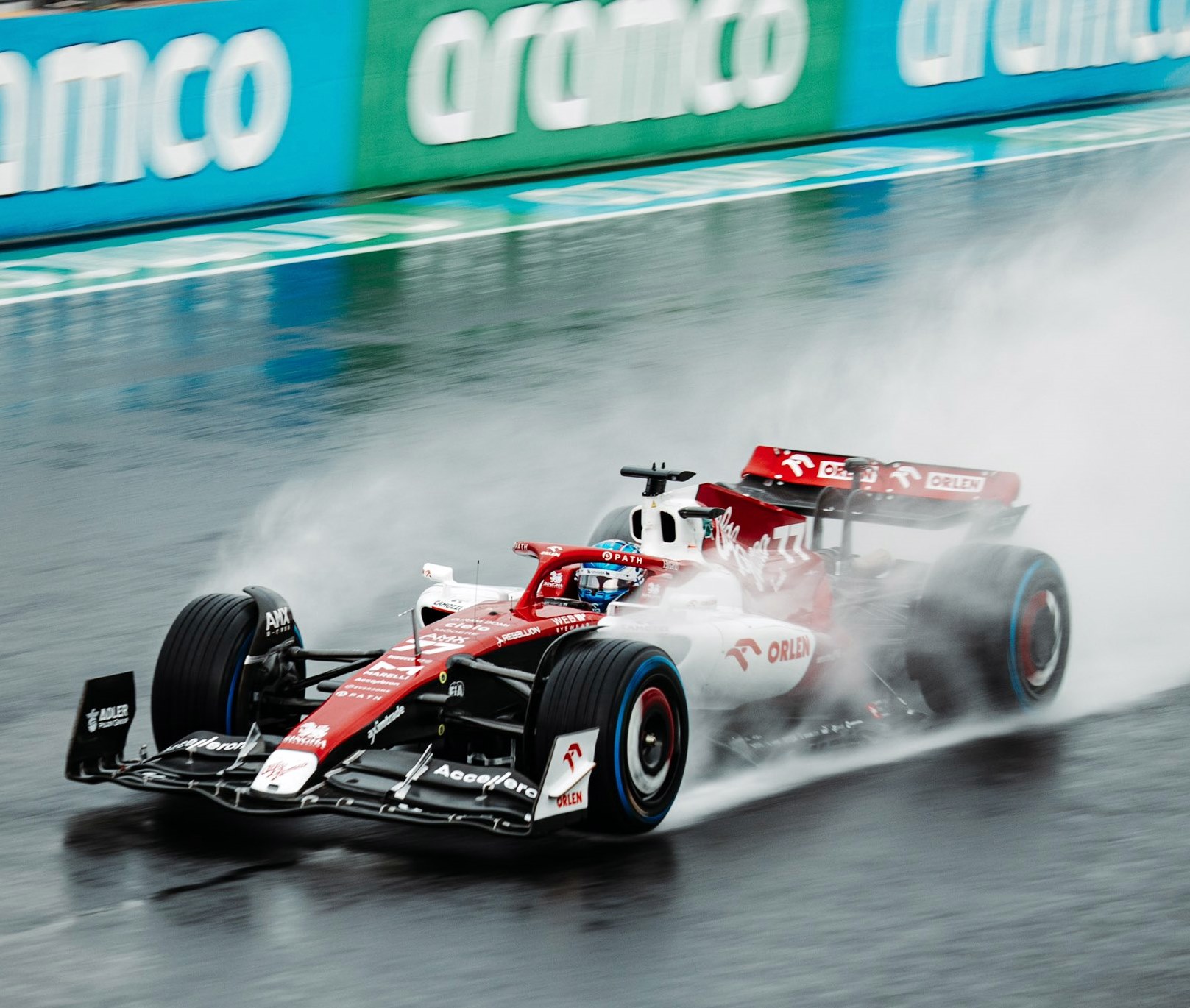
And then on lap 68, Alfa Romeo’s Valtteri Bottas went off on Turn 11 as his car lost all power. The yellow flags came out, followed by the VSC. It was active for just 1½ laps and then it was a rush to the finish. The rain was heavier and Verstappen was doing his best not to lose it. And he didn’t, taking the eighth chequered flag of the F1 season at Hungaroring.

Race starts at 3 pm in Hungary/9 pm in Malaysia

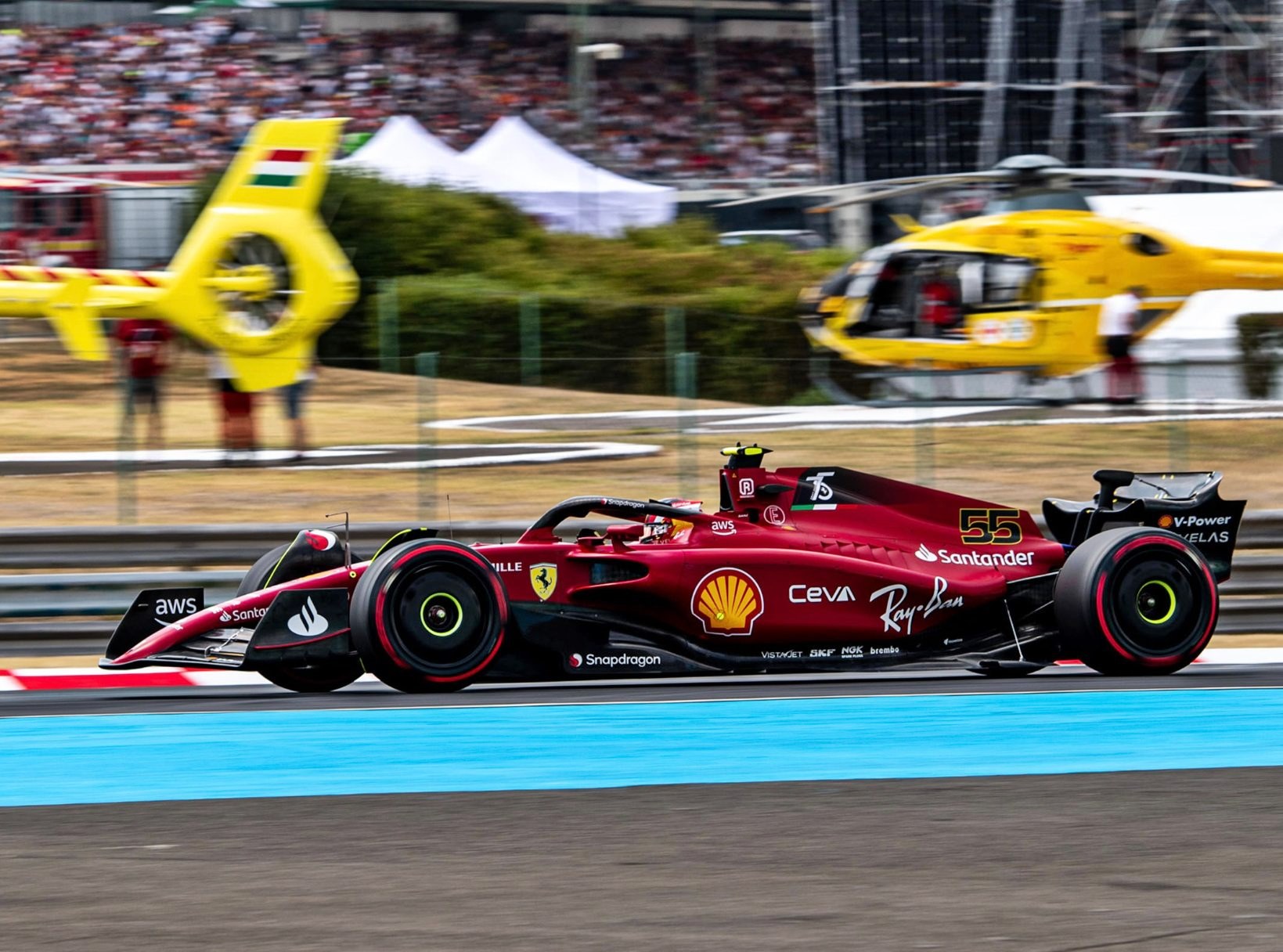
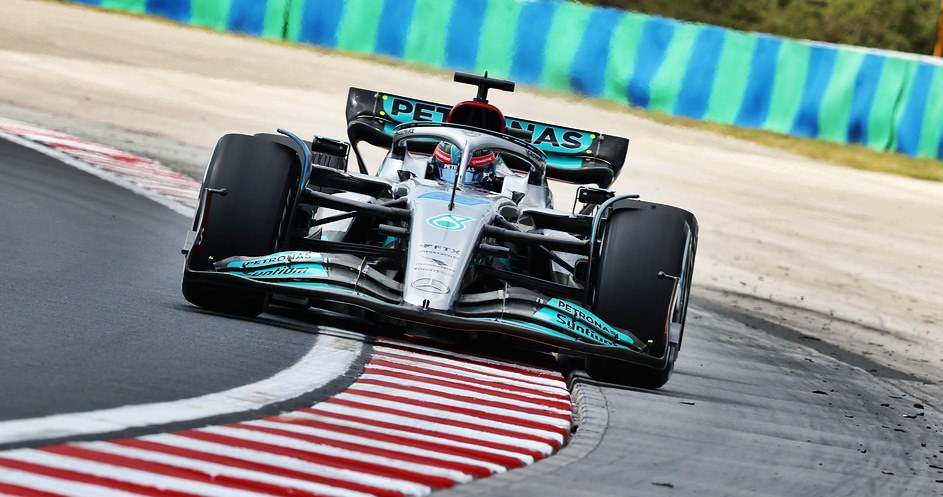
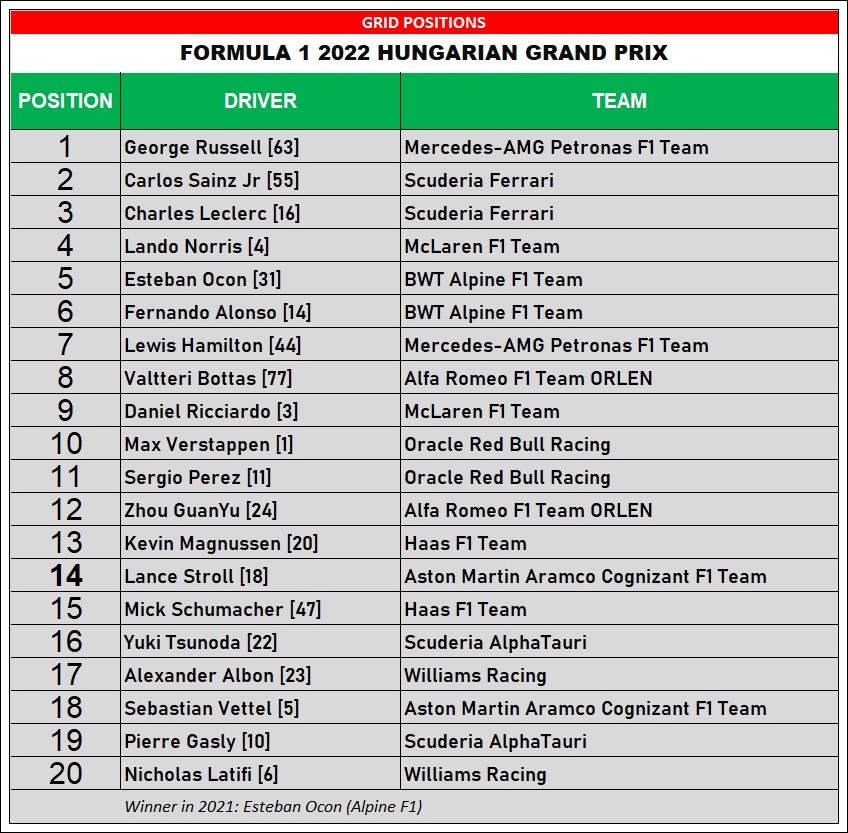
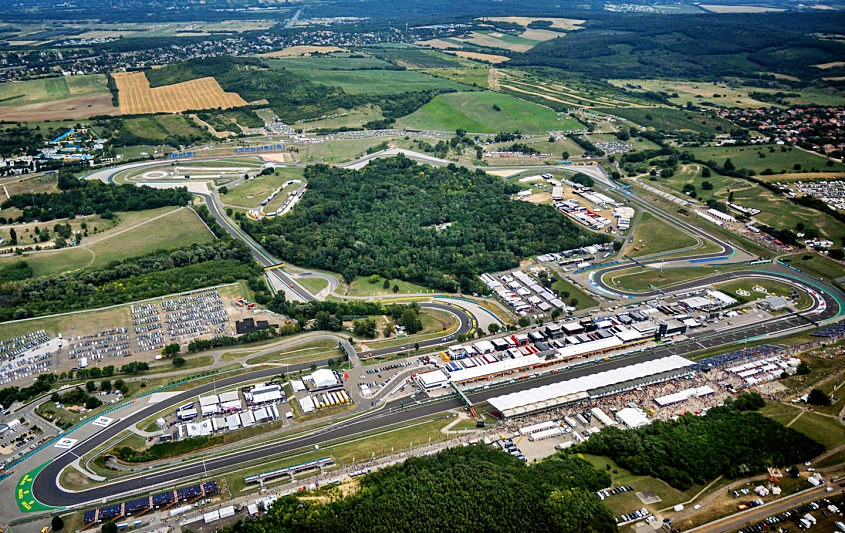
Just days after a dramatic race in France, the 2022 F1 World Championship is at the Hungaroring in Budapest for the Hungarian Grand Prix. This is the 37th time the event has been held and it has been on the calendar every year since being added in 1986. All of the F1 races in Hungary have been held at the Hungaroring; Monza in Italy is the only track with a longer run of consecutive Grands Prix.

It’s therefore a familiar circuit and engineers who have prepared for the hot and dusty environment. The air and track temperatures experienced at the Hungarian F1 Grand Prix are typically some of the highest of the season, with an average air temperature of 30°C and average track temperature of 49°C. In fact, during practice last year, the temperature was seen to reach nearly 60°C.!

Formula 1

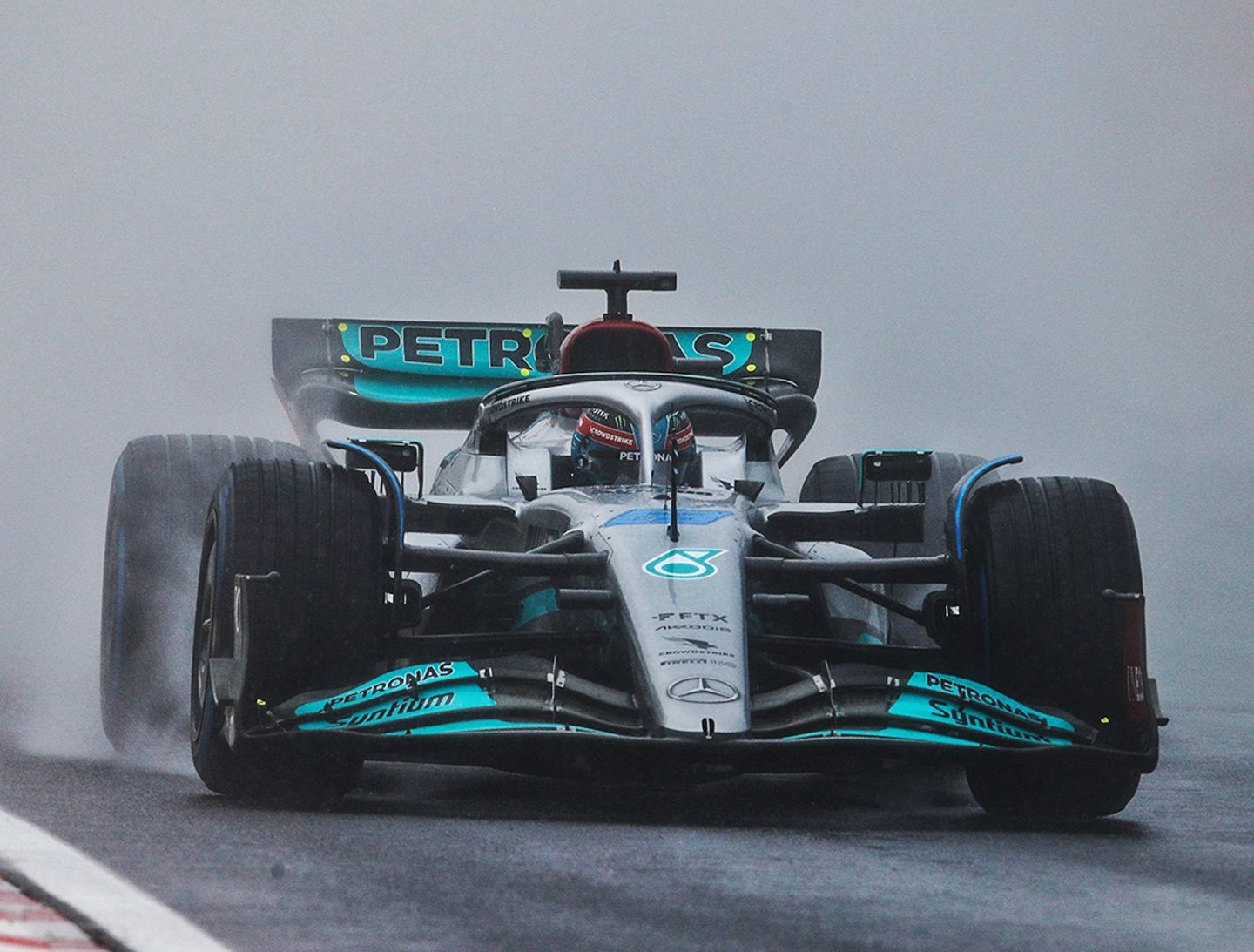
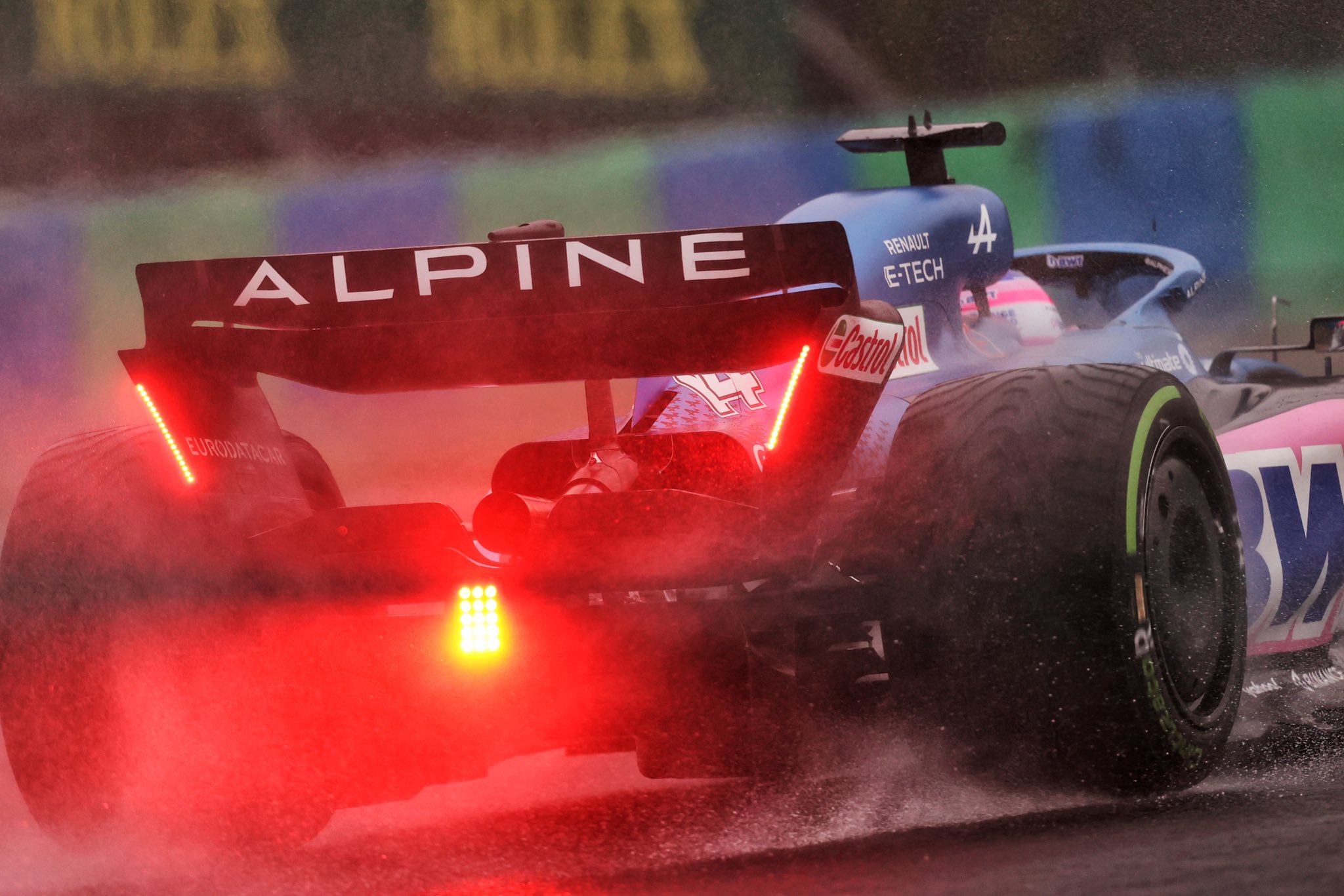
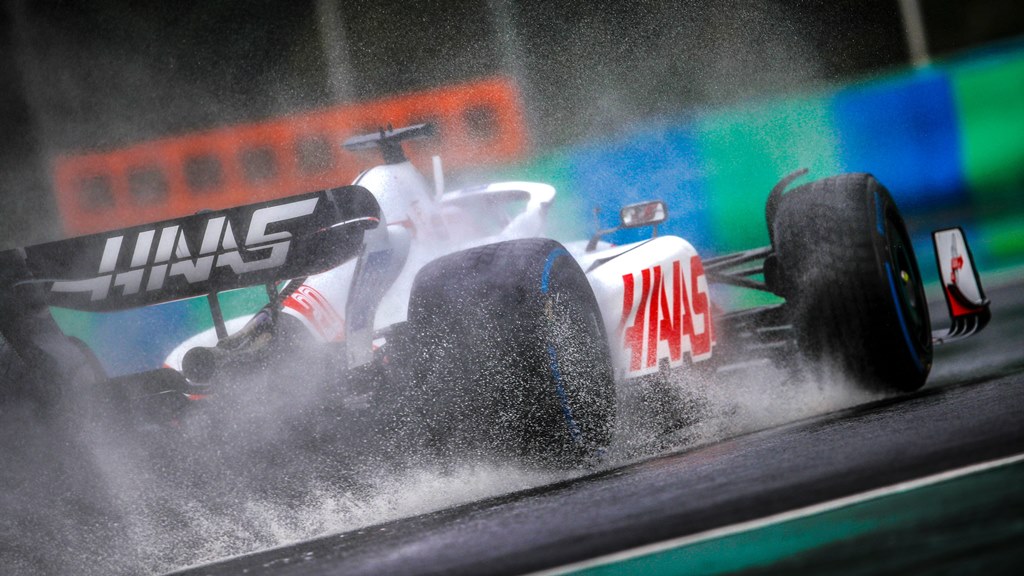
But with climate change, unexpected weather can also occur. On the past two occasions,  it’s actually rained just before the race – and this year. rain came down during final practices. Last year, that led to a somewhat surreal re-start following a first corner incident. “We’ve seen some surprises at the Hungaroring before, and that could be the case even more this year,” predicts Mario Isola, Pirelli’s Motorsport Director.

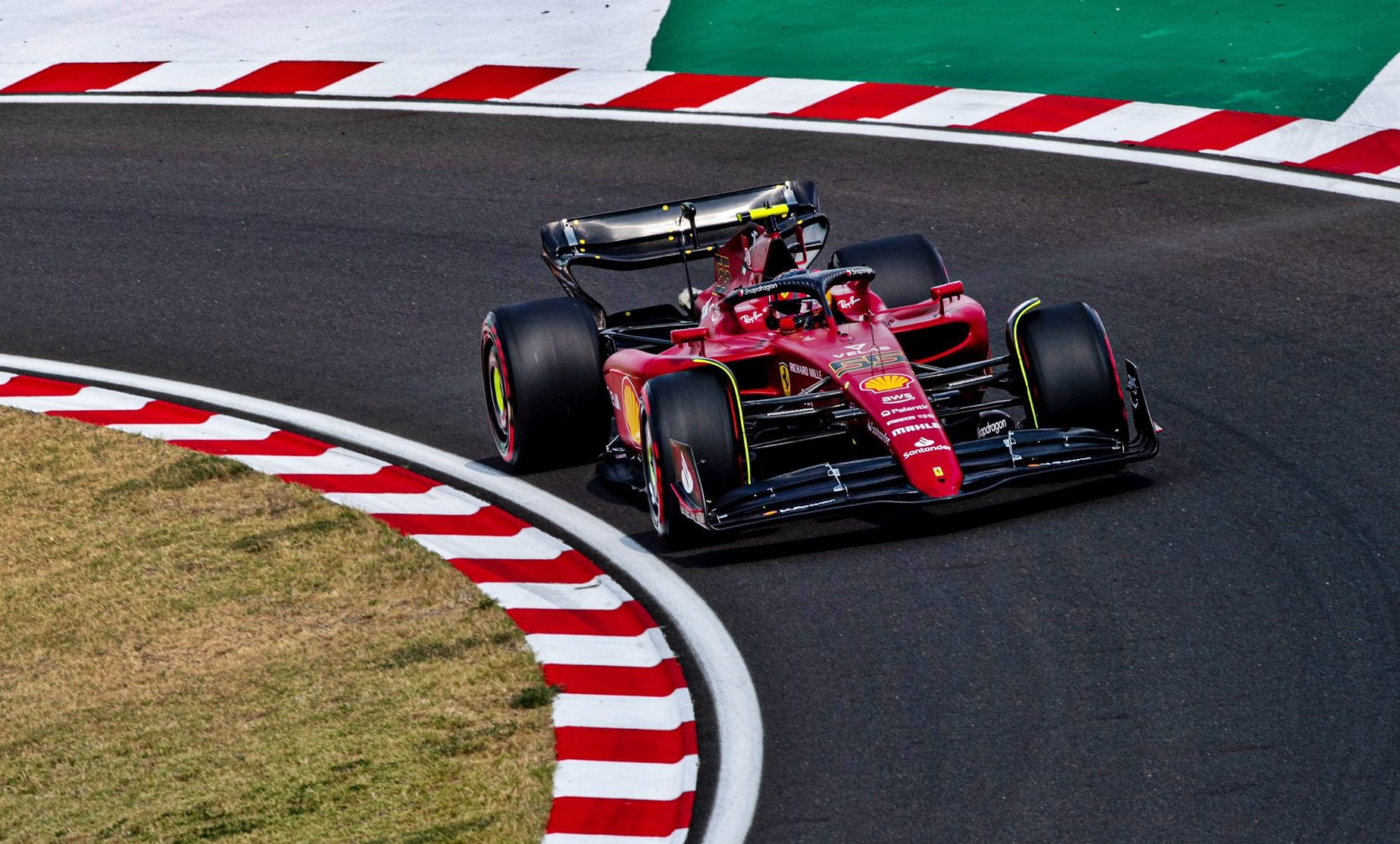
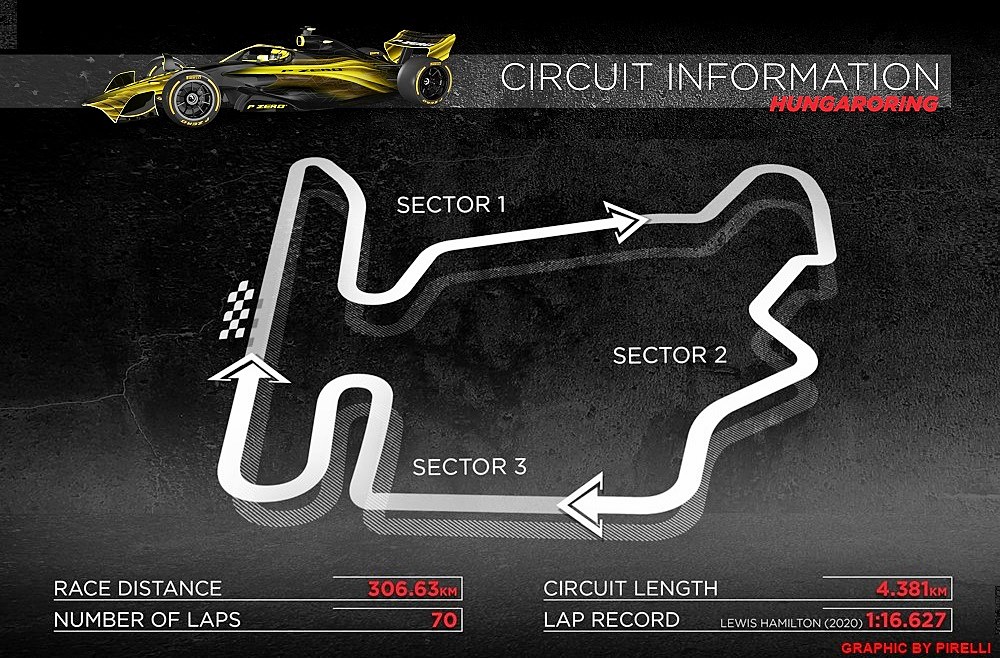
The Hungaroring circuit has 14 turns running around a valley. It is twisty and bumpy, giving a ‘street circuit’ feel like that of Monaco (or rather ‘Monaco without walls’, as some describe it). It was resurfaced several years ago, and most of the bumps were flattened out. However, the track surface is gradually starting to show its age and the irregularities are forming again.

Formula 1 2022

Six of the 14 turns are left-handers and 8 are to the right. Many of these corners are combined, making good directional changes more important. The straights are relatively short and taking the corners at the right speed is crucial. Consequently, the standard setup for Hungary includes maximum downforce.

Due to its nature as a high-downforce track, the Hungaroring has one of the lowest top speeds of the season so far: 308 km/h. The F1 cars only go straight for about 10 seconds during the course of a fast lap, spending the remaining 65 seconds or so cornering. Only 65% of the lap distance of 4.381 kms will be taken at full throttle – one of the lowest ratios in Formula One.

The kerbs in the final corner can be very aggressive, and the same applies to the exit of Turn 11. However, unlike on faster tracks such as Spielberg, the kerbs in Hungary are driven over at lower speeds (but keeping within track limits, of course). The chicane (Turns 7 and 8), on the other hand, can prove problematic, especially in the wet, and take the drivers by surprise.

Formula 1 2022

The twisty track makes it seem like a big go-kart circuit and this affects the average lap speed which is below 205 km/h throughout the race, but can increase to 214 km/h during the qualifying rounds. On each lap at the Hungaroring, the drivers use their brakes 11 times for a total of 14.3 seconds per lap which amounts to 19% of the duration of the race. ​

The hardest on the brake system is going into Turn 1: to go from 321 km/h to 95 km/h, the drivers have to brake for 2.43 seconds with a load of 142 kgs on the brake pedal, during which they are subjected to 4.6 G deceleration. In that length of time, the F1 cars cover a distance of 118 metres.

“In the past, the Hungaroring has been known as a place where it’s difficult to overtake, but the new package of cars and tyres this year helps drivers get much closer to each other, which is why we have seen some great races with plenty of overtaking so far this season. Hopefully, that’s going to be the case at the Hungaroring as well; a tight and twisty track where the cars are often grouped together,” said Pirelli’s Isola.

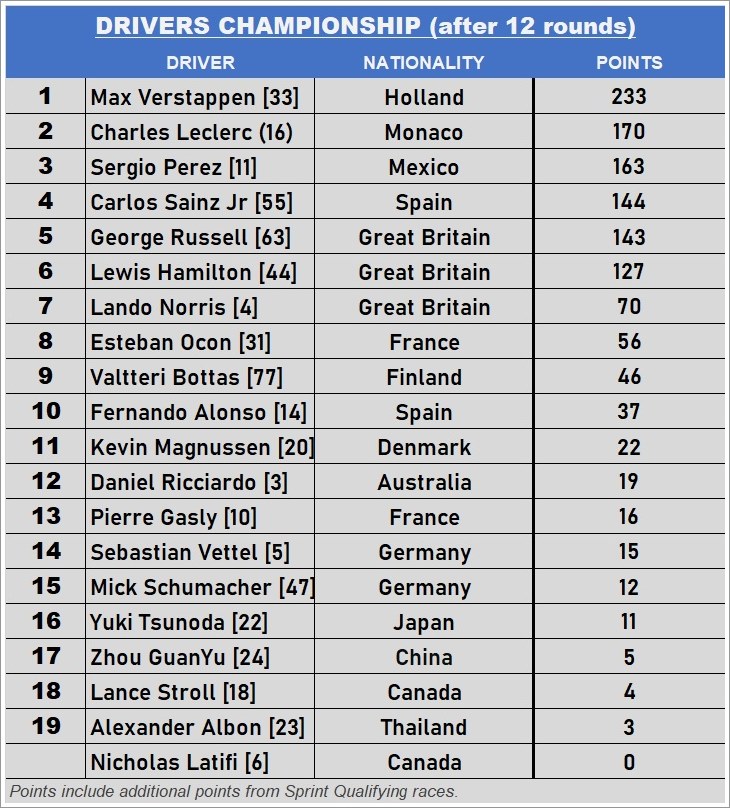
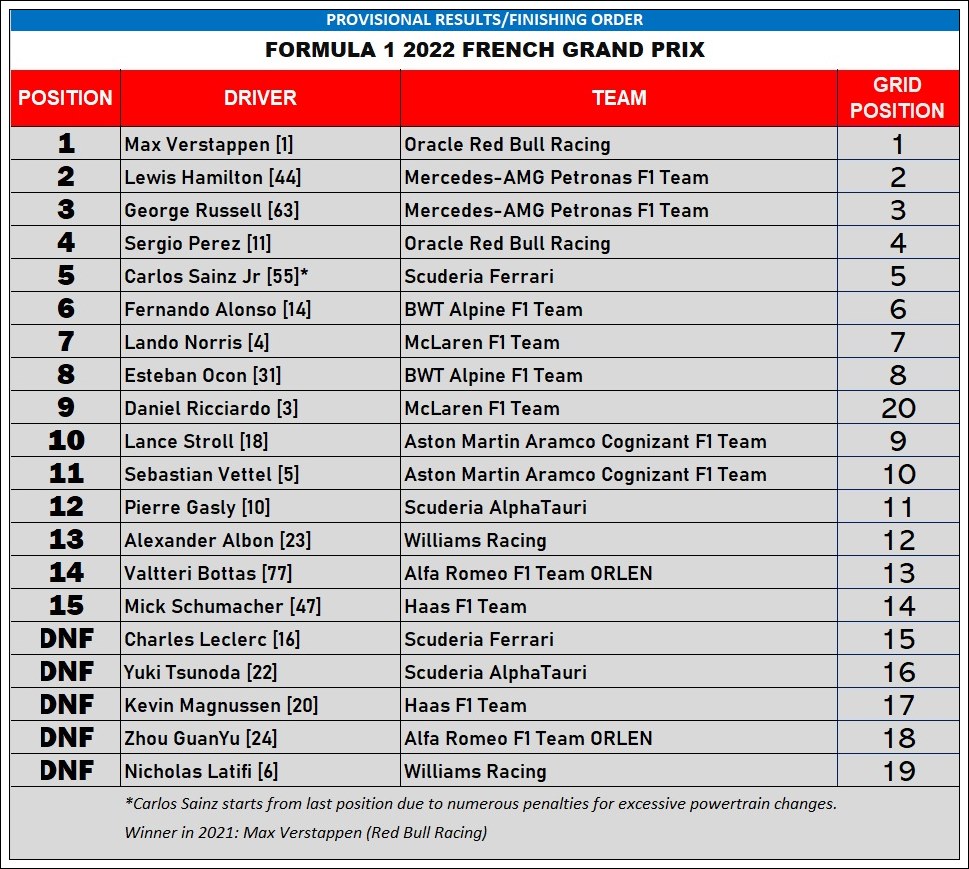
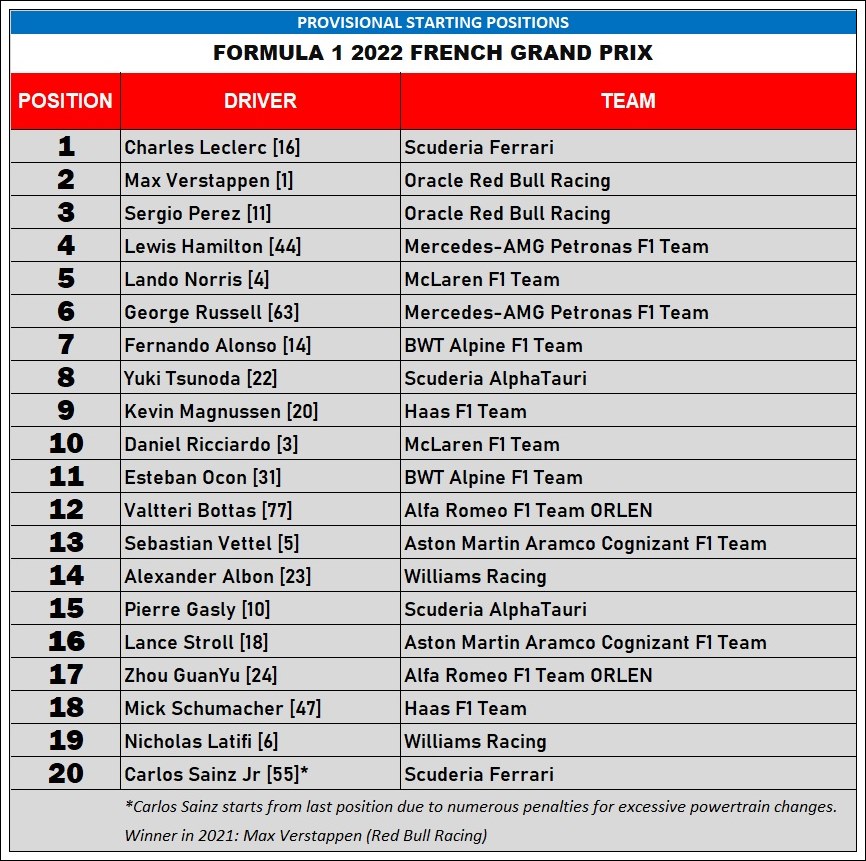
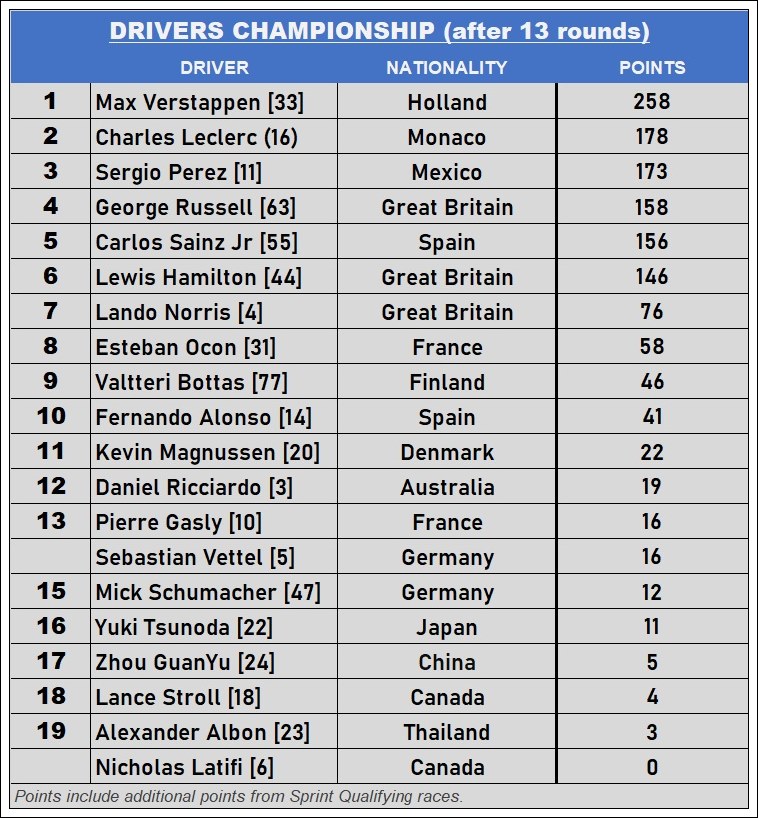
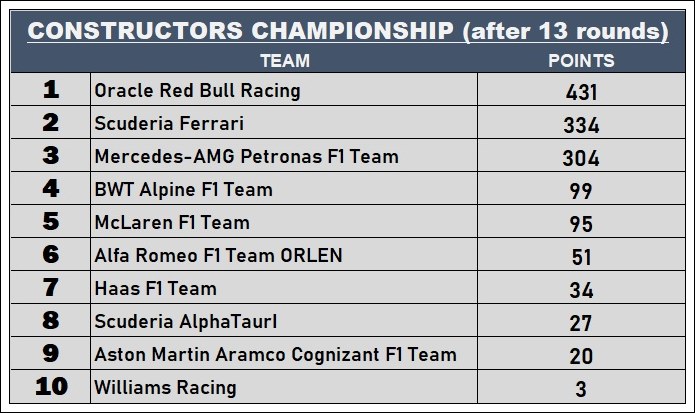
Max Verstappen’s victory in France, combined with a disappointing DNF for Ferrari’s Charles Leclerc and fourth place for Red Bull teammate Sergio Perez, gives the defending World Champion a healthy lead in the Drivers’ Championship. He is 63 points ahead of Leclerc and a further 7 points beyond Perez. Red Bull, meanwhile, pull ahead in the Constructors’ Championship and now lead Ferrari 396-314. And the Italian team is now seeing a resurgent Mercedes-AMG just 44 points behind.

A bit of history: the 2009 Hungarian Grand Prix was the first race in F1 history to be won by a hybrid car. Back then, using the Kinetic Energy Recovery System (KERS) was optional and the opening races were won by cars with conventional engines. However, Mercedes-AMG had developed a hybrid system run by McLaren-Mercedes in 2009. So, when Lewis Hamilton won the event that year, it was the first ever victory for a hybrid F1 racing car.

Over its long history, Lewis Hamilton has been the most successful driver at the Hungarian Grand Prix, with 8 victories – twice the number of Michael Schumacher, who is the next driver on the list. McLaren has had 11 victories at the Hungaroring, the most of any team.

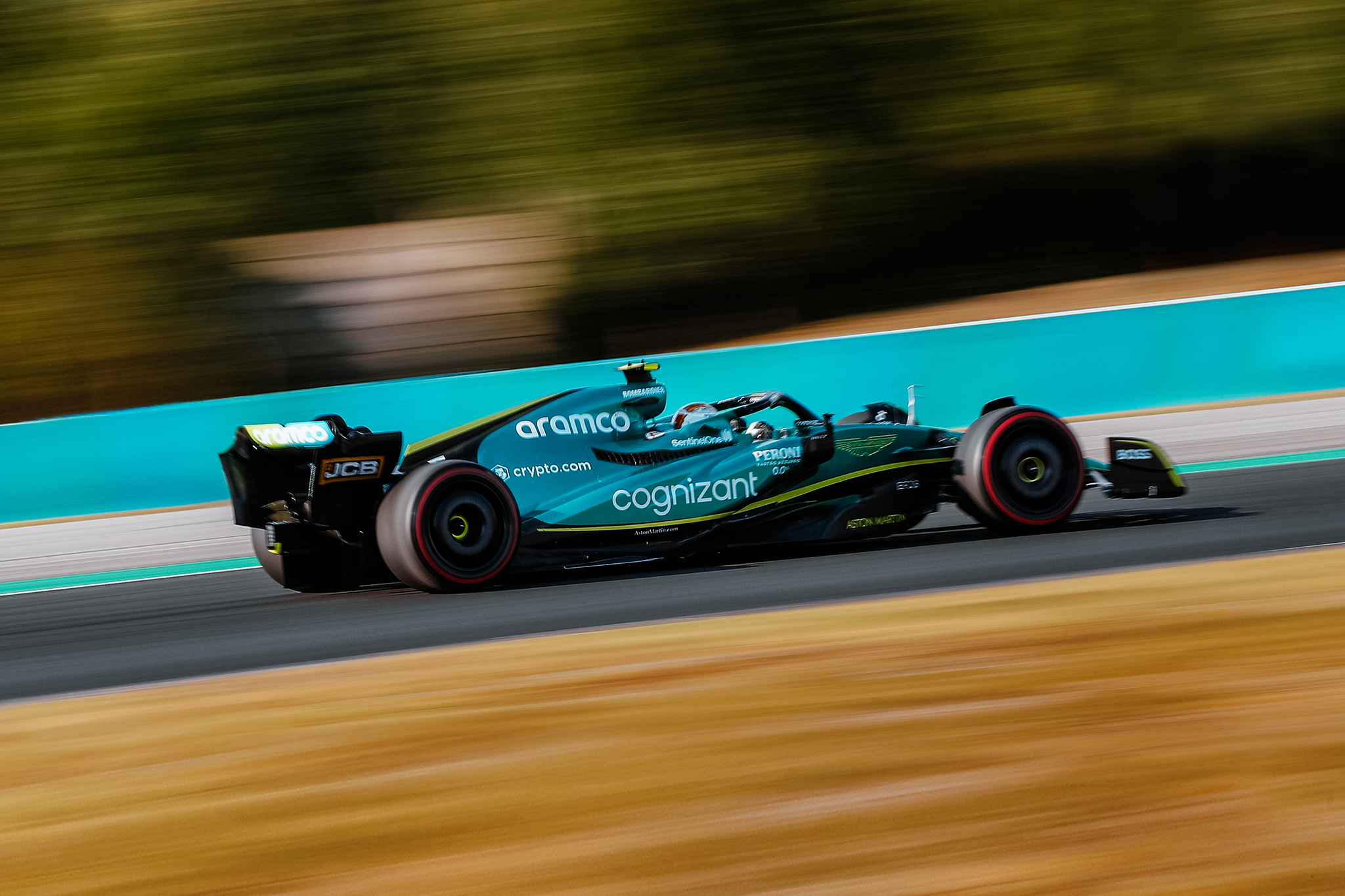
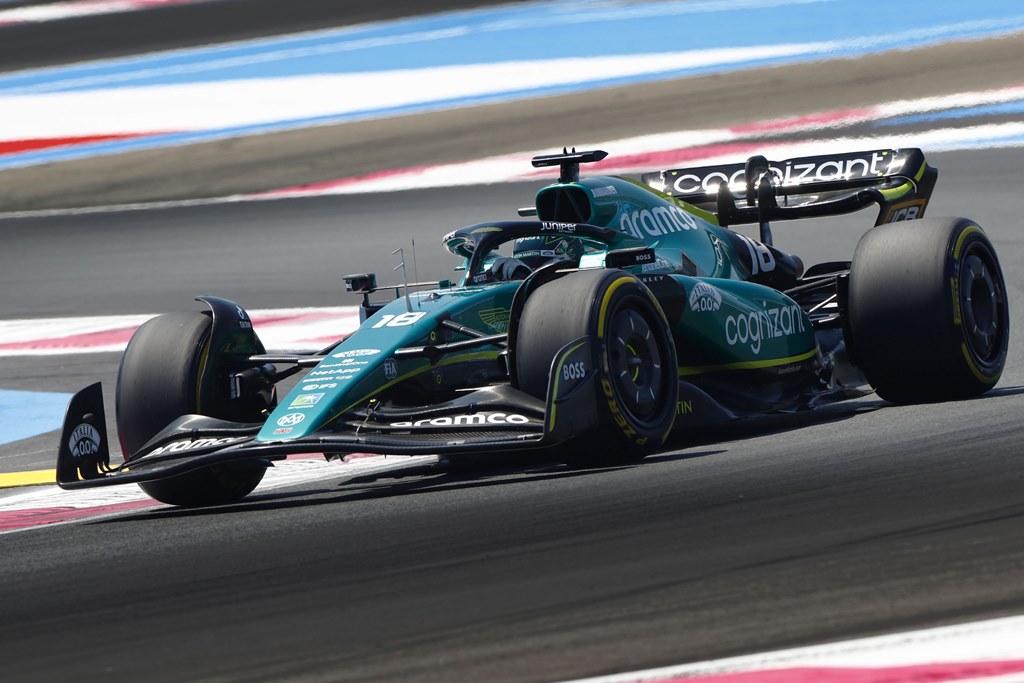
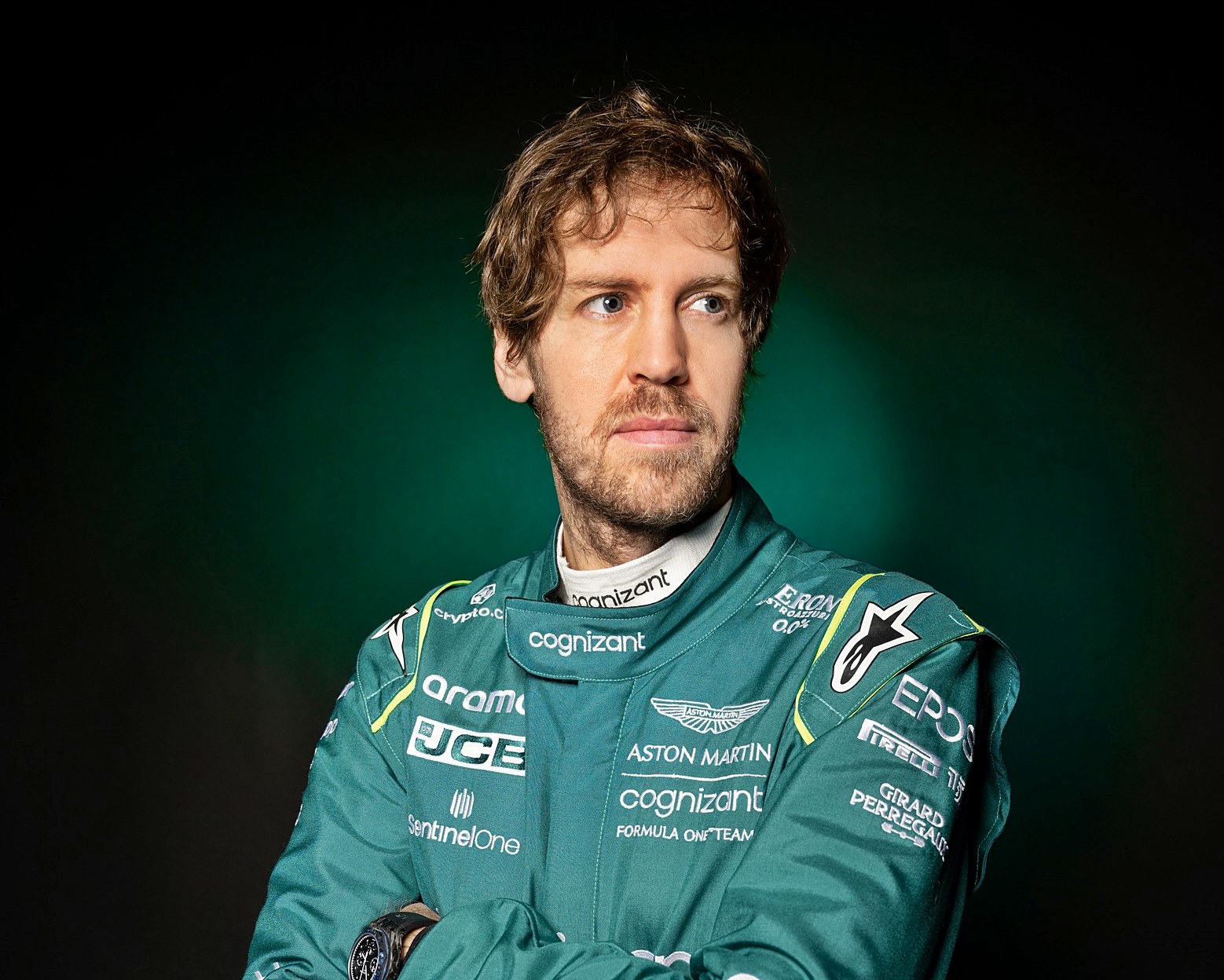
Sebastian Vettel has announced his retirement from Formula 1 at the end of this season. Since entering F1 in 2007, the German driver, now 35 years old, has won 53 races and with 4 world championship titles, he is beaten by only Lewis Hamilton, Michael Schumacher and Juan Manuel Fangio. Now with the Aston Martin ARAMCO COGNIZANT Racing Team, Vettel has previously raced with BMW Sauber (2006–2007), Toro Rosso (2007–2008), Red Bull (2009–2014), and Ferrari (2015–2020).

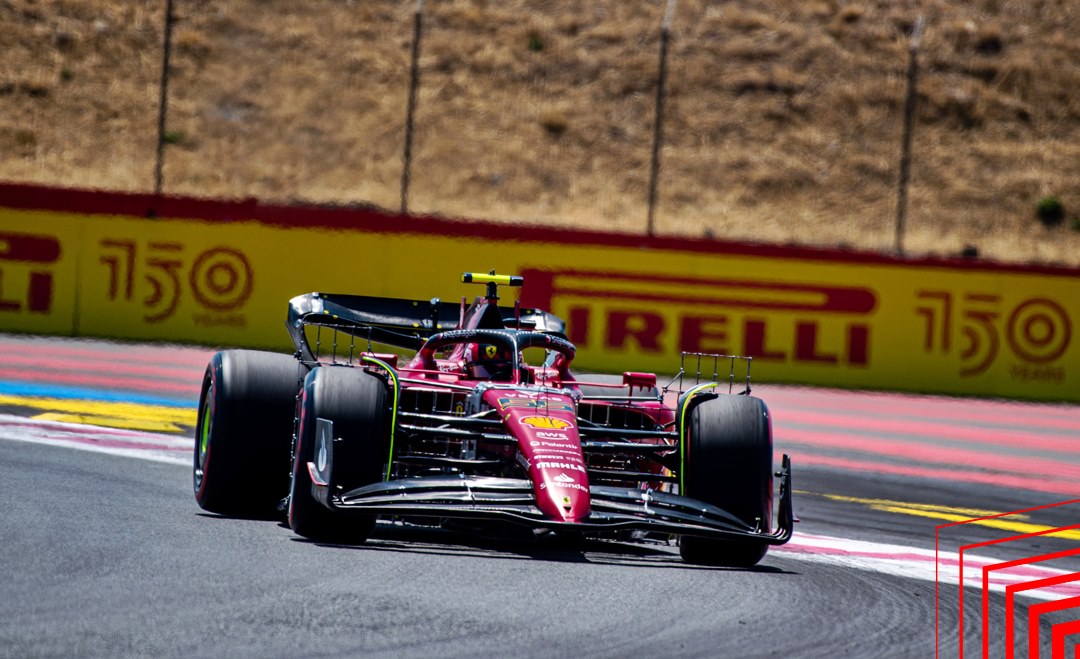
With no risk of rain and a hot sunny day, almost all the drivers chose to start on mediums, except for Ferrari’s Carlos Sainz, Scuderia Alphatauri’s Pierre Gasly and Alfa Romeo’s Valtteri Bottas.

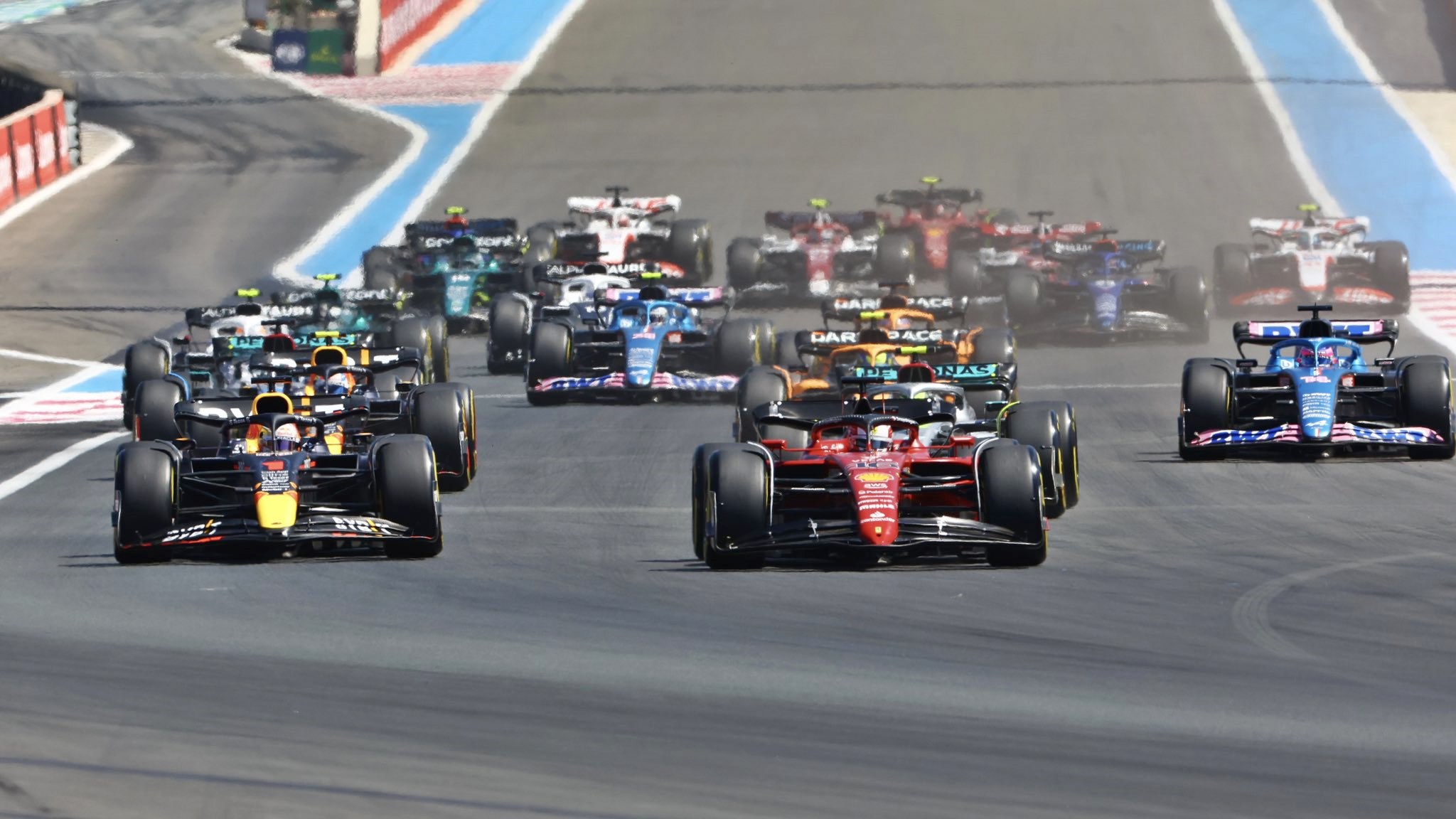
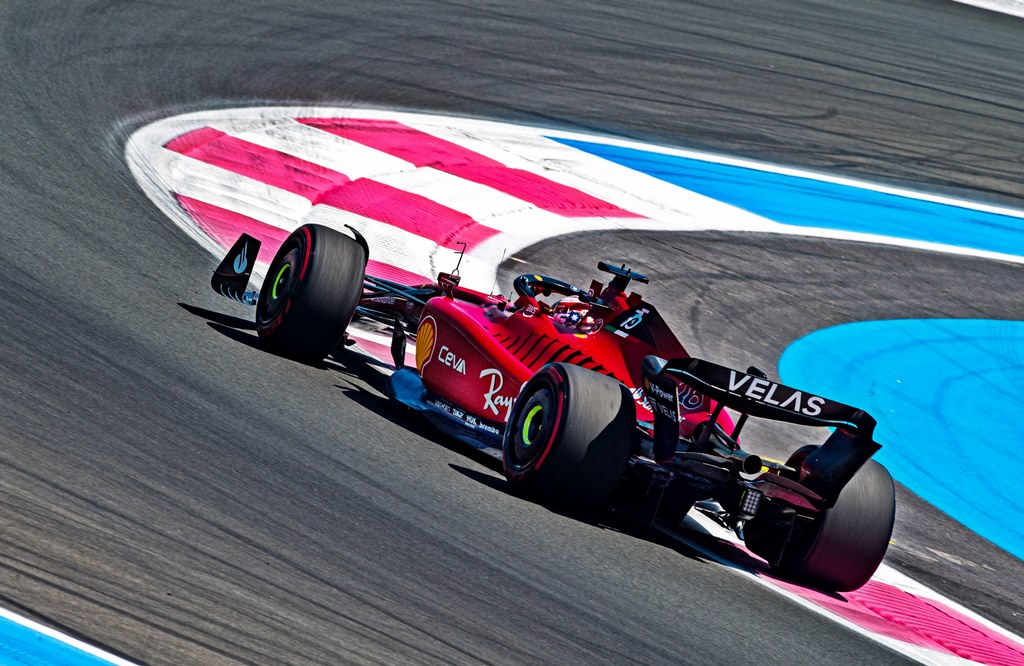
Poleman Charles Leclerc got his Ferrari off to a clean start and already had a slight lead ahhead of the two Red Bulls chasing him into Turn 1. While Max Verstappen was able to grab second position, it was a quick-moving Lewis Hamilton who got ahead of Sergio Perez in the first few seconds. His Mercedes-AMG team mate, George Russell, was also right on the Red Bull’s tail but then, as he eased off, Alpine’s Fernando Alonso suddenly shot past.

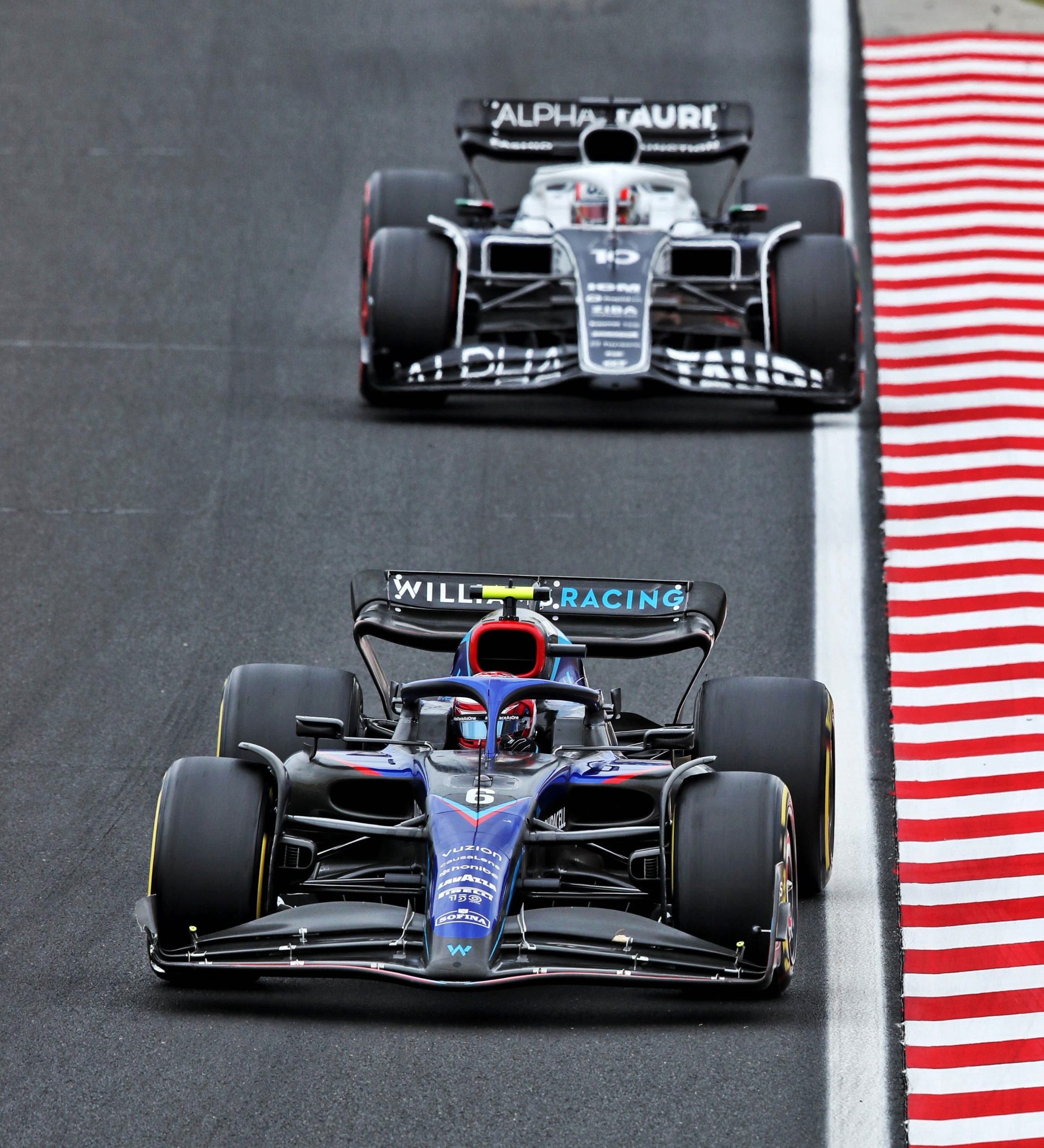
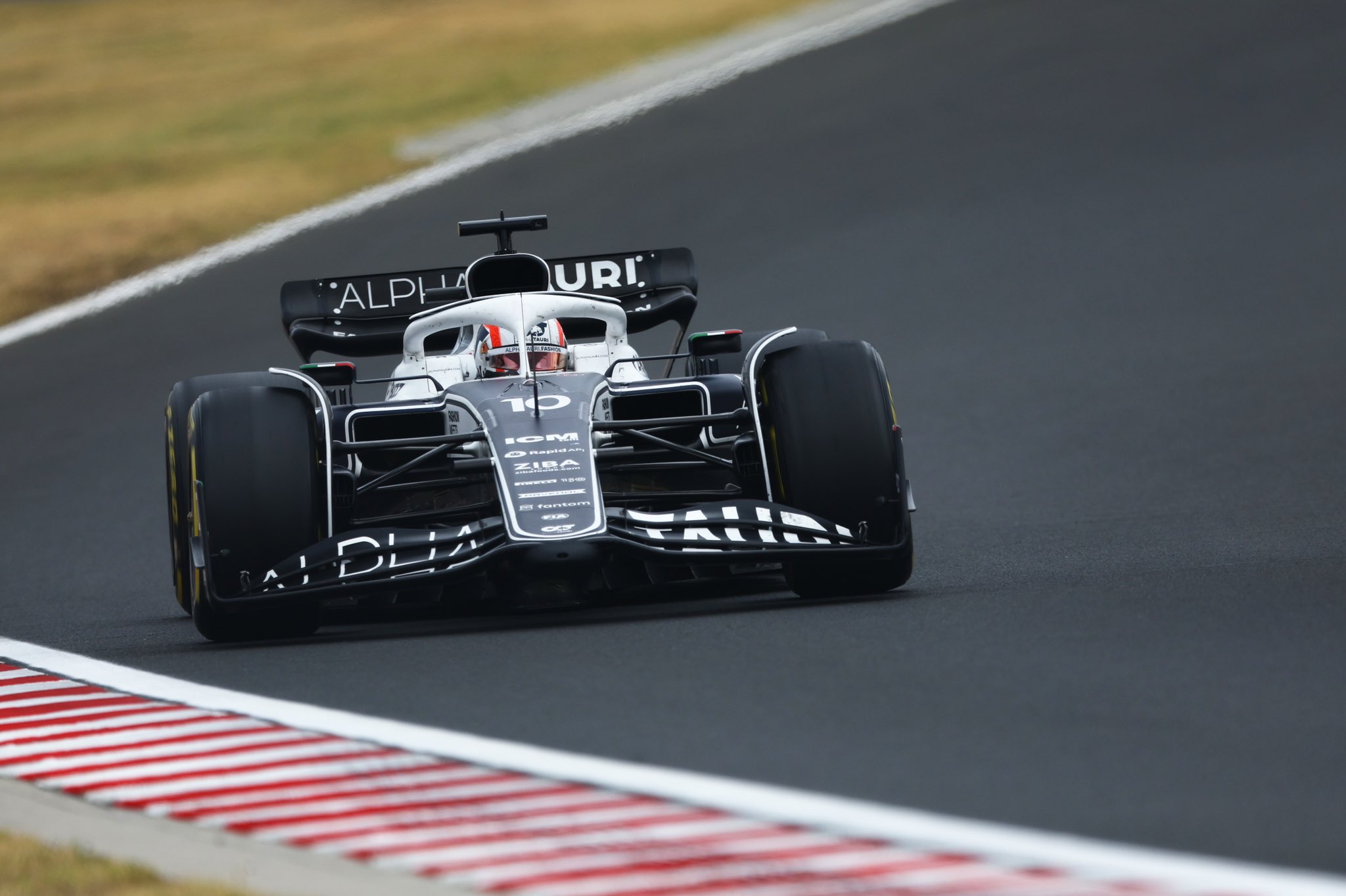
Scuderia Alphatauri’s Yuki Tsunoda, who had started from P8, spun and by the time he recovered, the rest of the cars had pulled away and he was right at the back. But a closer look at Tsunoda’s spin showed that Alpine’s Esteban Ocon might have caused it and the Stewards gave him a 5-second penalty. But it would be little comfort for Tsunoda as the damage was great and he had to retire eventually.

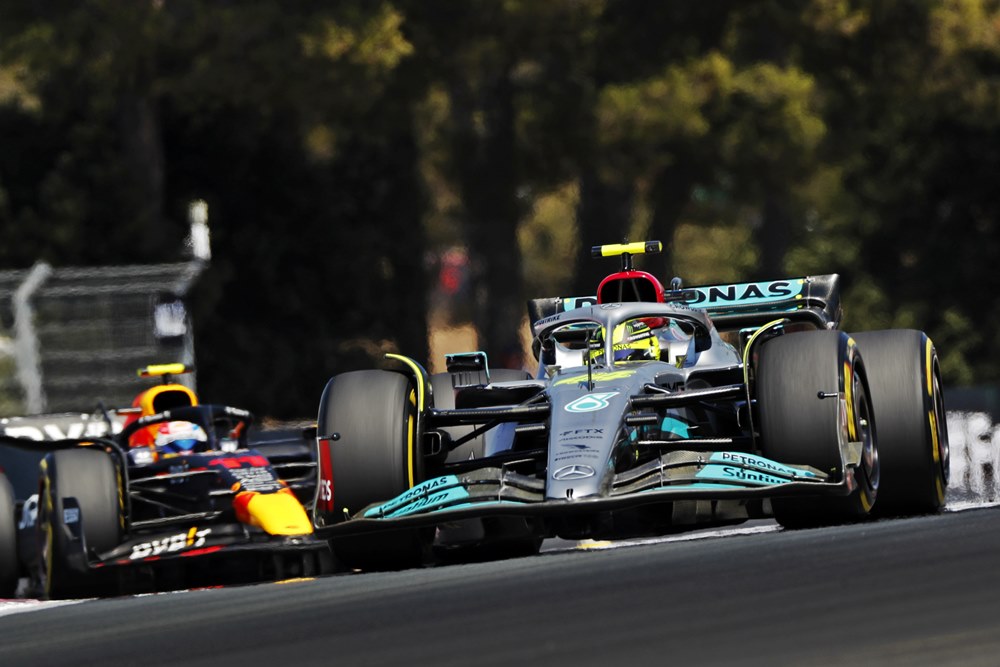
Sainz, who started from the back, had moved up 4 places by lap 4 and was prepared to be in ‘overtaking mode’ for much of the race. While Hamilton was having a tough time with Perez, Russell was able to get past Alonso and grab back fourth place.

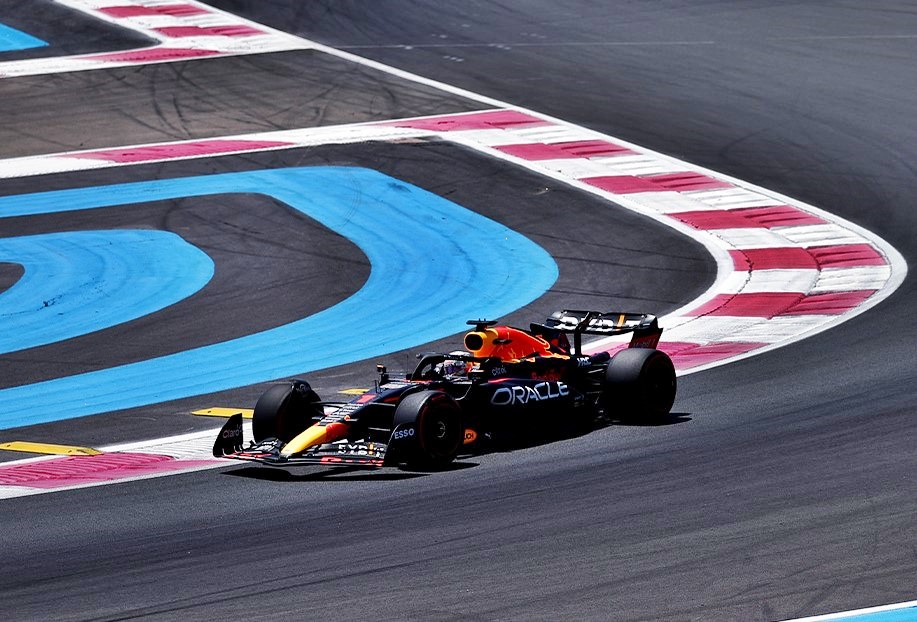
Verstappen was right up to Leclerc’s tail and determined to capture the lead early, even to the extent of seeming to ignore the need to manage his tyres. His crew, avoiding distractions, only suggested to him to control his pace.

Up to lap 10, the battles at the front saw no changes in positions, with Leclerc staying just ahead and Verstappen not able to find the right opening to make his move. Likewise for Perez who was duelling with Hamilton while Russell was just waiting for the Mexican to make a mistake.

By lap 13, Sainz had entered P10 and was 29 seconds behind his team mate, who was still in the lead. Verstappen’s gap seemed to open up a bit and it appeared that the Red Bull driver might be easing off to hold on to his tyres.

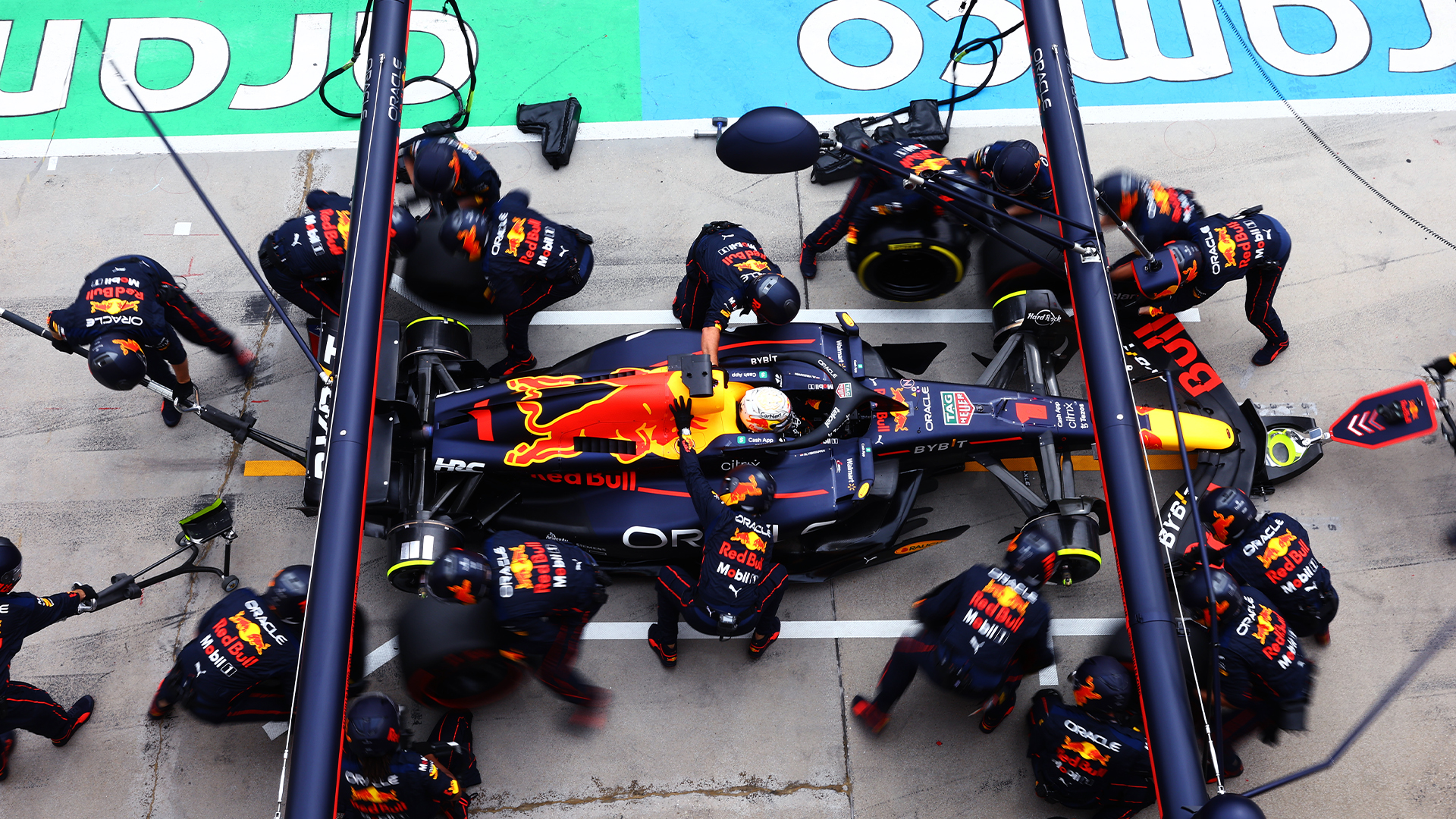
On lap 17, Verstappen pulled off to the pits, stood still for 2.4 seconds to get hard tyres fitted and rejoined in 7th, behind McLaren’s Lando Norris. Alonso was still at 6th, after having passed a few cars early in the race.

And then disaster struck for Leclerc as he crashed into the barriers on lap 18 at Turn 11. He was unhurt and came out of the car as the Safety Car began its duty. It seemed that the car had lost rear traction in mid-corner and at the speed he was doing, he could not recover fast enough. As his car was not obstructing, the Safety Car was able to come in after 2 laps.

By then, Verstappen has moved into the lead and the pressure was on Sainz to get up as high as possible and maximise the points to take home for the team. On lap 23, he was 6 seconds from the leader.

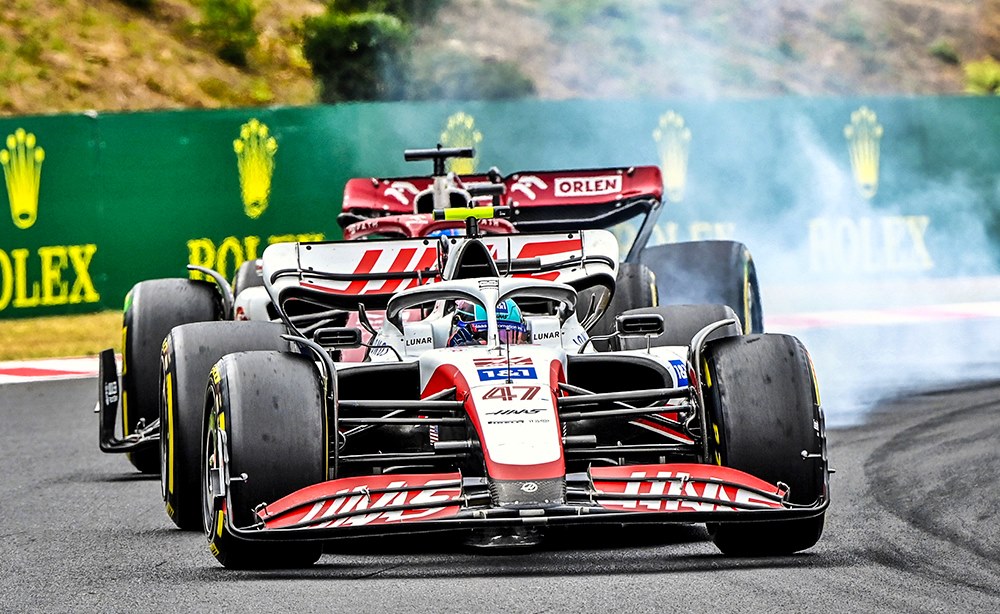
Turn 11 seemed to be a bad corner as Alfa Romeo’s Zhou GuanYu collided with Haas F1’s Mick Schumacher (damaging his rea wing) and the Chinese driver was given a 5-second penalty.

Hamilton was second, 2 seconds behind Verstappen, and the Mercedes-AMG driver had to keep an eye on Perez just behind while trying to close in on the Dutchman. The Ferrari team was also informed that Sainz had picked up a penalty for an unsafe release as he left his bay just as a Williams car was approaching.

As the race reached itsd halfway point, Verstappen had set a number of fastest laps and created a gap of 3 seconds from Hamilton. Both cars were on hard tyres but those on the  Red Bull had 2 more laps than the ones on the Mercedes-AMG, so was that going to be a deciding factor? In 2021, Hamilton had done a 1-stop in the race.

On lap 32, it was still more of a Perez-Hamilton battle than a Hamilton-Verstappen duel.  Pushing hard, Sainz got past Russell into fourth place but it may have taken a toll on his tyres. Behind the top five, Alonso was holding on to his reasonably secure 6th place.

With 15 laps remaining, the teams were trying to guess each other’s strategies and whether or not to try to last till the end. Pirelli was expecting Sainz to come in to get new tyres. Verstappen was 7 seconds ahead of Hamilton and having minor tyre issues but still able to keep going.

On lap 39, Williams Racing’s Nicholas Latifi left the track at Turn 2 after coming into contact with Haas F1’s Kevin Magnussen. Both drivers had to return to the pits as their cars sustained some damage, the Williams seeming to be worse off than the Haas.

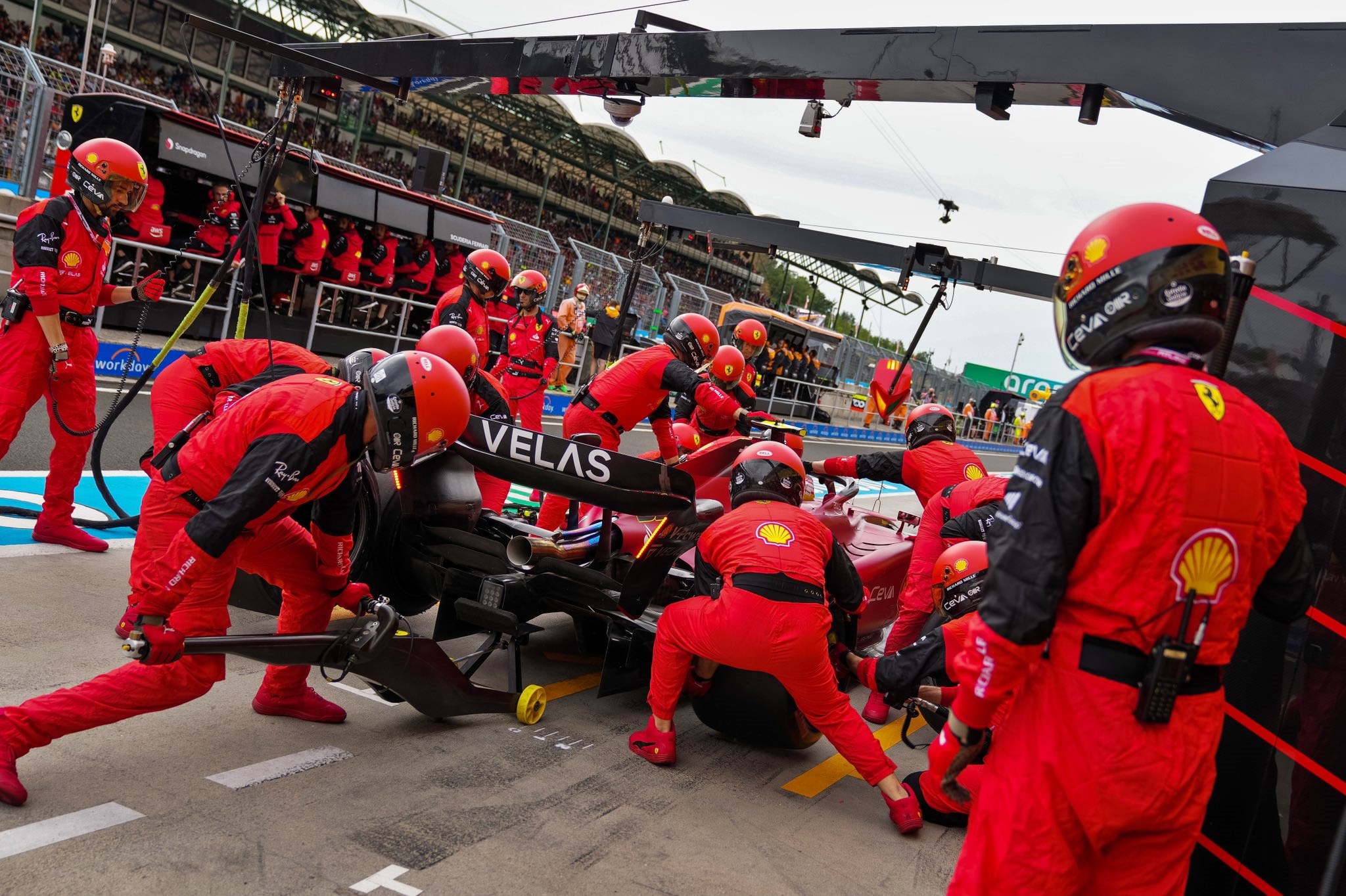
Sainz was getting concerned about his tyres and wanted to come in but was told to remain out. And one lap later (lap 42), he was told he could come in just as he had come up alongside Perez and got past into third. But it was short-lived as he came in, finally got new tyres – but had to serve his 5-second penalty – and dropped to ninth. Back to work, while Perez was safely back in third.

The battle between Russell and Perez heated up and at one point, they came in contact. However, there was no attention from the Stewards. The battle was good for Hamilton who could be less concerned about Perez bothering him while he figured out how to get closer to Verstappen who was 9 seconds away.

Sainz, on fresh tyres, was flying and intent on getting onto the podium at least. He was sixth with 6 laps remaining and had Alonso to clear before chasing after a distant Russell. At this point, it looked like the only change would be between Russell and Perez as Hamilton was too far and running out of laps to catch Verstappen.

On lap 49, Zhou again had the frustration of his Alfa Romeo stopping before the end of the race. The Virtual Safety Car (VSC) was activated as the marshals pushed his car off the track.

Just as the VSC went off, Russell made his move and shot past Perez to claim third place with 3 laps remaining. He had timed his surge perfectly but the Red Bull driver was not giving up easily. Sainz was too far back to get any further forward after passing Alonso but might get an extra point for his fastest lap.

While Verstappen comfortably took the chequered flag to win the French GP again, his team mate worked hard all the way to the finish line, trying to regain third from Russell. But time ran out and Russell stayed ahead although the Mexican still didn’t want to accept his place, suggesting that Russell may have exceeded the track limits at Turn 6 and should incur a penalty.

Race starts at 3 pm in France/9 pm in Malaysia

From the Red Bull Ring in Austria two weeks ago, the Formula 1 teams have travelled 1,100 kms west to the Paul Ricard Circuit in France for Round 12 of the 2022 world championship. This is the 62nd French Grand Prix that is a part of the Formula 1 World Championship and it was on the calendar of the very first championship in 1950.

However, the Paul Ricard Circuit has not always been the venue of the French GP and including this weekend’s event, has held it 18 times. Other circuits that have hosted F1 rounds have been Reims, Clermont-Ferrand, Le Mans, Dijon and Magny Cours.

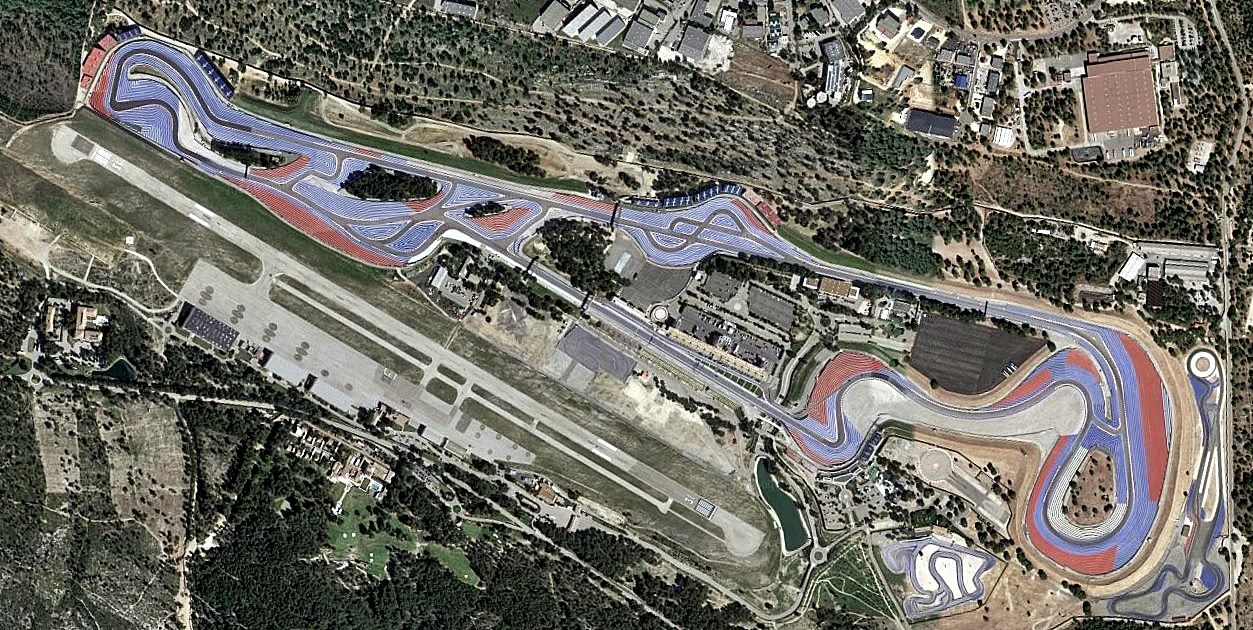
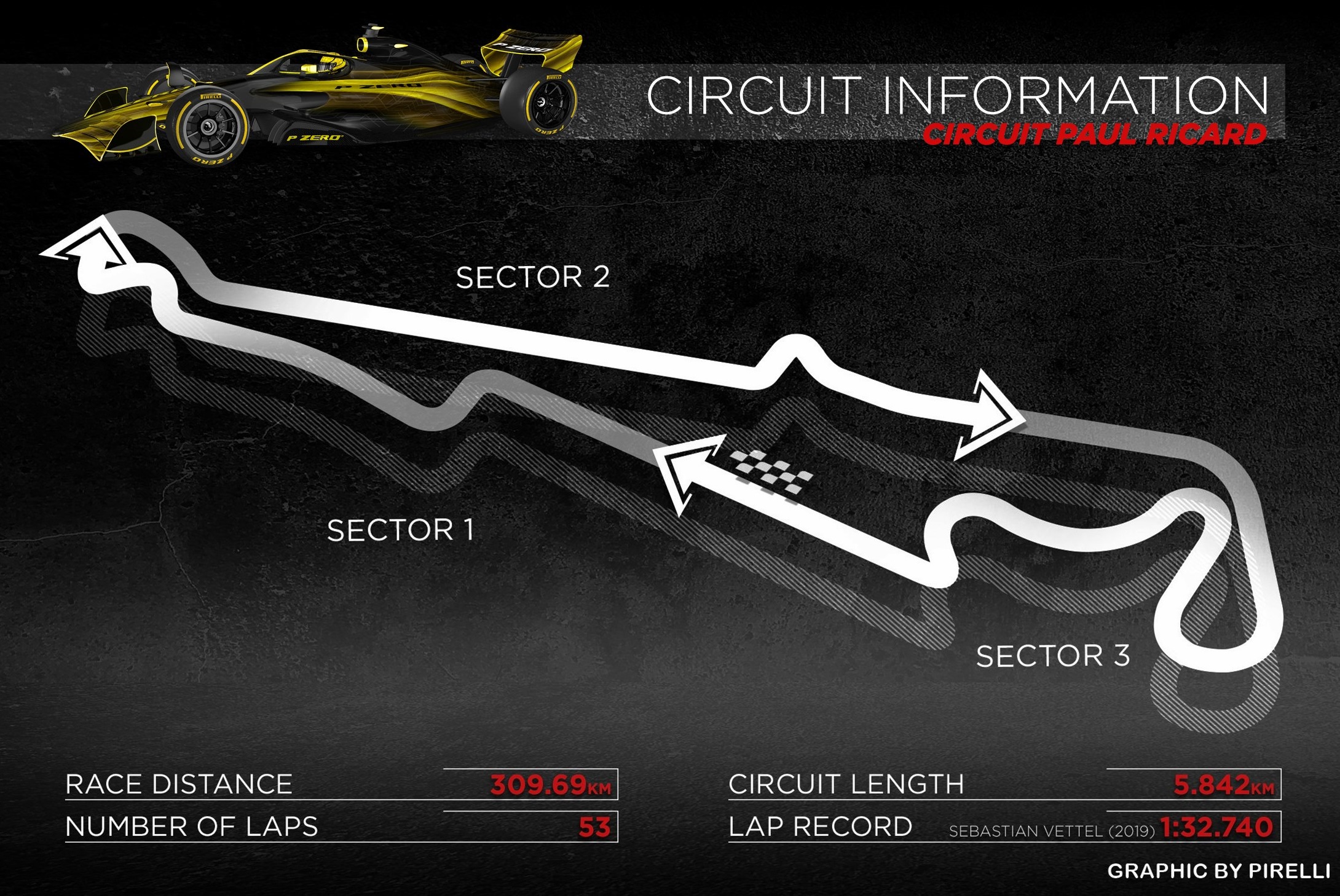
Paul Ricard is an interesting track which features no less than 247 possible track configurations – ranging from 800 metres to 5.86 kms (the lap length for this weekend’s race will be 5.842 kms). While it is used for many races, it is also a popular track for testing and it is possible to make it something like Monza or Monaco or a combination of both circuits. There’s also a sprinkler system that can simulate wet weather driving on 64 of the different layouts.

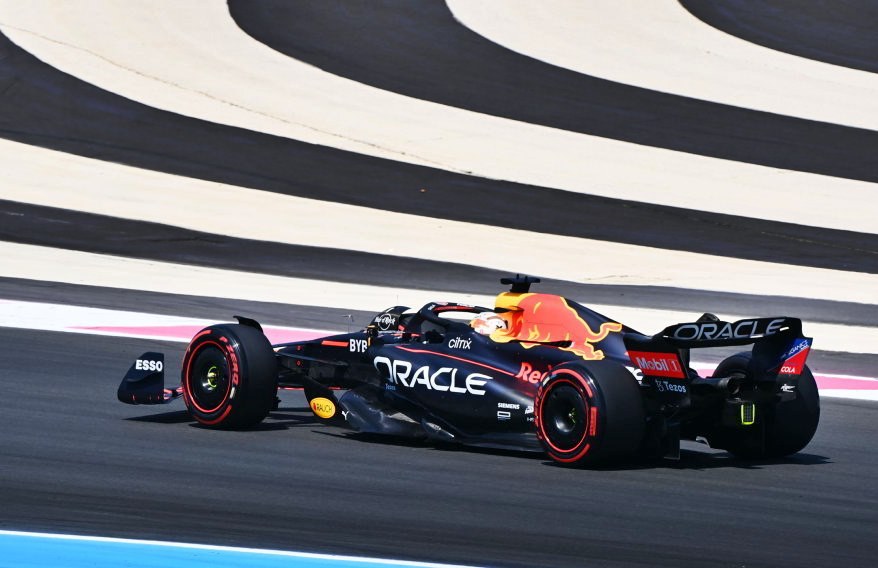
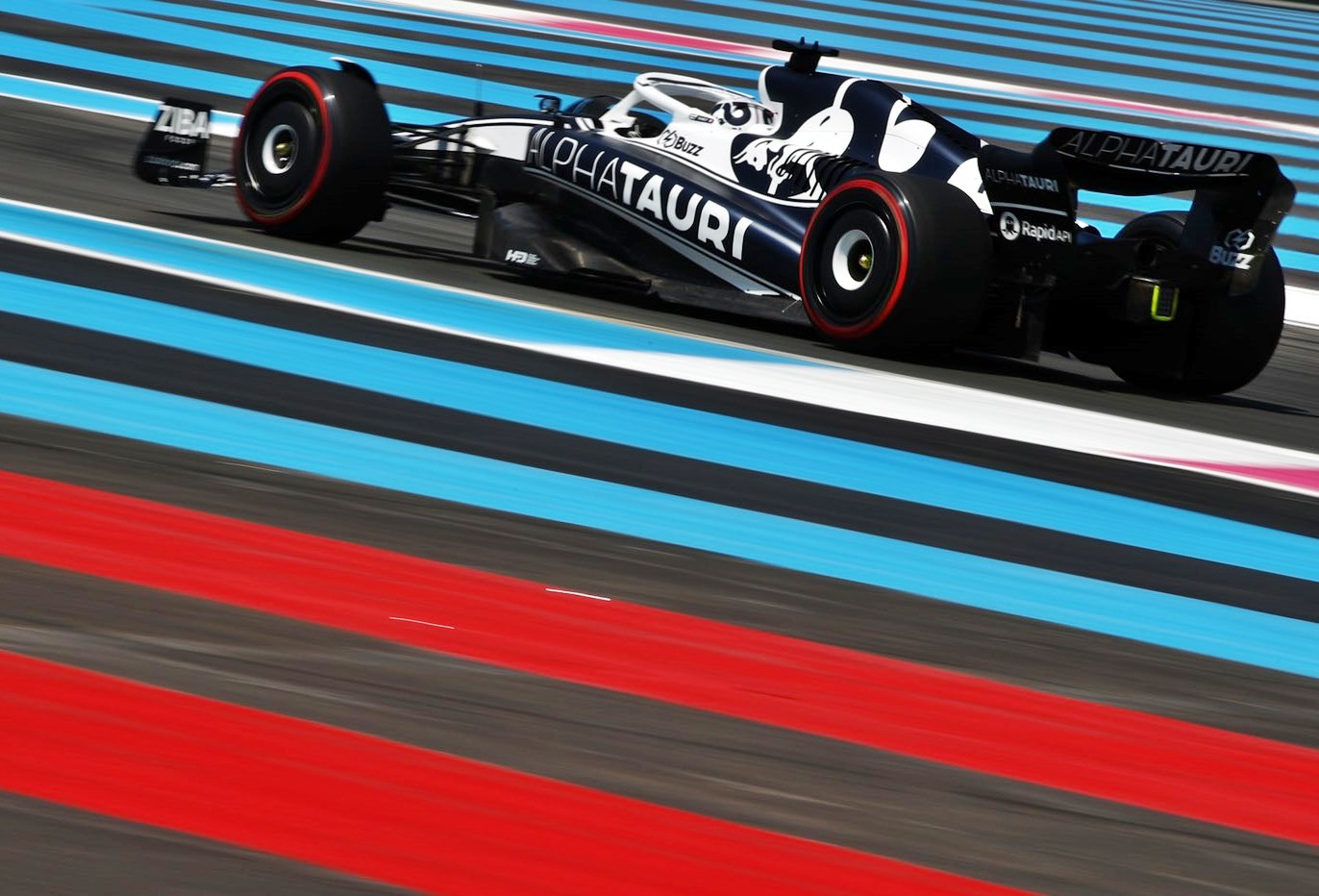
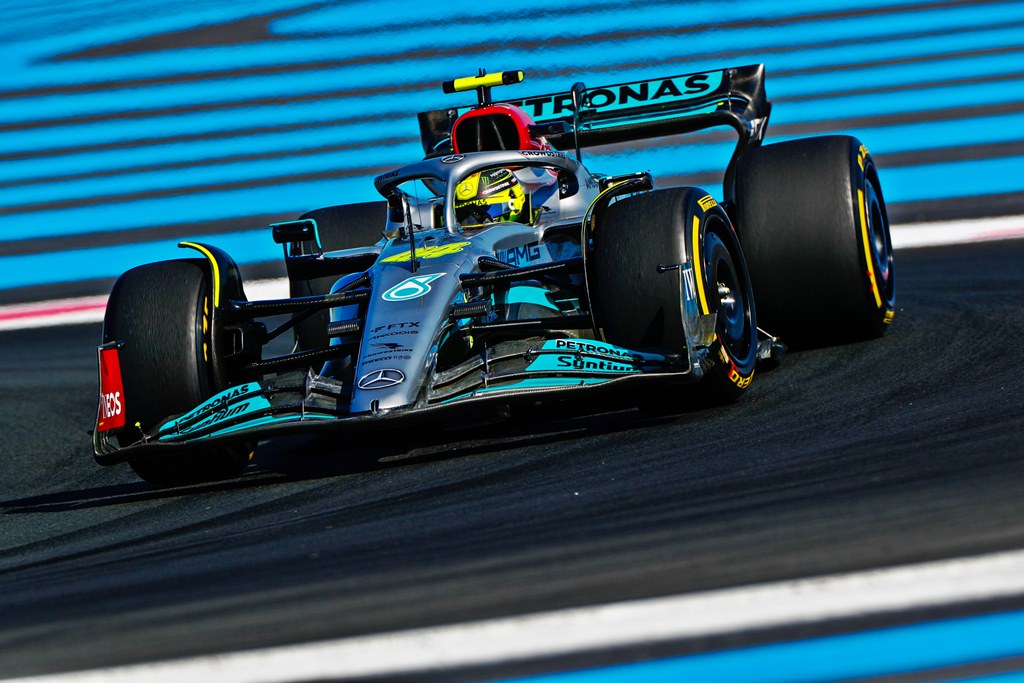
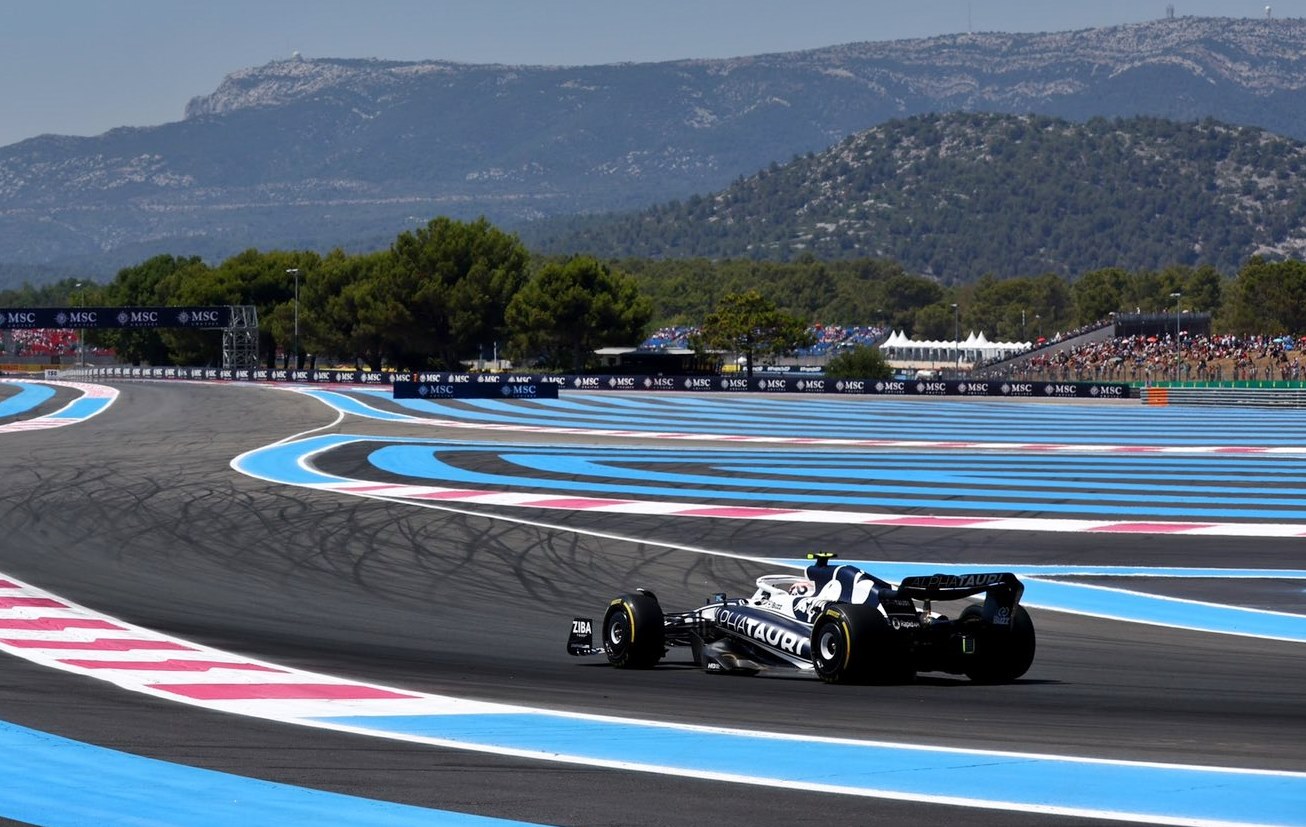
One of the circuit’s special and eye-catching features are its brightly coloured run‑off zones which offer plenty of grip and replace the more usual gravel traps. The blue zone is not especially abrasive and has only a small negative effect on cars going off track, while the red zone close to the barriers has a much coarser texture and slows cars down (and can flat-spot tyres). Both of these distinctive zones use tarmac combined with tungsten to create an abrasive surface that helps reduce car speeds when they exceed track limits.

The circuit itself has been regularly resurfaced with fresh tarmac and provides a high grip level, compared to other tracks in F1. Plus, the tarmac is very dark in colour, which is why it gets so hot in the sun and can reach temperatures approaching 55°C, one of the year’s highest figures. The asphalt is extremely smooth and while smooth tarmac means tyres don’t wear out as quickly, they are much more difficult to warm up. But the normally high temperatures experienced at the track, especially in summer, should help with getting heat into tyres.

“This year’s French Grand Prix takes place nearly a month later than it did last year, when it rained on Sunday morning, so it’s fair to expect warmer temperatures. This year’s generation of tyres and compounds is different and more resistant to overheating than the 13-inch versions used last year, so we’ll have to see how that affects the strategy,” said Mario Isola, Pirelli’s Motorsports Director.

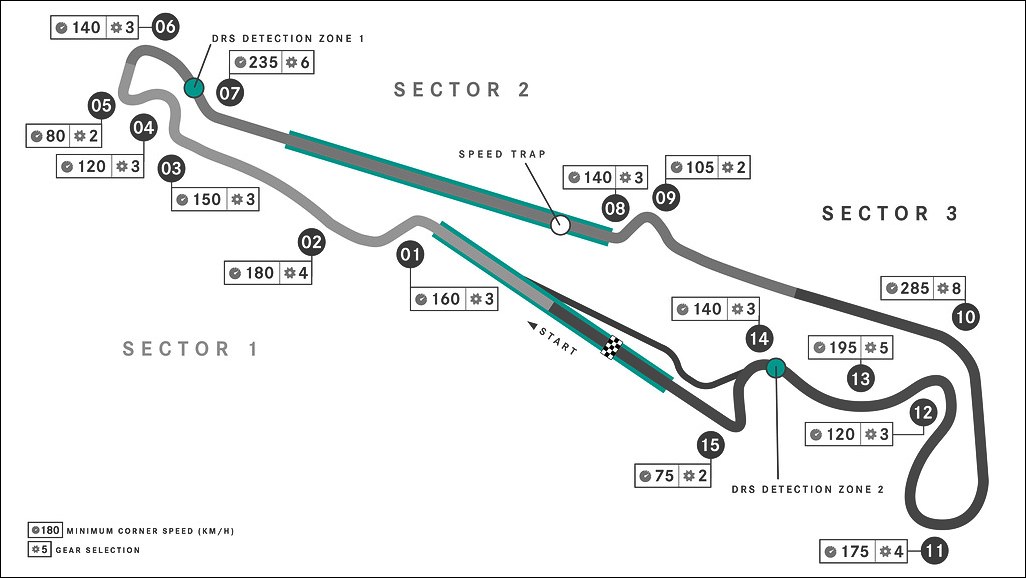
The layout used for F1 racing will challenge teams in optimizing set-ups as there are varied demands. Of the 15 turns, 6 are left-hand and 9 are right-handers. Many of the right-hand corners are long sweeping turns, which puts a great deal of stress on front left tyres. All in all, the Circuit Paul Ricard has a good mix of fast, medium and slow corners.

Defined by long straights, the circuit’s first sector ends in a low-speed complex that requires agility and good traction on exit for the high-speed run to Turns 7 and 8. The faster sequence following the sweeping Signes curve will put more energy through the tyres.

Although the track is generally very smooth, there is one heavy bump. Turn 5 was remodelled for the 2021 season with the intention to make it a slightly banked entry towards the apex, similar to Turn 4 in Austria but in the end, there is now a bump where the track drops away from the car between Turn 4 and Turn 5.

Brake cooling at Paul Ricard is not as critical as at some other circuits, because there is enough track between braking zones to allow pads and discs to cool down sufficiently, so overheating is not a particular problem. Brembo’s technicians agree and on a scale of 1 to 5, it has a difficulty rating of 2, the joint lowest of the season with Silverstone.

Gear positions and cornering speeds of Mercedes-AMG racing cars.

The most demanding braking is on Turn 8, the chicane that bisects the 1.8-km long Mistral straight. The cars come onto it at 319 km/h and brake for 2.12 seconds, covering a distance of 116 before going into the turn at 135 km/h. For 53 laps, the drivers have to exert a load of 141 kgs and during that time will experience a deceleration force of 4.7g.

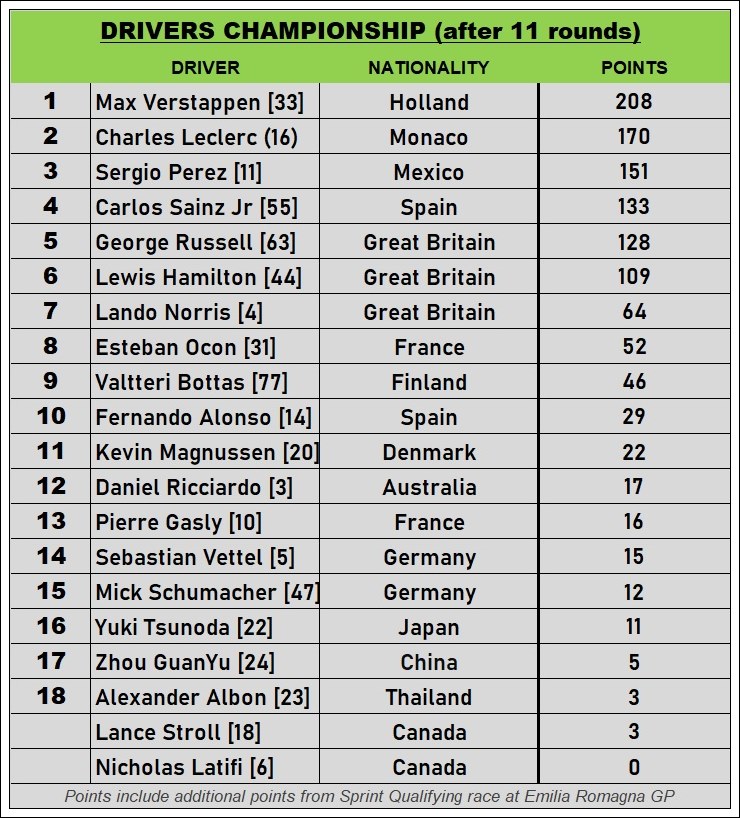
In the championship standings after half the season has been completed, Charles Leclerc’s win in Austria a fortnight ago closes the gap with leader Max Verstappen, cutting it down to 38 points. The Dutchman’s team mate, Sergio Perez, had bad luck and failure to finish dropped him to third place, 21 points behind the Ferrari driver.

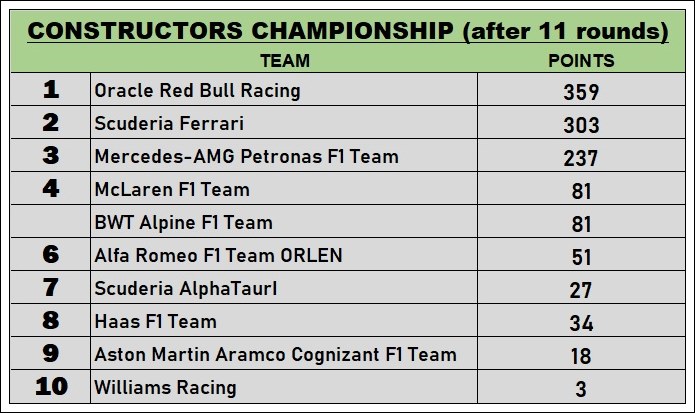
In the Constructors championship, Red Bull Racing still has the lead with 359 points, 56 points ahead of the Italians. The British-based Mercedes-AMG PETRONAS Team is some way down with 237 points.

During the drivers’ briefing, Aston Martin’s Sebastian Vettel walked out of the room and officials deemed that he had ‘left without permission’ and therefore committed an offence under the regulations. As a result, he was handed a suspended fine of 25,000 euros which will be held for the rest of the 2022 season. Vettel’s action was prompted by frustration as drivers sought explanations for inconsistent decision-making by race officials.

Mercedes-AMG’s Lewis Hamilton also had a worrying moment 15 minutes before the start of the 71-lap race as there seemed to be a problem that brought mechanics running to his car as it was parked on the starting grid. But they managed to get it fixed (believed to be the brakes) in time.

The starting positions for the race were determined by the finishing order of the Sprint Race yesterday and of the 19 cars that took part (Alpine’s Fernando Alonso retired before the race started), the top four finished in the same order as the Qualifying session.This put two Ferraris behind poleman and championship leader Max Verstappen of Red Bull Racing. It was going to be interesting seeing if the Ferrari team had decided to continue letting their two drivers fight each other if the situation arose (as it did during the Sprint race).

Verstappen got a clean and smooth start but Carlos Sainz (Ferrari) left the track at Turn 3 and that allowed Mercedes-AMG’s George Russell to slip ahead. But at Turn 4, the British driver came inb contact with Red Bull Racing’s Sergio Perez and the Mexican’s car slid into the gravel although he was able to keep going but dropped to the end of the field. The incident had the attention of the Stewards who would review it and later give Russell a 5-second time penalty.

The contact caused damage to Russell’s car and he was having understeer. Vettel too reported damage on his car. Haas F1’s Mick Schumacher again tangled with Hamilton and took his seventh place – which might mean the world champion would go through the same frustrations he had in the Sprint race. Meanwhile, at the front, Ferrari’s Charles Leclerc was right on Verstappen’s tail and looking to displace the Dutchman from the lead.

Leclerc had DRS but the Red Bull Racing car was superior in straight line speed. But without Perez nearby, Verstappen would have to stay focussed against two Ferraris right behind him as Sainz had also closed in.

Russell came in on lap 12 to serve his 5-second penalty and during that time, he also got a new rear wing. But it costs him many places and he was down to 19th when he rejoined the race.

On lap 13, Verstappen came in to switch to hards and Leclerc took over the lead. When the Red Bull driver rejoined, he was down in fifth, behind Hamilton and about 20 seconds behind Leclerc. But as drivers ahead began to also come in, Verstappen was able to move upwards quickly and was in fourth (still behind Hamilton) by lap 17. The gap to the front was still a double-digit time.

By lap 20, Verstappen was able to get past Hamilton easily into third place, though still 19 seconds behind Sainz who, in turn, was 4 second behind his team mate. Further down, there was a battle for sixth place between Yuki Tsunoda (Scuderia Alphatauri), Zhou GuanYu (Alfa Romeo) and Alonso as well as his Alpine team mate, Esteban Ocon.

On lap 25, Leclerc left the track to enter the pits, along with Perez whose sidepod damage forced retirement at that point, Sainz was in the lead when Leclerc rejoined just ahead of Hamilton. Then Sainz came in and it was Verstappen in the lead again but Leclerc was closing in fast too.

When Hamilton finally came in, he was delayed by a problem with the wheel, and when he rejoined, he was behind Aston Martin’s Lance Stroll and Ocon. He had to work hard again to get back his original position but that’s what he’s paid such a huge salary for anyway. Meanwhile, team mate Russel was duelling with McLaren’s Daniel Ricciardo for ninth place.

Lap 33 saw Leclerc finally getting past Verstappen who (from radio exchanges) seemed to be having some issues with inconsistent tyre grip. And the Dutchman had also to watch out for Sainz who was coming up from behind as well. Not taking chances, Verstappen quickly headed to the pits on lap 36 to change tyres and managed to get back into the race in third place, with a 25-second gap from Hamilton.

Lap 40 saw yellow flags coming out as Vettel went off into the gravel after a collision with Scuderia Alphatauri’s Pierre Gasly (for which Gasly would get a 5-second penalty). But the Aston Martin was able to get out although Vettel was down to 17th.

The Stewards were obviously keeping a close eye on the cars in the corners and many drivers receive warnings and penalties for going over the track limits. At the front, Leclerc was clearly the faster of the two Ferrari drivers, with Sainz about 5 seconds behind and then a gap of 17 seconds to Verstappen. 24 laps remained.

Both Leclerc and Sainz gave up the front positions as they came into the pits, allowing Verstappen to lead the race. But it was not going to be easy to stay there because Leclerc had been quick to get back out and was right on the back of Verstappen within half a lap – and one lap later, he recaptured the lead.

Hamilton was fourth and came in on lap 52 for medium tyres, retaining his position as the next car with Ocon in it was some distance back. With 17 laps to go, what was the strategy for Sainz? It was uncertain if he would pit again so the Ferrari man stayed within striking distance.

Sainz was pushing hard to catch Verstappen when, on lap 55, his car was on fire and he had to quickly come to a stop. The Virtual Safety Car (VSC) was activated as he managed to park in a safe spot, and many cars quickly shot into the pits. Lap 60 was coming up and Hamilton was able to move up another position and look forward to standing on the podium. Behind him was Russell so the team could get another chunk of points today. The VSC was turned off with 11 laps remaining.

Leclerc was in the lead when the VSC was turned off with 11 laps remaining. However, one lap later, he was on the radio reporting that the throttle felt like it was sticky and the engineers quickly looked at the data. They assured him that all was well; his engine was fresher than the one in Sainz’ car so he did not have to be so worried though he had to watch his foot pressure.

With 6 laps remaining, Alfa Romeo’s Valtteri Bottas put in a stronger effort to get into the top ten for points and managed to grab it from Williams Racing’s Alex Albon. The Thai driver then dropped another place as Alonso also swept past him in Turn 5.

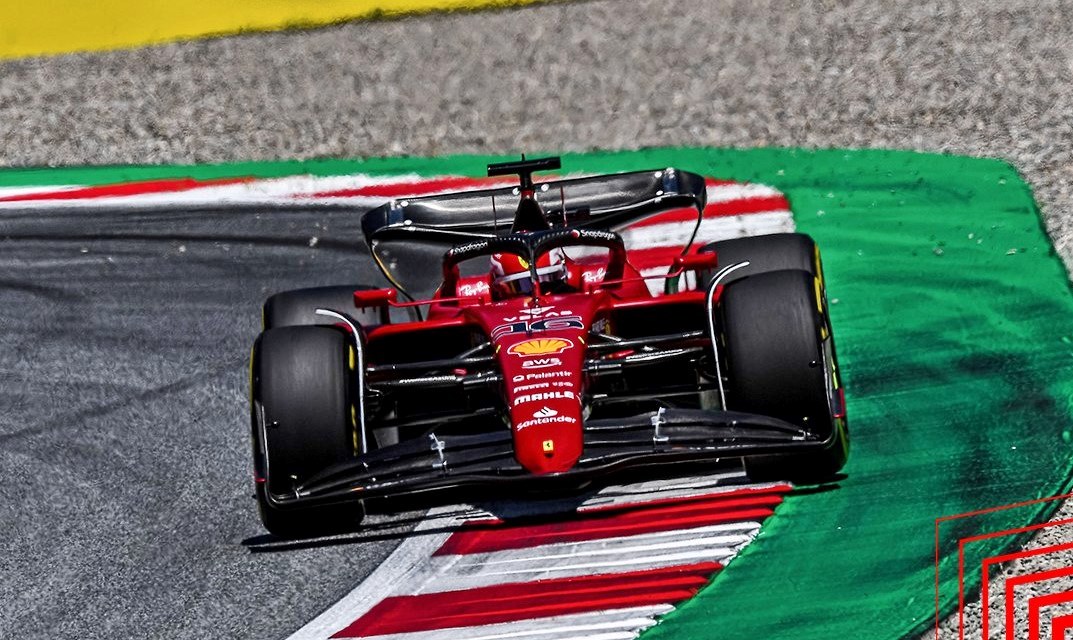
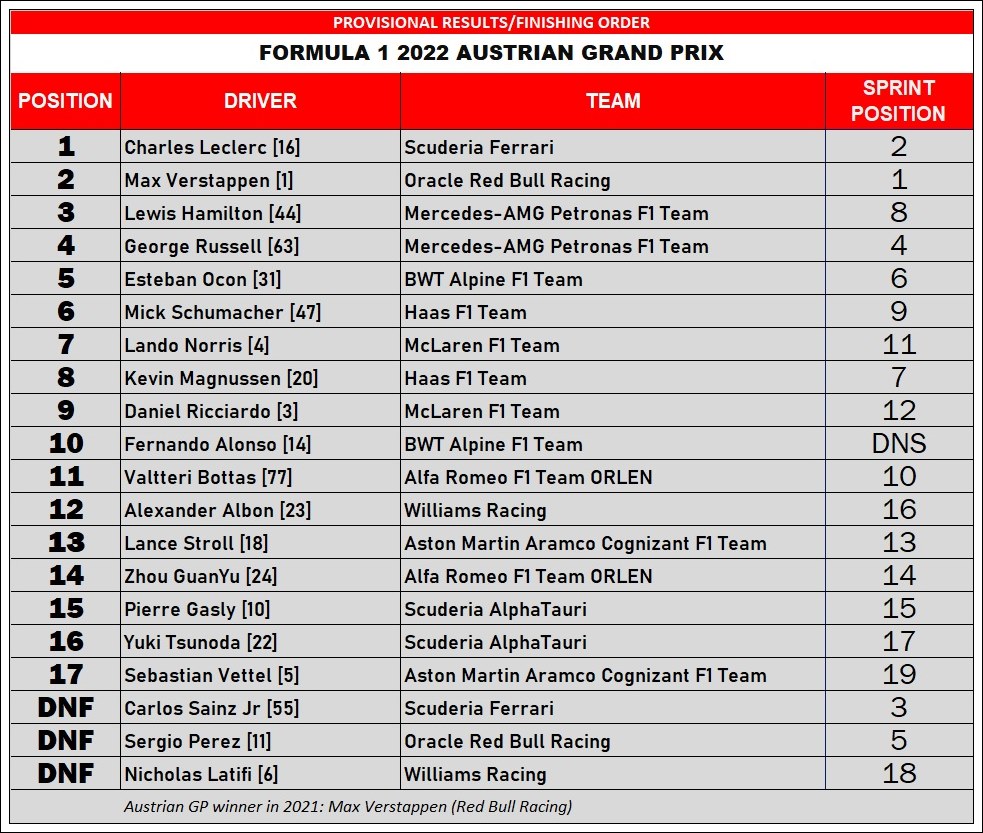
The final few laps must have been very tense for Leclerc as his throttle was not working properly and then he found that downshifts were not being executed. Could the power unit hold on just a little bit more, even as Verstappen was pressuring him? Verstappen got within 2 seconds just as the finish line came into sight and it was Leclerc who took the chequered flag to win the Austrian GP this year.

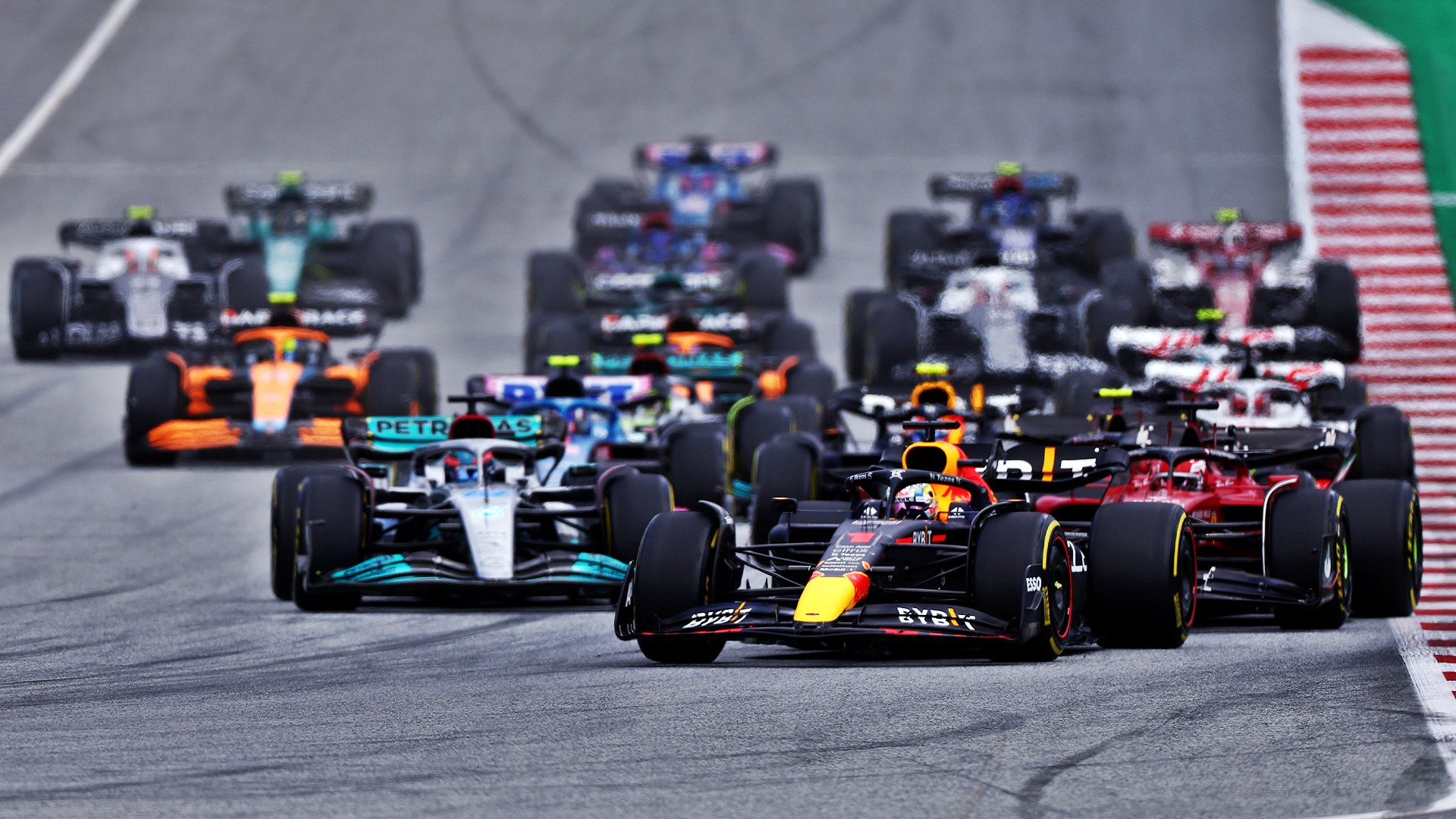
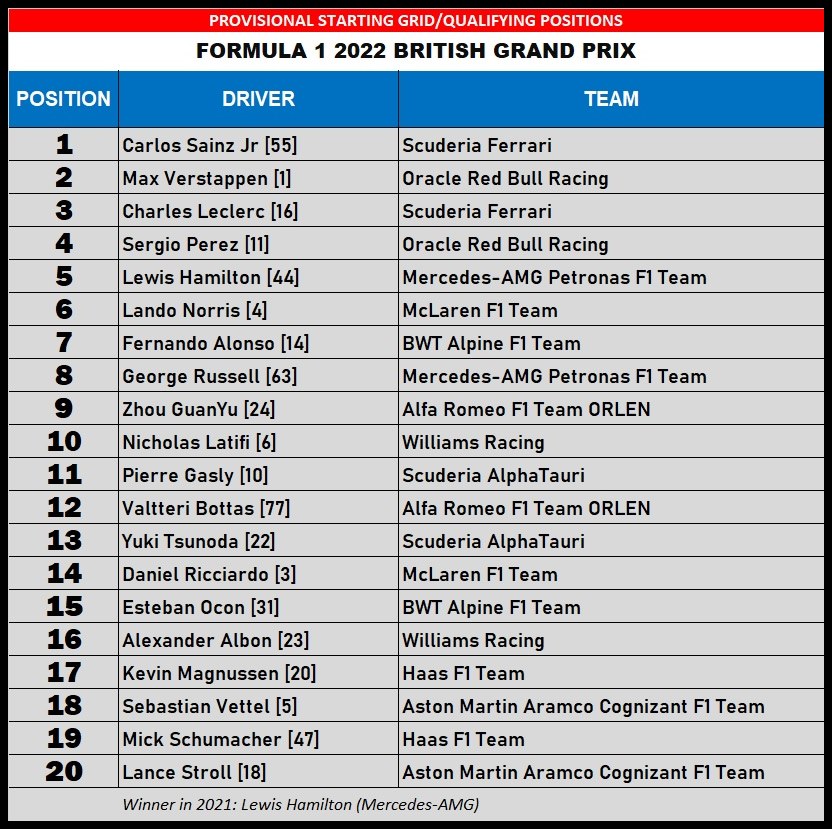
After a wet qualifying session the day before, the weather was dry though windy as the drivers took the places on the starting grid, with a 20% chance of rain being forecast. Ferrari’s Carlos Sainz, Jr. occupied pole position for the first time in his F1 career, but Red Bull Racing’s Max Verstappen in P2 would be preparing to get to Turn 1 first. In fact, the Red Bull driver even slipped ahead during the formation lap! Sainz’ team mate, Charles Leclerc would also be looking for a way to cut through both drivers from his P3 position.

As the lights overhead went out, Verstappen was able to take the lead right away, displacing Sainz to second place. Mercedes-AMG’s Lewis Hamilton managed to get through ahead of Leclerc to grab an early third place.

But further back, there was a lot of drama – and when the cars stopped bouncing around, out came the red flags suspending the race even before the first minute had passed. At least 5 cars were involved and damaged – Alpine’s Esteban Ocon, Williams Racing’s Alex  Albon, Scuderia Alphatauri’s Yuki Tsunoda, Alfa Romeo’s GuanYu Zhou and Mercedes-AMG’s George Russell.

The Mercedes-AMG, which started from P8, appeared to collide with the Alfa Romeo which was sent upside down and sliding off the track for some distance with sparks flying. The Chinese driver was extracted from his car (which had gone over the barrier and was stuck against the fencing) and carried on a stretcher. Zhou as well as Albon were taken to the medical centre for examinations.

There was also a rather silly episode after the red flags came out as a group of people attempted to get onto the track, apparently to stage some sort of protest by lying down. Track security managed to remove them right away and passed them over to the police.

It was 56 minutes after the 2022 British GP had originally started that the race resumed. However, Russell was not allowed to rejoin the race as FIA rules state that he cannot continue racing if he had received mechanical assistance (for a puncture) during the race. It was unfortunate for the British who had jumped out of his car the moment it stopped spinning and ran over to where Zhou’s car had ended up to try to help.

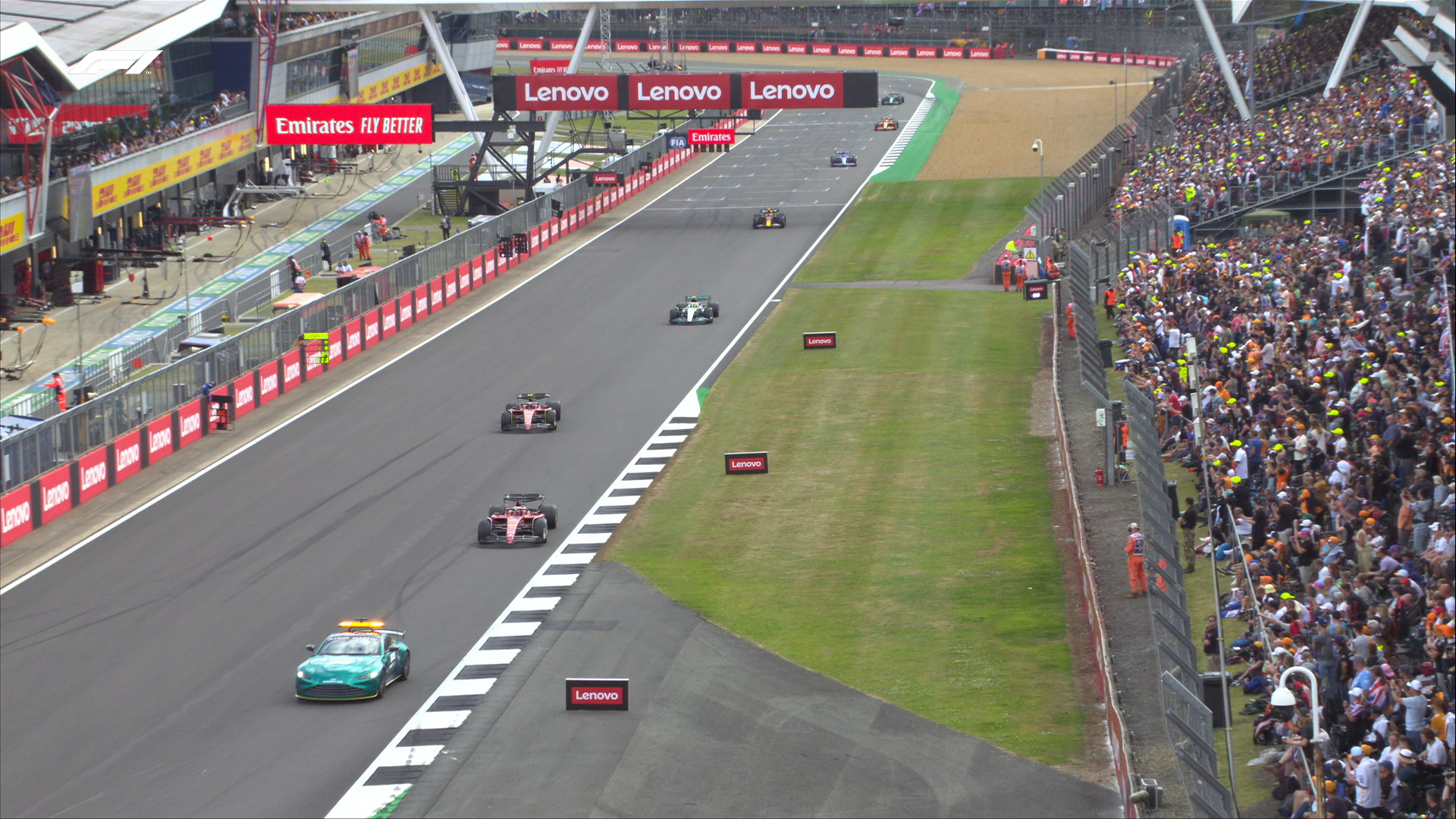
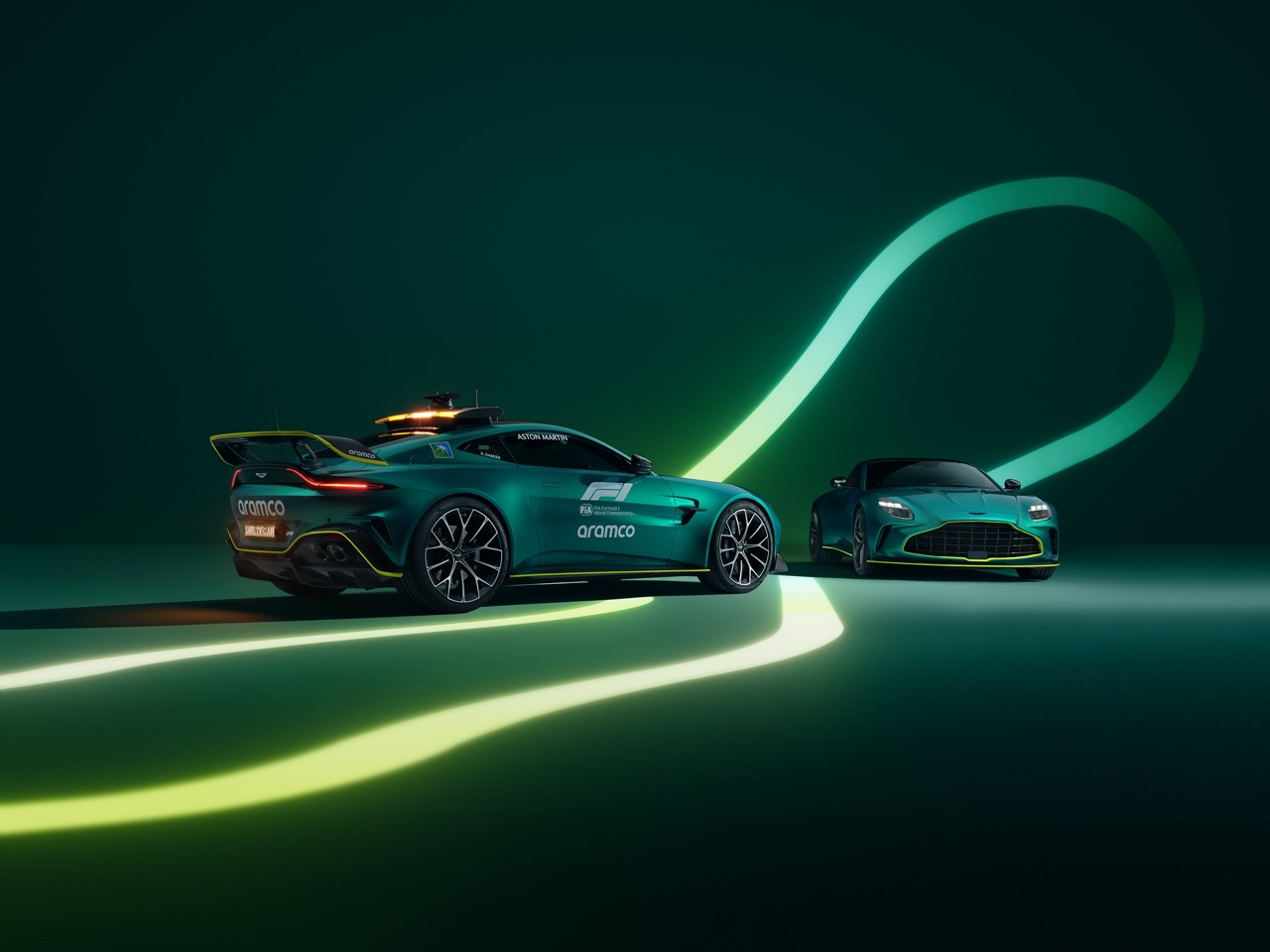
As the race had not even completed its first lap when it was suspended, the restart was done with the same positions as the original grid based on qualifying times. That put Sainz back in front of Verstappen as the cars followed the green Aston Martin Safety Car around the track to a standing start.

This time, Sainz managed to stay ahead of Verstappen, as Leclerc and Sergio Perez, the  other Red Bull, other duelled behind. Leclerc managed to pull away and tried to pass Verstappen and contact occurred between the cars at Turn 6, with the Red Bull car getting some damage on the front wings. The Ferrari may also have got some slight damaged climbing the kerb. Perez meanwhile dropped to the back after returning to the pits to replace his wing, which was also damaged.

Hamilton would not have his team mate as wingman for this race and had to keep McLaren’s Lando Norris from displacing him from fourth position. While keeping an eye on Norris, he was also closing in on Leclerc. It took 4 laps before Verstappen finally passed Sainz on lap 10 as the Ferrari driver made a mistake and slipped off onto the grass. On lap 10 too, the two Alphatauris had a strange coming-together which saw Yuki Tsunoda going into a spin. The Japanese driver would later get a 5-second penalty for causing the incident.

Verstappen’s lead was brief as his car appeared to slow down and Sainz shot past him. Fortunately, it was a puncture and not a powertrain fault and he was able to get back to the pits for a quick replacement. When he rejoined the race on lap 12, he was down in sixth place and would have to work hard again. He was also unhappy (saying it was ‘100% broken’) as his car seemed to have some other damage that was preventing him from pushing it harder.

Lewis Hamilton was up higher than usual (for this year) in third place but still 5 seconds behind Leclerc who was following Sainz, the race leader. Porpoising or not, the 7-time world champion was putting in quick lap times in front of the home crowd, hopeful that he could add another Silverstone victory to his collection.

There was tension between the two Ferrari drivers up front. Leclerc was eager to get past Sainz to get away from Hamilton, who was closing in. But the team did not seem willing to ask Sainz to ease off; in fact, they were urging him to push harder. Verstappen was still holding sixth and could not push harder.

On lap 20, Sainz gave up his lead to Leclerc as he headed into the pits for new tyres. When he rejoined, he was behind Hamilton who was about 3 seconds behind Leclerc. Meanwhile, the second Alfa Romeo driven by Valtteri Bottas was out.

Verstappen was not having a good day and even after coming in again for hard tyres, he was finding that the grip was poor. Team mate Perez was two positions ahead in sixth which the Dutchman had held for a while.

A loud cheer went up as Hamilton moved into the lead at the British GP when Leclerc pulled into the pits on lap 25. He may have had bad luck all year but at the race which has has been won 8 times, he was in the lead. It was crucial for Leclerc to stay in touch so even though he had a damaged wing, he was asked to stay in the chase. He was within sight of his team mate and was given the go-ahead to compete for the second position with Sainz. But by lap 31, the team decided that Leclerc had the edge and asked Sainz to let him through. There was still an 18-second gap to reach the Mercedes-AMG.

On lap 32, Ocon skipped past Williams Racing’s Nicholas Latifi to slot into ninth place and then came right behind – and passed – Verstappen. But he was then pursued by both Haas F1 drivers. Mick Schumacher was eager to secure a position in the top ten to collect his first points in Formula 1.

On lap 38, Hamilton began to feel vibrations and he was asked to come in to get new tyres. 4.3 seconds at standstill and off he shot to rejoin in third place. He would need a little while to get his tyres warmed up before going after the Ferraris that were 4 seconds ahead.

Ocon leading the world champion Red Bull driver was a short pleasure the Alpine driver then had to pull over 3 laps later to retire from the race when his fuel pump failed. This brought out the Safety Car on lap 40. Sainz and Hamilton took the opportunity to come in for soft tyres but Leclerc remained running to gold on to the lead.

After 2 laps, the Safety Car pulled in and racing resumed. Leclerc was on hard tyres but the 4 cars behind him had moved to soft tyres. It was lap 42 and of the 20 cars that started, 6 had retired.

Perez had been ready for the restart and managed to get past Hamilton at Turn 5. Leclerc was forced to go wide by Sainz as the Spaniard got ahead of his team mate at Turn 6. As Sainz pulled away, Perez and Hamilton were getting closer even while fighting each other. Top Gun Maverick Tom Cruise, who was among the spectators, would have appeciated the ‘dogfights’ taking place.

Hamilton’s pursuit of Leclerc and Perez was distracted by the presence of Alonso and Norris coming up behind as well, so it was getting to be an intense race as 5 laps remained. On lap 47, Hamilton got past the Ferrari and began to go for Perez who was 3 seconds ahead. Further back, Schumacher was trying hard to get past Verstappen and get extra points by the finish line.

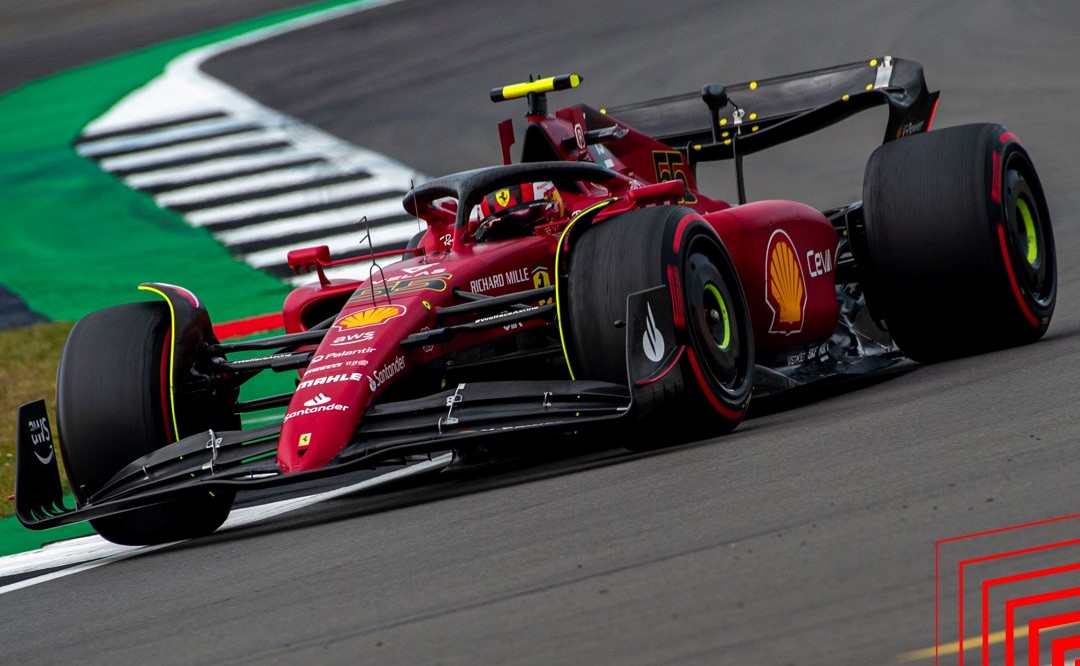
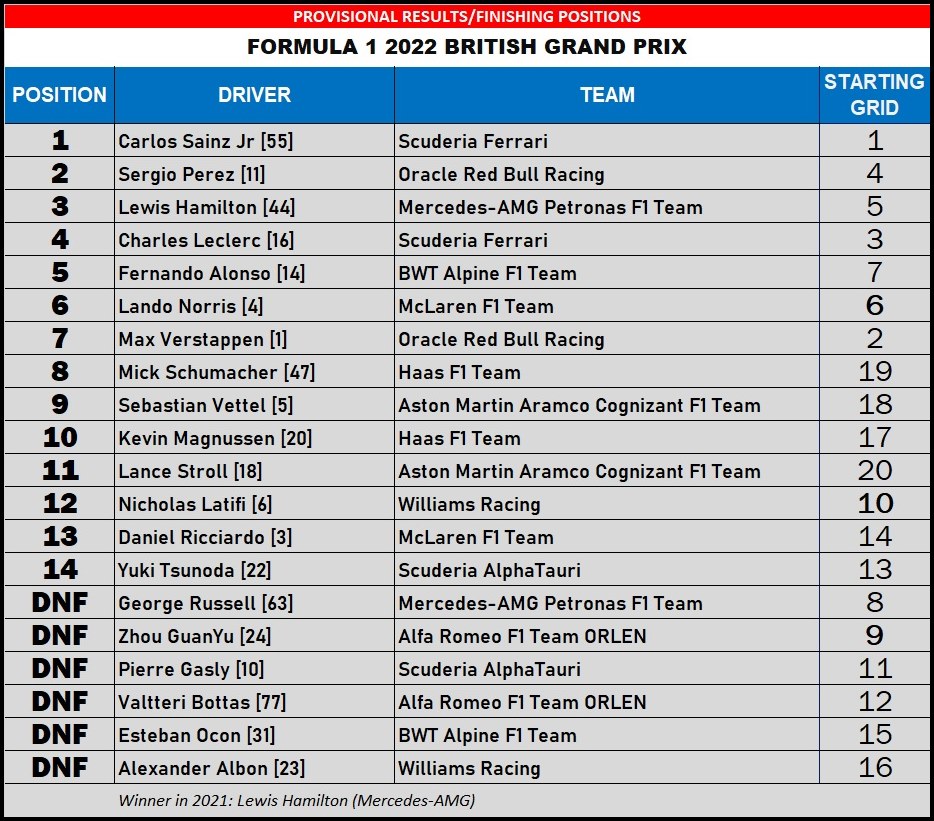
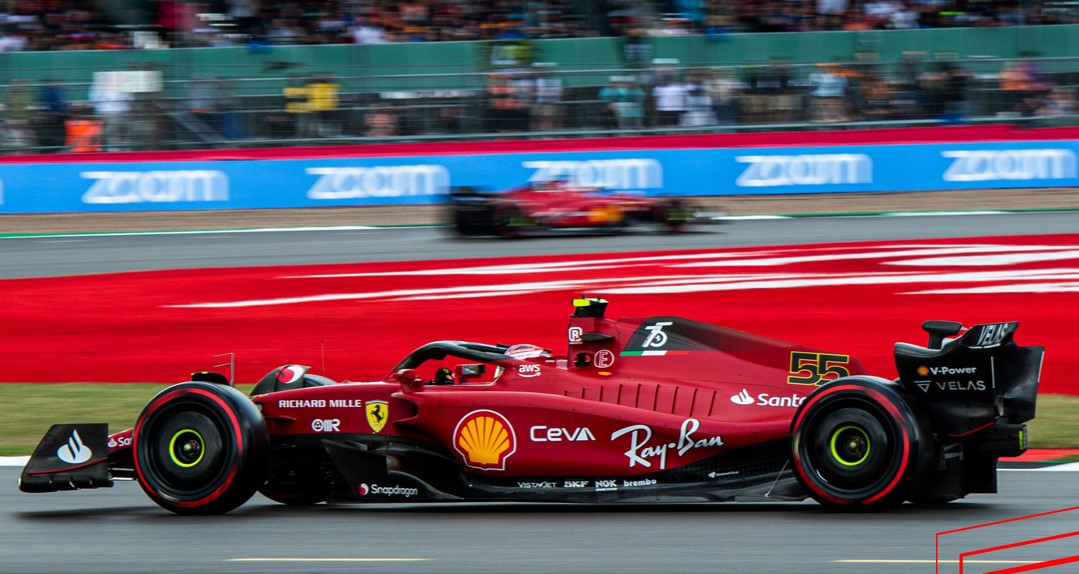
And on lap 52, Sainz managed to keep his lead to take the chequered flag for very first F1 win, after having also started from pole position for the first time as well. Try as he did, Hamilton just could not close the gap with the Red Bull driver in time, but at least got to stand on the podium as well to wave at the home crowd.

Race starts at 3 pm in Britain time/10 pm in Malaysia

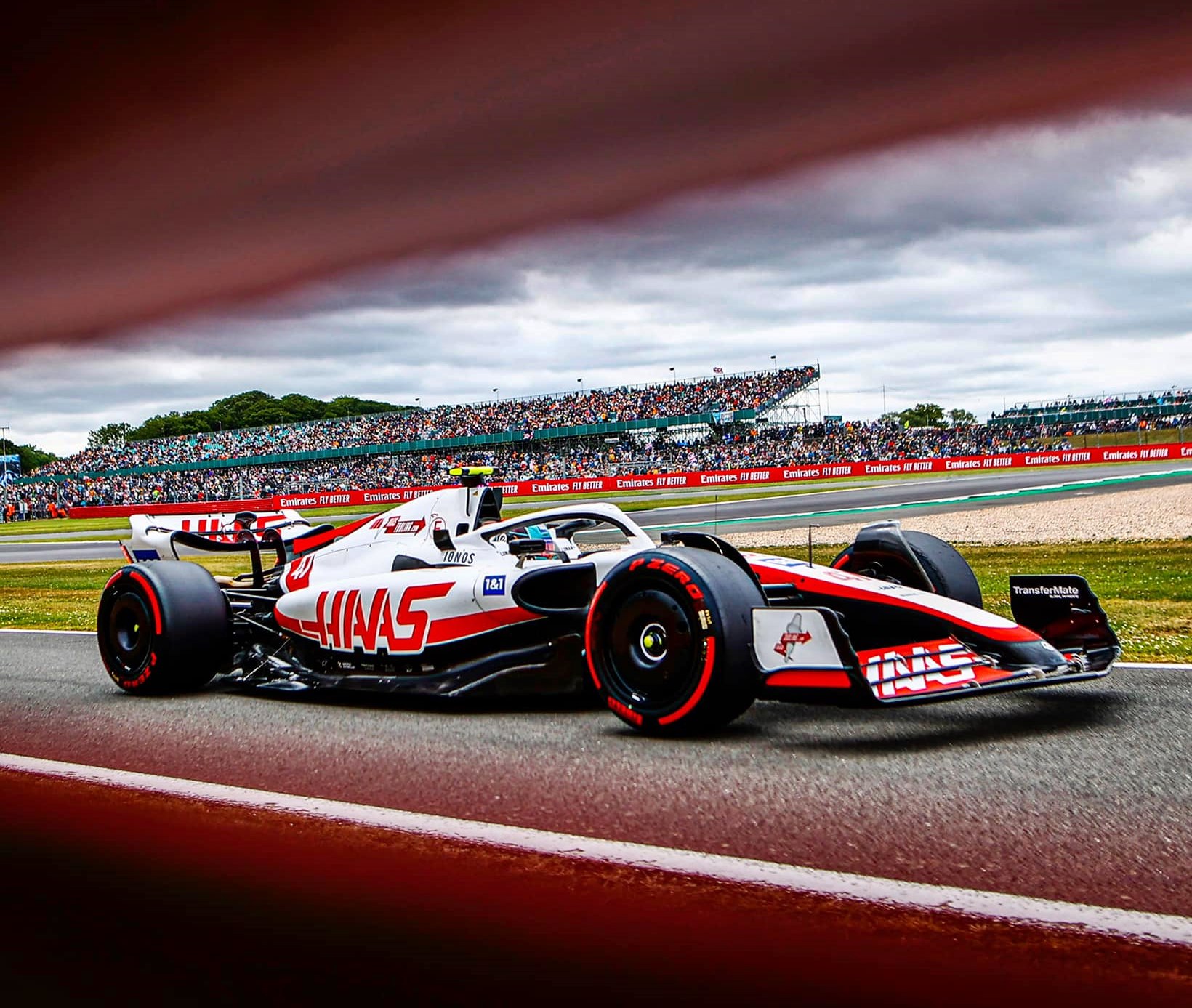
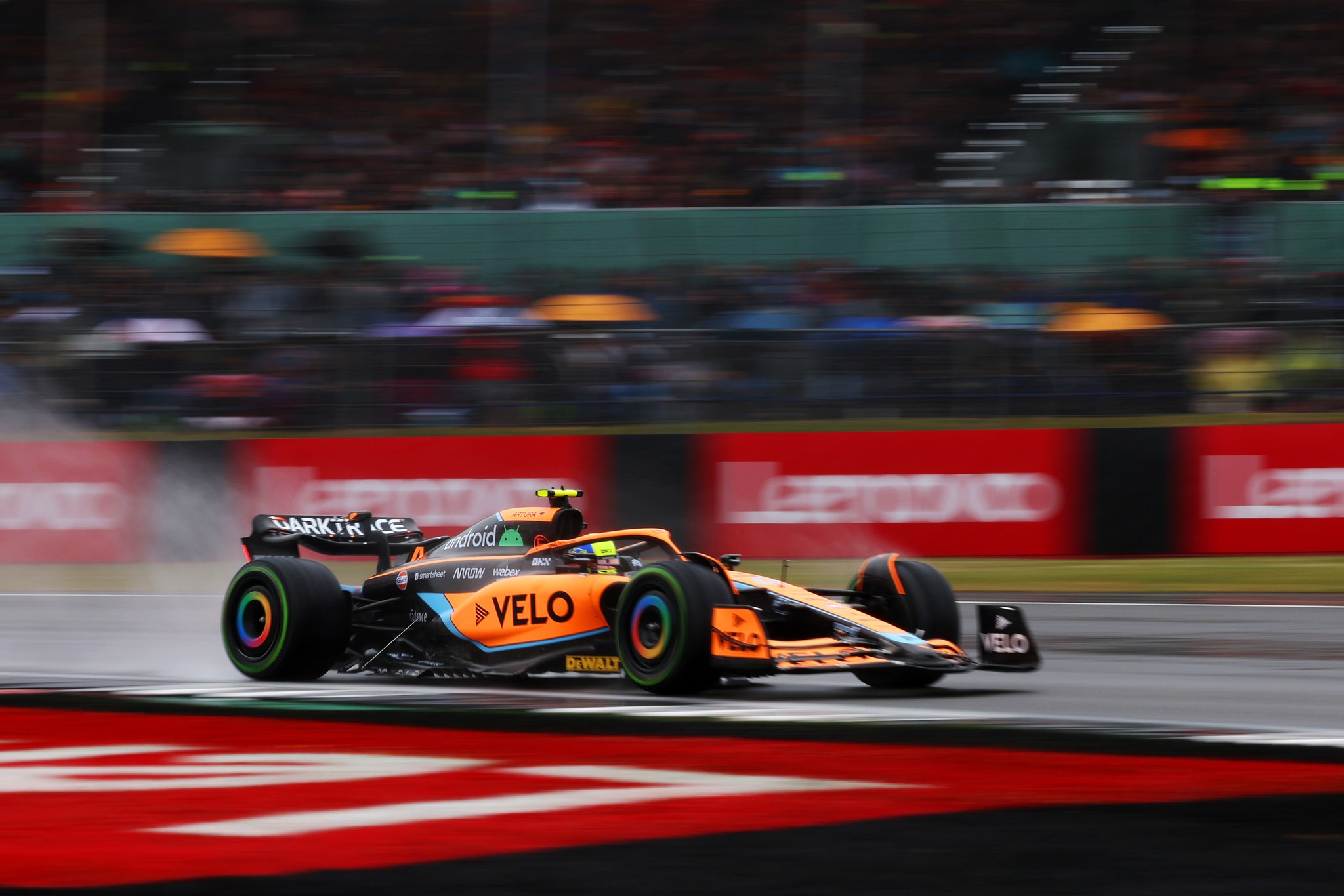
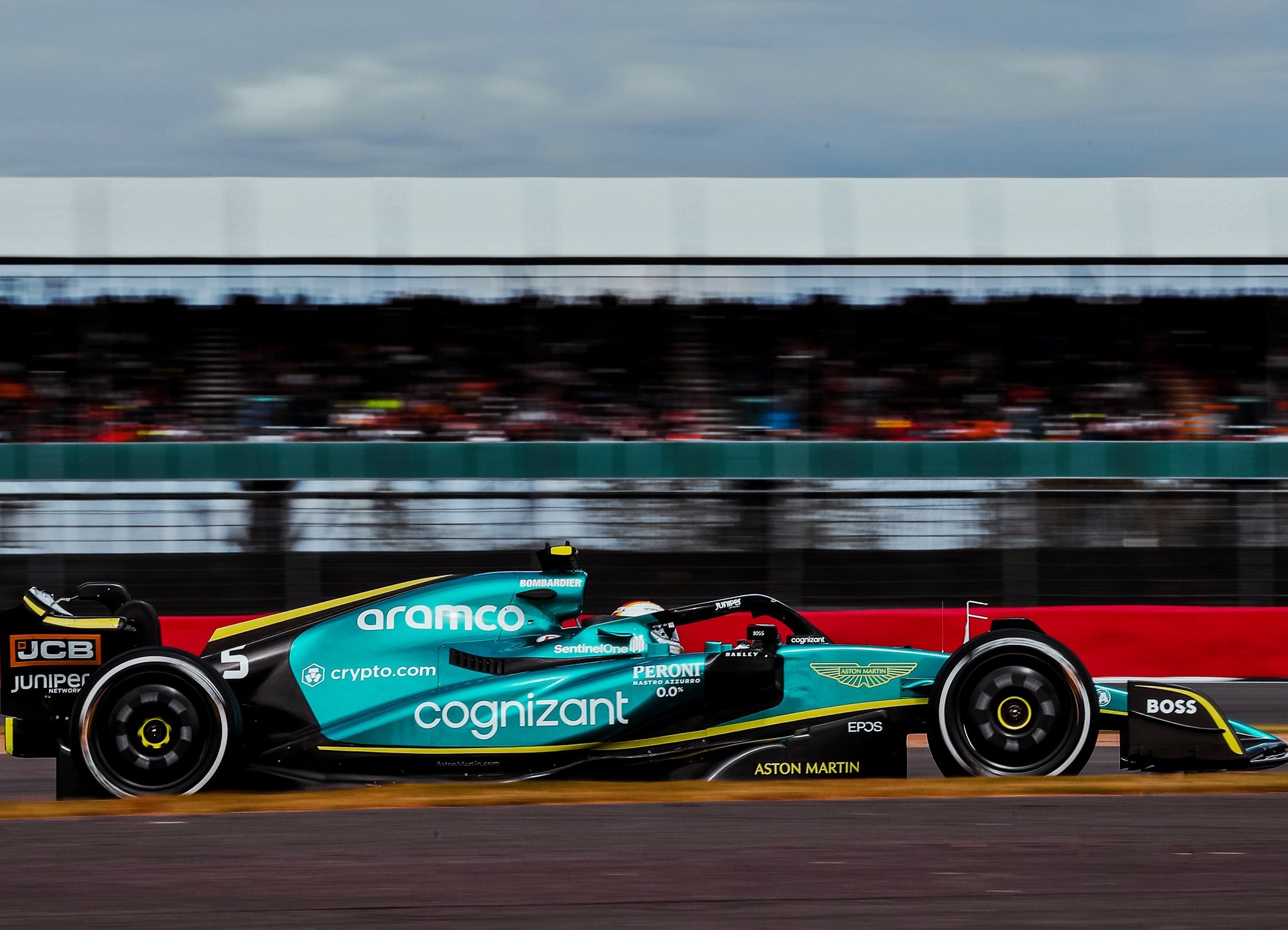
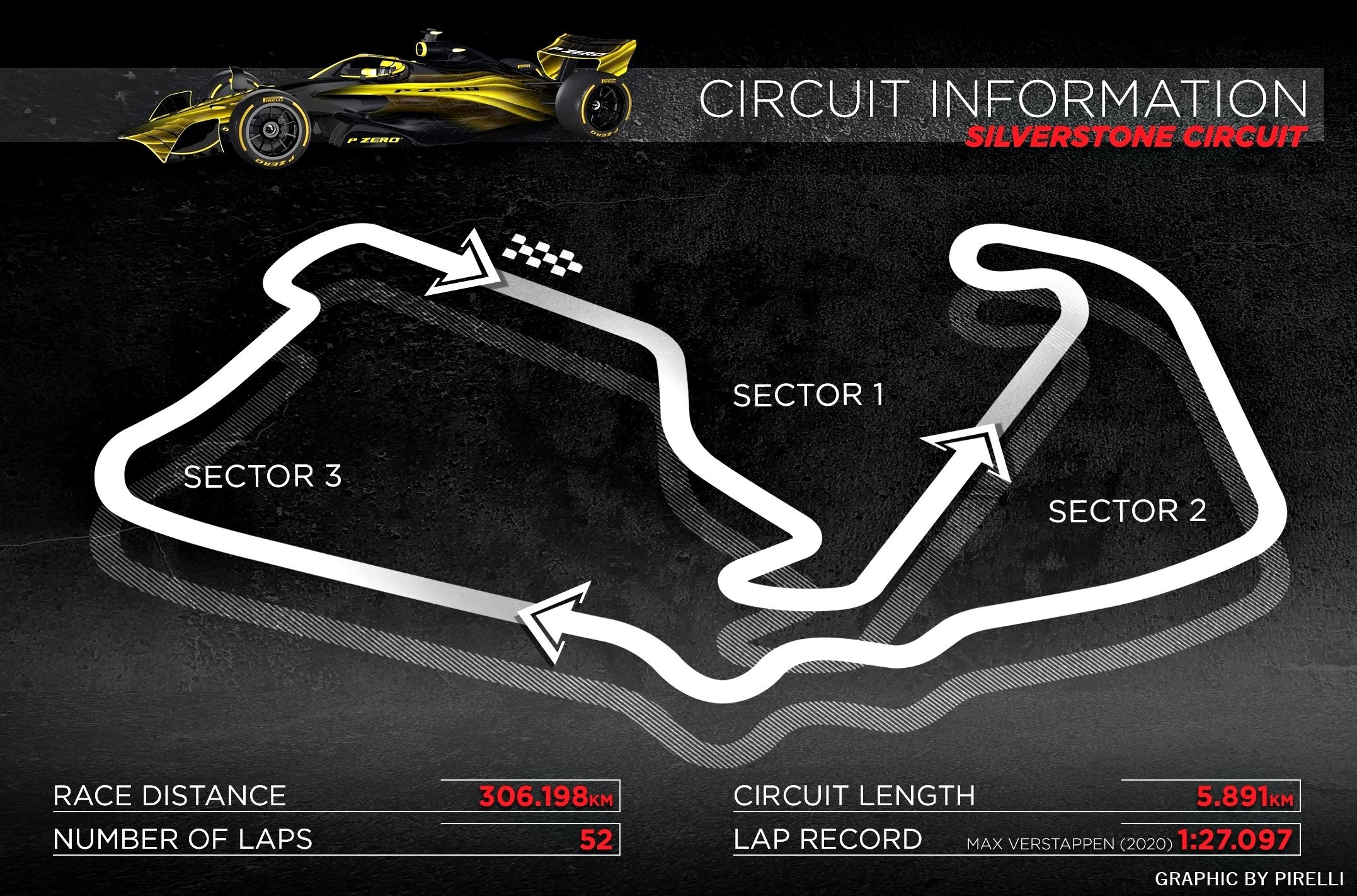
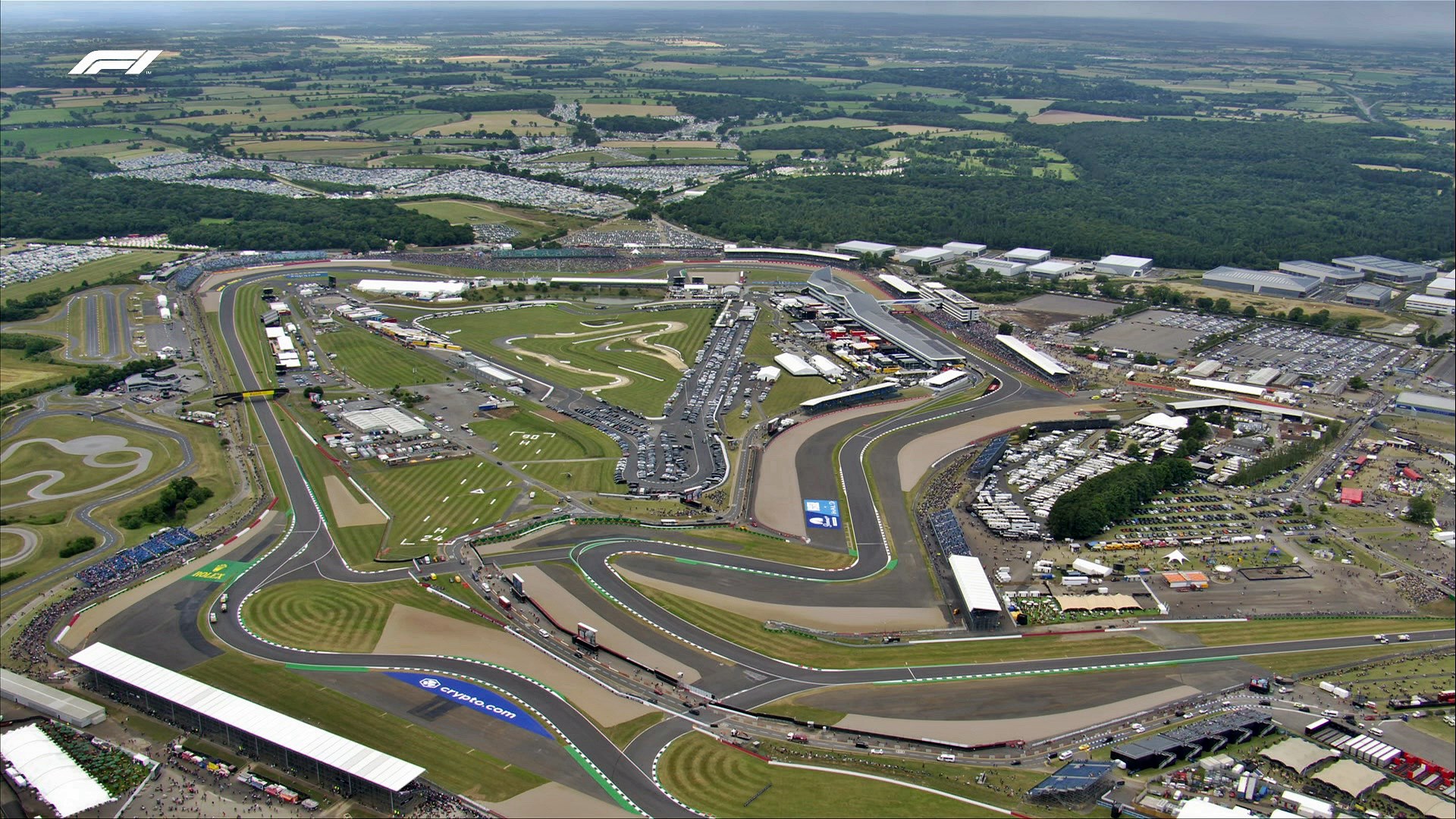
The British Grand is one of only two events that have been constantly on every season’s calendar since the inception of Formula 1. This weekend’s Round 10 of the 2022 Formula 1 World Championship will be the 73rd British GP, and the 56th time Silverstone has hosted the race. The other venues have been the Aintree Circuit in Liverpool and Brands Hatch.

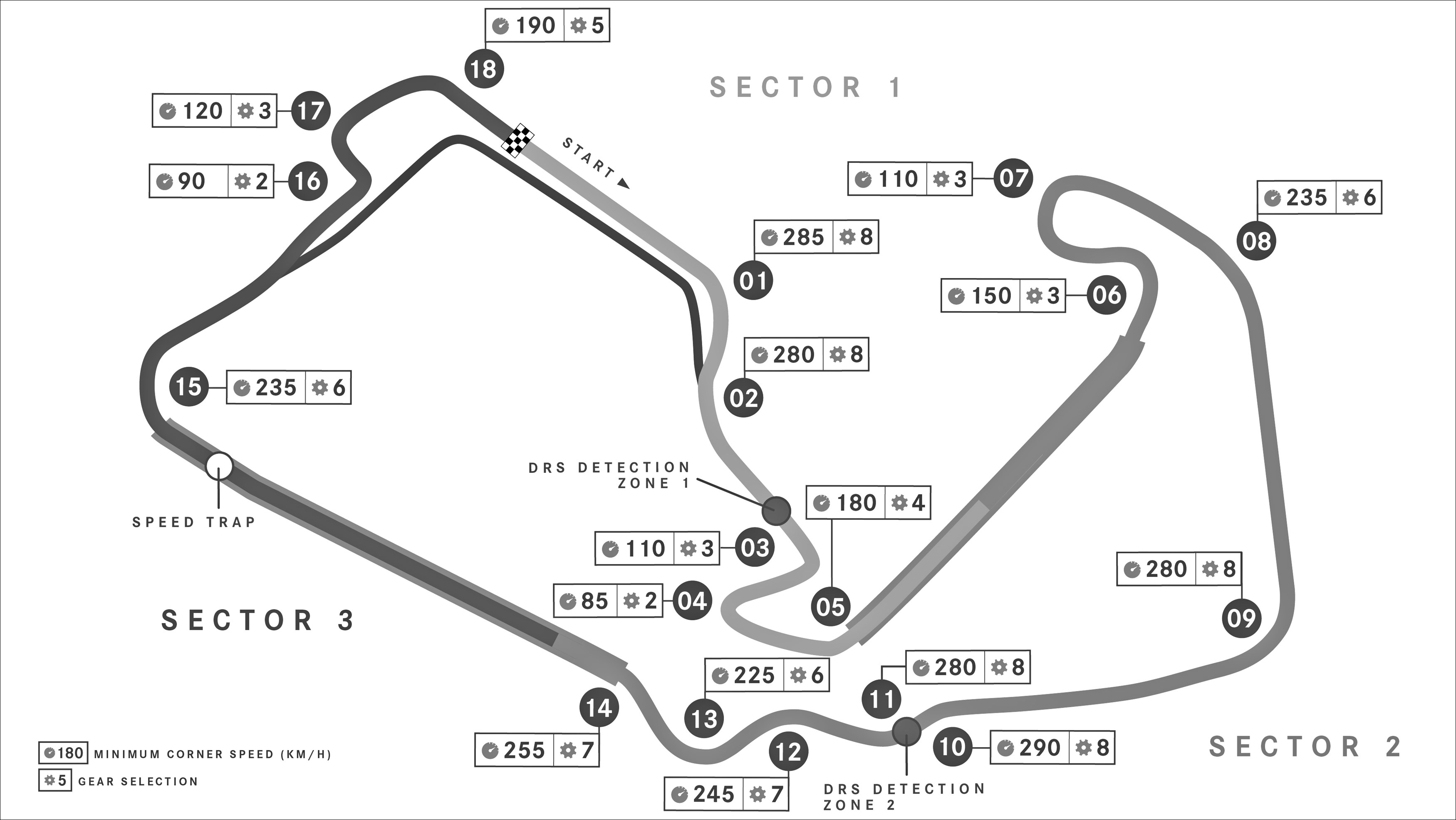
Silverstone, built on a former Royal Air Force base 74 years ago, is a true power circuit, and drivers will spend 80% of each 5.891-km lap racing at full throttle. The layout, with 18 turns, is very tough on tyres, especially on left-front tyres which have huge loads imposed on them in Turns 1, 8, 9, 10, 11, 12 and 15.

“Along with Suzuka in Japan and Spa in Belgium, Silverstone places the highest energy demands on tyres all year, which is why the hardest tyres in the range have been nominated: C1 as the P Zero White hard, C2 as the P Zero Yellow medium, and C3 as the P Zero Red soft. This is the third time that this combination has been nominated all year,” said Mario Isola, Pirelli’s Motorsports Director.

Suzuka, which will be back on the calendar later this year (in early October), puts even greater demands on tyres but distributes the loads equally to all 4 tyres as it is the only track on the calendar in the shape of a figure eight. At Silverstone, putting down the car’s energy is firmly focused on


Pirelli’s choice of its hardest compounds to cope with wear rates is based on past experience. However, with the new 2022 racing cars, the tyres are designed to provide less overheating, more stability, and increased driveability within a wider working window. “This year, the compounds and structures are completely different, and there’s no sprint qualifying either – which was a factor in the strategy last year,” Isola added.

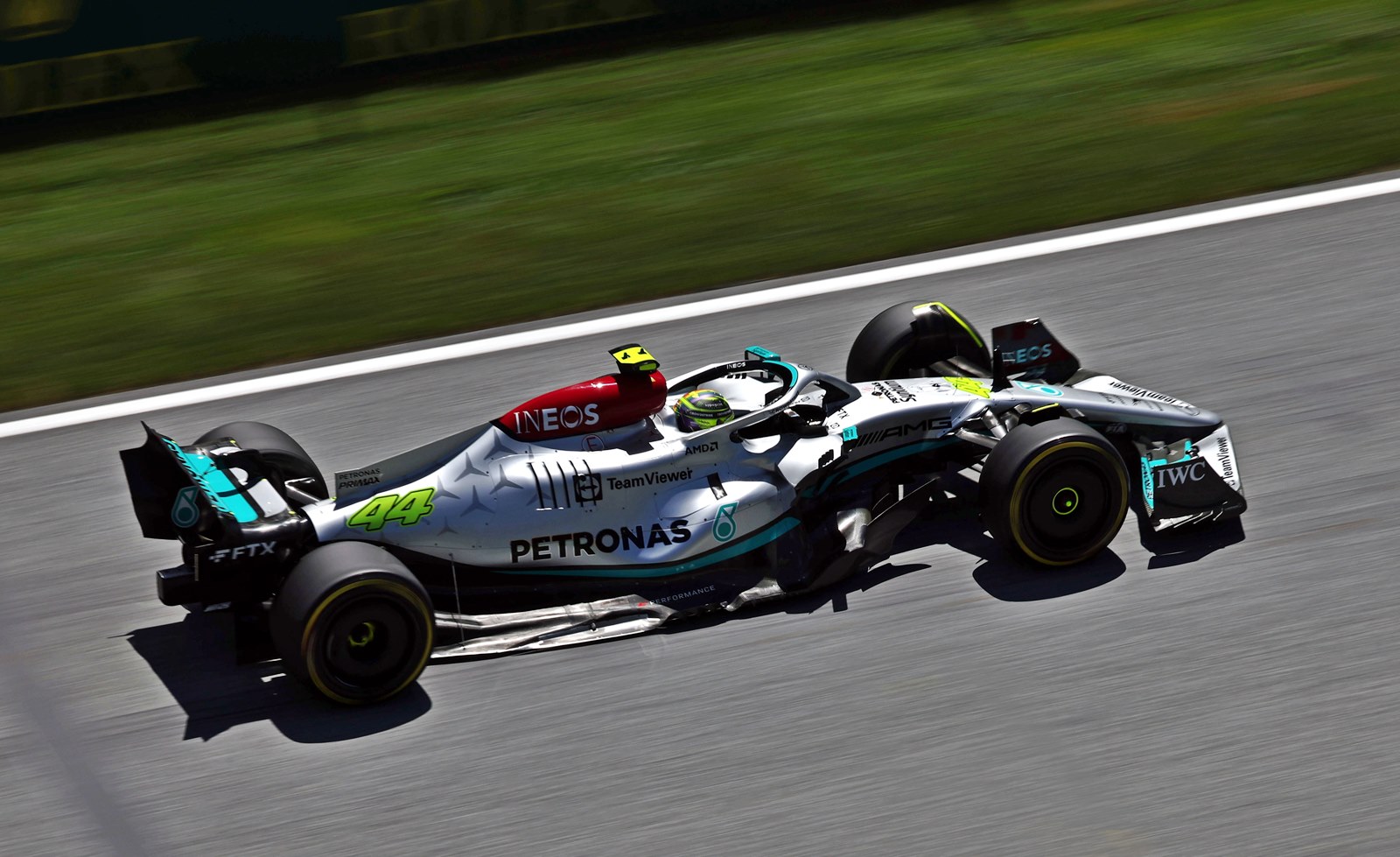
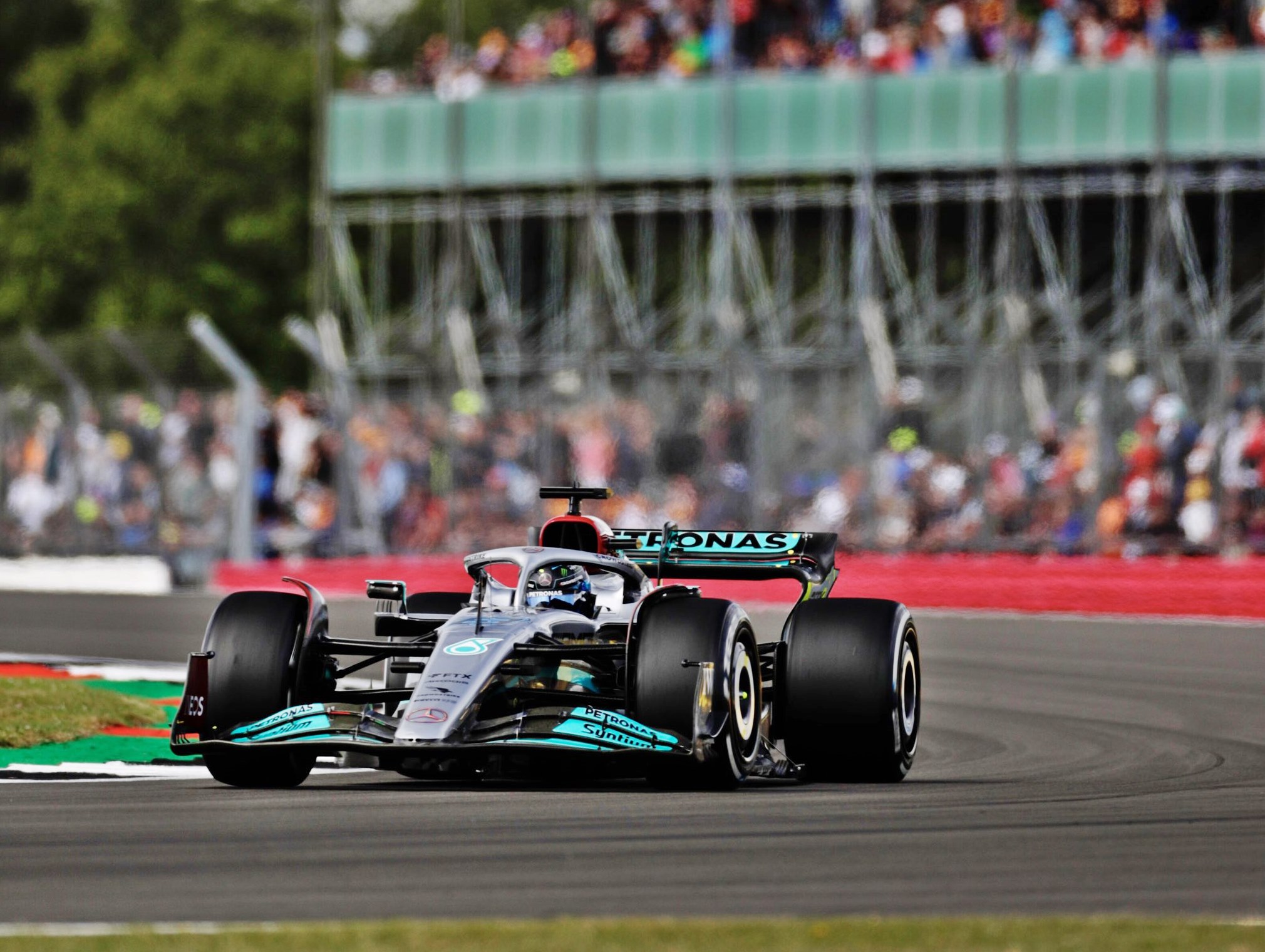
The gears and cornering speeds of the Mercedes-AMG racing cars.

According to Brembo technicians, the Silverstone Circuit makes little demand on the brakes, in contrast to the tyres. This does not mean that the brakes are not important on this track. Grip is critical and depends on both the weather conditions and the number of consecutive laps run. As the grip increases, so does the braking power transferred to the ground.

The biggest risk at Silverstone is glazing of the friction material caused by problems bringing the carbonfibre discs and pads to the minimum operating temperature. However, the Brembo material has been specially designed to prevent this problem. There are 9 turns where the brakes are used for a total of 13.5 seconds per lap which amounts to 15% of the whole race.

The hardest one is on turn 6 because drivers come onto it with the throttle full on after turn 5 and reach a speed of 324 km/h. They use the brakes to reduce speed by 50% in 2.4 seconds and cover a distance of 142 metres. To do this, their leg must apply a load of 127 kgs on the brake pedal and undergo a deceleration of 4.2g.

Fittingly, Lewis Hamilton has been the most successful driver in the history of the British Grand Prix, the team’s home race. He has won 8 times, which puts him in the same league as Michael Schumacher for the most wins at the same event; the German driver’s record is for the French Grand Prix. Hamilton also has 8 wins at the Hungarian Grand Prix.

A non-British team – Scuderia Ferrari – has won the event the most times. Since its first F1 win in the 1951 British GP, it has won the event 17 times. Current drivers who have contributed to the string of victories are Sebastian Vettel (2018) and Fernando Alonso (2011).
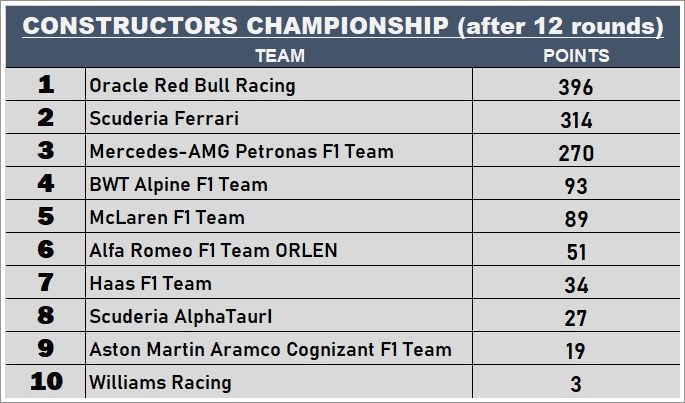
Thanks to a victory in Canada, Red Bull Racing’s Max Verstappen starts at Silverstone with a 46-point lead over team mate Sergio Perez. Ferrari’s Charles Leclerc, who has started the season with so much promise, seems to have had a string of bad luck, dropping him to third place, 3 points behind Perez.

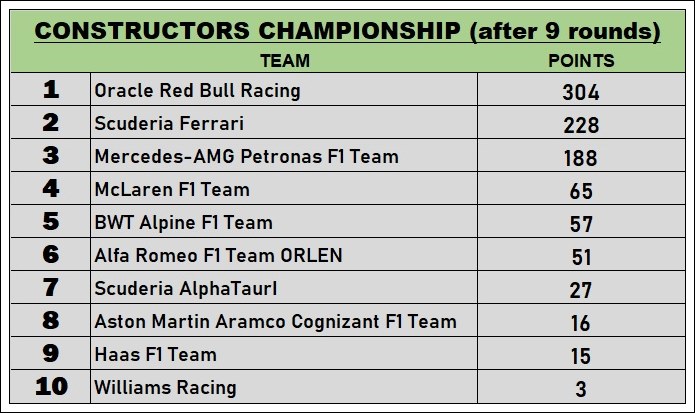
Consistent wins by Verstappen and Perez have boosted Red Bull racing’s lead in the Constructors Championship to 304 points, 76 ahead of Ferrari. The Mercedes-AMG PETRONAS team is in third place, 40 points behind the Italian team.


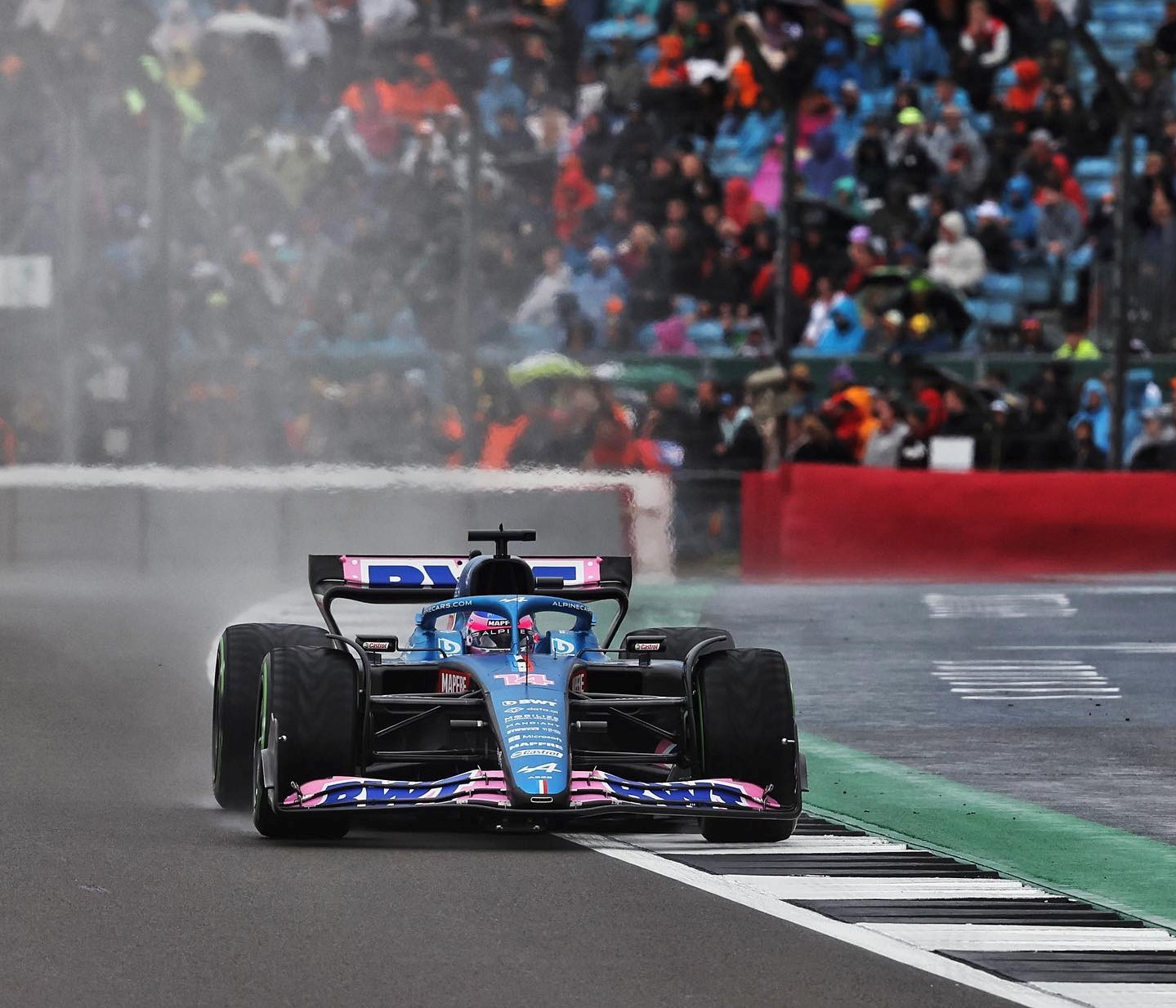
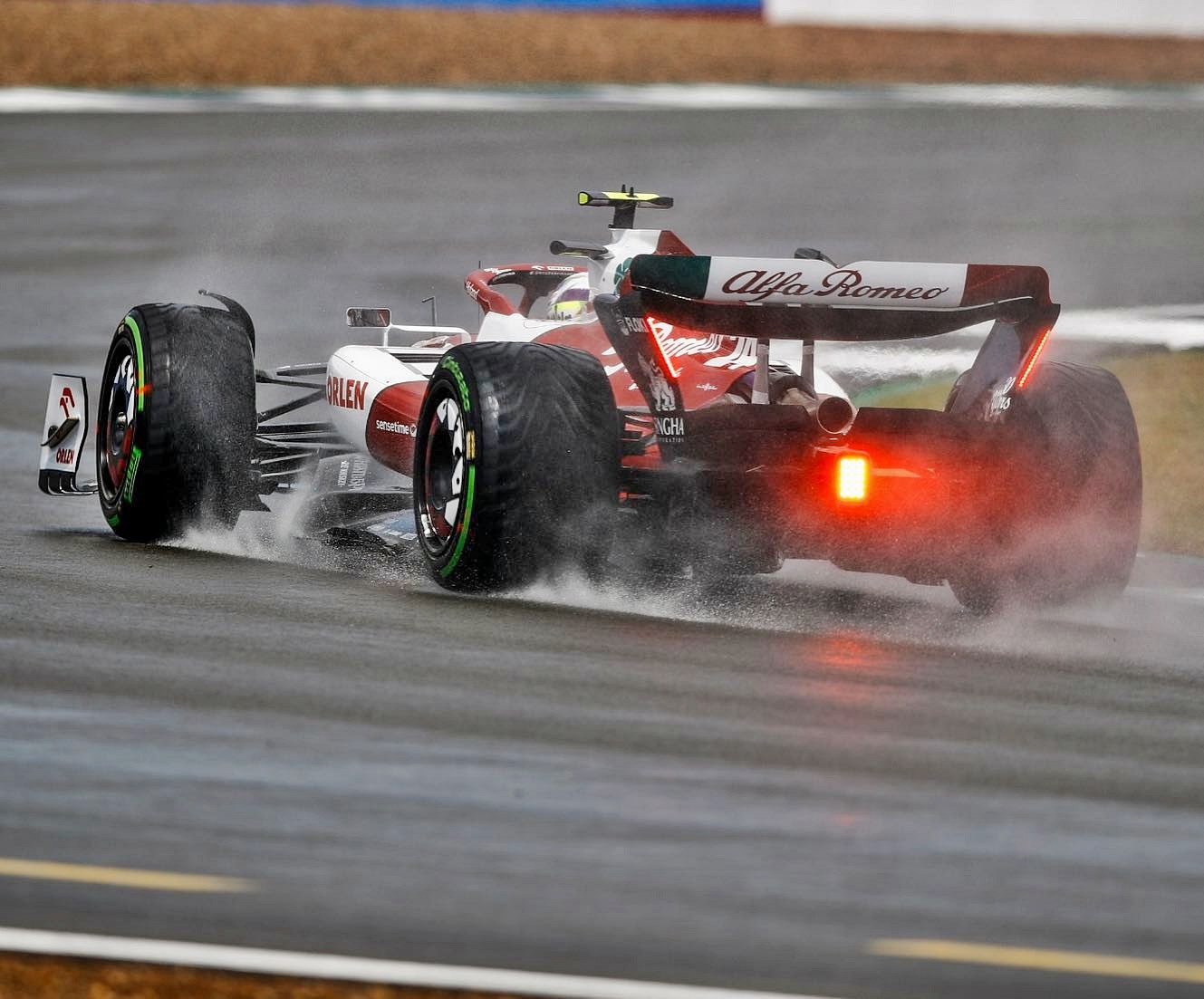
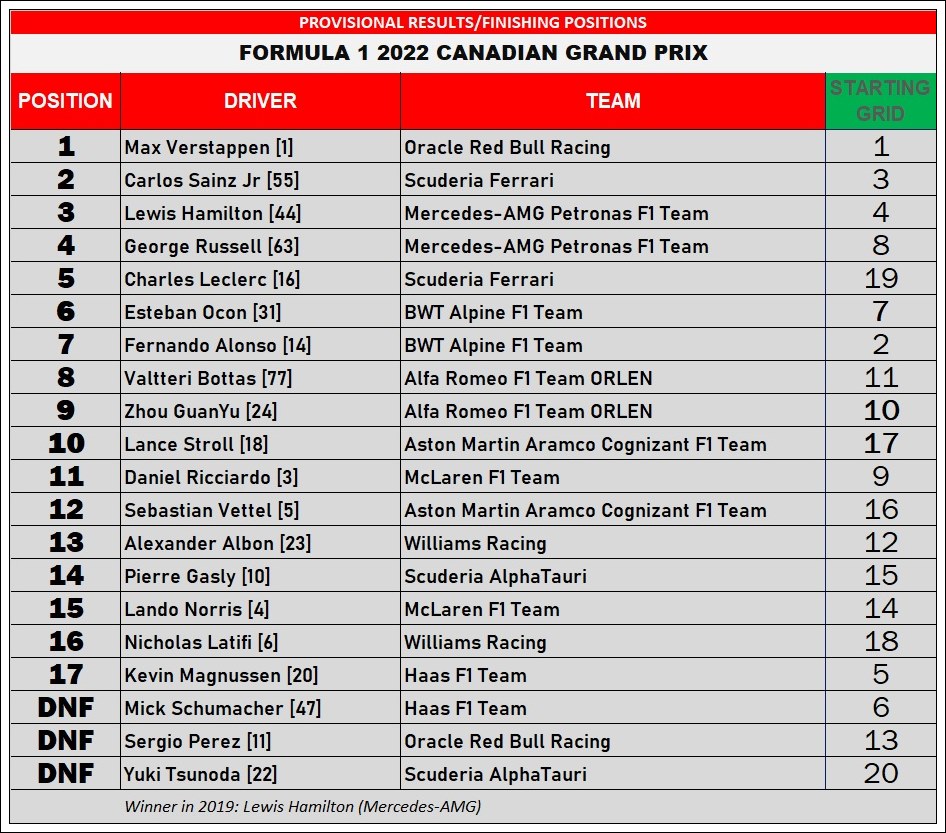
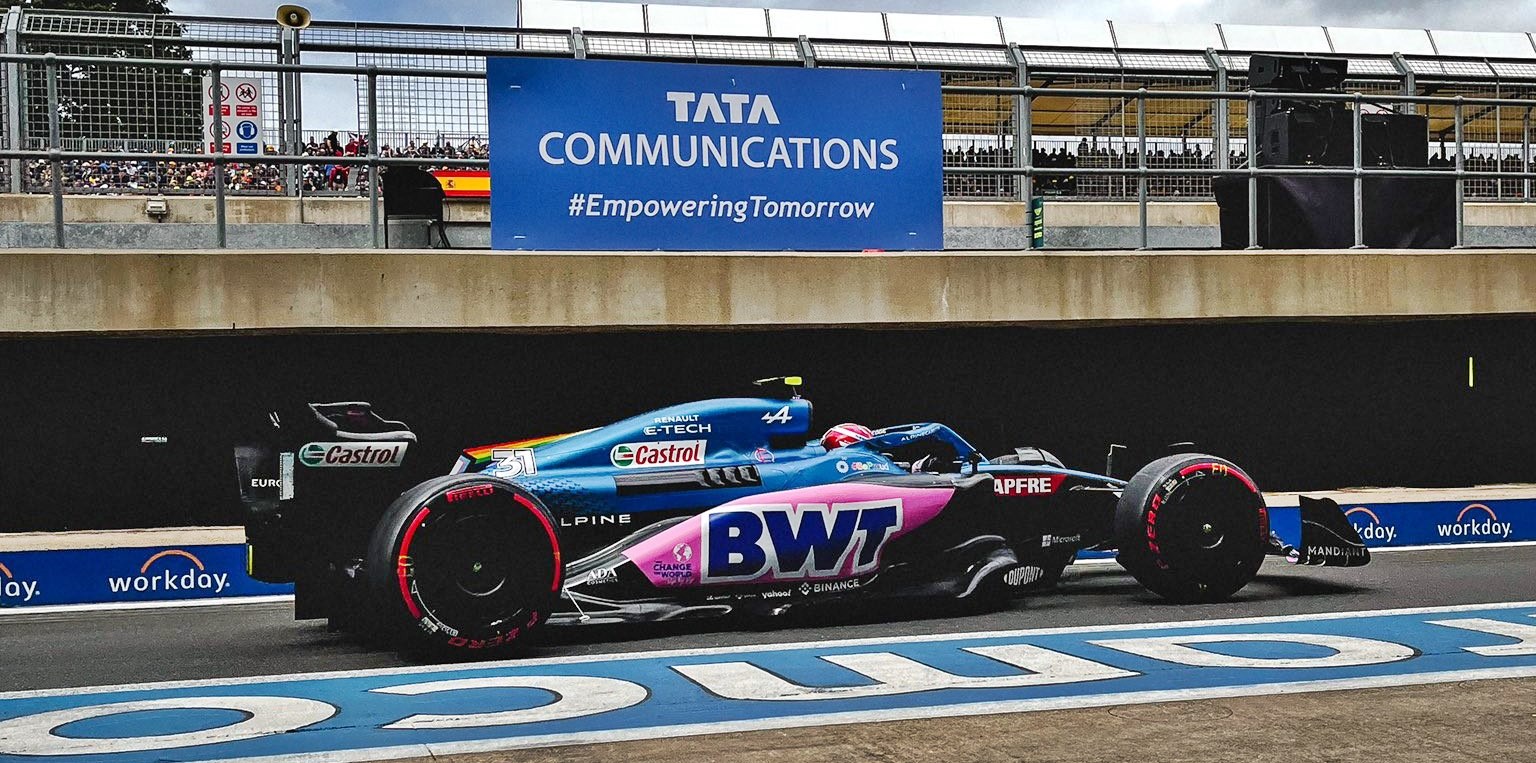
Unlike the day before when there was a heavy downpour (and the pitlane was even flooded earlier in the week), race day greeted the drivers with sunshine and nice cool weather. The rain during qualifying resulted in a rather boxed-up grid with Red Bull Racing’s Max Verstappen and BWT Alpine’s Fernando Alonso on the first row, and it would be an interesting race as the faster drivers tried to move forward – especially Ferrari’s Charles Leclerc who was starting from the back due to a penalty.

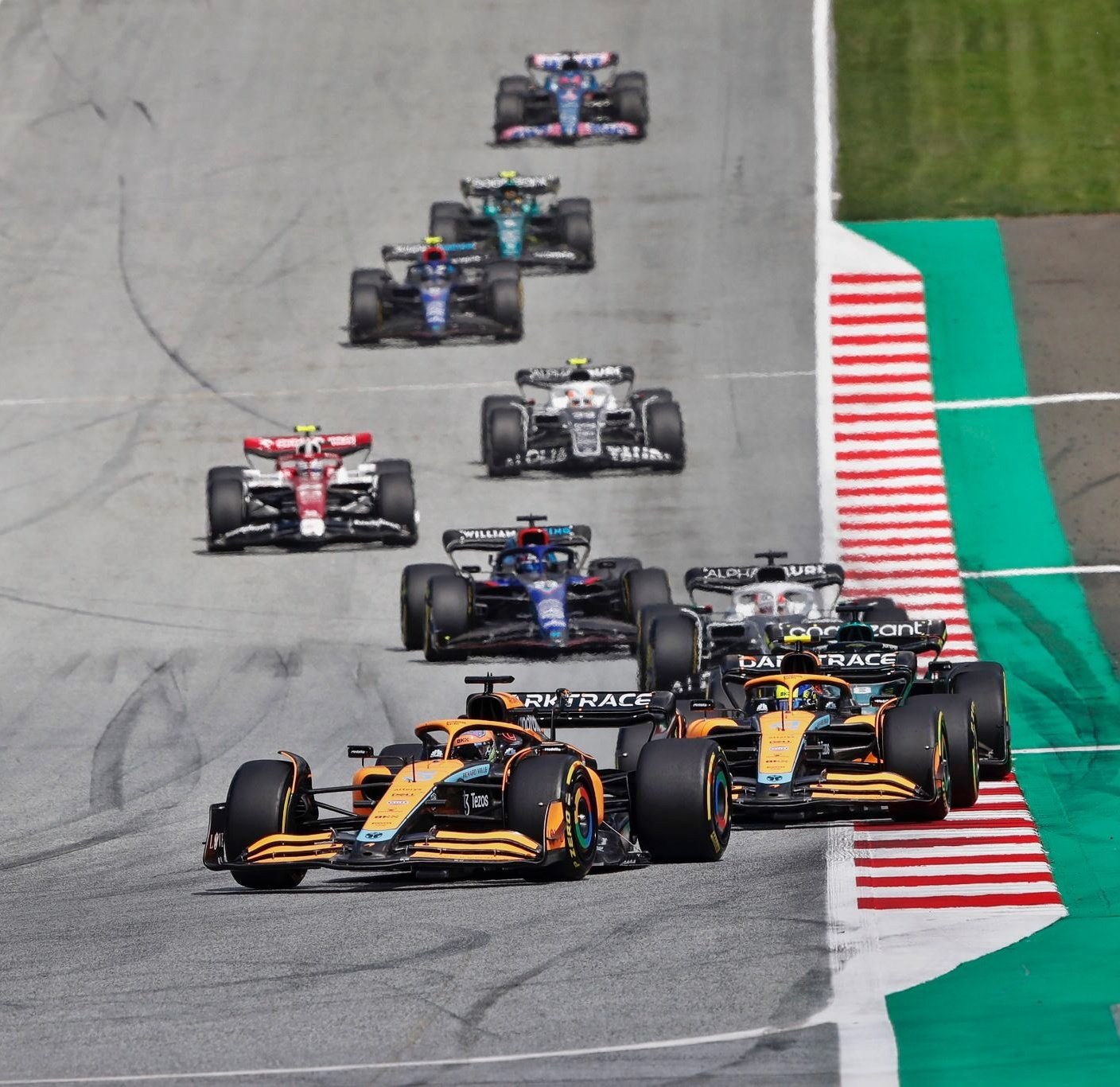
All eyes were on Alonso as the race started but Verstappen started well and was ahead of Alonso into Turn 1. The Alpine driver had to instead deal with Ferrari’s Carlos Sainz, with Hamilton pushing forward alongside Haas F1’s Kevin Magnussen. At the back, Leclerc got down to work right away and moved up 4 places within the first 2 laps. But he was still 15 seconds behind the leaders.

On the third lap, after a close fight, Sainz moved into second position as he passed Alonso. Magnussen, who was trying to hold on to sixth, apparently sustained some damage to his wing and on lap 4, he was given a black and orange flag and came in on lap 8. Meanwhile, Scuderia Alphatauri’s Pierre Gasly and Aston Martin’s Sebastian Vettel were the first to come in to switch to hard tyres on lap 6.

14 minutes into the race (on lap 8). Red Bull Racing’s Sergio Perez reported power unit failure and he pulled over, fortunately at a safe spot. The yellow flags came out, as did the Virtual Safety Car (VSC). At that point, Verstappen had come into the pits and Sainz was in the lead with Alonso behind him. Most cars began coming in and changing to hard tyres as no rain was forecast. Fighting for fifth place were Mercedes-AMG’s Lewis Hamilton and Alpine’s Esteban Ocon.
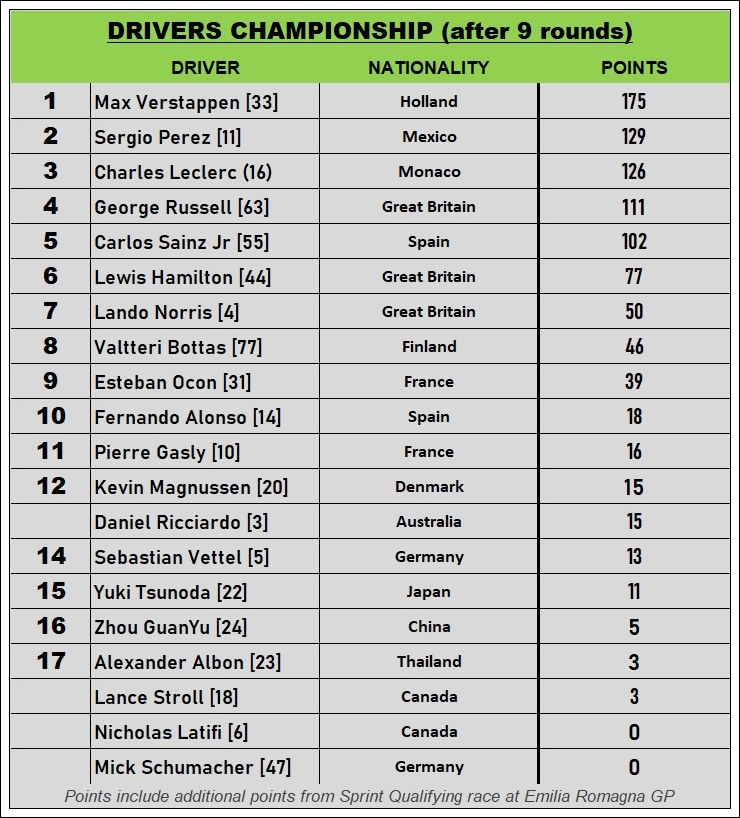
With Perez out, Verstappen had a change of strategy as he went after the two Spaniards ahead. By lap 16, he had overtaken Alonso and was within 5 seconds of Sainz. He could bide his time as the Ferrari driver had not pitted yet and had to do so eventually. In fourth was Mercedes-AMG’s George Russell playing a steady game, as usual, while Hamilton was just 2 seconds behind.

Leclerc appeared at tenth place as lap 20 started, steadily moving up the field. For Haas F1′ Mick Schumacher, however, the race in Canada came to the end on that lap as he slowed the car and parked it to one side of the track. The VSC came out for a short while and Sainz gave up his lead to Verstappen. When Sainz rejoined, he was in third behind Alonso but very quickly got past the Alpine to grab second position.

On lap 29, Hamilton displaced Alonso for third, appearing higher than he has been for a long time. Russell has fallen back but would keep Alonso occupied while Hamilton went after the Dutchman.

China’s Zhou Guanyu was praying there would be no disappointment again like the last race as he moved into tenth place on lap 27. He was aiming for the Aston Martin of Lance Stroll but had to also watch out for Yuki Tsunoda and his Alphatauri. Alonso came in on lap 29 for new tyres. rejoining in seventh place, just behind Leclerc who was beginning to struggle with his tyres.

At the halfway point of the race, Verstappen was in the lead, 8 seconds ahead of Sainz and 16 seconds ahead of Hamilton, with Russell in fourth place some distance back. Leclerc was up to sixth but still fighting with Ocon. The question was when the Ferrari driver would come in replace his tyres which had done 35 laps already. Besides Leclerc, Alfa Romeo’s Valtteri Bottas and Aston Martin’s Lance Stroll were also on rubber that was over 35 laps old.

Leclerc finally came in on lap 42 and was frustrated by a somewhat slow stop (for the Ferrari team). When he rejoined, he was down to twelfth place, behind McLaren’s Daniel Ricciardo. Two laps later, Sainz was in the lead as  Verstappen came in to get new hard tyres. As he rejoined, he was alongside Hamilton, giving the spectators an exciting moment of the two drivers racing each other. But Hamilton would come in on the next lap, and Verstappen zoomed to second, 9 seconds behind Sainz.

Russell’s tyres were replaced on lap 45 and his departure from the race gave Hamilton a chance to slot into third place easily. But by then, Verstappen had gone way ahead in his pursuit of the Ferrari.

Just before the 50th lap, the yellow flags came out as Tsunoda crashed after Turn 1. The Safety Car was deployed and Sainz took the chance to pit. This gave Verstappen the lead but it might become difficult for the Dutchman as the Ferrari now had fresh tyres. Other drivers also rushed into the pits while the Safety Car was out. When its duty ended, there were 16 laps remaining.

As the pack resumed racing, the top five frontrunners jostled for position. Sainz did his best to keep close to Verstappen while Hamilton came up behind, just slightly ahead of Russell. Alonso was also eager to try for a podium position but had to contend with his own team mate first.

With 10 laps remaining, the top four cars were about one or two seconds apart, with Leclerc having made it to fifth but still hacing a gap of about 10 seconds to close with Russell. Verstappen was working very hard to keep his lead as Sainz kept looking for a way to displace him. The two Alfa Romeo drivers, just behind Alonso, were waitinf for him to make a mistake and take his seventh place.

As two laps remained, the order still had not changed and Sainz had already pushed hard enough to claim the fastest lap of the day. Less than a second and he just could not beat Verstappen and then the chequered flag came out and it was the Red Bull racing car that crossed under it first.


Archive

Follow us on Facebook

Follow us on YouTube