
Piston.my

SUV

Although there has been an auto industry in existence in China for a long time, it concentrated largely on commercial vehicles. As there was no infusion of technology from the outside world, advancements were slower as the manufacturers either drew on Russian technology (which was also not advanced) or developed themselves slowly. As a result, when the country opened up in the 1980s and its economic boom began, the early cars were quite basic and somewhat out of date… and quality was poor too.

The early cars from Chinese brands that appeared in Malaysia (in the 2000s) thus made a poor impression, not to mention the fact that they did not have strong representatives with experience in the auto industry. Even though the cars were cheap, Malaysian consumers were wary and had already moved further up the ‘curve’ in their expectations and the Korean offerings were better.

But with the rapid expansion of the market in China to become the world’s largest, the manufacturers have had the financial and technical resources to advance their technologies. Initially, they had formed technical tie-ups with European and Japanese carmakers as a quick way to get new technology. Once they got the technology, they then began to invest in developing their own to move ahead and rely less on foreign technologies (although they too source some systems from global leaders).

Looking outside China
Many of the top Chinese carmakers have begun to enter overseas markets even though their domestic market is still taking whatever they can make. With better products than what they offered 20 years ago, they are now gaining attention and slowly growing volumes in export markets. Companies like Geely have even gone to the extent of becoming a partner in Proton, providing its technical expertise and some products.
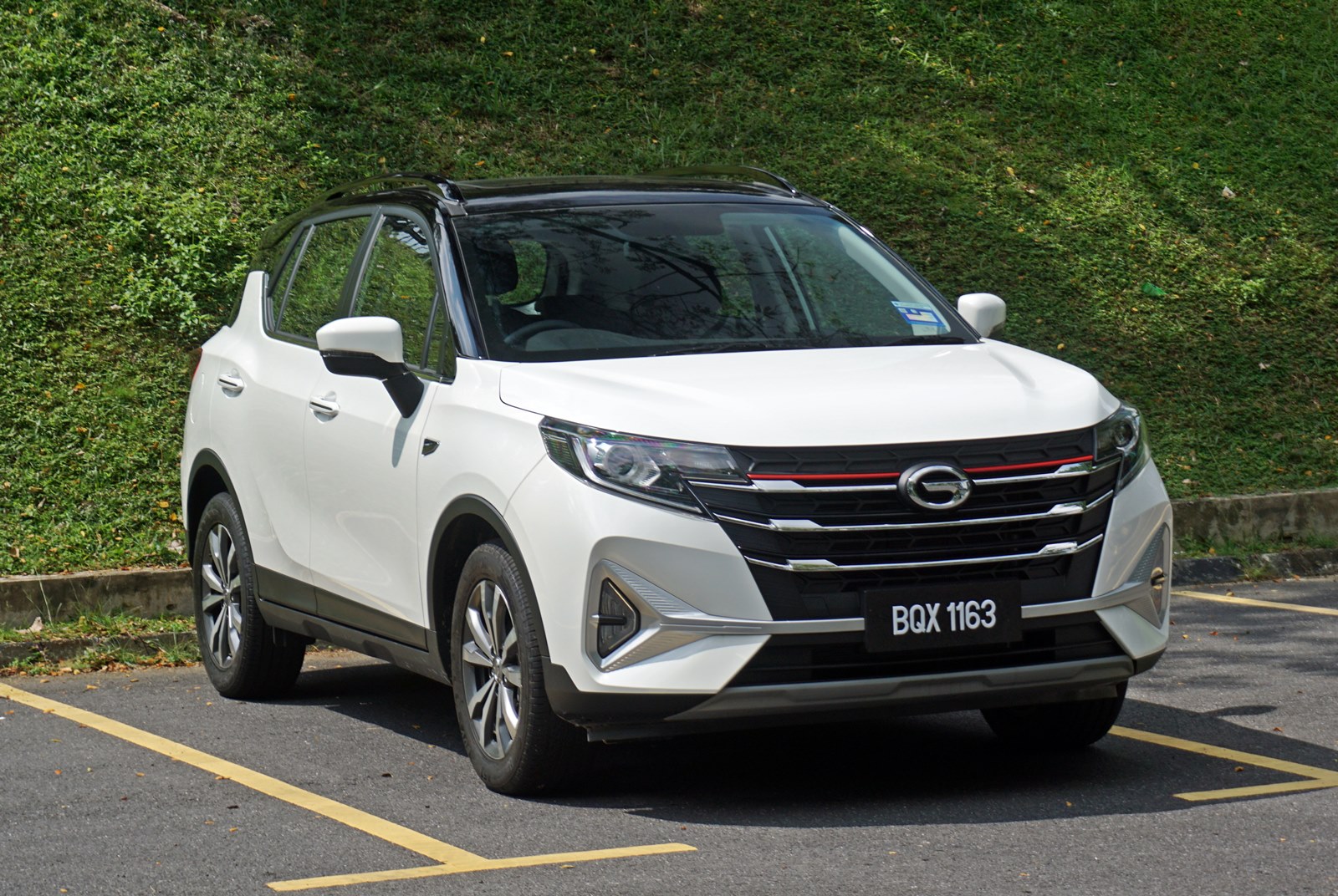
2022 GAC GS3

Guangzhou Automobile Group Co., Ltd. , or GAC, as it is known, is one of the carmakers that is looking at global markets and in fact has had its eyes on the US market. While it has not actually started selling in America, the 25-year old carmaker already has a presence in some 25 countries and exported over 2 million vehicles.

Experienced partner for GAC
GAC has come to Malaysia and it’s picked a very experienced company – the Tan Chong Group – to be its business partner and help build the brand here. The Tan Chong Group, as most will know, was the one that brought Nissan (then known as Datsun) to Malaysia 65 years ago. And older readers will know that those early Datsuns were like the earlier Chinese cars and were not considered as tough as the European ones that were then dominant in the market. People even called them ‘milo tin cars’ because they seemed to have body panels as thin as milo tins!

GAC is represented by WTC Automotif (WTCA) which is appointed as its official distributor. WTCA is a subsidiary of Warisan TC Motor Holdings Bhd, a member of the Tan Chong Group of companies. As such, there is the established and extensive network of aftersales outlets and also experienced people in the organization to handle the business.
2022 GAC GS3

“What is also important to know is that Tan Chong has always been a long-term partner with whoever it represents. We don’t just go into a partnership but we look at all aspects and especially whether sustainability is possible. Our track record will show our commitment to our brands. So, customers can have confidence in becoming owners of GAC, even though it is a new brand in the market. We will be there to support them over many years to come,” said Tan Keng Meng, CEO of Warisan TC Holdings Bhd., the publicly-listed parent company of WTCA.

GAC’s first product for Malaysia
The first product that WTCA is importing, with a view of assembling in due course, is the GS3. This is a compact SUV which is sold under GAC’s Trumpchi brand in China but because of the name’s closeness to a former US president, the company avoids using ‘Trumpchi’ outside China. Exports began in 2019 but due to the pandemic, things have moved a bit slowly and it’s only this year that the model has arrived in Malaysia.

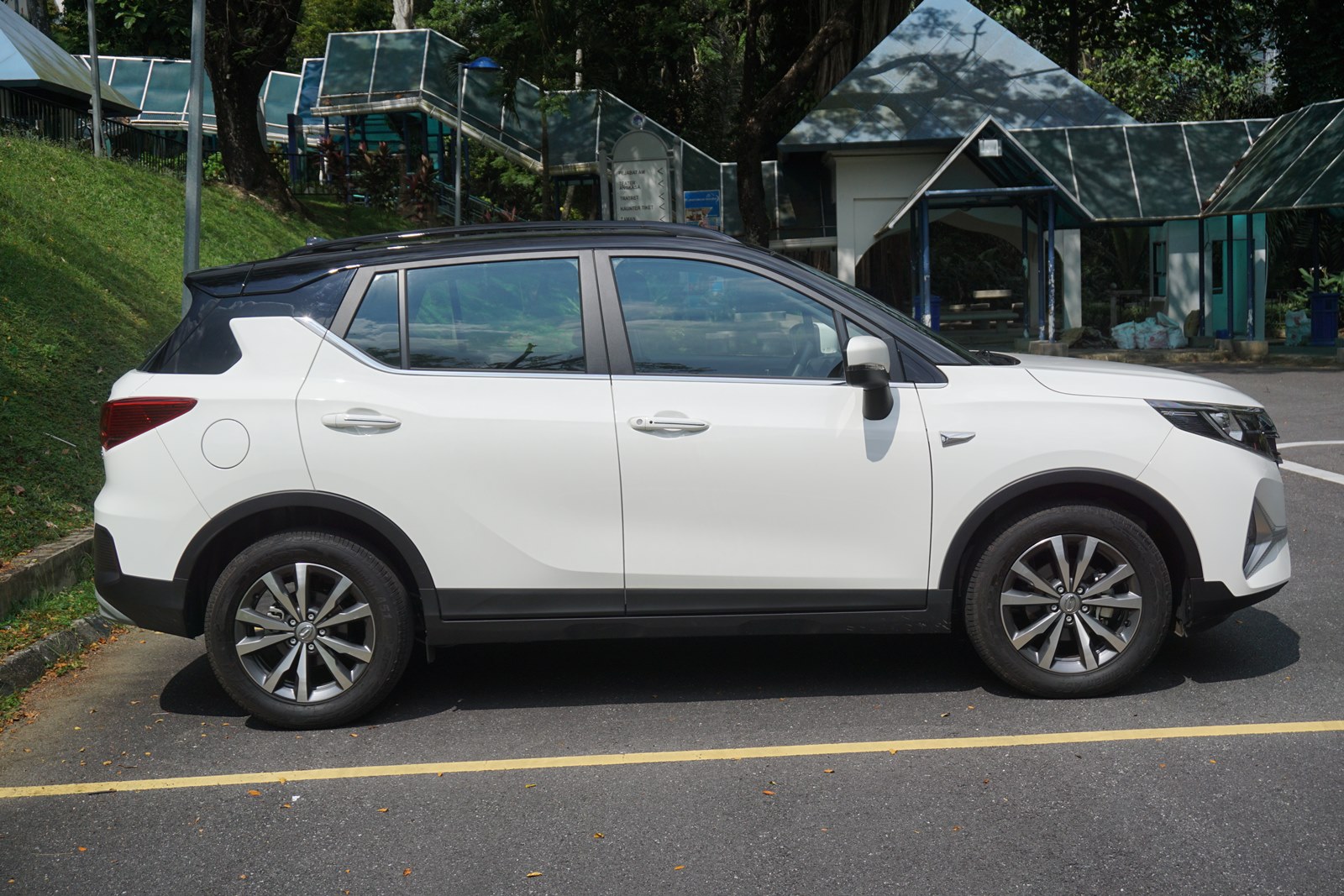
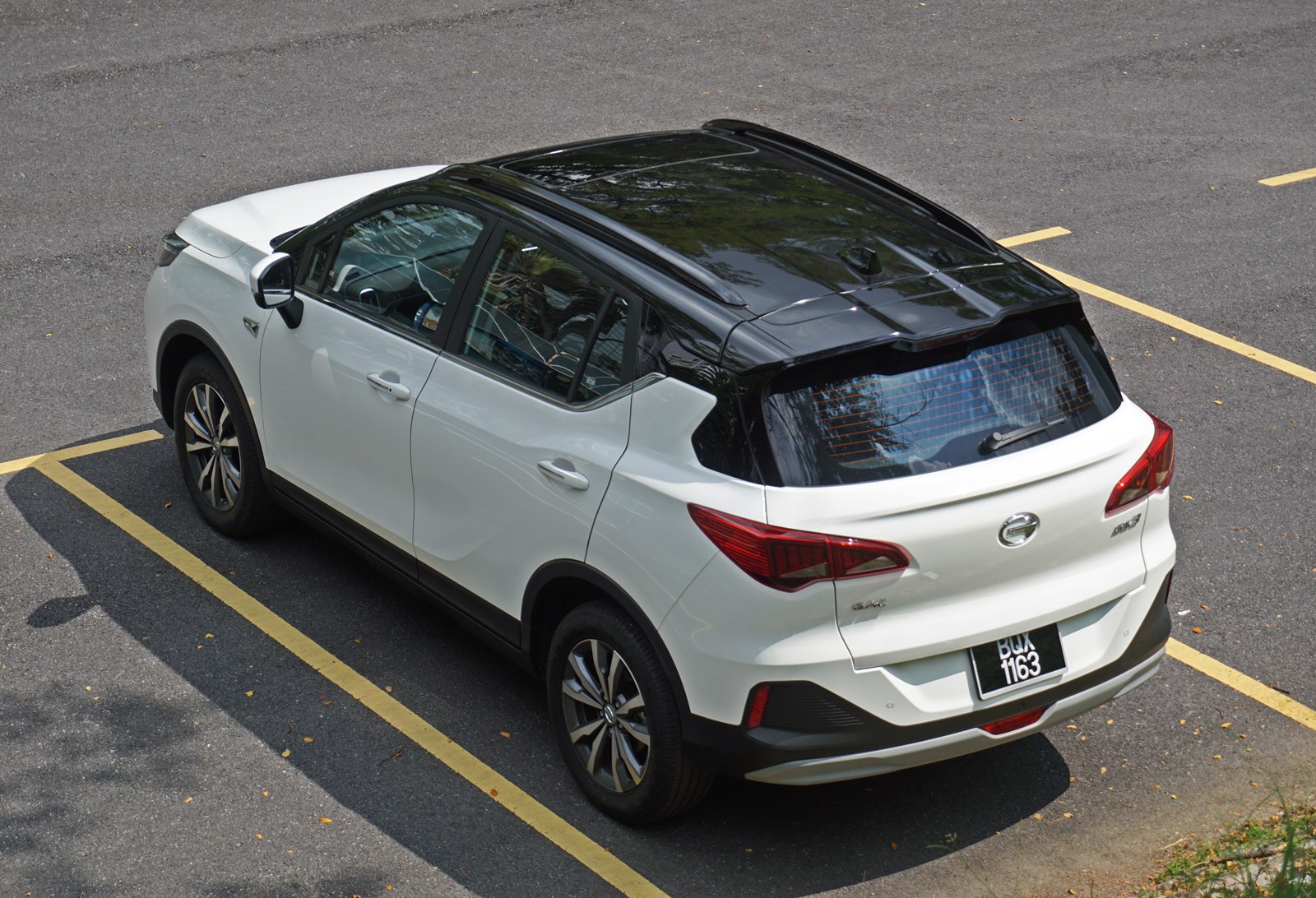
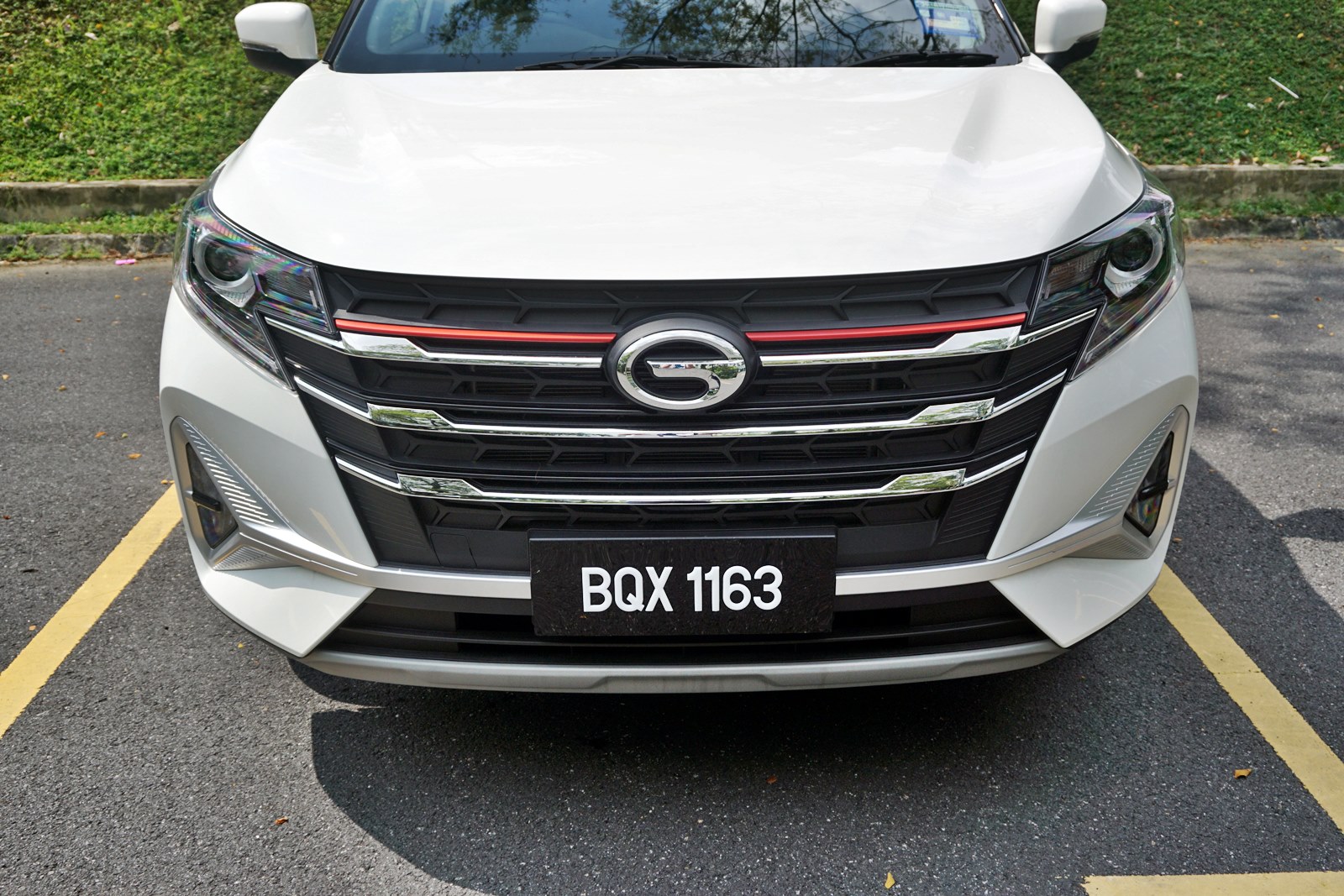
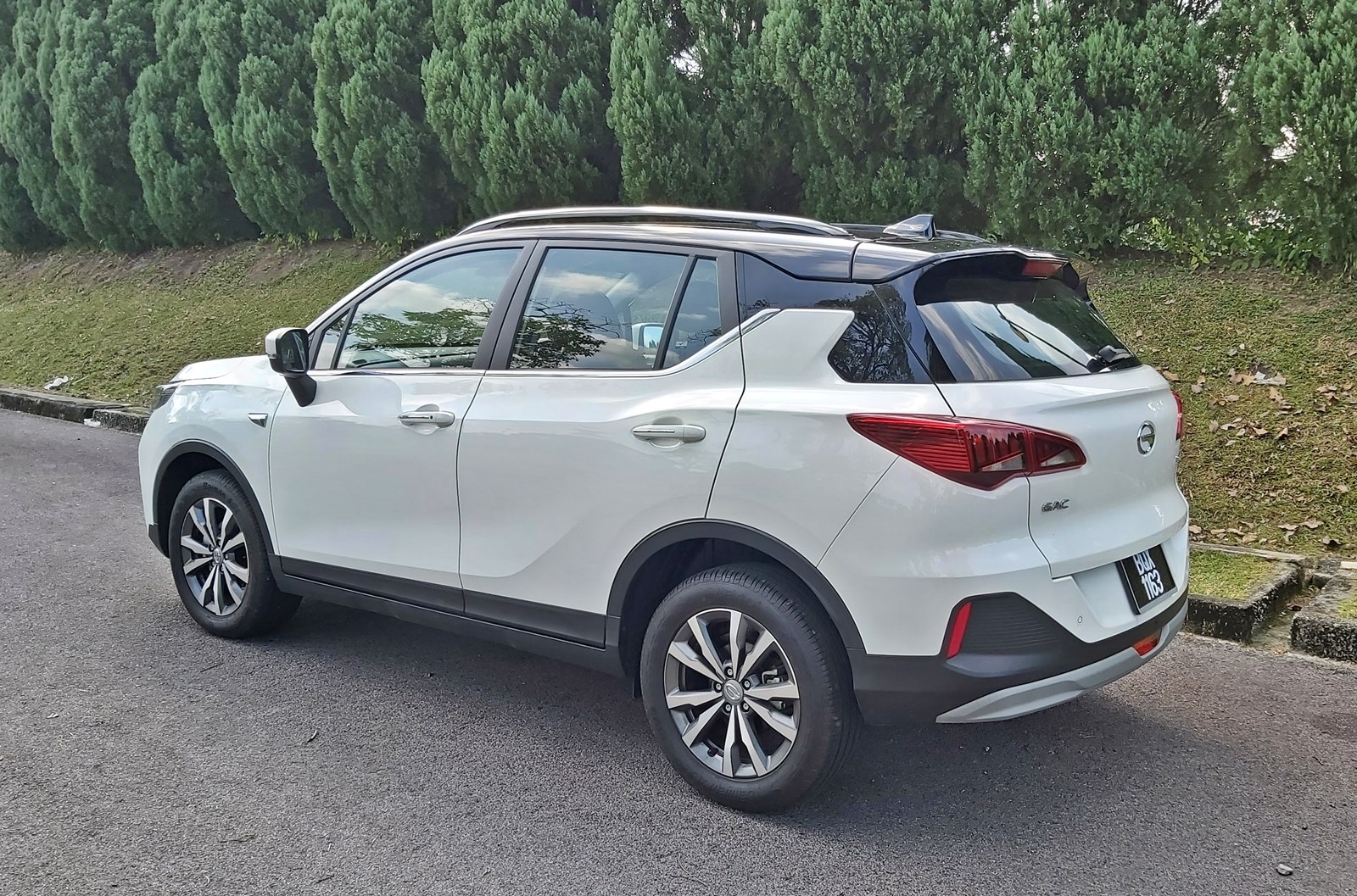
The design of the GS3 could be said to be a ‘typical SUV’, with many modern styling elements. There is a prominent grille which is referred to as a ‘Flying Dynamic Wing 3.0’, with chrome strips to give an elegant image. The profile has some resemblance to other SUVs in the market (Hyundai Tucson comes to mind) but for the Premium version we tested, there was a 2-tone colour scheme with a black roof that gave distinctiveness.
2022 GAC GS3

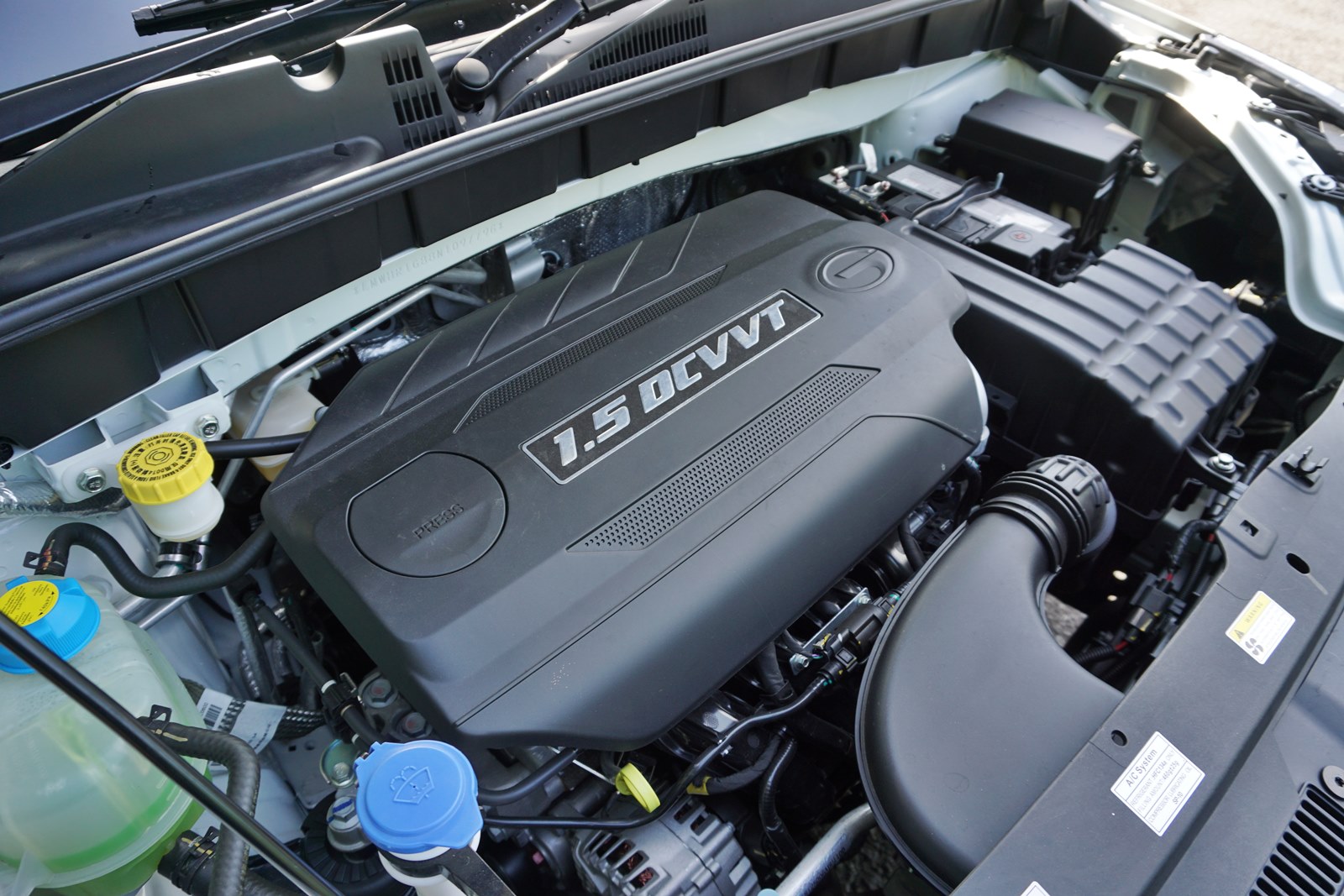
GAC has two powertrains for the GS3 and it is the 1.5-litre unit that is in the model sold in Malaysia. The engine is said to be developed by GAC itself and unlike some other new 1.5-litre engines in the market, it does not have turbocharging. Thus, the 4-cylinder engine has a modest output of 114 ps/150 Nm with efficient breathing by having variable valve timing on the intake and exhaust sides.

The transmission, which delivers power to the front wheels only, is a 6-speed automatic torque converter type. It’s supplied by Aisin which is one of the leaders in the field of drivetrains. With the small displacement and efficient power delivery, the GS3 has a claimed fuel consumption of 14.5 kms/litre and we actually got better than that (15.1 kms/litre) during our testing.
2022 GAC GS3

The GS3 platform is a fairly straightforward one typical of SUVs in this segment. MacPherson struts are fitted up front with a torsion beam at the rear end. 17-inch alloy wheels are fitted at the end of each axle and the front wheels are controlled by with electrically-assisted power steering. Disc brakes are also fitted to the rear wheels, a plus point though engineers will tell you that a drum brake will suffice.

The safety systems available in the SUV are generally what would be expected in a modern vehicle with things like ABS, stability control, brake assist and brakeforce distribution being standard. Just as it chose Aisin to supply its transmission, GAC also uses the ESP (Electronic Stability Program) system from Bosch, a global leader in active safety systems.

For those who are not so confident on slopes, there’s a Hill Hold Control to momentarily keep the vehicle in place before moving off, without having to step on the brakes. If heading downwards, the computer can manage the speed to maintain a safe pace and the driver just has to steer the vehicle. A Blind Spot system is also included and alerts the driver of other vehicles coming up nearby.

Around the cabin (except at the back) are 6 airbags to provide protection during collisions. The ones on the side cover the windows so, in a violent accident, the occupants won’t get ejected (as has happened in some cases although they were probably not belted in either). For those with children, there are ISOFIX points to securely attach compatible childseats. The law requires their use now, by the way.
2022 GAC GS3

Widest body in class
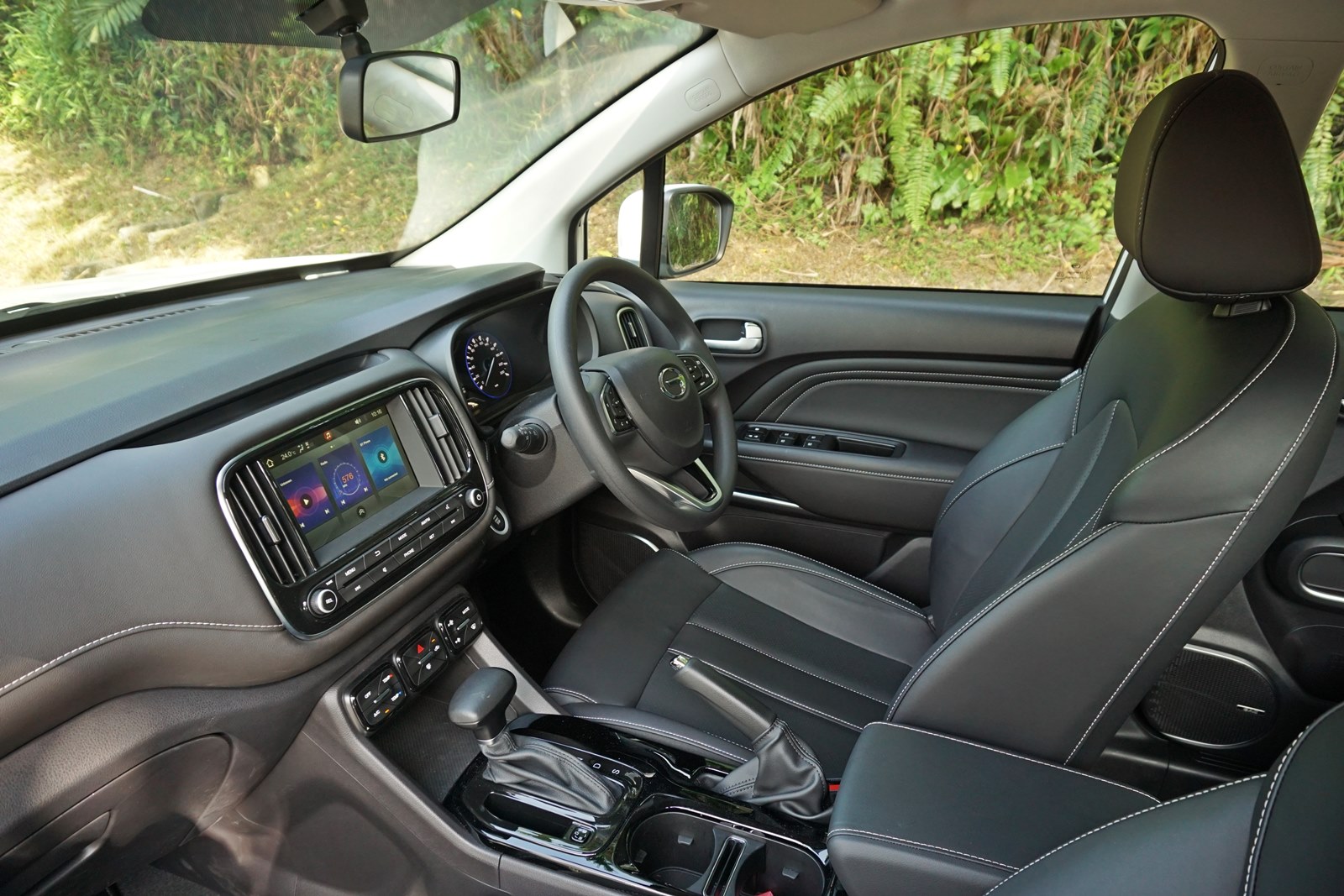
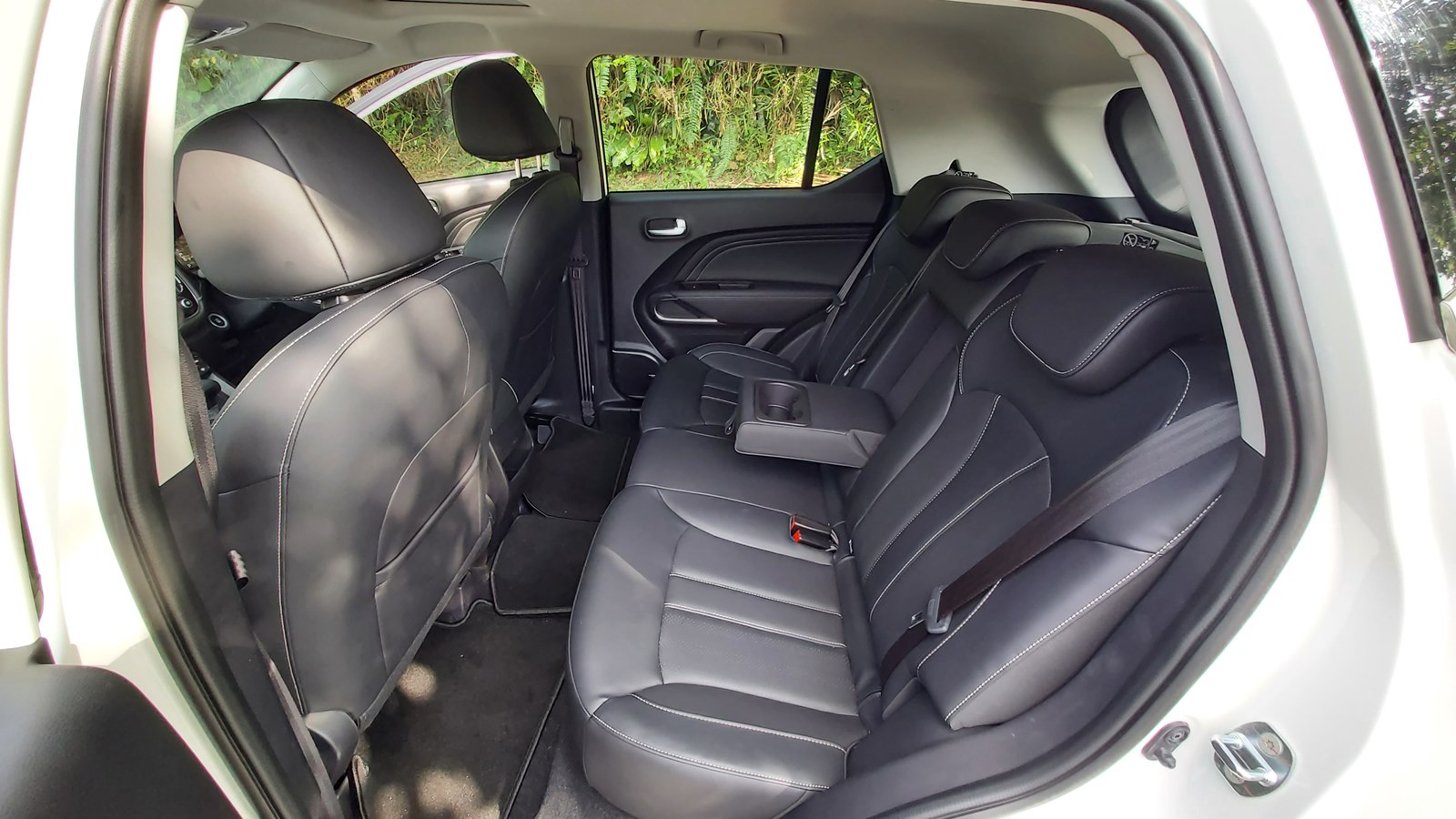
The GS3 has the widest body in its class (1825 mm) and this means more space within, especially the space between the front seats. It’s not a big difference from rivals like the Proton X50 and Perodua Ativa but can still be physically discerned. The width of the cabin is also emphasized by the horizontal theme of the dashboard, creating a visual expanse of space.
2022 GAC GS3

In the Premium version, there’s also a further enhancement of spaciousness with the ‘Sliding Star View’ sunroof. It’s something which is not so common in this class so it helps give the GS3 one more selling point against rivals. Understandably, being a newcomer, the GS3 needs to offer more without costing a lot more to win over new customers.
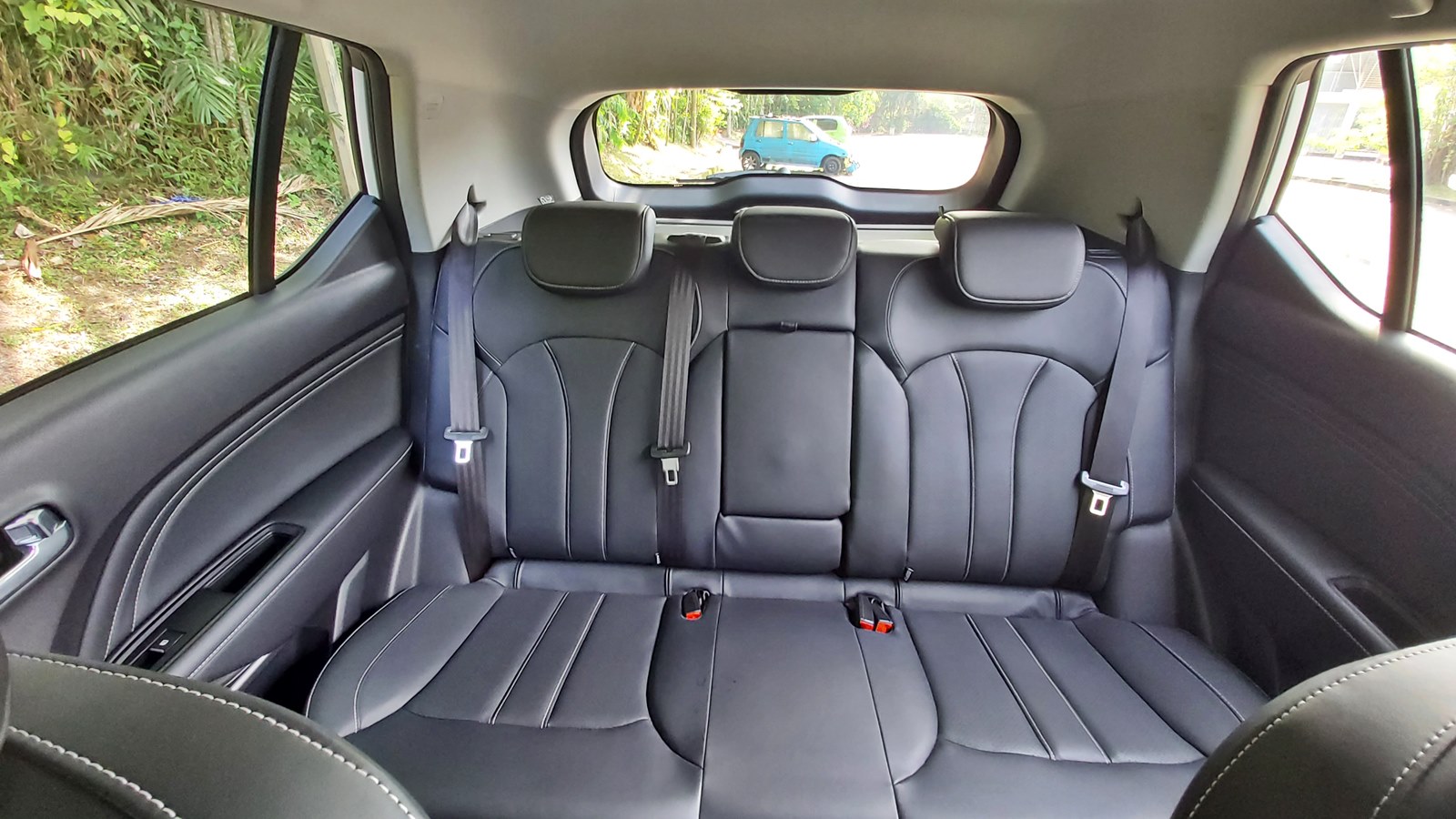
2022 GAC GS3

The cabin materials have a high quality look and feel and assembly quality is very good. It’s certainly a far cry from those cars from China 20 years ago which had loose panels and hard plastics. Now, with SUVs like the GS3, the materials have nice texturing which is important to give a quality image.
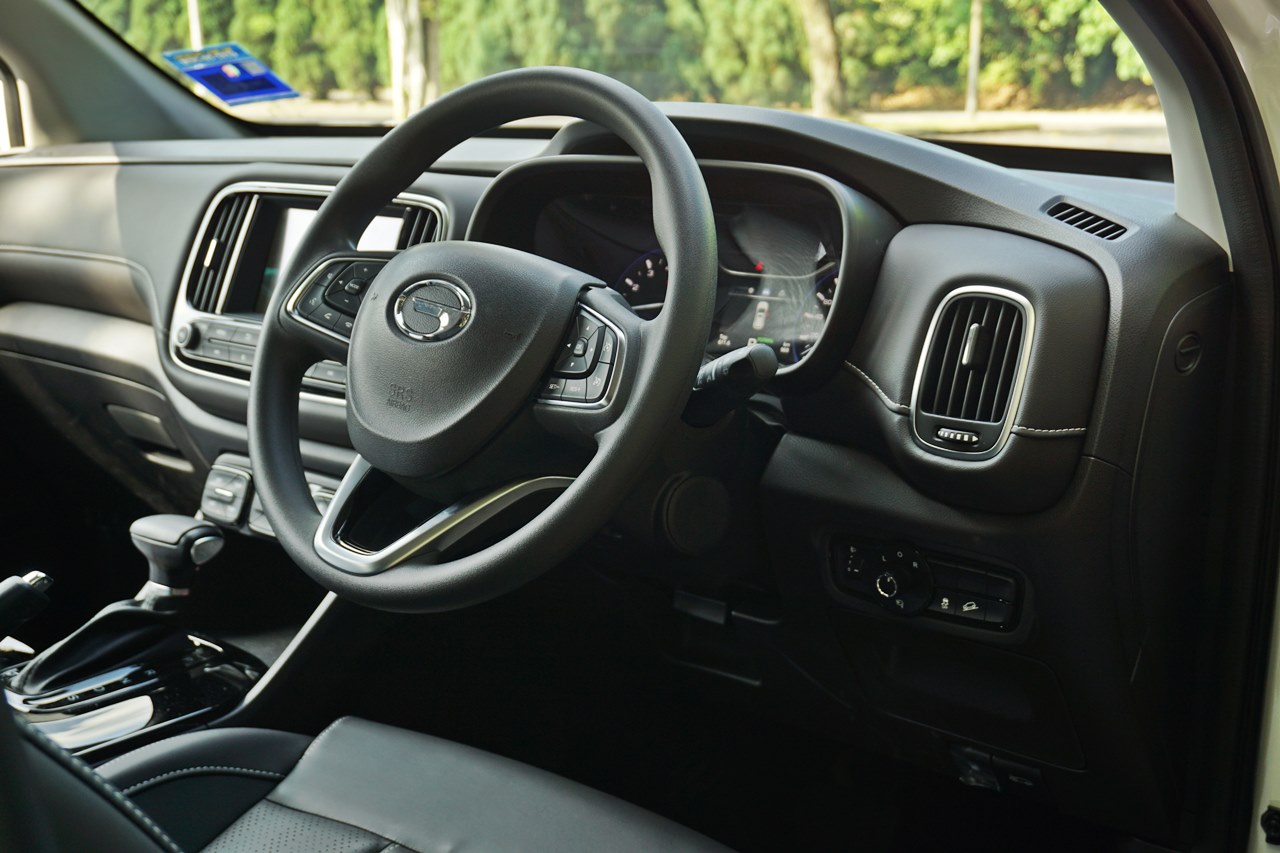
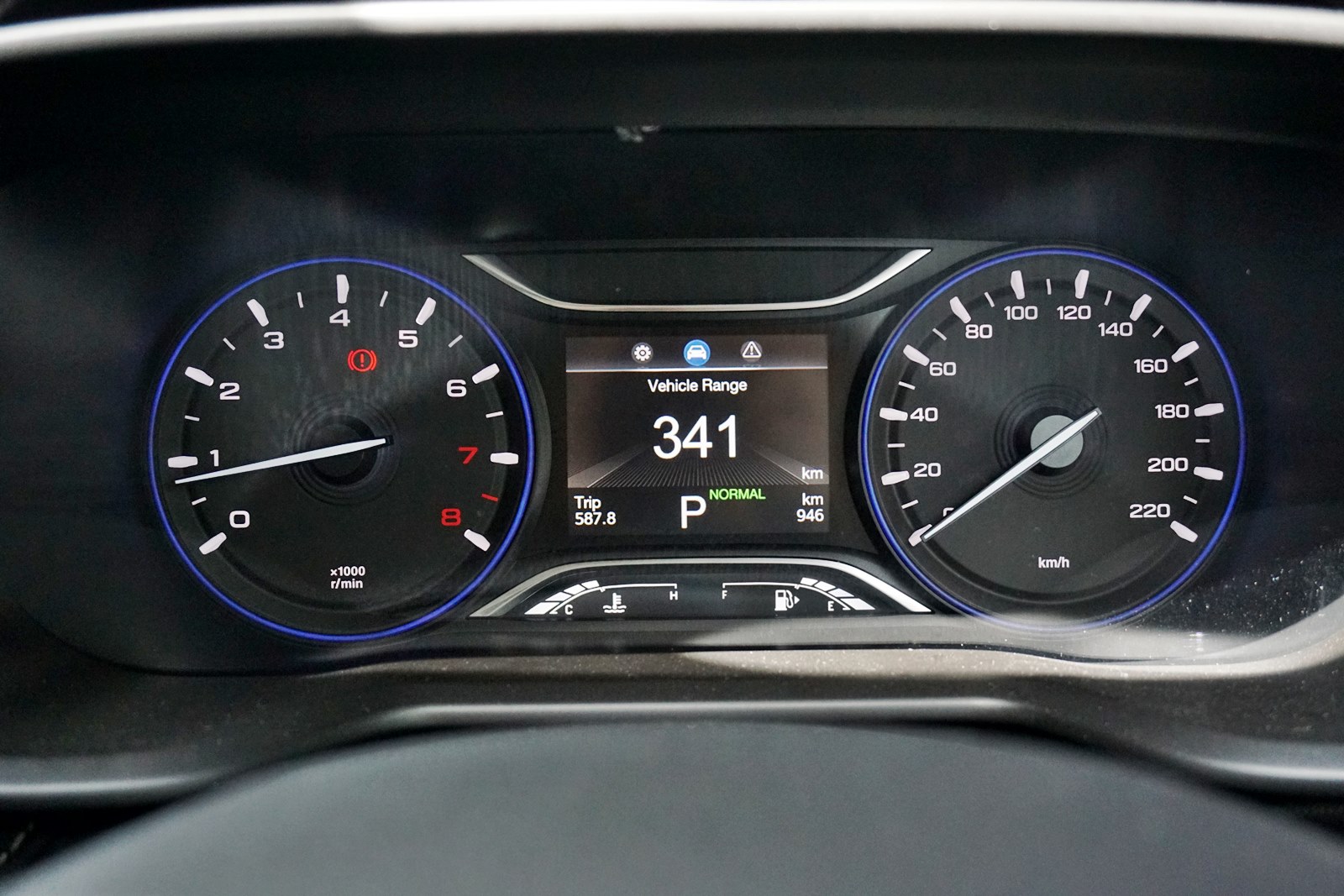
2022 GAC GS3

2022 GAC GS3

2022 GAC GS3

Unlike the Korean designers, GAC’s designers do not seem to be trying to ‘reinvent the wheel’, so to speak. Switches and controls are conventionally shaped with no strange shapes to try to be ‘different’. There are also switches on the leatherette-trimmed steering wheel and they are laid out in an intuitive manner so a new driver will operate them easily right from the first day.

For the price that WTCA is asking, which is just under RM100,000 for the Premium version, we’d say that the features list is appropriately comprehensive (even includes a pushstart button). You also get cruise control and the Climate Control System has PM2.5 particulate filtration and purifier which helps to keep the cabin air clean and removes smells.

Driving the GS3
As mentioned earlier, past experiences with cars from China left poor impressions so to be frank, there was an assumption that the GS3 would lack refinement. But just as the Japanese cars of the 1980s were a big difference from those of the 1960s, it’s the same with the GS3. It feels as good as any modern car from a Japanese or Korean brand, and if you strip it of its branding identity, you would not think it is from China.
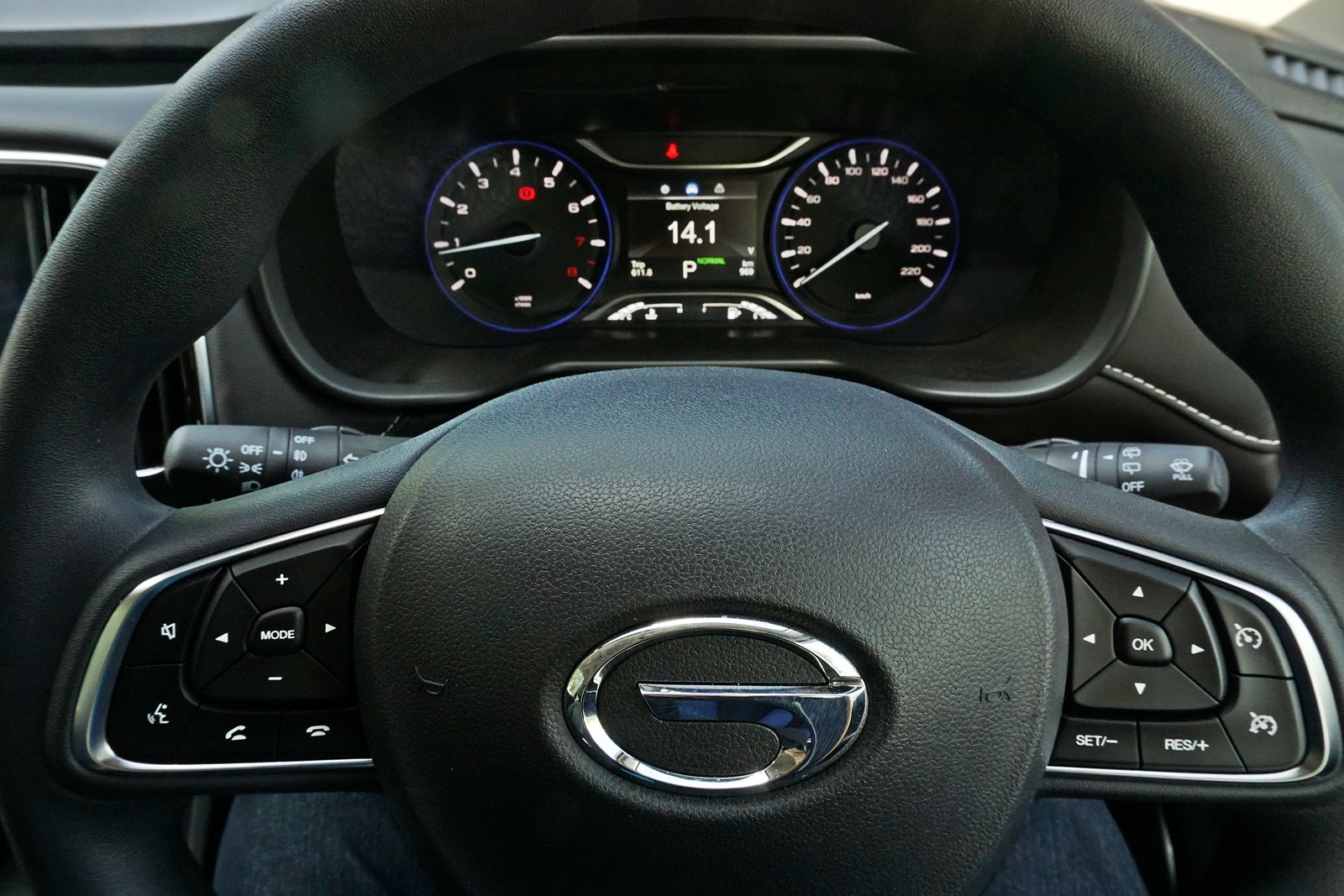
2022 GAC GS3

The engine also ran smoothly and though it lacked forcefulness without a turbocharger, the output 150 ps is good enough to give brisk acceleration and maintain high speeds easily. Remembering how the engines in those old Chinse cars didn’t take kindly to hard driving, we pushed the GS3’s engine hard using the manual mode to stay in each gear and the engine never felt like it was going to ‘explode’. In fact, though there were vibrations at higher revs, they were not the erratic type. Noise levels were also not particularly high and it could be that insulation is also generous.

The transmission operates smoothly and you can choose a default mode, litre-stretching ECO mode or a manual mode. We didn’t feel a big difference in the ECO mode though but it would probably help over long distances. The shifter has a rocker switch for changing gears up or down sequentially. However, this only works when in manual mode and not in the default or ECO modes. We think that manual selection should be available in all modes so that the driver can downshift for engine braking, reducing the need to use the brakes.
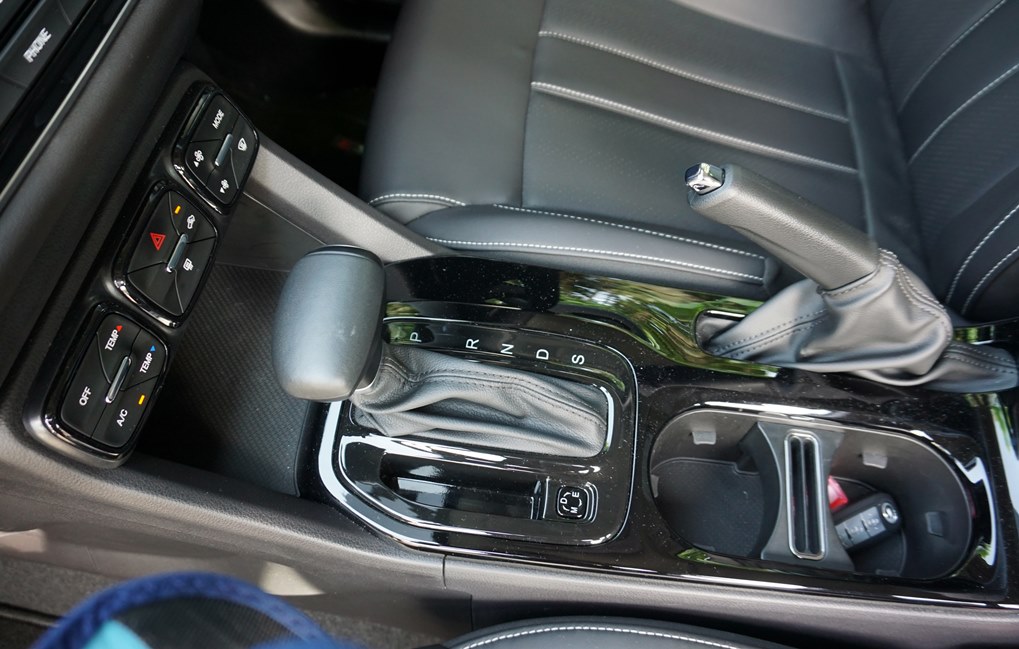
2022 GAC GS3

Driving the GS3 is no different in feel from a Japanese or Korean car (or even a Malaysian one). It has a pleasant ride although the standard tyres (from some Chinese manufacturer) seemed a bit on the hard side, even after the pressures had been set to what was recommended. Perhaps when it is locally assembled, more testing will be done and tyres better suited to our road conditions will be fitted.

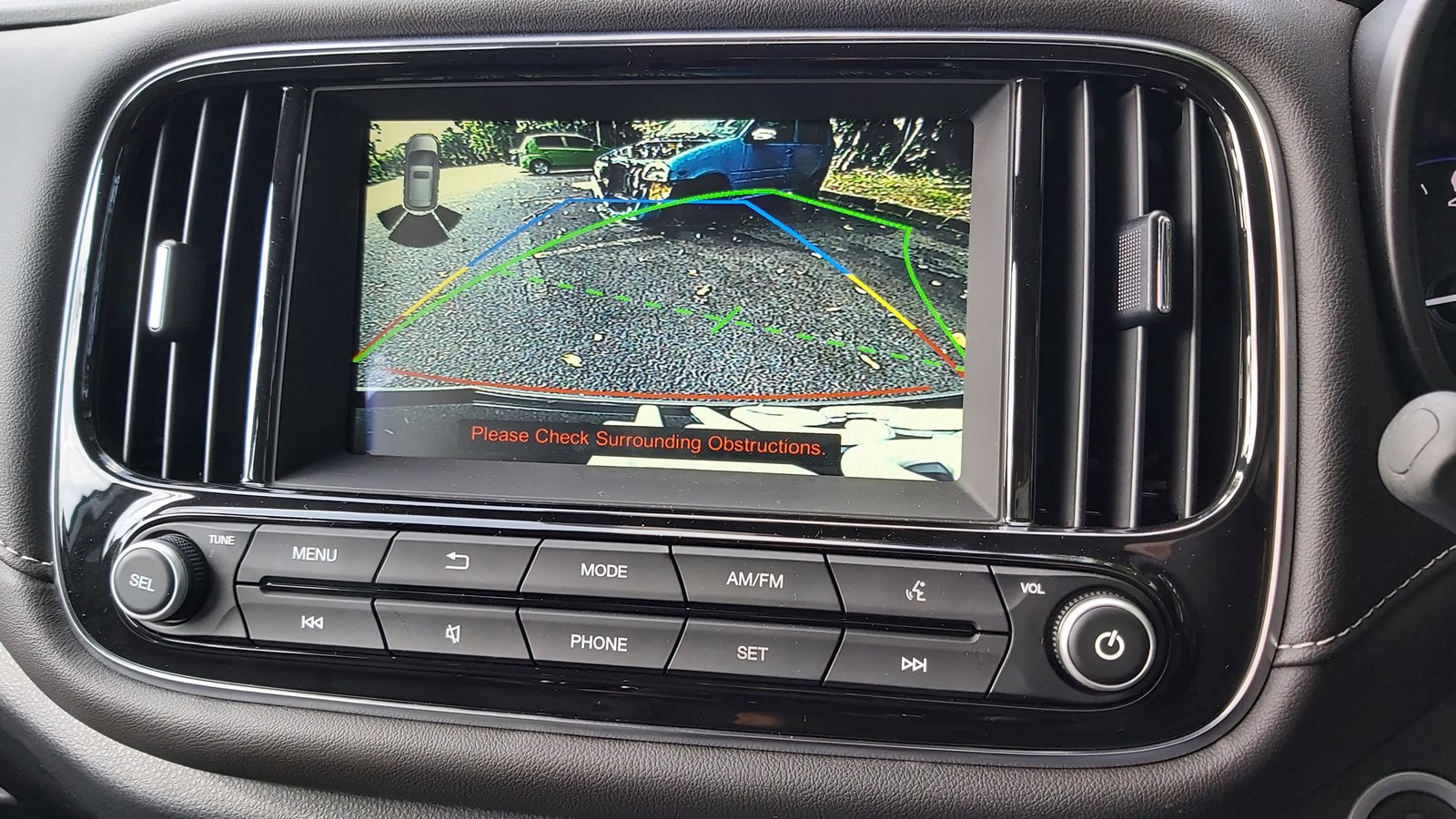
With its compact size, the SUV has an agile feel and even when pushed hard around corners, it stays the course without drama. Of course, you don’t get a car like this for ‘dramatic’ driving and as an urban runabout, it certainly does that job well. It comes with a reverse camera as well so parking should be easy, and being a SUV, you sit higher up of course.
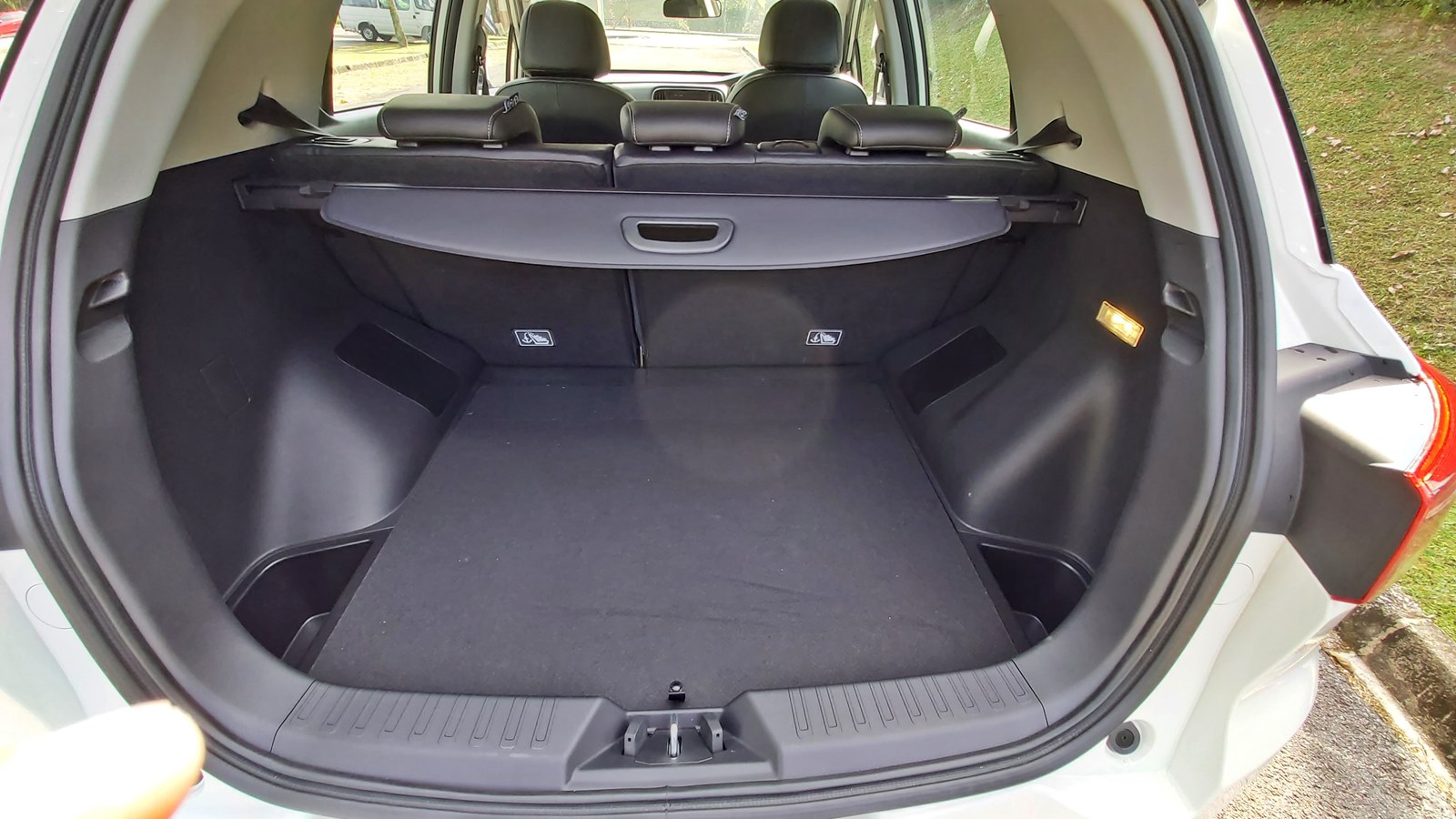
2022 GAC GS3

As for scheduled maintenance, the intervals are 10,000 kms or 6 months (whichever occurs first) and up to the first 100,000 kms, the RM63 labour charge for every alternate service will be waived. Maintenance costs (depending on mileage) will be between RM182 and RM815, the latter cost on just one occasion at 60,000 kms when the timing belt is changed. Aftersales support will be available through WTCA’s own outlets, with additional support from the Tan Chong network which is well established and nationwide. And you also get a warranty that is 5 years long or a maximum of 150,000 kms.

If the GS3 is an example of the standard that Chinese carmakers have reached today, then the other East Asian carmakers (and Malaysian ones too) will have strong additional rivals in future. We can’t say much about durability and reliability at this stage. Those early Datsuns also seemed like they were fragile and would not last long but they eventually became known for their reliability and durability which made them a household name. What’s to say that GAC products won’t go the same way?

In the 1960s, Volvo drew attention to the importance of a car seat being designed for a correct posture to provide not just comfort but also promote driving safety. Its seat designers consulted specialists on a subjected that would come to be known as ‘ergonomics’ and developed a revolutionary seat that would set new standards in the industry.

The carmaker’s pioneering work encouraged other companies to also give more attention to car seats and not treat them as just a place for the occupants to sit on. In the years to follow, many more new ideas (some by Volvo) would be introduced in seat design which would increase comfort as well as safety.

Bentley Bentayga EWB Airline Seat 2022

New benchmark in wellbeing
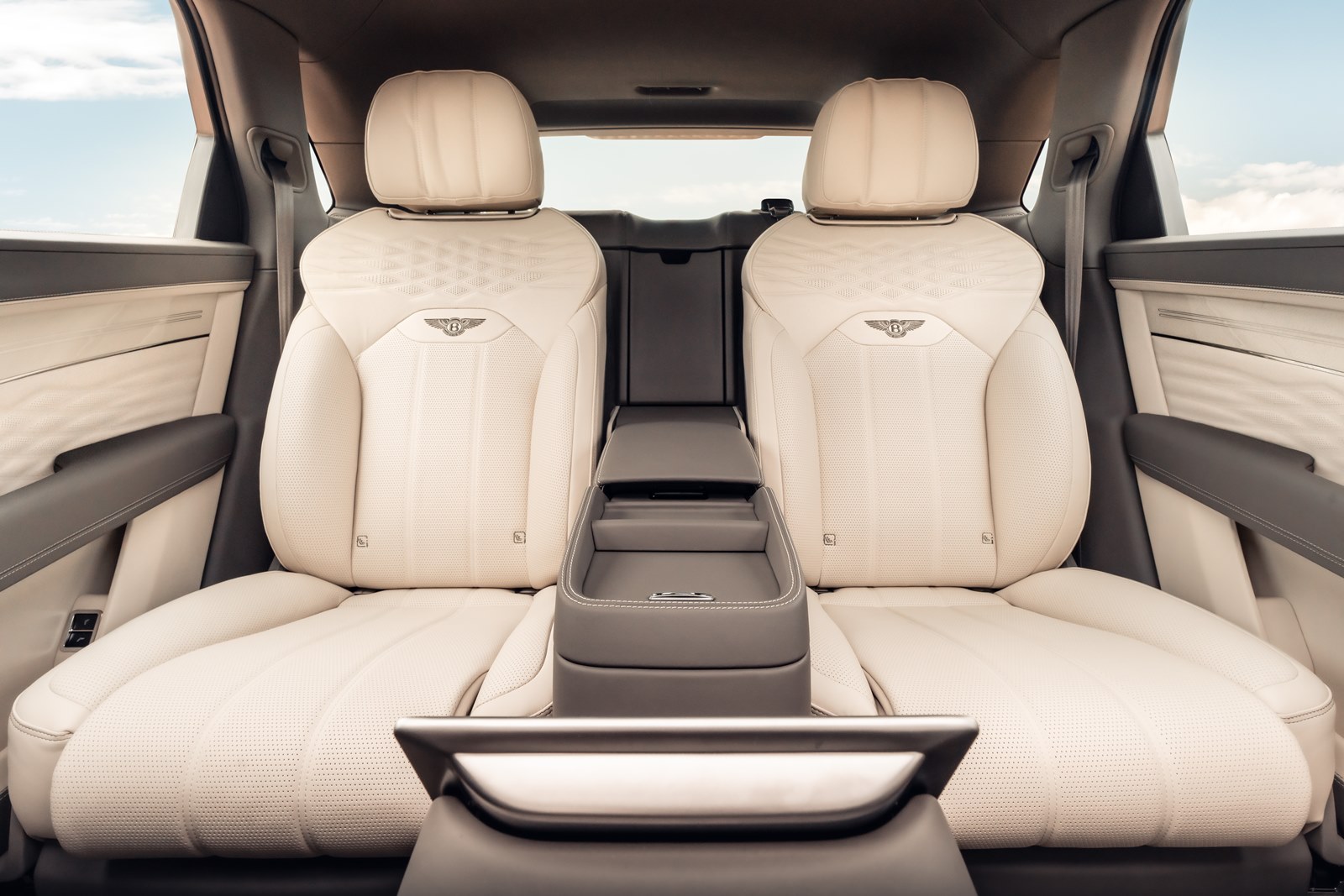
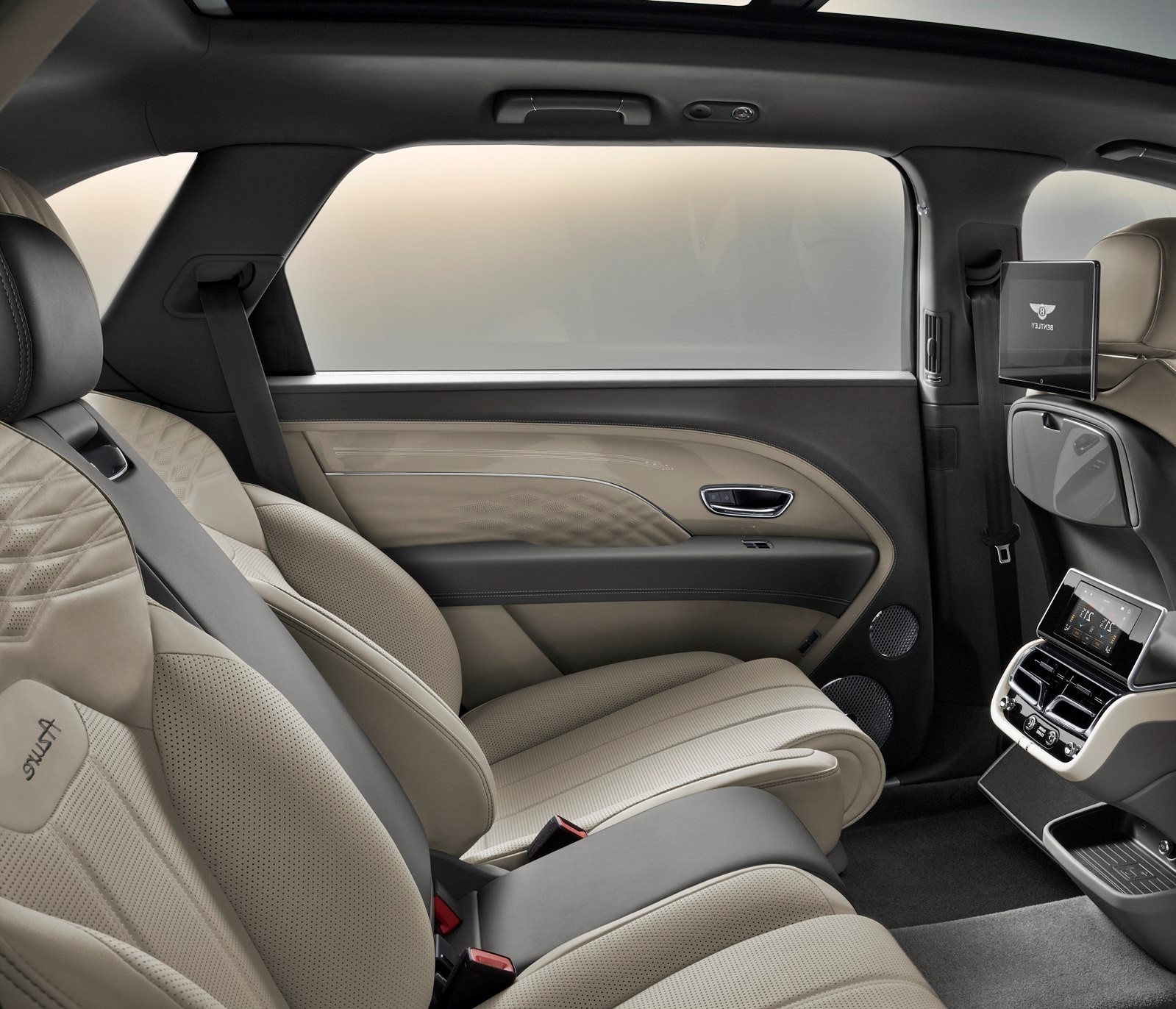
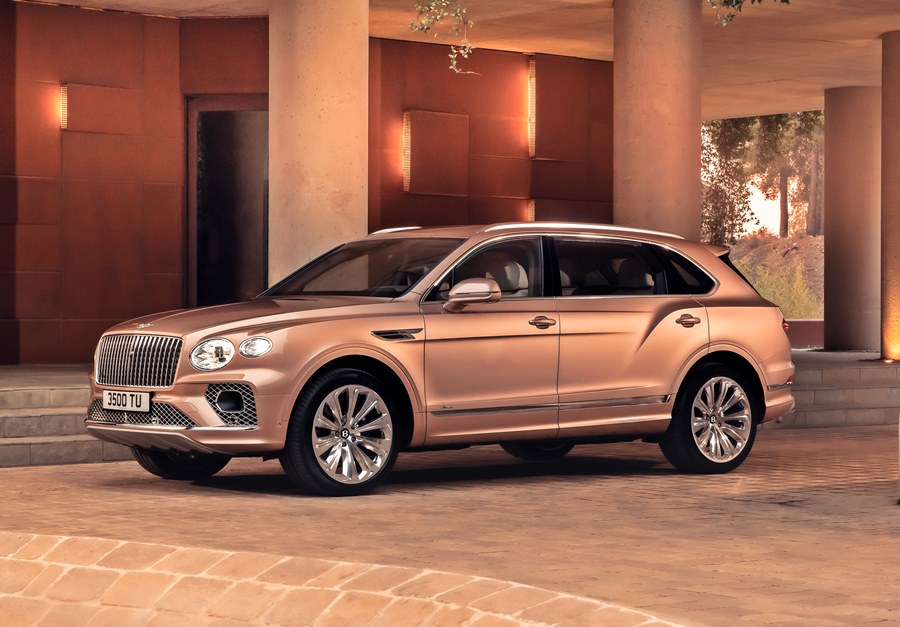
In 2022, the new Airline Seat Specification of the Bentley Bentayga EWB represents ‘the most advanced seat ever fitted to a car’. It demonstrates a new benchmark in wellbeing features, providing the most comfortable experience possible for those travelling on extraordinary journeys. 50% of the customers who are buying the longer version of the Bentayga have specified this seat to go with their purchase.

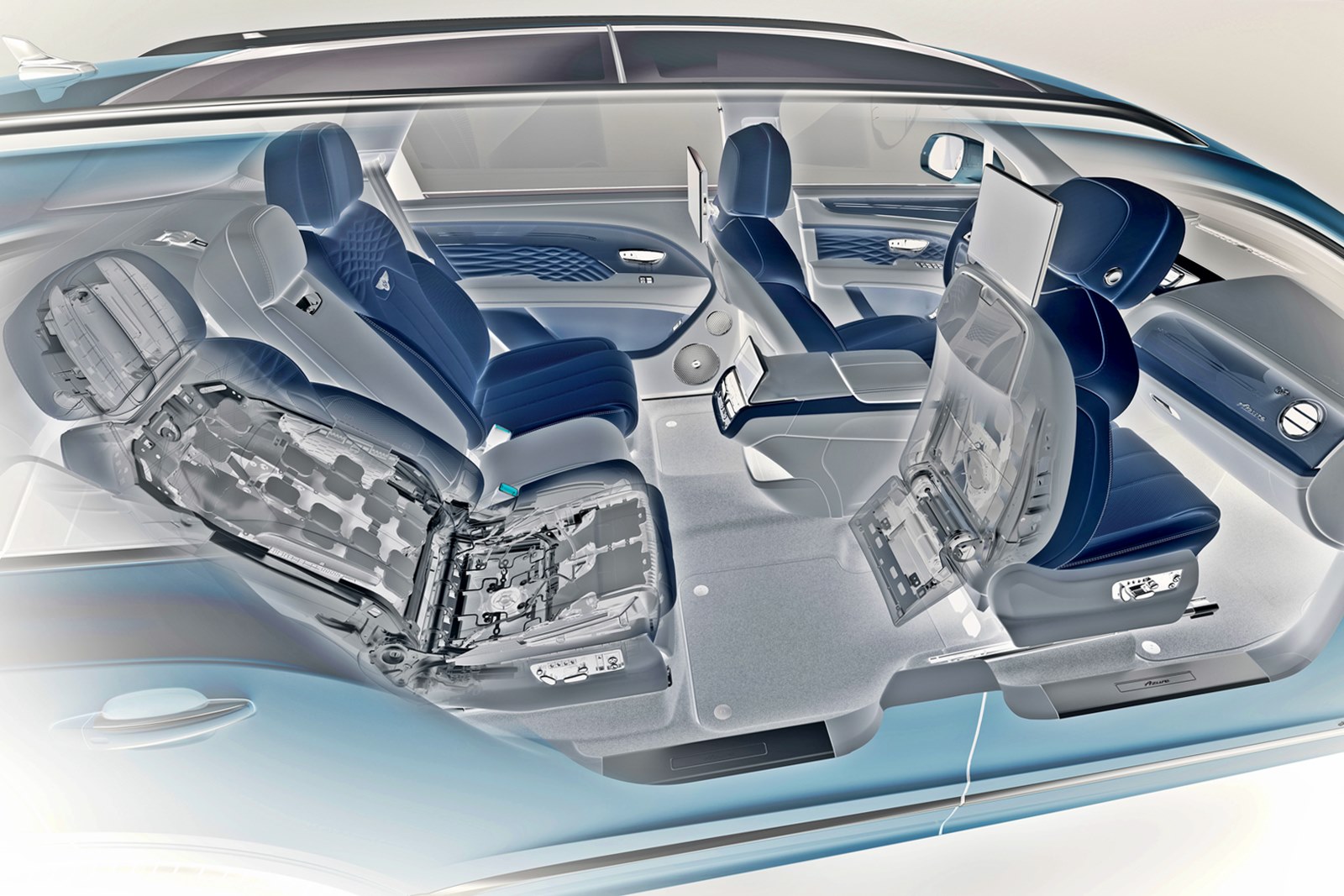
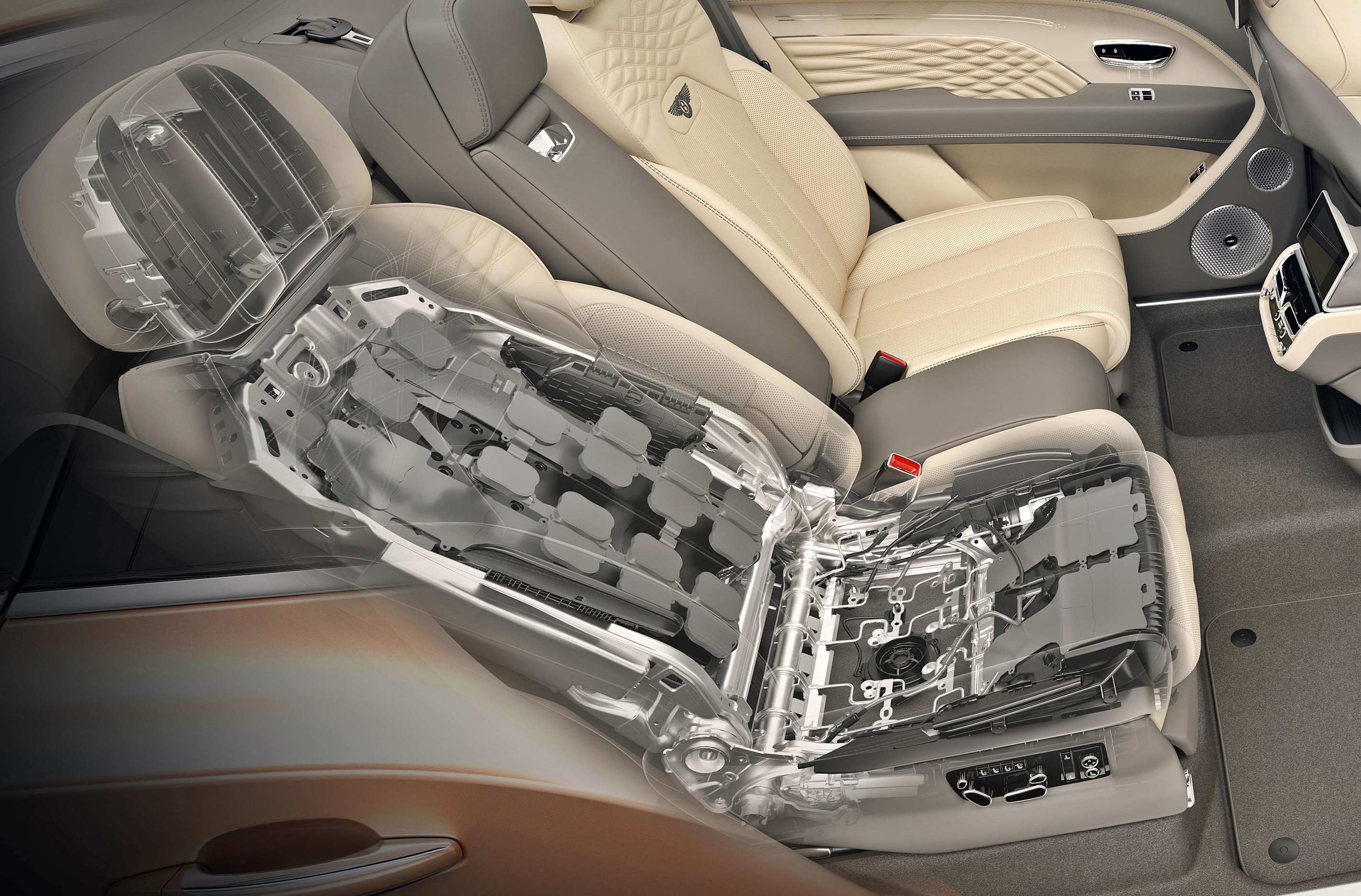
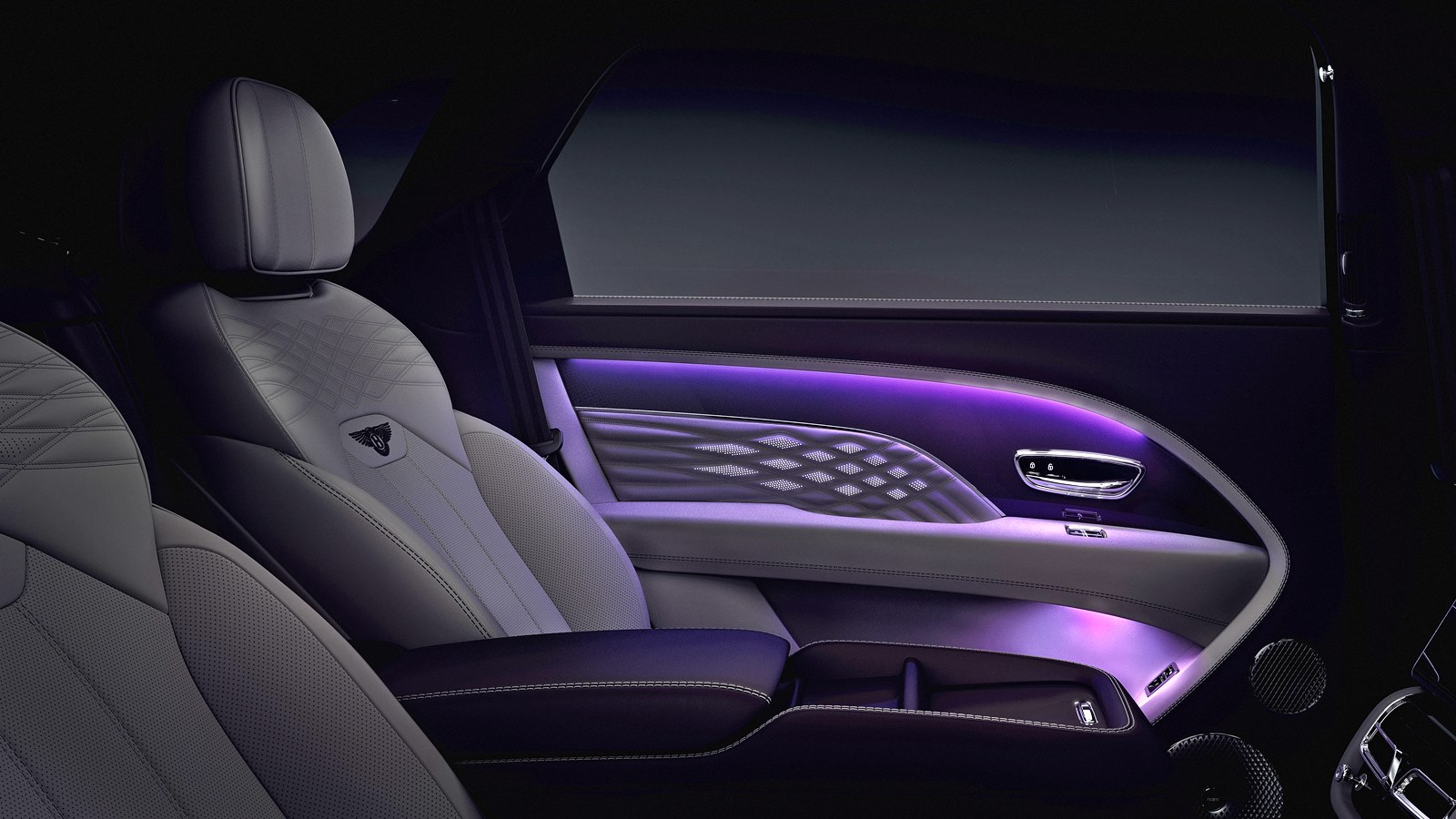
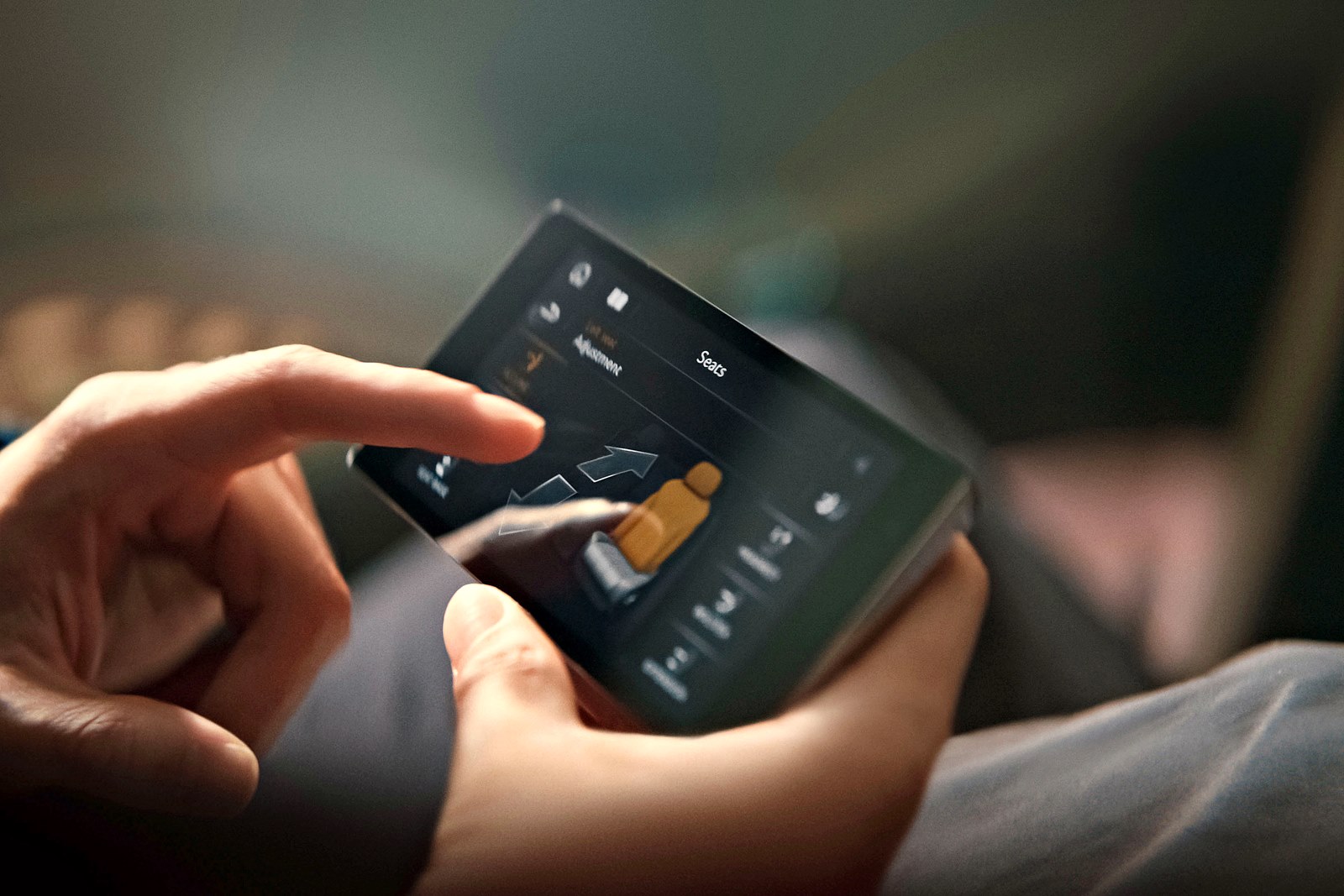
Along with the systems to deliver Auto Climate and Postural Adjustment, the Airline Seat has a suite of technology beneath its handcrafted leather surfaces. An array of no less than 12 electric motors operate silently to deliver 22 ways of adjustment in the seat alone. This allows the user to shape the seat to suit their body shape and also to work or rest. The motors are joined by three intelligent pneumatic valve electronic control units, and the combination of motors and valves is overseen by a master Seat Motion & Wellbeing ECU.

Bentley Bentayga EWB Airline Seat 2022

Studies have shown that actively supporting body weight in a dynamic way relieves strain, which can prime mental stress and create lack of focus. Natural supported postures have been shown to alleviate stress from tensed muscles. The postural adjustment system automatically makes micro adjustments to the passenger’s seating position and pressure points, using an algorithm developed in collaboration with a chiropractor.

The system can apply 177 individual pressure changes across 6 fully independent pressure zones over a 3-hour period, improving comfort and minimizing fatigue throughout a journey. By subtly changing the shape of the surfaces of the seat over time, no single area of the body endures pressure fatigue for an extended period – meaning the occupant is always comfortable.

Bentley Bentayga EWB Airline Seat 2022

Postural Adjustment System
While many fatigue recovery system exist (seat massage, for example), the Postural Adjustment system is the next step further providing a proactive anti-fatigue system. By subtly adjusting the contact pressure between body and seat through soft pneumatic activation zones, the system goes beyond the 2D motions typical of adjustable seats, and employs a 3-dimensional twist to relieve pressure points. These motions are controlled by complex algorithms that have been developed in collaboration with a chiropractor who deals with clients who experience discomfort on long car journeys.

Working with specialists Comfort Motion Global (CMG), Bentley has developed a scientific, pneumatic postural adjustment system. CMG has been working in the field of fatigue prevention for several years, conducting medical-based research trials that highlight the benefits of changes in posture for comfort and wellbeing.

Bentley Bentayga EWB Airline Seat 2022

By creating subtle changes in the seat surface contact zones, body tissues that have been under pressure are relieved, and other areas, pressure is then applied. This allows the body a chance to locally recover naturally. The postural motion creates small changes in back and limb angles and can increase blood flow. Particularly in the lower back and lower limbs reducing discomfort, therefore passengers remain more alert and focused for a much longer period.

Seat surface sensing system
Many premium and luxury models have ventilated seats nowadays, with fans within that blow hot or cool air onto the body. The Airline Seat offers even more with the world’s first seat surface sensing system for thermal comfort. It uses a suite of sensors that constantly measure both passenger contact surface temperature and humidity level, to an incredible accuracy of 0.1°C every 25 milliseconds.

The passenger defines an optimal surface temperature target from 7 settings. Sensors measure and produce live data to determine what seat heating, cooling and ventilation levels are required to achieve the best comfort temperature for the passenger. The system then maintains the optimal thermal comfort throughout the journey with micro adjustments to the seat thermal system to maintain the setpoint.

In trials, it was observed that a human can only notice a change in surface temperature between 1° -2°C, but the system is constantly monitoring actual temperature to a much more detailed level, so it knows what the passenger is going to need before they would know themselves. This live data allows the system to activate before the passenger even knows it is required, providing an intelligent and autonomous experience where manual control is no longer needed to maintain comfort.

Bentley Bentayga EWB Airline Seat 2022

Auto Climate System
The auto climate system, which has 7 set points) uses existing seat heating technologies, but a new seat ventilation fan has been developed that can move approximately 80% more air than the previous system. Less power is consumed than the current seat climate system and, in Auto Climate mode, the overall power consumption of the complete system is around 40% less than being manually activated by the passenger.

The EWB Airline Seats have optimized seat contact profiles as well as a complex seat interlayer construction, tuned to work in perfect harmony with the chassis of the car. Working together the ride comfort is smooth and passengers are isolated from road vibration.

Bentley Bentayga EWB Airline Seat 2022

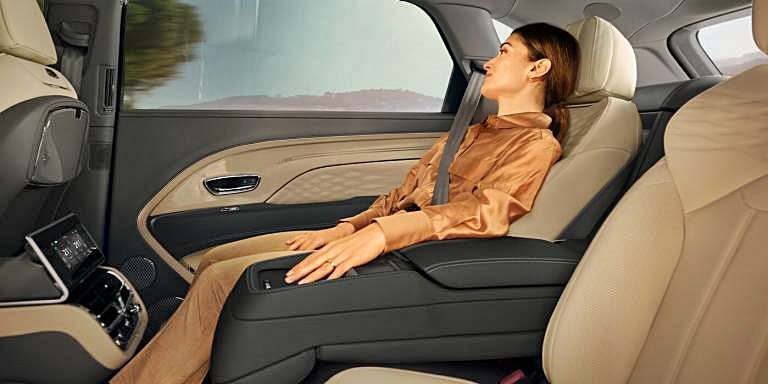
The adjustable profiles can morph to suit different customer shape and build. The adjustable leg and footrest feature allows customers to achieve a seated posture that is individually comfortable to them for longer periods.

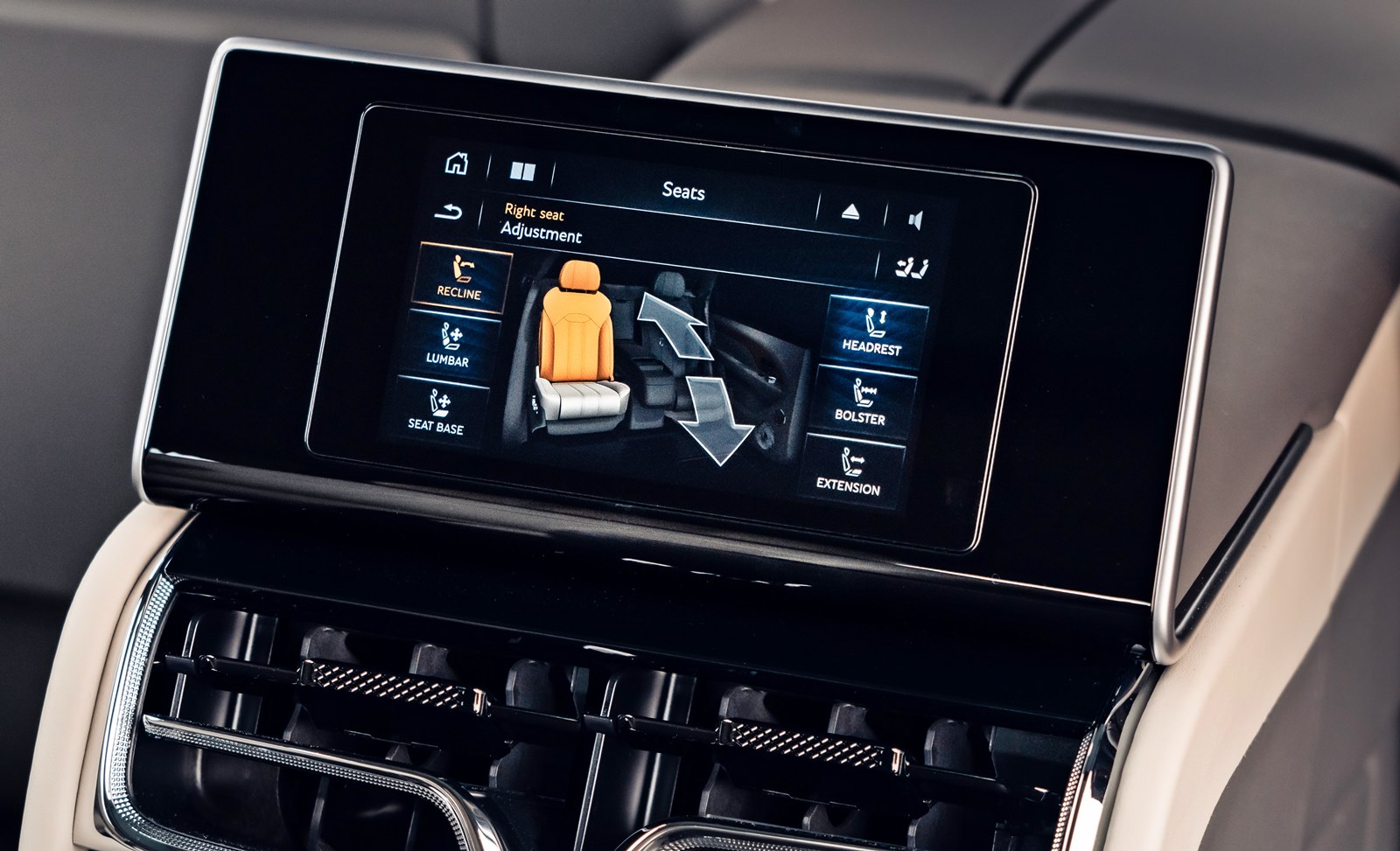
The Airline Seat Specification also adds further cushion and backrest bolster adjustment, cushion extension, electric headrest height adjustment and a deployable footrest to the back of the front passenger seat. The rear seat passenger on this side of the car can also move the front passenger seat forwards via a ‘VIP mode’.

2022 Bentley Bentayga EWB

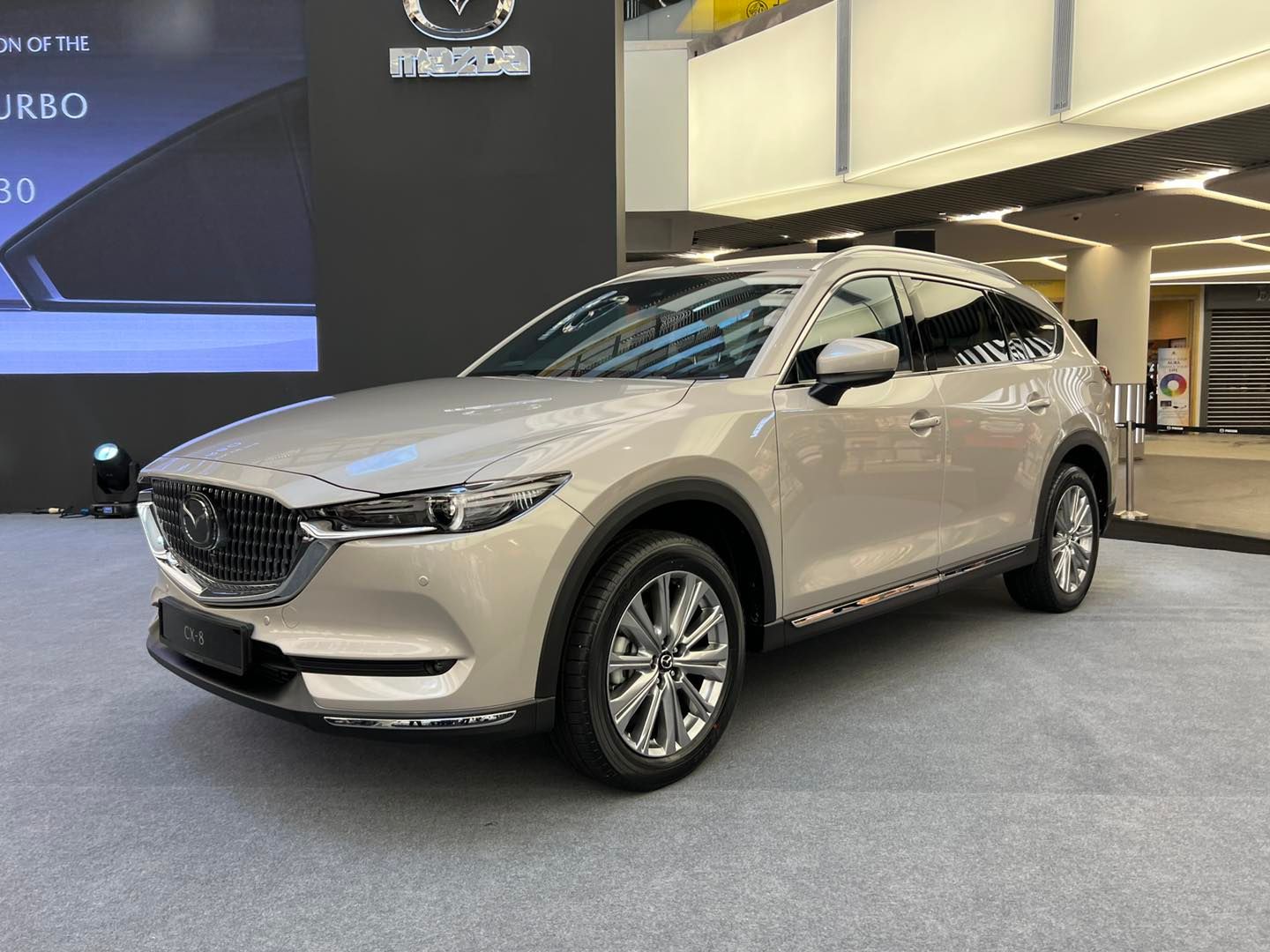
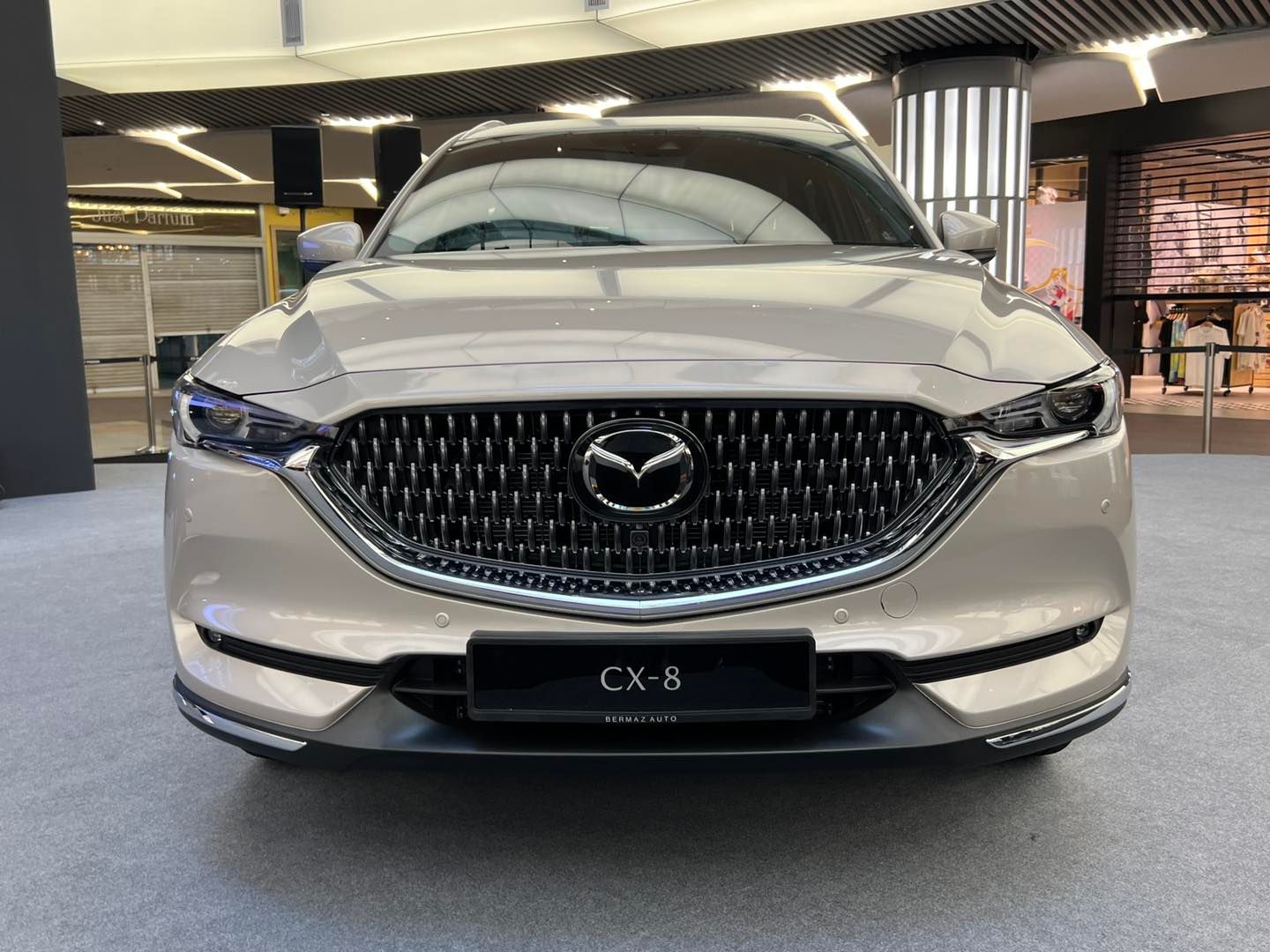
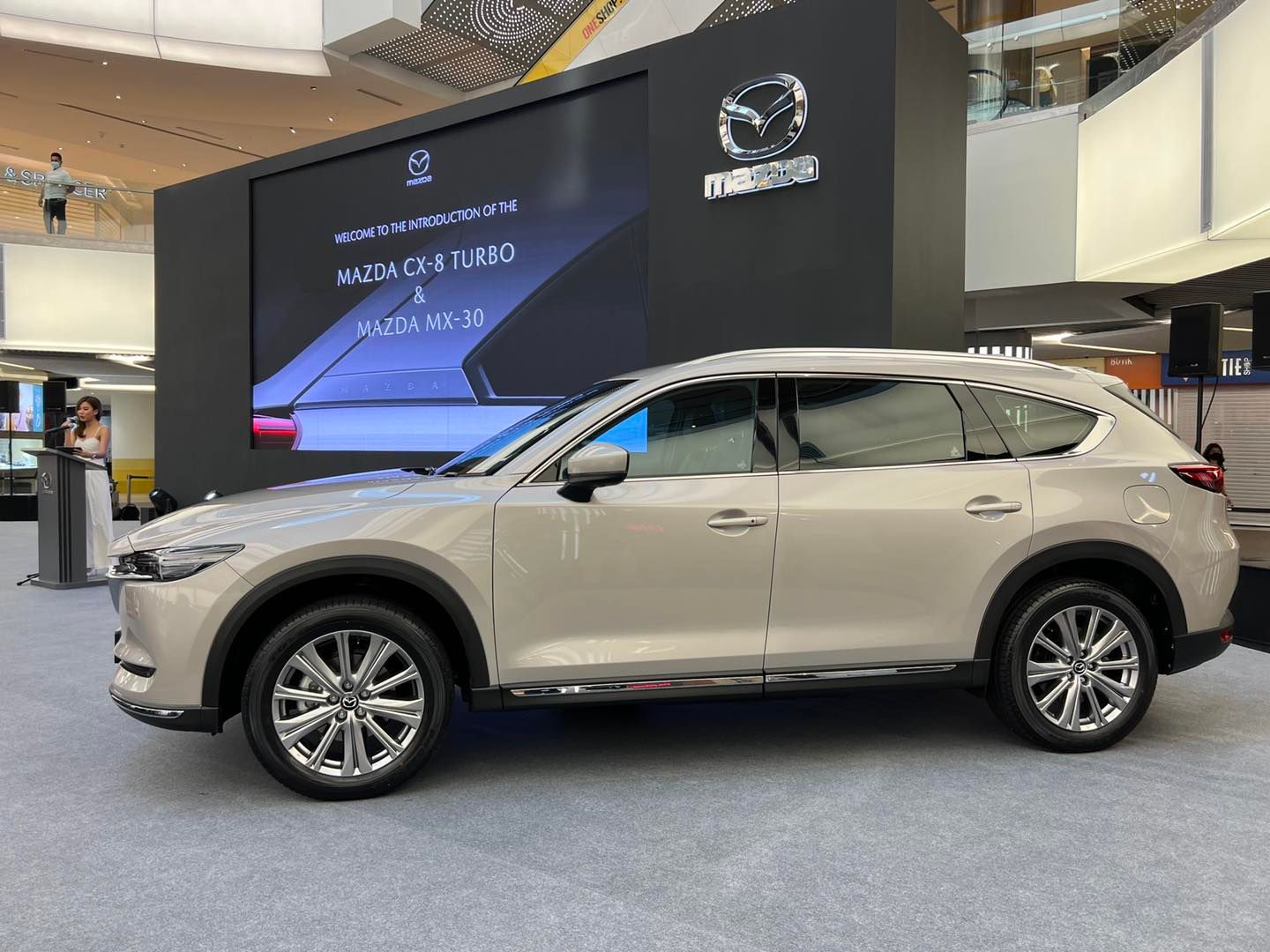
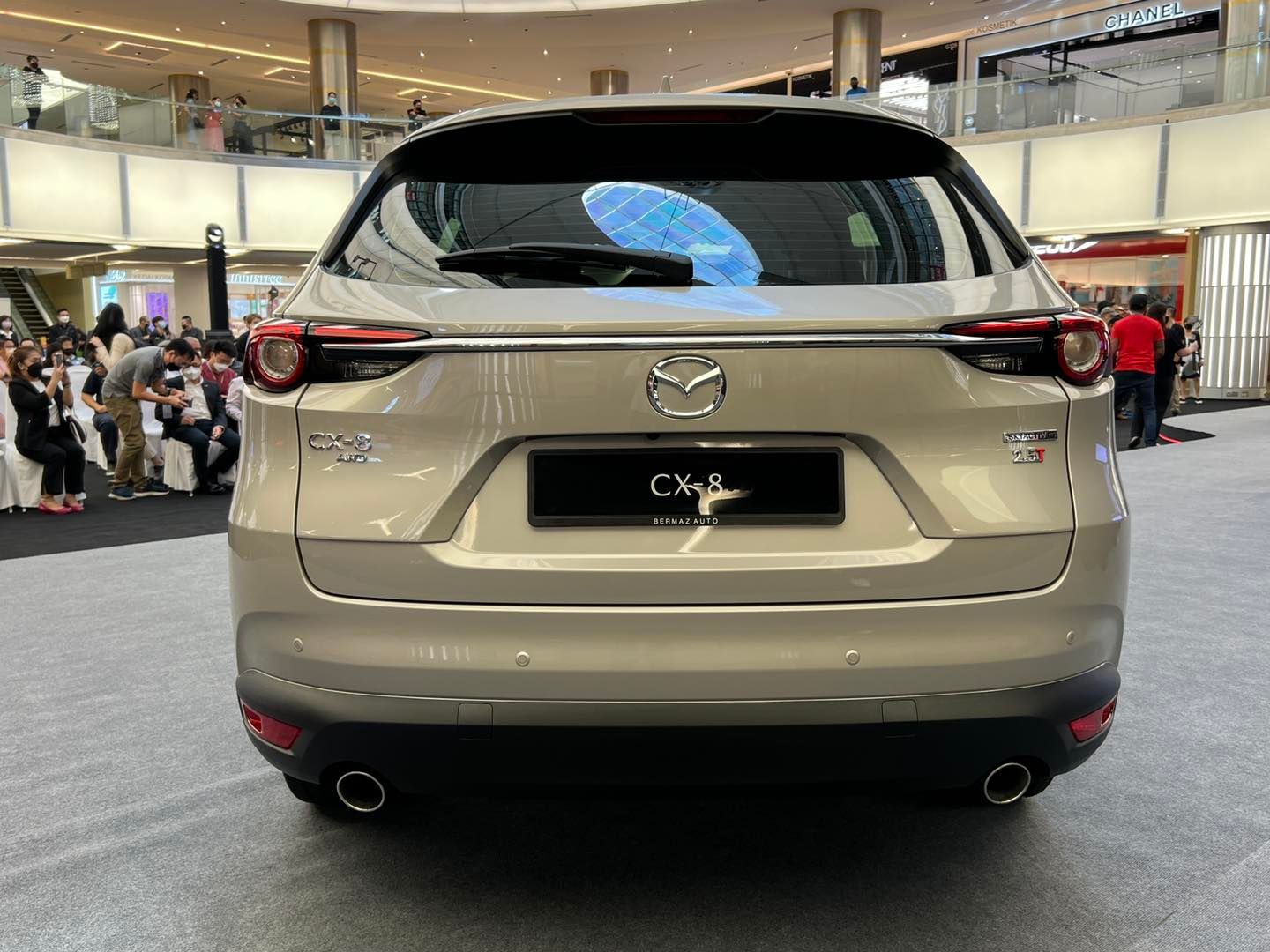
The CX-8 joined the Mazda range offered by Bermaz Motor in 2019 and like the CX-5 below it and the CX-9 above, it found its own niche in the competitive SUV segment. With 3 rows, it provided the extra seating space which was required by some customers that the CX-5 could not offer. And being assembled locally at the Inokom plant in Kedah, it could be priced competitively.

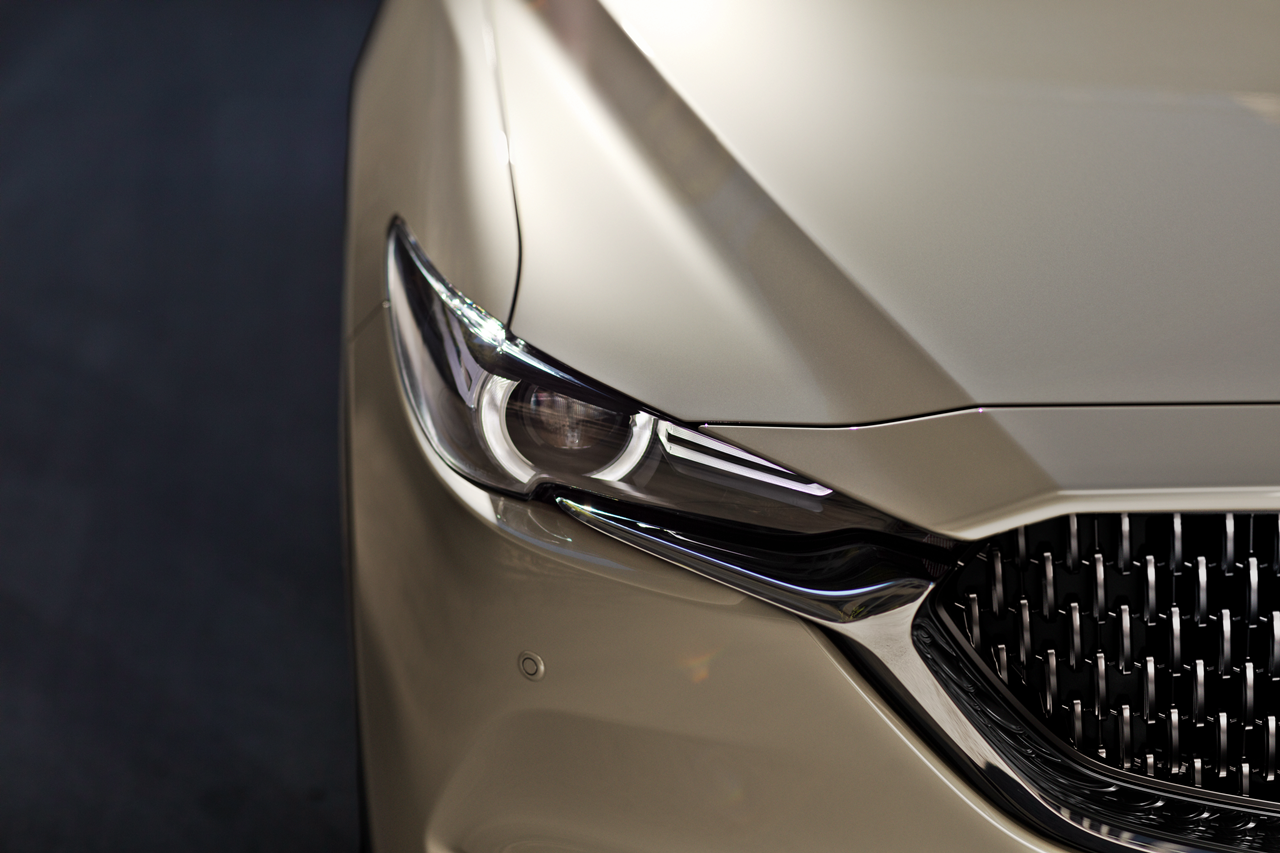
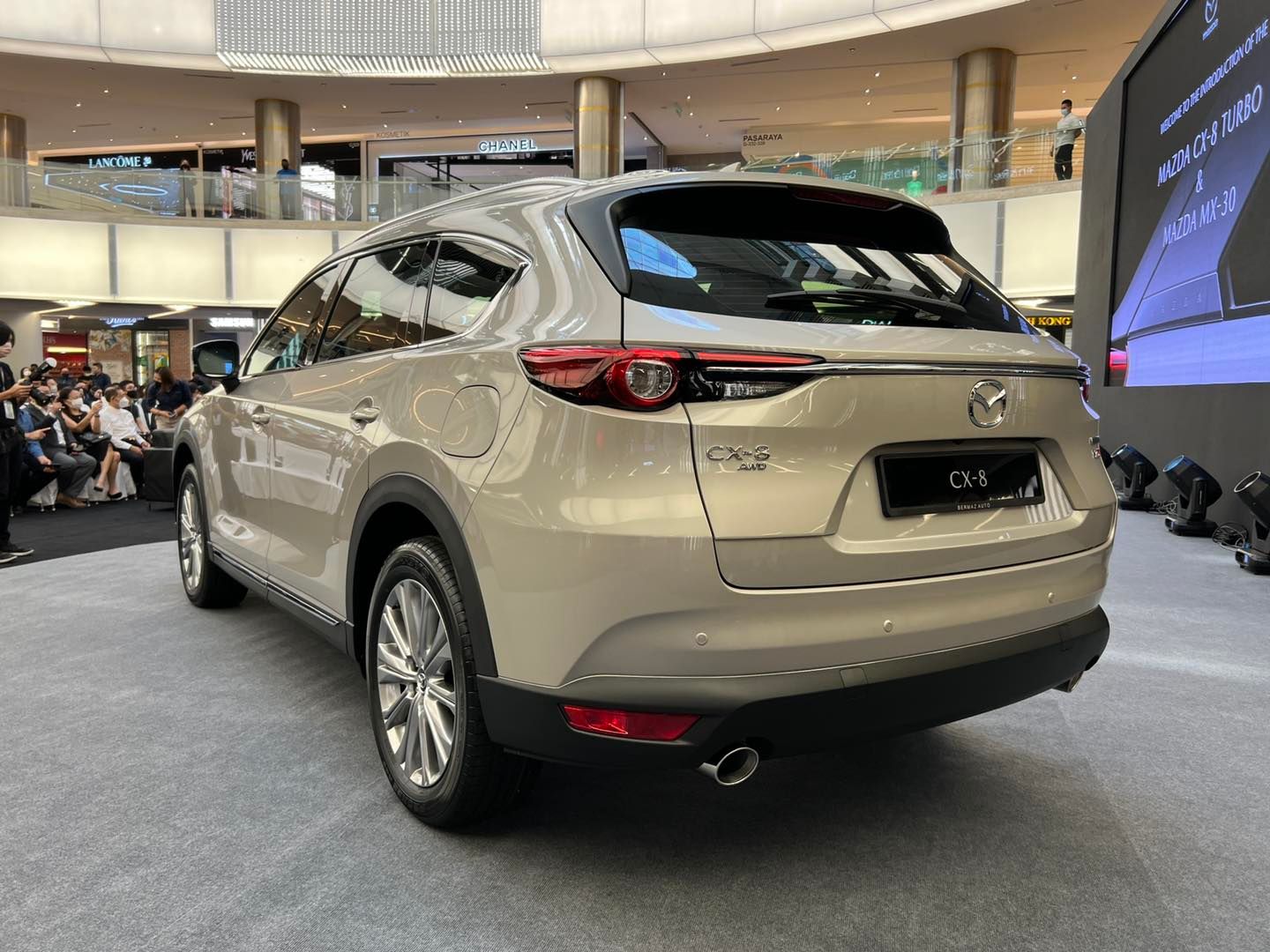
Today, the updated CX-8 made its debut with the usual enhancements that products in the middle of their generation received. The overall design with KODO: Soul of Motion philosophy is retained but the front grille has been revised a bit to present a strong, mature and dignified presence. LED headlamps are also fitted and give a visual signature.

2022 Mazda CX-8

2022 Mazda CX-8

2022 Mazda CX-8

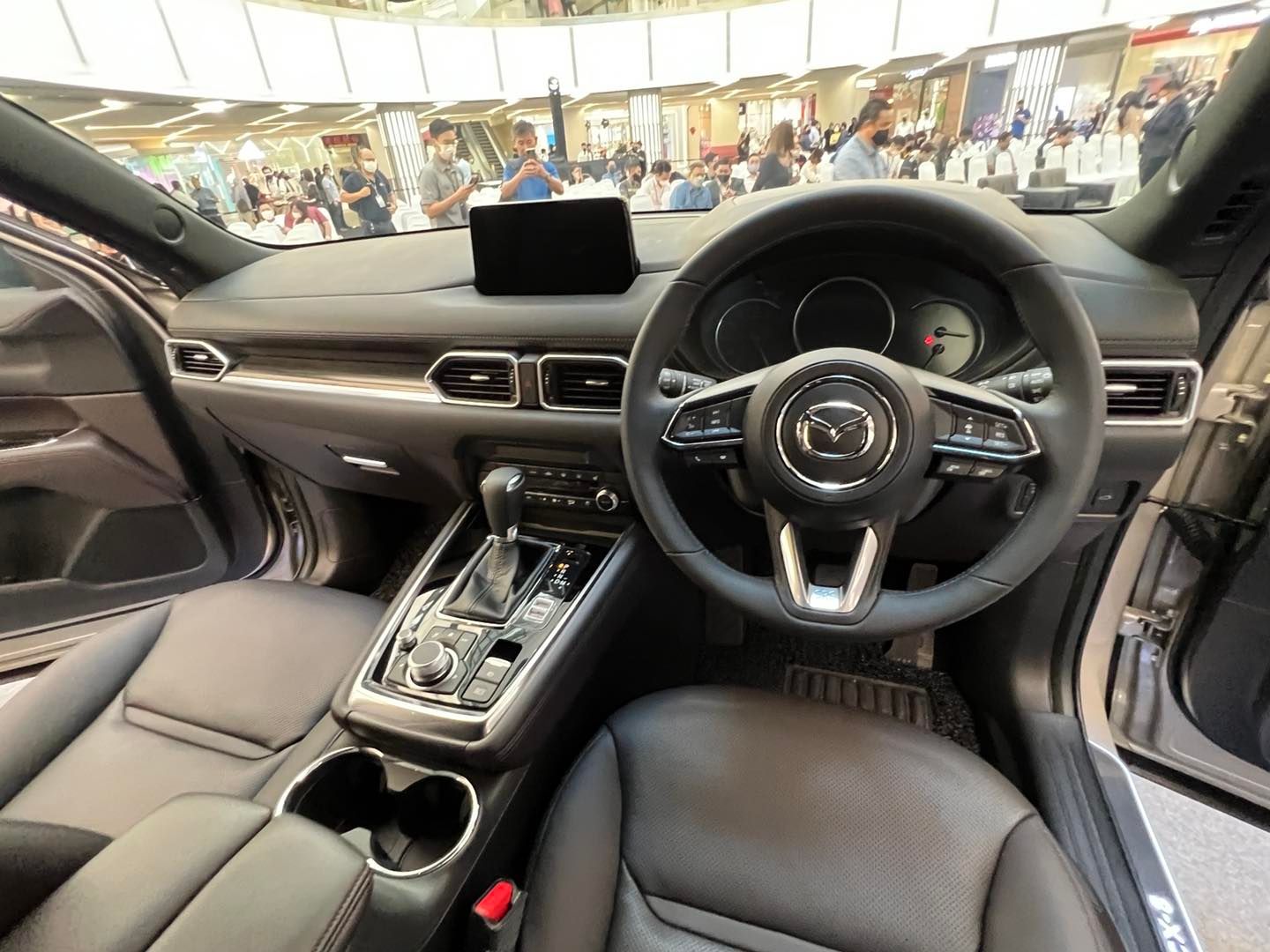
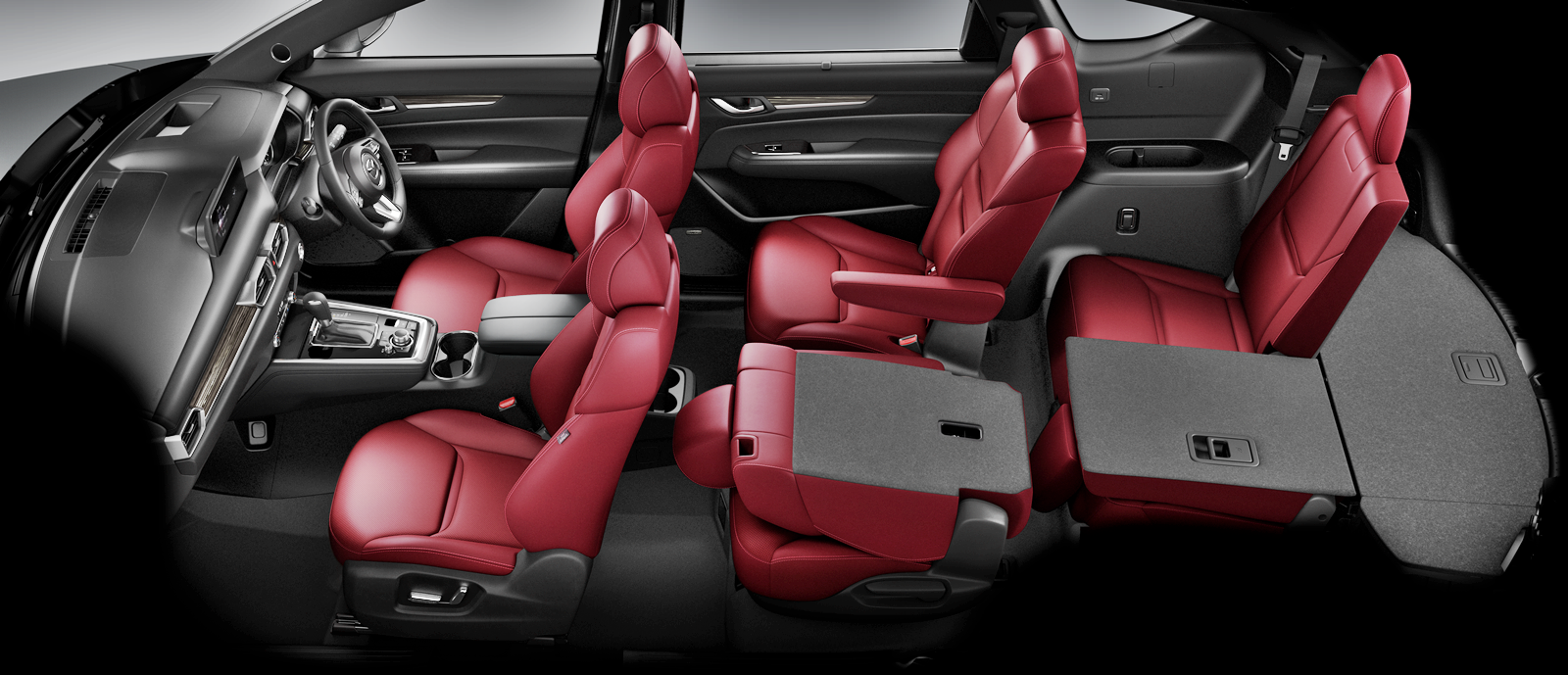
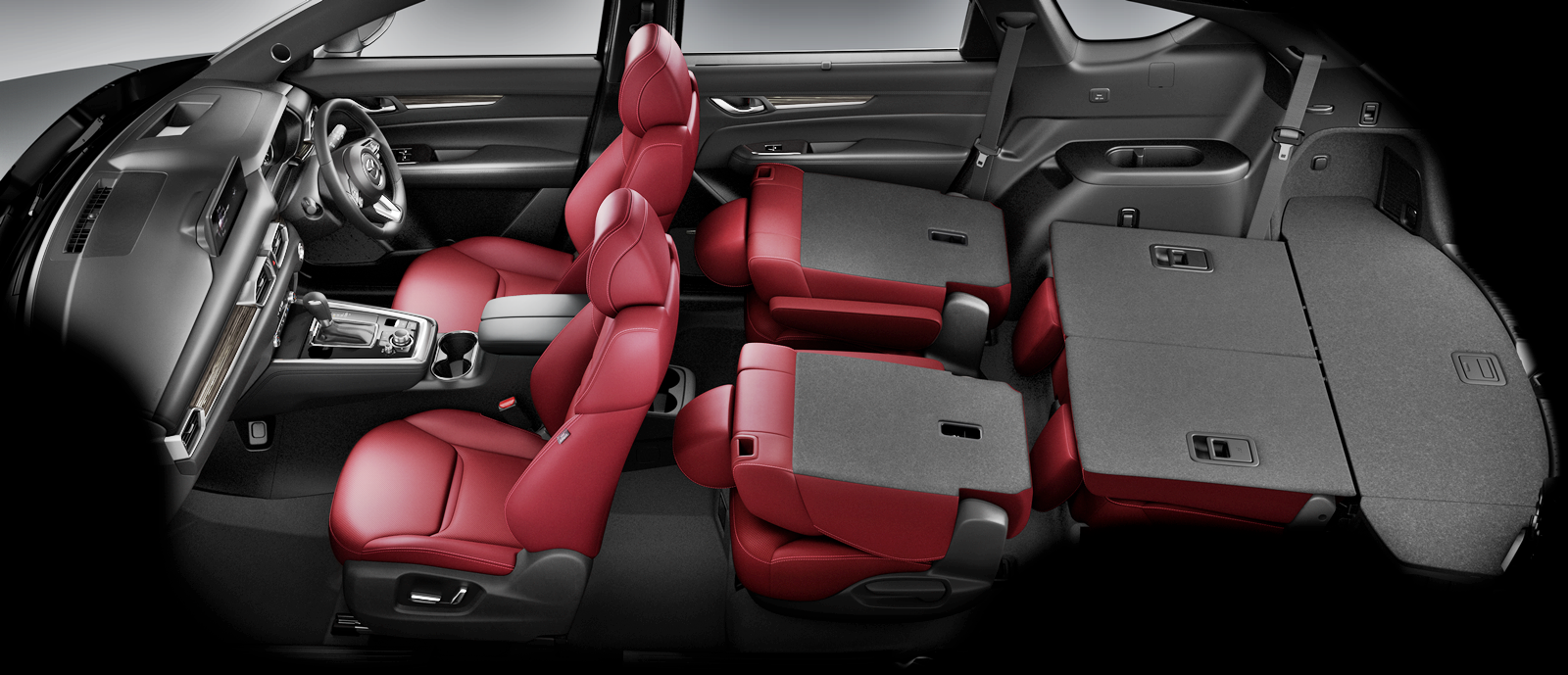
The 3-row cabin retains all the comfort and convenience features with the more premium features now becoming standard. These include the 7-inch instrument panel display, 6-way power seat for front passenger, handsfree power tailgate and auto-folding mirrors, along with additional USB ports for the passengers in the third row. There are also LED interior lamps as well as a wireless charger and wireless Apple Carplay which is accessible through the 8-inch Mazda Connect Infotainment display.

2022 Mazda CX-8

2022 Mazda CX-8

2022 Mazda CX-8

The CX-8 Mid and High variants get updated leather upholstery for the seats in black, while the 2.5L High Plus variants retain the Nappa leather in Deep Red. For added comfort, the front seats have an internal ventilation as well as heating functions.

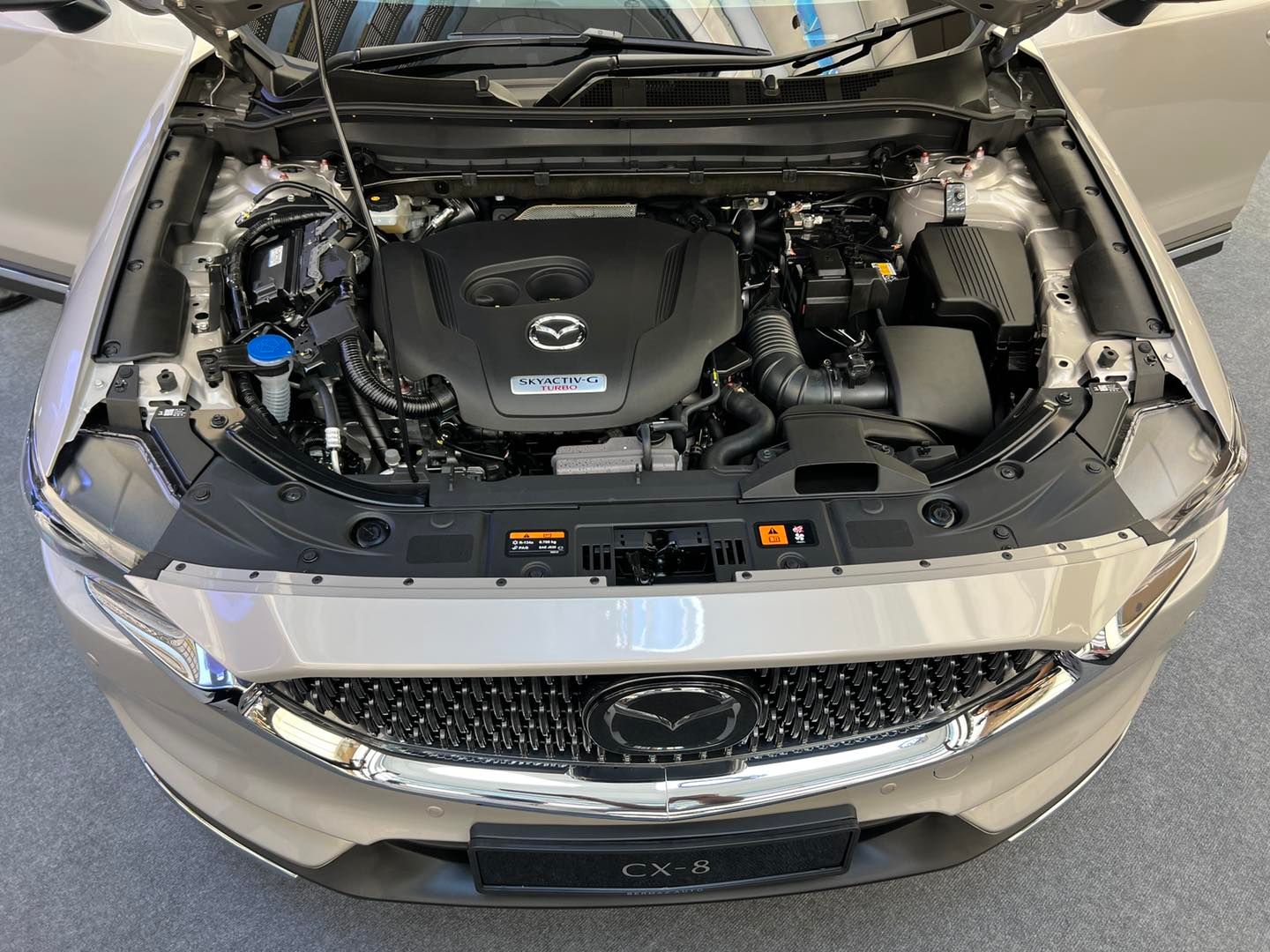
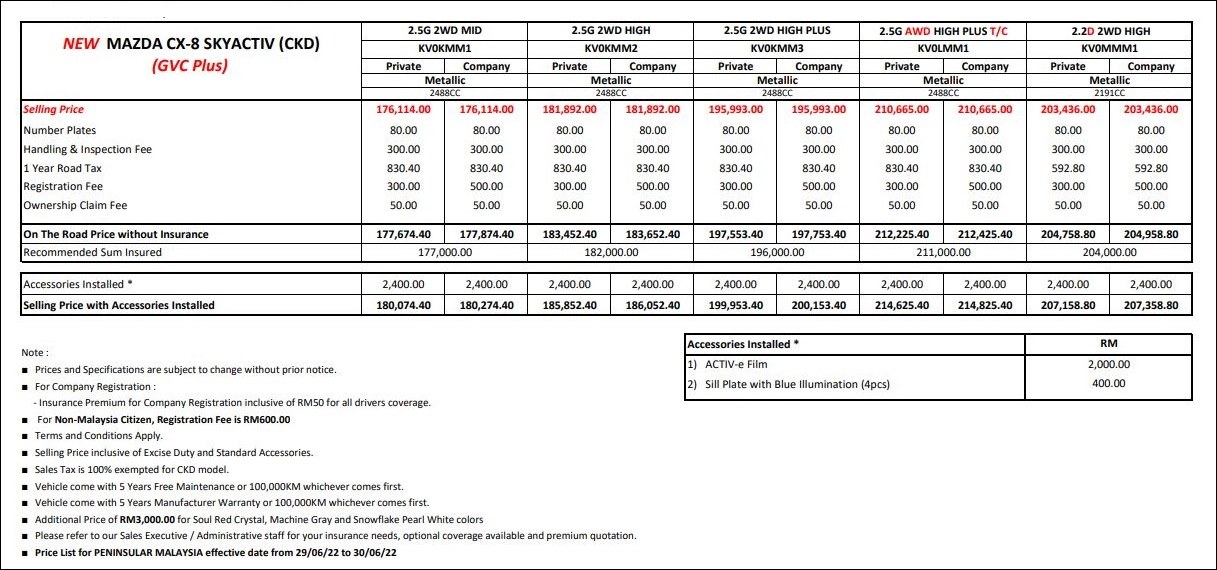
Customers can choose from 5 variants, three of which have the SKYACTIV-G 2.5-litre 4-cylinder petrol engine (192 ps/258 Nm) and one with a 2.2-litre 4-cylinder turbodiesel engine( ps/Nm). A powerful new engine is also offered in one variant and this is the turbocharged version of the SKYACTIV-G 2.5 which produces 228 ps/420 Nm. All variants are paired with the efficient SKYACTIV-DRIVE 6-speed torque converter automatic transmission with manual shift mode.

2022 Mazda CX-8

The drivetrains are front-wheel drive but there is now a new variant with All-Wheel drive (AWD) as well and only this variant has the turbocharged engine. At the same time, the turbodiesel variant which used to have AWD is now 2WD. Mazda’s AWD system is advanced and intelligent to allocate power to specific wheels to improve stability and grip on slippery surfaces. However, all variants of the CX-8 also have G-Vectoring Control Plus (GVC Plus) and this too controls and stabilises vehicle behaviour at high speed when cornering. GVC Plus uses braking force on the outside wheels to counteract undesirable vehicle movement.

Mazda’s i-Activsense integrated safety suite has been updated and drivers can now enjoy safer motoring with the newly added Adaptive Front-lighting System, High Beam Control, front and rear Smart Brake Support, and Mazda Radar Cruise Control with stop/go (meaning the system operates down to standstill).

Colour choices for the 2022 CX-8 are Soul Red Crystal, Machine Gray, Snowflake White Pearl, Deep Crystal Blue, Jet Black and Platinum Quartz and Polymetal Gray, the last two being new additions.

2022 Mazda CX-8

2022 Mazda CX-8

Mazda vehicles distributed by Bermaz Motor come with a 5-year manufacturer warranty or maximum of 100,000 kms after original registration. Additionally, owners get 5 years of free scheduled maintenance (except for the BT-50), inclusive of labour, parts and lubricants. Both Manufacturer Warranty and Free Maintenance have a coverage period of five years and a mileage limit of 100,000km, whichever comes first.

To know more about the new CX-8 range and other Mazda models, or to locate an authorised showroom in Malaysia, visit www.mazda.com.my.

How Bose has been developing premium sound for Mazdas over 30 years

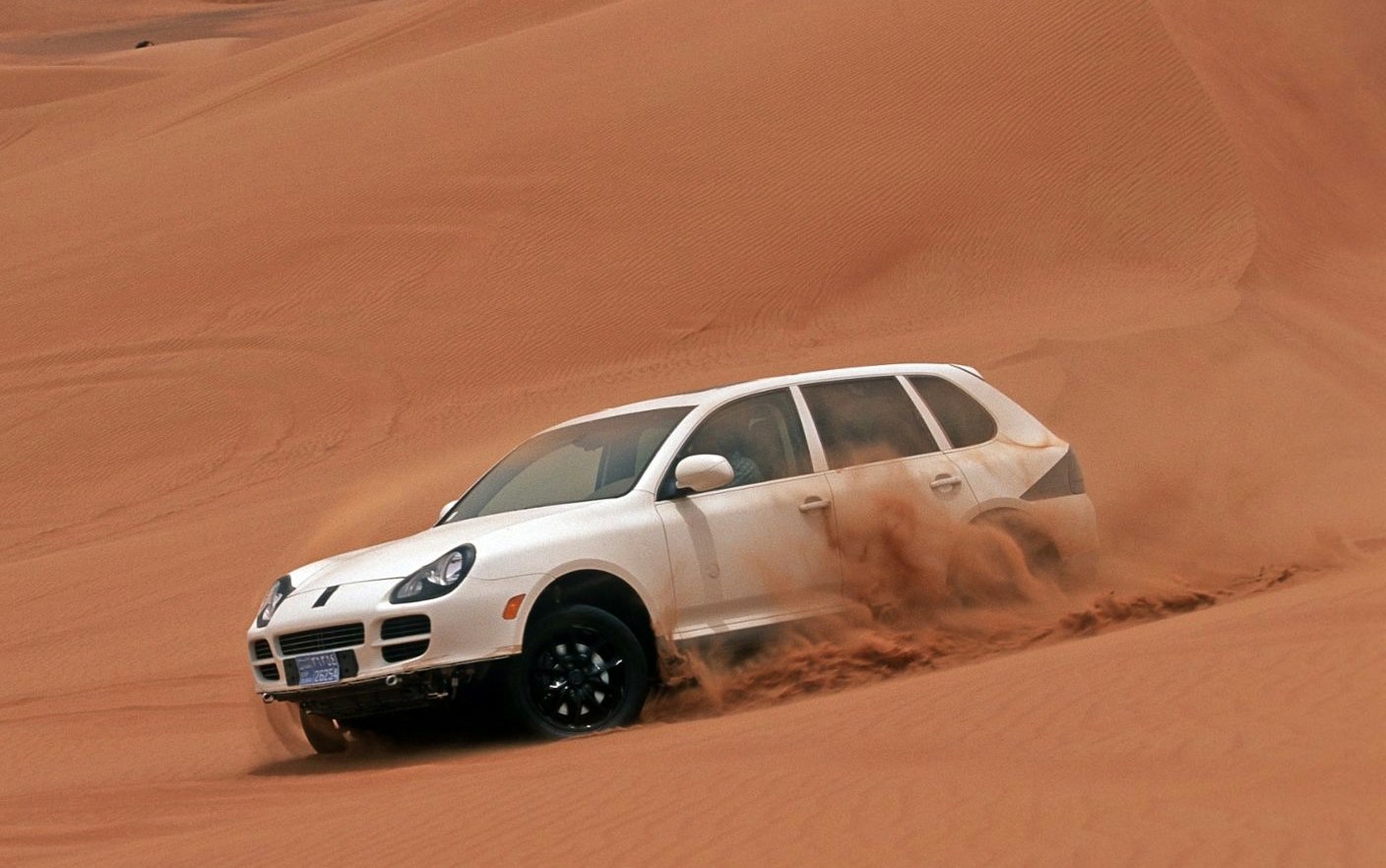
Ferry Porsche predicted it back in 1989: “If we build an off-road model according to our standards of quality – and it has a Porsche crest on the front – people will buy it.” He would go on to be proved right. Since 2002, the Cayenne has been one of the top selling models of the carmaker, a success globally and now, it is even being assembled in Malaysia.

The decision to develop a SUV after decades of making sportcars was influenced by the recommendation of the sales organisation in the USA – Porsche’s largest market at the time. While a people-carrier had been under consideration, the company opted for an off-road vehicle as it was increasing in popularity in North America. BMW and Mercedes-Benz had even set up new factories there to build their first SUVs in the second half of the 1990s.

A new type of Porsche that was not a sportscar joined the carmaker’s range in 2002.

Crucial decision for Porsche
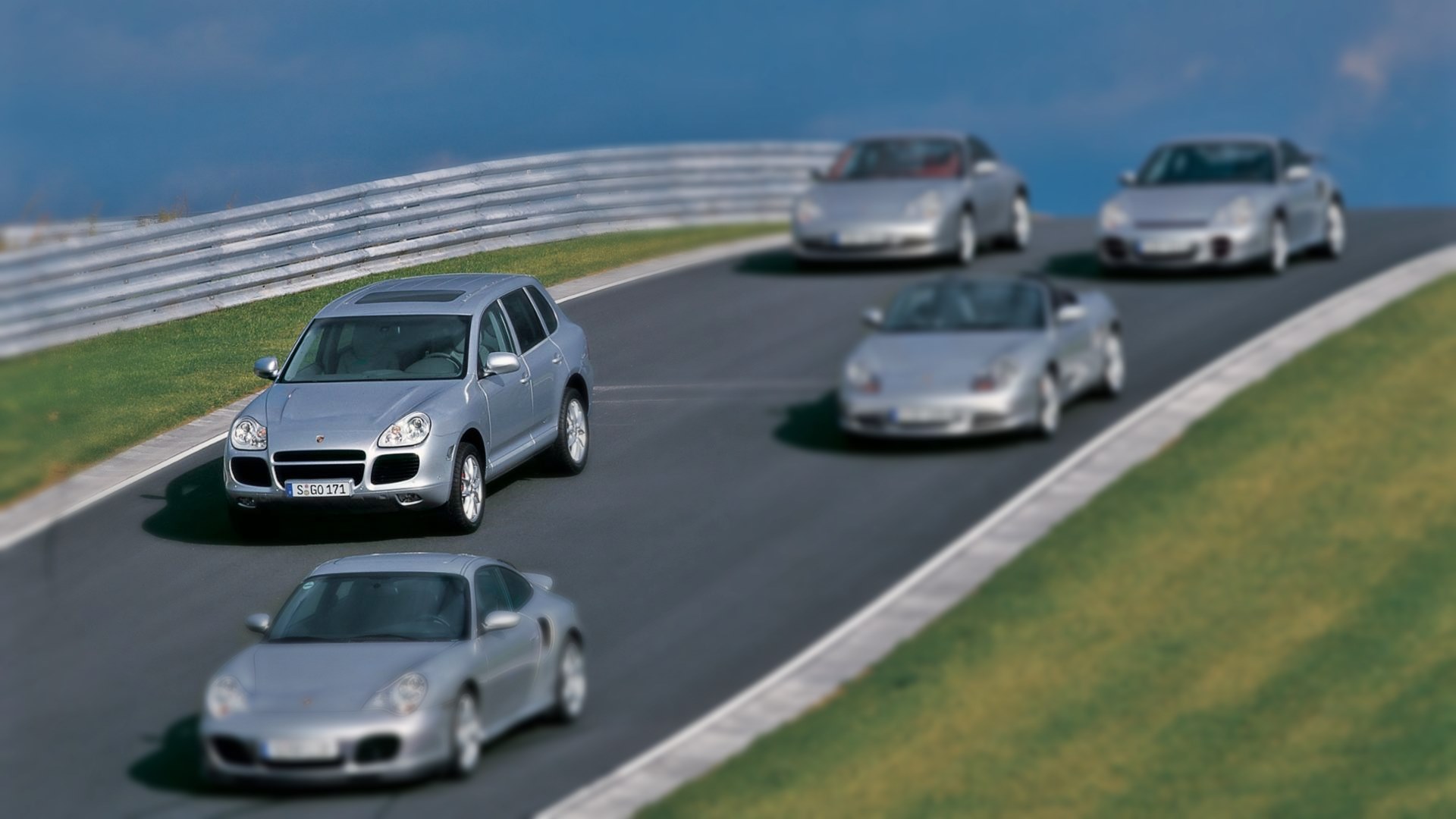
The decision was a crucial one because, at the beginning of the decade, the company found itself in one of the most significant economic crises in its history. It was in the red and delivered only 23,060 cars in the 1991/92 financial year. While the Boxster (launched in 1996) helped Porsche out of its downturn, it was clear that the legendary 911 and the new mid-engined model would not be enough to ensure a secure future. A ‘third Porsche’ was therefore necessary and this would eventually be a SUV.

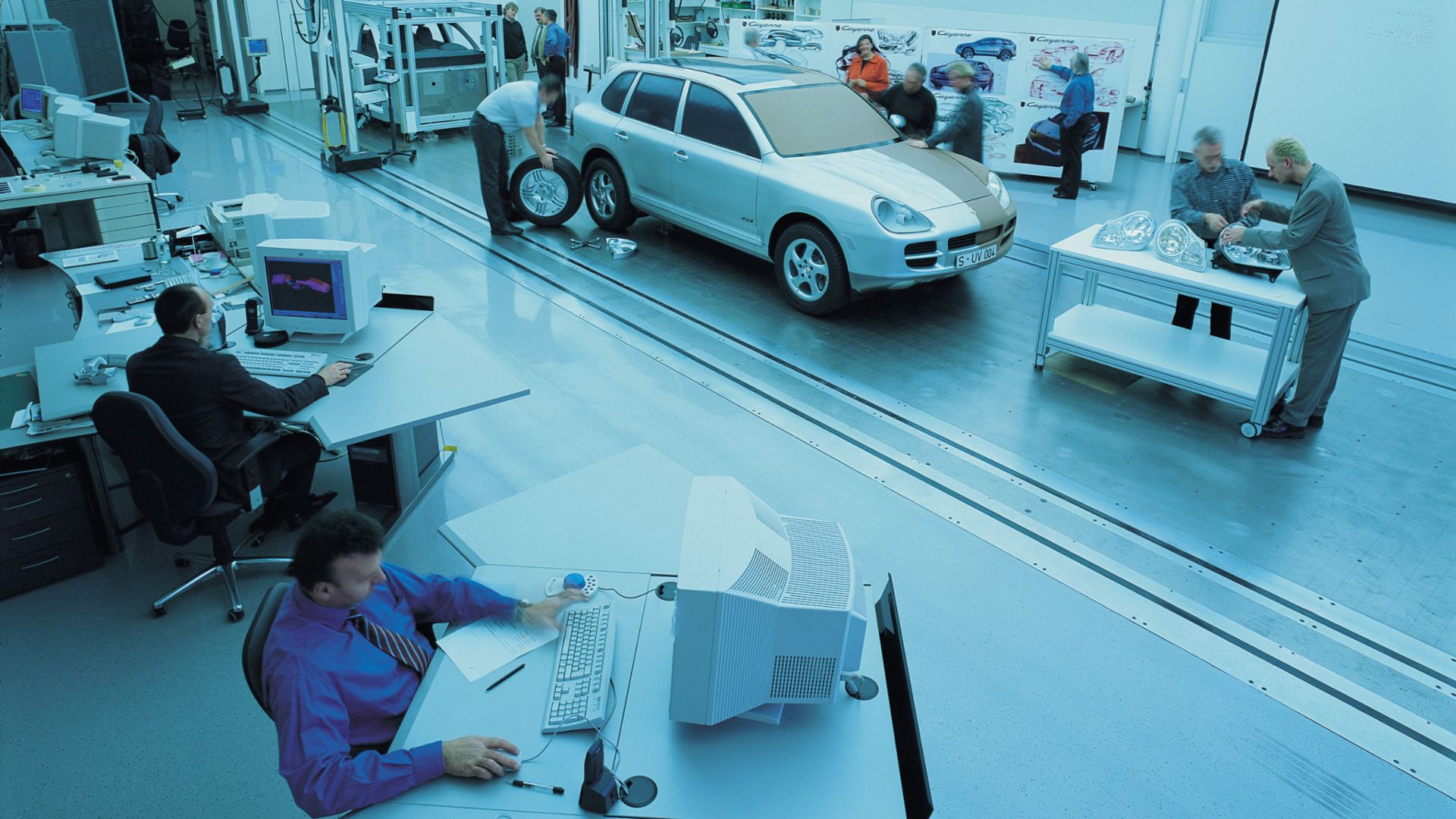
This saw the start of the Colorado project, a massive undertaking tackled as part of a joint project with Volkswagen and announced in June 1998. However, Porsche was not content merely to build just another SUV but aimed to give the top competitors in the off-road segment a strong rival. In fact, in early advertising, it even suggested that the Cayenne not be considered just ‘another SUV’ but rather, another Porsche.

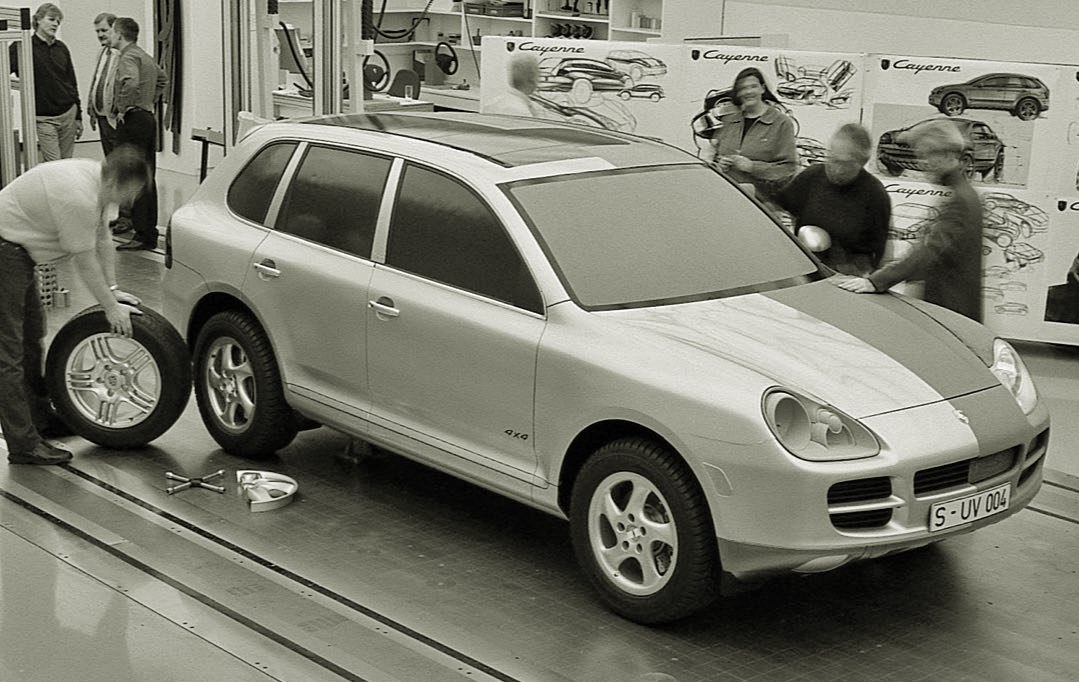
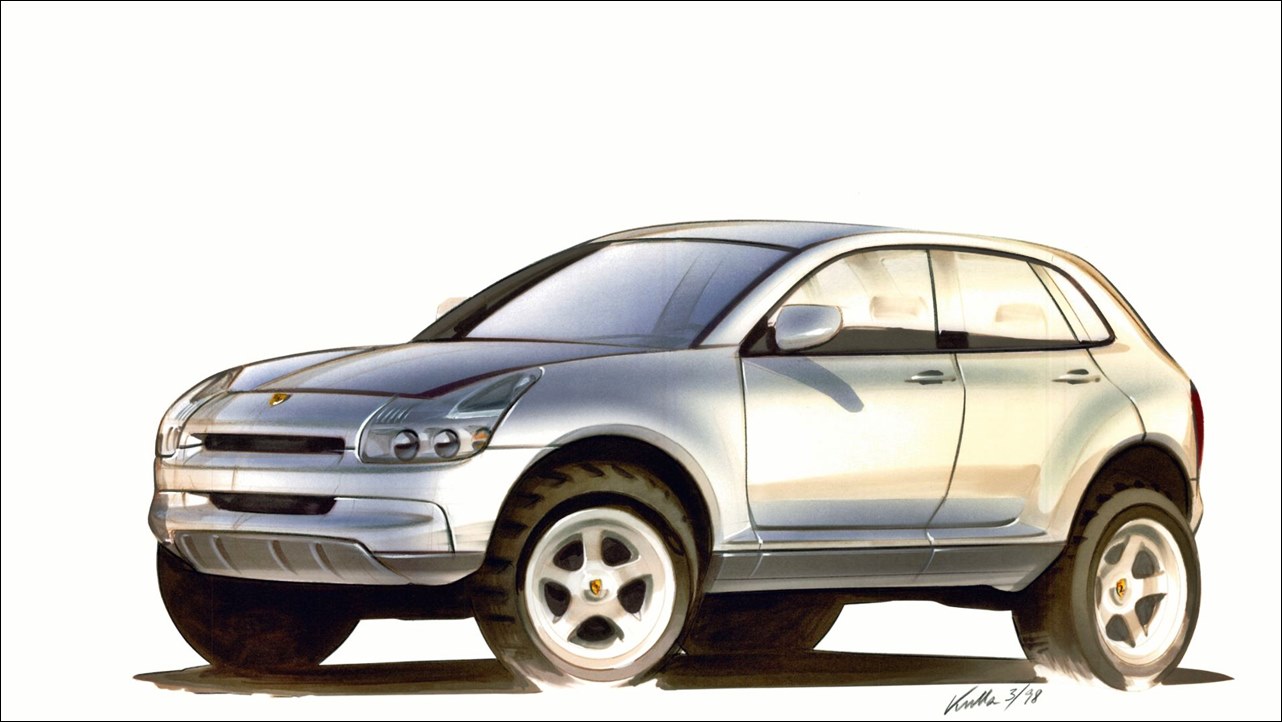
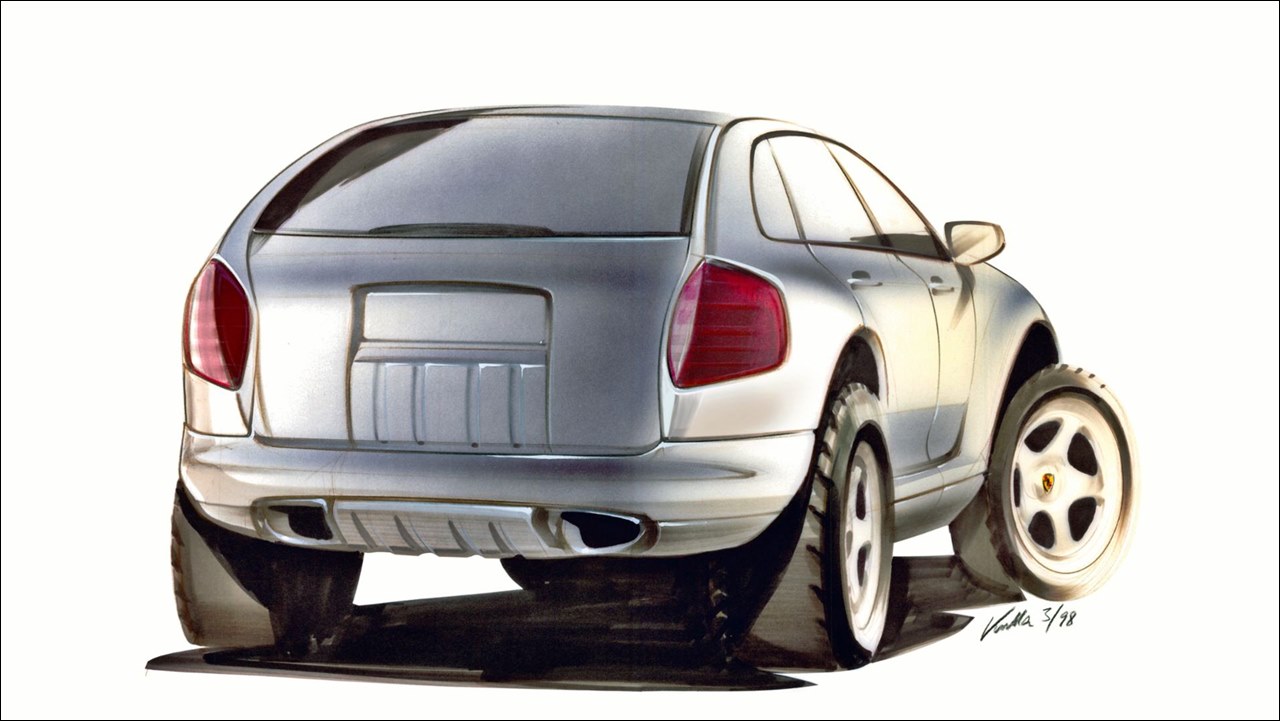
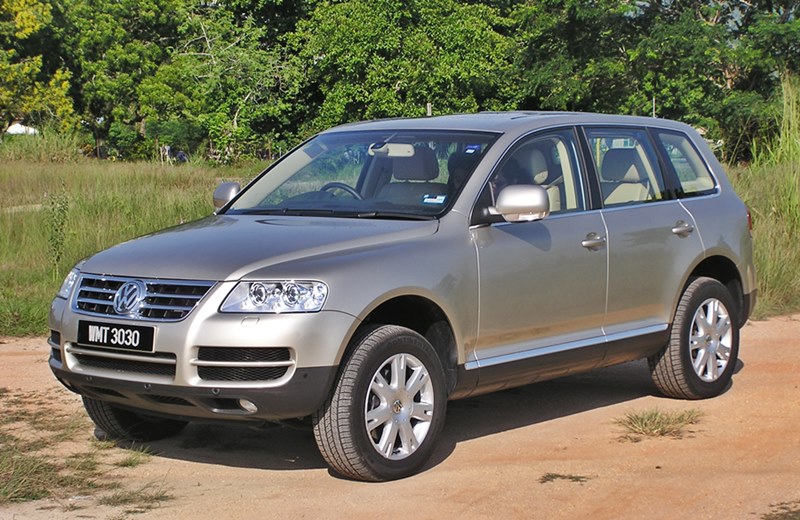
First design sketches of the Cayenne in the late 1990s. The model was developed as a joint project with Volkswagen which called its SUV the Touareg (below).

Like BMW with its X5, Porsche could not offer a product that did not also have the brand’s DNA of superior driving dynamics. Thought the platform was shared with the Volkswagen Touareg, each company initially used their own engines and developed their own chassis set-ups. Porsche was responsible for developing the joint platform, while Volkswagen contributed its production expertise for large volumes.

A very different type of Porsche
It was the first time in Porsche’s history that, instead of a sportscar, a blueprint for an SUV was required. This was, in a way, the exact opposite of a sportscar layout – a big, high-roofed car with 4  doors and room for 5 people and their luggage. Additionally, the Cayenne needed much greater ground clearance than a classic sportscar, as it was expected to count among the best when driving off-road as well.

“Of course, it wasn’t at all easy to express the identity of the Porsche brand in a car that had absolutely nothing in common with the existing models made by our company,” said Harm Lagaay, head of the design department. The designer spent a whole year on the headlights alone. It wasn’t just that they had to incorporate the low and high beams and the cornering light while preserving the clear lines of the Cayenne body – these were among the components that guaranteed the brand identity.

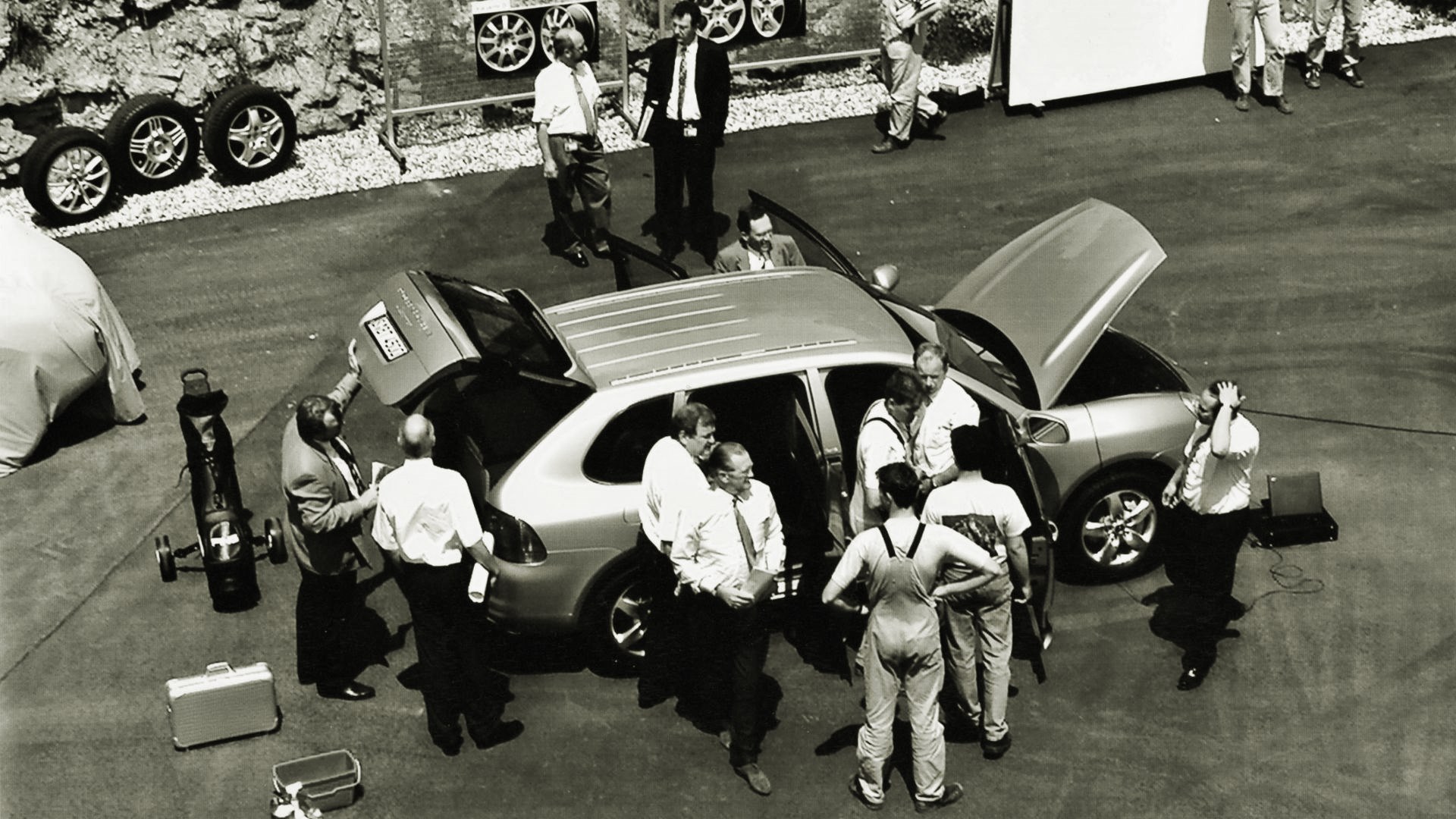
Porsche board members looking over a Cayenne prototype in 2001.

Even today, the face of the 996-generation 911 can be seen in the face of the first Cayenne. This impression was reinforced by what is referred to as the topography of the front section. The highest point of the wings and the headlights is above that of the bonnet. This is a distinguishing feature for a Porsche, because these contours are a clear visual reference to the design of the iconic 911. However, it was significantly more difficult to incorporate this specific element in the Cayenne, which would have a big V8 engine under the bonnet.

The Porsche product became a brand
Another feature of the 911-style bonnet is its noticeable taper towards the front. The designers also wanted to adopt this for the Cayenne, but the engineers initially suggested a square engine bonnet. This would make it easier to access the air filter and the headlights. The designers prevailed on this point, but they also worked with the car’s engineering team on areas that were not visible. For example, they worked together to find an optimised arrangement of the air filter.

Michael Mauer, who took over Lagaay’s position later, was also pleased that Porsche was willing to invest so much in design and construction. “For me, the Cayenne is about a fundamental question. No matter which type of vehicle concept would have been used to enhance the 911 and Boxster sportscar lines, the step to the third Porsche made a brand out of the product. And the design gave the car, the proportions of which take it as far away from the sportscar as it is possible to go, a Porsche identity that transcends the brand name,” he explained.

This remains evident today in the distinctive shoulder at the back of the original Cayenne – in which Ferdinand Alexander Porsche played a significant design role – as well as the smooth surfaces of the body and the omission of a traditional radiator grille between the headlights.

These classic Porsche characteristics also reduced the significance of the comparatively large air intakes in the front apron. A front-mounted engine requires air for combustion and cooling. And Porsche customers were already used to front air intakes from the sportscars. In this case, though, they are responsible for cooling the brakes.

The biggest design challenge
Mauer remembers the side profile of the car as the most difficult design challenge. The Cayenne was created together with the Volkswagen model, which is why the windscreens and all 4 doors of the two SUVs are identical. “It’s easy to underestimate how much the doors define the side of a car. Behind the rear door, we’ve got maybe another metre, and only a little more at the front, so there is not a lot of room to do very much,” said Mauer, who first worked on the Porsche SUV for the first generation facelift which appeared in 2007.

“With the facelift, we gave the whole car more visual sharpness and definition,” he recalled. However, the door issue was still there, along with the difficulty of designing a fastback-style rear – one that would taper diagonally to the rear like a sportscar. At Porsche, this is known as the ‘flyline’.

However, if the doors cannot be changed to prevent the roofline from dropping, there is little space left at the rear to create a flyline that the customer recognises as a characteristic feature. The options that remained to solve this were a more sloping design of the rigid side windows behind the rear doors, and the addition of a spoiler to extend the roof line.

Compromises within
Overall, even from today’s perspective, the first Cayenne with its formal clarity and emphasis on characteristic Porsche elements was a worthy and consistent member of the model range. The interior was, however, strongly influenced by Volkswagen.

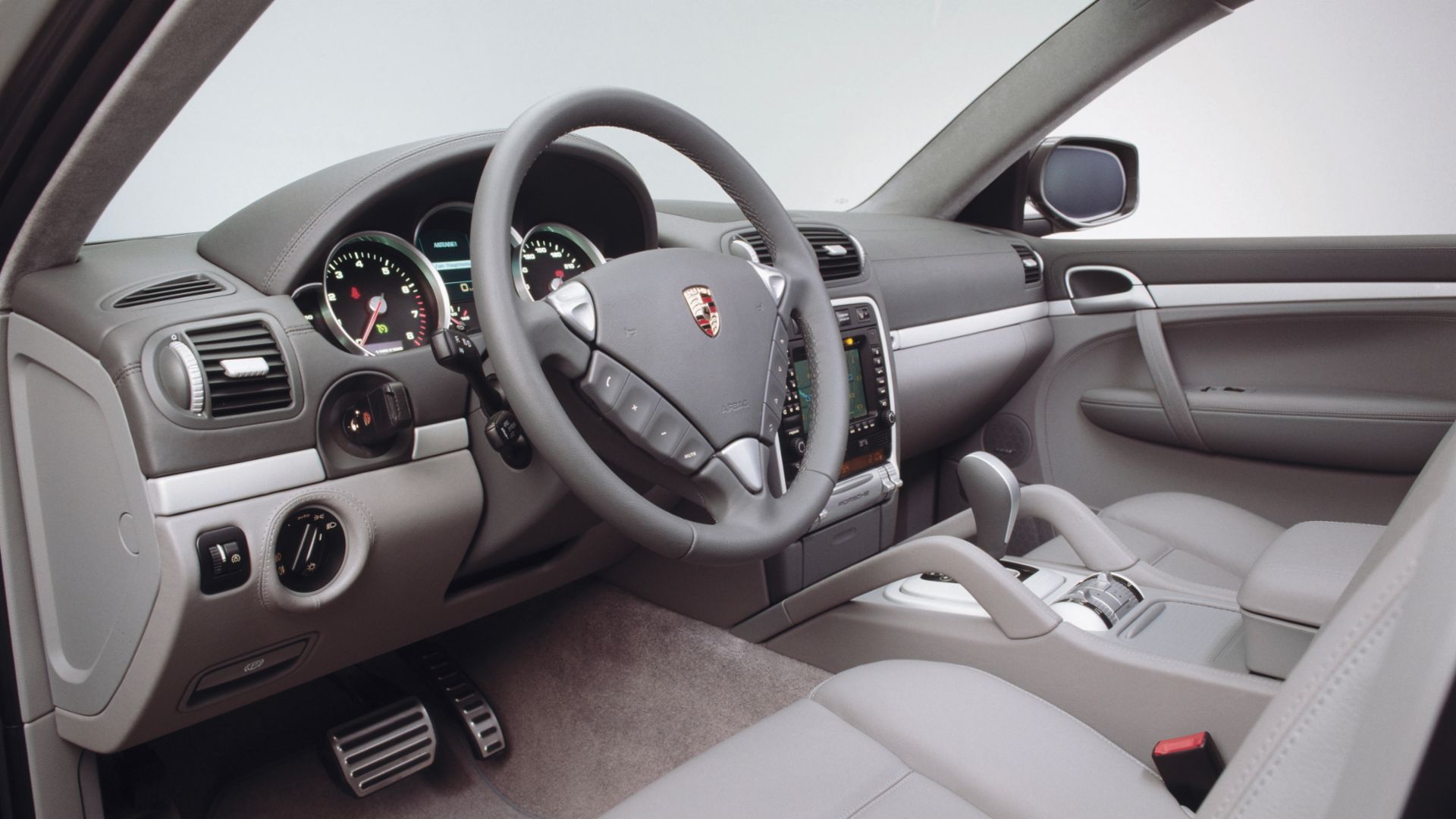
“The interior can hardly deny its kinship with the Touareg,” said Markus Auerbach, Head of Interior Design Style at Porsche. This is where Porsche had to make compromises; one example was on the brand’s customary 5-tube design for the instrument cluster. While five interlinked rings can be seen in front of the steering wheel, the tachometer is not positioned in the middle as is usual for Porsche, but on the left.

To obtain the usual Porsche arrangement, developing a new instrument cluster would have been necessary – an unplanned investment for the first Cayenne. However, Porsche was still able to include a number of characteristic elements: its own 3-spoke steering wheel, hand-grips on the centre console, and the ignition lock that can be found in the same place as in every Porsche – to the left of the steering wheel.

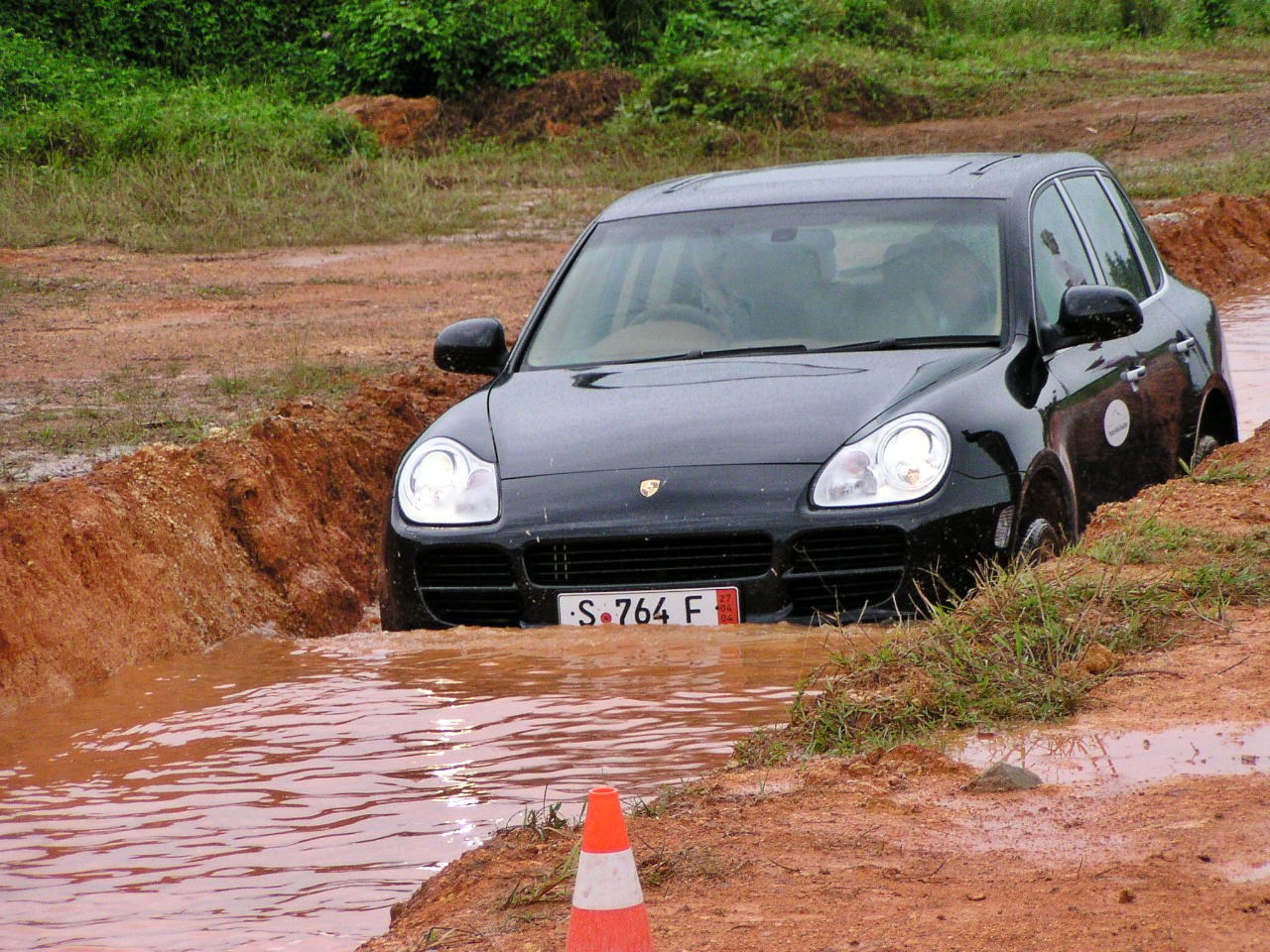
After its launch, the Cayenne was shown worldwide and in places like Malaysia, its off-road capabilities were convincingly demonstrated as this picture shows. The rough and muddy course near the Sepang Circuit was used during the Porsche Roadshow in 2003.
An early advertisement introducing Porsche’s new SUV in America.

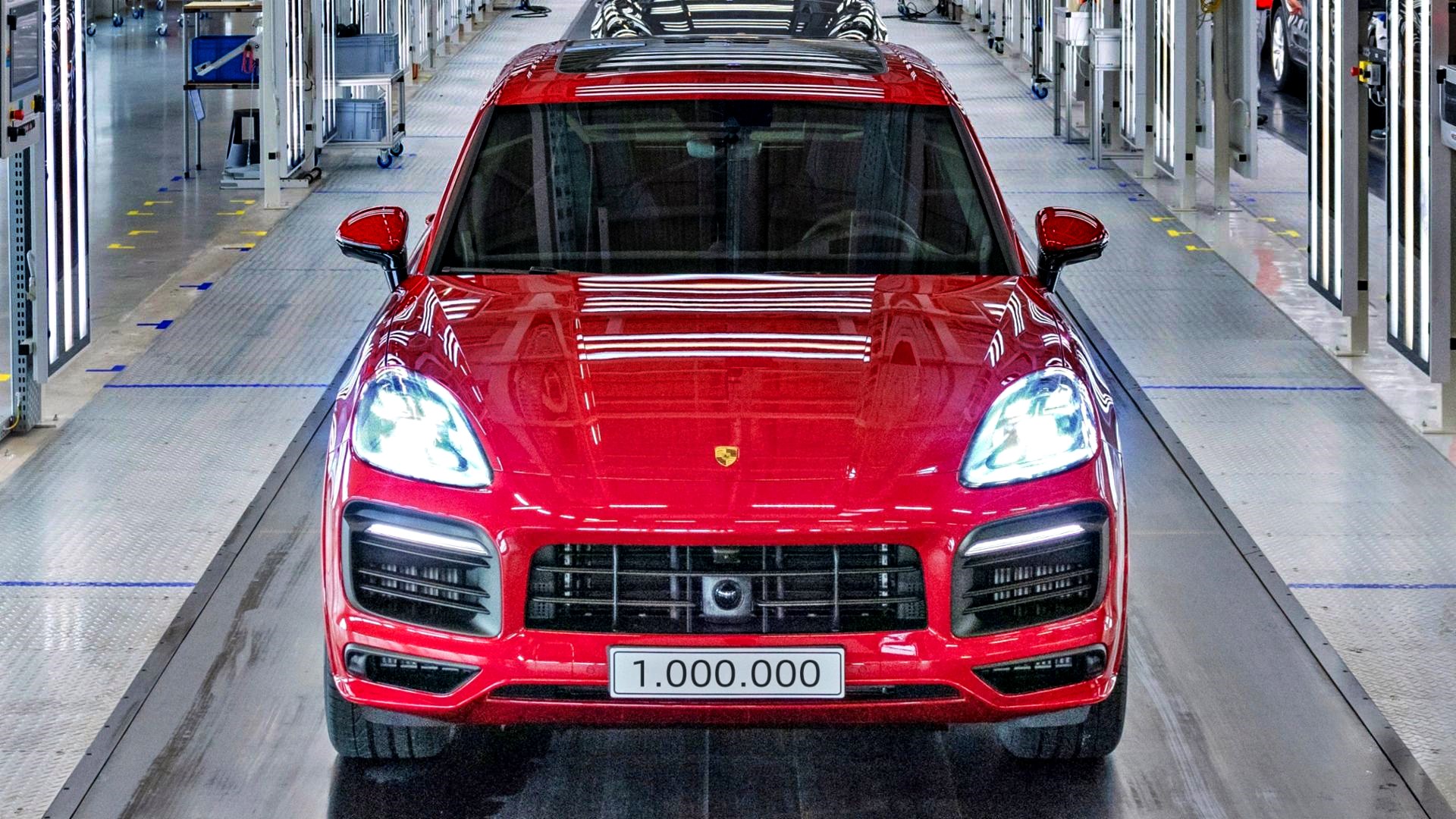
Shortly after its world premiere at the Paris Motor Show in September 2002, the Cayenne became a worldwide success, exceeding sales expectations. Originally, Porsche expected to sell 25,000 units a  year but in the 8 model years of the first generation, 276,652 SUVs were sold – just under 35,000 vehicles per year. By 2020, the one-millionth Cayenne left the factory. In 2021, just over 83,000 units were delivered worldwide, with the US market alone taking around 21,000 units.

Porsche begins vehicle assembly in Malaysia, the first time outside Germany

The F-PACE, Jaguar’s first SUV, has been in the global market since 2016 and over the past 6 years, it has been selling well and even winning the overall World Car of the Year award in 2017. It appeared in Malaysia in 2018 and like many SUVs in the premium luxury segment, it has not had a shortage of buyers.

With its success, it’s clear that the F-PACE ticks all the right boxes for customers and has been a well designed and engineered product from the outset. But it has been 6 years and in an industry where someone is introducing something new every month, periodic refreshing of the looks and enhancing the features list is necessary to keep the model fresh.

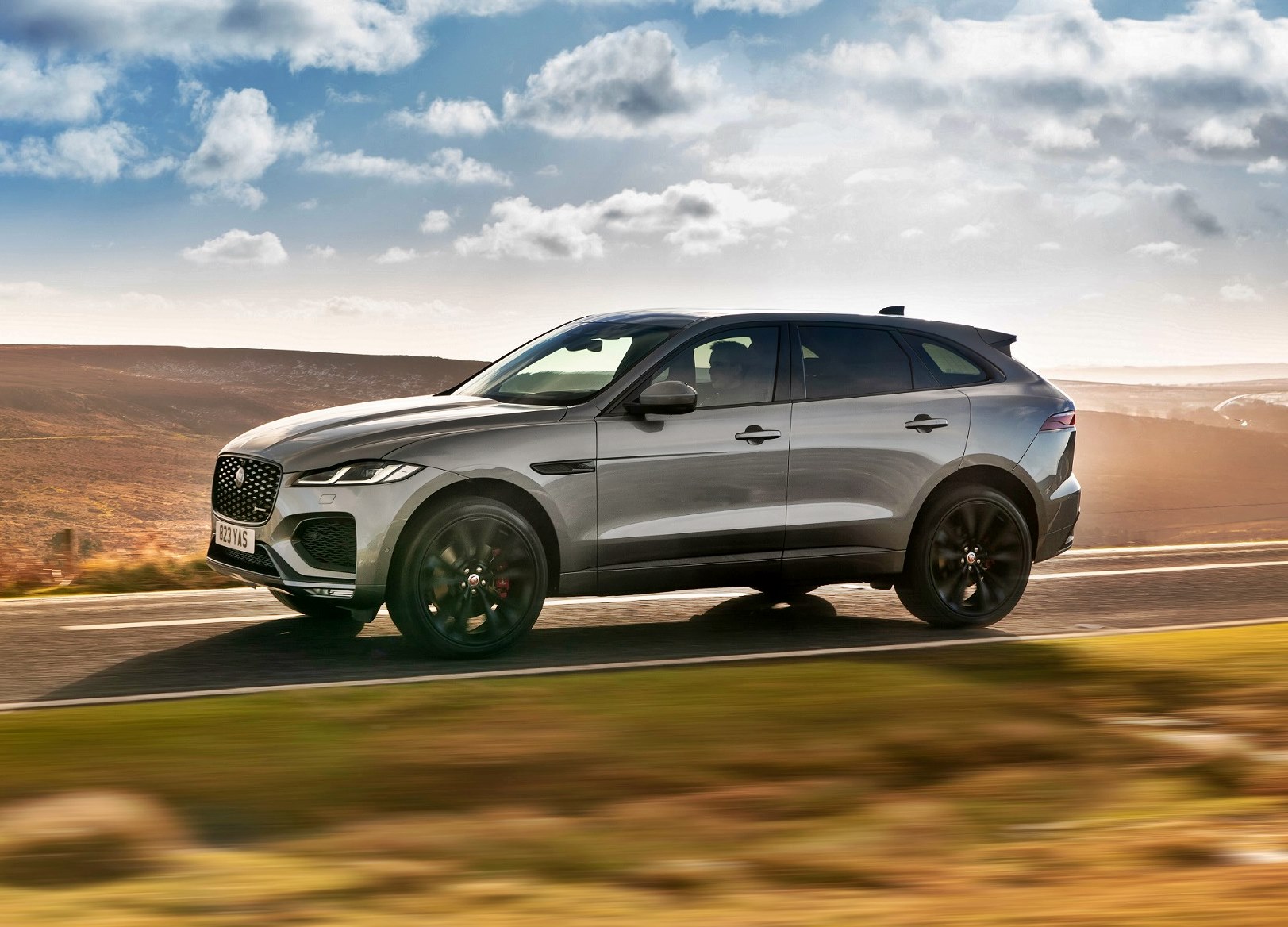
Jaguar Land Rover Malaysia (JLRM) has now begun selling the 2022 model of the F-PACE which has some cosmetic changes on the outside and updated features within. While the overall form and profile are unchanged, the sculpted bonnet has a wider power bulge for a stronger presence.

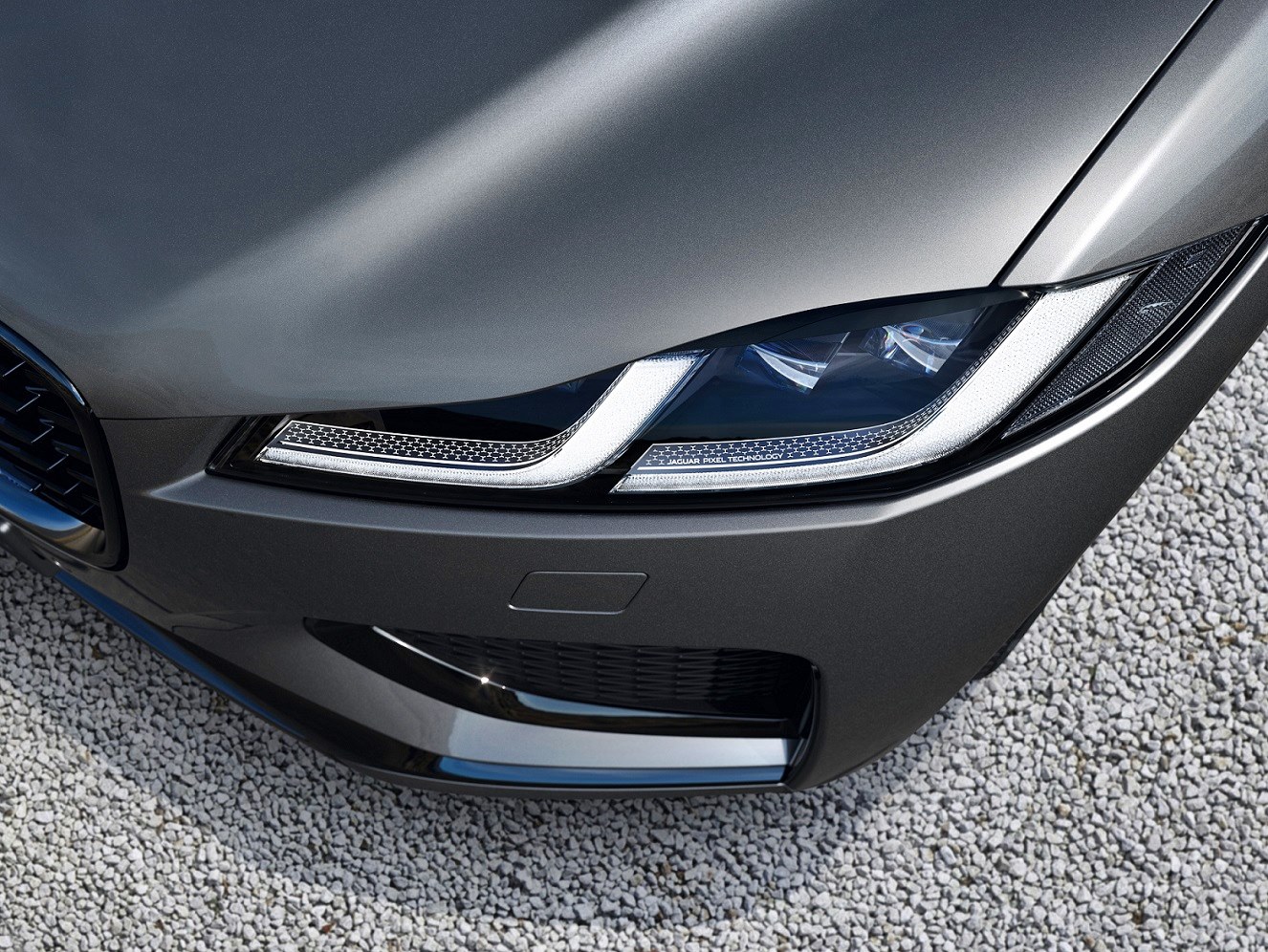
The lighting units are new and super-slim (10 mm slimmer) all-LED quad headlights that give stronger illumination. At the same time, they also create greater visual width. The lights have a ‘Double J’ signature graphic formed with the Daytime Running Lights to identify the F-PACE from a distance.

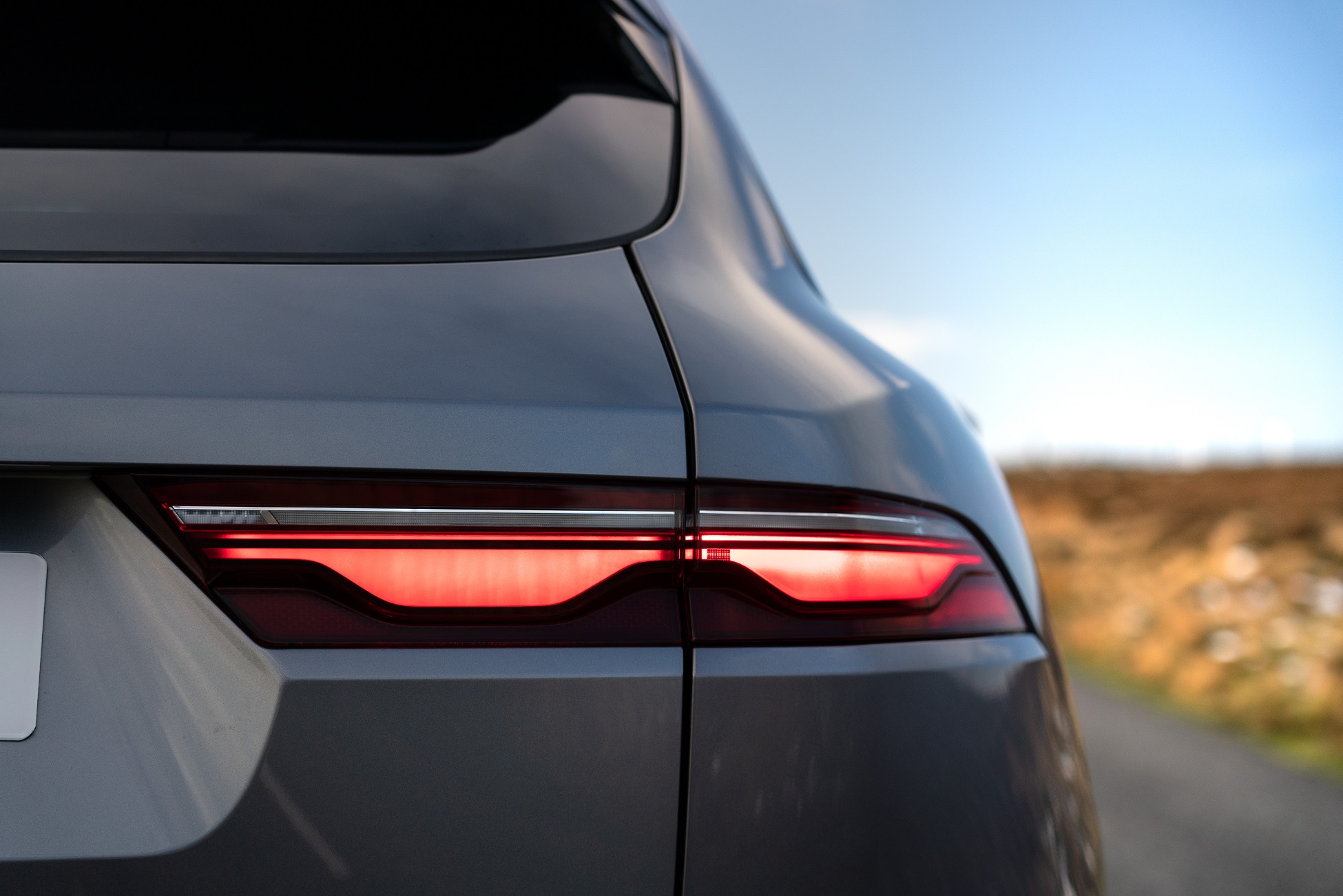
At the rear, the new tailgate accentuates the visual width of the vehicle and below it is a redesigned lower bumper. The new fully LED rear lights with sculpted lenses are inspired by the fully electric I-PACE and feature Jaguar’s chicane graphic.

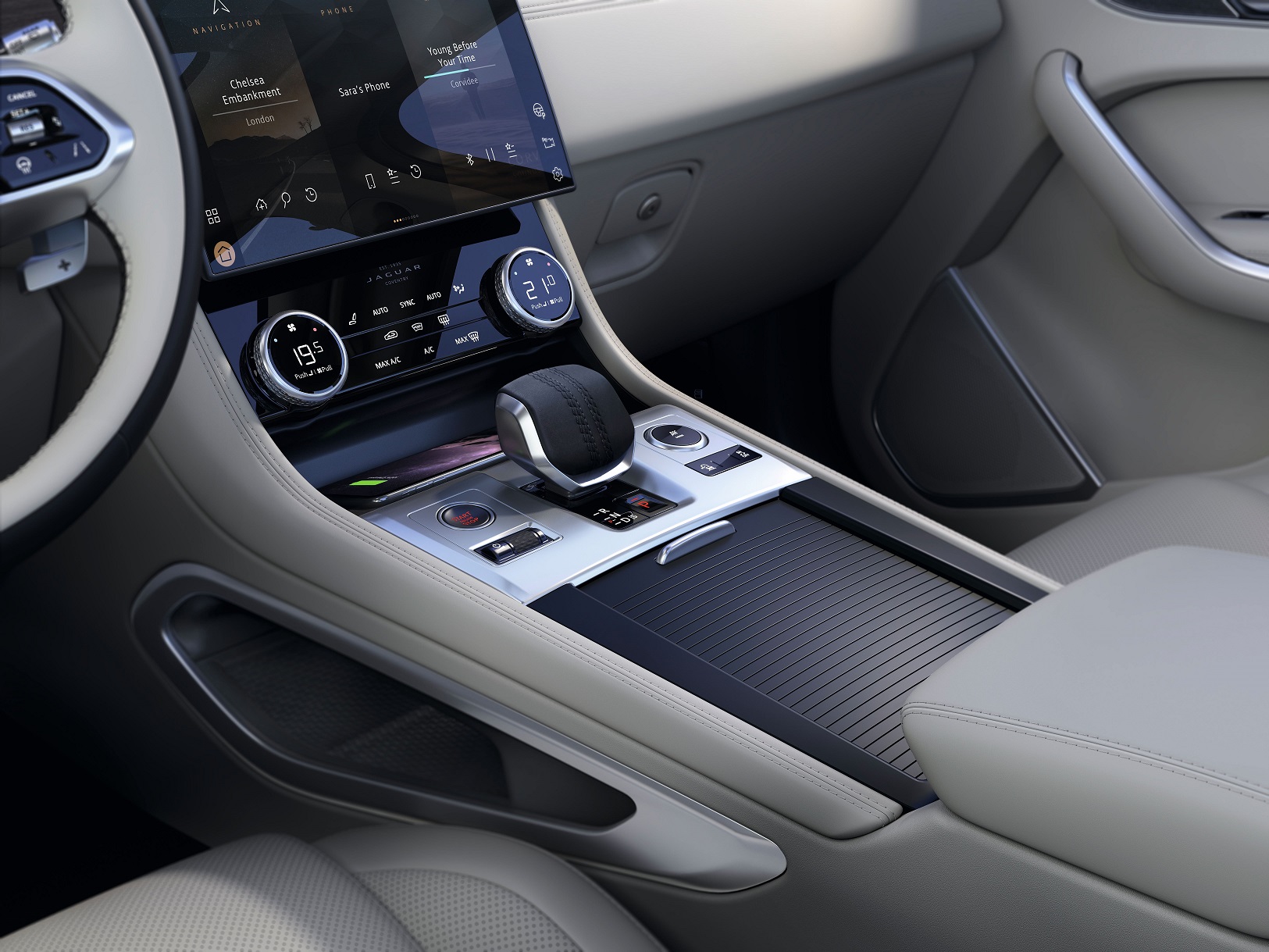
The cabin of the F-PACE has an elegant ambience merged with elements of engineering ingenuity. The revised cockpit area has a bolder, more dynamic look with greater focus on the driver. The new Drive Selector epitomises Jaguar’s approach to contemporary controls. The soft upper trim wraps round the ‘palm grip’ and proudly features a ‘cricket-ball’ stitch, inspired by iconic British craftsmanship. Below, the precision-engineered metal cradle is sculpted for added tactility and an engaging quality feel.

The centrally mounted 11.4-inch curved-glass HD touchscreen is the control centre for the new Pivo Pro infotainment system. Besides more intuitive operations, it also provides greater clarity for ease of viewing in any lighting conditions. Its simplified menu structure (mimicking a smartphone interface) allows the driver to carry out 90% of common tasks within two taps from the home screen. This reduces the time spent looking towards the display panel, which is safer when driving.

The Pivo Pro system can also connect to compatible smartphones using Apple CarPlay or Android Auto which can put favourite apps like Waze or Spotify on the display panel, and they can be operated from the touchscreen. The wireless approach extends to charging too as there is a charging pad available.

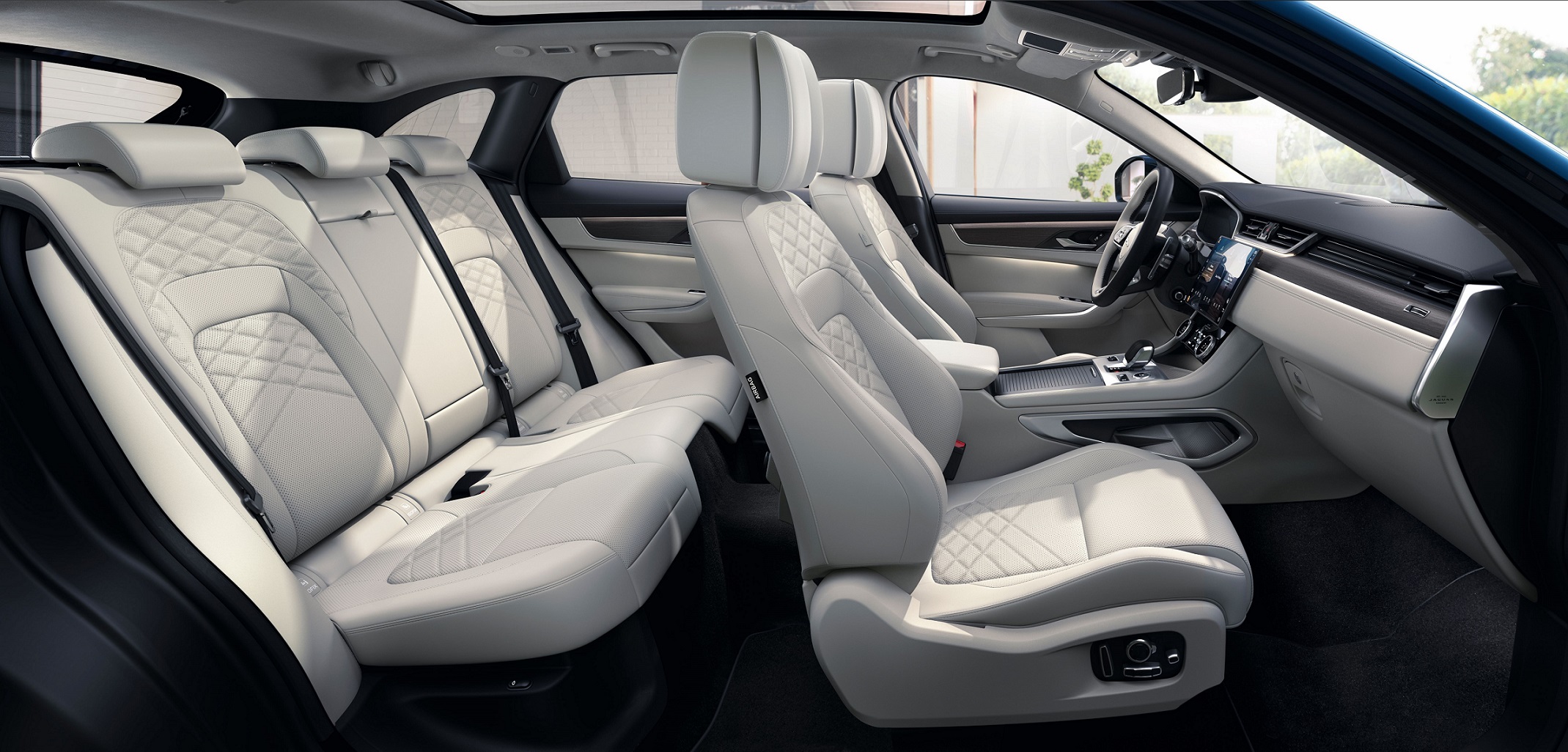
Though the cabin size is unchanged, there is a feeling of extra spaciousness with softer forms and dramatic contrasting use of colour at eye-level. One trick used by the interior designers: light-coloured finishes on lower sections of the cabin which immerse the interior in one tone, visually enhancing the sense of space.

The 5-seater cabin has exquisitely crafted leather upholstery with the rear seats having a 40:20:40 division so that there is flexibility to carry extra cargo or people. With the seats folded, there’s a long floor all the way to the back seats, ideal for bringing home furniture packs from IKEA.

“By offering modern luxury with this latest evolution of the award-winning F-PACE, we are raising the bar even further with this best-in-class SUV, which combines practicality, performance and comfort with a distinctive look and cutting-edge technologies. Everything in the design and the specifications, from the sleeker silhouette and all-new Drive Selector to the spacious and luxe interior equipped with an intuitive infotainment system, are all geared towards ensuring an enriched driving experience,” said Syed Ahmad Muzri Syed Faiz, Managing Director of Jaguar Land Rover Malaysia.

“Tapping into the positive growth prospects for the luxury car segment as well as  the SUV segment in Malaysia, the Jaguar F-PACE bridges both worlds as a globally renowned premium SUV. This is part of Sime Darby Motor's continuous expansion of our range of vehicles through new and exciting models,” added Jeffrey Gan, Managing Director, Retail and Distribution of Sime Darby Motors Malaysia.

Priced from RM598,800 (inclusive of sales tax but without roadtax, registration fees and insurance) the latest F-PACE is available only in the R-Dynamic version. This has a 2-litre 4-cylinder 250 ps/365 Nm Ingenium petrol engine.

To know more about the new F-PACE and other Jaguar models in Malaysia, visit www.jaguar.com.my.

Jaguar Land Rover Malaysia showroom upgraded and now has Robot Assistants!

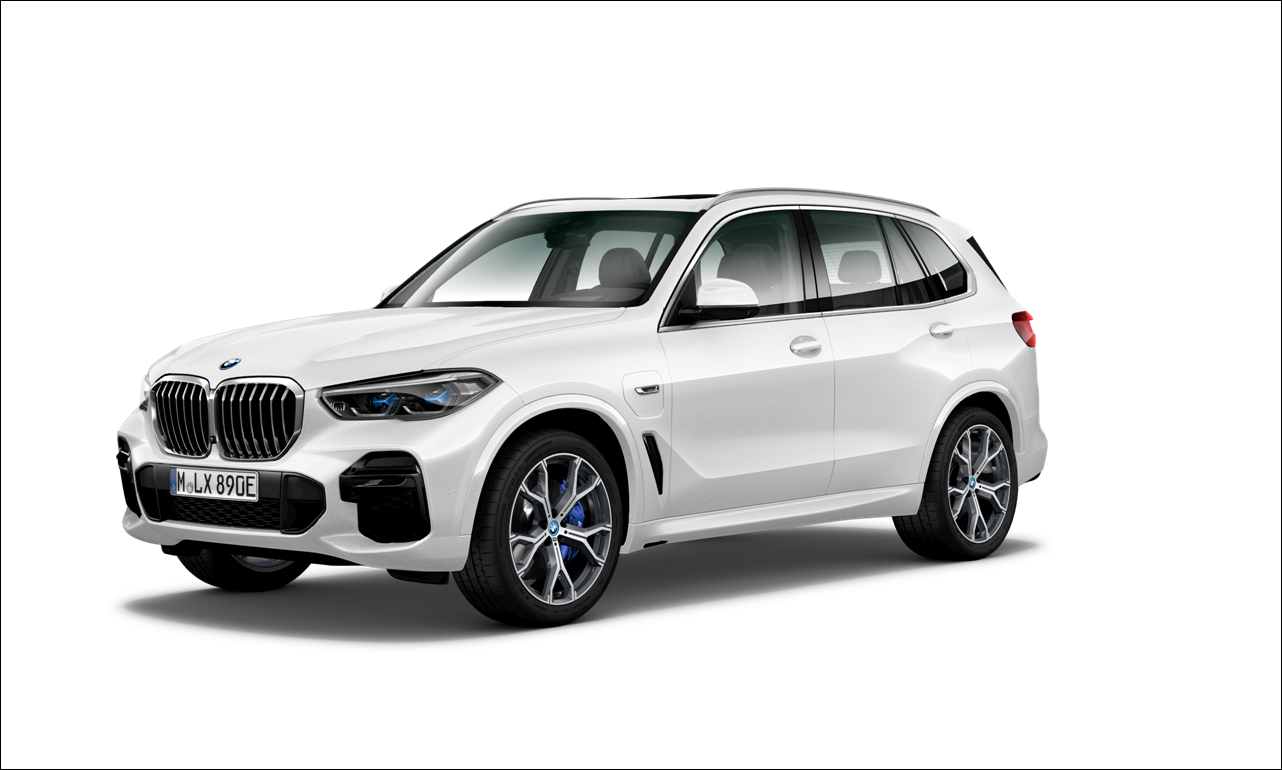
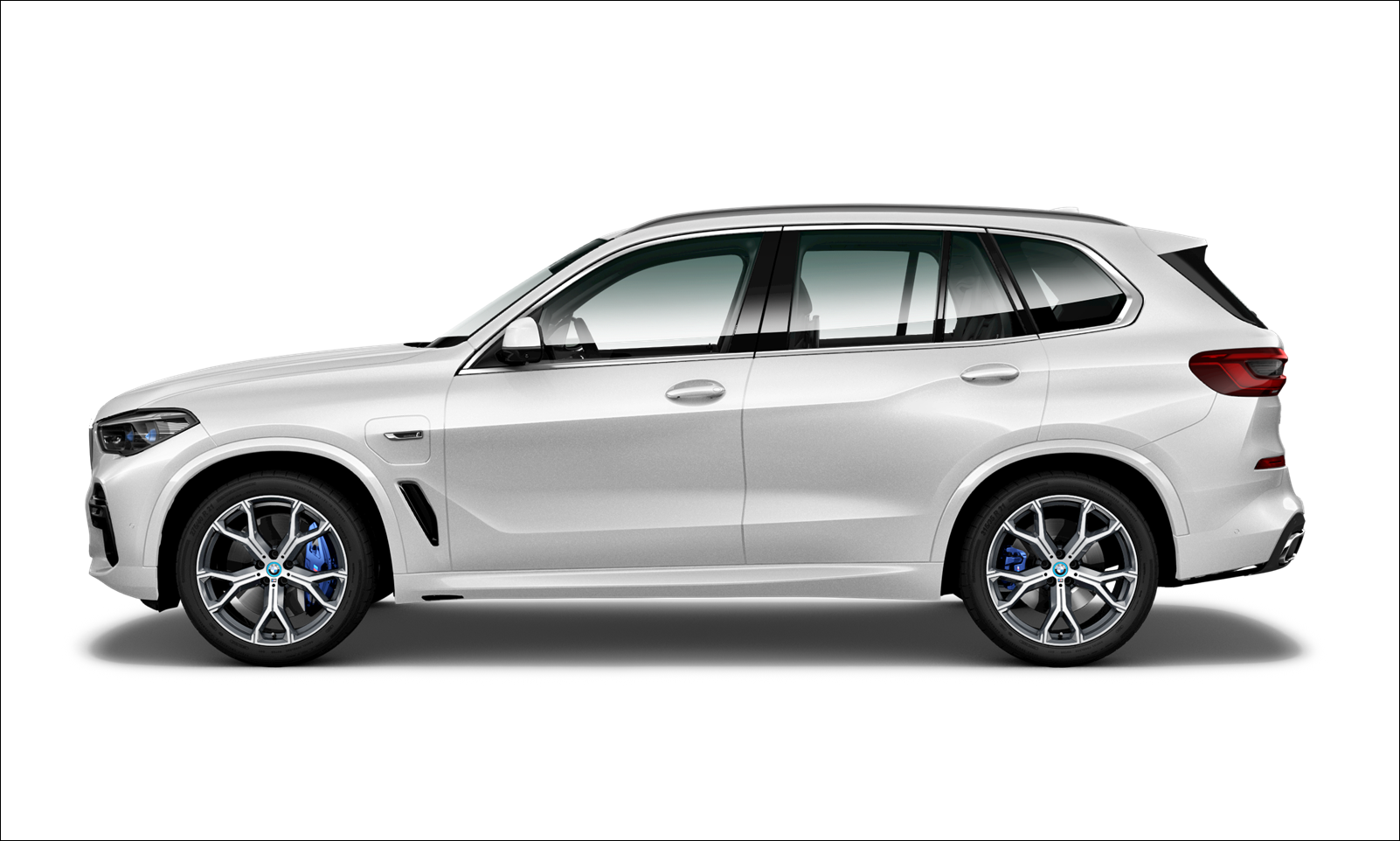
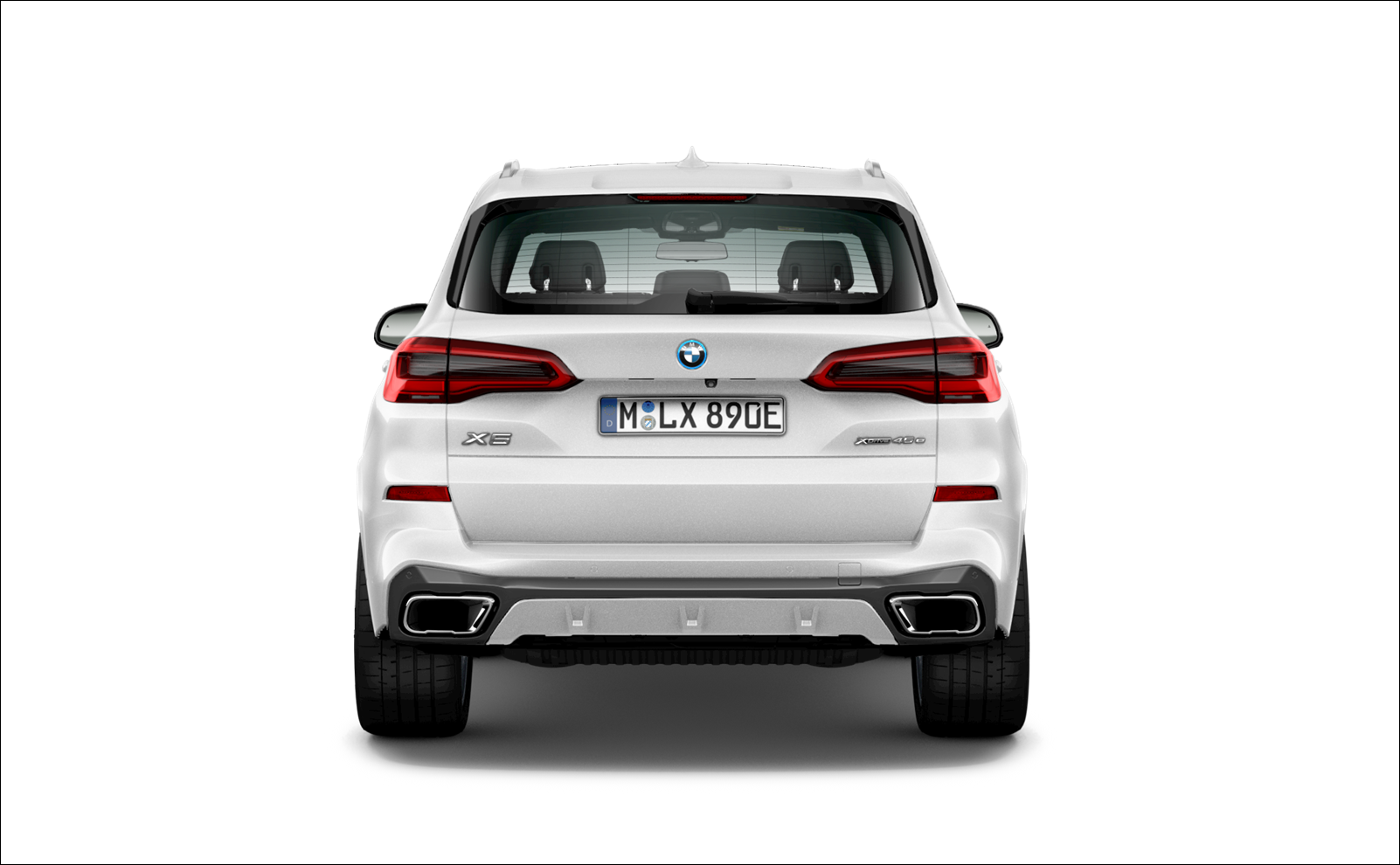
The electrified version of BMW’s first SAV (Sport Activity Vehicle) – the X5 xDrive45e M Sport – has received new features for improved safety after being in the Malaysian market since mid-2020. The model is assembled locally at the BMW assembly facility in the Inokom plant in Kedah.

Retail pricing for the new X5 xDrive45e M Sport with BMW Service and Repair Inclusive is RM457,498.37 (without insurance). The price given does not include Sales and Service Tax but unless you make your purchase before the end of the month, you would have to pay the tax as the exemption ends on June 30, 2022. The indications are that there won’t be any extension, but it is believed that those who complete their transactions before the expiry date may have up till next year to register their vehicle and still enjoy the exemption. This is probably in recognition of the delays in supplies which have caused a backlog in deliveries.

2022 BMW X5 xDrive45e M Sport

2022 BMW X5 xDrive45e M Sport

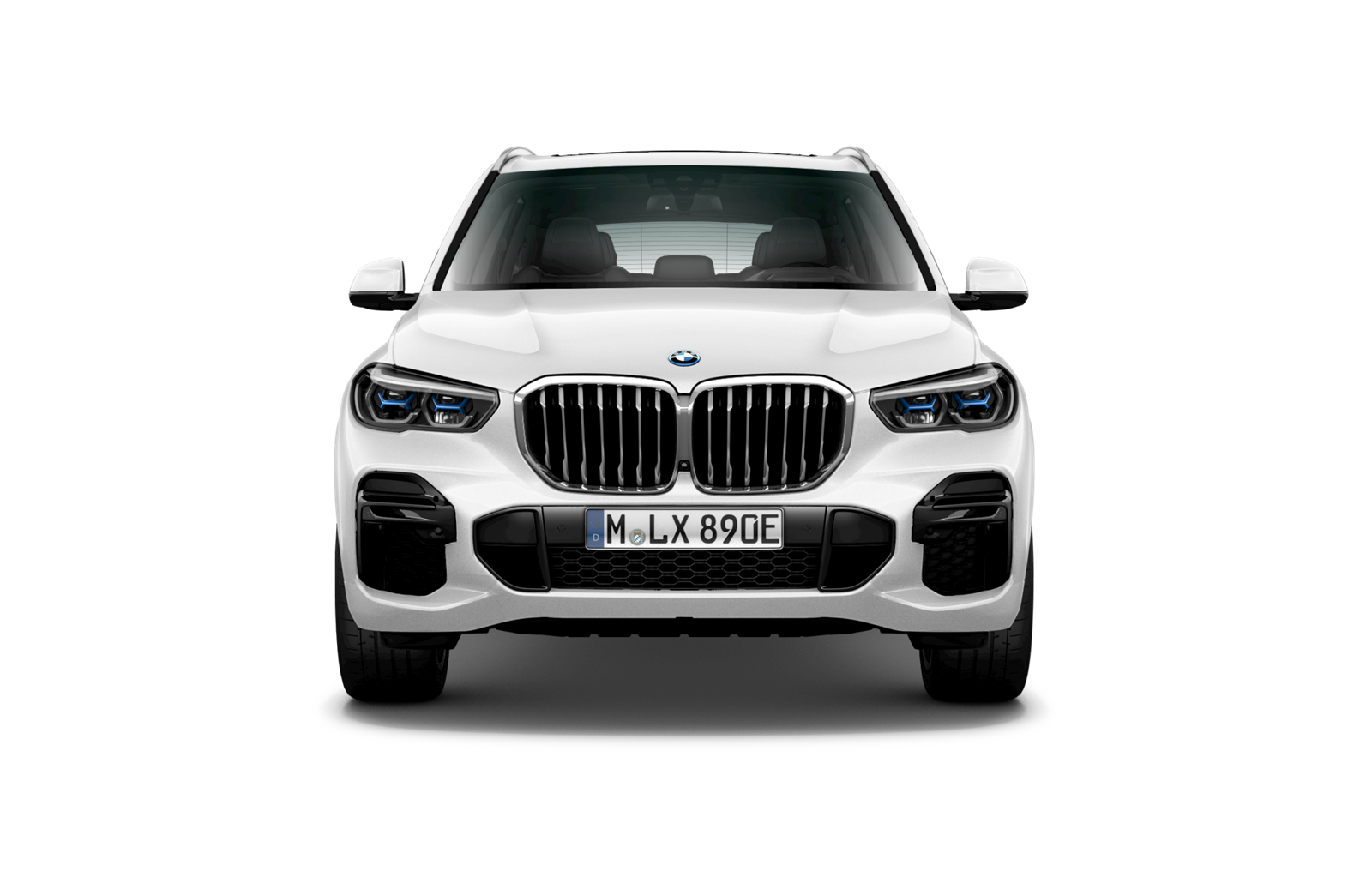
The new X5 xDrive45e M Sport now has BMW Laserlight headlights which give better illumination with a wider spread. The Adaptive Headlights with BMW Selective Beam are equipped with laser high beam modules that have increased intensity compared to bi-LED lights.

Safety enhancements
Additional enhancements in safety include two more side airbags added to the second row of the vehicle. This brings the total number of airbags around the spacious cabin to eight. The Active Protection system also prepares passengers for a collision, should an accident be imminent. For example, if the windows and sunroof are open, they will automatically be shut to ensure the highest level of safety for all passengers.

2022 BMW X5 xDrive45e M Sport

Additionally, reversible seatbelt pre-tensioning is also implemented where upon seatbelt fastening, an electric motor will automatically tighten the seatbelt to the ideal tension based on the passenger’s body.

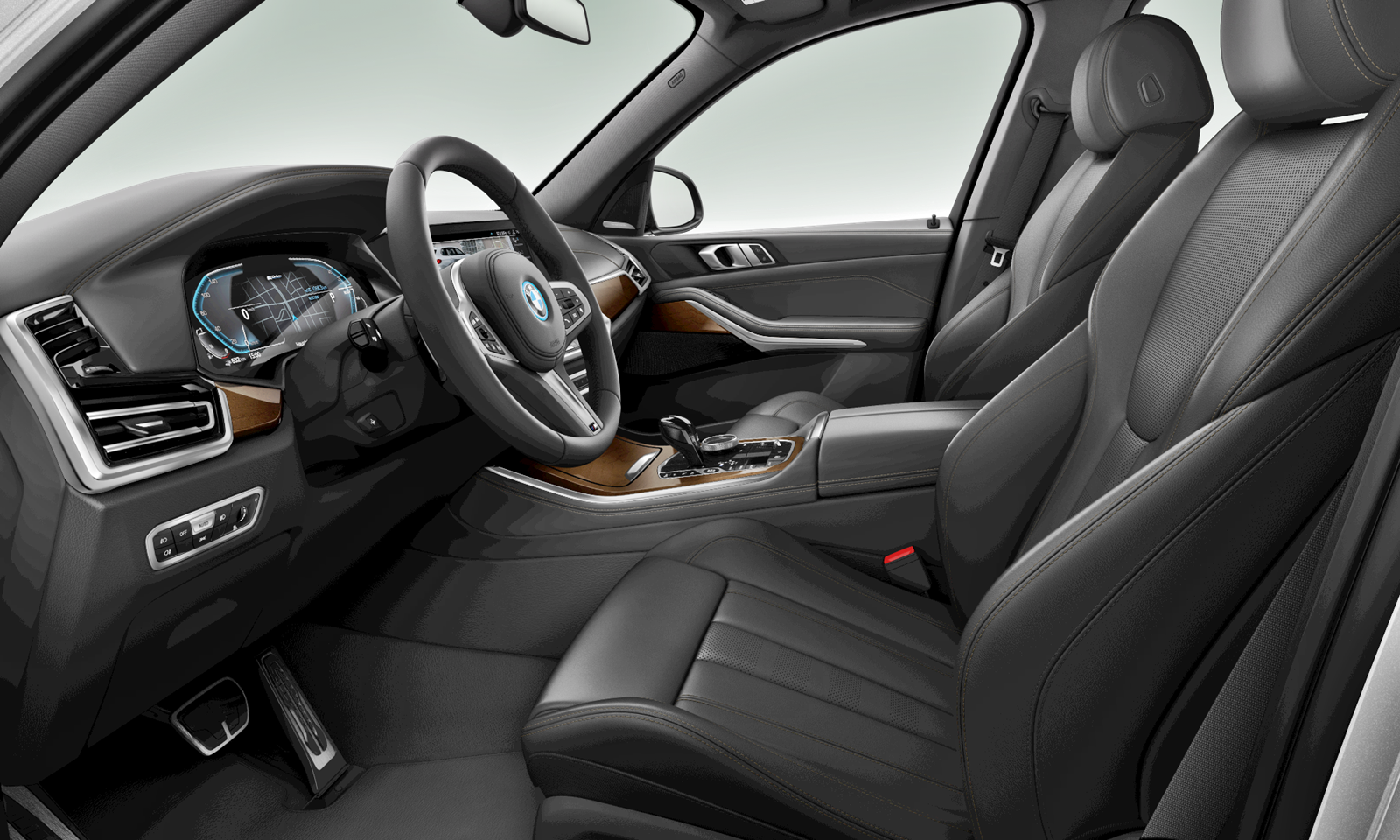
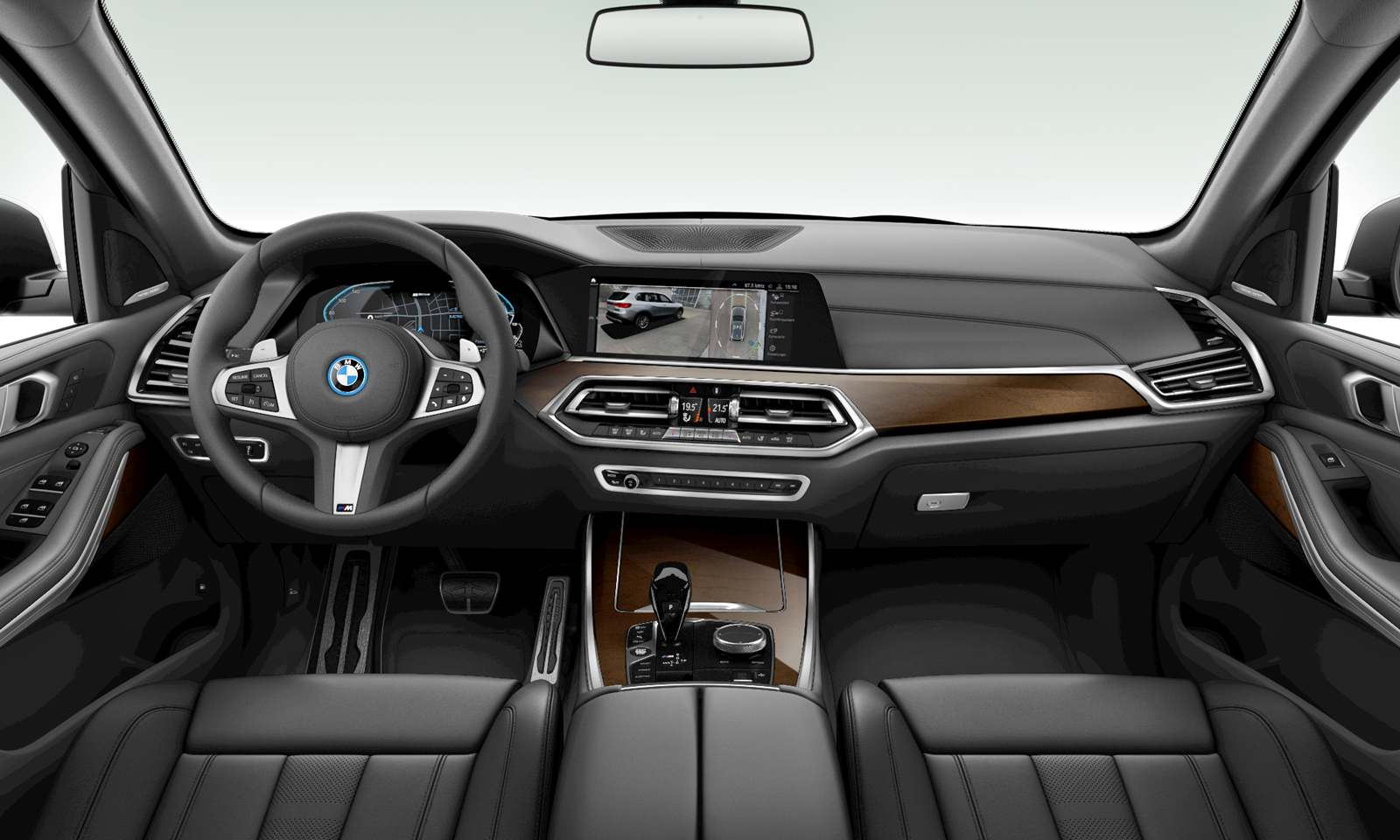
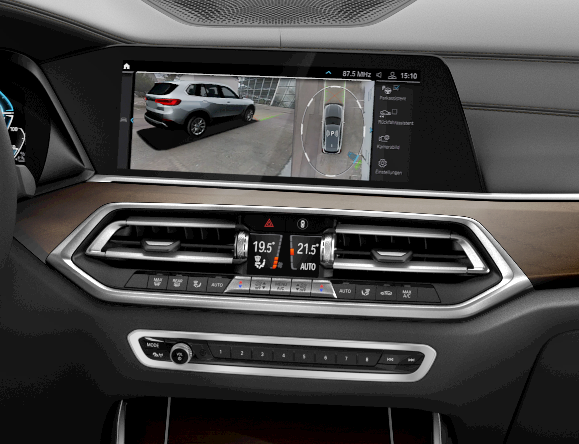
Also with the X5 xDrive45e M Sport, which BMW Malaysia refers to as ‘The Boss’, are new 21-inch 741M Alloy Wheels in Orbit Grey. Other standard equipment that is maintained is the Live Cockpit Professional, Driving Assistant, Parking Assistant Plus, Rear Seat Entertainment, as well as Vernasca genuine leather upholstery.

2022 BMW X5 xDrive45e M Sport

2022 BMW X5 xDrive45e M Sport

Like many car companies these days, financing packages are also available. BMW Group Financial Services Malaysia offers Easy Drive Financing Plan with plans for the X5 xDrive45e M Sport having monthly instalments starting from RM 4,882 (terms and conditions apply).

Premium Ownership experience
For those who become owners, BMW Group Malaysia promises a Premium Ownership experience. This includes a 5-year warranty (unlimited mileage), free scheduled service programme for the same period, BMW Roadside Assistance and Accident Hotline, BMW Group Loyalty+ Mobile App – BMW Privileges Card, and BMW Service Online.

2022 BMW X5 xDrive45e M Sport

5 new models introduced in Malaysia to celebrate BMW M’s 50th anniversary

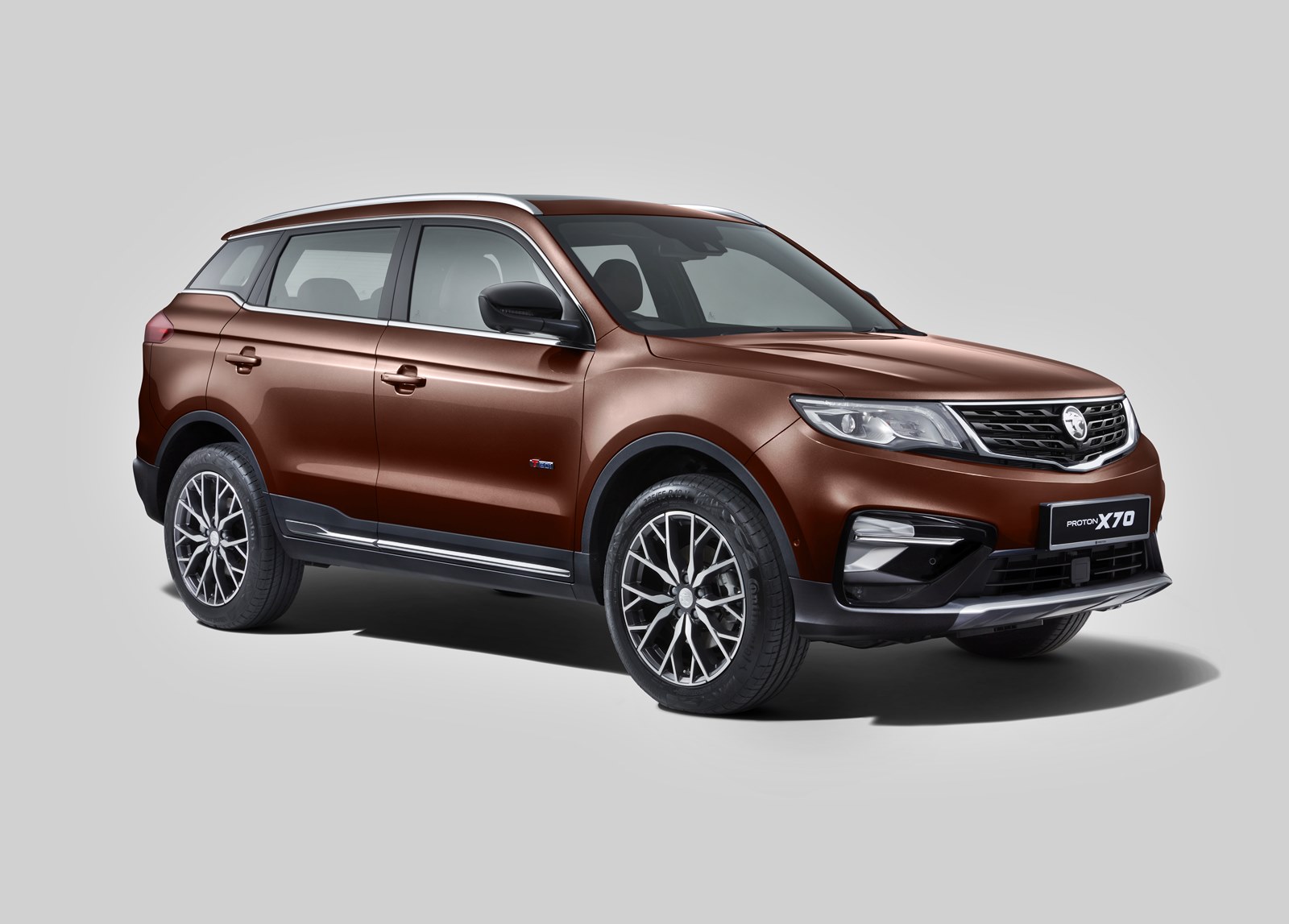
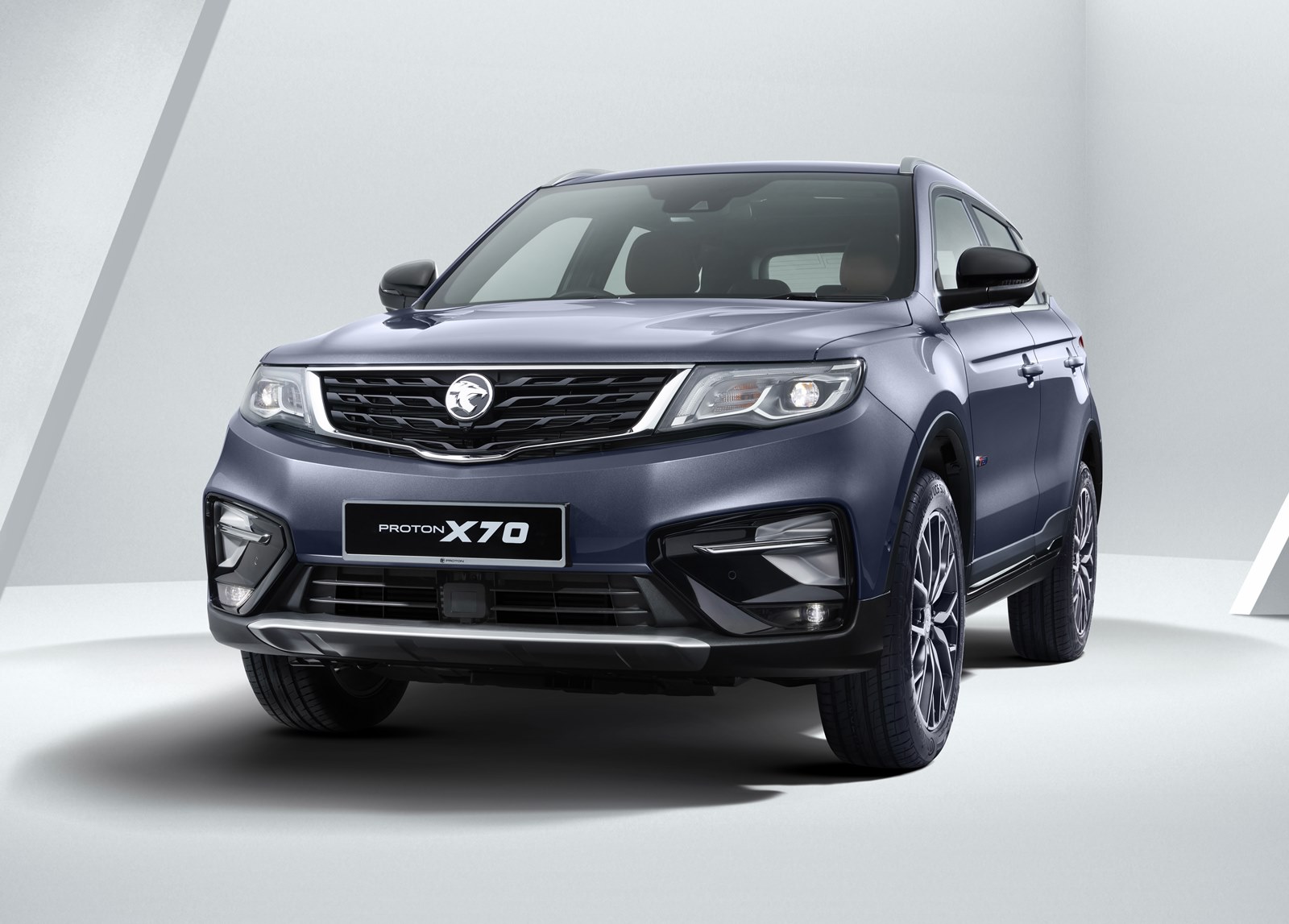
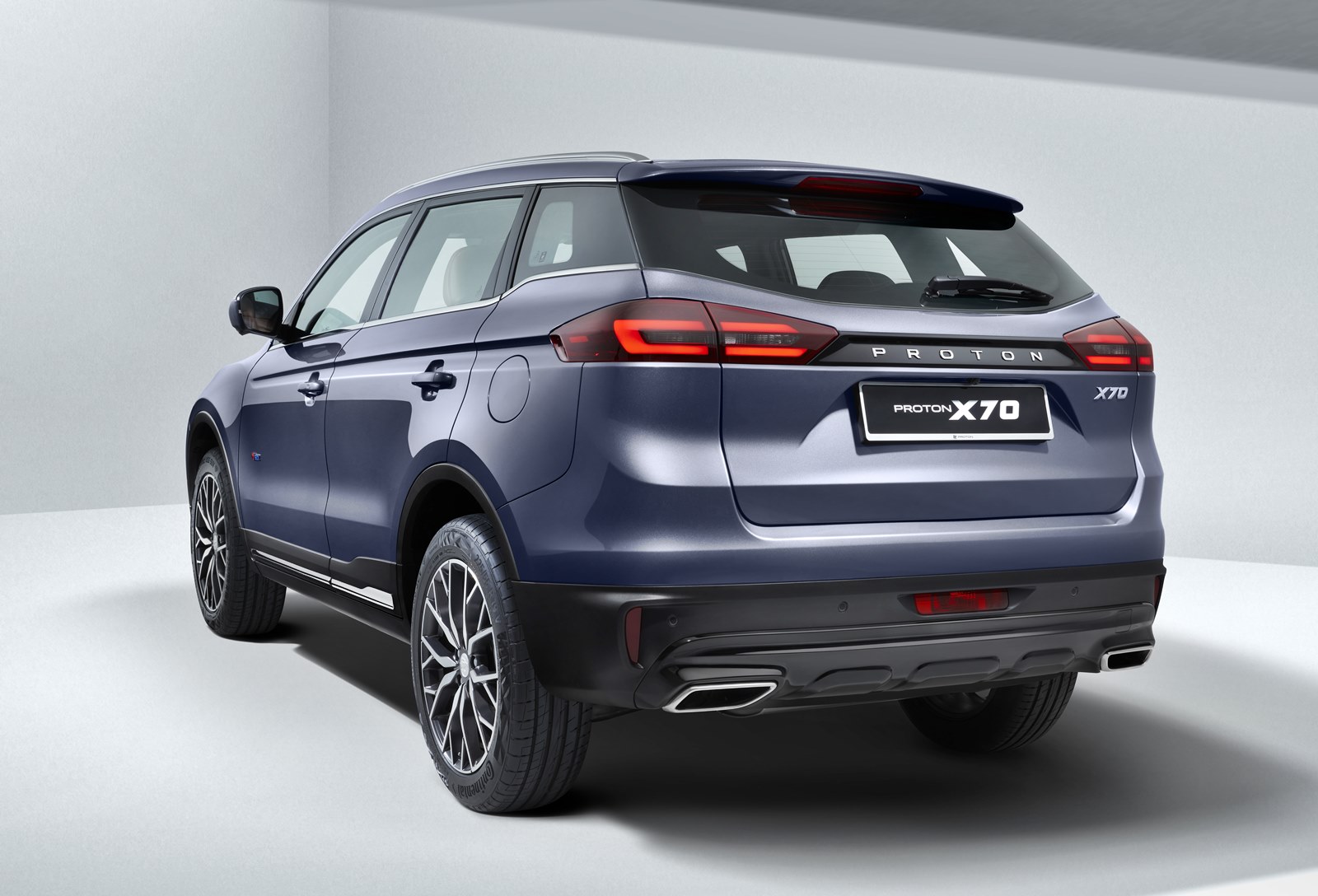
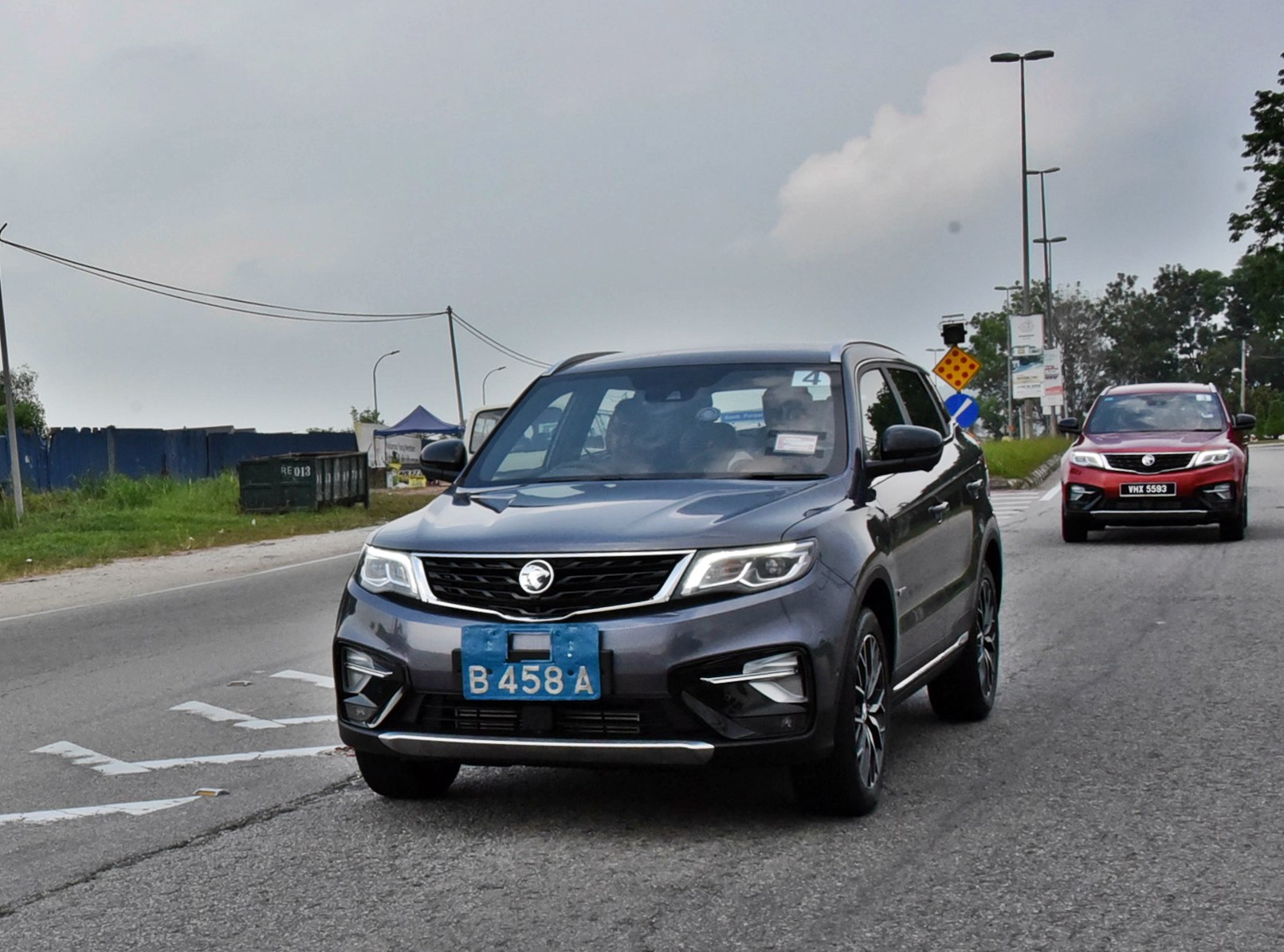
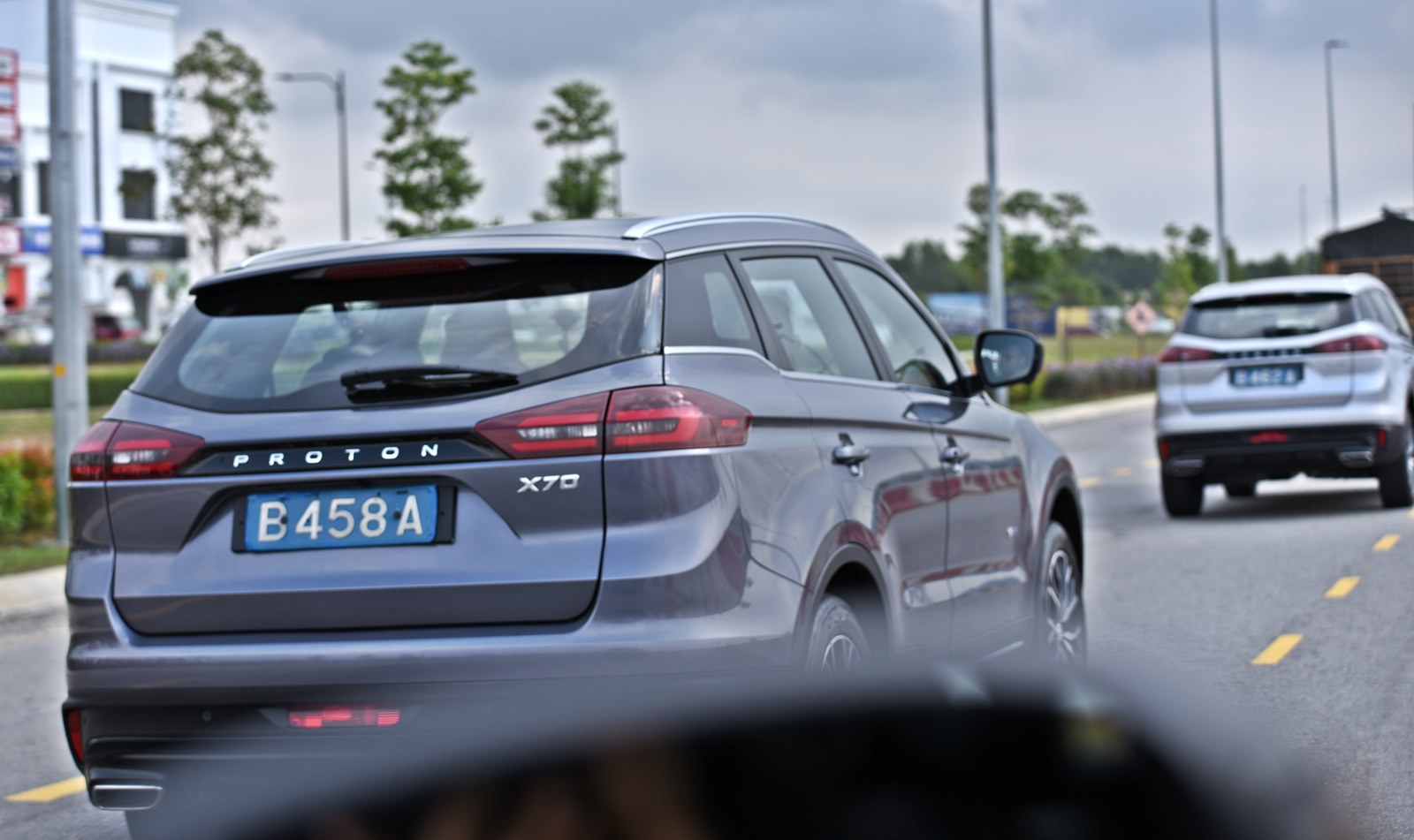
The first product to be launched when the Zhejiang Geely Holding Group (Geely) became DRB-HICOM’s partner in Proton was the X70, ‘Malaysianised’ from the Geely Boyue within a year of the partnership agreement being signed. It has remained a strong seller in the 4 years it has been in the market and is sold overseas as well.

Although demand remains strong, Proton is not taking things for granted and has given it some updating for the 2022 model launched online this morning. As with most midcycle changes, the new features are largely cosmetic with no changes to stamped parts to avoid incurring new production costs.

[Click here to download the 2022 Proton X70 brochure]

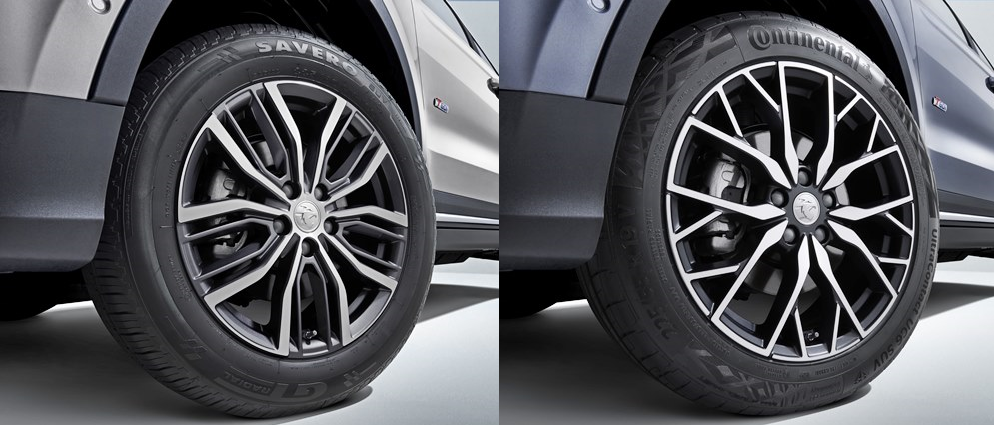
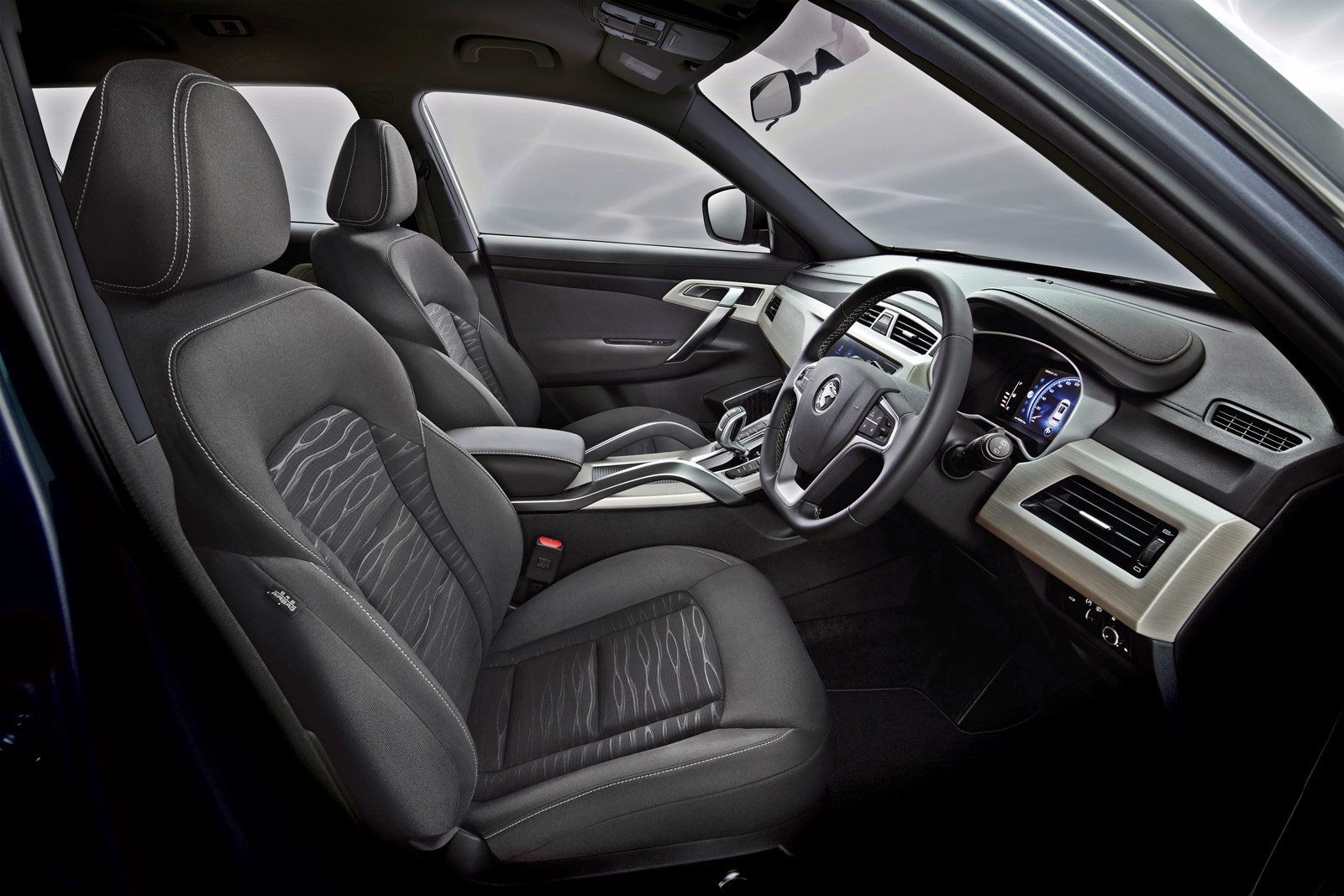
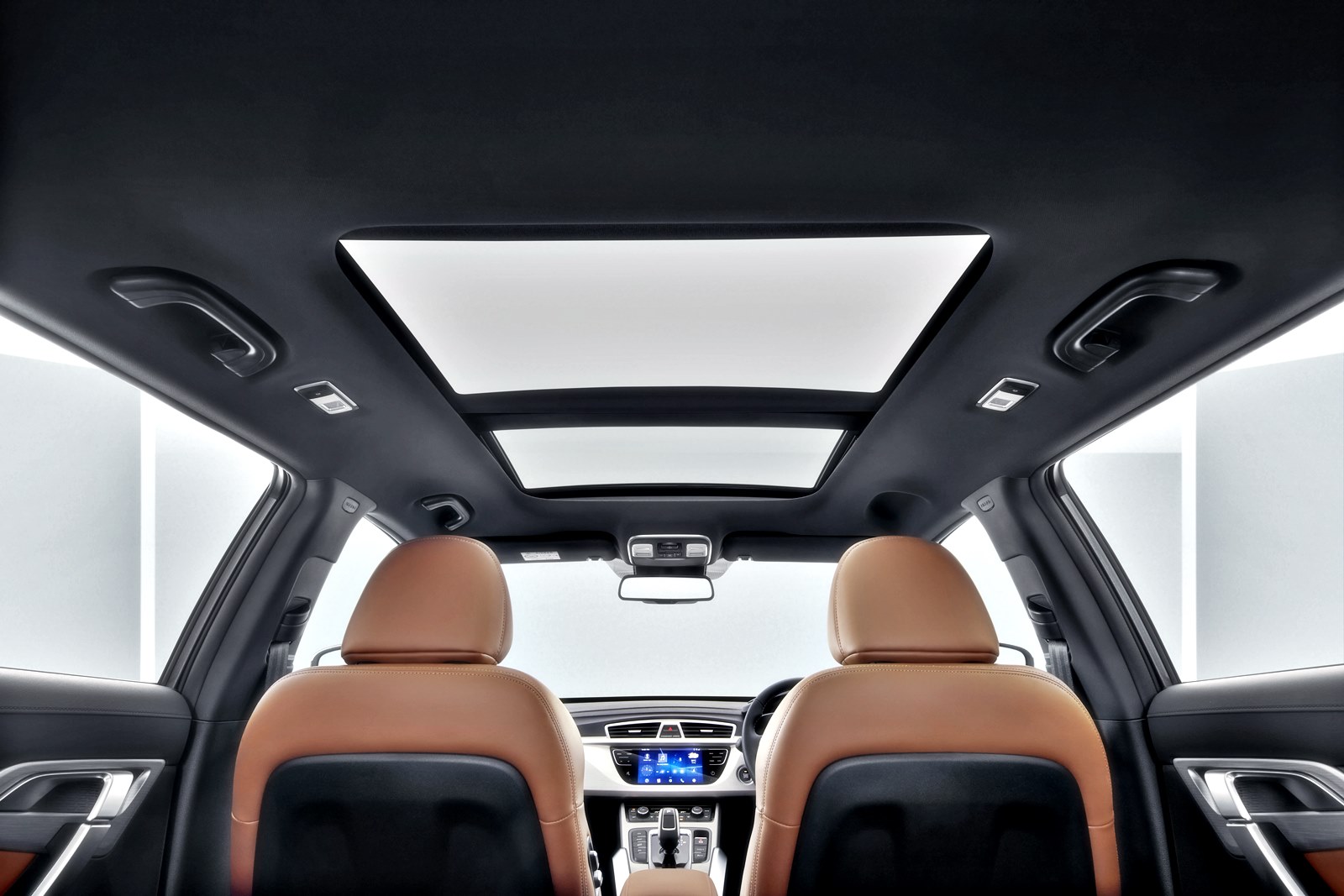
These include quartz black finishing on the front and rear bumpers, new 19-inch alloy wheels, power tailgate with foot sensor for handsfree opening and Nappa leather seats with new black headlining. Other features remain unchanged for each of the 5 variants.

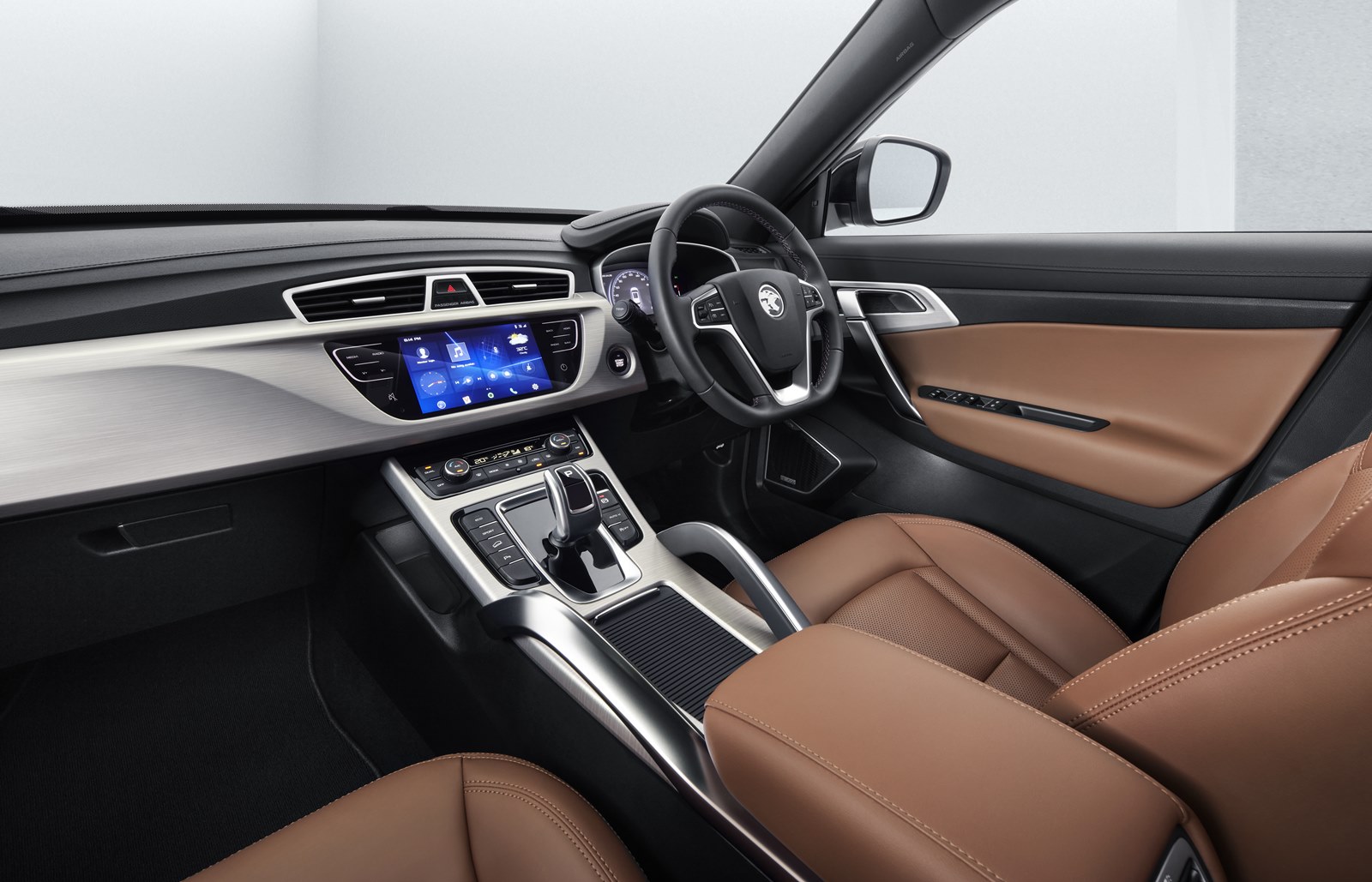
2022 Proton X70 1.5

2022 Proton X70 1.5

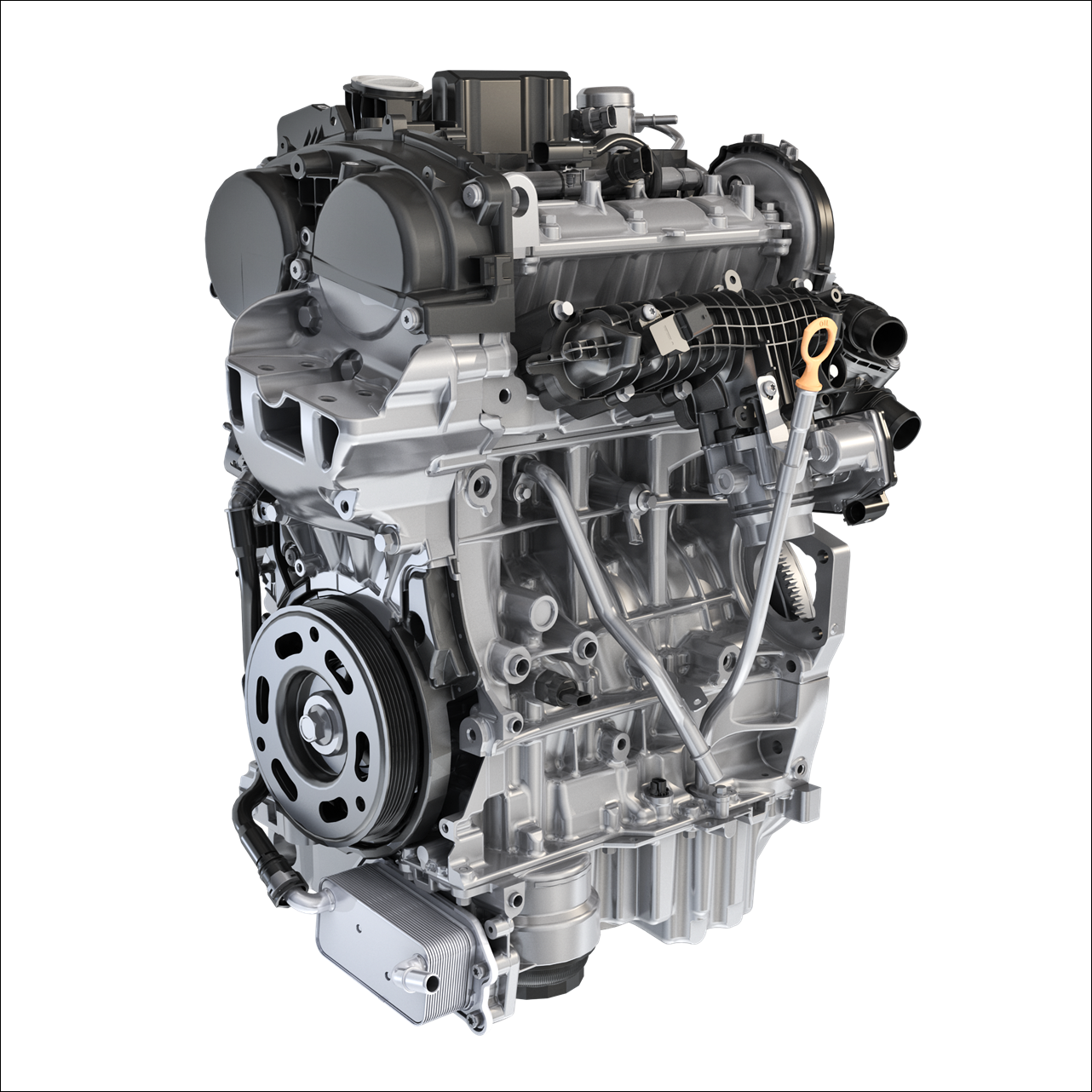
1.5-litre 12-valve 3-cylinder engine
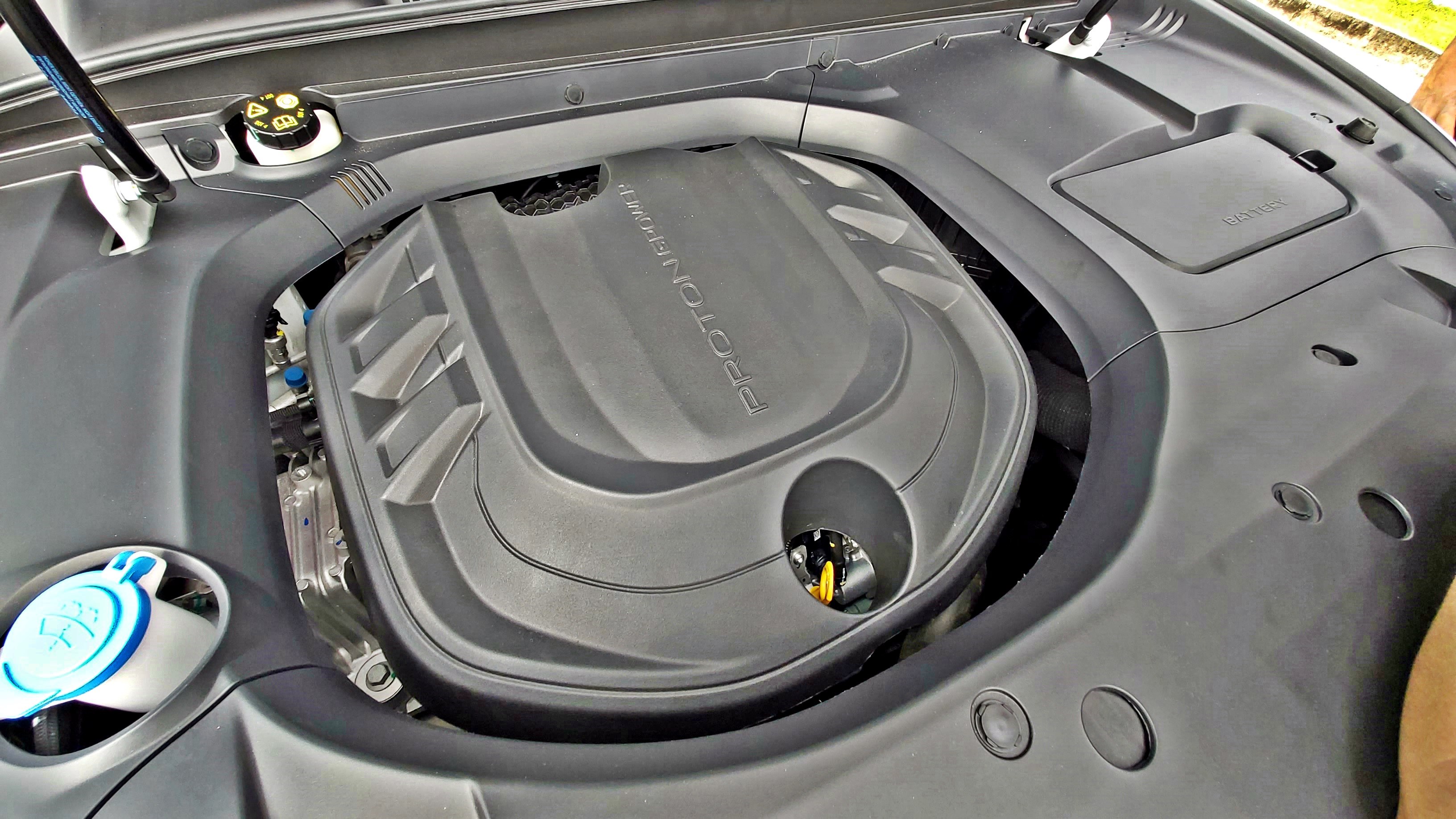
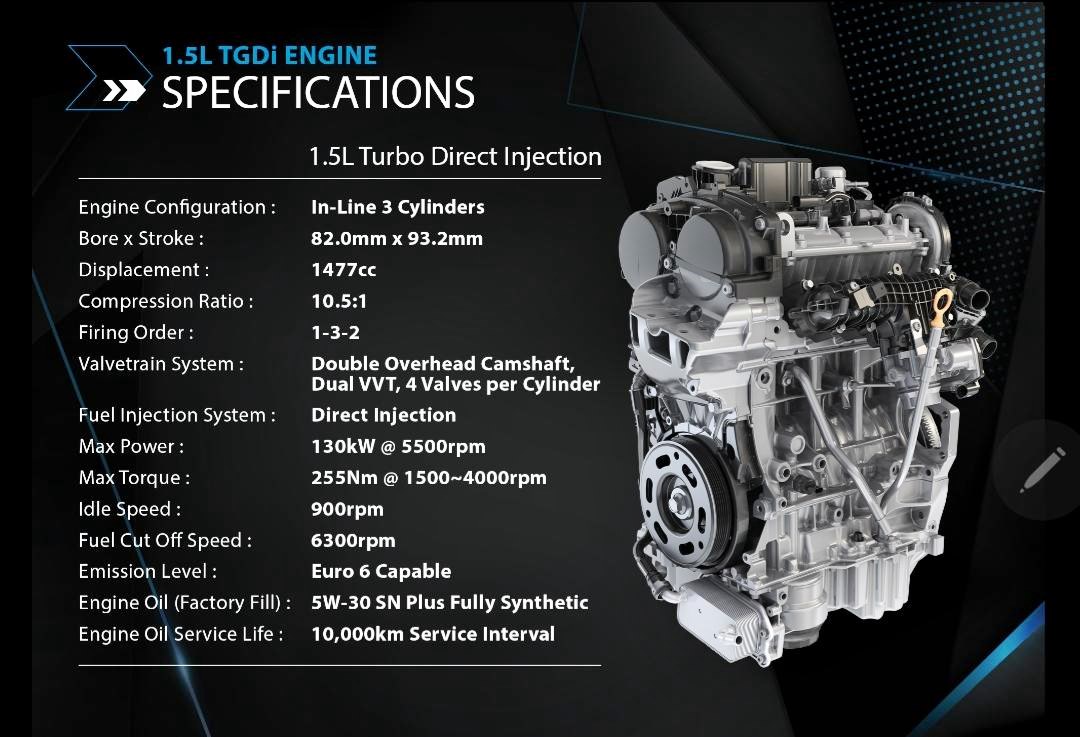
However, under the bonnet, there is significant change with an additional engine option. This is the 1.5-litre JLH-3G15TD engine jointly developed by Geely and Volvo. It is already used in the X50 as well as export versions of the X70. If you add the other Geely Group models it is used in, the engine is powering vehicles in 22 countries.

Actually, if you look at Geely’s history, you will find that its very first car, the HQ/Haoqing, had a 3-cylinder engine. This was the 1-litre unit that was originally developed by Daihatsu for its Charade and which Geely licensed to make and use in its own models. That was back in the late 1990s and with the technology of that period, the output was around 50 ps with 70 Nm of torque.

2022 Proton 1.5-litre engine

The 1.5-litre 3-cylinder 12-valve engine in the latest X70 produces 177 ps/255 Nm and it shows just how far engine technology has advanced. Of course, it has a larger displacement and has a turbocharger and direct fuel injection to boost power output, as well as other technologies that were not available in the 1990s.

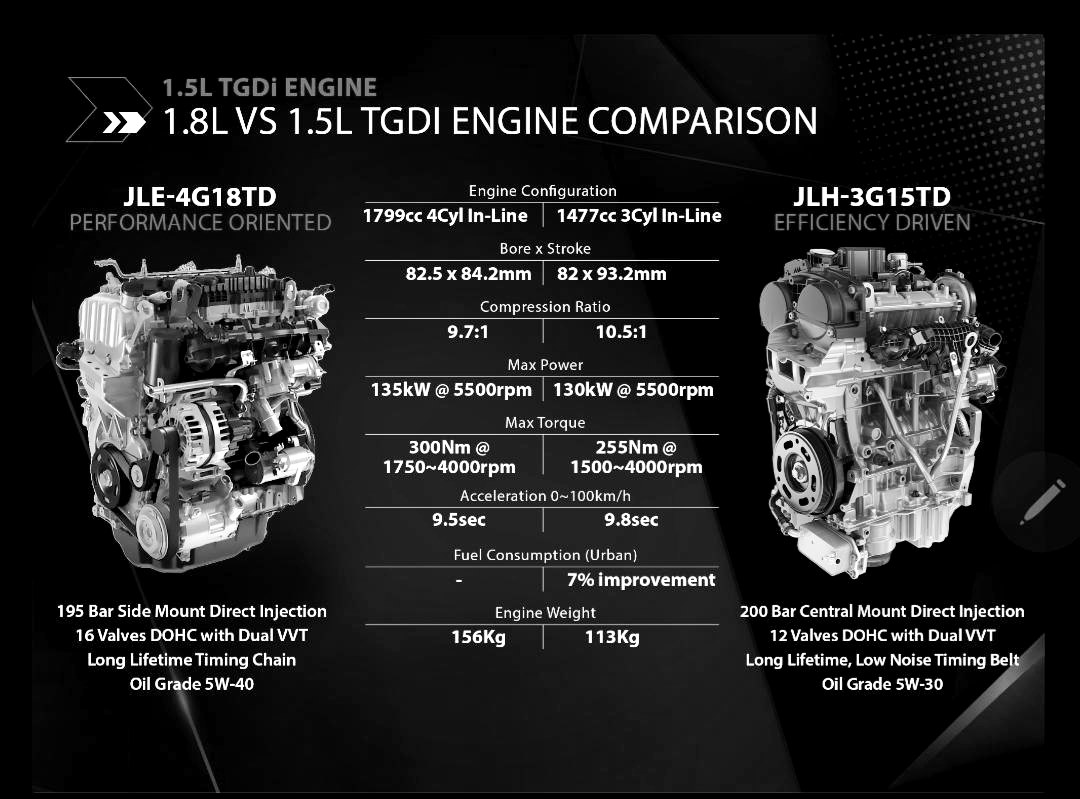
3-cylinder engines have been around all along since the late 1970s when Daihatsu started mass-producing them for the Charade and other models. Millions of Malaysians have also been driving cars with them as they are used in Perodua models. But the reason why this configuration has gained more widespread use over the past 15 years has been that the industry has been downsizing powerplants to improve fuel efficiency and reduce emissions. With turbocharging and more advanced fuel delivery, it has been possible to squeeze more out of a 3-cylinder engine with a smaller displacement. The reduced displacement and size means less consumption, which Proton claims is 7% less than the 1.8-litre engine.

2022 Proton 1.5-litre engine

The earlier generation of 3-cylinder engines were noisy, partly because of vibrating more due to their odd firing pulses and also because they were usually in low-cost models. Today, with more extensive measures against noise, vibration and harshness (NVH), their inherent noises are masked more effectively from the cabin.

One interesting measure in the X50 engine is the use of a softer material for the engine cover, which is usually just hard plastic that doesn’t absorb sound so well. Furthermore, much of the engine bay is also covered up, helping to contain mechanical noises.

Is it less durable?
There are some who feel that a 3-cylinder engine may not be as durable and lasting as a 4-cylinder engine because it has to work harder. Where durability is concerned, the engine has been tested thoroughly over 12 million kms in all types of conditions. And because it is already in over 750,000 vehicles globally, there is plenty of real-world feedback to help the engineers identify any areas needing improvement or rectification. So what Malaysians are now getting (the engine is assembled at the Tg. Malim factory as well) could be considered an optimised version with all the improvements made over the past few years.

There’s a 7-speed dual-clutch transmission (wet type) which sends power to the front wheels or all four wheels, the latter all-wheel drive system having been demanded by some customers. It was available initially in the CBU models from China but omitted with the locally-assembled version. Whether to pay the extra RM5,800 for having AWD is really up to you. Where we would have said (and that would be years ago) that AWD can help make driving safer with better grip and stability, there are many active systems like ESC and traction control which can also provide stability and grip in slippery conditions so the added cost of AWD (plus some extra weight) may not be necessary any longer.

2022 Proton X70 1.5

2022 Proton X70 1.5

2022 Proton X70 1.5

First driving impressions
As the cosmetic and feature changes are minimal, let’s jump straight to the first impressions we had of the X70 running with the 1.5-litre engine. Though it’s been in the X50 a while, this writer has not driven that model so far so the comparisons would be with the X70 1.8 that has been on sale for 4 years now – and the last time we drove the car was just before the MCO began.

Anyway, Proton’s drive event earlier in the week was for us to get brief impressions of the performance which they expect to be of interest to many in view of the heavier and larger vehicle size. It was a short drive around Selangor, about 130 kms, with mostly highways and moderate traffic conditions. A more comprehensive video report will be done later when we can get a new X70 for a longer period.

Generally, if not told whether it is a 1.5 or 1.8 engine, most people are unlikely to discern the difference except either someone who owns one or the enthusiasts who are more sensitive to the smallest differences. However, when accelerating hard, there is still that familiar ‘motorboat noise’ of 3-cylinder units but it is not too intrusive due to the good NVH measures. It sounds ‘distant’ and is at a frequency that does not irritate. In terms of engine smoothness, there’s virtually no difference to the X70 1.8 when cruising.

On paper, the difference in 0 to 100 km/h time is said to be just 3/10ths of a second longer than the X70 1.8 and though this seems insignificant, there is some perceptible difference at the lower end when you accelerate hard. To compensate for the lower output but heavy body, the maximum torque is available 250 rpm earlier than in the 1.8 engine, but the engine doesn’t surge off the way the X70 does.

But then again, how often does the average driver floor the pedal when moving off, unless he or she is in a real hurry? In real-world driving (which is how I assess a car), the acceleration is strong enough to move off briskly and get up to speed fast enough.
The more important thing is how quickly the car can accelerate in mid-range as this is when you overtake others or join a highway. With plenty of torque, there’s little lag and the engine doesn’t hesitate, accelerating cleanly from low revs. And the 7-speed DCT also provides a good spread of gears to smoothly transition up and down.

One thing that would be interesting to check is how the engine performs on steep inclines, Unfortunately, we could not do this as our route was generally flat. That it has only 4% less power may not be an issue on level roads but the heavy weight could have an effect on performance when climbing slopes. In the lighter X50, it is okay but we’re not sure about the X70 and that’s something we’ll have to find out later on.

2022 Proton X70 1.5

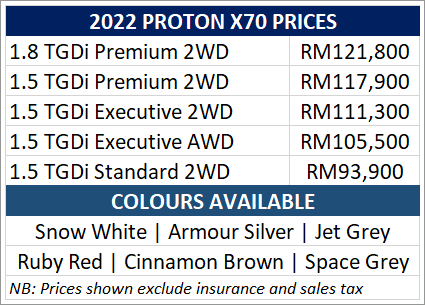
While Proton still has the supply issues delaying deliveries, the earlier you book, the better since you get in the queue earlier. The prices quoted are without sales tax and the Finance Minister has said before that the exemption will not be extended again. So the number of customers who book today who can get the lower price may be very few as there are still others waiting for their X70s.

Proton delivers more vehicles as the two factories increase output

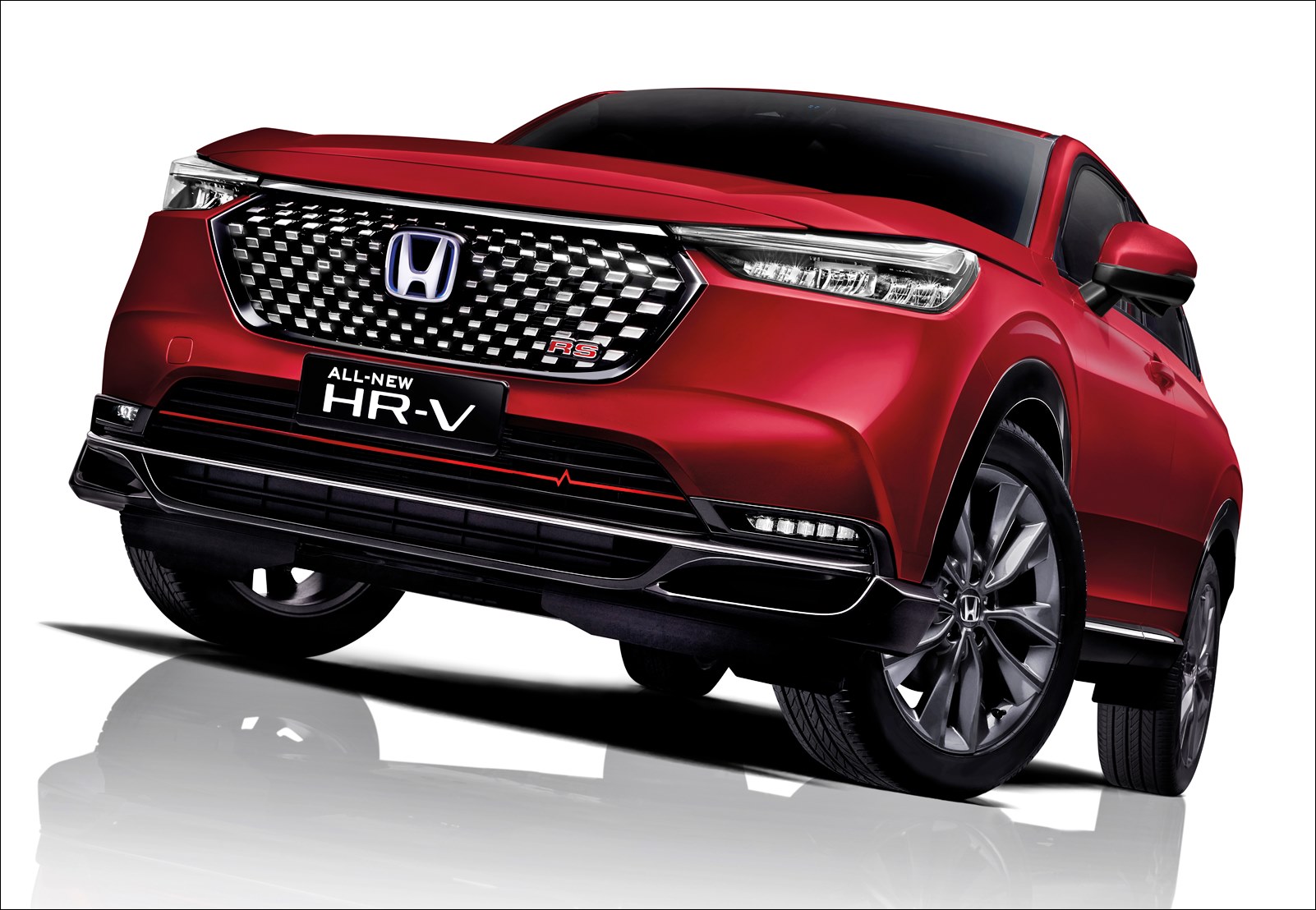
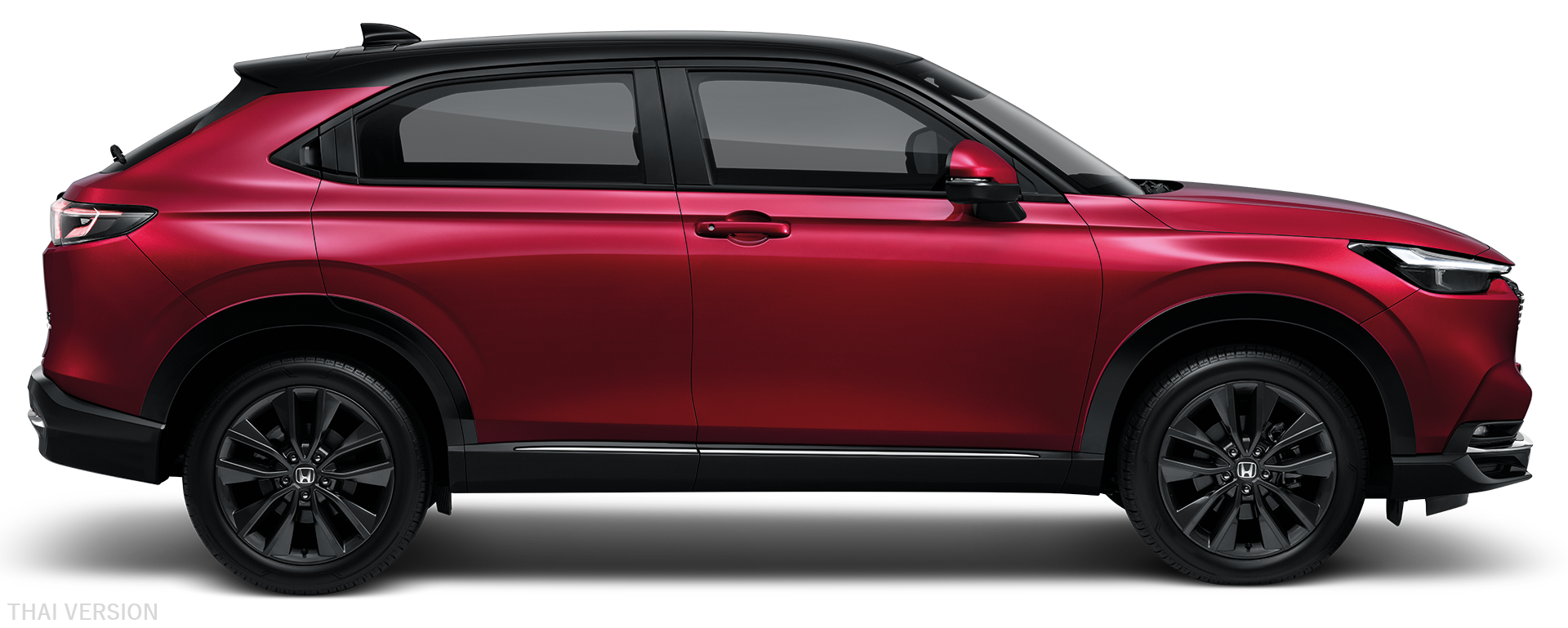
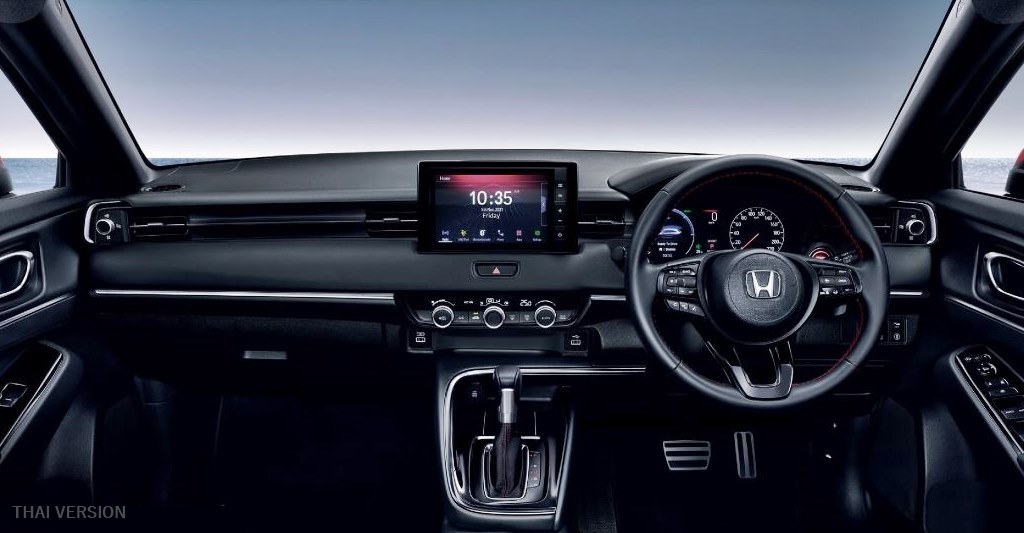
You’ve probably heard that Honda will soon be launching the all-new HR-V in Malaysia, following its launch in Thailand and Indonesia over the past 8 months. As usual, Honda Malaysia is offering a chance for those who want to be the first in the neighbourhood to own the new model a chance to make their bookings from today.

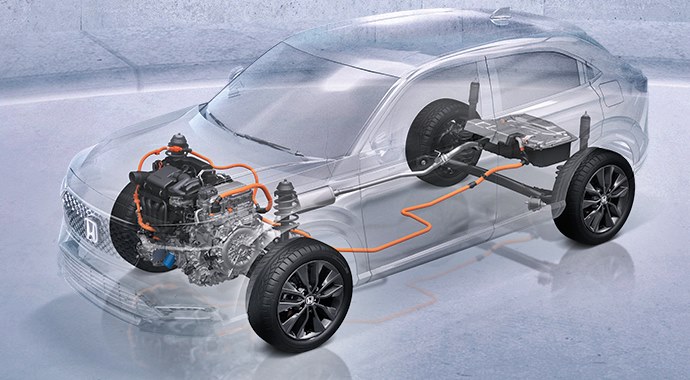
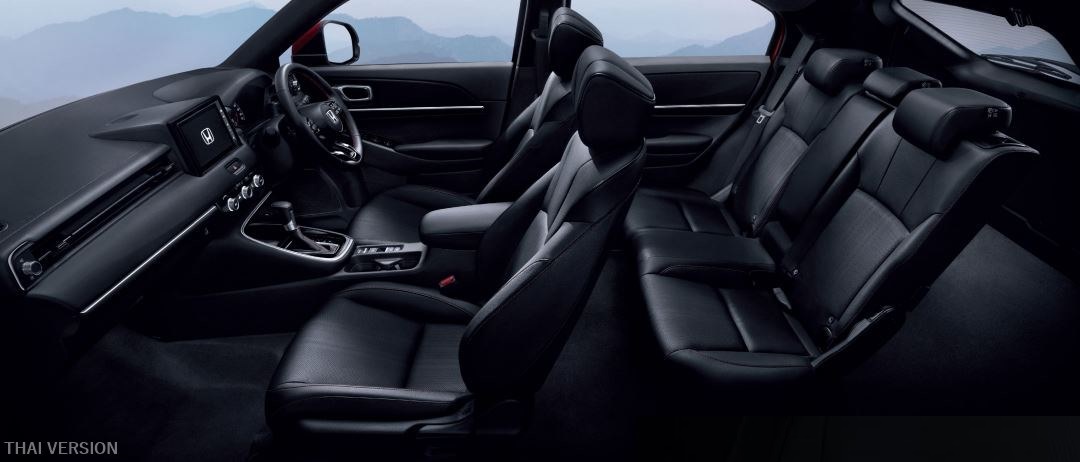
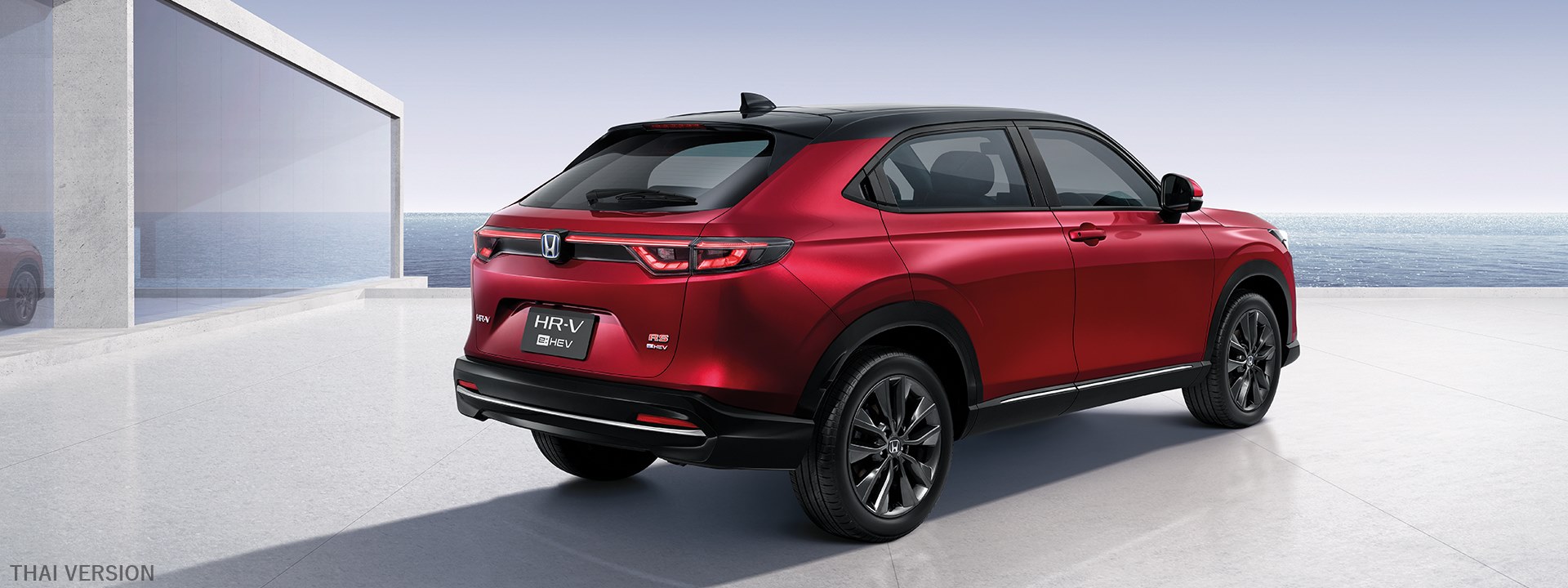
Honda Malaysia will launch the model sometime in the next 3 months and as with the current range, there will be petrol and hybrid powertrains. The HR-V Hybrid progresses from the Sport Hybrid i-DCD system to e:HEV technology with the intelligent Multi-Mode Drive (i-MMD) system. Already available in the latest City, e:HEV technology in Honda’s hybrid system combines the benefits of a 1.5-litre petrol engine and an electric motor to provide more power (131 ps/253 Nm) with good fuel efficiency.

Measuring 4385 mm in length, the new HR-V is 39 mm longer than its predecessor while the 1790 mm width is similar (to the current RS version only) while the roof is 15 mm closer to the road.

The front appearance is dominant with a new grille design which is a total departure from the previous ‘wing’ theme, while the rear has fastback styling though to our eyes, it looks less sleek than before.

New exterior features include front LED Sequential Turn Signals (the signals ‘move’ as the illuminate), and a LED Taillight Strip which adds a visual signature visible from a distance. Other key exterior features include new LED headlights with DRLs, LED foglights and 18-inch alloy wheels.

As with other models, there’s Honda SENSING, a suite of active safety systems but this is only in the RS version. Honda SENSING includes automatic emergency braking, lane keeping and adaptive cruise control (with low-speed follow). Additionally, the RS version also has the useful Honda LaneWatch system which provides a real-time camera view of the blind spot of the left side of the HR-V.

This variant also has a Hands-Free Power Tailgate with Walk Away Close function, where the tailgate will start closing automatically upon detecting that the individual with the remote key is moving away from the car. Other features are Remote Engine Start and Walk Away Auto Lock functions.

“The HR-V was first introduced to the Malaysian market in 2015, and it became a best-selling as well as a sensational model. With its proven track record, the HR-V is truly the compact SUV that is loved by many Malaysians. Therefore, we are excited to be introducing the All-New HR-V in Malaysia, which is now officially open for bookings,.” said  Honda Malaysia’s Managing Director & CEO, Hironobu Yoshimura, adding that some 150,000 units have been sold nationwide since its launch 7 years ago.

When the HR-V was originally launched, it was a hotseller from the first day. Will this new model continue to command the biggest following in the segment? Since 2015, a number of new rivals have appeared on the scene so there are more choices at competitive prices.

To pre-book the new HR-V, customers can visit prebook.honda.com.my or download the HondaTouch application on their smartphones. Honda dealerships will also accept bookings, of course, as well as provide more information. To locate a showroom in Malaysia, visit www.honda.com.my.

Like a number of manufacturers, Spanish carmaker SEAT (a member of the Volkswagen Group) also has a performance sub-brand. Known as CUPRA, its name was taken from the high-performance motorsport subsidiary of the company. CUPRA was established in 2018 to focus on high-performance products which, like those of SEAT, uses much of the Volkswagen Group’s technologies and platforms.

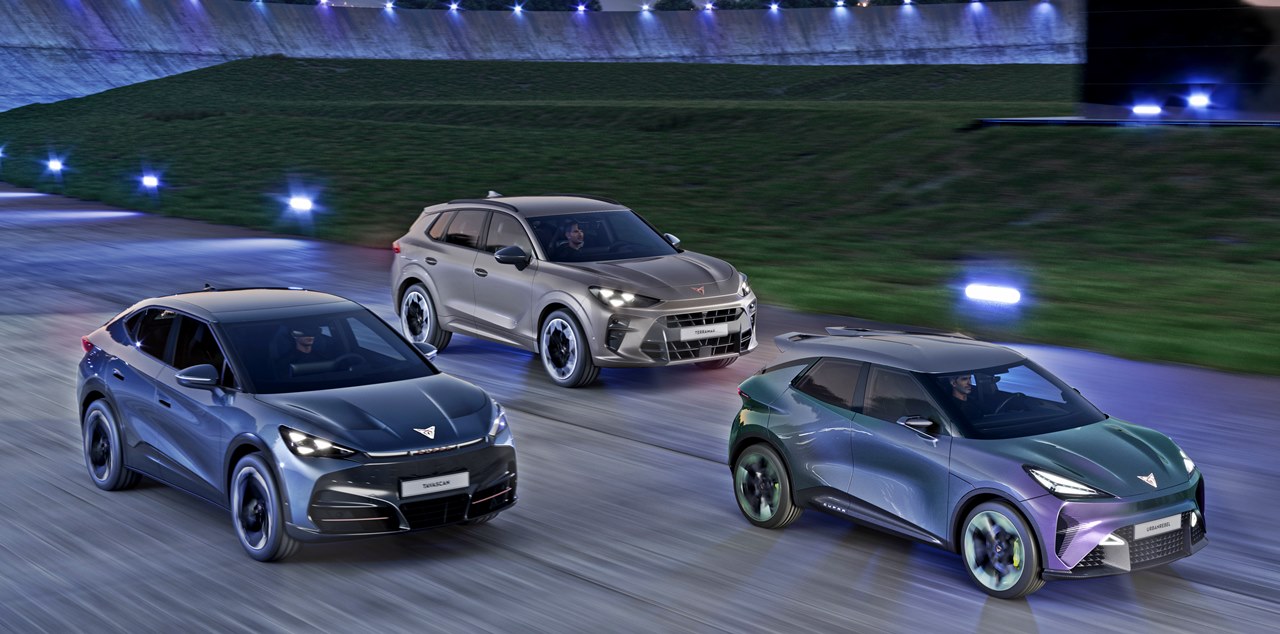
The brand has gained a lot of credibility with its high-performance models, delivering close to 200,000 units to date, mostly in Europe. Now it is looking ahead to an electrified future and will launch 3 new electrified models by 2025. The names of the new models were revealed recently – Terramar, Tavascan and UrbanRebel.


“Here is the entire range of CUPRA’s next generation of heroes to be launched by 2025,” said Wayne Griffiths, CEO of CUPRA, at the presentation of the future models. ”In the mid-term, our aim is to deliver 500,000 cars per year and push forward with our international expansion into new markets as well as entering new segments. The CUPRA Tribe is committed to making all this happen, it’s the people that count. Because at the end, it’s the people who make the brand.”

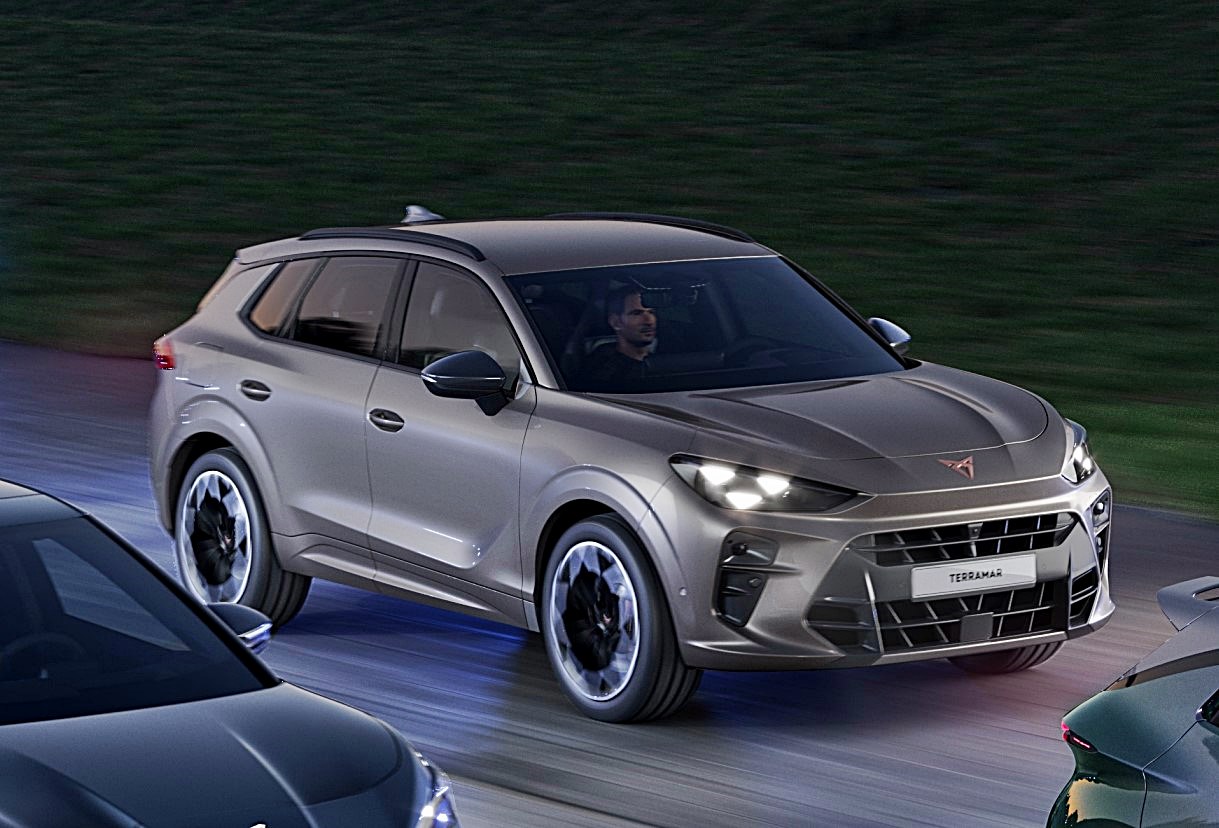
The Terramar
This will be the first electrified SUV of the brand which is expected to move the company to the hotspot of the SUV segment, the fastest-growing segment in Europe. To be produced in Hungary at Audi’s plant, the Terramar will be available with conventional petrol powertrains as well as a new generation of plug-in hybrid powertrains that are promised to deliver around 100 kms in all-electric mode. The e-HYBRID range focuses on performance and contemporary sportiness and are part of the bigger journey as CUPRA fulfils its electrification revolution.

“Terramar, our new sporty hybrid SUV, perfectly combines bold proportions with a long striking bonnet, while the shark nose means breakthrough resistance and the determination to win,” said Jorge Diez, Design Director at CUPRA. “Thinking of how the driver will feel, we provide a unique experience with the latest technology, thanks to the driver oriented interior concept. All in all, a 4.5-metre long SUV, with CUPRA DNA ready to shake one of the most competitive segments”.

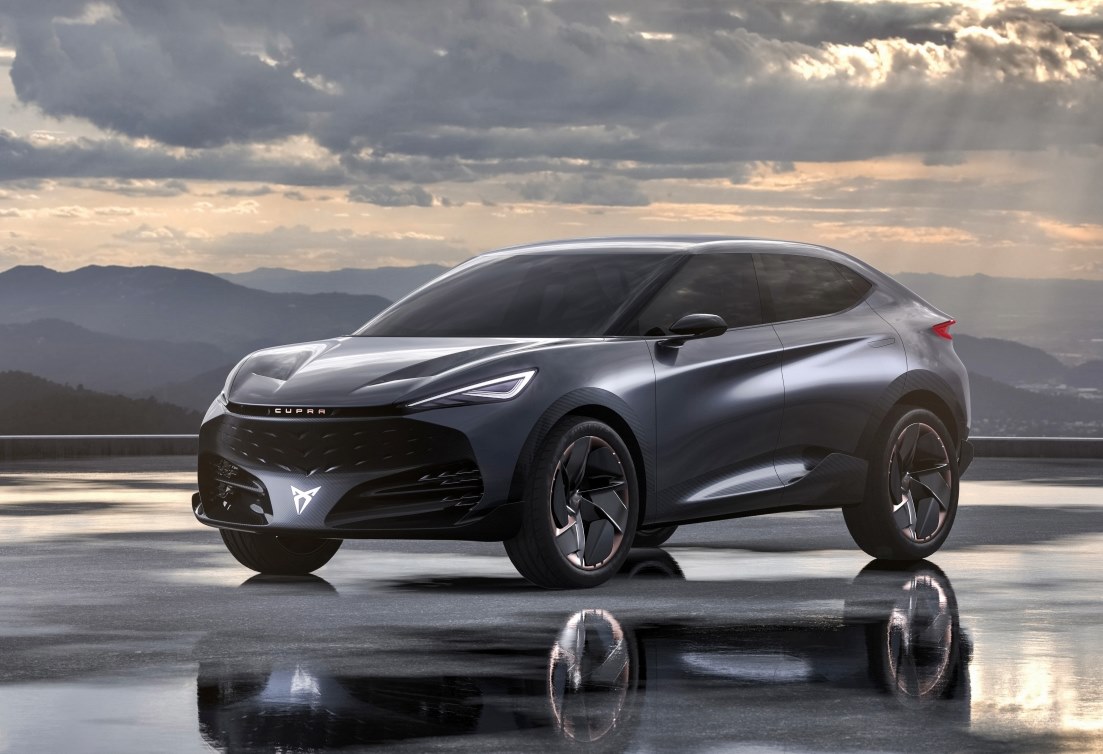
Tavascan
In 2024, CUPRA will launch the Tavascan, based on the electrified vision shown in the 2019 concept car of the same name. Some design elements were already strongly hinted at in the 2021 Tavascan Extreme E Concept. The Tavascan will have the mission of globalising the brand and take CUPRA to new markets.

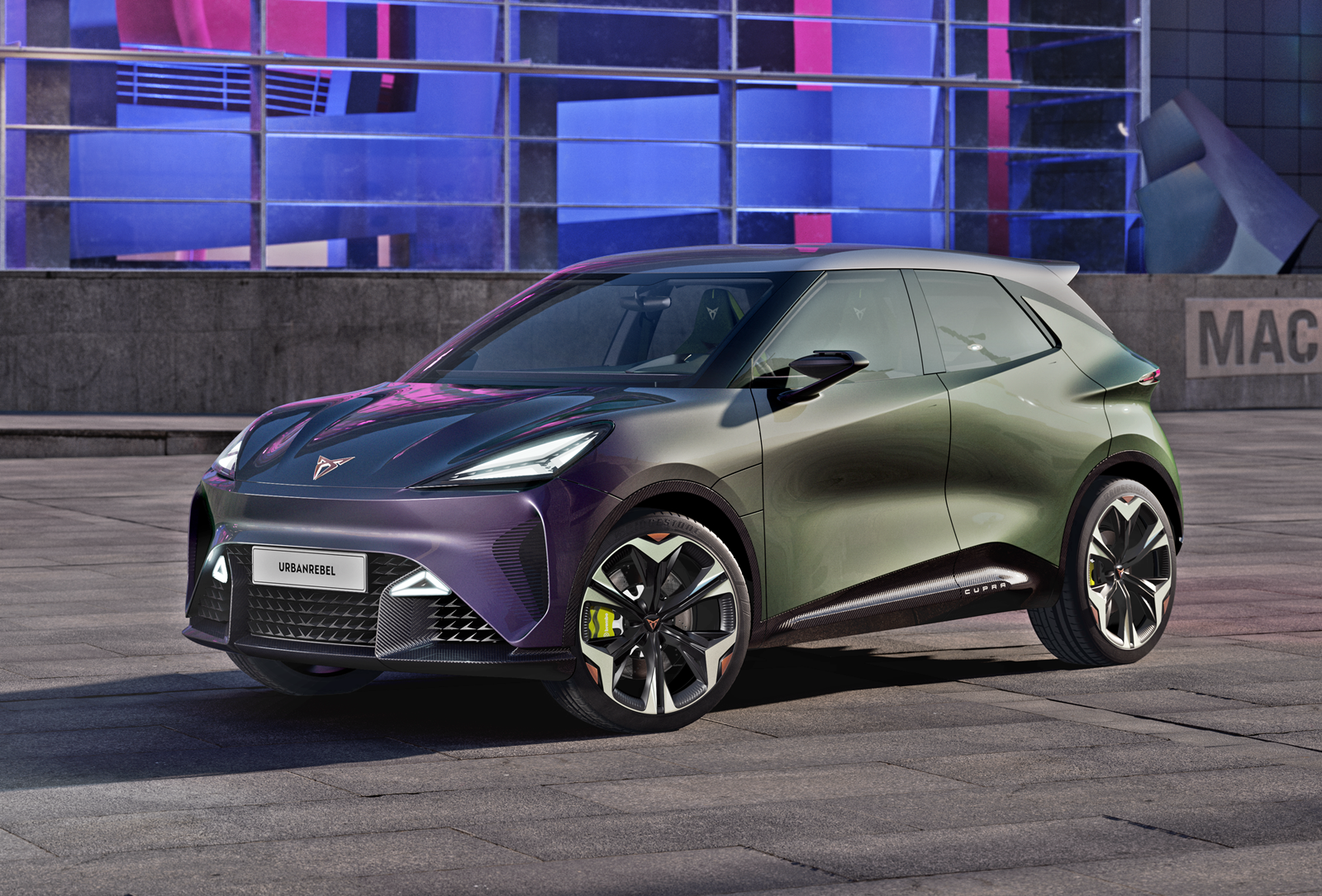
UrbanRebel
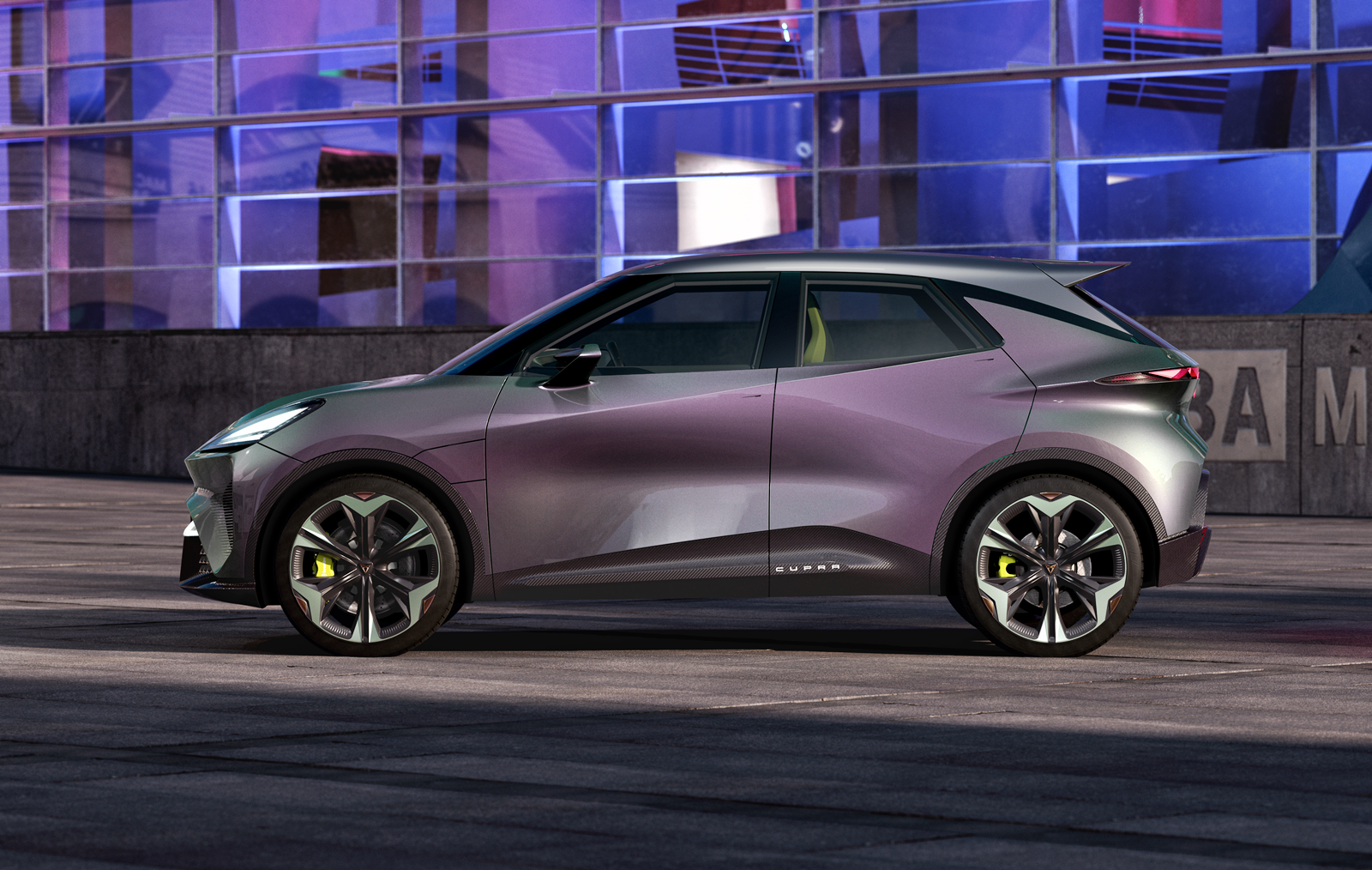
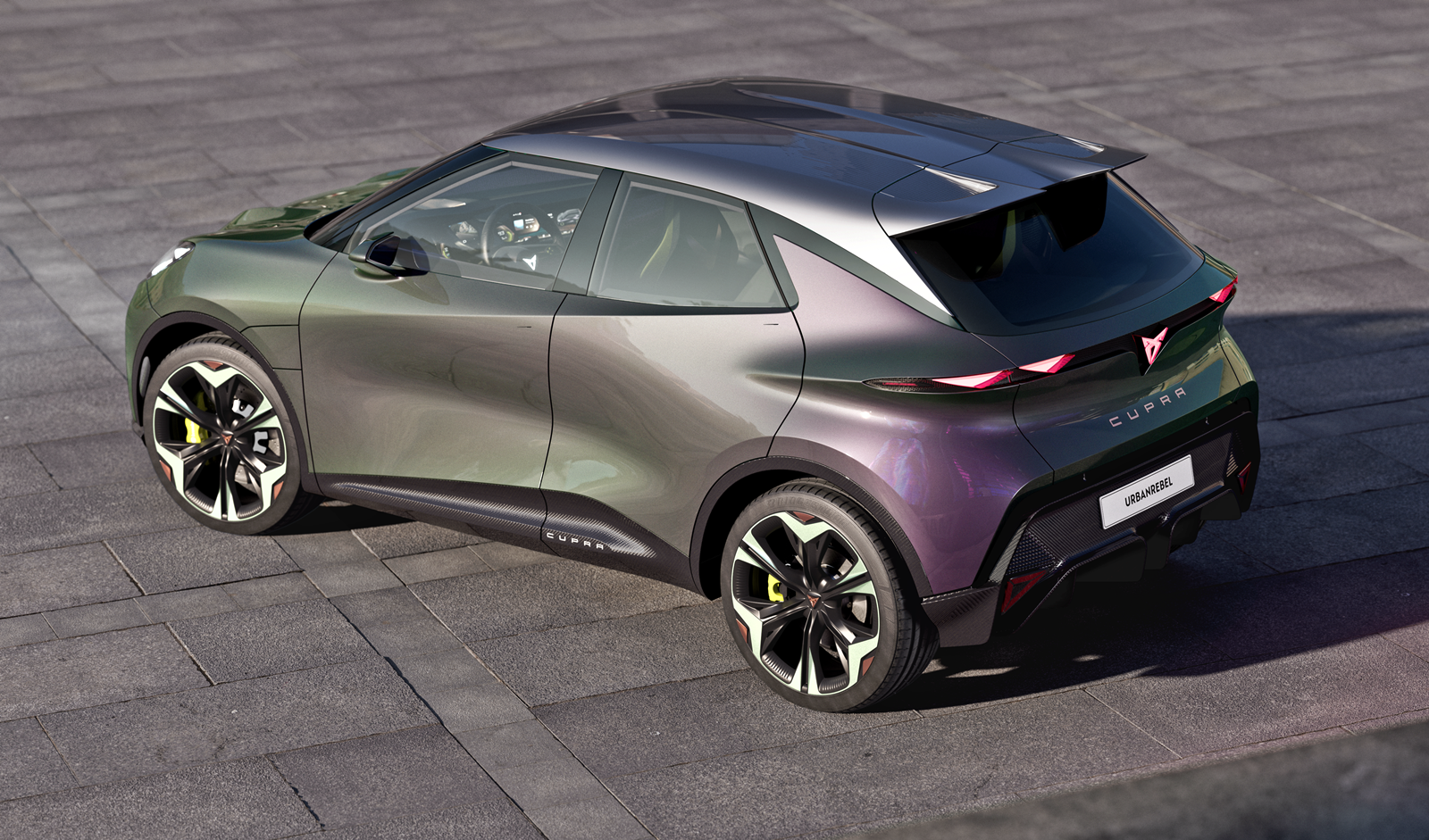
In 2025, the UrbanRebel will be the final model to be launched. Its name suggests that it will take the brand beyond its traditional boundaries. It will have an emotional design and be ‘developed for a more rebellious electric world’, according to CUPRA. The front-wheel drive model will sit on Volkswagen Group’s MEB Small platform.

Measuring 4030 mm long, the vehicle has sustainability at its core, integrating advanced recycled polymers and bio-based materials to push the boundaries of what is achievable, and delivering a more environmentally-conscious vehicle. It mixes 3D printed and 3D knitted manufacturing approaches with parametric design to improve performance and value perception.

Lightweight design both in the exterior and interior help the vehicle’s 166 kW (226 ps) electric motor propel the urban electric car to 100 km/h in a claimed 6.9 seconds. The battery pack will have energy to give a range of up to 440 kms.

CUPRA URBAN REBEL EV 2025

CUPRA URBAN REBEL EV 2025

“The CUPRA UrbanRebel will be the biggest project for our company in the upcoming years since it is key for our transformation as a fully electric brand. We are leading the cluster development, the family of vehicles that will democratise sustainable urban mobility, for different brands within the Volkswagen Group,” said Werner Tietz, Vice-President for Research & Development at CUPRA.

During the impulse event, CUPRA’s CEO also hinted at the future versions of the current range which consists of the Leon, Formentor and Born, to be renewed by 2025.

CUPRA is first carmaker to join new EXTREME E off-road championship

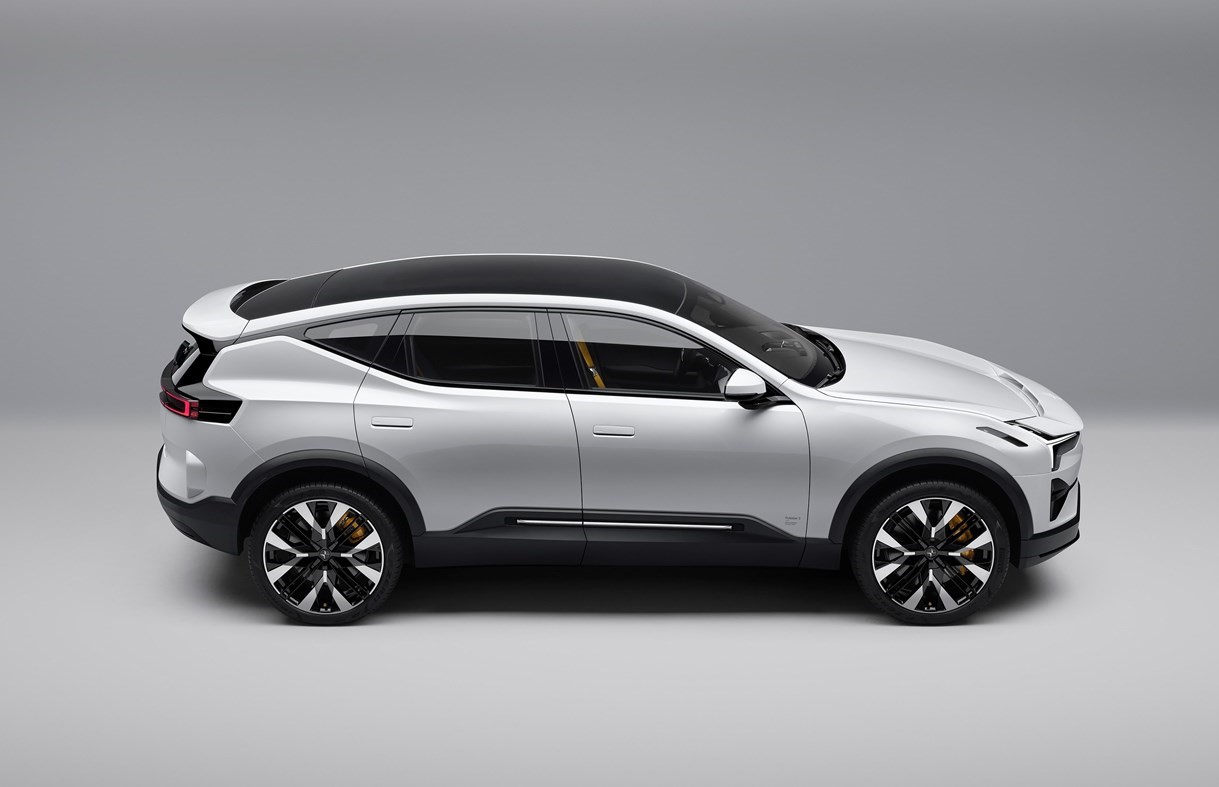
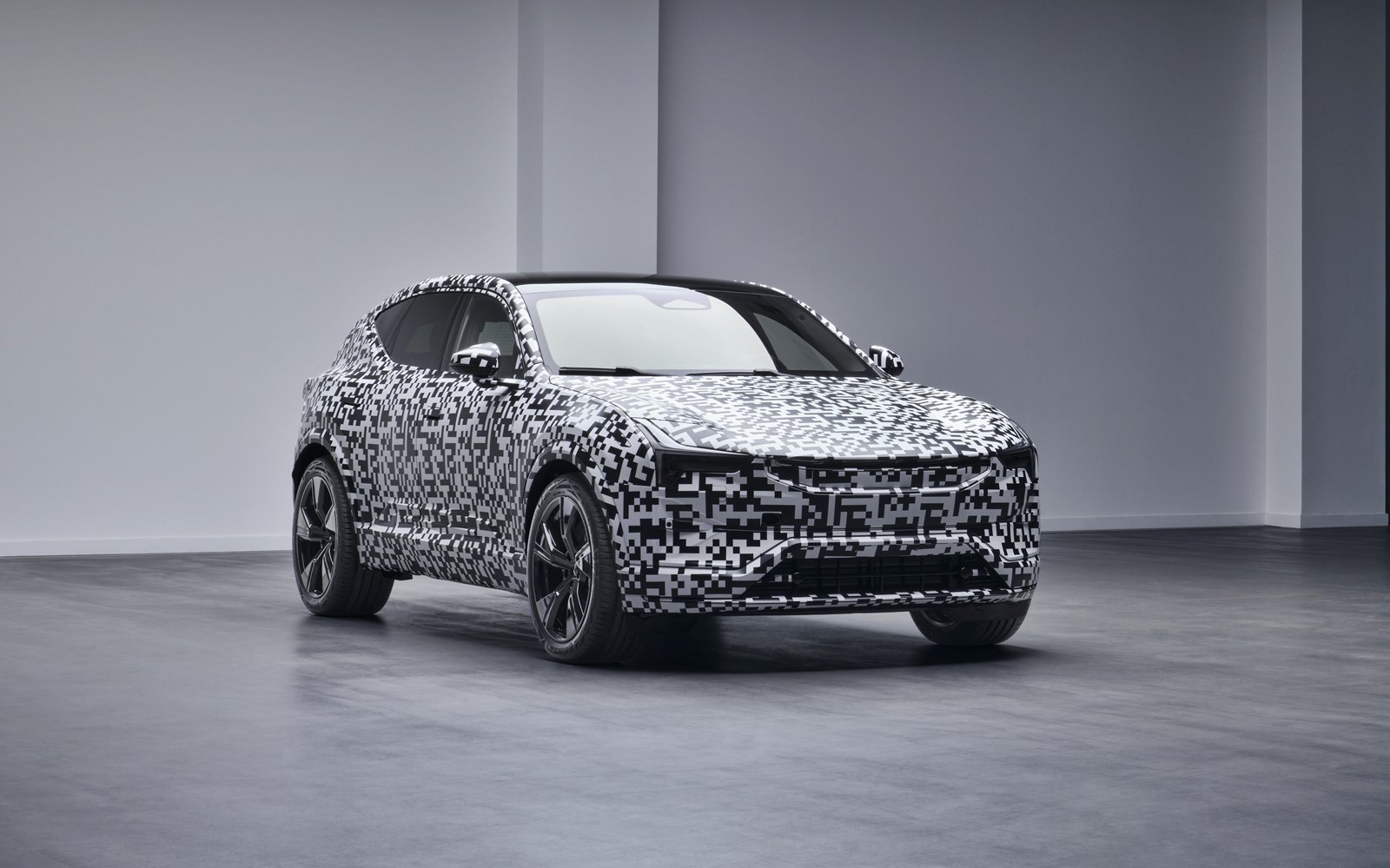
Polestar, the Swedish car company which makes and sells on battery electric vehicles (BEVs), will hold the world premiere for its next model, the Polestar 3, this October. This will be a SUV, the company’s first, and reflects the significance of the segment which is the most competitive today. Polestar will be entering one of the highest margin and growth segments in the automotive industry, particularly in the USA.

Customers can expect to order Polestar 3 in initial launch markets from the day of the premiere. Production is expected to begin in early 2023, and besides China, the model will be manufactured in the USA. This follows carmakers like Mercedes-Benz and BMW which set up factories for their first SUVs in the USA in the 1990s.

“This is a major milestone for our company, one that boosts our growth trajectory and takes us into our next phase,” said Thomas Ingenlath, Polestar’s CEO. “Polestar 3 is the SUV for the electric age. Our design identity evolves with this high-end large luxury EV, with a strong, individual brand character. With this car, we bring the ‘sport’ back to the SUV, staying true to our performance roots.”

The company said that Polestar 3 will, over time, offer autonomous highway piloting powered by the best-in-class LiDAR sensor from Luminar and centralized NVIDIA computing power. At launch, it will have a dual-motor drivetrain for all-wheel drive and a large battery, with a range target of over 600 kms.

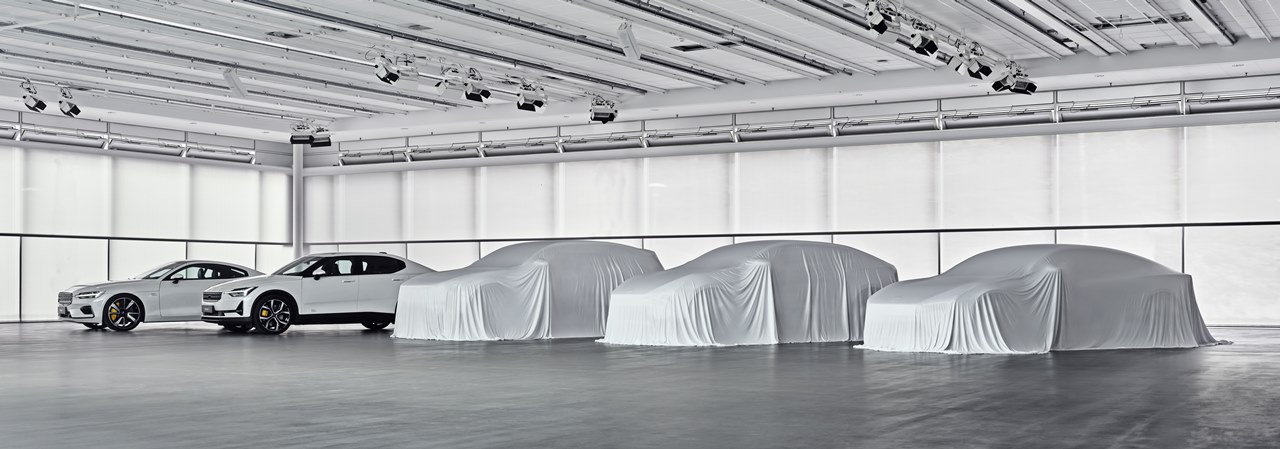
Polestar plans to launch a new model every year for the next 3 years, starting with Polestar 3. Polestar 4 is expected to follow in 2023, and it will be a smaller SUV coupe. In 2024, the Polestar 5 performance 4-door GT is expected to debut as the production evolution of Polestar Precept.

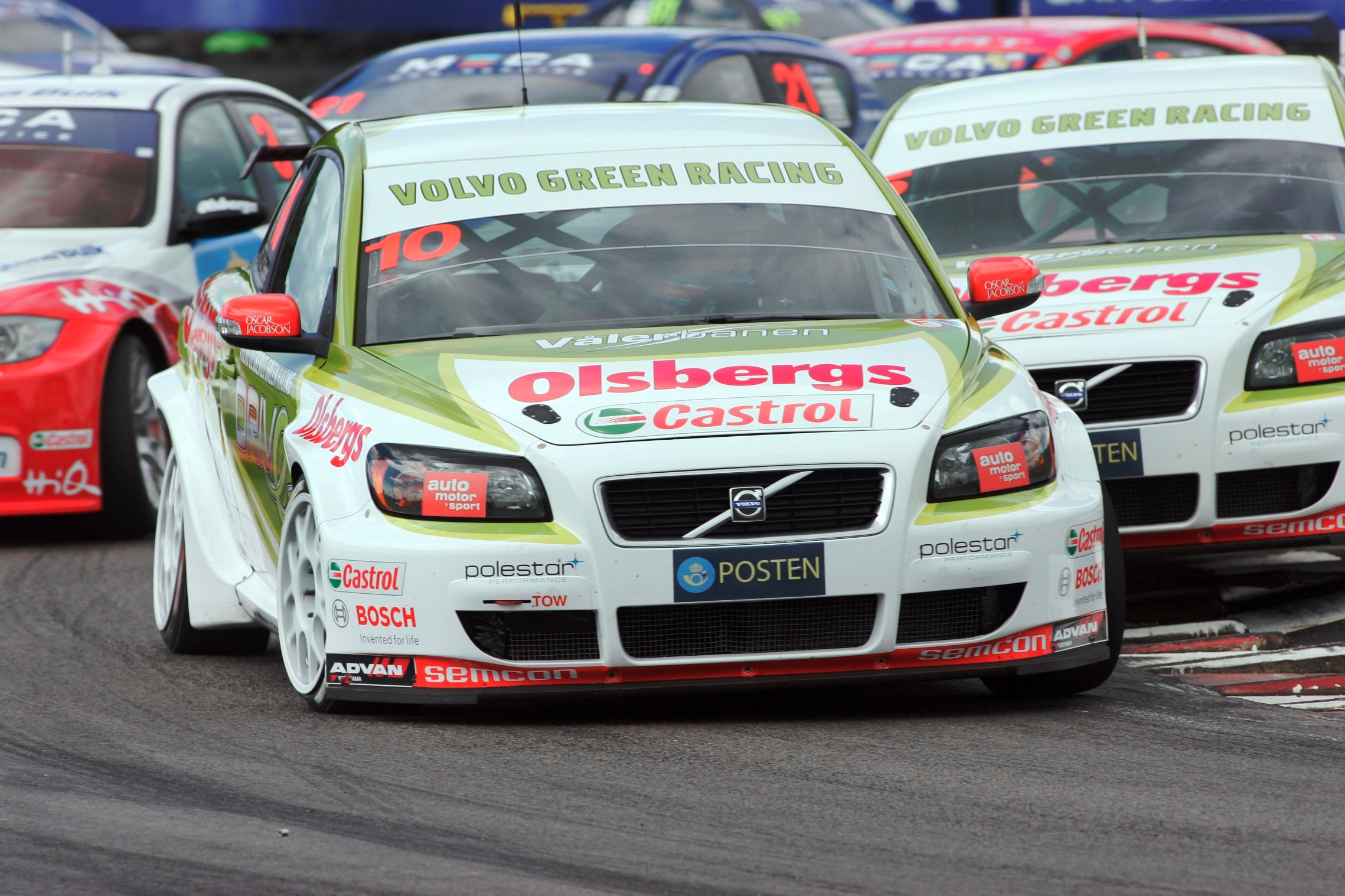
While Polestar is a recognised carmaker today, its origins were rather unusual as it started off as the name of a racing team in 1996. It gained prominence in the Swedish Touring Car Championship running Volvos and by 2015, Volvo Cars decided to take it in and give it a role involving high performance products.

The Polestar name first appeared with a successful racing team running in the Swedish Touring Car Championship with Volvos.

With Volvo Cars being acquired by the Geely Group in 2010, Polestar also became part of the group while its racing activities have been run by Cyan Racing. Under the Geely Group, Polestar grew further and besides developing and selling electric performance cars, it offers performance hardware upgrades and engine software optimisations for Volvo models through their Polestar Engineered division.

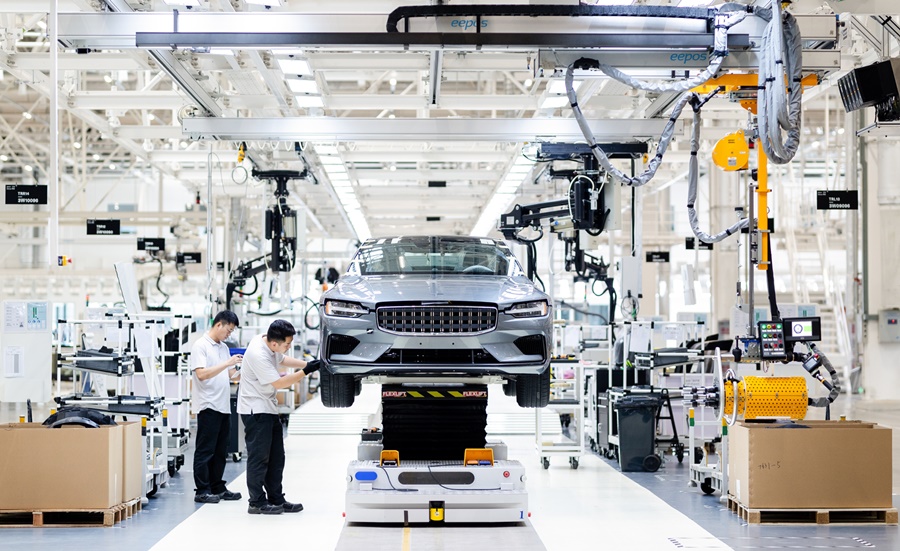
Polestar also functions as an innovation lab for Volvo Cars, developing designs and technologies. Being part of a huge group, Polestar enjoys technological and engineering synergies and benefits from significant economies of scale as a result, as well as sharing resources. Polestar has production facilities in China, and as mentioned earlier, there will be a new factory in the USA to manufacture the new SUV model.

Polestar factory in Chengdu, China.

To date, Polestar has produced two models – the Polestar 1 which was built between 2019 and 2021 as a low-volume electric performance hybrid GT with a carbonfibre body, and the Polestar 2 which sells in larger volumes.

The company plans to increase its presence to at least 30 global markets by the end of next year. This supports its plans to grow ten-fold from global sales of approximately 29,000 in 2021 to approximately 290,000 by the end of 2025.

Polestar O2 concept shows that sportscars will still exist in the electric age

Archive

Follow us on Facebook

Follow us on YouTube