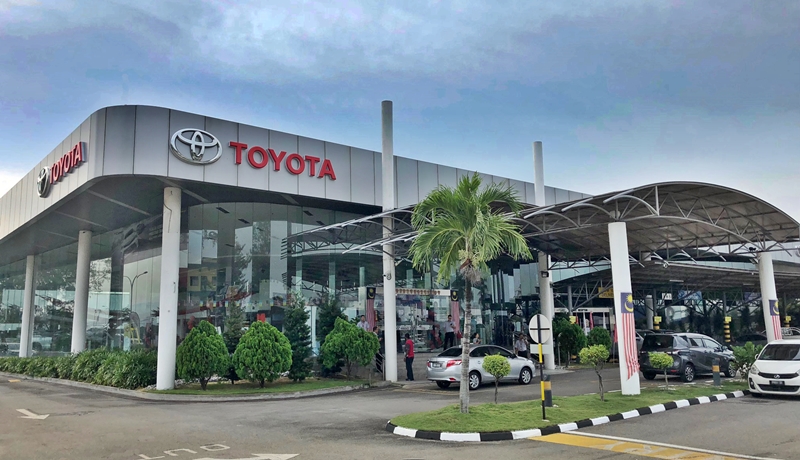
Like many companies in various industries across the country, UMW Toyota Motor (UMWT) is abiding by the requirements of the full Movement Control Order (FMCO), which started on June 1, 2021, by temporarily suspending all its sales and manufacturing operations. However, while all non-essential services remain closed, Toyota and Lexus owners can still be assured of support for vehicle emergencies and breakdowns.
Assistance and support for owners
“The past few weeks have been challenging for all of us. During these difficult times, we at Toyota and Lexus stand with all of you in solidarity in our fight against the pandemic. We have temporarily shut down our non-essential services. At the same time, we understand that during this time of uncertainty, we can still be of assistance and support. This is why we continue to be here for vehicle emergencies and breakdown,’ said Ravindran K., President of UMW Toyota Motor.
Although Toyota and Lexus outlets are closed in compliance with the FMCO, owners can still get emergency assistance by calling the Hotline number below.
Warranty will be extended
He added that all vehicles purchased from UMW Toyota Motor or its authorised dealers nationwide which have warranties that are expiring during this period will enjoy a 30-day extension calculated from the last day of the MCO.
“We are extremely grateful to the Government for taking numerous intervention measures to not only safeguard Malaysians from the threat of the pandemic, but in introducing financial and industrial policies to ensure that the pandemic does not have a too severe impact on the economy. This includes a further extension of the SST (Sales & Service Tax) exemption which we believe has, and will continue, to contribute significantly towards restoring consumer purchasing confidence,” added UMW Toyota Motor’s Deputy Chairman, Akio Takeyama.
Recovering consumer purchasing confidence
UMWT has seen clear signs of consumer purchasing confidence improving with the sales of its Toyota and Lexus vehicles rising for many months now. In May, 7,595 units of vehicles from the two brands were delivered. The volume was largely driven by models such as the Vios sedan which accounted for 32% of sales, followed by the Yaris hatchback (25%) and the Hilux pick-up truck which contributed 21% of the units sold in May.
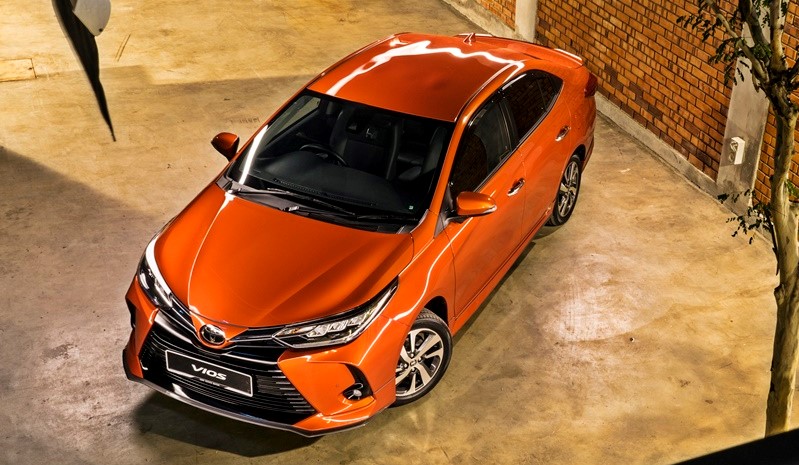
Vios was company’s bestselling model in May, accounting for about a third of total sales.
Mr. Takeyama added that the impact of the pandemic has been both unpredictable and unprecedented, but the introduction of several new models throughout the year combined with the SST incentives for consumers has helped the local automotive industry to navigate the storm in a position of strength.
Meanwhile, Mr. Ravindran said the company will continue to extend service excellence to all customers and continue to introduce numerous sales and aftersales initiatives to assist with savings in these difficult times. “We are here for you. This is an effort that is not only solely on the shoulders of the government, but it involves everyone and all stakeholders. We thank our customers for their continued support and in return, rest assured that we will continue to support you through these challenging times,” he said.
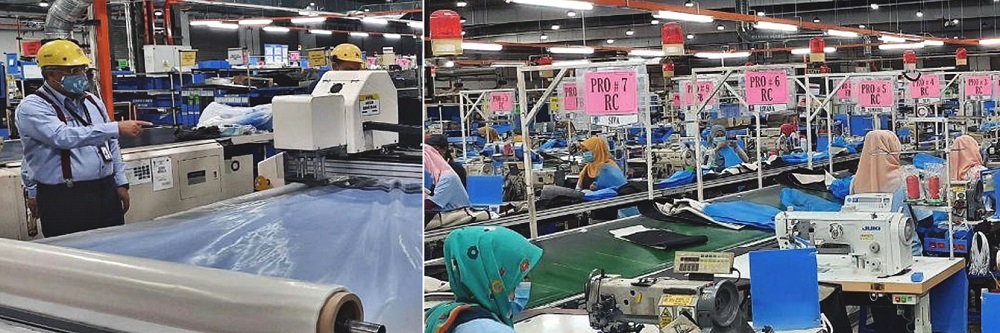
Last year. a subsidiary of UMW Toyota Motor made Personal Protective Equipment (PPE) for frontliners who needed them urgently.
‘Thank you’ to frontliners
UMW Toyota Motor encourages everyone to stay home, stay safe and to take care of one another. It assures all customers that support, where necessary, will be provided during this period. “To all of our healthcare workers and those upholding peace and order in every way big and small, we owe each of you a profound debt of appreciation and gratitude for your selfless service. We would like to say a big ‘Thank You’ you to all of you,” said Mr. Ravindran.
One of the longest running environmental program for Malaysian youth has reached its 20th edition this year. It’s the Toyota Eco Youth (TEY) program organised by UMW Toyota Motor (UMWT) in collaboration with the Ministry of Education.
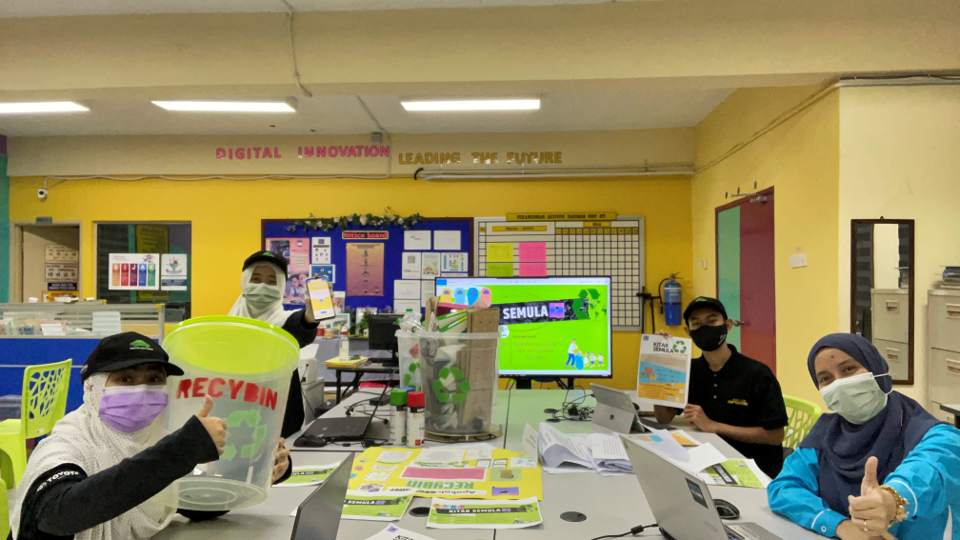
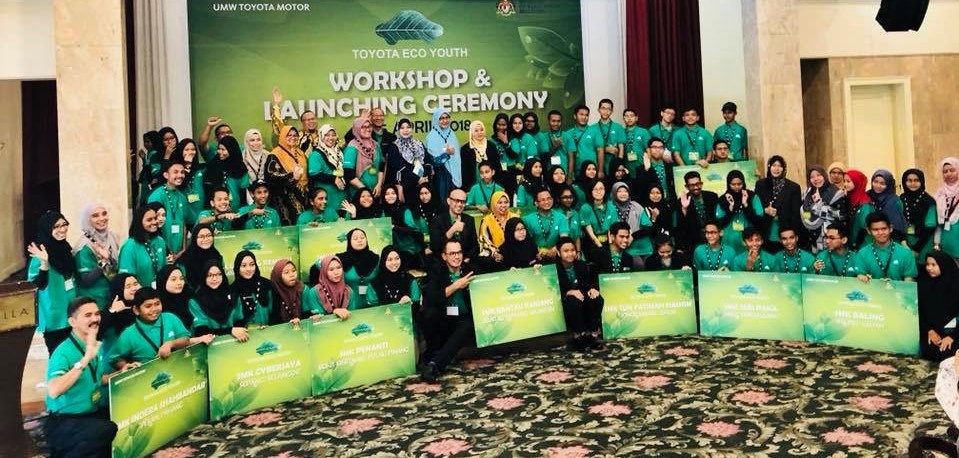
The 20th edition recently came to a satisfying and exciting conclusion with the announcement of the Top 5 winning teams from secondary schools around Malaysia. A total of 16 teams participated in the program which had a revised format and presentation due to the ongoing COVID-19 pandemic. To overcome the new challenges and limitations brought on by the Movement Control Order (MCO), the activities were moved online with interactive e-learning lessons and workshops. In all previous years, TEY activities involved face-to-face interactions but the need for social distancing and to protect each other meant that this approach could no longer be used.
During the online sessions, the participants were trained on project management skills that incorporate Toyota’s Problem-Solving Methodology. This new e-learning approach, conceived within a few months, proved so successful that it will be adopted for future programs.
This year’s program had the theme of ‘Reimagining Mobility’, with the spirit of inclusivity and freedom of ideas as the foundation to this theme which depicts the creation of safe and eco-friendly mobility.
The winning teams
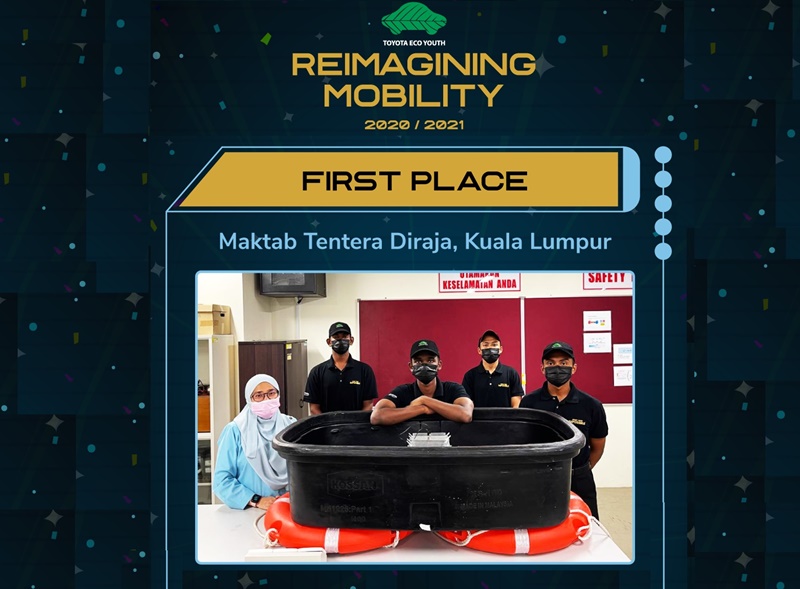
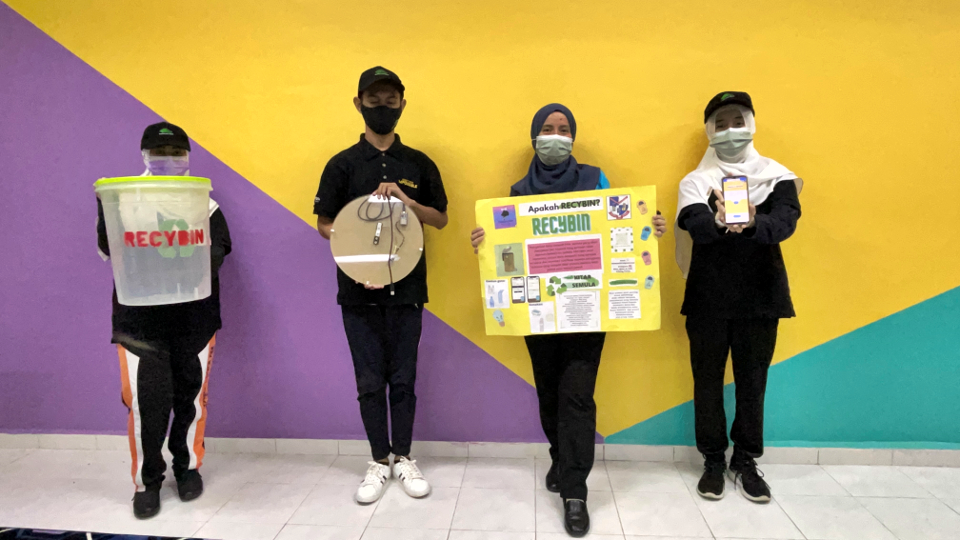
Following the final judging phase after each of the 10 finalists made their respective ‘pitches’ with live presentations on May 29, 2021, the winning teams were chosen. They are, in first place, Maktab Tentera Diraja, Kuala Lumpur (We-Sea-It Smart Tool); second place, SMAP Labu, Negeri Sembilan (UCOnverter Smart Tool); third place, SMK Kubang Kerian, Kelantan (Recybin App); fourth place, SMK Chung Hua, Sarawak (Recyclo Smart Tools), and in fifth place, SMJK Katholik, Selangor (MOSS AFV Smart Tools).
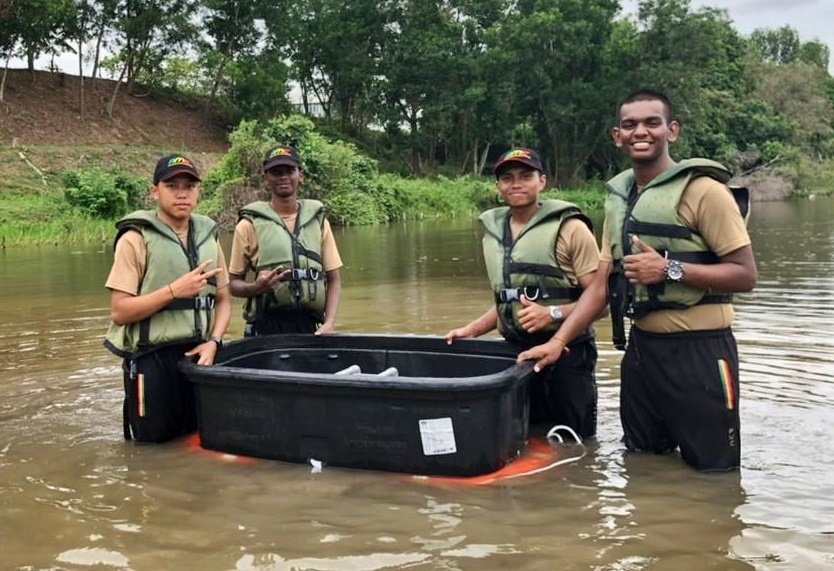
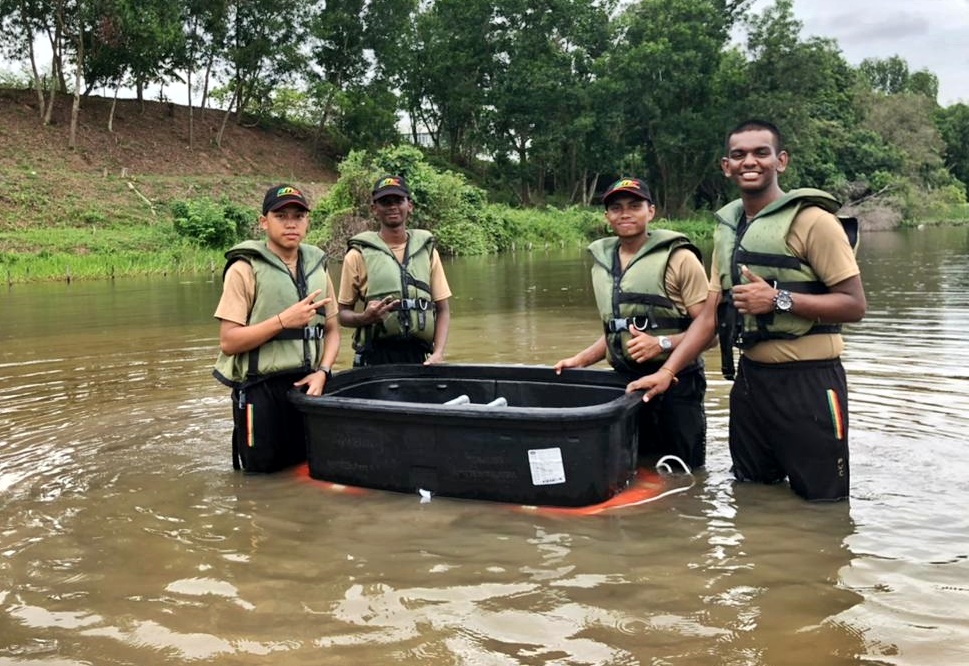
The winning team from Maktab Tentera Diraja with their project that developed the ‘We-Sea-It Smart Tool’ that can help to address microplastics pollution in water sources.
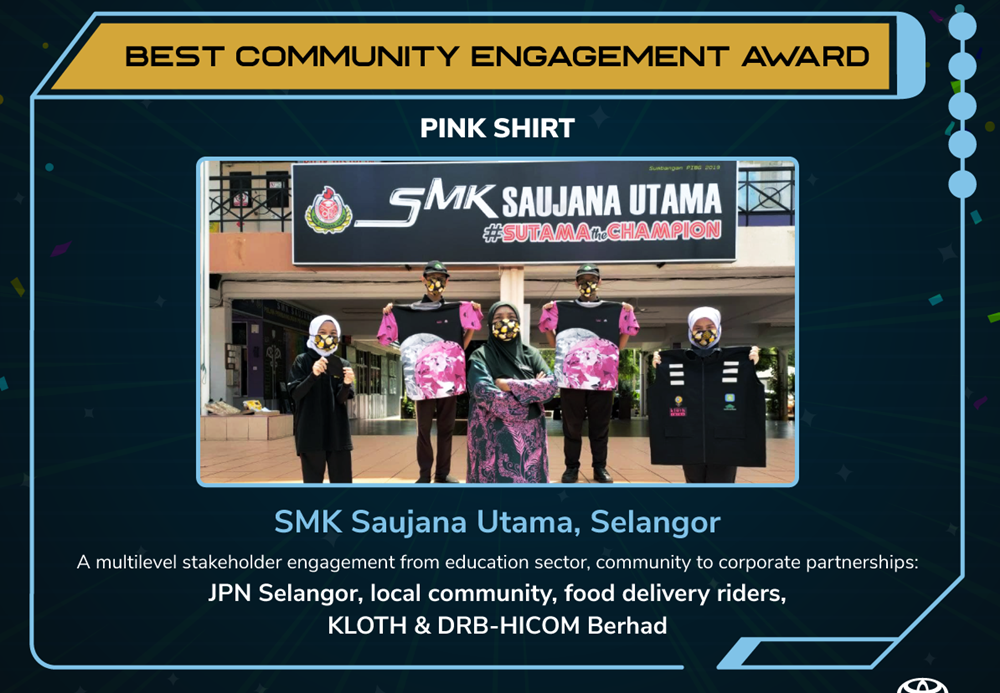
SMK Saujana Utama, Selangor won recognition for the ‘Best Community Engagement’, with Noor Liyana Shamsudin from Maktab Tentera Diraja nominated as the ‘Most Supportive Teacher’. Three students were selected as the Top ‘Agent M’ – Hani Nabila from SMAP Labu, Negeri Sembilan; Lim Bo Jing from SMJK Katholik, Selangor and Muhammad Uwais Darwis from SMK Majakir, Sabah.
Increased prize money
For 2021, the total prize money has been doubled to RM64,000 to further reward ingenuity amongst the youth. This year, the winning team received RM20,000 in cash, followed by RM15,000 for second place; RM 10,000 for third place; RM7,000 for fourth place and RM5,000 for fifth place. The Most Supportive Teacher was rewarded with RM3,000 and RM1,000 each was offered for Best Community Engagement and Top Agent M.
The Closing Ceremony was conducted live via a virtual platform with Dato’ Haji Adzman bin Talib, Deputy Director-General of Education Malaysia (School Operational Sector), Ministry of Education, as the Guest of Honour. Also present for the virtual gathering was Mohd. Shamsor Mohd. Zain, Director of Marketing, UMW Toyota Motor, as well as other senior representatives from the Ministry of Education and UMWT.
Holistic learning experience
“This year’s Toyota Eco Youth program reflected the adaptability of the new generation to embrace technological advancements and take on an innovative approach in solving the environmental problems. The fundamental training which is the Toyota Problem-Solving methodology was done virtually and I’m proud to say that all students were extremely receptive towards it,” said Encik Mohd Shamsor.
“Throughout the program, with the guidance of teachers and mentors, the participants would have learnt team spirit, confidence, communication, presentation skills, all of which encompass a more holistic learning experience,” he added.
The well-thought proposals of the 16 teams were posted on social media channels for the public to view. Additionally, each team developed a podcast episode presented on the TEY Channel in two platforms – Agency on Leaderonomics FM and On TEY Channel.
Winners continue involvement
For the winners, the program does not end, as it did in previous years. The duration of the program will now be for 3 years and the winners from the 2020/2021 edition will continue as facilitators for the following year’s batch. They will thus be able to contribute their experience to the next batch. At the same time, digitalization of TEY is taken up a notch by setting up a TEY Apprentice online club.
About the Toyota Eco Youth program
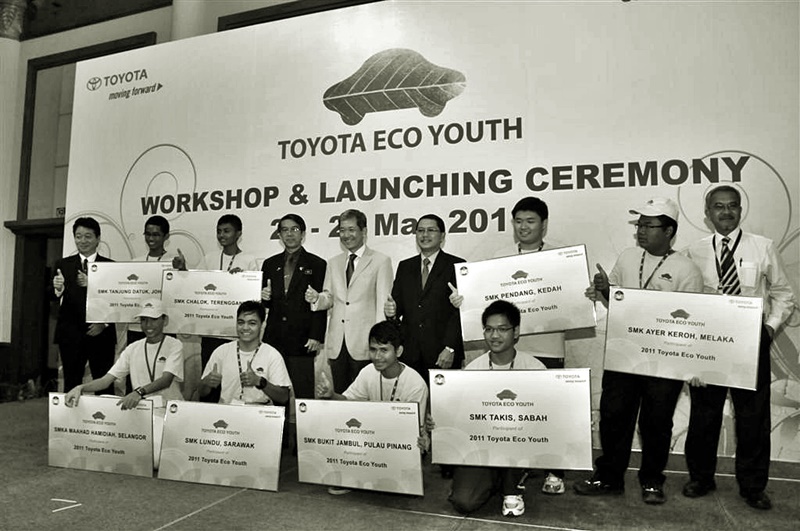
Over the course of two decades, participants in the TEY have included 258 schools, 1,910 secondary school students and 762 teachers. Each year, challenging and interesting themes have been provided, and participants have come up with interesting, innovative solutions and proposals applicable to their school or community. Over RM7 million has been spent by UMWT to run the program annually.
“Toyota Eco Youth is a unique event in the Toyota world. Toyota Motor Corporation and UMW Toyota Motor are proud to be playing a part in cultivating environmental consciousness and innovative thinking for the young generation. It is assuring to know that the next generation will be ready to face new challenges that arise as we all strive to make our planet a better place for everyone,” said Akio Takeyama, Deputy Chairman of UMW Toyota Motor.
The Toyota Eco Youth (TEY) Program began 20 years ago and has become an annual event which UMW Toyota Motor (UMWT) continues to run. Even the ‘new normal’ brought on by the COVID-19 pandemic did not dampen UMW Toyota Motor’s efforts to cultivate environmental consciousness among Malaysia’s younger generation.
Spirit of inclusivity and freedom of ideas
For its 20th year, the event has an aptly coined theme – Reimagining Mobility – to promote the spirit of inclusivity and freedom of ideas as the foundation for creation of safe and eco-friendly mobility, despite the challenges of the pandemic.
Digital/online platform
In view of the pandemic conditions, the format has been revised to run on a fully online platform. Launched in January 2021 (for secondary school students aged 13 – 16 years old), it attracted the participation of 282 teams from 177 schools, the highest ever participation recorded by the program.
The adaptability of the program into a digital/online platform has included interactive e-learning lessons and workshops which proved to be highly effective. All in all, school teams were able to showcase their ideas through impressively produced videos and online presentations.
Since last December, 16 shortlisted teams have been formulating their proposals which were posted in social media channels for the public to view. Additionally, each team developed a podcast episode presented on Spotify.
The final judging phase in April saw 10 finalists being selected and the winning teams will be chosen after making their respective ‘pitches’ through live presentations on May 29, 2021.
Waste and recycling themes
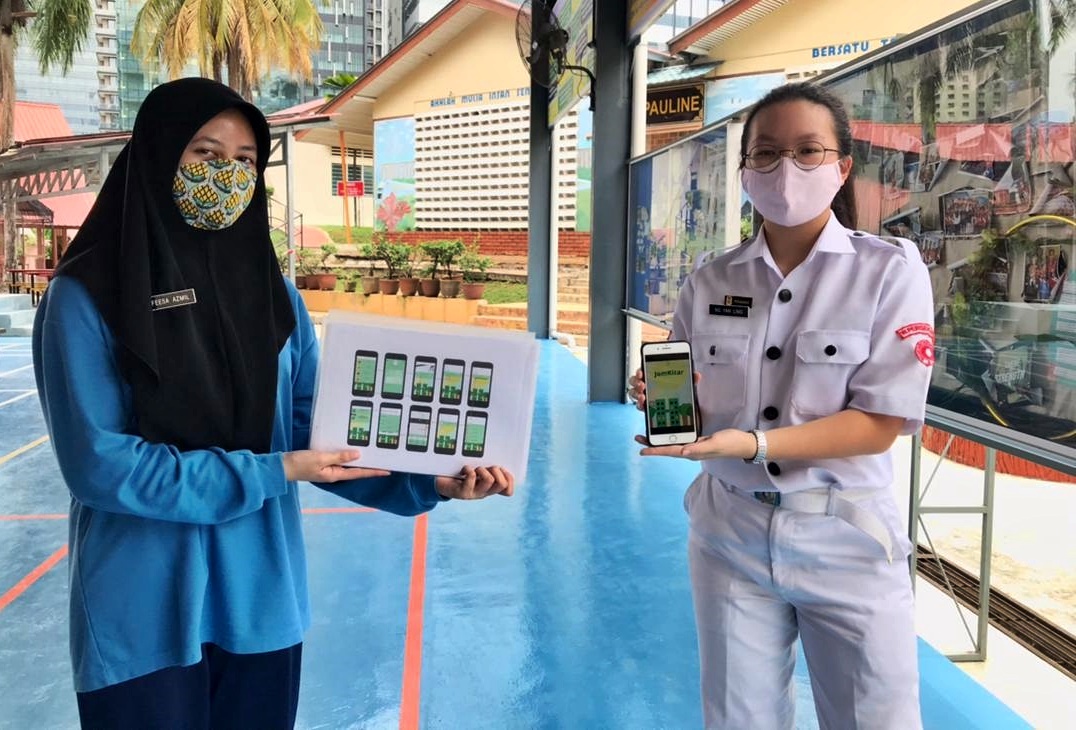
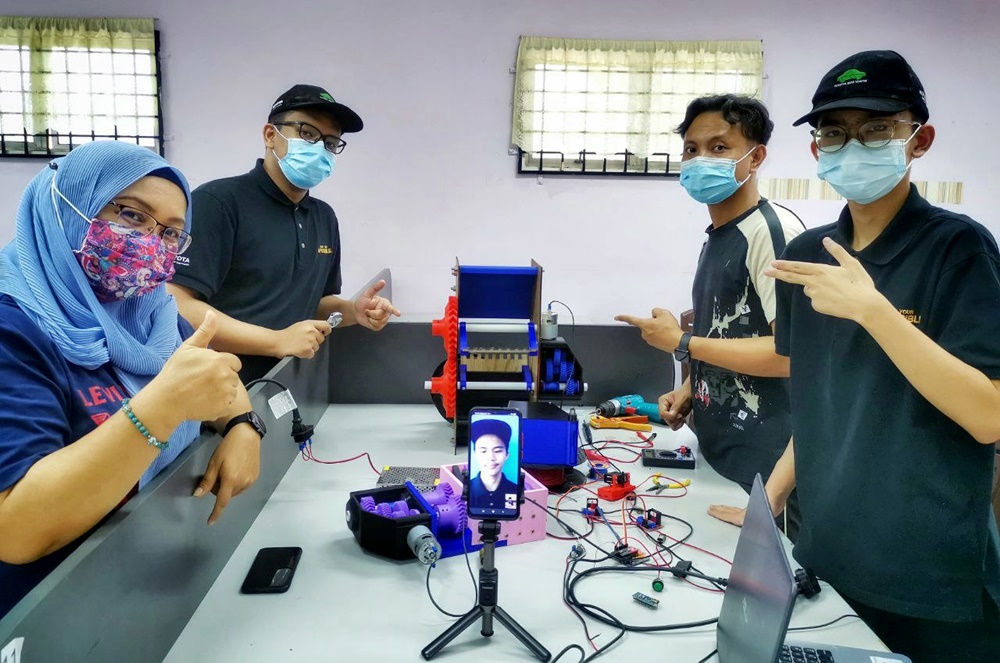
Addressing the issue of waste and recycling were popular themes for the proposals. Showcasing impressive capability for innovation and advanced technology, many schools put forward ideas for digital smart tools, supported by carefully built prototypes.
Prize money doubled
“As always, we are highly impressed by the quality of the projects and the innovative ideas proposed. It is never easy for our judges to choose the best as everyone is a winner in their own way,” said President of UMW Toyota Motor, Ravindran K.
This year, UMWT has doubled the prize money to further reward ingenuity amongst the youth. Winning teams stand a chance to win cash prizes from a RM64,000 prize pool.
About the Toyota Eco Youth program
The program began 20 years ago in collaboration with the Malaysian Ministry of Education. Over the course of two decades, 258 schools, 1,910 secondary school students and 762 teachers. Have participated.
Each year, challenging and interesting themes have been provided, and participants have come up with innovative solutions and proposals applicable to their school or community. Over RM7 million has been spent by UMWT to run the program annually.
An annual event that has the participation of secondary schools from all over the country.
“Toyota Motor Corporation and UMW Toyota Motor are proud to be playing a part in cultivating environment consciousness and innovative thinking for the young generation. This year, we are pleased to share our vision for mobility with these students. It is assuring to know that the next generation will be ready to face new challenges that arise as we all strive to make our planet a more mobile and inclusive place for everyone,” said Akio Takeyama, Deputy Chairman of UMW Toyota Motor.
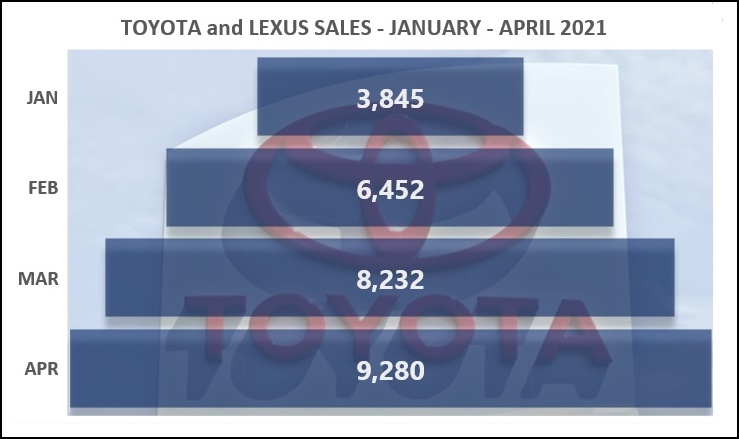
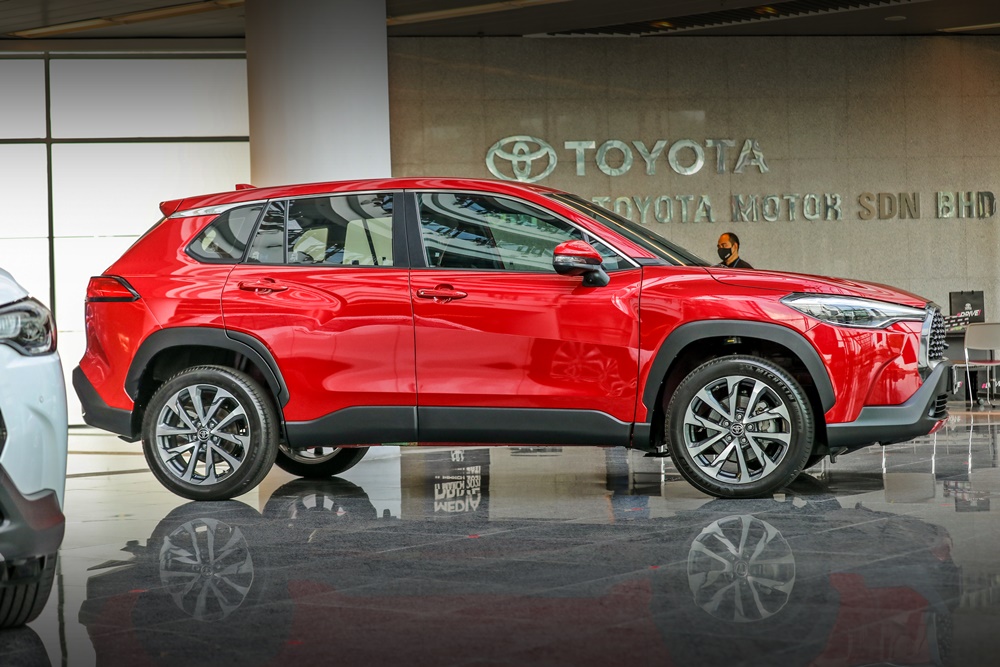
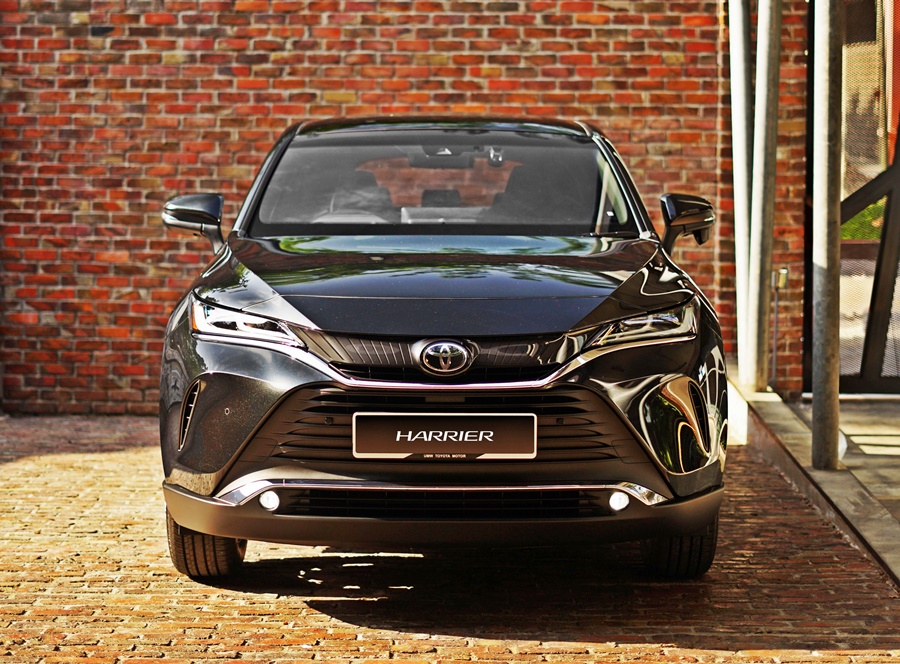
UMW Toyota Motor (UMWT) reported that it started off the second quarter of 2021 with strong sales of 9,280 vehicle for the Toyota and Lexus brands, a 12.7% increase over the number of vehicles delivered in March. The rising sales volume was largely driven by restored consumer purchasing confidence, with growing demand for the appealing new models such as the Corolla Cross and Harrier.
Furthermore, with the PENJANA sales tax exemption set to expire at the end of June this year, many are also not wasting the chance to save money.
Measures helping restore confidence
“The COVID-19 pandemic has resulted in an extremely challenging year for both manufacturers and consumers, but measures put in place by the Government has successfully restored and strengthened consumer purchasing power,” said Akio Takeyama, Deputy Chairman of UMW Toyota Motor.
He also attributed the growth in sales to the timely introduction of numerous new models that have been able to firmly establish new benchmarks in the various vehicle segments by enhanced technological and safety features, styling and driving dynamics.
Latest Corolla Cross and Harrier (below) helped boost sales in April.
Network expansion continues
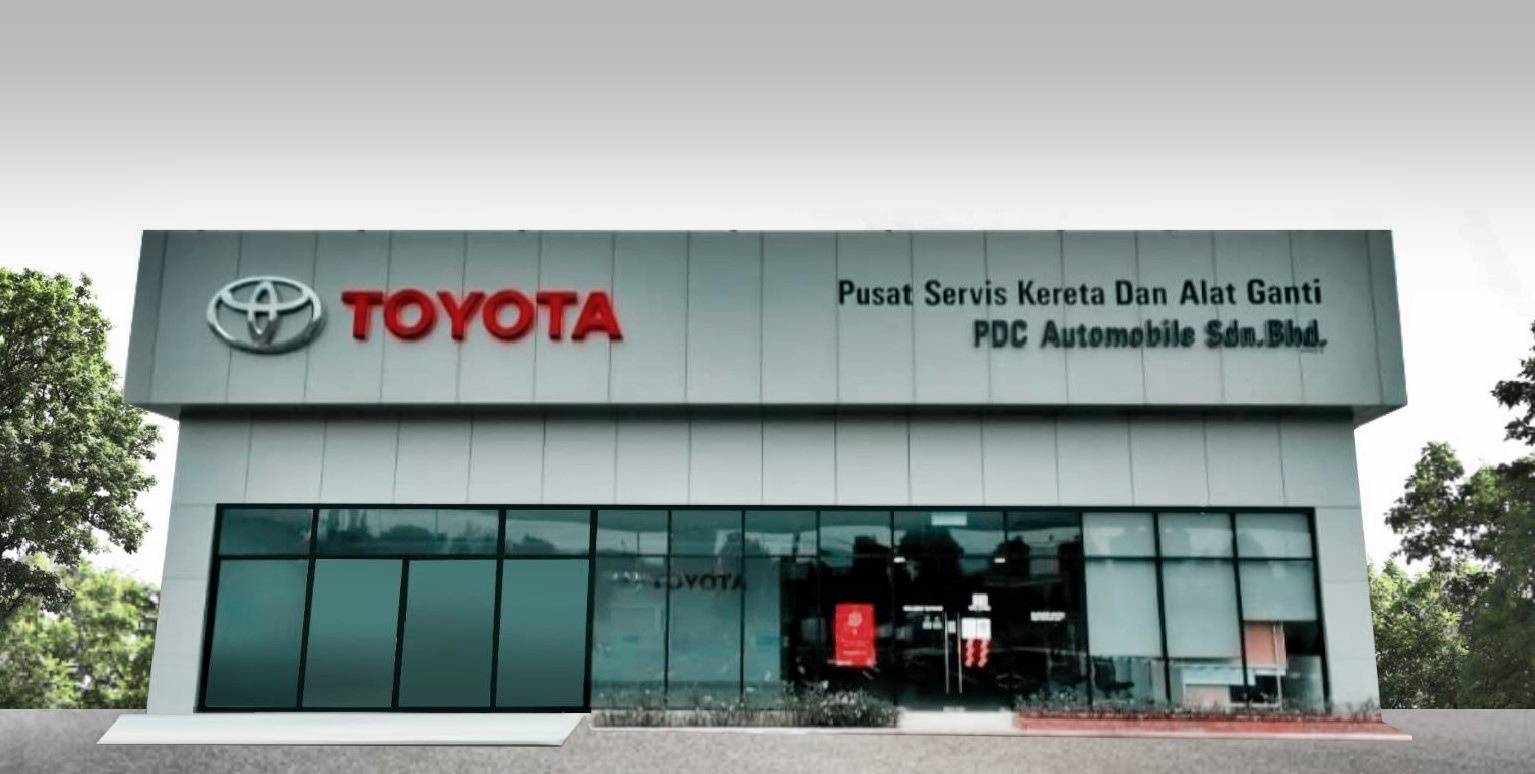
Although business may seem slow for now due to the pandemic, UMWT is not sitting still and preparing for the future with continued commitment for expansion and the enhancement of its sales and aftersales service network. It has opened a new 2S Sales and Service Centre in Cheras (PDC Automobile) and two new 3S Sales, Service and Spare Parts Centres in Johor Bahru and Terengganu.
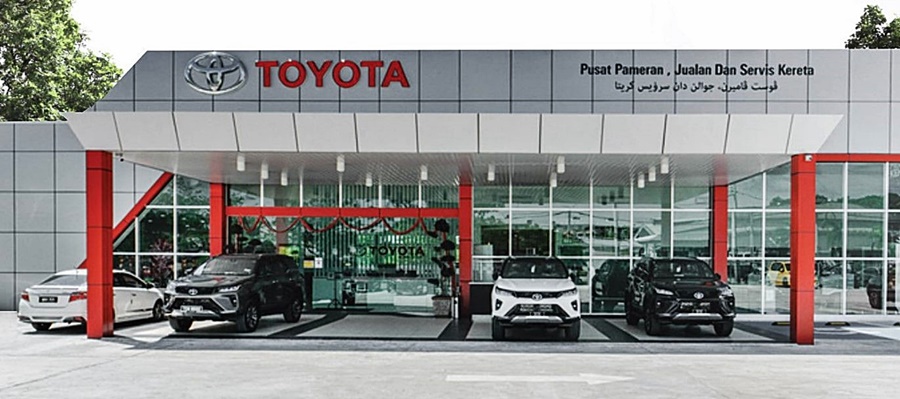
New Toyota 3S dealership in Kemaman, Terengganu.
“Additionally, we have also been paying close attention to customers’ inclinations for online connections as indicated by strong digital preferences and gains that we have received through online enquiries and bookings. We will continue our assertive pursuit on digitally-led avenues and serve our customers better on all platforms, moving forward,” said Ravindran K., President of UMW Toyota Motor.
Hari Raya Aidilfitri promotions
With the Hari Raya Aidilfitri festive period underway, UMWT has a Countless Rewards promotion which offers customers will continue savings that can be enhanced with Toyota Service Savers that lower maintenance cost for their vehicles. New car buyers can also opt to benefit from lower instalments (depending on model) with UMWT’s EZ Beli financing scheme.
Mr. Ravindran added that UMWT’s annual Hari Raya Festive Film titled ‘Umi Pembaris’ will be released this week. “It honours timeless lessons on family values, culture and tradition that we keep ever so closely to our hearts even in this age of change, transformation and modernization,” he said.
For more information on Toyota models available in Malaysia and the locations of showrooms nationwide, visit www.toyota.com.my.
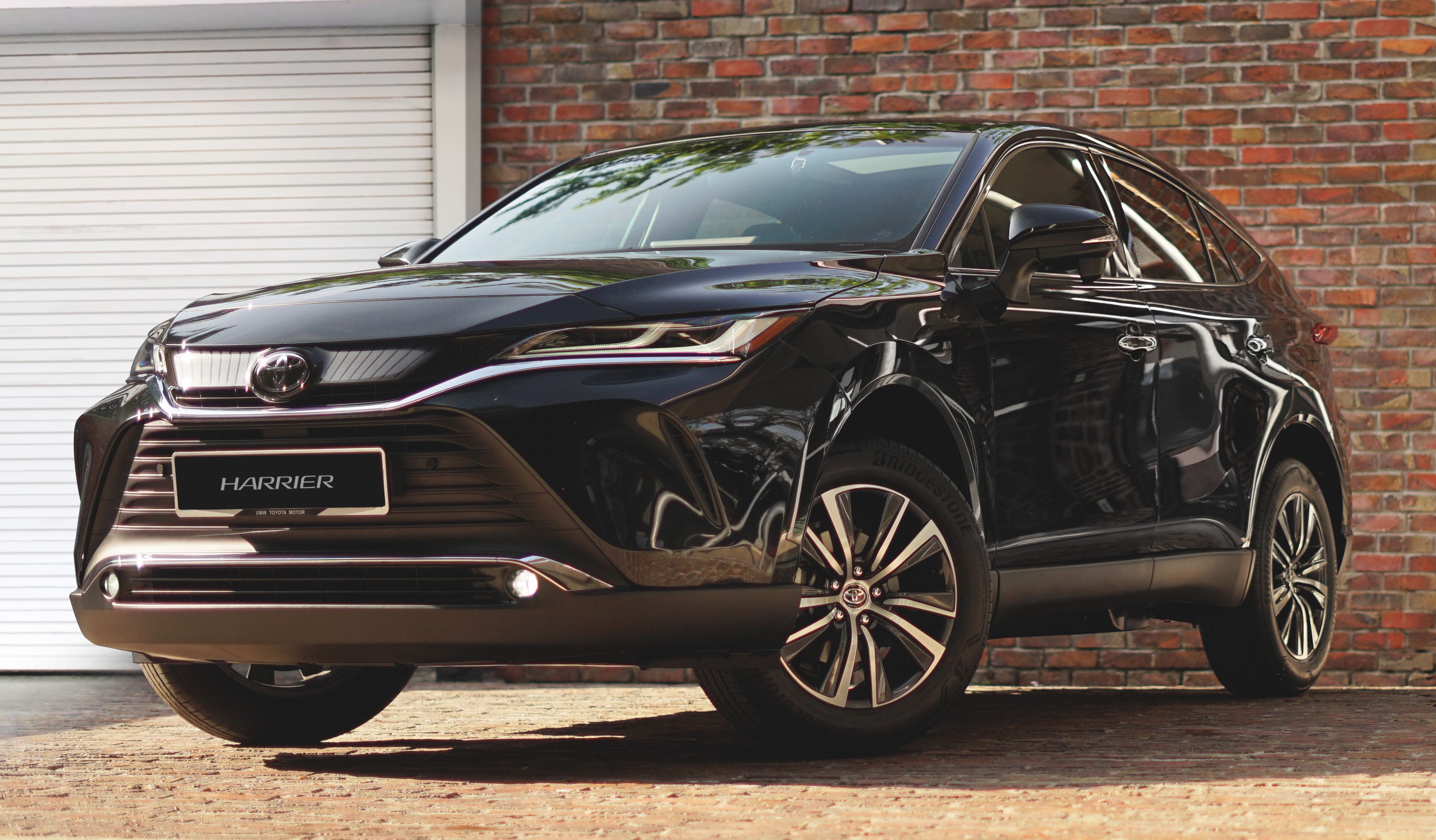
While the Lexus RX is often regarded as the model that took SUVs into the premium segment, its sister model, the Toyota Harrier, also did the same. The only thing was that while the RX was marketed globally, the Harrier was primarily for the Japanese domestic market as the Lexus brand was not introduced there in 1997 when the RX was launched. However, in a number of places, including Malaysia, the Harrier was brought in by private importers and became very popular. It was never officially sold by UMW Toyota Motor (UMWT) until 2018 and with the popularity built up over 20 years, it met with strong response with initial shipments from Japan quickly sold out.
First three generations of the Harrier.
Today, the all-new fourth generation is officially launched with a price of RM249,706.50, excluding insurance for registration in Peninsular Malaysia. Only the 2.0 Luxury version is available, and customers can choose from 5 exterior colours (extra charge for White Pearl CS and Precious Black colours).
5-year warranty and aftersales support assured
According to UMWT, Malaysia is one of only two countries outside Japan where the new Harrier is sold officially with full warranty and aftersales support. The 5-year unlimited mileage warranty and assurance of parts and service are something that were not available from private importers which has been a strong selling point for the model. Furthermore, the company also provides owners with Toyota 24 Seven Road Assist for peace of mind.
Like other recent Toyota models, the new generation (incidentally, Lexus no longer shared the model since the previous generation and the Harrier is an independent development), is designed around Toyota’s New Global Architecture (TNGA) with the GA-K platform. TNGA’s versatility and flexibility allows it to be used for sedans like the Corolla and also SUVs like the RAV4 and Harrier, and even electrified models like the Prius. Besides creating a highly rigid body structure, the centre of gravity is also lower which enhances stability, handling, agility and ride comfort.
Wider but lower body
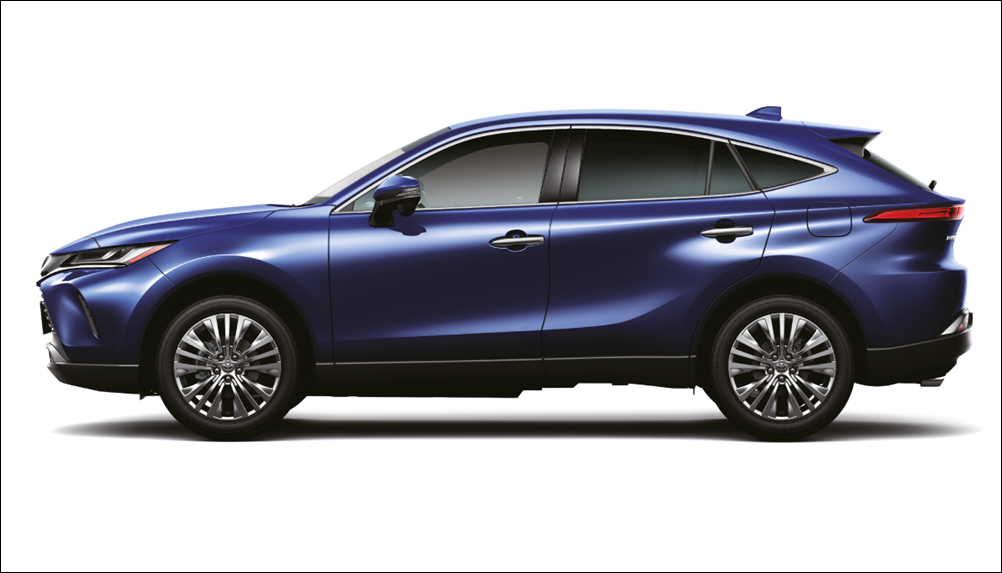
The overall size of the new Harrier is almost the same as before but the width has gained 20 mm while an extra 30 mm has been added to the wheelbase, both increases obviously benefitting interior space. Although there is still good ground clearance, as would be expected of a SUV, the overall height is now 30 mm lower.
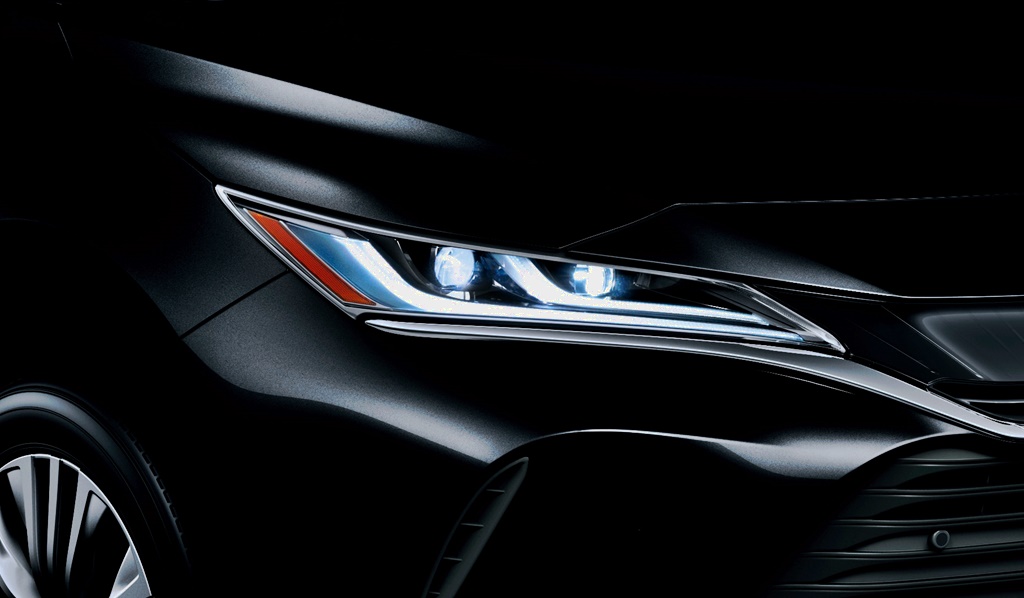
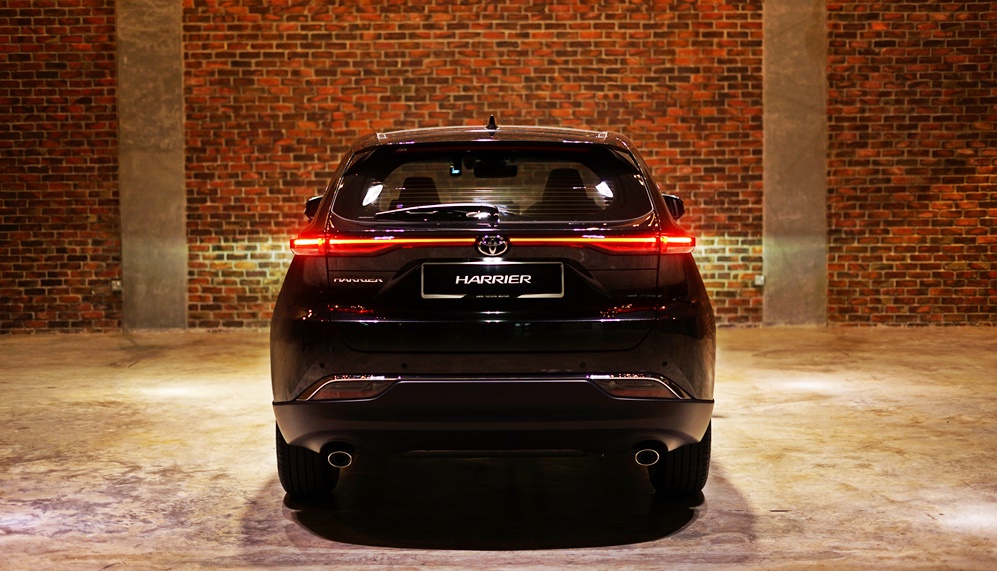
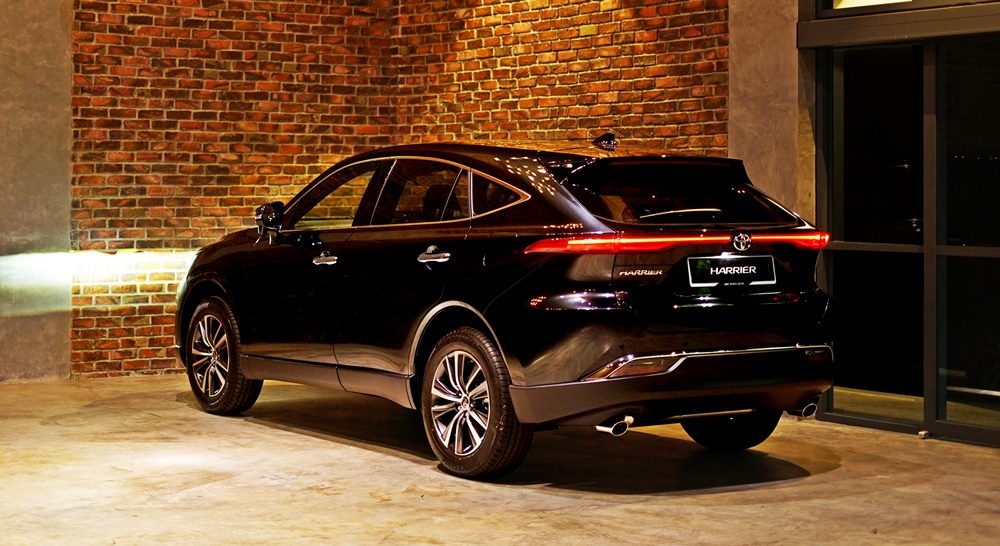
The profile follows the same coupe-like form with a design concept Toyota calls ‘Dignified Elegance’. The front end has a sharper appearance with the eye-catching slim Bi-LED headlamps on either side. The L-shaped Daytime Running Lights (DRLs) also provide a strong and distinctive visual signature apart from enhancing daytime visibility. The rear has a clean design, defined by a thin LED strip for the full width, while twin exhaust pipes with oval baffles add a sporty touch.
‘Dignified Elegance’
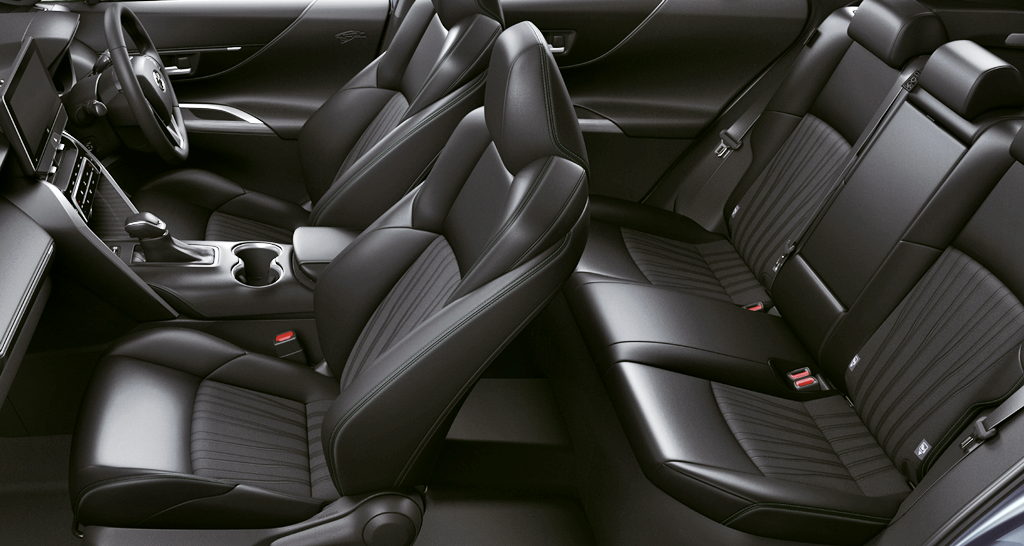
The ‘Dignified Elegance’ concept is also adopted for the interior which gets a more premium feel. The occupants are welcomed with the Illuminated Entry System at the front door sills which is complemented by blue LED illumination inside. Premium materials used include thick black leather with woodgrain and silver ornamentation.
Any driver should be able to get the right and comfortable seating position with 12-way power adjustment for the seat, and for ease of getting in and out, the steering wheel automatically rises out of the way when the engine is switched off and the door opened.
The Automatic Dual-Zone Air Conditioning system has nanoeX technology which generates ions. First introduced with a previous generation of the Camry, nanoeX technology is known to deactivate viruses which is, of course, a very welcome feature in these times. It also keeps the air fresh and clean.
High-tech features
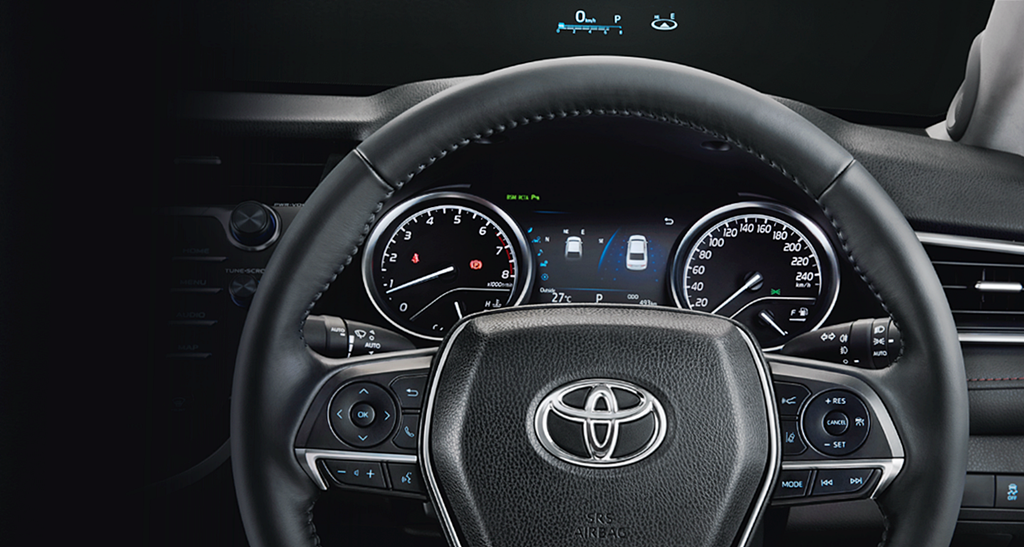
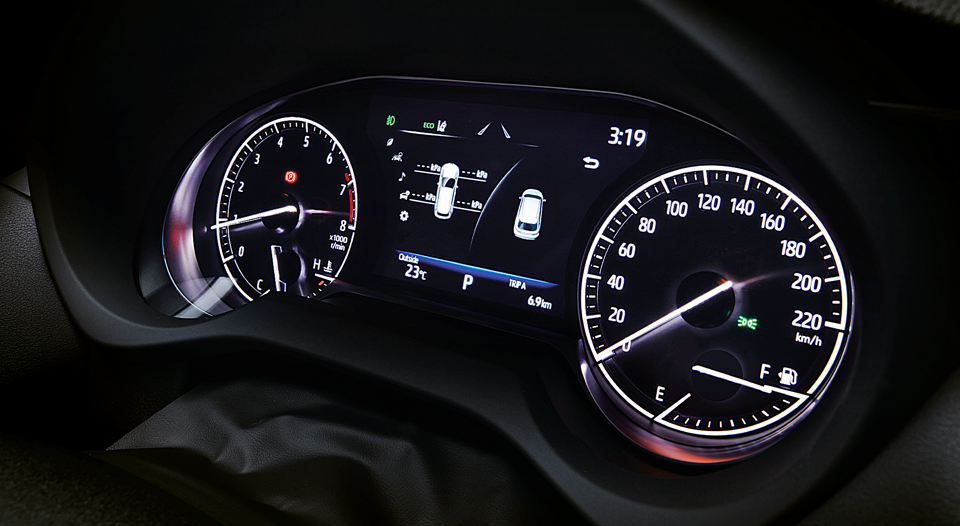
Besides the bright and clear Optitron instrument panel, the driver can also refer to the standard Head-Up Display (HUD) which is projected on the windscreen. Information show includes road speed, gear position, Driving Support System (directions, ACC display, LDA Display, Parking Sensor), audio mode with song titles, and warning alerts. That’s certainly a lot more than the early HUDs which showed only the speed.
The new Harrier has Panoramic Sunroof with electrochromatic glass which can alter the intensity of light passing through at the touch of a switch. The effect is like that of traditional paper windows found in Japan, enhancing comfort. The glass panels cover almost the entire length of the roof so a lot of light can be allowed in when sunlight conditions are not too harsh or at night.
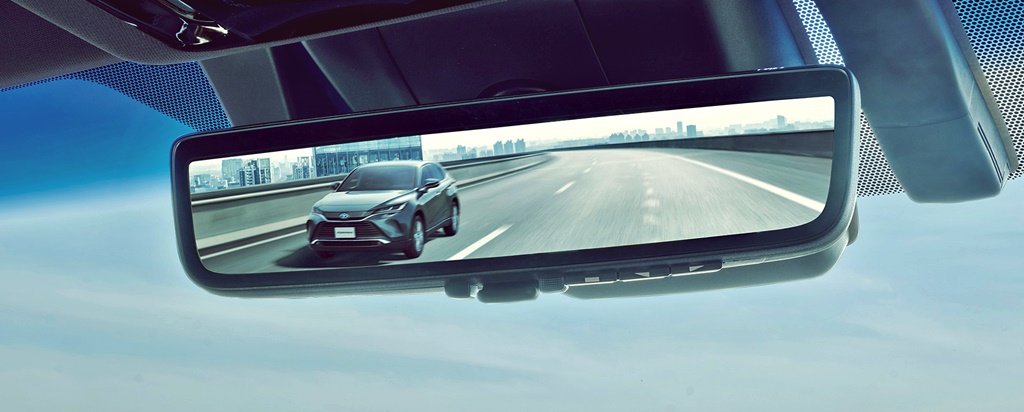
The other high-tech feature is the new Digital Display Rear View Mirror. This shows live images from a wide-angle high-definition camera at the back to give greater night-driving clarity and eliminates glare from oncoming headlights.
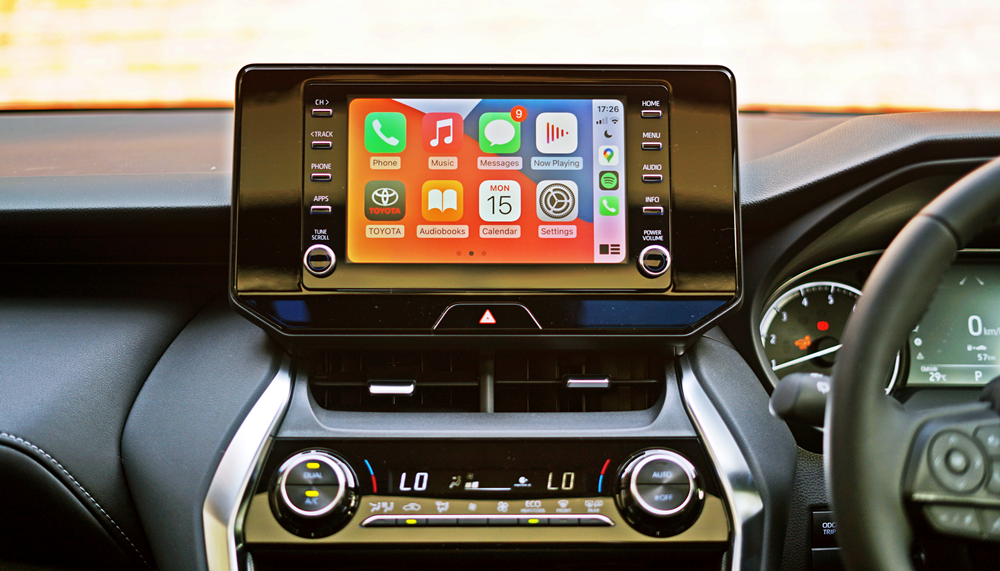
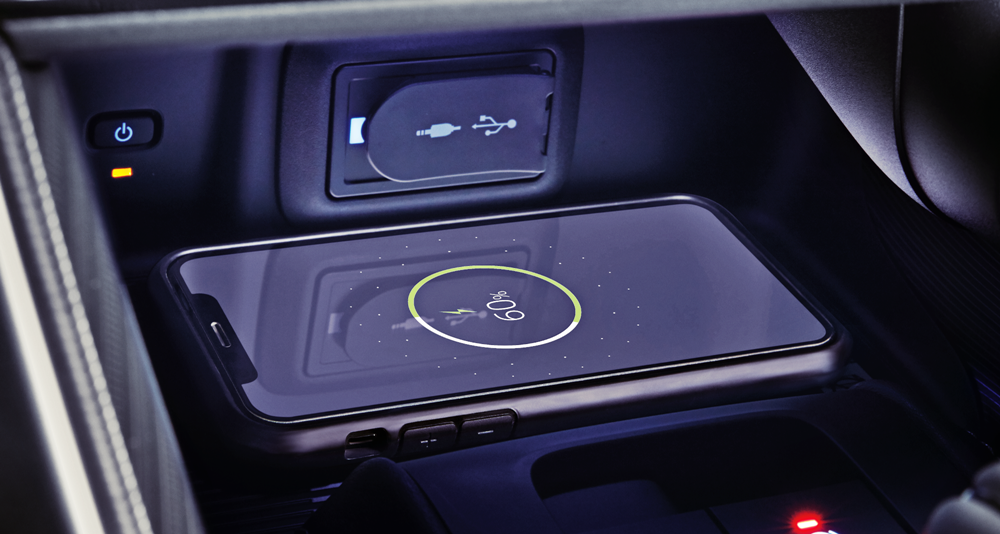
Other standard features include a wireless charging pad, USB ports, Kick Sensor Powered Back Door, Electric Parking Brake, and an advanced infotainment system with Apple CarPlay and Android Auto connectivity. The 8-inch capacitive touchscreen serves the infotainment system as well as shows the images from the rearview camera. Front and rear digital video cameras are also fitted while a Vehicle Telematics System can keep track of the vehicle’s location at all times.
One area that Toyota engineers paid special attention to was reduction of Noise, Vibration and Harshness (NVH). The new Harrier is claimed to be much quieter than before, thanks to the use of highly-efficient sound-absorbing glass on the windows. Sound-absorbing materials and their placement were optimized to lower NVH as well while sealing at the doors is improved to stop wind noise from seeping in.
New Dynamic Force engine
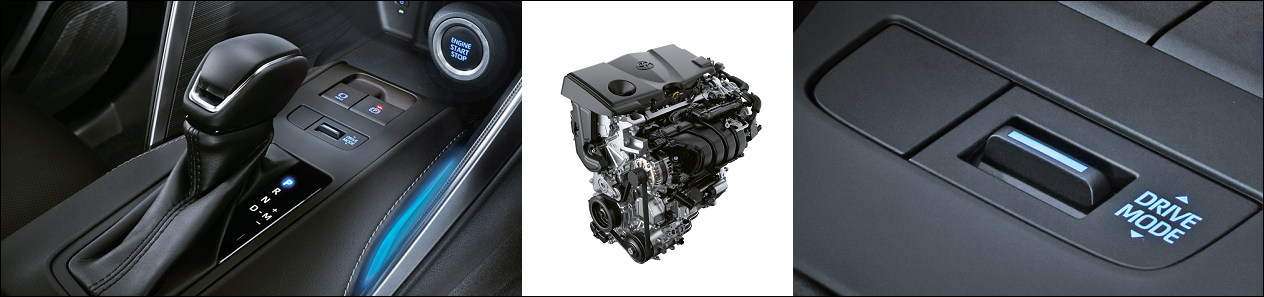
The Harrier is powered by Toyota’s latest Dynamic Force (M20A-FKS) 4-cylinder DOHC engine with Dual VVT-i (Variable Valve Timing with intelligence) that operates electronically for quicker response. As before, it is a 2-litre engine but now has improved output of 173 ps/203 Nm without turbocharging.
A Direct Shift Continuously Variable Transmission (CVT) with Sequential Shiftmatic, allows the seamless shifting of gears. The driver can choose from three modes – ECO, Normal and Sport – to suit driving conditions or personal preference. ECO and Sport modes will prioritise fuel economy or acceleration, respectively, while the Normal mode offers a good balance of performance and fuel efficiency.
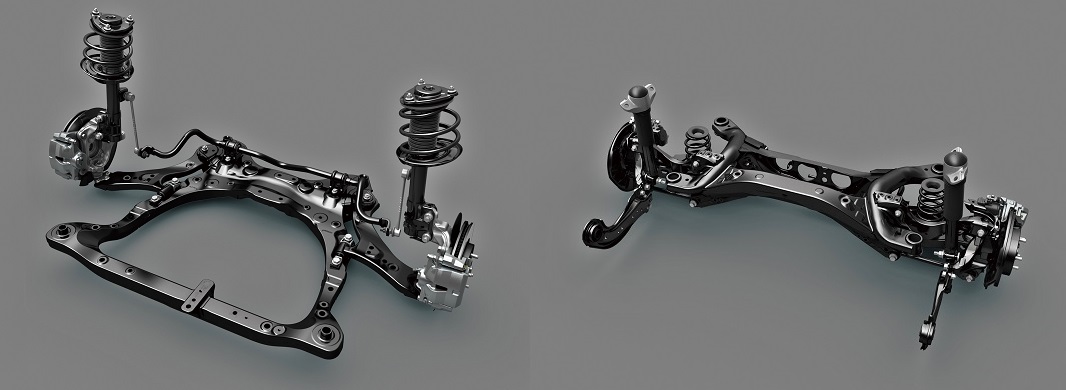
The TNGA chassis has front MacPherson struts with trailing wishbones at the rear, with optimized suspension geometry for balanced and predictable handling, while maintaining a high standard of ride comfort. The 18-inch alloy wheels at each corner are fitted with 225/60 tyres.
Toyota Safety Sense
Toyota Safety Sense (TSS) is the suite of integrated active systems that help the driver to avoid an accident, especially front collisions. Most of the latest Toyota models have TSS but the systems vary depending on the model. In the case of the new Harrier, there is a Pre-Crash System, Lane Departure Alert, Dynamic Radar Cruise Control and Adaptive Highbeam System. These use a camera and radar to scan the road ahead and identify vehicles and the data is analysed by a computer to determine if there is any danger of a collision. The Pre-Crash system has autonomous capability, meaning that it will activate the brakes if the driver does not take corrective action if a possible collision is detected.
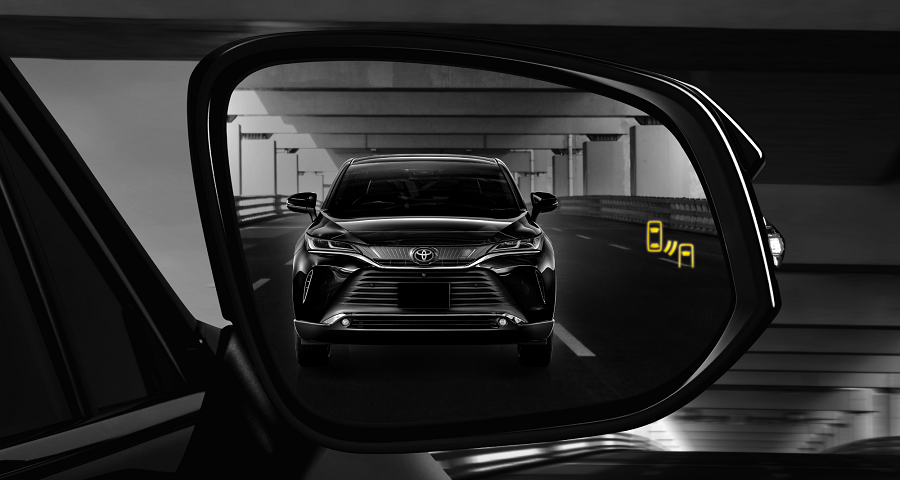
Additionally, there’s a Blind Spot Monitor with Rear Cross Traffic Braking, and a Tyre Pressure Monitoring System. The 4-wheel disc brake system is managed by ABS with Electronic Brake-force Distribution and Brake Assist, while Vehicle Stability Control and Traction Control will help stabilize the vehicle on slippery surfaces.
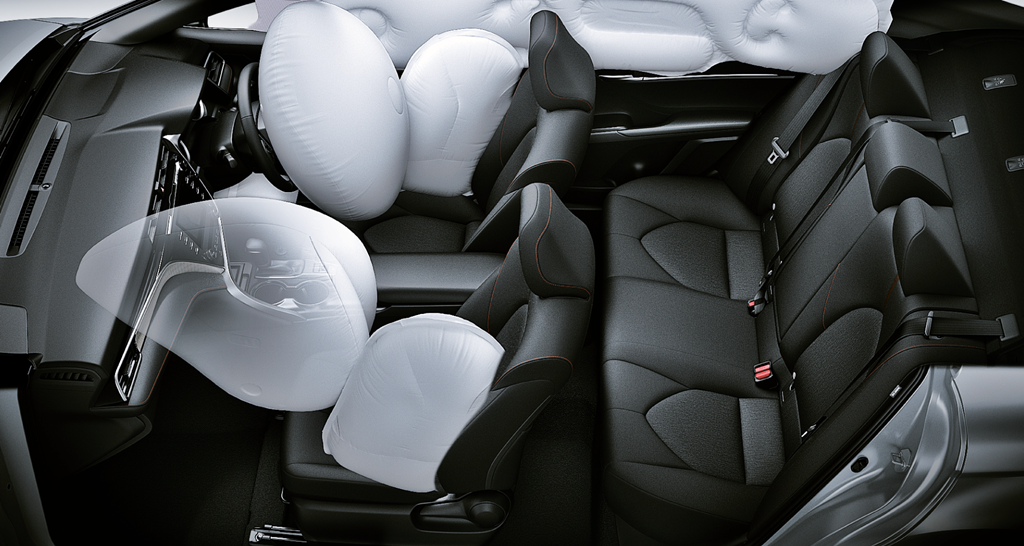
Even with the best active safety systems, an accident can still occur and to minimize injuries, there are 7 SRS airbags around the cabin (one for the driver’s knees). These include curtain airbags which deploy downwards over the windows and besides providing cushioning, they also reduce the chance of ejection from the cabin during violent crashes. ISOFIX points are provided in the rear seats for compatible childseats which are now required by law.
UMW Toyota Motor (UMWT) reports strong growth in sales for the first quarter (Q1) of 2021. The Toyota/Lexus importer and distributor said the total number of new Toyota and Lexus vehicles sold in the first 3 months of the year were more than 17,000 units with a market share of approximately 12.1%, an increase of 62% year-on-year compared to the sales volume for the same period in 2020.
Commenting on the achievement, UMWT’s President, Ravindran K., said: “During the first quarter of 2020, the market was already declining due to the pandemic. This year, it’s a different story; with the situation easing as well as the support by the government through the PENJANA program that exempts sales tax partially or fully until June 30 this year, new vehicle sales have been consistently high. In fact, for Toyota, our momentum started in December when we launched the Toyota GR Yaris and Vios GR-Sport which excited the market and set a positive note to enter 2021.”
Bestselling models
The bestselling models were the Vios and the Hilux, the latter being the market leader, accounting for approximately 56% of the pick-up truck market in the first quarter. The updated versions of the Innova and Fortuner were also introduced early in the year with new styling and extra value-added features.
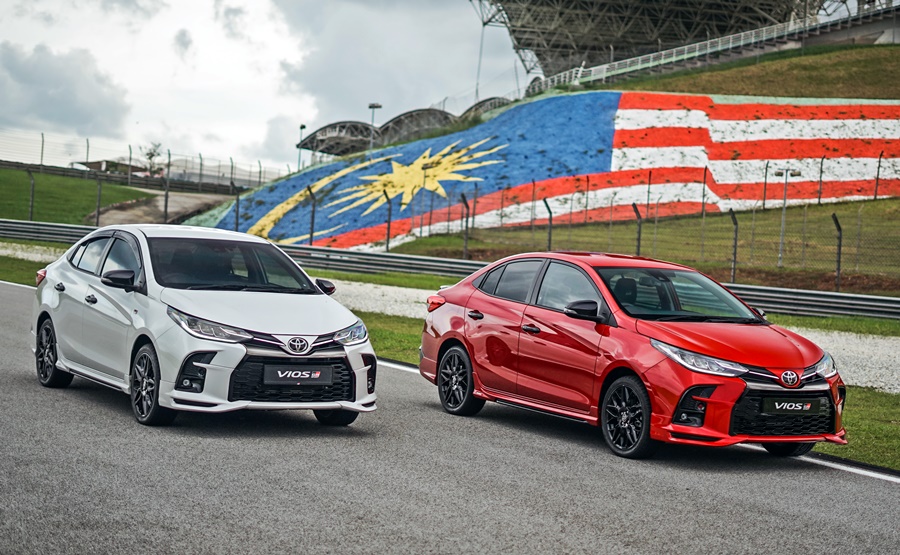
2021 Vios and Vios GR-Sport
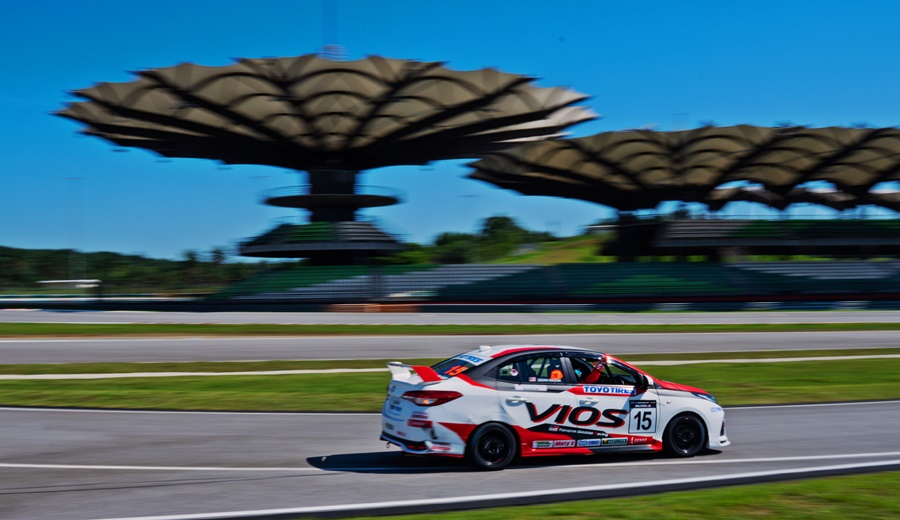
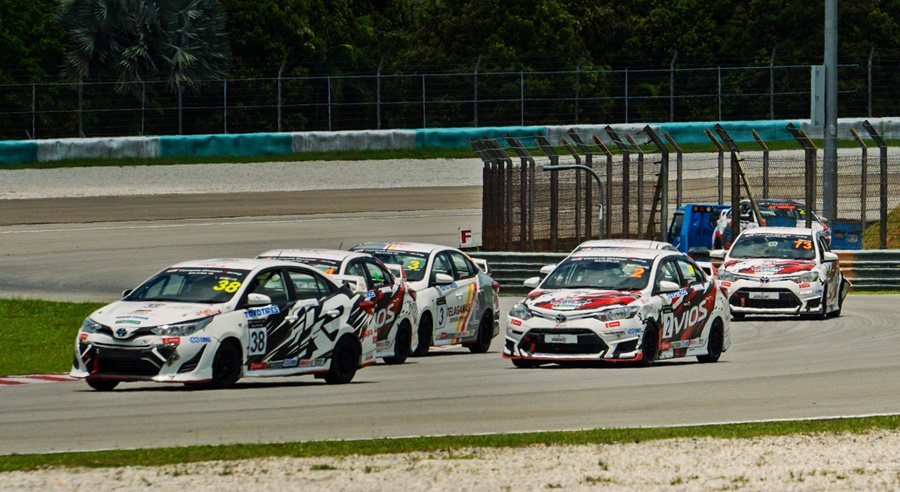
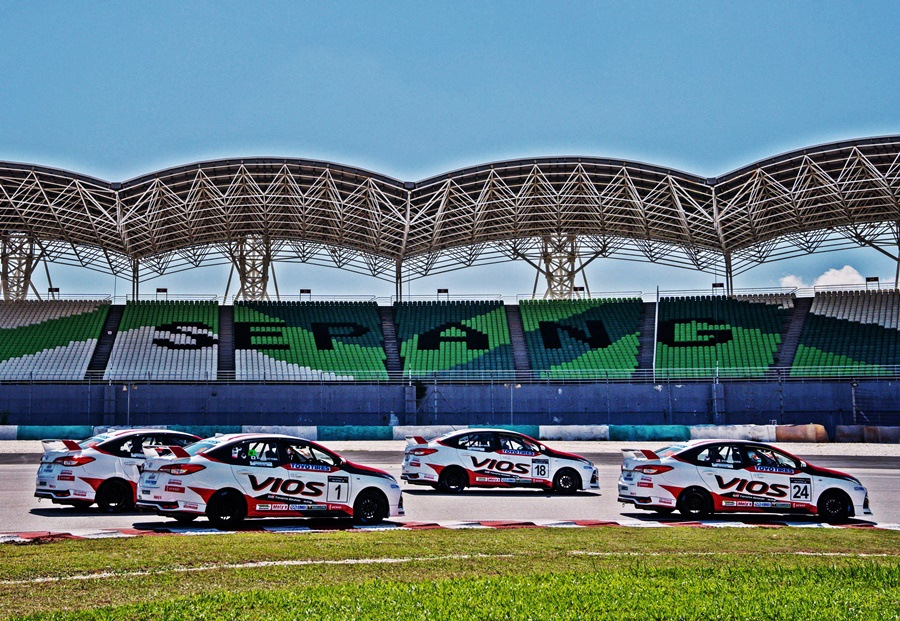
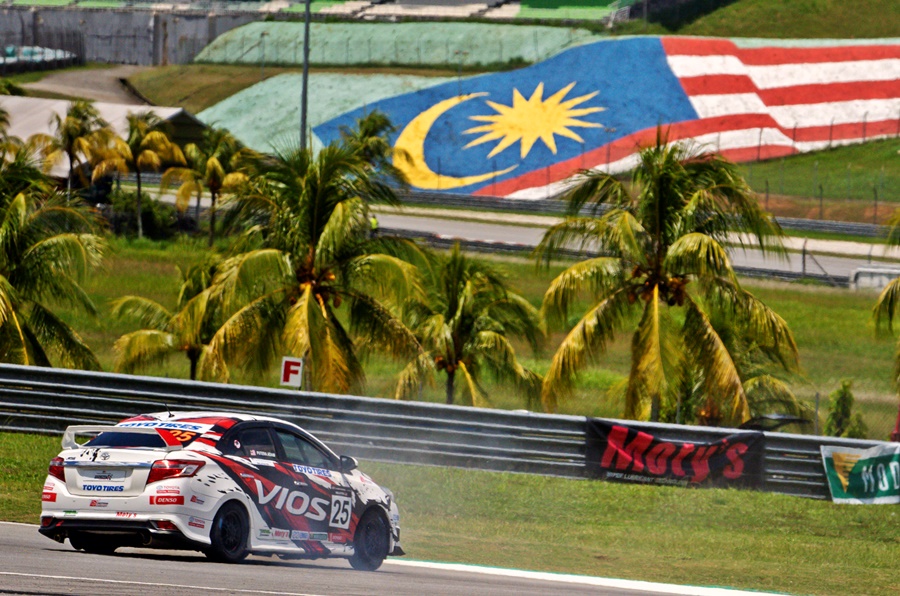
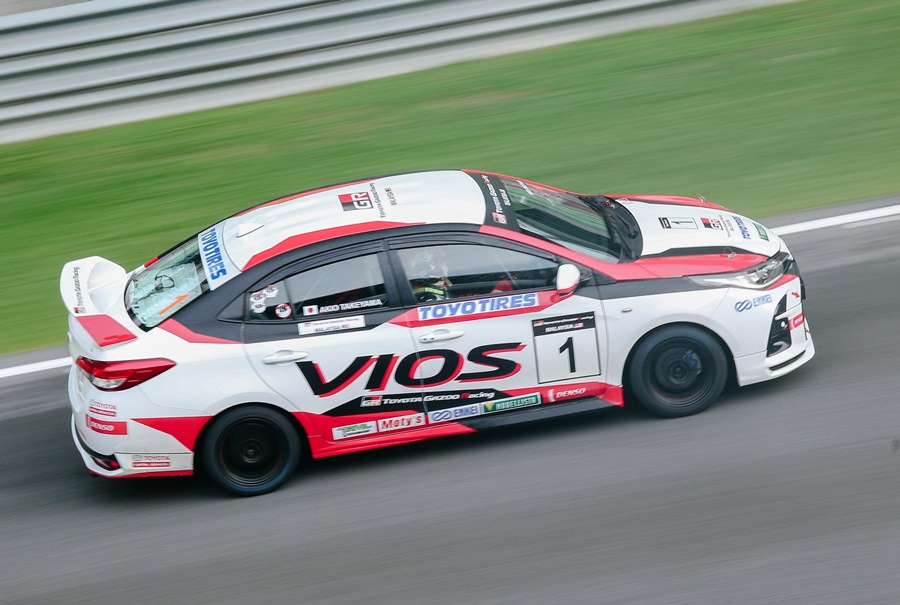
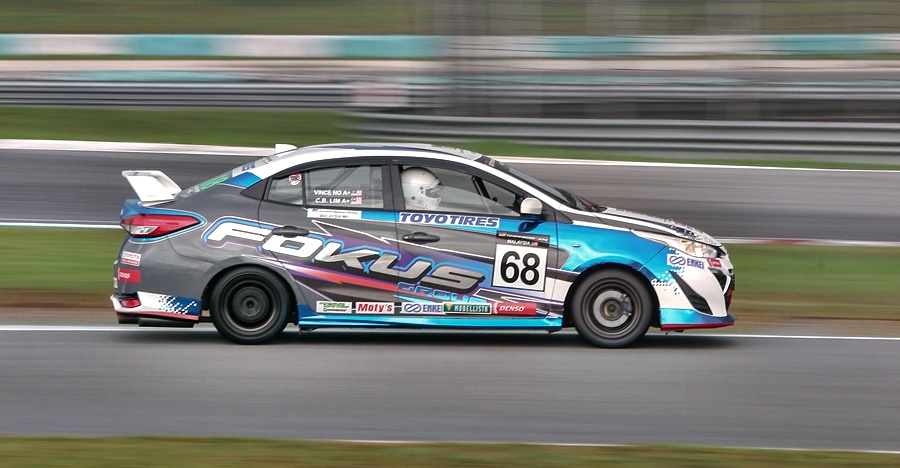
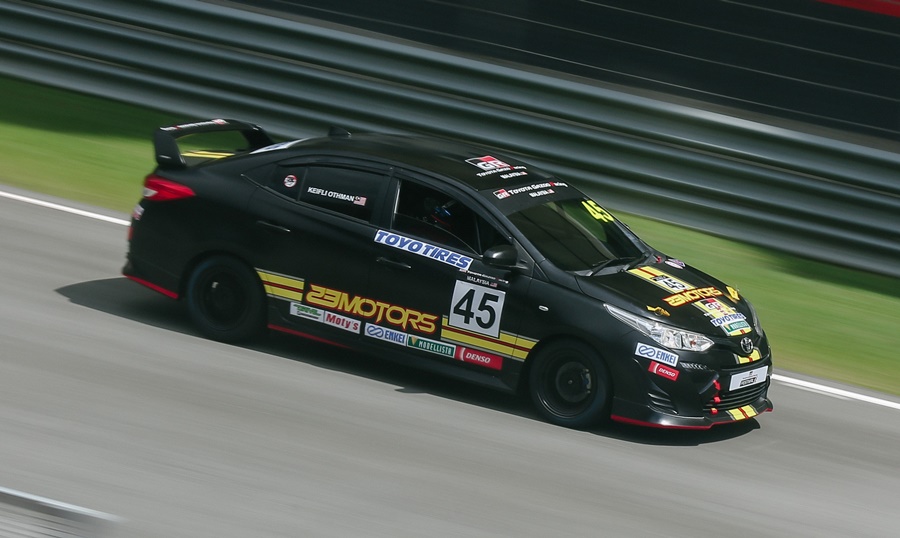
The Yaris hatchback has been consistently leading in its Non-National hatchback segment with Q1 estimated market share of 73%. Meanwhile, the Vios and sportier Vios GR-Sport (GR-S) version saw approximately 5,600 units sold since their launch. With the addition of the sporty, enhanced performance GR-S, the appeal of this model is expected to increase. Furthermore, the Vios Challenge One-Make Race Series that is now in its fourth season has left a strong impression on the public with regards to the dynamic side of the model.
GR Yaris sales exceeded expectations
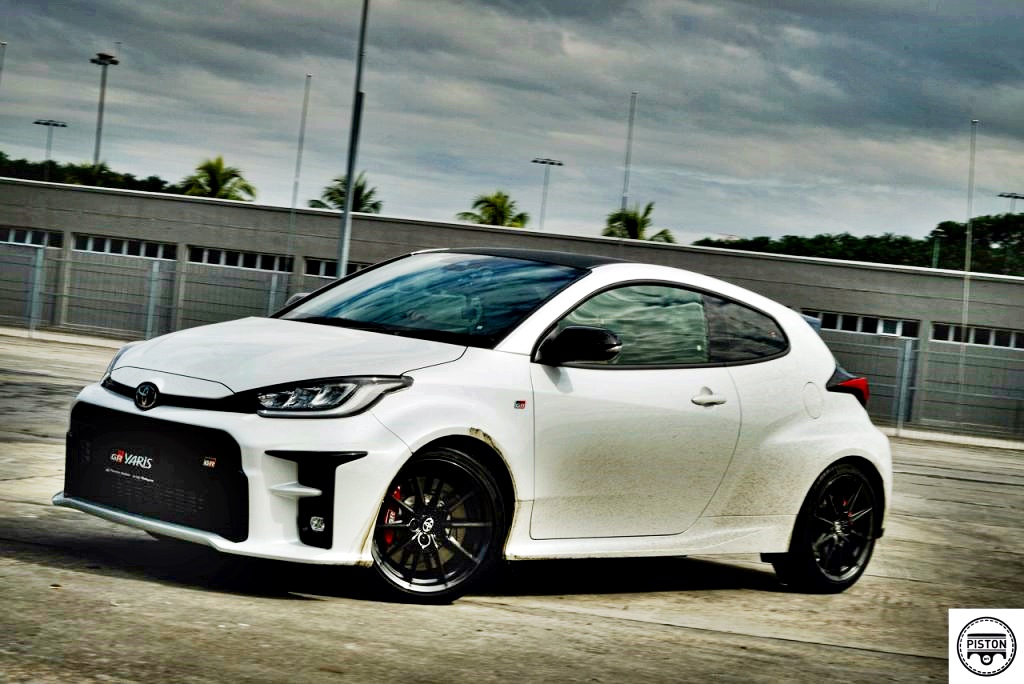
Sales of the GR Yaris, imported from Japan, exceeded expectations. Most of the units allocated for the Malaysian market (out of 25,000 units for worldwide sales) were booked within a month of launch. The strong response mirrored that in other markets as enthusiasts could not resist owning the competition-ready hatchback that has the world’s most powerful 3-cylinder engine (261 bhp/360 Nm) and the lightest and smallest 1.6-litre turbo unit currently in production.
The GR Yaris (above) is one of three models in Toyota’s high-performance GR brand which are available in Malaysia. The other models are the GR Supra and Vios GR-Sport. These models are exclusively sold through dealerships with the GR Garage that is dedicated to the brand.
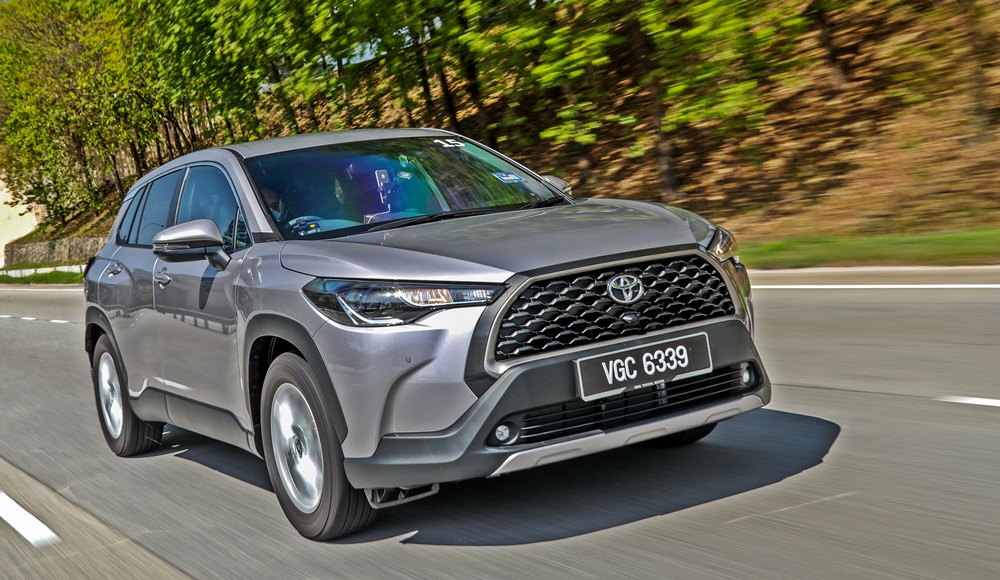
Early response to the all-new Toyota Corolla Cross launched in March indicates that it is a winner. With the strong demand, UMW Toyota Motor has been encouraged to consider local assembly of the model to increase available stocks and this could happen by the end of 2021.
“Malaysia has seen strong Toyota sales this year due to improving conditions of the pandemic. With our wider line-up of models and exciting offerings, we are confident that our sales volume will grow steadily this year and certainly exceed the volume recorded in 2020. As always, we thank our loyal customers and also welcome those who are owning a Toyota for the first time,” said Akio Takeyama, Deputy Chairman of UMW Toyota Motor.
New Corolla Cross
Promotions for Hari Raya
With the Hari Raya festive season coming up during the second quarter, UMWT will be running the ‘Countless Rewards’ promotion, encouraging purchases to be made before the sales tax exemption period ends on June 30. The exemption is not only for locally assembled models but also imported ones such as the Alphard, RAV4, GR Supra and Camry.
Financing schemes available include the EZ Beli scheme which offers customers low instalments (depending on the model). Additionally, savings are available with Toyota Service Savers which provides owners lower maintenance cost of their vehicles.
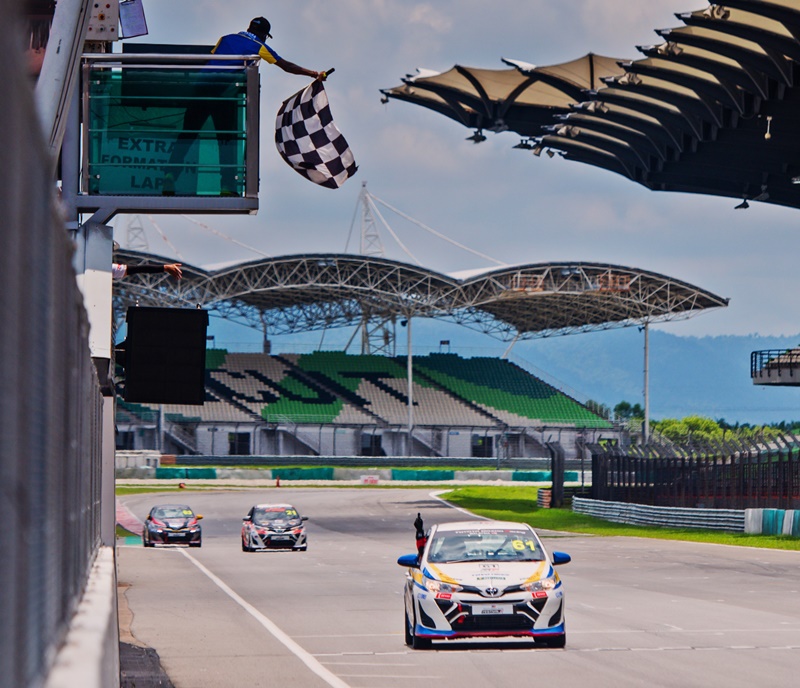
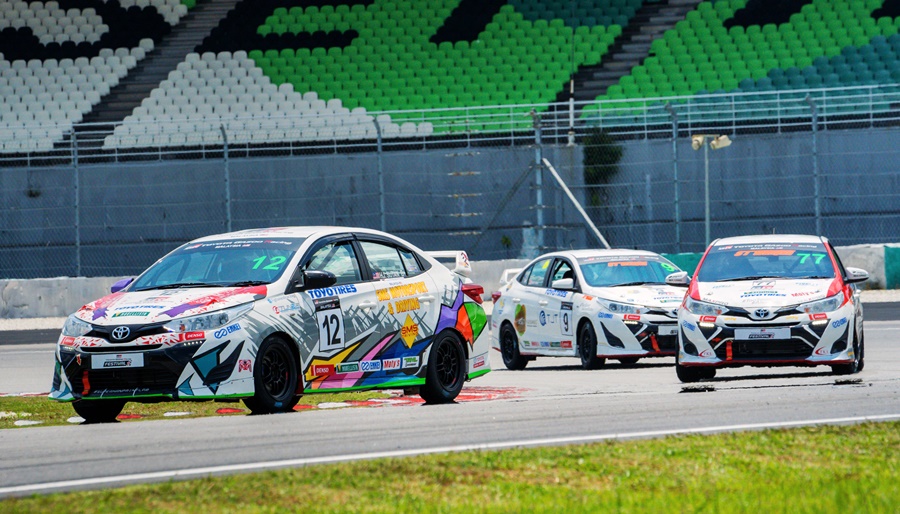
The COVID-19 pandemic has changed many things in our lives but mankind has survived for so long by adapting to changes and moving on. This has been the case in motorsports, in Malaysia as well as in other countries; to continue to have such activities requires change, at least in the short-term. The TOYOTA GAZOO Racing (TGR) Festival had to change for its fourth season this year, with the most significant difference from the past three seasons being that there could not be the huge crowds attending.
With this change, the organisers moved the action online with a livestream over two days to bring the action to fans not just around Malaysia but also globally as the internet is accessible from virtually anywhere on the planet. According to a GAZOO Racing Malaysia official, there were more than 2 million viewers online – certainly way bigger than any audience that a single round has had.
“On track especially, the suspense and quality of racing in the Vios Challenge has not diminished, in fact amplified even more, despite a one-year break. Brand affinity for GAZOO Racing has grown tremendously over three seasons of organizing what is today recognized as Malaysia’s premier motor-racing series, and I would like to thank all our GAZOO Racing fans and online viewers for their continued support, even in the absence of an on-ground festival,” said UMW Toyota Motor’s President, Ravindran K.
“Looking ahead to the following rounds, we hope to bring spectators back to the festival and enhance our live broadcast reach in line with our mission to bring motorsports to the masses,” he added. “One of the biggest challenges has been to organize the TOYOTA GAZOO Racing Festival while doing our utmost best to retain the same level of energy and excitement it has been known for over the past three seasons. Yes, there are many limitations considering we are now in the recovery stages of a post COVID-19 pandemic era, but we are nevertheless grateful that motorsports activities can continue despite stricter standard operating procedures.”
SUPER SPORTING CLASS
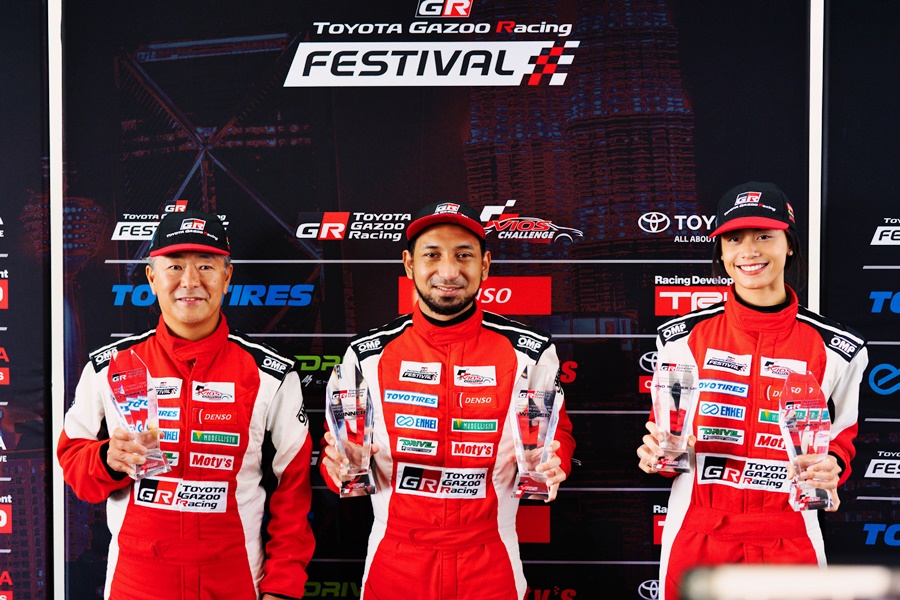
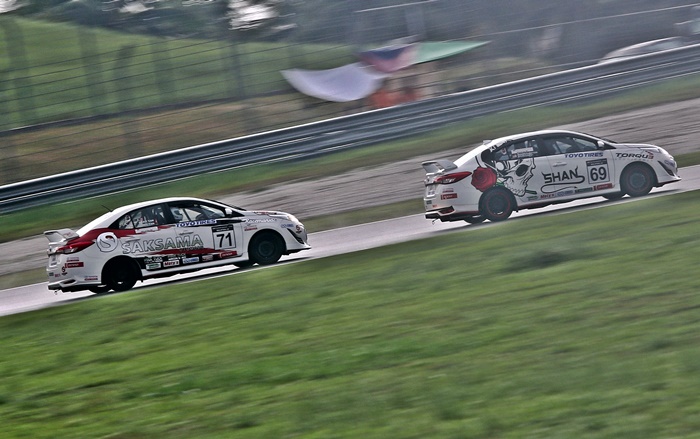
The drama and outcome in the Super Sporting Class was again a repeat of yesterday’s first race victory for Tengku Djan Ley who ended the race weekend with a double race win. Starting from sixth position on the grid, Tengku Djan again played a waiting game before mounting an 11th hour assault for the race win, finishing ahead of Season 2’s Super Sporting Class champion, Boy Wong, who returns to the podium after a long absence, and Laser Motor Racing’s Mark Darwin who rounded up the top three positions.
The lead in the 20-lap race exchanged hands several times with Mark Darwin emerging the top contender in the opening laps of the race. His lead of almost 3 seconds however, evaporated when the Safety Car came out and at the restart, faced the onslaught of challenge from Boy and M7 Japan Project Team’s Syafiq Ali. Tengku Djan’s assault came in the 15th lap and he gradually extended his lead to 3.5 seconds by the time he took the chequered flag.
“In dry weather conditions, everyone was quick and I basically capitalized on the situation out on the track and made full use of it,” said Tengku Djan, well known for his drifting skills as well. “Racing is very much weather dependent, and there are so many variables at play such as the tyres. It’s a long 20-lap race and you have to be able to manage your tyres and car, knowing when to push and when to hold back. Maybe I just managed to do a better job of this.”
ROOKIE CLASS
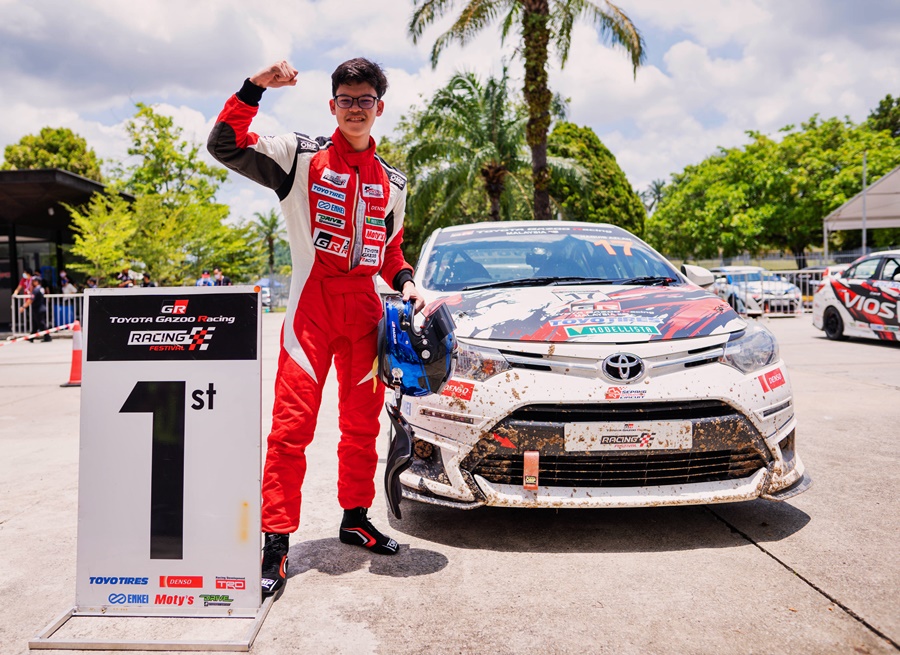
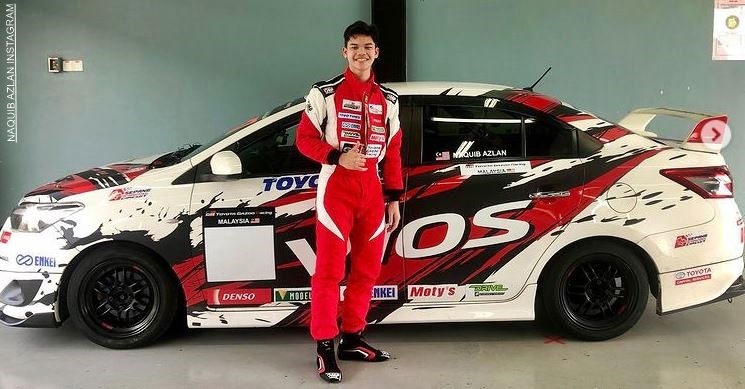
Naquib Azlan showed that yesterday’s win was no fluke and that he has The Right Stuff. He was victorious again today ahead of Jwan Hii and Amer Harris who makes his second appearance on the podium.
The fight for the lead again exchanged hands several times during the 20-lap race with all three drivers, including Mika Hakimi in contention for victory. “At one moment, I was down to last position and I had to climb my way back up with a damaged car so I really didn’t know what to expect. I just kept my head down, kept my cool,” said 20-year-old Naquib who has actually driven thousands of laps at Sepang – on a simulator.
“Yesterday was really unpredictable with the wet race, and it boiled down to instinctive driving. What I never expected was the high degree of racecraft demonstrated by the Super Sporting Class drivers who were very aggressive, but it gave us a lot of knowledge going into further races in the season,” he said.
“Sim racing helps me prepare before coming to a racetrack and with experienced trainers and a data engineer helping us out in the GAZOO Racing Young Talent Development Program, I have learnt more about my driving…I want to learn more and proceed further,” Naquib added.
For Jwan, the dry conditions were well-suited to his driving preference. “I’m more comfortable in the dry,” said the 18-year-old. “It’s been quite a journey for me coming from karts to saloon car racing. Personally, I feel that the simulator sessions have had a huge impact in terms of racecraft and consistency.”
SPORTING CLASS
Racing to only his second win in the Sporting Class since joining last season was Haji Sutan Mustaffa Salihin had a flawless start which kept him at the front for the 20-lap race. By the time the chequered flag appeared, he was a comfortable 4.4 seconds ahead of Eric Yong and Adam Khalid who finished second and third, respectively.
“I’m actually speechless because we struggled since the practice session on Friday to get the most ideal set-up for the car. And when we finally found a set-up we were comfortable with, the rain started and unfortunately, I had to race in the wet conditions, forcing me to make a strategic decision to play it safe and get the car to the finish to try for a better result for Race 2 with the reverse grid format that would see starting at the front of the starting grid,” said Haji Sutan.
“My strength has always been with my start and the ability to get a strong launch as we head into the first corner. I managed to do this as planned and from then onwards, it was a matter of being precise and consistent throughout the race,” he revealed.
Preparing for Season 4, Sutan made a conscious effort to enhance on fitness stamina and strength. “With the Movement Control Order, I weighed in at 80 kgs and that can be a big disadvantage for me, especially competing in a class with a lot of younger drivers. I told myself I needed to do something and I began exercising and controlling my diet. I managed to reduce my weight by 15 kgs, and that has been a huge motivational push for me,” said the 49-year old veteran racer.
PROMOTIONAL CLASS
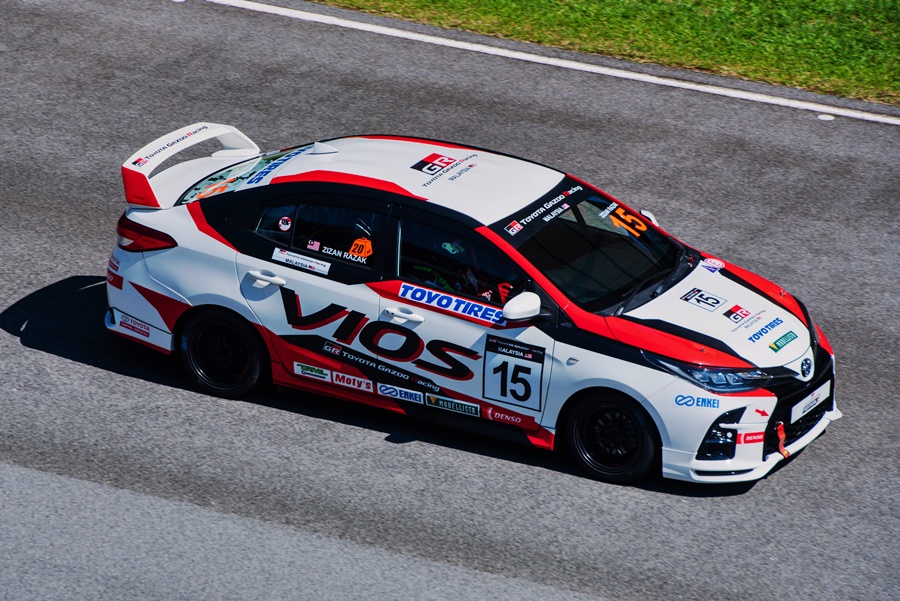
The battle of celebrities in the Promotional Class saw actor-comedian Zizan Razak winning again, certainly impressive for a newcomer to the series. He finished the 18-lap race with an unassailable 8-second gap over second place winner singer Khai Bahar and fellow Vios Challenge newcomer TV presenter, Ahirene Ahirudin.
“I expected stiff competition from the very beginning, especially from the likes of Shukri Yahaya and Nabil Ahmad. I knew they were going to be fast because they have the experience of competing in previous seasons but what I can say is my experience so far has been exciting,” Zizan said.
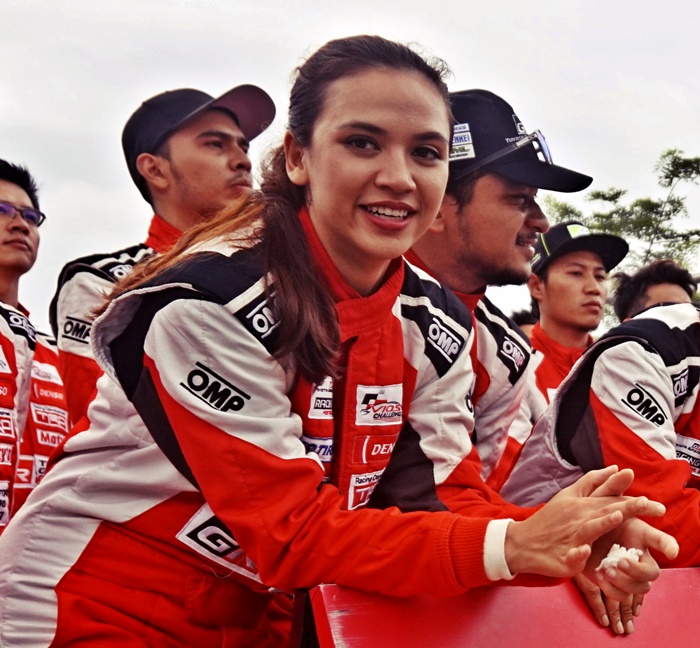
GAZOO Racing Malaysia’s Chief Motorsport Officer, Akio Takeyama (left), with Zizan Razak and Shirene Ahirudin (right), the two newcomers who have made a very good impression in their debut races in the Promotional Class.
Commenting on his third season competing in the Vios Challenge, Nabil said his journey so far has indeed been a fulfilling one. “I’ve learnt a lot from my very first race when I tried to beat actress Diana Danielle [who is not among the participants this year]. Back then, I had a hard time controlling my ego which was to not lose to a lady driver. But racing has taught me that it is not all about winning but more importantly, the skill and commitment which helps you to evolve into a better racer,” Nabil explained.
“In the process, I believe we have all also learnt to become more patient drivers on the road,” he said Nabil after leading the race today but then dropping all the way back to 10th position after a racing incident involving Shukri.
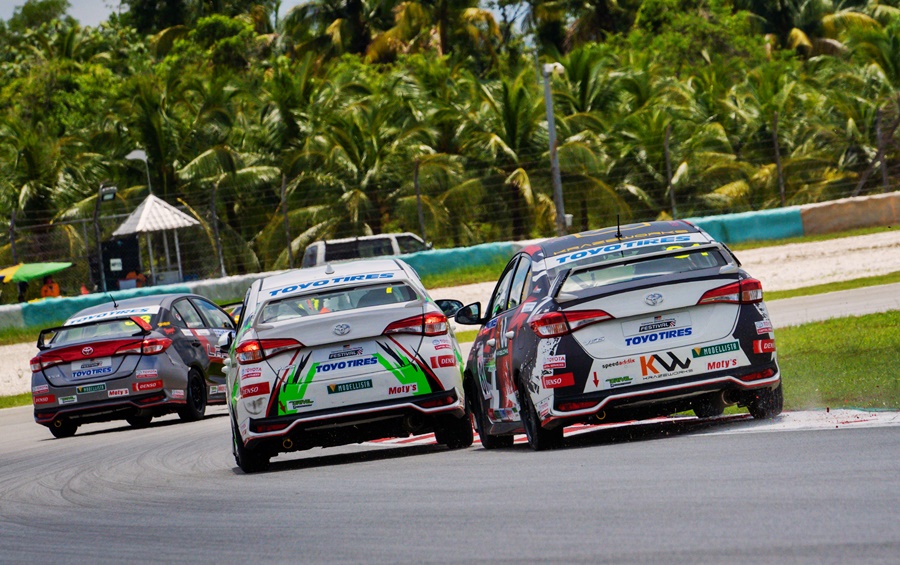
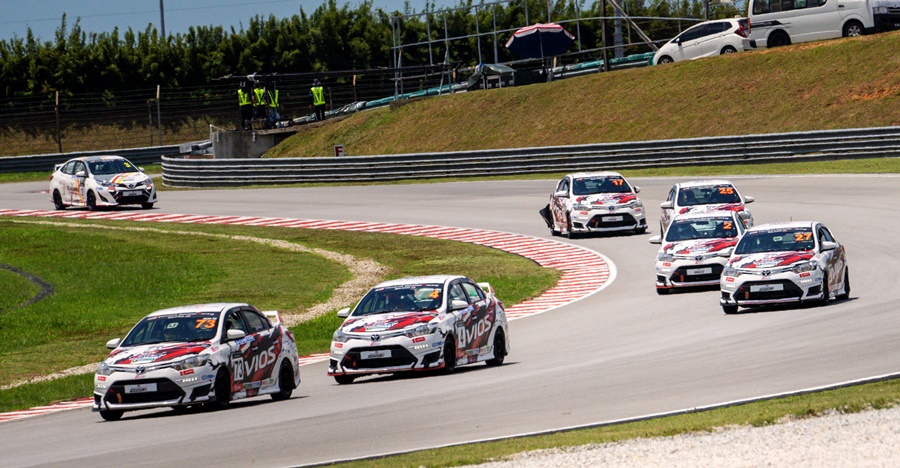
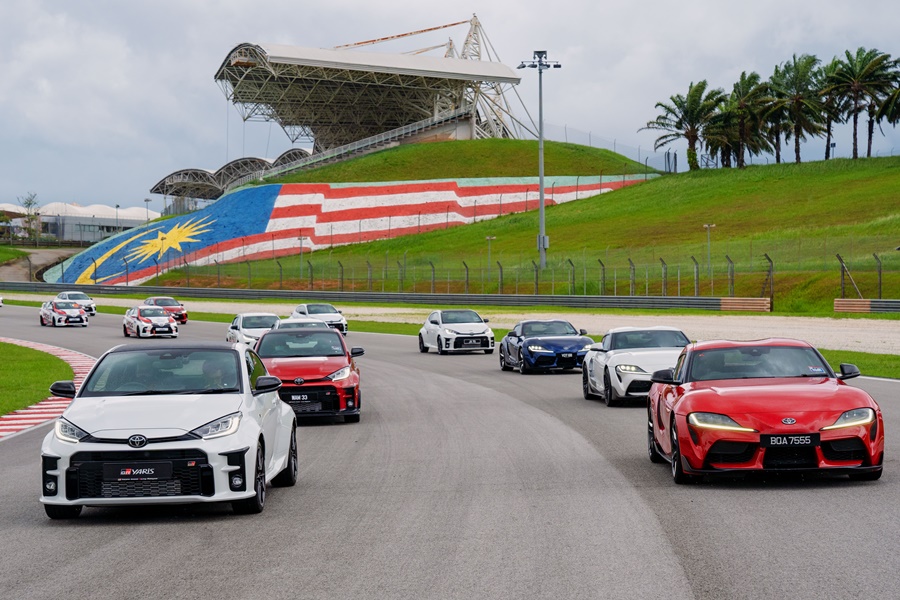
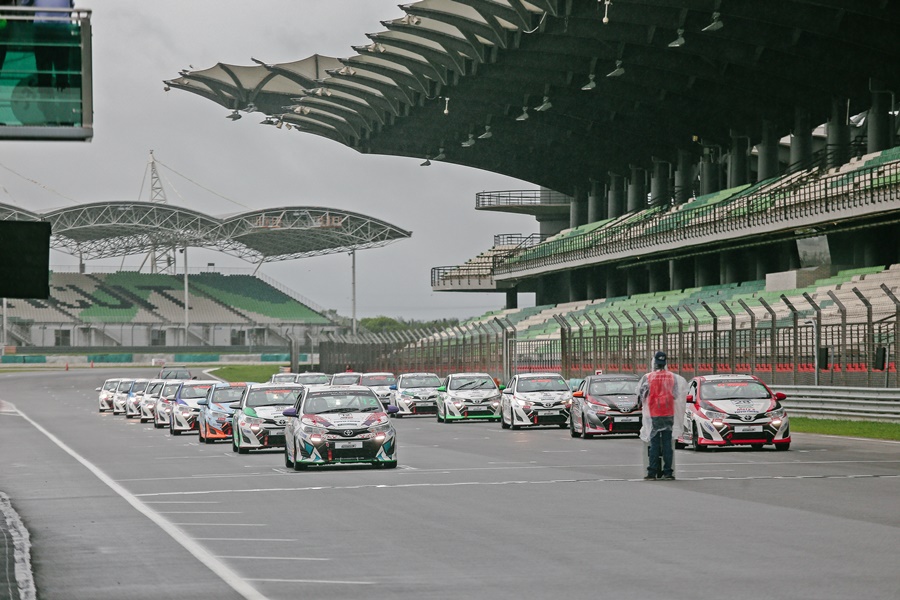
The range of high-performance Toyota GR models – GR Supra, GR Yaris and Yaris GR-Sport – led the racing cars of the Vios Challenge in a Drive of Honour around the Sepang International Circuit.
The next rounds
After this weekend’s first round, the second Round will be held from July 16 – 18, also at the SIC, while the third and final rounds will be from September 24 – 26. The use of SIC is probably in case there are limitations to the number of spectators, or if the races must still only be run without spectators. By September, perhaps things will be better and a custom street circuit can be used, as with previous seasons. Each round has 2 races with individual round prize money, and with points being scored as a championship series.
Season 4 of the TGR Festival will also see the introduction of the GR Vios Sprint Cup and GR Enduro Cup (an endurance race). The former will consist of 2 rounds with 2 races each, and the latter will be run in conjunction with the annual Sepang 1000km Endurance Race. The 2 Sprint Cup rounds will be in March and May, while the Enduro Cup will be in November.
These additional events are independent of the Vios Challenge series and intended to provide drivers and teams with more racing activities to use their cars, and the opportunity to win additional prizes.
Both the Vios Sprint Cup and Enduro Cup will retain the format of a one-make race, and only cars used in the Vios Challenge will be eligible. The races, however, will only be run as one single open class and drivers competing in the Vios Challenge. Teams meanwhile, are also not confined to competing with their regular driver/s signed up in the Vios Challenge and are free to field new drivers for both events (but they must have the requisite competition licence).
When the pandemic hit last year and brought things to near-standstill, motorsports activities were suspended as such events typically have huge crowds which are a definite no-no these days as they can promote the spread of the coronavirus. No one knew just how long the situation would last and motorsports organisers kept praying that things would ease so they could run some events.
At UMW Toyota Motor (UMWT), even though the final round of Season 3 of the TOYOTA GAZOO Racing (TGR) Festival had to be cancelled, there was optimism that the pandemic could not go on ‘forever’. And although Season 4 could not start off around the usual time in the third quarter of the year, planning was still done with a hope that eventually, the new season could be run.
The company even decided to use the ‘downtime’ to train a group of young men who excelled in karting and sim racing (or eSports). They were recruited for the GAZOO Racing Young Talent Development Program where they would not just receive professional training – physically and mentally – but also have cars to use during the Vios Challenge. The new Rookie Class would complement the hugely popular Promotional Class in the series which had local celebrities taking part.
And so, with the green light given by the health authorities, Season 4 could get underway this weekend – but with some conditions for the protection of participants. Apart from the strict observance of Standard Operating Procedures that every Malaysian should now be familiar with, the public also could not attend the event held at the Sepang International Circuit. This is similar to many motorsports events in the past year, including F1 races, where spectators have been absent. Instead, organisers have provided live broadcasts of the races and GAZOO Racing Malaysia has done likewise for this weekend’s activities.
“This is our fourth season organizing the Vios Challenge and the TOYOTA GAZOO Racing Festival, and we constantly challenge ourselves to improve and push the limits not only in terms of our vehicles but also what the brand represents,” said GAZOO Racing Malaysia’s Chief Motorsport Officer, Akio Takeyama (who has been racing in every season in the Promotional Class).
“We are very much committed to continuing with such activities moving forward and you can expect an even better performance from Toyota, our vehicles, the activities we undertake, and from all the drivers who continue to support in making the Vios Challenge a huge success,” he promised.
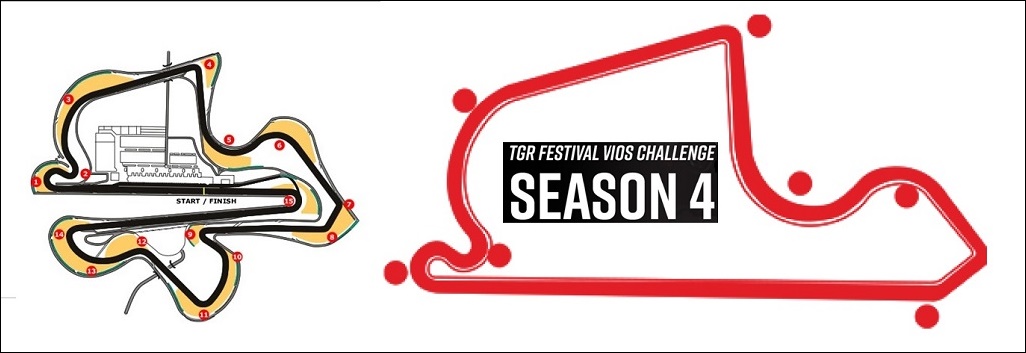
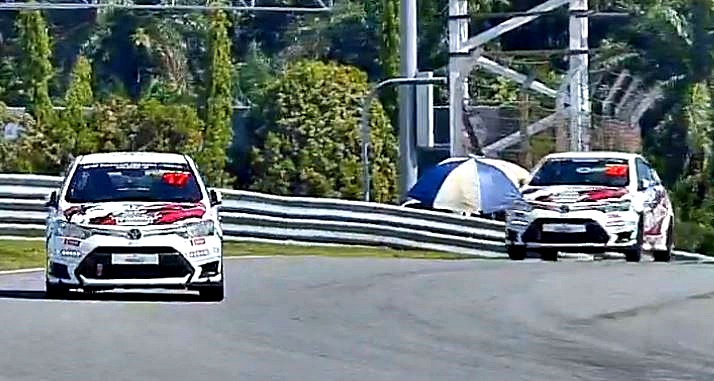
Only the North Track is used for this round and it is about half of the full circuit. It has a length of 2.706 kms with 9 turns and 5 straights.
PROMOTIONAL CLASS
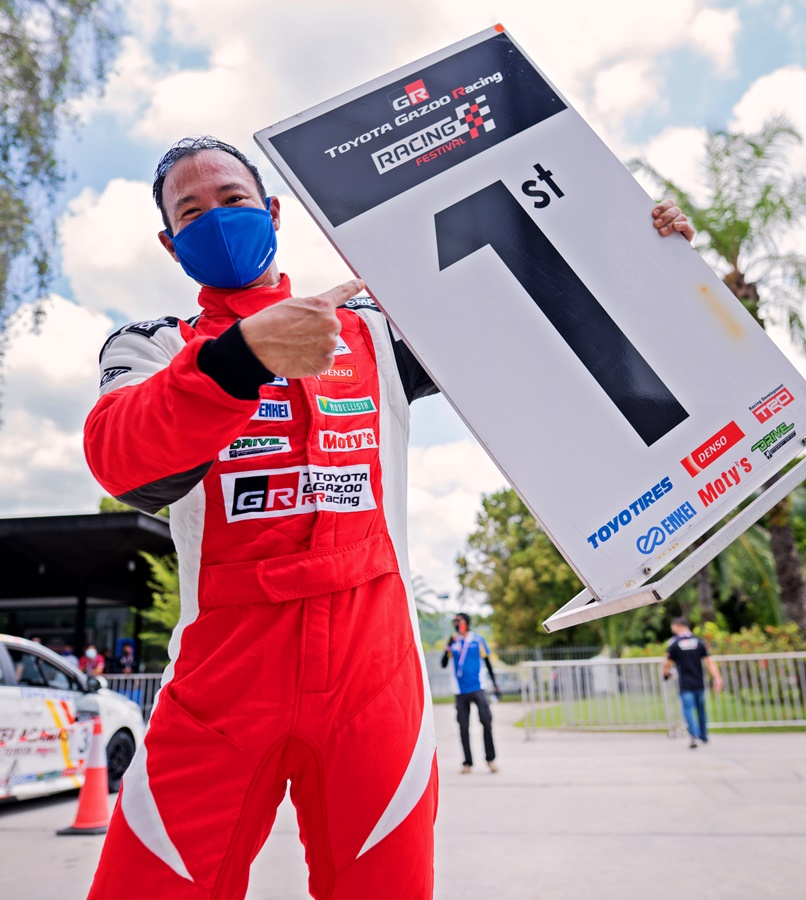
Mr. Takeyama, who is also Deputy Chairman of UMWT, found himself on the winner’s podium after finishing second position in the battle of the celebrities in the race while newcomer Zizan Razak stormed to victory in a wet race, with fellow newcomer Ahirene Ahirudin coming in third place. Quite an impressive showing for the two first-timers in the Vios Challenge.
Earlier in the race, actor Shukri Yahaya had shot into the lead from pole position with TV presenter Nabil Ahmad in second and Zizan in third position. An early mistake however, sent Nabil out of contention for a podium finish which paved the way for a two-car battle for the lead between Shukri and Zizan. The latter eventually inherited the lead as early as the third lap with a brilliant overtaking move.
“Because this was my first race, I was honestly just out to gain experience. The rain however, worked in my favour. I enjoy driving in the wet!” said Zizan.
Starting the race from sixth position, TV presenter Ahirene kept her calm throughout the 18-lap race and benefitted from the misfortunes of Shukri, Nabil and singer-song writer Talitha Tan who started the race ahead of her.
“I want to thank Toyota for inviting me to join Season 4. I was a bit nervous before the start of the race, especially with the rain making it more difficult and challenging. I really wasn’t expecting anything and I just wanted to enjoy the race,” said Ahirene, who has racing experience on 2-wheelers and is also in the Royal Malaysian Navy.
SUPER SPORTING CLASS
In this top-tier class, the lead exchanged hands 4 times in the 20-lap race before GAZOO Racing ambassador and Prima Pearl Auto driver Tengku Djan Ley overtook M7 Japan Project Team’s Syafiq Ali for the lead in the very last lap for victory. Coming in third was 16-year-old Hayden Haikal who was making his debut in this class after impressive racing in the previous season.
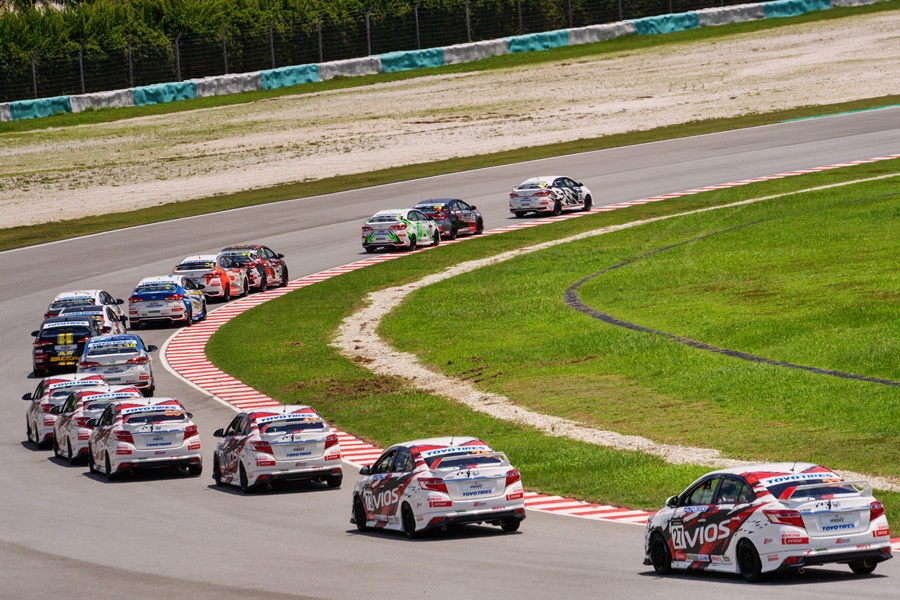
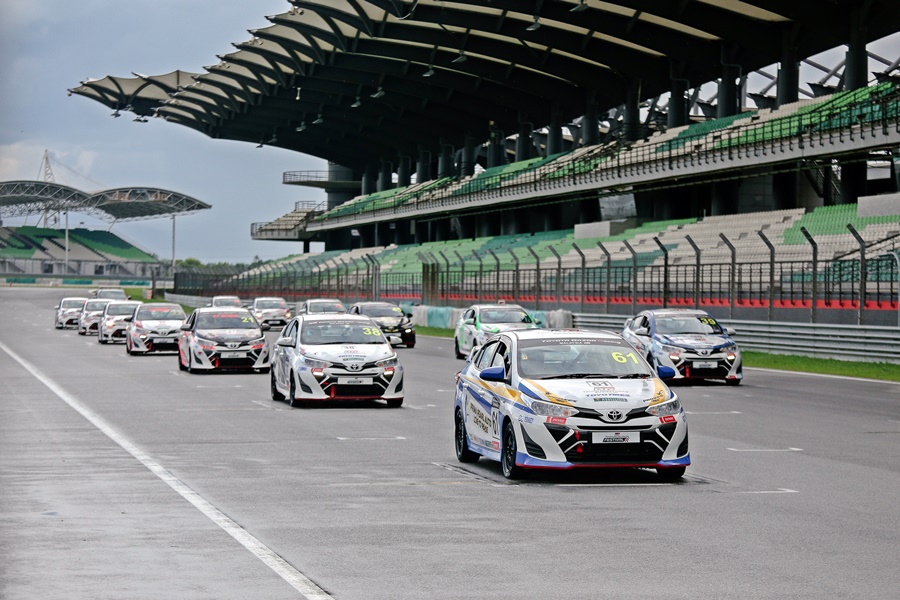
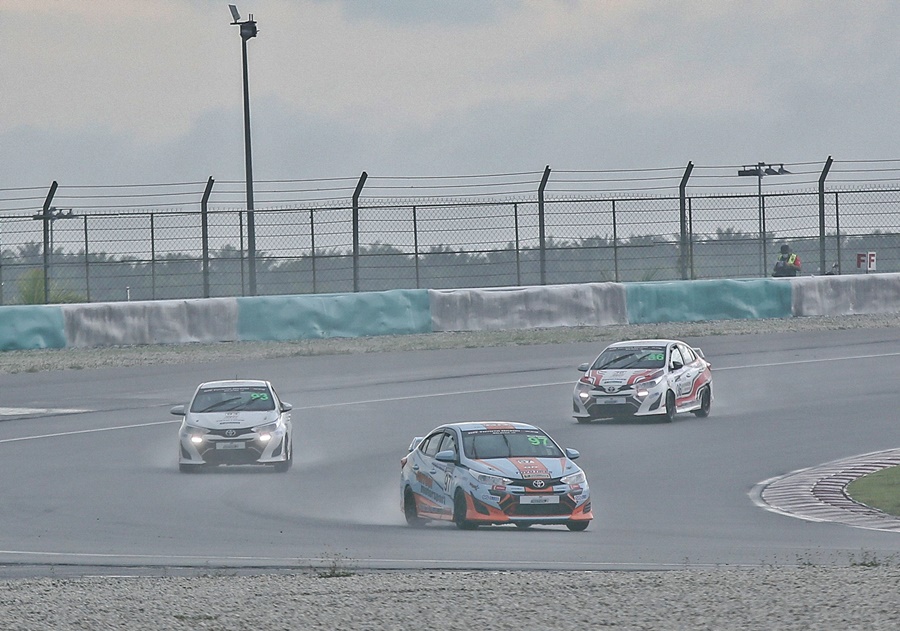
The start of the race around the North Track (half of the whole circuit) was delayed for 20 minutes due to a brief thunderstorm as the cars lined up on the starting grid. Conditions on the track precipitated for two citing laps behind the Safety Car for safety reasons and the Race Director decided on having a rolling start instead of a conventional grid start.
Laser Motor Racing’s Mark Darwin led the first 2 laps from pole position with Hayden and Tengku Djan hot on his heels. Hayden pushed into the lead on the third lap and held the lead for more than 10 laps before conceding to Syafiq who later led for another 5 laps. With all the action up front, the experienced Tengku Djan paced himself and was ready to strike in the very last lap.
“Instead of me paving the way, I let others do it. It was a difficult race to begin with as Syafiq was super fast. Rather than trying to defend my position I decided to just follow him and understand what the front competitors were doing and observe where their strengths and weaknesses were. I knew the race would be decided in the last 2 laps and that was when I started to push and began to make my move,” said Tengku Djan who is also Season 3’s defending Super Sporting Class champion.
ROOKIE CLASS
In the battle of the young drivers in this new Class, the top 3 podium positions were surprisingly dominated by two simulator racers and a single karter. The graduates of the GAZOO Racing Young Talent Development Program certainly made a good impression on their debut race.
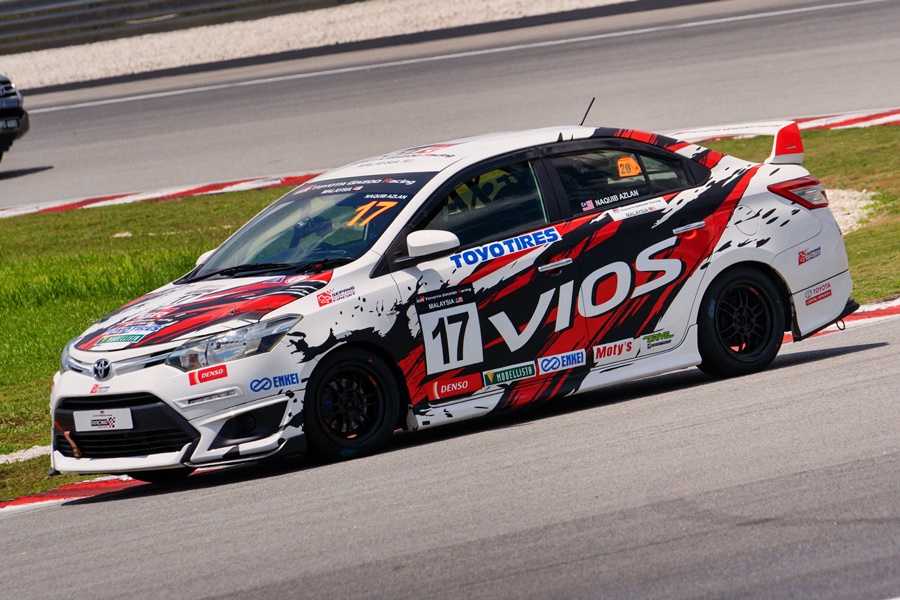
For Naquib Azlan, who was fastest throughout practice and qualifying, the 20-lap race could not have been a more memorable debut for the young simulator racer who was racing in a saloon car for the very first time. He finished the race ahead of karter Amer Harris and a second simulator racer, Mika Hakimi.
“The weekend has gone really smoothly and we managed to achieve everything we set out to do throughout practice, qualifying and the race. I was hoping to have been able to keep up a little bit more with the Super Sporting Class drivers [in times] but the main goal was to win the Rookie Class. These guys [in the Super Sporting Class] are really quick,” said Naquib.
Representing the karting fraternity, Amer was also pleasantly surprised with his result. “I had a really bad start and to be honest, I wasn’t expecting to be up to speed especially in the rain. I caught up to Naquib but I later made a mistake,” said the 17-year-old.
SPORTING CLASS
With 19-drivers on the grid, the Sporting Class was the most highly-anticipated race, and the return of the rain made conditions even more challenging for the drivers. At the end of the 20-lap race, it was Crestmax Motorsport’s Adam Khalid who took the chequered flag ahead of Team Distinctive Model’s Clement Yeo and privateer Eric Yong, all three of whom have been podium finishers in the previous seasons.
“At the start of the race, it was really tough to find the best racing line because it was dry throughout practice and qualifying and this was the first time I’ve driven the car in the wet. After dropping back a few places and managing to regain my momentum and composure, I tried to save the car for tomorrow’s race. Hopefully, it will be a dry race tomorrow,” said Adam.
Yeo meanwhile, was the biggest gainer in the race having started from seventh position on the grid. “The conditions were very slippery. Every single corner was a gamble and I believe we all struggled for grip. I had a good and lucky start and I was fortunate to have had a clear path ahead,” he said.
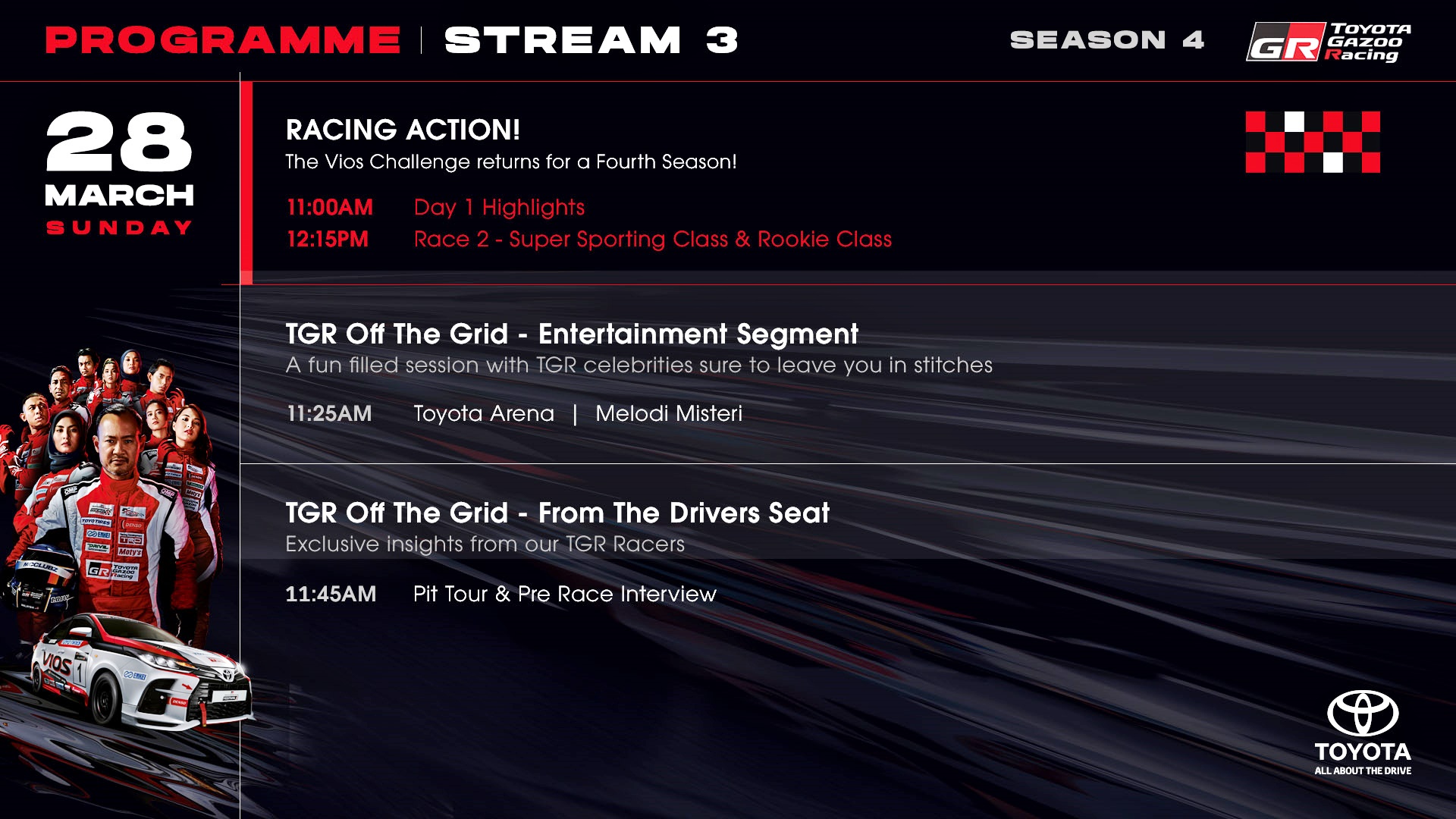
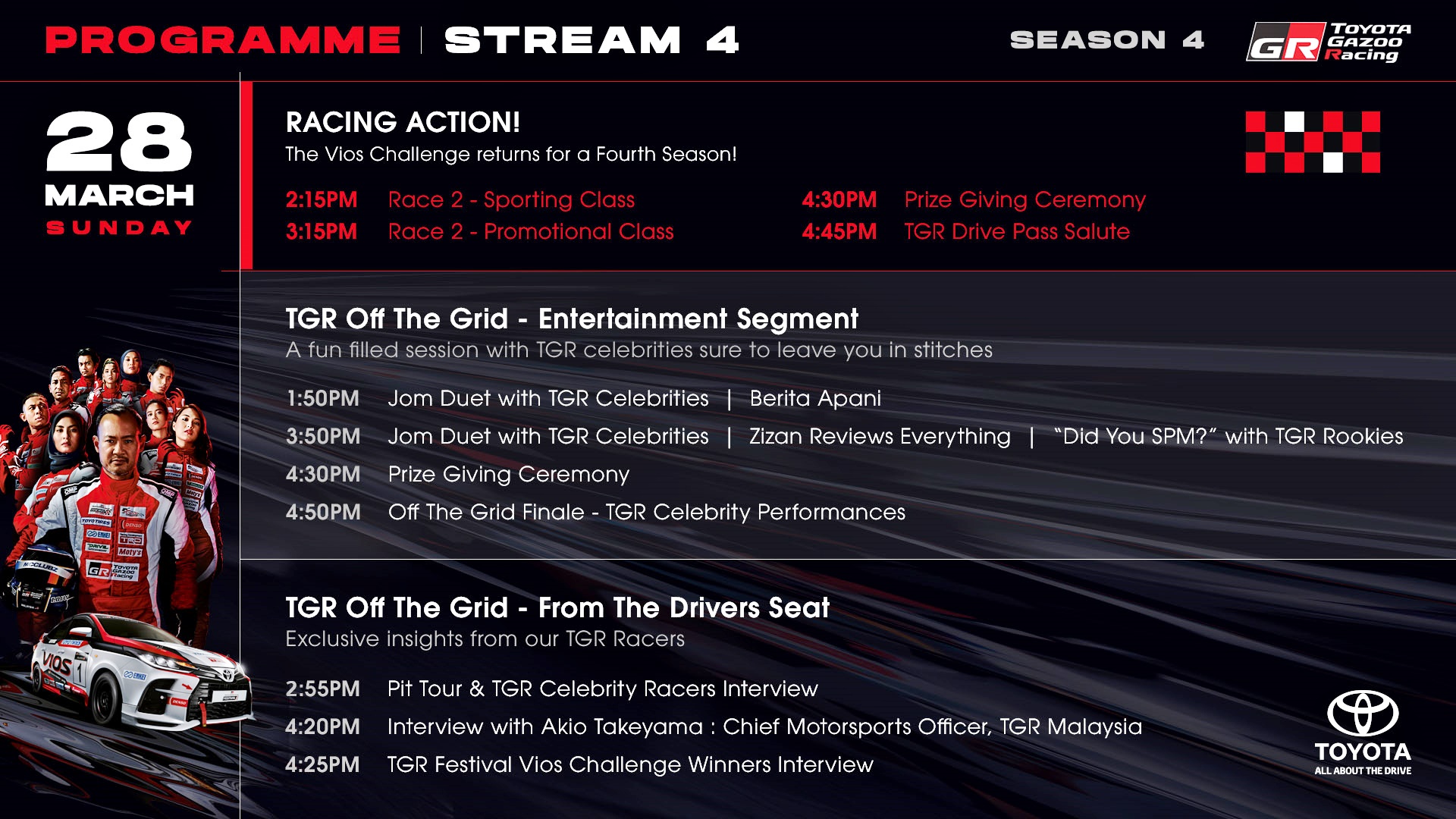
Tomorrow sees the second series of races in the Vios Challenge and you can watch the live broadcasts at the times show below:
It’s always been an interesting question – does racing on simulators help to develop driving skills? A whole generation has now grown up on sim racing and there are some very skilled racers in the online world who even race against the real-world racers like F1 drivers. What if they are put inside a real racing car… would they be able to perform just as well?
TOYOTA GAZOO Racing Malaysia and UMW Toyota Motor are finding out with their GR Young Talent Development Program which started last year and the first batch of rookies, most of whom have been racing in the virtual world for many years, are taking to the track this weekend in the first round of the TGR Festival Vios Challenge at the Sepang Racing Circuit.
They have been given training which has been rigorous both physically and mentally, with guidance from veterans like Alex Yoong and Tengku Djan, the latter a champion in the Vios Challenge. The cars are also provided, and all are prepared to have identical performance so it is really down to driver skill and strategy.
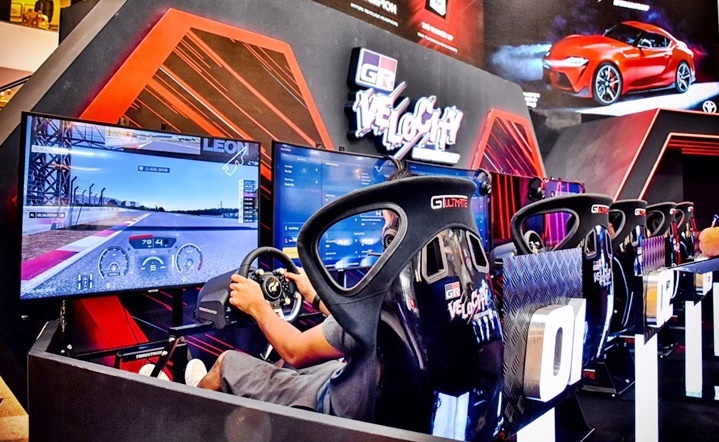
Naquib Azlan, one of the rookies, has ‘driven’ thousands of laps around the Sepang International Circuit – in the virtual world – so he is thoroughly familiar with the layout and would have learnt the fastest lines through the turns. However, for the qualifying laps and the real race today and tomorrow, he will be racing only on half the circuit, otherwise known as the North Track.
From his performance, it seems that all those thousands of laps have helped him as he clocked the fastest time in the official practice session of the Vios Challenge. And it’s the first time the 20-year old is doing a saloon car race. He clocked 1 min:26.614 seconds to post the fastest time of the day from a field of 45 racers who included celebrity, amateur and professional drivers, completing a total of 29 laps in official practice and another 20 laps in unofficial practice.
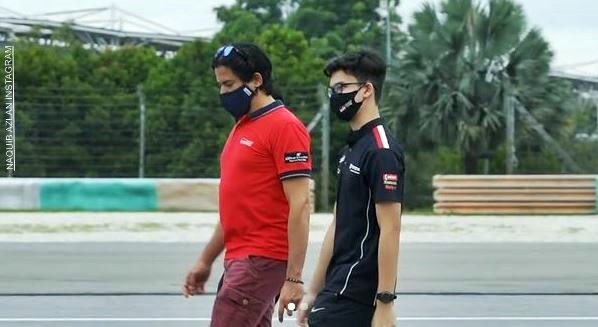
Walking around the circuit to study the surface and the corners is what the professional drivers do, Guiding Naquib and the rookies is Alex Yoong, one of the instructors.
“Yesterday was mainly about getting as much information as I could, especially running on newer tyres, and to prepare the car for today’s race. The main aim was to prepare for this race weekend – no intention of becoming quickest,” said Naquib, who has qualified in pole position on the starting grid with a time of 1:26.012 after completing the Qualifying session.
“It definitely came as a surprise to me to post the fastest time. We (the rookie racers) are sharing the same grid with some of Malaysia’s best drivers – racers like Tengku Djan Ley, Mark Darwin and Hayden Haikal and they are all super quick. I didn’t expect to be the quickest but I believed I had the capability to be close to them and it was nice to do have been able to that…This is my first ever race in real life,” he said.
Naquib agreed that all the hours on a simulator have paid off in being super beneficial in preparing him for his real-world racing debut. In the simulator he has used, it has not been in a Toyota Vios but that has not made a difference as he settled into the racing car provided by TOYOTA GAZOO Racing.
UMW Toyota Motor and GAZOO Racing Malaysia have been supporting eSports which sees strong participation from sim racers, some of whom can now transition to real-world racing like Naquib.
“In sim you don’t feel anything, unlike the sensation of being in a real racing car. It’s not 100% the same as when driving with the simulator but what you learn in sim in terms of entry speed, how much braking you use, and how early you can be on the throttle definitely translated perfectly for me in real life and really helped me prepare for this weekend. I try to perfect this in sim so that when I jump into a real race car and I have that extra sensation it becomes easier,” Naquib explained.
“Being able to drive to the limit and being on the limit is a skill that is very difficult and that was what I wanted to find. I would add that the Vios is rewarding to drive and I get much confidence even though it is new to me,” he said.
Practice is one thing, the real race, however, can be an entirely a different story. “The way I mentally prepare is I focus on what I have to do for the race. I don’t focus on what the other competitors are doing because this is when you start to get nervous and over-think things. I focus on the job I have to do and what I have to do to achieve the outcome I want – and that job this weekend is to drive fast and win!” he said.
The GR Young Talent Development Program aims to develop the best talents across the country and propel grassroots racing to the pro stage. With guidance, careful and proper nurture, young drivers like Naquib and the other five drivers are now on the journey to becoming a champion.
In the early years of the Toyota Corolla, which was introduced in 1966, there were many bodystyles available. Besides the sedan (which was in 2-door and 4-door versions), there was a coupe, hardtop, liftback, stationwagon and even a MPV (in the 1990s). But after the 1990s, the number of variants diminished as volume became important and models that didn’t have sufficient demand had to be discontinued.
Back then in the 1990s, the SUV trend was just starting and MPVs were in great demand too, hence the MPV variant of the Corolla (called the Spacio) which was produced for a while. But in recent times, as the SUV trend continued going upwards, manufacturers began to look at how to offer such models without the high cost of developing new models. The solution lay in having a common platform and having a bodystyle with an SUV image and the requisite extra ground clearance.
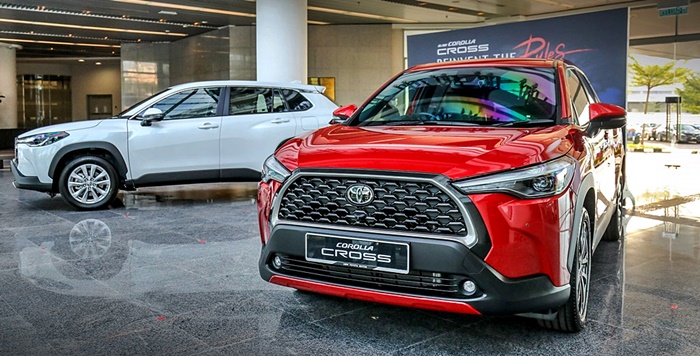
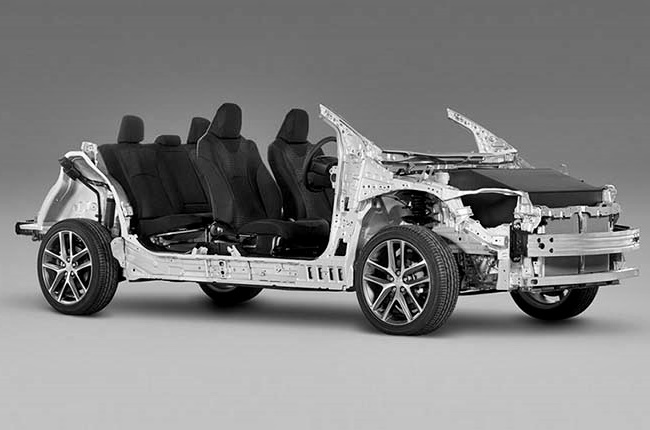
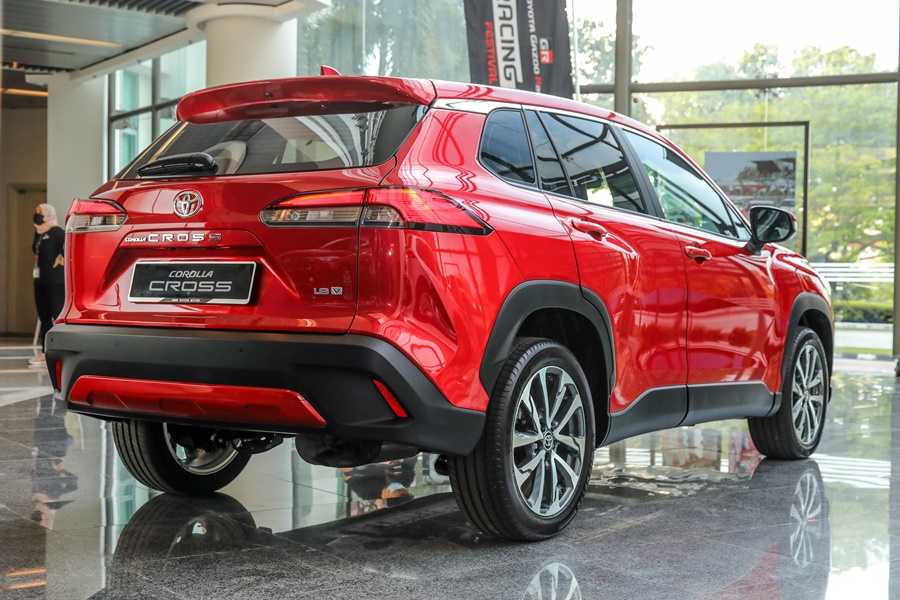
Toyota decided that the Corolla family would get a totally new SUV variant which it has called the Corolla Cross. Like many recent new models, it also sits on the TNGA (Toyota New Global Architecture) which has a lot of variability so engineers can put different model types on it. That saves Toyota a lot of money compared to the old days when a different platform had to be developed for each model.
In the case of the Corolla Cross, the TNGA platform has been configured for a higher ride height – which is expected of SUVs – but it has an inherently low centre of gravity too. This means that even though the car has extra ground clearance, its stability is still good and the highly rigid body enhances agility and ride comfort.
Toyota New Global Architecture (TNGA) platform
CBU import from Thailand
The Corolla Cross for Malaysia is imported from Thailand in CBU (Completely Built-Up) form but seeing how response has been even before it was launched, UMW Toyota Motor (UMWT) has already started discussions with Toyota about having the model assembled locally as well. That might not be so soon as the plant near Klang, Selangor, has also to be prepared, and with local assembly, there is also a need to source some of the parts locally. So it may only be in 2022 that we see a locally-assembled Corolla Cross.
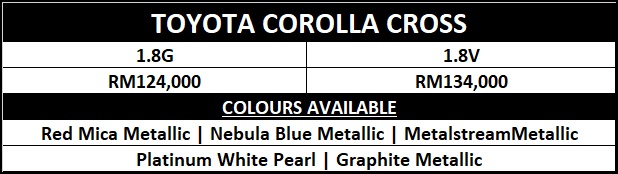
There are two variants being imported – the 1.8V and 1.8G, with the former being the better equipped variant. The price difference is RM10,000 but the standard items that come with the 1.8V are certainly more high-tech. We understand, however, that the 1.8V is not immediately available but bookings are accepted at dealerships.
Prices are for private registration in Peninsular Malaysia and do not include insurance premiums. 50% of sales tax is exempted until June 30, 2021.
Not just a taller Corolla
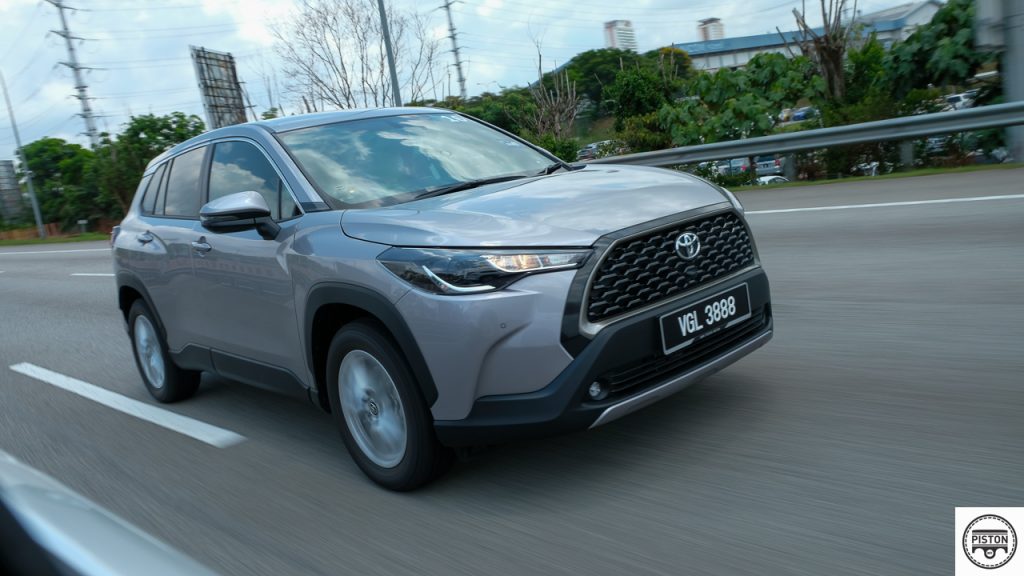
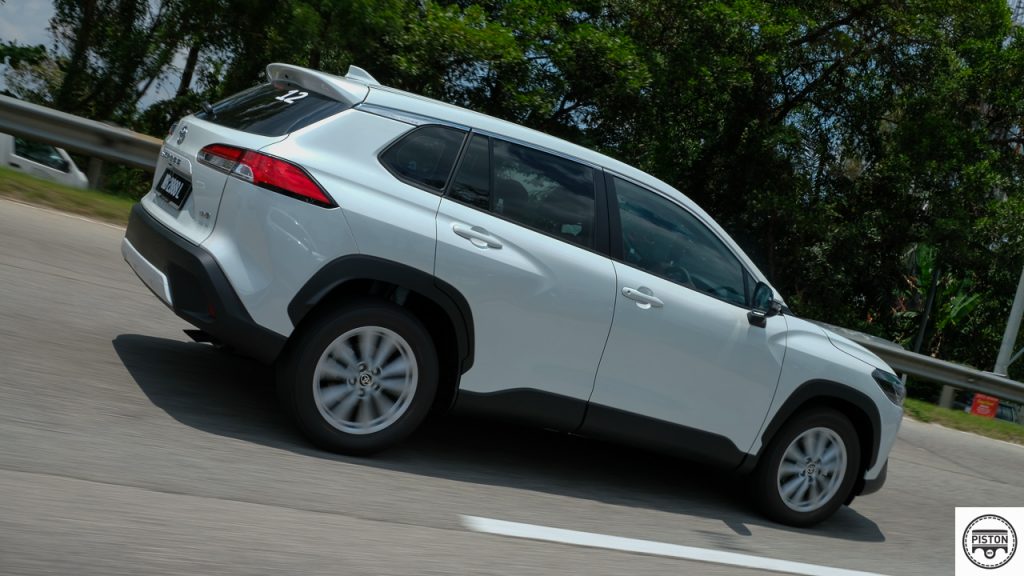
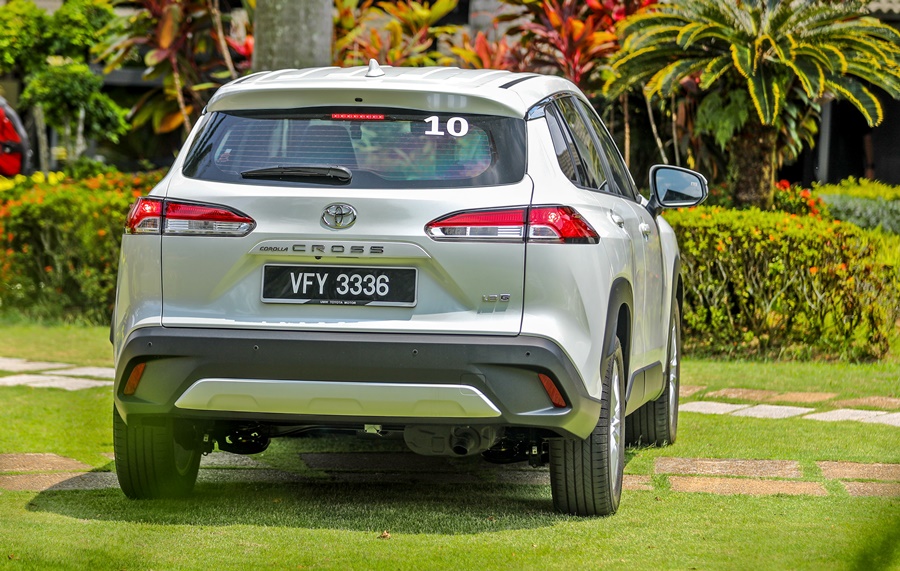
The design of the Corolla Cross is very different from that of the sedan and if you put the two cars next to each other, you won’t see similarities. This is probably the right approach as people buy a SUV for its image and just raising the ground clearance and adding cladding for the ‘rugged’ effect would be a mediocre effort.
Though it is shorter than the sedan (by 170 mm), the Corolla Cross has a wider (+ 45 mm) and taller (+ 185 mm) body. The wheelbase is also slightly shorter by 60 mm which does not seem to have impacted the cabin space noticeably. Ground clearance is, of course, more with a distance of 161 mm (+ 33 mm) from the underside to the road. However, that increase is well ‘camouflaged’, so the car doesn’t look like it is just ‘jacked up’. Additionally, with an 18° approach angle, it can also travel over rough terrain and steep inclines, as well as easily cross over taller speedbumps and mildly flooded stretches.
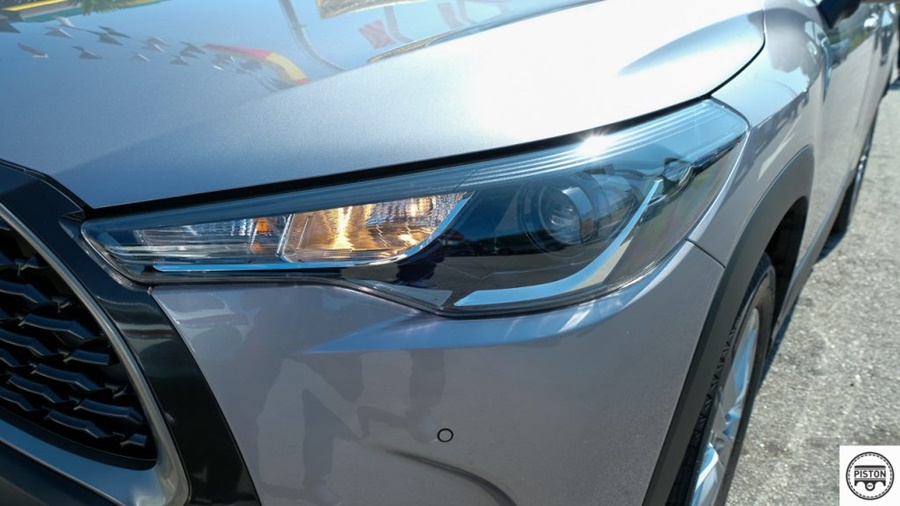
While the Corolla Cross 1.8G uses projector-type halogen headlamps, the 1.8V variant has Bi-LED units that give better illumination. The integrated Day Running Lights (DRLs)/clearance lamps of the 1.8V feature an intricate ‘light curtain’ graining which is also featured on the rear lighting units.
Both variants use LEDs for most of the lighting units, including the third brake light. Besides being energy-efficient, LEDs have advantages such as producing light that is closest to daylight, quicker light-up times, and having a much longer service life because they are more durable and resistant to vibrations.
Proven engine and CVT
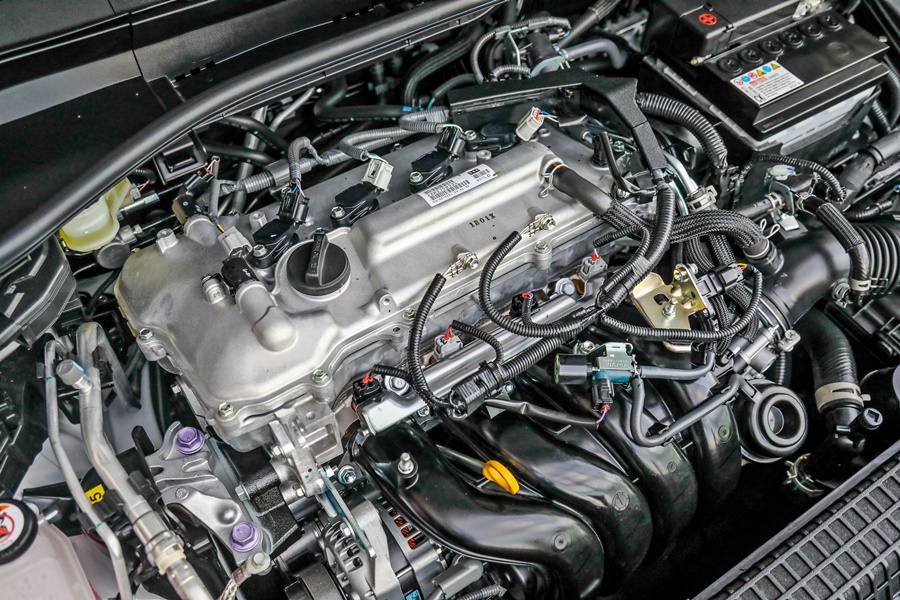
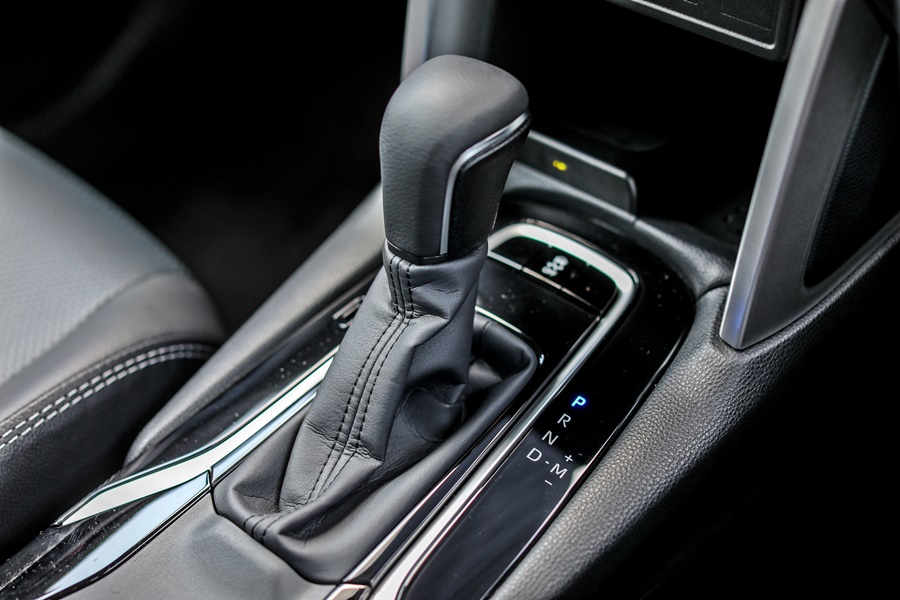
The Corolla Cross uses the same engine type as the sedan, ie the proven 2ZR-FE 1.8-litre petrol DOHC 16-valve engine with Dual VVT-i. This engine produces 139 ps/172 Nm which goes through a 7-speed Sequential Shiftmatic (CVT) only to the front wheels. There is no all-wheel drive (AWD) but most people don’t really care anyway. And for those who like to have AWD for enhanced grip and stability, systems such as traction control and vehicle stability control (both of which the Corolla Cross has) provide that.
Without AWD, the suspension layout is simple with the universal MacPherson struts at the front and a torsion beam at the rear. From extensive testing in ASEAN conditions, the engineers decided that large, highly durable rubber bushings would be better to allow the suspension to effectively cope with large undulations on the road surface, enhancing comfort.
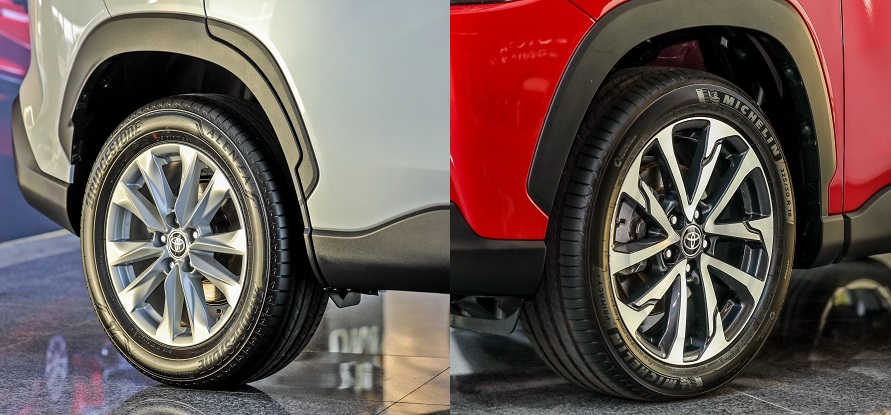
The Corolla Cross 1.8G has 17-inch wheels with Bridgestone tyres (left), while the 1.8V has 18-inch wheels with Michelin tyres.
Toyota Safety Sense
Where active safety systems used to operate independently, many are now integrated and function cooperatively. Most manufacturers have adopted this approach and Toyota’s is called Toyota Safety Sense (TSS) which helps the driver avoid accidents. This has been introduced in some models already and the 2.0 version is installed in the Corolla Cross 1.8V.
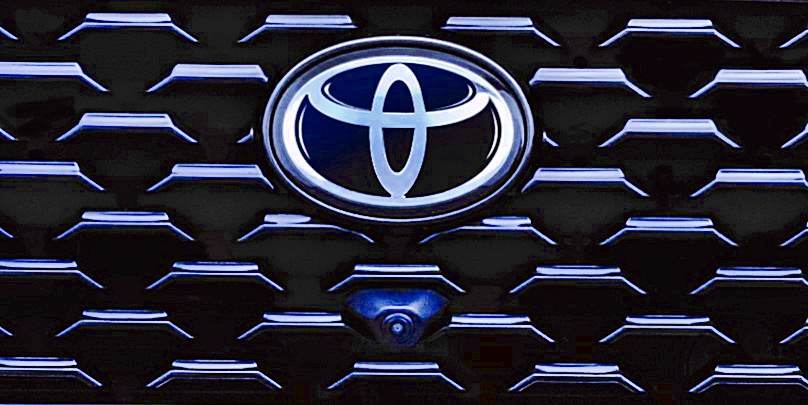
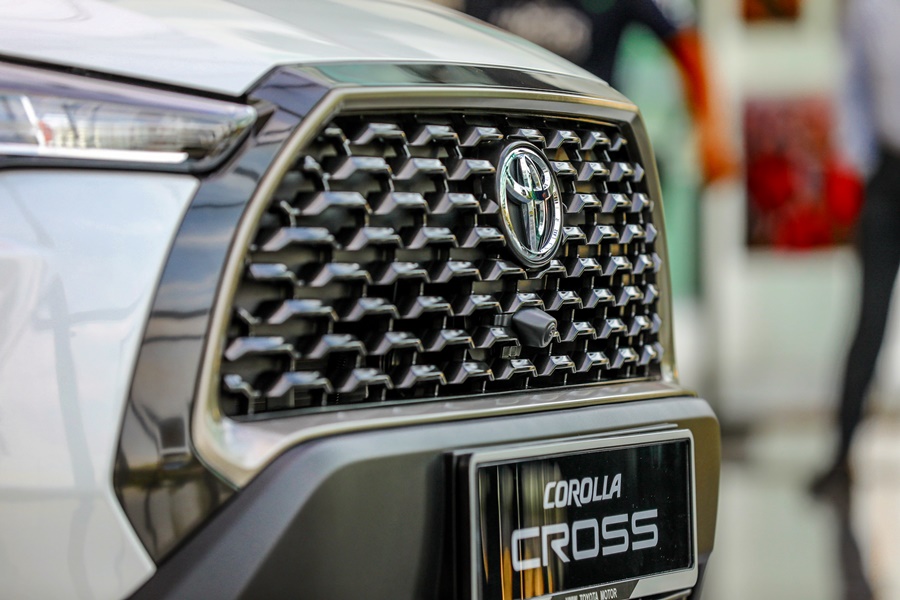
TSS 2.0 makes use of a camera installed in the windscreen to scan the road ahead. the imagery is sent to a computer to analyse and determine if there is a dangerous situation. Additionally, a millimetre-wave radar signal from the grille is also used to monitor the road ahead.
Lightning-quick analysis of the data and imagery will determine if a collision with a vehicle or pedestrian (or other road-users) might occur. If the driver does not take appropriate action, the brakes will be activated automatically to reduce the vehicle’s speed and bring it to a quick stop. This is known as Automatic Emergency Braking (AEB) and even if it does not fully prevent a collision (due to road conditions or the speed), AEB could still save you expensive repairs because the car would be slowed down earlier, reducing the force of the impact.
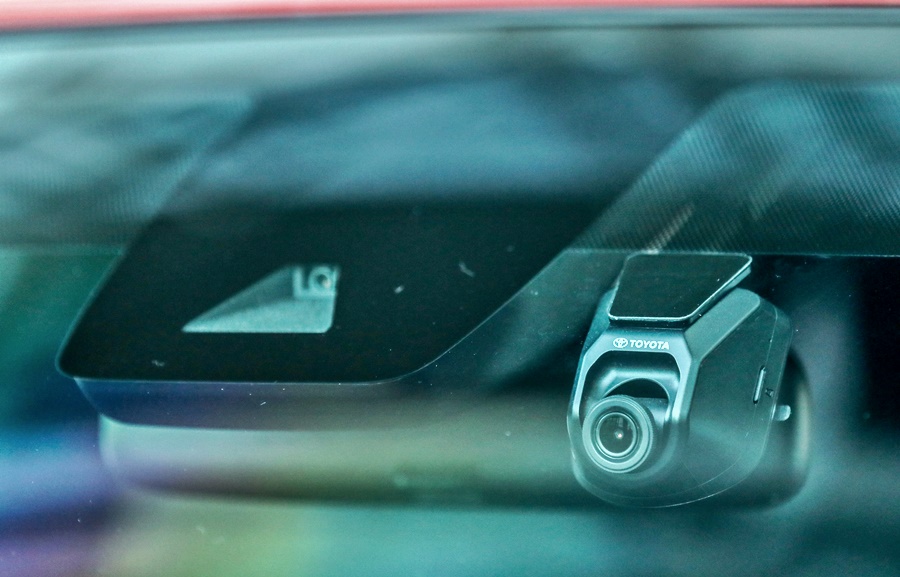
Radar transmitter in the grille (above) and camera at the top of the windscreen (left side in the picture below) constantly scan the road ahead and send data and imagery for Toyota Safety Sense to analyze. The lens to the right is for the Digital Video Recorder.
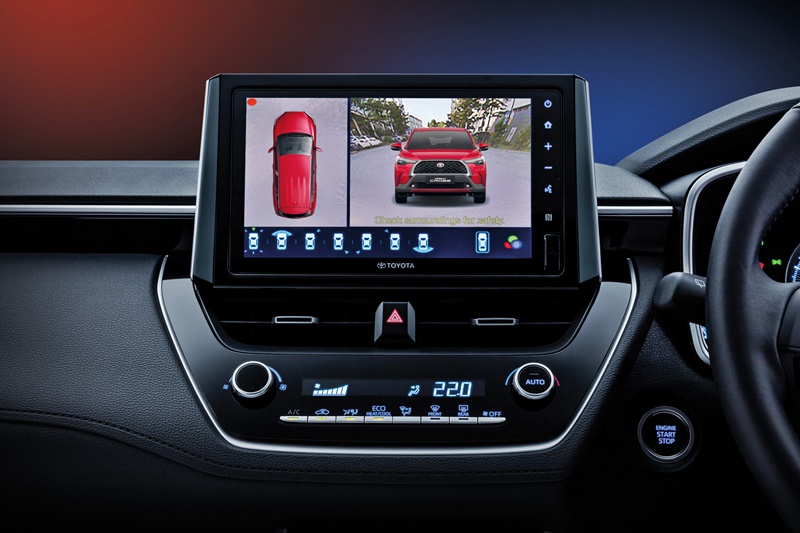
Besides the Pre-Crash System just explained, TSS also has Lane Departure Alert (LDA), Dynamic Radar Cruise Control (DRCC) and Automatic High Beam (AHB). These core technologies are complemented by other safety technologies such as Blind Spot Monitor (BSM) with Rear Cross Traffic Alert (RCTA), Tyre Pressure Warning System (TPWS) and a 3D Panoramic View Monitor which helps in situational awareness all around the car.
The LDA system includes Lane Tracing Assist (LTA) which implements steering assistance to remain in the lane. The function can also operate on sharp curves and helps reduce vehicle swaying during straight line driving.
DRCC introduces drivers to semi-autonomous motoring as a safe gap will be maintained with a vehicle ahead at all times. This is done by automatically adjusting the speed, lowering it from the set cruising speed if necessary. With DRCC, long-distance motoring can be more enjoyable with less fatigue experienced. The system in the Corolla Cross doesn’t operate at very low speeds and that would be good to have in future.
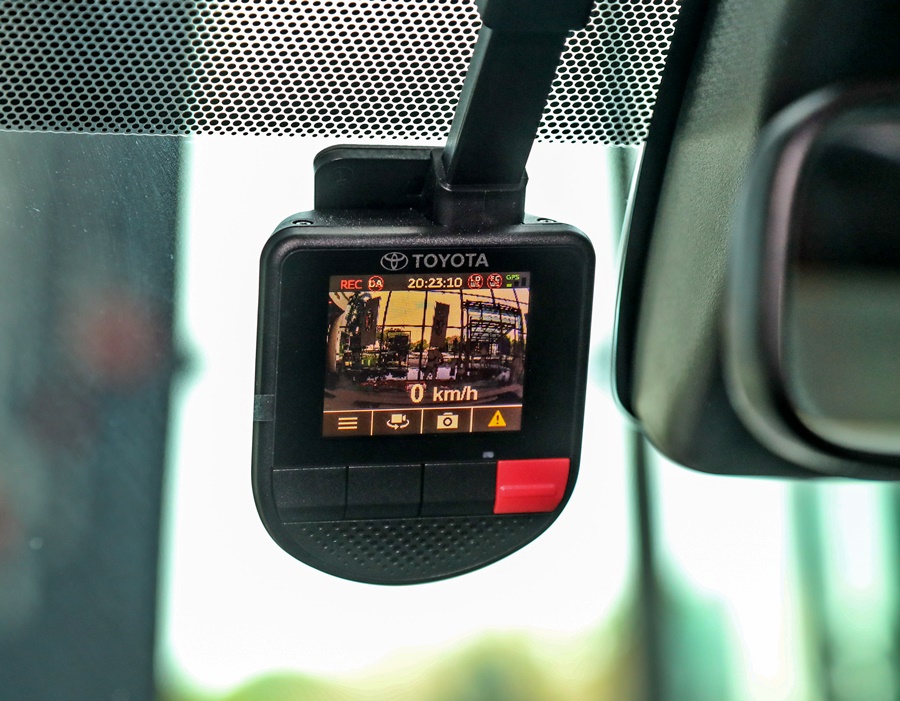
Front Digital Video Recorder is a standard fitment.
For additional safety, Drive-Start Control is included to prevent sudden starting or unintended acceleration. This can occur if the wrong gear has been selected from PARK while the driver is pressing hard on the accelerator pedal. When such a condition is detected, a warning is flashed on the dashboard and engine output is immediately reduced to avoid an accident.
The other safety systems are present for both variants, such as ABS with EBD and Brake Assist, Vehicle Stability Control and Traction Control and Hill-start Assist Control (HAC). There is also an Emergency Stop Signal (ESS) which activated the hazard warning lights automatically if sudden or strong braking occurs due to an emergency. The flashing lights will alert drivers behind so that they can take their own action to avoid a collision.
Besides the protection from the high-strength TNGA platform and structure, there are 7 airbags around the cabin (including one of the driver’s knees) and the seatbelts have pre-tensioners and force-limiters to maximise restraint. ISOFIX points are also available in the rear outer seats for installation of compatible childseats, which are now required by law.
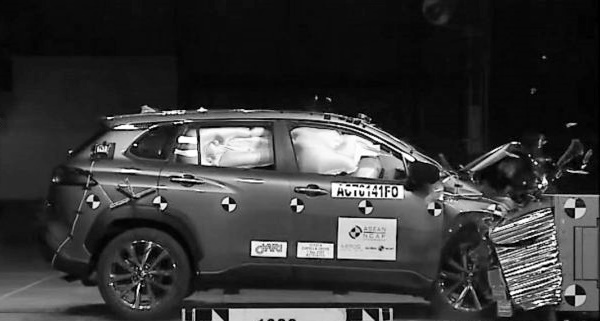
ASEAN NCAP crash test
With such high safety standards, it’s not surprising that the Corolla Cross, as with many other Toyota models sold today, has achieved a maximum 5-star rating from ASEAN NCAP which evaluated the model with crash testing.
SUV outside, passenger car inside
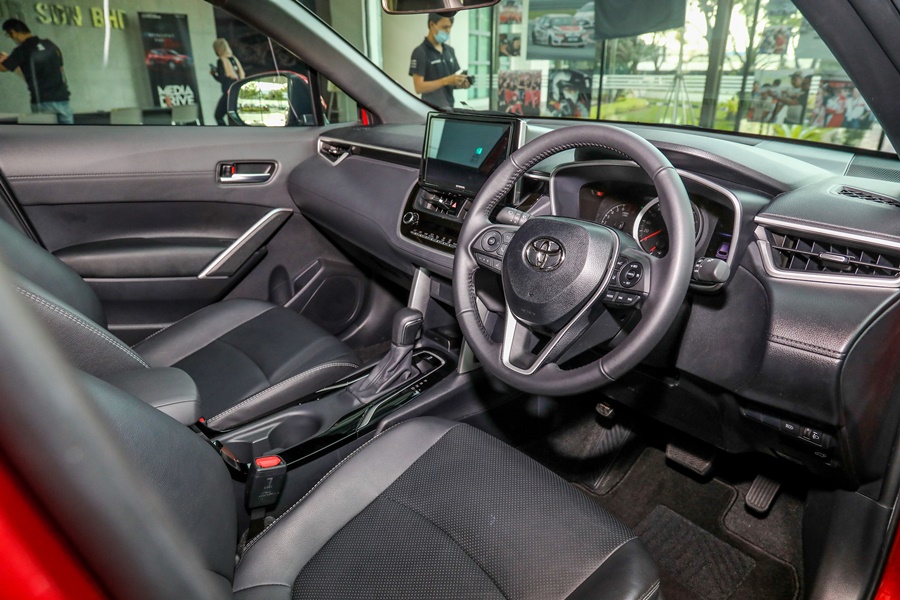
While the exterior looks bear no resemblance to the sedan, the interior of the Corolla Cross is certainly more like a passenger car than the traditional SUV. It’s something which was pioneered by the original RAV4 25 years ago and got people interested in driving a SUV as it was just as easy and comfortable as their sedan.
The Corolla Cross continues with this concept and the extra height of the vehicle is not only used for ground clearance but also interior space, providing significantly better headroom than other competitor SUV models in the same class. The driver’s eyes are also higher up, giving a more commanding view which many like a SUV for.
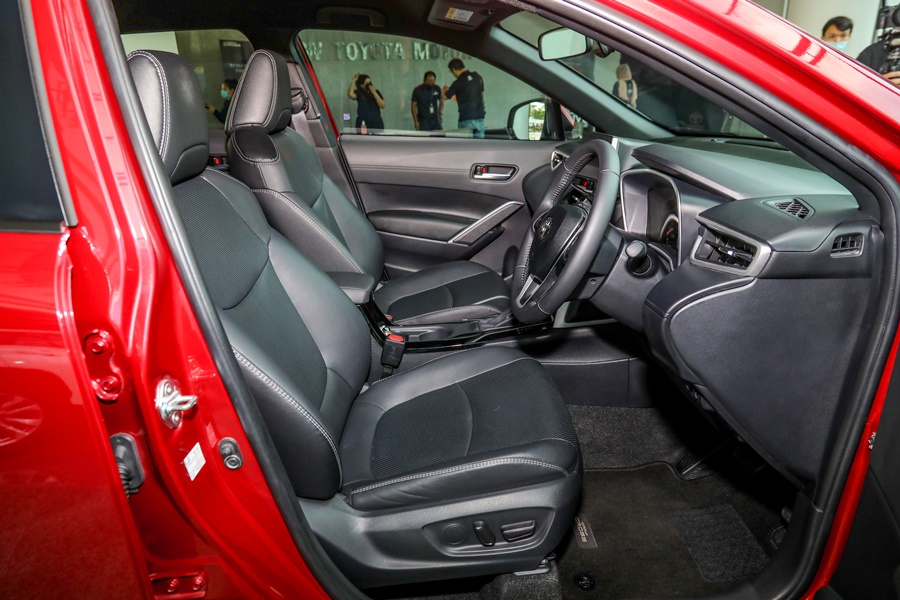
The overall colour theme for the cabin is black with black leather upholstery for the seats. The driver’s seat for the 1.8V has power adjustment, which is convenient. At the rear, the backrest recline angle of 6° from the normal position makes for a more comfortable posture.
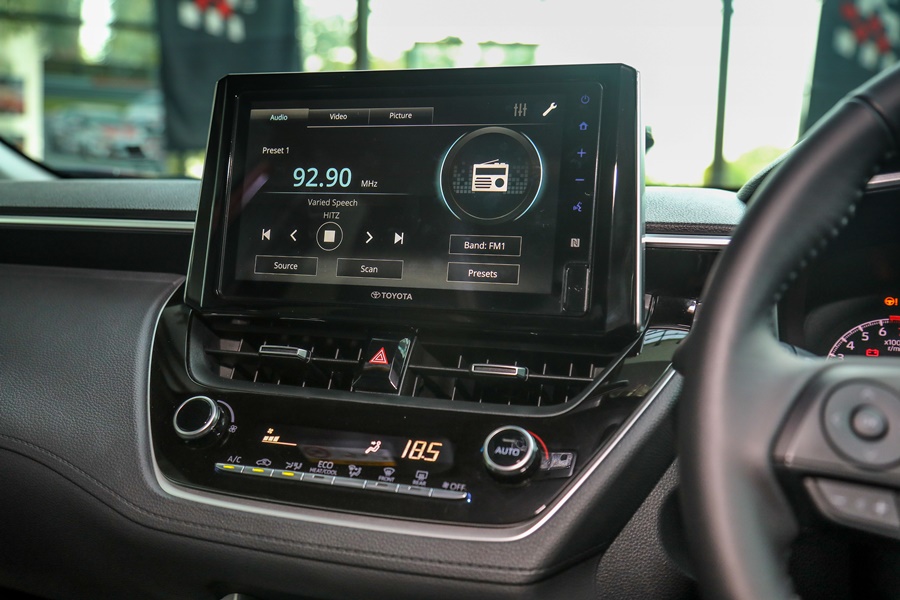
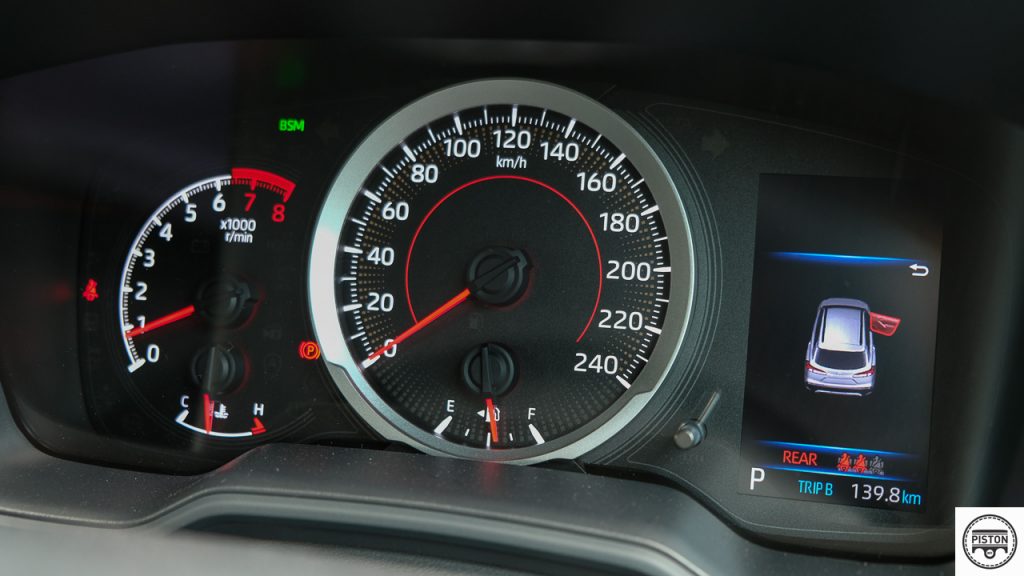
Instrumentation and infotainment are quite standard nowadays with a 4.2-inch colour Multi-Information Display between the meters providing the driver with travel information. The large 9-inch panel in the middle of the dashboard serves as the display for the audio and infotainment system, as well as the image from the rearview camera.
The system is Apple CarPlay and Android Auto ready so compatible smartphone apps can easily be transferred and accessed from the dashboard. Management of some functions can be done using switches on the steering wheel.
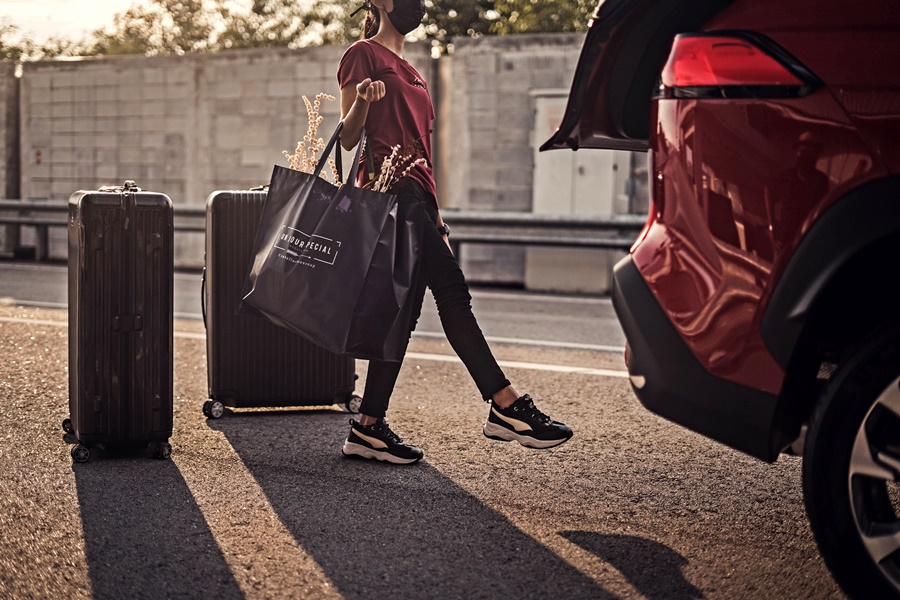
These days, most cars have keyless entry and pushbutton starting/stopping and the Corolla Cross is now exception. But a standout feature is the Power Back Door which has handsfree operation – by placing a foot under the rear bumper, the door will open and close automatically. It wasn’t that long ago when this feature was only found on much more expensive models, and now it is moving downwards. It’s also possible to open the rear door from inside the car.
Other equipment and features include automatic air-conditioning, USB ports, lots of cupholders and an extra-cost wireless charging pad option which can be specified at the time of purchase. The car comes with one Digital Video Recorder at the front and the owner can add a second one at the rear as well.
Over the past few years, UMWT has been including a Vehicle Telematics System (VTS) in its new models to enhance security. VTS tracks the vehicle’s position using GSM/GPS signals so if it is stolen, its location can be determined by a 24/7 Command Centre will locate it which will then inform relevant authorities to recover it. In the event there is an impact detected (suggesting an accident), the centre will inform emergency services to provide assistance at the vehicle’s location.
FIRST DRIVE IMPRESSIONS (by Chips Yap)
As mentioned earlier, the 1.8V is not available at this time so all the vehicles for our media drive were the 1.8G. Generally, the performance would be the same since both variants use the same engine. However, while the car we drove was fairly quiet already, the 1.8V should be even quieter because it has acoustic glass for the windscreen which cuts out a lot of external noise.
The cabin obviously has an open airy feel with sweeping dashboard line having the 9-inch display as the dominant centrepiece. It can accept apps from an iOS or Android device which expands its functionality.
The 3D Panoramic View Monitor is an interesting system that has different views of the vehicle which can be selected. The virtual images created from the cameras around the bodywork give the impression of seeing the Corolla Cross while standing on the outside. It’s a bit more sophisticated than the usual top-down views in other systems and will take a bit of getting used to. But once the driver becomes familiar with the imagery, he or she will find it to be quite useful during parking.
I really like the Power-Operated Boot Door with what I call a ‘Kick the Bumper’ system of operation. It’s a feature which you will want in every car you get after the Corolla Cross. Not so long ago, only luxury SUVs had this convenience and Toyota has somehow managed to bring the cost down to be able to offer it in a Corolla-class model as well.
The ride quality was very good, with the suspension soaks up the bumps easily without making the car feel unstable. The taller stance was virtually not perceived although I think that in my case, I am already used to it as I drive a SUV daily. But what matters is that even along twisty roads, like the one we went along around the Semenyih dam, the car remained stable and responded well to sudden manoeuvres.
While the engine is a familiar unit and its performance is similar to the one in the sedan with a smooth power flow and some punchiness when you push it hard, it is the CVT that has impressed me all along. Somehow, the Toyota engineers have been able to programme the characteristics to give a feel more like a conventional automatic transmission without the ‘rubber band’ behaviour. Response is good and supposed to be improved with some internal improvements.
I owned a number of Corollas before and I also had the first RAV4, which converted me to SUVs forever. The RAV4 provided an easy transition to the SUV world and the Corolla Cross is doing the same thing again. It’s actually the best of both worlds and I would say it has many of the good things of a SUV with the comfort and space of a sedan. The Corolla has for a long time been seen as ‘just another sedan’ but now, the Corolla Cross brings new interest to the family and clearly, it is the right type of car for these times.
Diana Danielle (above) and Danny Koo are the Toyota Corolla Cross Ambassadors and will be closely associated with the new SUV model in advertising and promotional activities. Both are former racers in the Vios Challenge One-Make Series, and lead active lives that the Corolla Cross has been designed to support. “Diana and Danny are celebrities well known to the Malaysian public,” said Ravindran K., President of UMW Toyota Motor. “We are happy to have them associated with the Corolla Cross. Diana has a bold personality and constantly breaks boundaries, which matches the Corolla Cross perfectly, while Danny reinvents his perspectives to go beyond his limitations – just like the way the Corolla Cross Reinvents the Rules.”